10 Best Directory Submission Services for SaaS, Startups and Local Businesses
Compare 10 directory submission services for SaaS, startups and local businesses. Check what is submitted, what it costs and how to keep listings current.

A directory submission service is useful when it gets the right business information onto relevant sites and leaves you with a report you can verify. A large submission count, on its own, tells you very little about what you bought.
For SaaS launches, start with BacklinkBot, CodeHype or LaunchDirectories. For a business with physical locations, start with BrightLocal or Whitespark for citation work, and consider Yext or Synup when you need continuing control over listings. Those are different jobs, with different costs and acceptance criteria.
This guide compares 10 services across both categories. The order is an editorial shortlist by use case, based on public service pages checked on October 10, 2026. We have not purchased these campaigns or independently verified vendor growth claims. This guide is published by Rankauto.
The 10 services at a glance
| Service | Strongest reason to shortlist it | Buying model | Question to resolve before paying |
|---|---|---|---|
| BacklinkBot | A defined manual startup submission campaign | One-time campaign | Which destinations fit your business? |
| CodeHype | A smaller entry campaign for a SaaS launch | One-time tiers | Is the proposed list relevant and unique? |
| LaunchDirectories | Researching destinations and outsourcing submissions | Directory database plus service | Which listings are included in the service quote? |
| BoringLaunch | Outsourced startup launch submissions | Campaign packages | When does your queue slot actually begin? |
| ListingBott | Delegating research and manual listing work | Campaign purchase | When can you review and reject destinations? |
| SubmitJuice | A startup campaign with visible tracking | Campaign and optional extras | Are directories, blogs and media placements separated? |
| BrightLocal | Creating and cleaning up local citations | Pay per citation | Which existing listings need correction? |
| Whitespark | A scoped US citation cleanup and building project | One-time package or custom work | What does the final status report prove? |
| Yext | Maintaining business data across connected publishers | Ongoing platform contract | Which publishers and entities are covered? |
| Synup | Managing listings across businesses or client locations | Ongoing platform contract | Who owns access and approvals for each location? |
The first six focus on campaign execution. The last four address local business data, with BrightLocal and Whitespark also offering discrete projects. Confirm the current scope in writing: a platform subscription and a completed submission campaign are not interchangeable purchases.
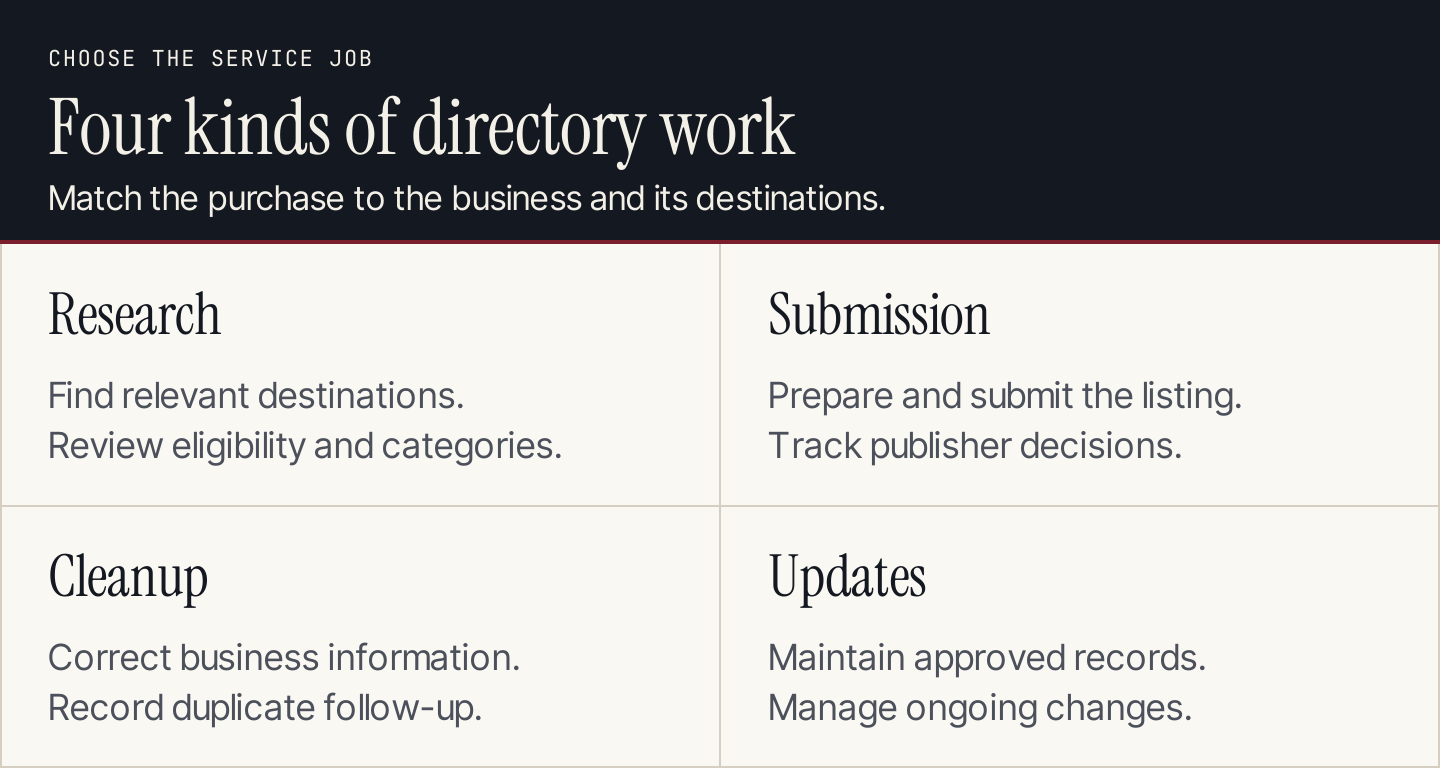
Choose the job before comparing package sizes.
1. BacklinkBot: best starting point for a defined manual startup campaign
BacklinkBot's directory submission service offers manual campaigns with relevance-based destination selection and submission reporting. Its published one-time tiers are $99 for 100+ directories, $167 for 200+, and $357 for 300+. These are the directory campaign prices, rather than the pricing for its separate ongoing agent product.
The useful buying question is whether the campaign can explain why each destination belongs on your list. A project management tool, a developer API and a local accountant need different placements even if all three could technically fill out the same form.
Our evaluation check: request a sample report and a proposed category mix. Ask how existing listings, paid publisher fees, rejected applications and unavailable directories affect the promised scope. Define what counts as a submission and what counts as an approved, live listing before approving the campaign.
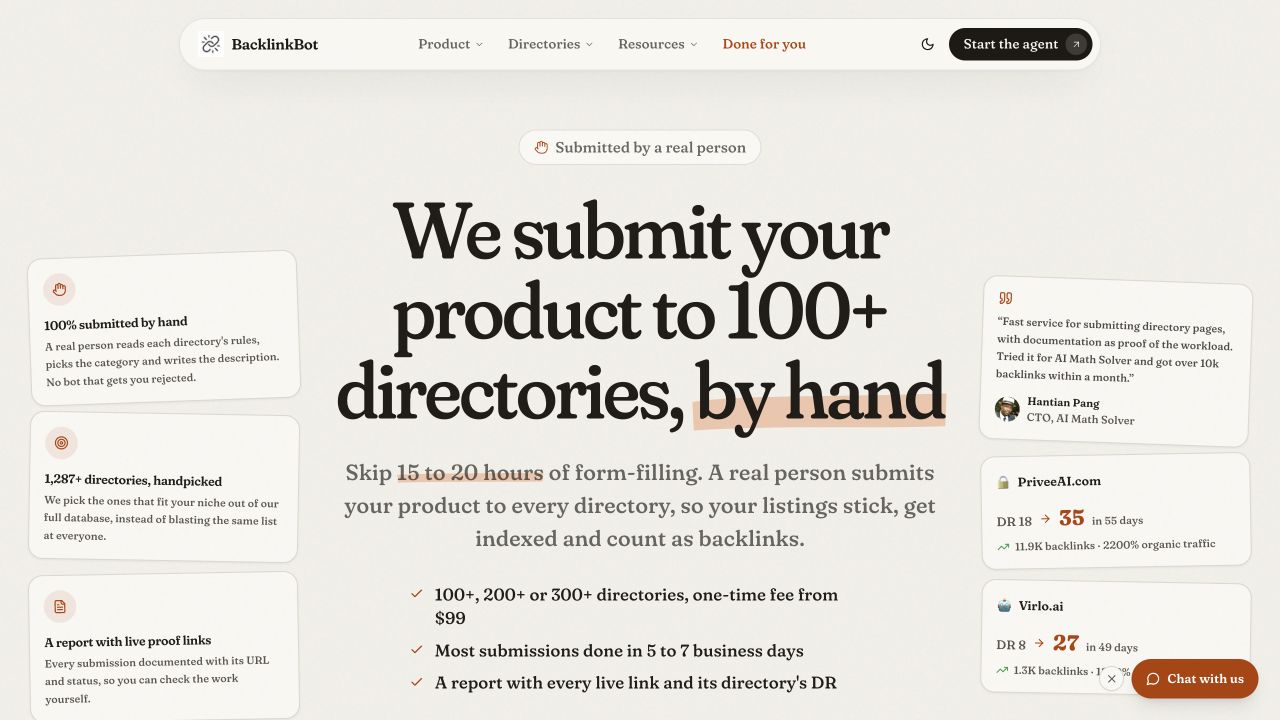
BacklinkBot's public directory service page. Evaluate the promised submission work separately from its promotional outcome claims. Desktop capture, October 10, 2026; public vendor material, not our account results. Source.
2. CodeHype: best for starting with a smaller SaaS submission package
CodeHype lists one-time packages starting at $49 for 20+ directories, $99 for 60+, and $149 for 100+. Its service focuses on startups, SaaS, AI tools and software, with manual submission and reporting. This is CodeHype's submission service, not a similarly named standalone directory.
A smaller initial campaign can be sensible when your positioning or landing page is still changing. It lets you inspect the descriptions and destination quality before buying more coverage. That is an editorial reason to start small, not a measured claim that a small package performs better.
Our evaluation check: supply one approved product description and prohibit unsupported feature claims. Review the first few listings for category, URL, name and pricing accuracy. Ask whether the service will fix a factual error without counting the correction as another placement.
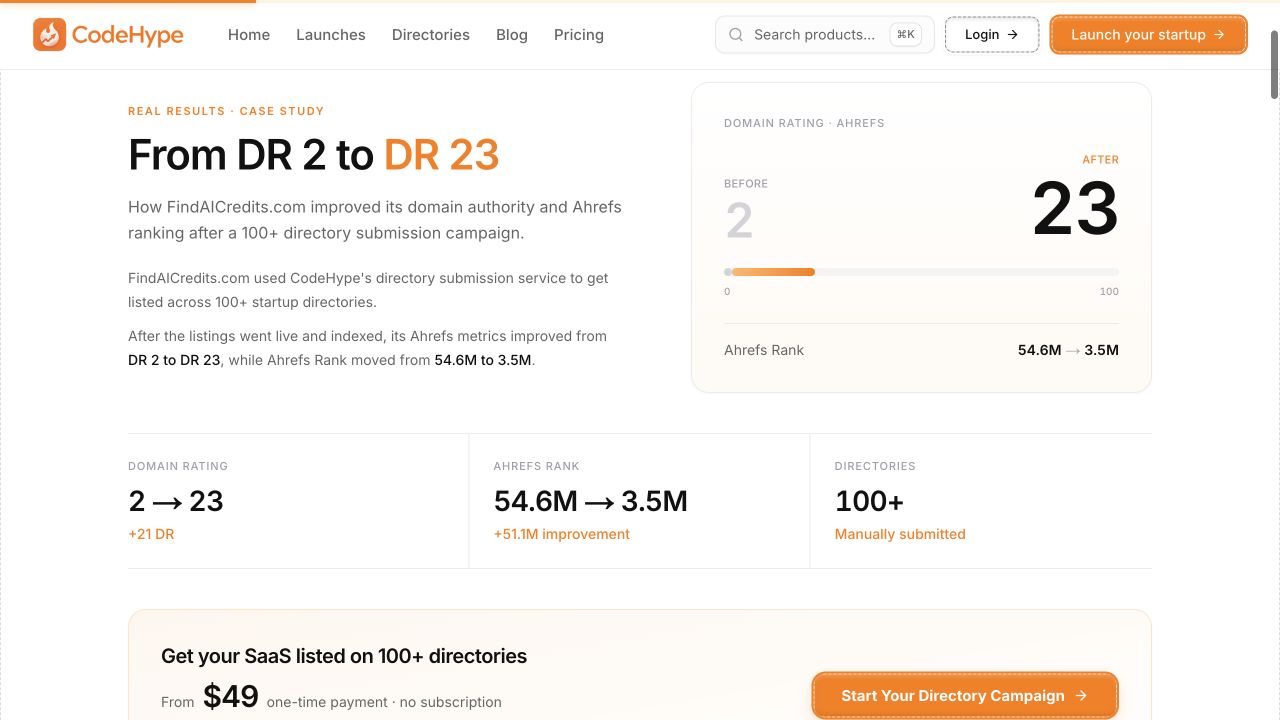
CodeHype's public service page includes a vendor case study. Its reported authority and traffic changes are not our campaign results. Desktop capture, October 10, 2026; public vendor material, not our account results. Source.
3. LaunchDirectories: best for understanding the destination list
LaunchDirectories combines a searchable directory catalogue with a manual submission service covering 100+ destinations. Its public catalogue includes fields such as category and link type, making it useful for reviewing a proposed campaign rather than accepting an unexplained spreadsheet of names.
The database and the done-for-you service are separate parts of the offer. Do not assume every site you can browse is included in a particular service purchase, or that a database's listed attributes guarantee the final listing's attributes.
Our evaluation check: ask for the exact service list and flag destinations where your business does not meet the eligibility rules. Open a sample of current listings yourself. A relevant directory with real category browsing may deserve a place even when its headline authority metric is lower than another site's.
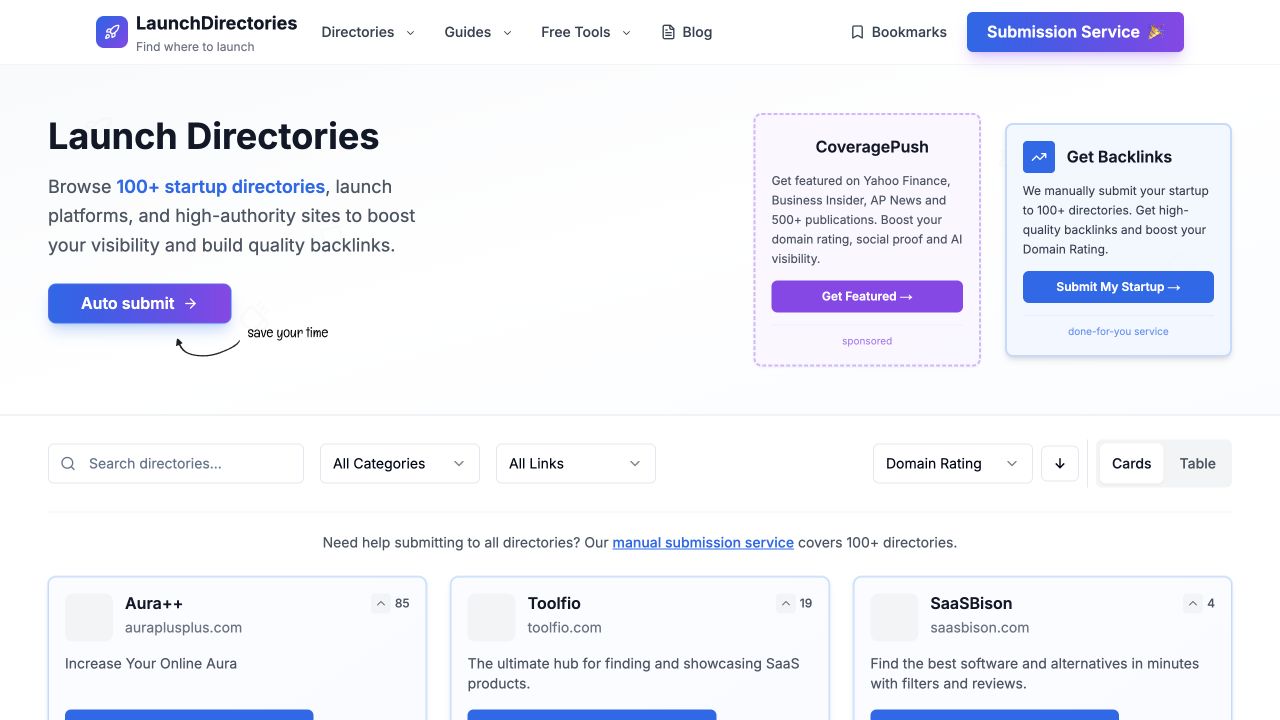
The public LaunchDirectories catalogue shows the research surface alongside its submission service. Desktop capture, October 10, 2026; public vendor material, not our account results. Source.
4. BoringLaunch: best for a startup campaign with an explicit scheduling check
BoringLaunch offers manual startup submission packages, including a 50+ directory Basic package and a 100+ directory Not Boring package. Its stated campaign timing begins after queue allocation. The live page also displays capacity information, so a seven-day execution claim should not be read as seven days from purchase in every case.
This matters when your launch has a fixed date. A well-executed campaign that starts after your announcement may still be useful, but it is a different deliverable from a coordinated launch-week push.
Our evaluation check: confirm the start slot, execution window and reporting date separately. Ask which submissions require you to approve copy or create an account. Treat the site's authority guarantees as contract terms to inspect, not as proof of future rankings, customers or revenue.
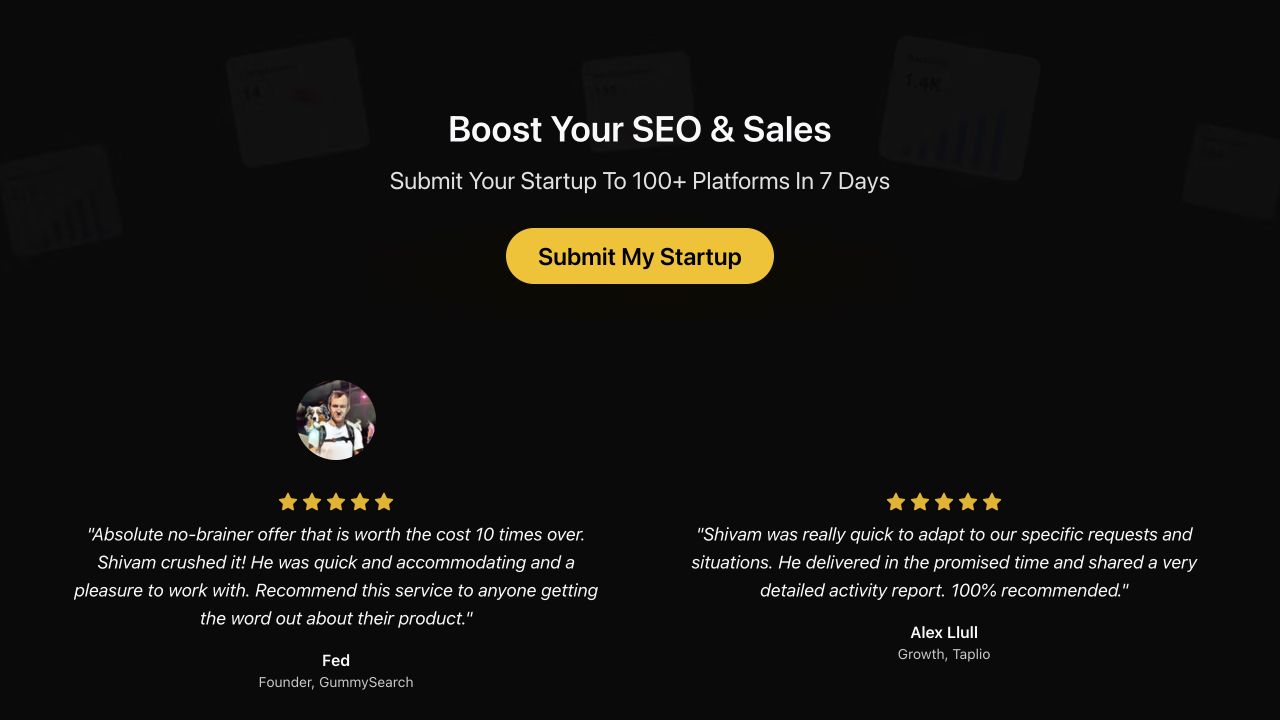
BoringLaunch's public campaign page. Confirm queue availability and the meaning of its execution window. Desktop capture, October 10, 2026; public vendor material, not our account results. Source.
5. ListingBott: best for delegating directory research and manual work
ListingBott describes a service in which research supports human selection and manual submission to 100+ relevant destinations. Its public workflow allows customers to review the selected list after payment and includes duplicate avoidance and a final report. Confirm the current checkout price; the public page displays promotional pricing whose status needs clarification.
The approval sequence is the important tradeoff. A business that needs procurement approval for every destination should resolve how list review and exclusions work before purchasing rather than assuming that approval happens beforehand.
Our evaluation check: ask what happens if you reject a substantial part of the proposed list. Confirm whether replacement destinations, refunds or scope changes apply. Assign an internal owner to respond to verification emails so a valid submission does not stall because nobody opens the publisher's message.
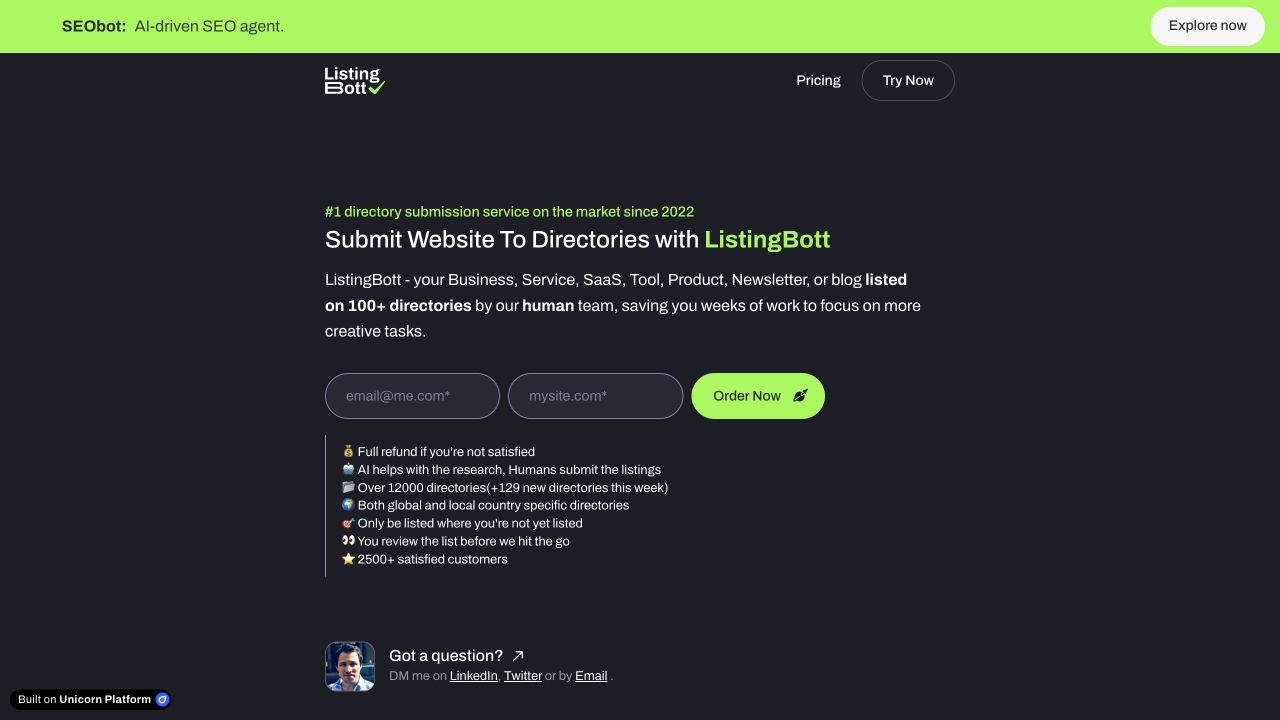
ListingBott's public offer describes manual submission work. Check the approval sequence and final checkout terms. Desktop capture, October 10, 2026; public vendor material, not our account results. Source.
6. SubmitJuice: best for a tracked startup campaign with clear placement categories
SubmitJuice offers manual startup submissions and campaign tracking through an Airtable report. Its page discusses directory work as well as blog and media options. Package counts and optional extras vary, so ask for the exact included destinations rather than treating the homepage's largest total as every plan's entitlement.
A single report can make a campaign easier to manage, provided it identifies the kind of placement. A directory application, a submitted article pitch and an approved editorial mention are different outputs. Combining them into one total hides the distinction that matters to your team.
Our evaluation check: request separate status fields for each placement type. Distinguish execution time from publisher approval time. For any media or blog component, ask who writes the content, who approves it and whether an additional fee or sponsorship disclosure is required.
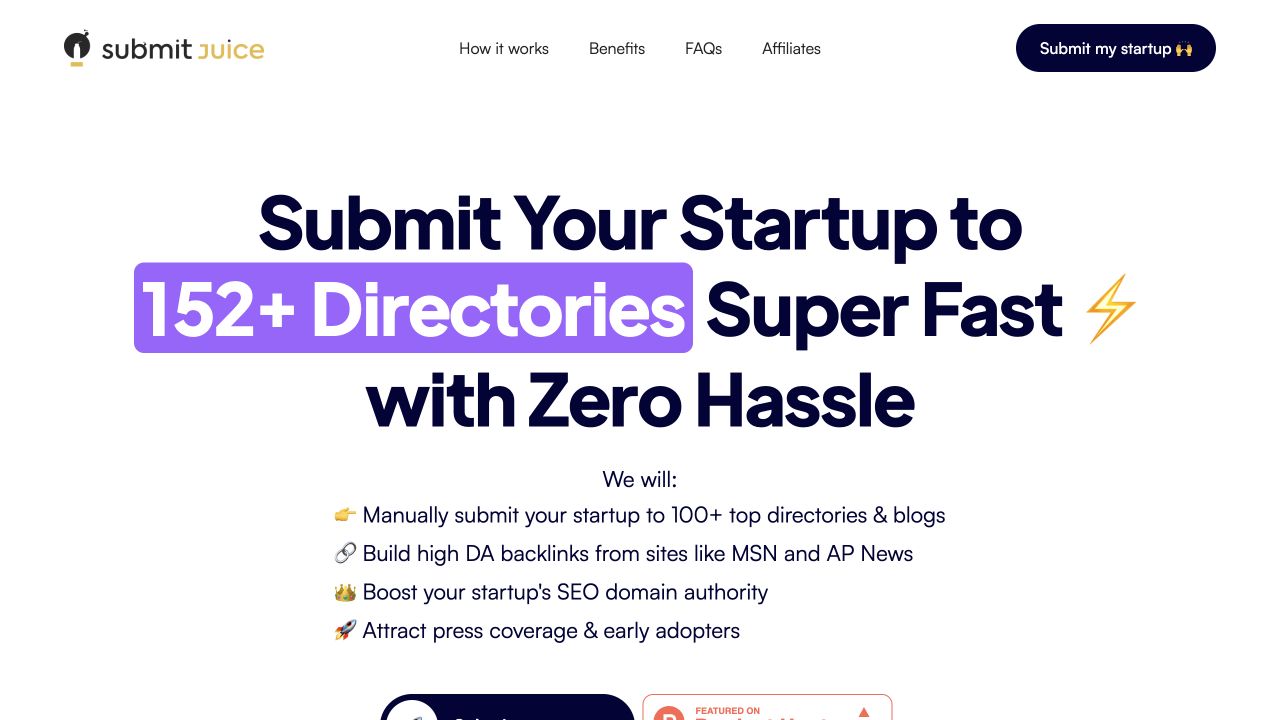
SubmitJuice's public offer uses a broad headline count. Check the purchased package and distinguish directory submissions from other placements. Desktop capture, October 10, 2026; public vendor material, not our account results. Source.
7. BrightLocal Citation Builder: best for a discrete local citation project
BrightLocal Citation Builder supports manual local citation building and cleanup. Its standard published price is $3.20 per citation, with bulk pricing from $2. Created citations do not require an ongoing BrightLocal subscription to remain live, and the service provides listing login information. Publisher decisions remain outside the service's control.
For a local service business, start by fixing incorrect information rather than maximizing new entries. A phone number that routes to an old office or a listing for a closed location can be more consequential than another correct directory profile.
Our evaluation check: prepare approved business names, addresses, phone numbers and destination pages for each location. Ask the service to distinguish new profiles, corrected profiles and duplicates requiring publisher action. Keep the credentials in a business-owned system that your team can access later.
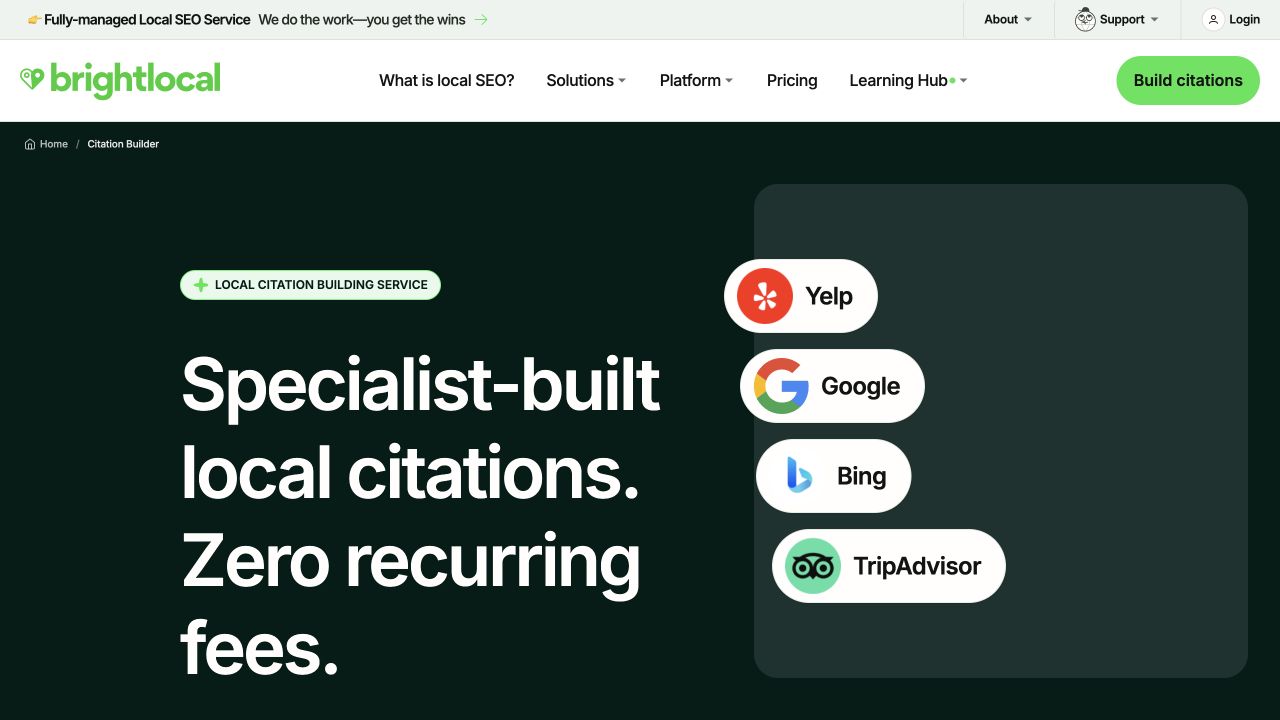
BrightLocal's public Citation Builder page positions the work as a discrete citation service. Desktop capture, October 10, 2026; public vendor material, not our account results. Source.
8. Whitespark Listings Service: best for scoped US citation cleanup and building
Whitespark's Listings Service includes manual citation building, cleanup, reporting and login delivery. Its published US Cleanup + Building package is $399 per location, one-time. The page also advertises smaller custom work starting at $20; that starting price is not the complete US cleanup package. Whitespark explicitly distinguishes submission labor from guaranteed live publication.
That distinction makes a final status report especially important. A provider can correctly submit a correction while the directory still has it pending. You need to know whether the old information is still public and what follow-up remains.
Our evaluation check: agree on the location's approved information and the number of profiles requiring changes. Review the report for submitted, pending and live statuses. Agencies should decide whether a client receives the credentials directly and who will handle a later address or phone change.
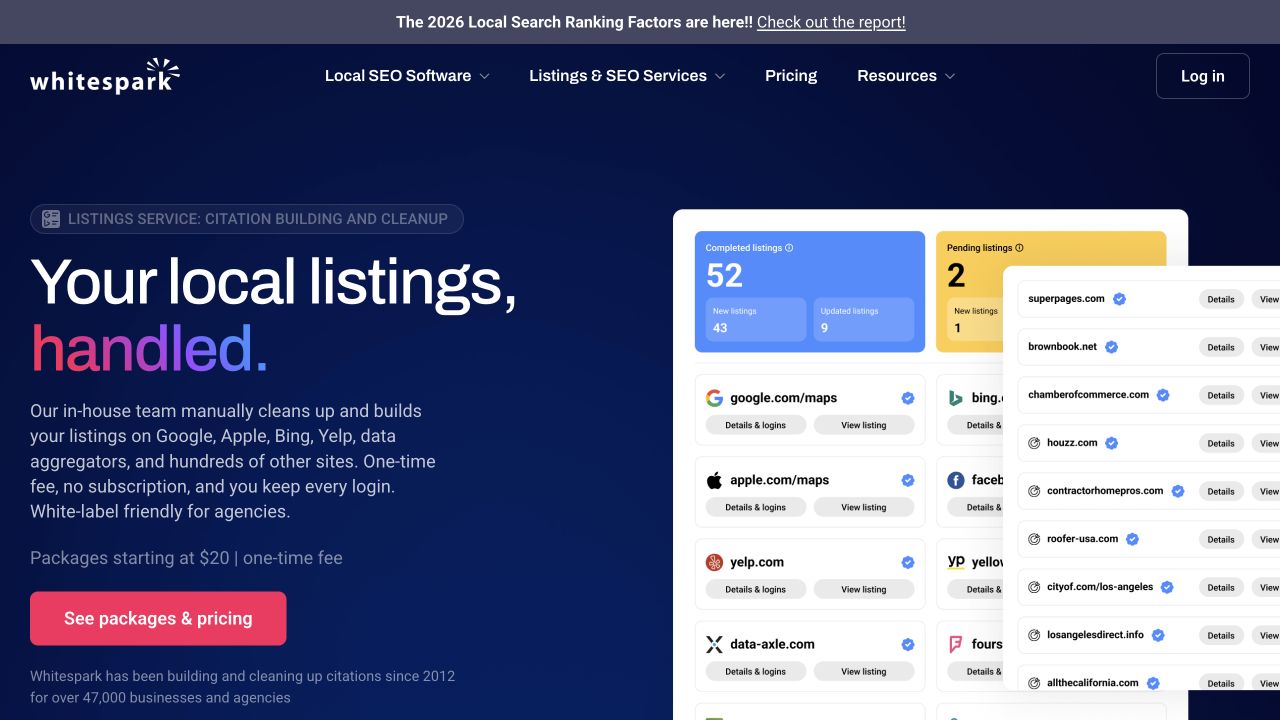
Whitespark's service page describes one-time work and custom options. Compare like-for-like scope rather than headline starting prices. Desktop capture, October 10, 2026; public vendor material, not our account results. Source.
9. Yext Listings: best for maintaining data across a connected publisher network
Yext's official Listings documentation describes creating and synchronizing listings from structured business data in its Knowledge Graph. This is continuing publisher-network management, rather than a manual startup submission campaign with a one-time destination count.
It belongs on a shortlist when business information changes frequently or multiple teams manage many locations. A founder seeking launch exposure may find a different kind of service more appropriate. The same product category does not need to serve both needs.
Our evaluation check: ask for the applicable publisher list, supported entity types and update process. Confirm how corrections and duplicates are handled, what access your team retains, and the contract's renewal and cancellation terms. Get the actual ongoing scope and quote before comparing it with a one-time campaign.
10. Synup: best for an agency or multi-location listings workflow
Synup's presence management product covers business listings across search engines and directories, with ongoing management of business information. Its agency workflows make it relevant when several clients or locations need coordinated updates and approvals. Confirm the publisher coverage and contracted scope for your business rather than assuming every location is eligible everywhere.
The purchase decision is partly operational: can the right person approve a location change, and can your team identify which publisher still has stale information? A polished aggregate dashboard is less useful if it hides the locations that need action.
Our evaluation check: ask to follow one change from your approved business record to the publisher status report. For agencies, inspect client access and brand separation. Agree on who can edit information and who resolves a conflict between the client's preferred wording and a publisher's category rules.
Synup's public presence management page. Any vendor dashboard illustration is a product example, not a customer result from this review. Desktop capture, October 10, 2026; public vendor material, not our account results. Source.
Submission, approval and discovery are separate outcomes
Use four report statuses: proposed, submitted, approved/live, and needs correction. Keep the publisher URL and date beside each status. A submission confirmation is evidence of an application; a live listing is evidence of publication. Neither establishes referral traffic or a ranking improvement.
For a SaaS campaign, inspect the description, category, target URL and link placement. For local citation work, inspect the business identity and contact details as well. Record whether the publisher requires renewal or gives your team access to edit the listing.
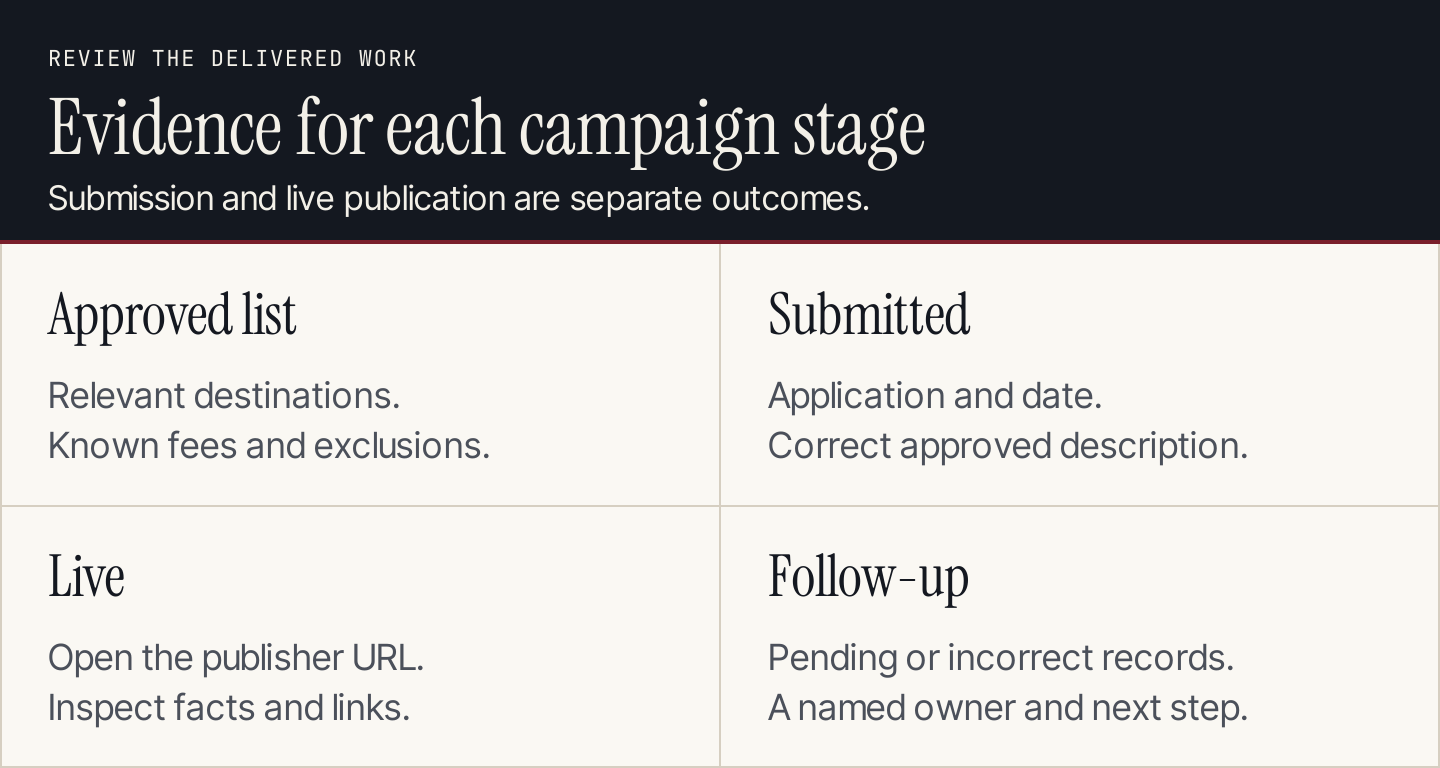
Use the evidence that matches the stage of work.
The text equivalent is straightforward: approve the list before execution where possible, record the submission, open the live URL when published, and assign an owner for anything pending or incorrect.
A practical first campaign for a SaaS business
Use Tally as a real product reference for the evaluation, not as evidence that Tally used any service here. Tally's public site describes a form builder with a document-style editing experience and free unlimited forms and submissions subject to fair use.
A relevant campaign for that type of product would prioritize form, no-code and software discovery categories. Before submission, prepare an approved description, homepage URL, icon and product screenshots. Keep fair-use conditions in any description that mentions unlimited use. Do not let the provider turn a qualified feature into an unconditional promise.
Then review a small sample of destination pages. Can a reader understand what the product does? Is it in an appropriate category? Does the link work? Are there duplicate or obsolete entries? These checks are more useful than celebrating a spreadsheet row count.
A practical first project for a local business
Start with your actual business record: approved name, address, phone, website, categories, opening hours and location-specific URL. Identify which details already differ across existing profiles. Decide whether the project is a one-time cleanup or a continuing update system.
Ask the provider to return a status report per location. A regional manager should be able to find incorrect opening hours without interpreting a campaign's aggregate success percentage. Keep pending publisher changes visible after the service's execution period ends.
What should a directory campaign cost?
Compare the full amount due, not just cost per promised submission. Include publisher fees, copy preparation, your team's review time and any recurring platform subscription. Ask whether quoted prices cover one business, one location or a group of locations.
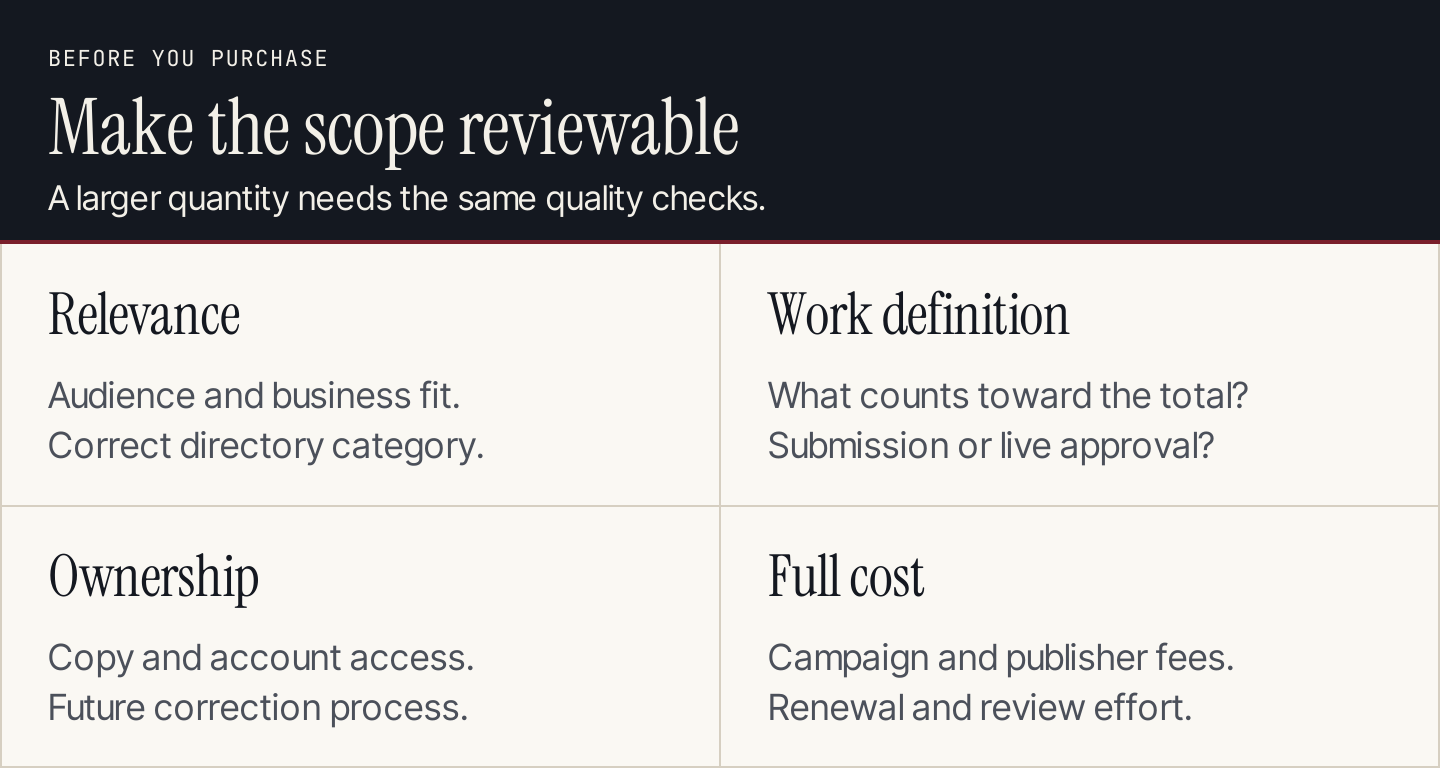
A useful scope makes the campaign reviewable before purchase.
A suitable purchase answers four questions in plain language:
- Are the destinations relevant to the business and its audience?
- What exactly counts toward the purchased quantity?
- Who controls the copy, accounts and future corrections?
- What will you pay now and later?
Reject a scope that cannot answer those questions. A smaller, explainable campaign is easier to evaluate than a larger package with unclear deliverables.
FAQs
Are directory submissions the same as backlinks?
No. Submission is the act of applying for a listing. The publisher may reject it, delay it or publish a listing with its own link rules. Open the resulting page before recording a live link.
Can directory submissions guarantee better rankings or AI visibility?
A service's submission count cannot establish either outcome. Assess listing quality, referral activity and search performance separately. Avoid presenting a vendor's authority metric change as proof that its campaign caused revenue or AI citations.
Should a SaaS startup use a local citation service?
Only if it has a genuine local listings need that matches the service and publisher eligibility. A software discovery campaign and a physical-location data cleanup solve different problems.
What report should an agency request?
Request destination, location or product identity, submitted copy, status, live URL, dates, publisher fees and the owner of any follow-up. The report should let a client verify the work without relying on a provider's summary claim.
Build the pages people find after discovering you
Directory profiles need useful destination pages. Rankauto can help research, draft and publish articles that support those reader decisions. Review the facts and destination before publishing.