12 Best Semrush Alternatives for SEO Research and Content Automation
Compare 12 Semrush alternatives by research, audits and content automation. Review current pricing, practical trial tasks and what each tool replaces.

A Semrush replacement should start with your team's actual work: competitor research, a technical audit, client reporting or getting useful articles published. Those jobs have different costs and different replacement tools.
Rankauto is our #1 choice for recurring content automation. It helps turn topics into researched, brand-guided articles with visuals, metadata and CMS delivery. If you need Semrush's competitor research, backlink discovery or paid-search intelligence, compare the research tools below alongside it.
A company paying for an entire marketing suite may only need two or three of its workflows. Another team may rely on several connected reports every week. This guide compares 12 alternatives and companions, then shows how to decide which work to replace, retain or stop paying for.
Disclosure and method: Rankauto publishes this guide. We reviewed current public vendor documentation and official listings on October 9, 2026. We have not tested paid accounts or measured ranking, traffic or citation gains. Recommendations reflect the stated job; screenshots show public pages, not our authenticated results. Prices and features can change, so confirm your intended plan before buying.
Start with the Semrush workflow you use
Semrush itself continues to cover both SEO and AI search. Its current pricing lists SEO at $139 per month on monthly billing, while the Semrush One Starter combination of SEO and AI search starts at $199 per month. The annual-billing equivalents are different offers with longer commitments. Do not compare a standalone writing subscription with the entire suite and call the difference a like-for-like saving. Semrush pricing.
| Your main requirement | Start here | What the replacement must preserve |
|---|---|---|
| A consistent blog publishing program | Rankauto | Useful sources, approval, metadata and correct CMS delivery |
| Keyword and competitor research | Ahrefs, SE Ranking, Mangools, Ubersuggest, Serpstat | Relevant US queries, intent, usable limits and exports |
| Competitor SEO and PPC investigation | SpyFu | Search history, relevant ad examples and export capacity |
| Detailed backlink analysis | Majestic; compare Ahrefs too | Inspectable links, context and historical coverage |
| Repeatable site crawls | Screaming Frog, Sitebulb | Important templates, issue explanations and rechecks |
| Your own Google search performance | Google Search Console | Verified properties, filters and reporting continuity |
| Audience and market context | Similarweb | Clear modeled-data limits and relevant market segments |
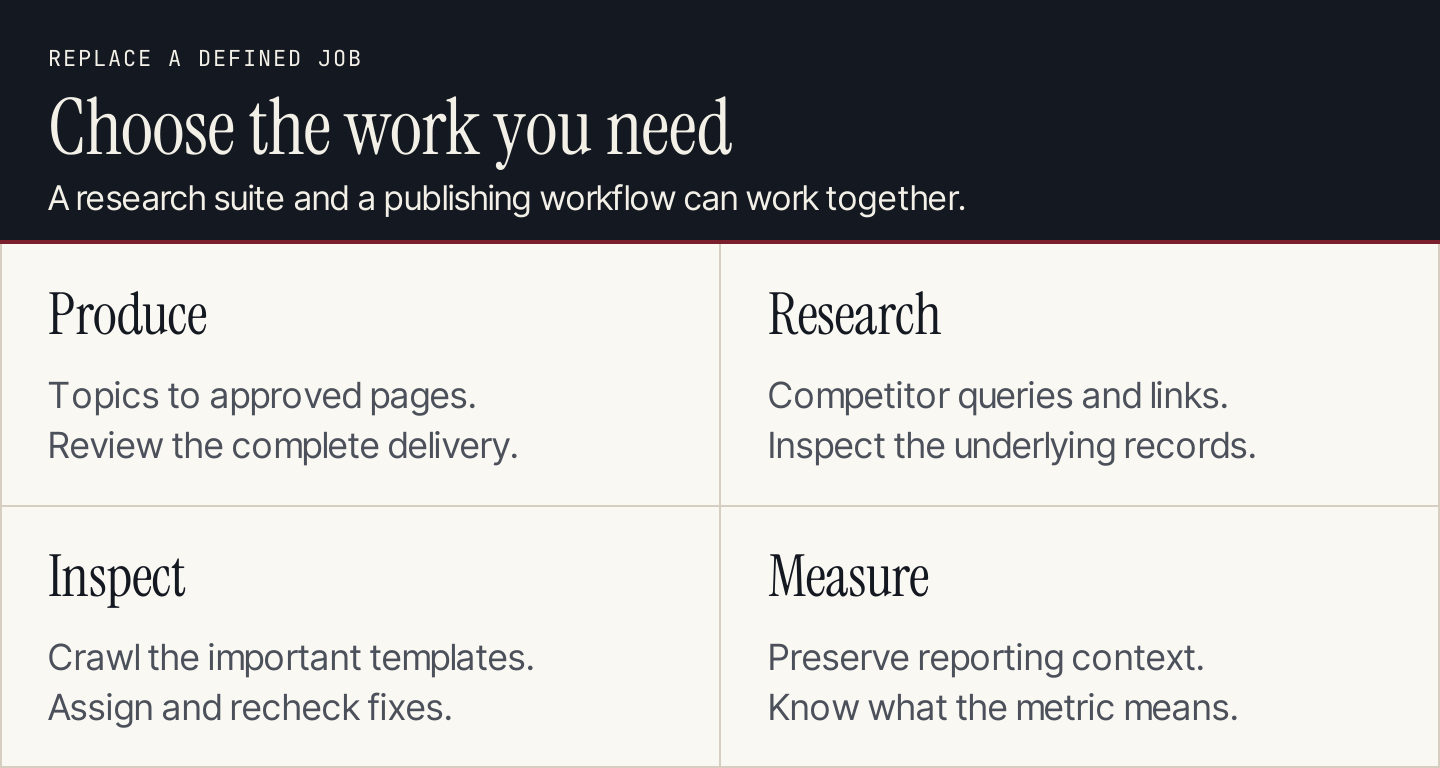
Choose the work before choosing the subscription. A content workflow and a research database can belong in the same stack.
Compare the 12 tools at a glance
| # | Alternative | Best fit | Main buying check |
|---|---|---|---|
| 1 | Rankauto | Recurring SEO article production | Accepted pages and CMS review controls |
| 2 | Ahrefs | Broad competitor and link research | Data coverage and plan limits |
| 3 | SE Ranking | SEO research and agency operations | Projects, users and add-ons |
| 4 | SpyFu | Competitor SEO/PPC investigation | Export limits and renewal price |
| 5 | Majestic | Backlink investigation | Link context, currency and history |
| 6 | Mangools | Focused keyword and SERP work | Daily lookup allowances |
| 7 | Ubersuggest | Research and site-health workflows | Site, seat and report allowances |
| 8 | Serpstat | Keyword, competitor and audit research | Export limits and billing commitment |
| 9 | Screaming Frog | Technical crawls | Configuration and who fixes the findings |
| 10 | Sitebulb | Audit explanation and prioritization | Desktop versus shared cloud workflow |
| 11 | Google Search Console | First-party site performance | It measures your site, not competitors |
| 12 | Similarweb | Market and audience investigation | Estimates and supported segments |
The order begins with our content automation recommendation. It does not claim that the tools have identical databases, replace every Semrush feature or were scored in a controlled performance test.
1. Rankauto: Best for recurring content automation
Choose Rankauto when the bottleneck is the gap between a content plan and approved pages on your website. A larger research dashboard will not solve that handoff by itself.
Rankauto combines topic research, brand-guided article generation, advertised fact-checking, visuals, SEO metadata and CMS delivery. Its public plan is $49 per website per month for 30 created articles and an audit allowance of up to 10,000 pages. You can keep drafts for review or enable automatic publishing. Product documentation.
Limit to check: Keep an editor responsible for factual accuracy and business relevance. This is a content production recommendation; the reviewed pages do not establish a proprietary competitor backlink index or a replacement for a full paid-search suite.
Trial task: Take one approved opportunity from your existing Semrush backlog. Supply the audience, product facts and preferred sources, review the generated article, then inspect its CMS preview. Record correction time and any publishing work still required.
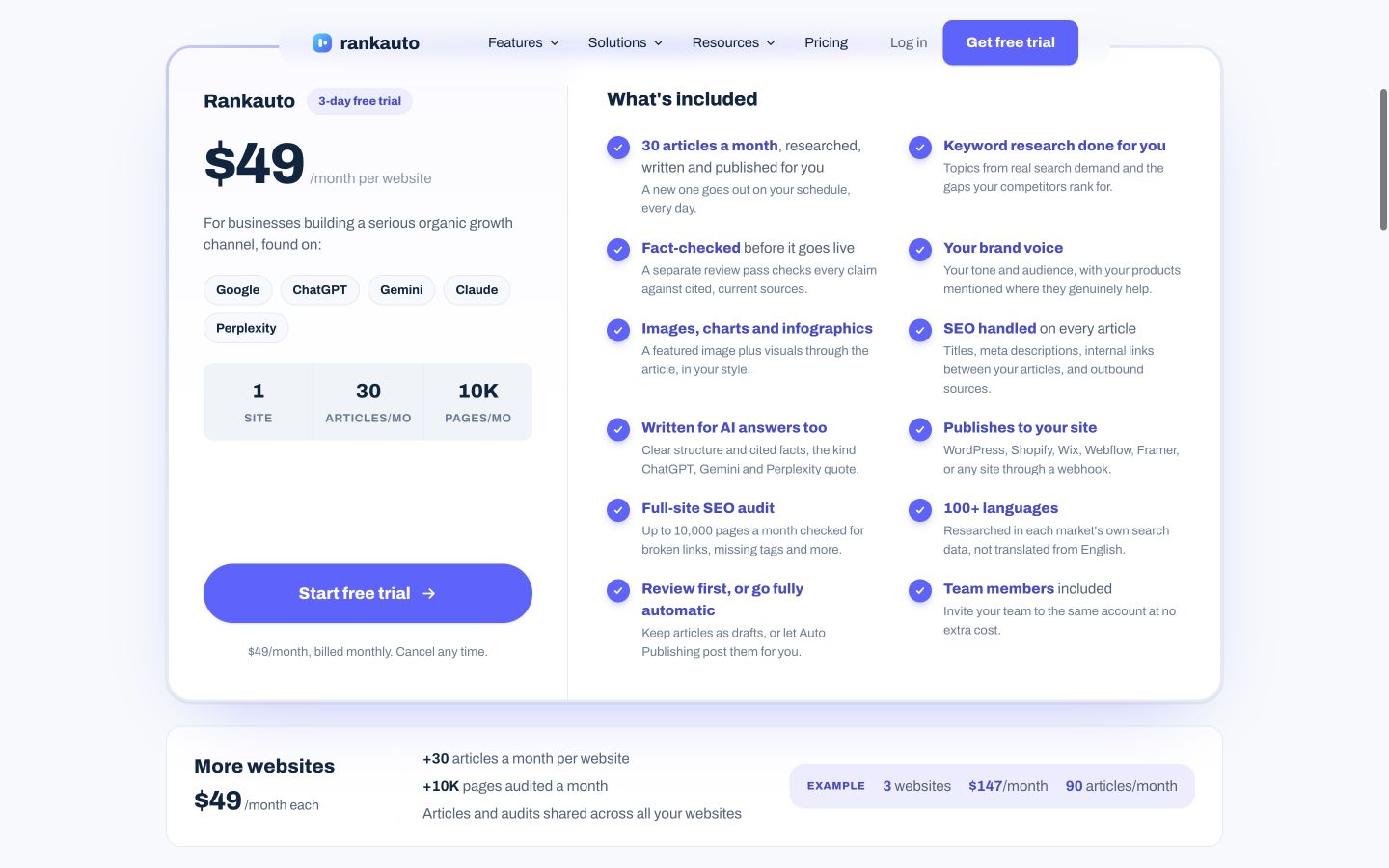
The public plan lists 30 articles per website per month. Use that allowance as production capacity, then assess how many pages your editor actually approves. Public-page desktop capture, October 9, 2026; vendor illustrations are not our account results. Source.
2. Ahrefs: Best for a broad research-suite comparison
Ahrefs is a strong candidate when you want competitor keyword research, backlink investigation, site audits and rank tracking in one product. Its current site also presents AI visibility, AI content helpers and paid-search intelligence. A comparison that describes it as a backlink checker alone misses the current scope. Ahrefs.
Pricing and tradeoff: The public monthly plans reviewed list Lite at $129, Standard at $249 and Advanced at $449. Compare the exact project, report, export and user allowances; the availability of a feature somewhere in the suite does not establish inclusion in every tier.
Trial task: Use your domain, two actual competitors and the same set of US queries you currently investigate in Semrush. Inspect a sample of suggested keywords and linking pages. Export the report your team relies on and ask whether it answers the same question. Different difficulty scores or estimated traffic totals should not be treated as interchangeable measurements.
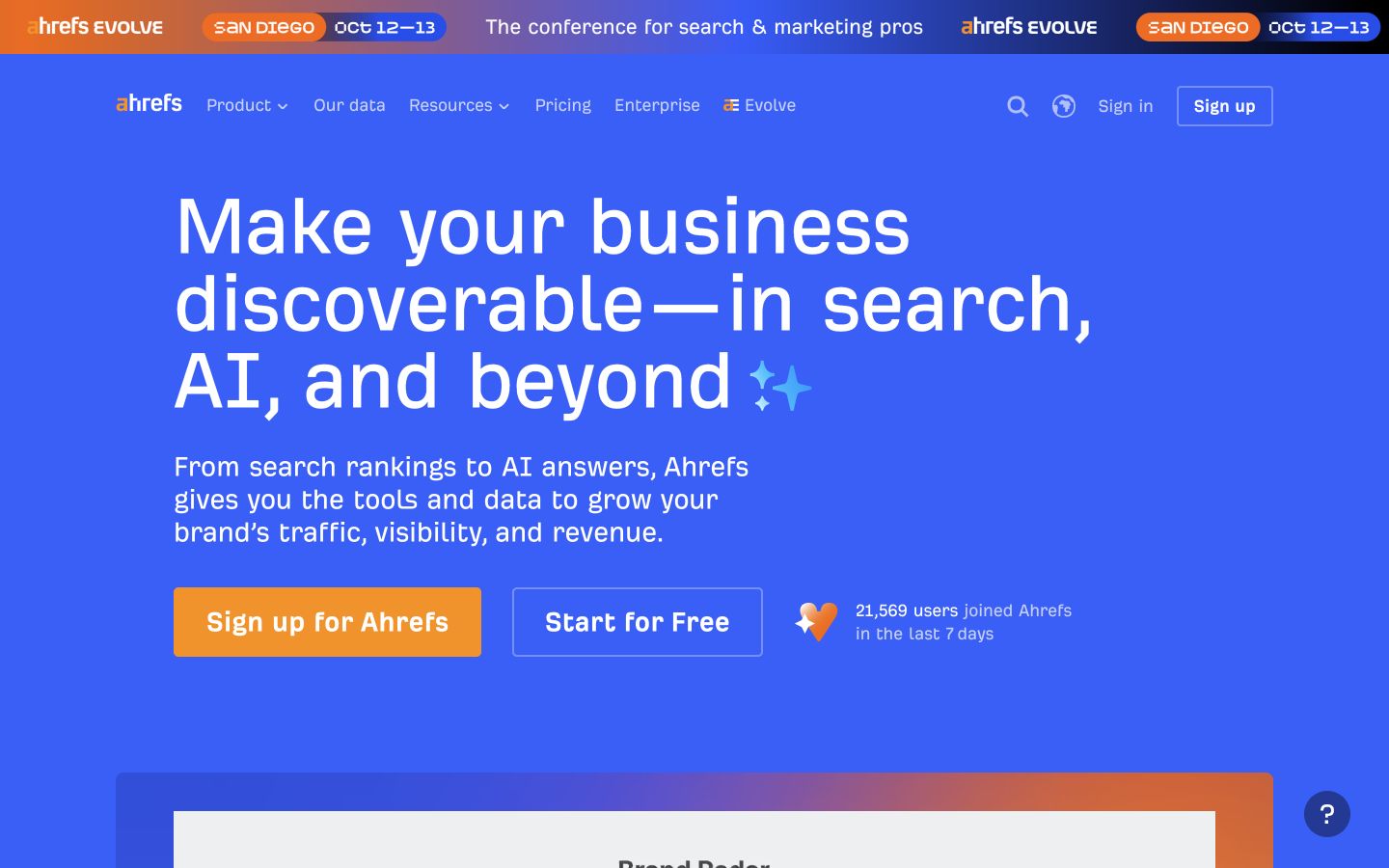
Ahrefs now presents research, AI visibility and content assistance together. Investigate the plan and task you need rather than relying on an older product label. Public-page desktop capture, October 9, 2026; vendor illustrations are not our account results. Source.
3. SE Ranking: Best for SEO operations across multiple sites
SE Ranking deserves a close look when your Semrush use spans research, audits, rank tracking and client reporting. Map each client and reporting requirement to a plan before deciding that the base subscription covers the whole agency.
SE Ranking's platform includes keyword and competitor research, backlink analysis, audits and rank monitoring, with content marketing and AI visibility capabilities also presented. Its site describes an Agency Success Kit and integrations with reporting and workflow tools. Product documentation.
Limit to check: Evaluate the package you need for your client count. Keyword, page, seat and add-on allowances can matter more than a headline monthly price, especially when reporting is part of the service you sell.
Pricing: The entry offer is displayed at $129 monthly or $103.20 per month billed annually. Agency and AI Search additions are priced separately, so budget for the client deliverables you need rather than assuming every module is included. Current pricing.
Trial task: Create one real client project, configure the intended market and generate the report the account manager would send. Confirm permissions, scheduled delivery, branding and which AI visibility or agency features need additional payment.
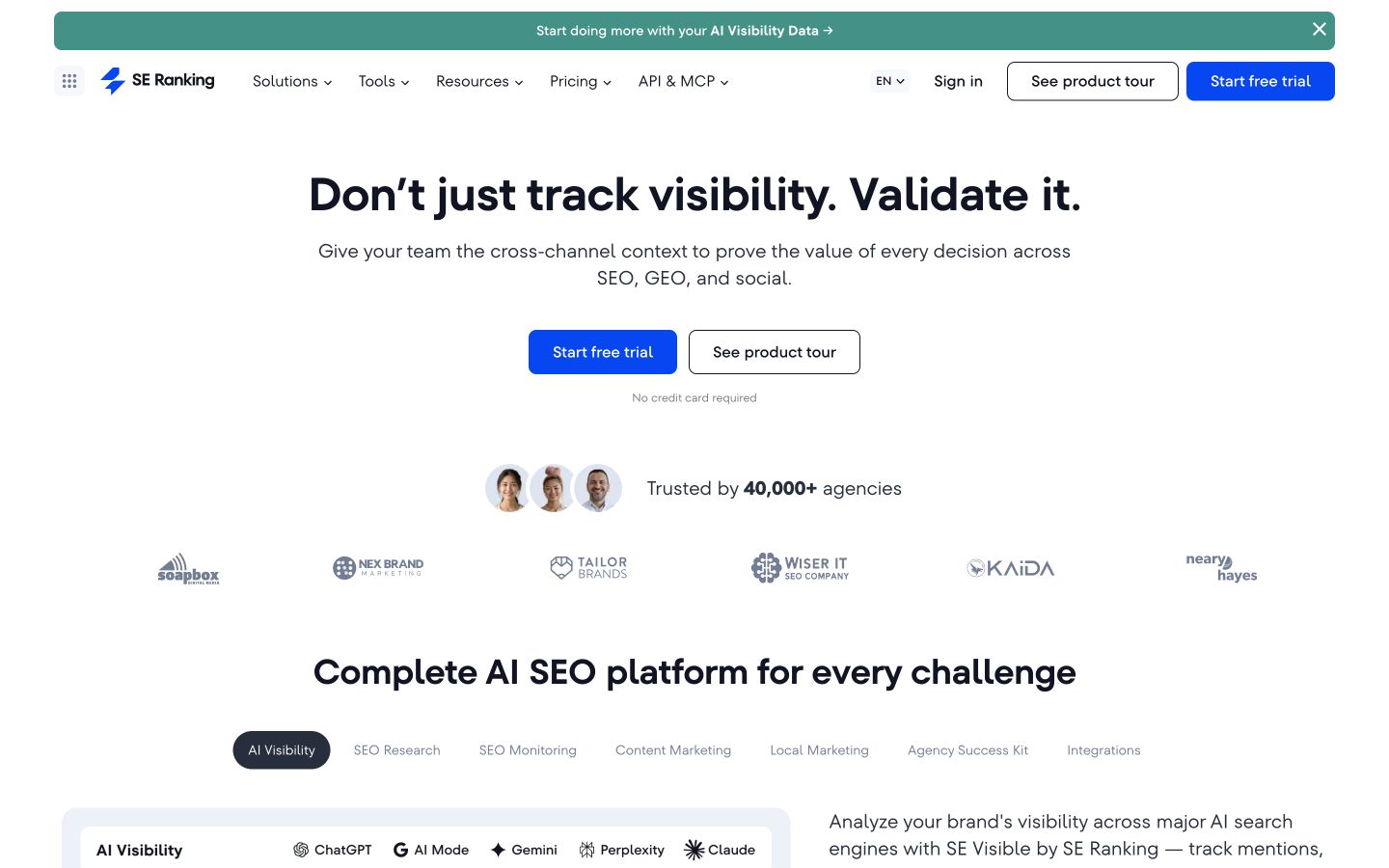
The suite groups research, audits and reporting. Check how many projects and agency functions your intended subscription actually includes. Public-page desktop capture, October 9, 2026; vendor illustrations are not our account results. Source.
4. SpyFu: Best for competitor SEO and PPC investigation
SpyFu is useful when you study how competitors approach organic keywords and paid search. Its current offering also includes site audits, AI fixes, Google Search Console integration and reporting; do not assume it remains a narrow historical-ad database. SpyFu.
Pricing: The monthly Basic plan displays $39, with 10,000-row search results and exports, one live-site tracking project and a 50,000-page monthly crawl allowance. The Pro + AI offer displays $59 for the first month and $119 per month thereafter. Basic lists RivalFlow with zero included sites; the paid bundle's inclusion differs. Official pricing.
Tradeoff and trial task: Estimated competitor history gives you investigation leads, not their actual advertising account results. Pick a real competitor and a product category you understand. Review the ad and keyword suggestions, export the working shortlist and compare recurring cost after the promotion ends. If you need publishing or AI fixes, test those separately on the intended tier.
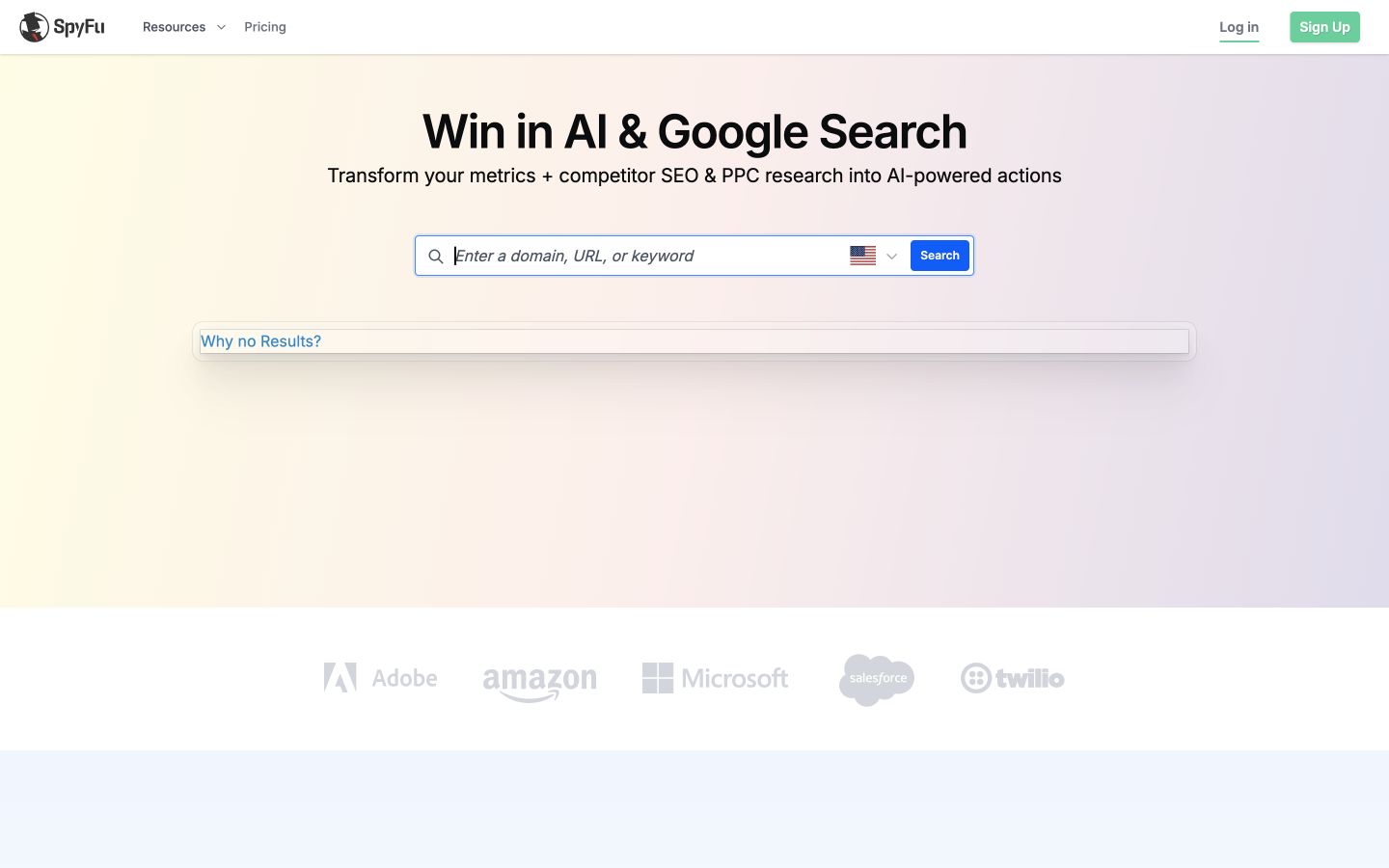
SpyFu’s public site emphasizes both competitor intelligence and newer AI features. Price the recurring plan, not just its first-month offer. Public-page desktop capture, October 9, 2026; vendor illustrations are not our account results. Source.
5. Majestic: Best for specialist backlink analysis
For a team whose Semrush use centers on backlink investigation, Majestic offers a more focused buying route. Keep your keyword planning, content publishing and client reporting requirements separate.
Majestic focuses on backlink exploration and offers proprietary metrics including Trust Flow, Citation Flow and topical analysis. It is relevant when link investigation is the main reason you use a broader SEO suite. Product documentation.
Limit to check: Vendor authority metrics are not Google scores. Compare meaningful referring domains, source-page context and export usefulness on your own sample rather than deciding by a database-size headline.
Pricing: The default GBP page lists Lite at £39.99 monthly or £33.33 per month billed annually (£399.90 per year). These are pounds, not a USD quote. US buyers should select the appropriate currency and verify the plan’s index and export access. Current pricing.
Trial task: Inspect a genuine linking URL, its surrounding context and relevant history. Decide whether the information changes a real outreach or link-review decision. A vendor authority metric alone should not determine whether a link is useful.
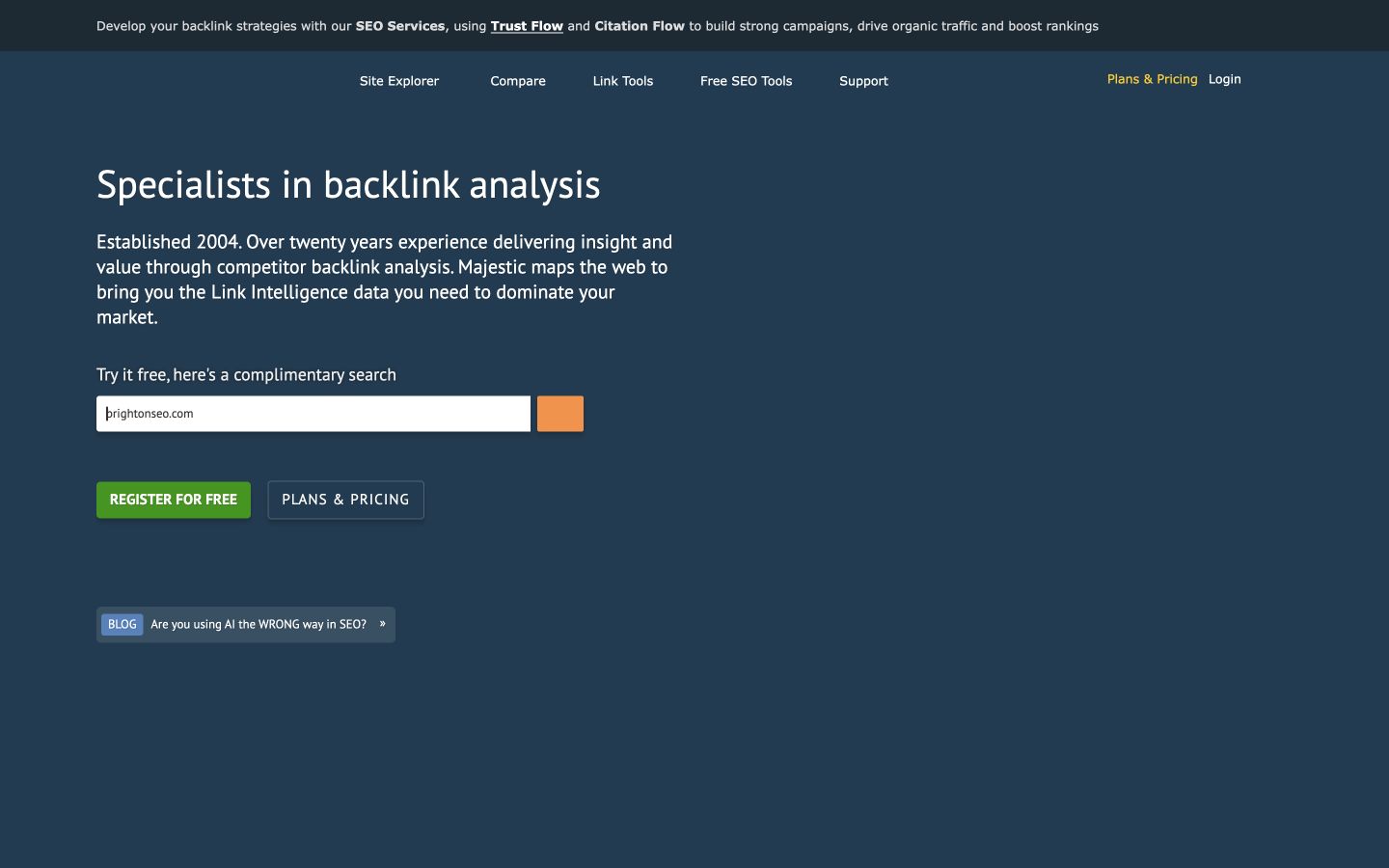
The public page makes backlink investigation the main job. Link-level evidence is more useful than comparing headline index-size claims. Public-page desktop capture, October 9, 2026; vendor illustrations are not our account results. Source.
6. Mangools: Best for a focused keyword and SERP toolkit
Mangools is a useful shortlist for a founder or marketer who wants focused research without adopting every workflow in a larger suite. Its separate tools make it important to check the allowances that apply to each task.
Mangools organizes its SEO capabilities around focused tools such as KWFinder, SERP analysis, ranking tracking and link research. Its current site also presents AI search visibility capabilities. Product documentation.
Limit to check: Test your country and niche coverage, and verify how daily or plan-level allowances fit your workload. Familiarity with one tool does not establish parity with every historical or export feature in Semrush.
Trial task: Run the queries from one real topic cluster. Check the visible results for intent, save a shortlist and see whether the daily lookup capacity supports your normal planning session. Confirm user access before treating a personal plan as an agency replacement.
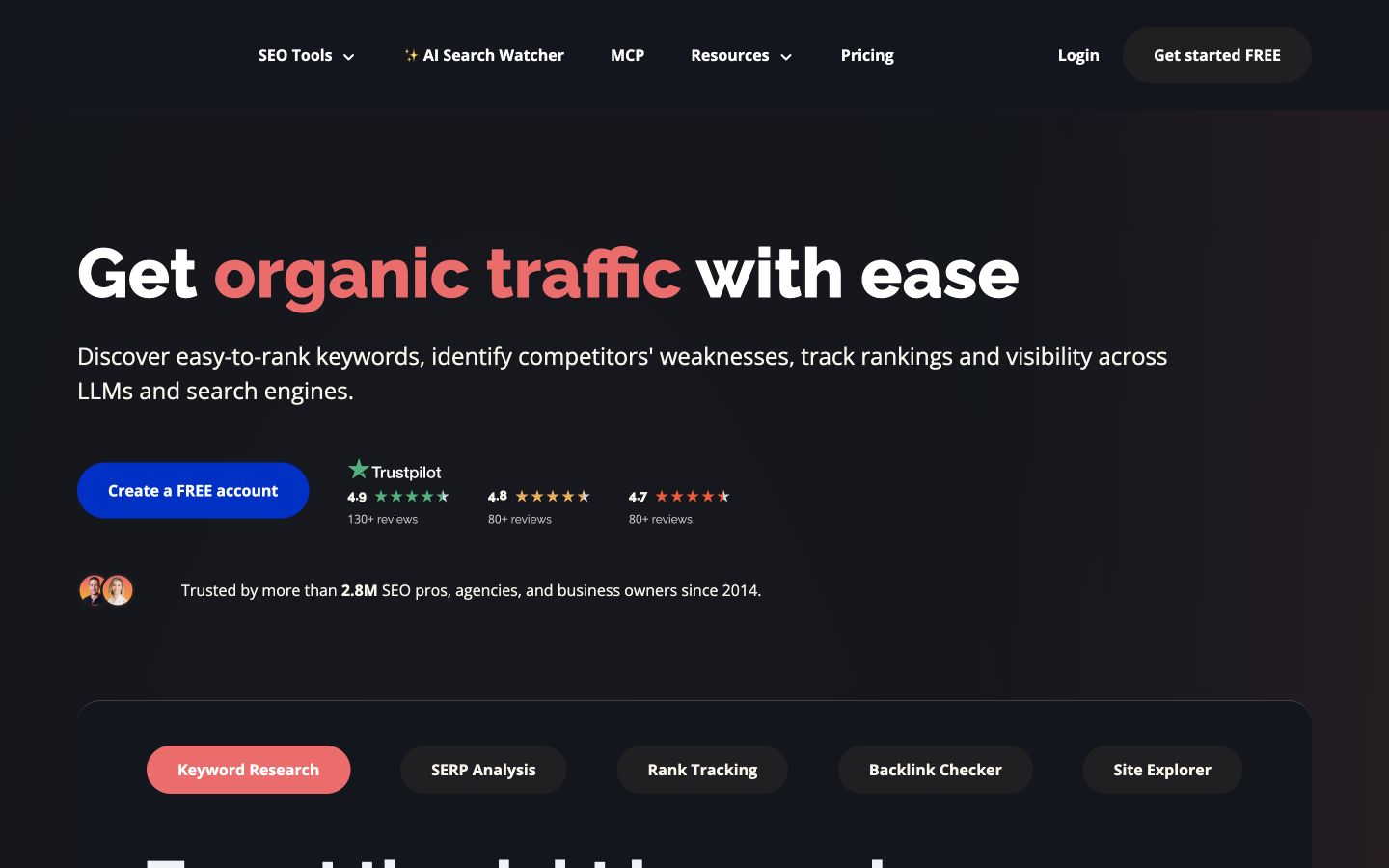
The tools are organized around specific research tasks. Check lookup allowances against the amount of research you do in one sitting. Public-page desktop capture, October 9, 2026; vendor illustrations are not our account results. Source.
7. Ubersuggest: Best for a compact research and site-health shortlist
Ubersuggest can suit a team that needs keyword ideas, competitor leads and site-health checks in a more compact workflow. Decide from the reports you will use, rather than from a promise that one tool handles all marketing work.
Ubersuggest presents keyword research, competitive analysis, site audits and tracking, with AI visibility now part of its public positioning. It can be shortlisted by teams that need a manageable set of research tasks. Product documentation.
Limit to check: Test actual search coverage, exports and usage allowances before making it a budget choice. A simpler package is useful only if it still answers the questions your team asks every week.
Trial task: Use a live landing page and a narrow topic. Check whether suggested queries match the page's customer intent, then inspect the audit finding that would create the most developer work. Confirm site limits, seats and renewal terms for the offer you choose.
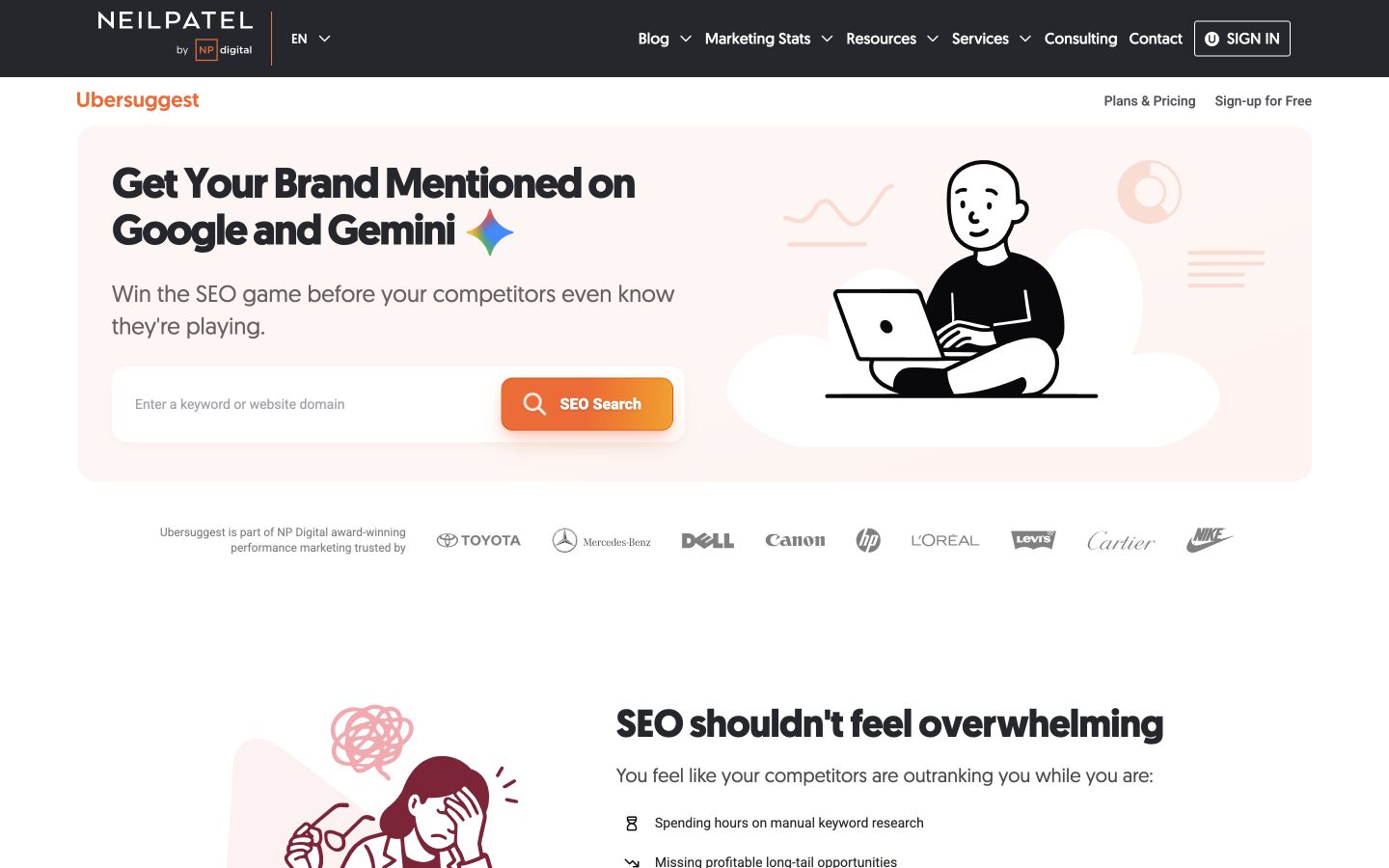
Use the public product overview to identify the relevant reports, then evaluate the current offer and account limits directly. Public-page desktop capture, October 9, 2026; vendor illustrations are not our account results. Source.
8. Serpstat: Best for combined keyword and competitor research
Serpstat belongs on a shortlist when you want several research and audit functions together. Its project and export limits matter especially when one person supports multiple businesses.
Serpstat's official page lists competitor analysis, site audit, keyword research, rank tracking and API/data solutions. Its competitor workflow includes keyword opportunities and website visibility or backlink metrics. Product documentation.
Limit to check: Compare country coverage, historical depth and export limits using your own sample. A large advertised dataset does not prove that the niche or report you need has enough useful information.
Pricing: The captured annual-discount offer shows Individual at $50 per month with five projects, 100 daily research searches and 50,000 export rows. Confirm the annual commitment and the limits of the plan rather than applying this figure to monthly billing. Current pricing.
Trial task: Build one research export for your next editorial meeting. Check duplicates, country relevance and how much cleanup is necessary. Make sure the intended plan supports the number of projects and rows you need, without assuming an annual offer is a month-to-month price.
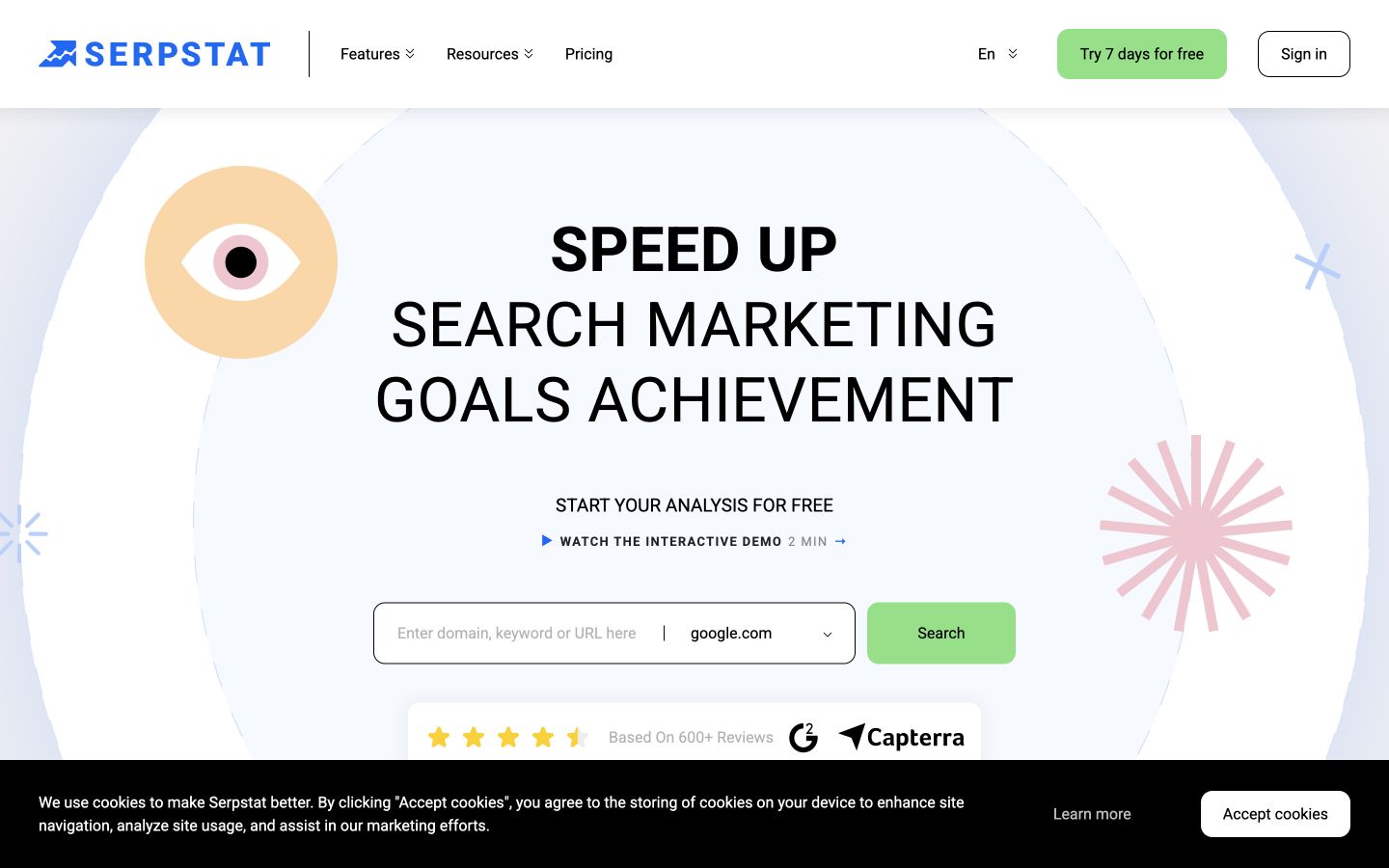
The current public offer distinguishes project, daily-search and export allowances. Those limits can matter more than the headline monthly equivalent. Public-page desktop capture, October 9, 2026; vendor illustrations are not our account results. Source.
9. Screaming Frog SEO Spider: Best for repeatable technical crawls
Choose a crawler when the work is inspecting your website pages, not reading a market-wide competitor keyword database. Screaming Frog is relevant when a technical specialist can configure the crawl and act on its findings.
Screaming Frog SEO Spider is a desktop website crawler for Windows, macOS and Linux. It analyzes common audit issues such as broken links, redirects and metadata, with advanced crawl features available under a licence. The official page states a 500-URL limit for the free version. Product documentation.
Limit to check: A crawl report needs interpretation and implementation. It is not a competitor keyword database or a published article program. Configure the crawl carefully so an audit represents the pages and rendering conditions you intended to inspect.
Trial task: Crawl a representative set of templates, inspect a redirect chain and check indexability. Record your settings so the same crawl can be repeated after a fix. Confirm whether the required rendering, integrations and crawl size need a paid license.
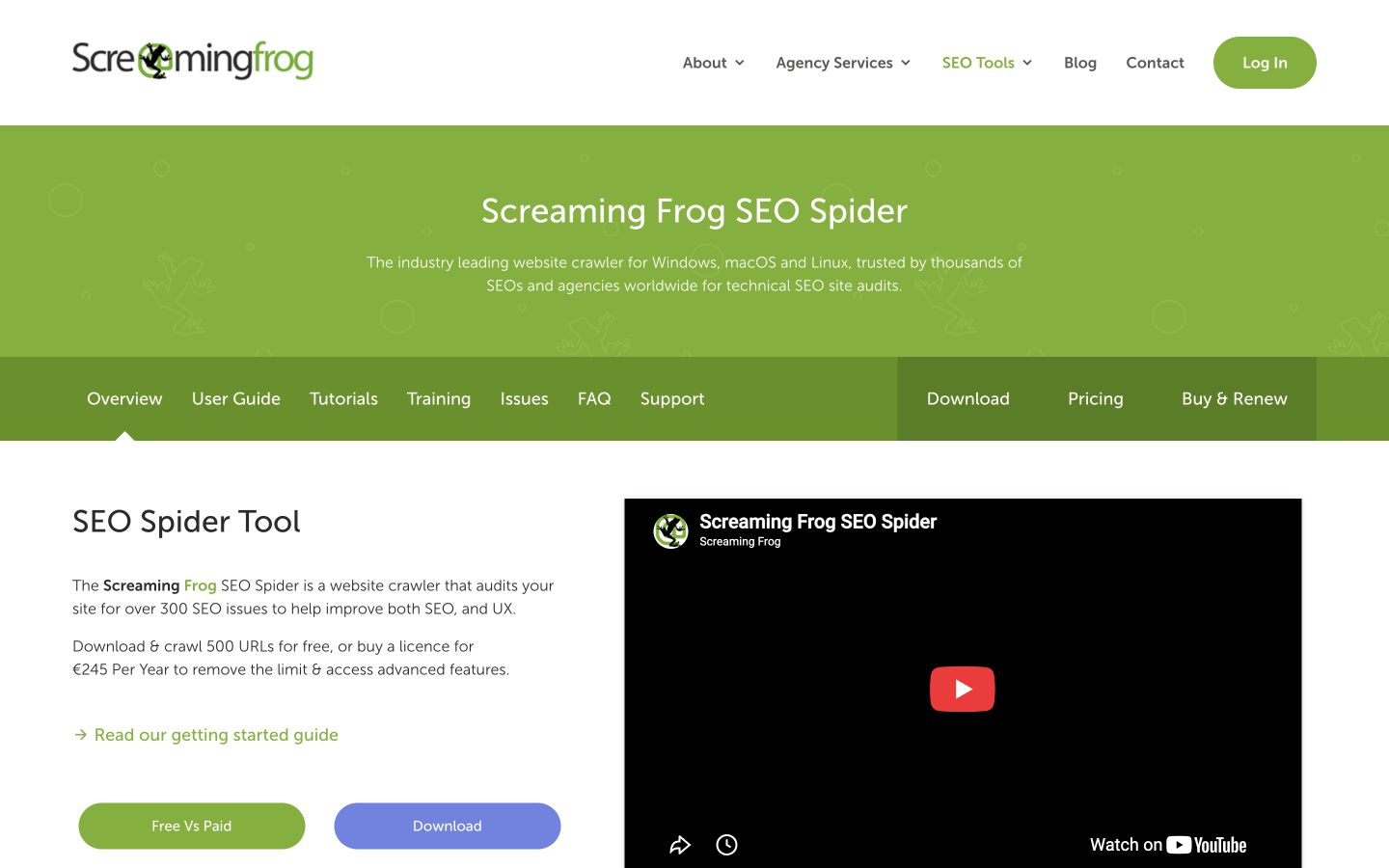
A crawler supports technical investigation. It still needs a defined scope, sensible settings and someone responsible for fixing the findings. Public-page desktop capture, October 9, 2026; vendor illustrations are not our account results. Source.
10. Sitebulb: Best for explaining and prioritizing technical findings
Sitebulb is worth evaluating when audits produce a long issue list but stakeholders need a clear reason to prioritize particular fixes. Compare both its desktop and cloud routes against the way your team shares work.
Sitebulb offers desktop and cloud website crawling with prioritized Hints, visualizations and explanations intended to help teams interpret technical SEO findings. Product documentation.
Limit to check: A prioritized finding still needs context. Check affected URLs, business importance and implementation cost before escalating it. Sitebulb addresses the audit role rather than replacing keyword, backlink and article work together.
Pricing: Lite and Pro desktop licenses have separate URL and feature allowances; Cloud is another offer. The dynamic price amounts did not resolve in our captured pricing text, so obtain a current USD quote rather than relying on an older comparison. Current pricing.
Trial task: Give the same crawl to the SEO lead and developer. Ask each to identify the first fix, the affected template and the recheck needed. Useful explanations should reduce clarification work without turning every warning into an urgent development ticket.
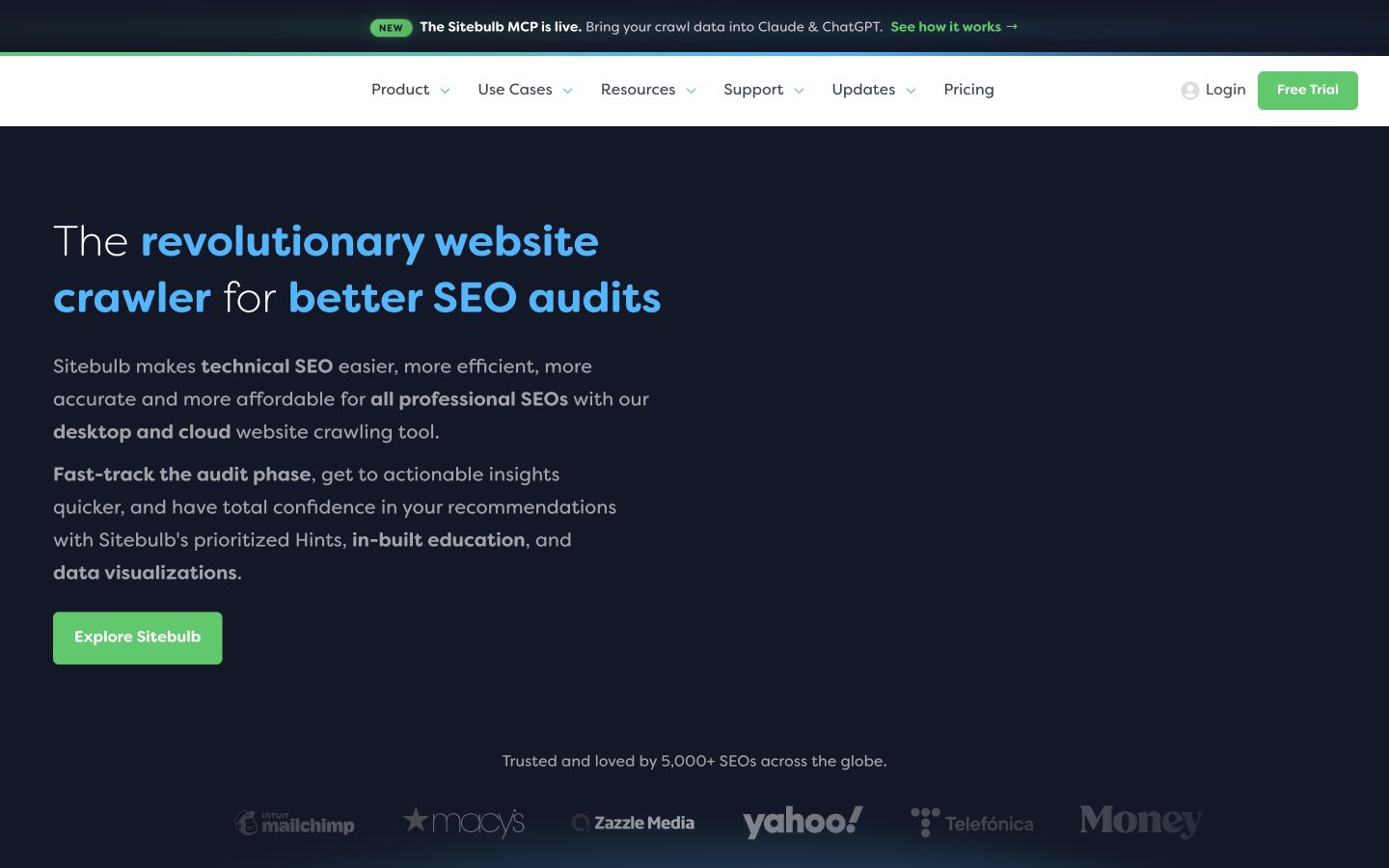
The public product page emphasizes technical findings and their explanation. Assess whether that improves the handoff to your developer. Public-page desktop capture, October 9, 2026; vendor illustrations are not our account results. Source.
11. Google Search Console: Best for your own Google performance
Search Console is a valuable first layer before purchasing more software. It supplies first-party information for properties you can verify, including search performance and indexing information.
Search Console provides query and page performance for a verified site, including impressions, clicks and average position. It also supports sitemap submission, indexing information and URL inspection. Product documentation.
Limit to check: It does not expose a competitor's private Search Console reports. Use it to diagnose your own visibility and validate priorities, with another research source when you need competitor estimates or backlink discovery.
Trial task: Export an important page's queries with the country, date range and search type documented. Compare like-for-like periods and separate branded from relevant nonbranded demand where useful. Preserve the filters with the export so another teammate can reproduce the report.
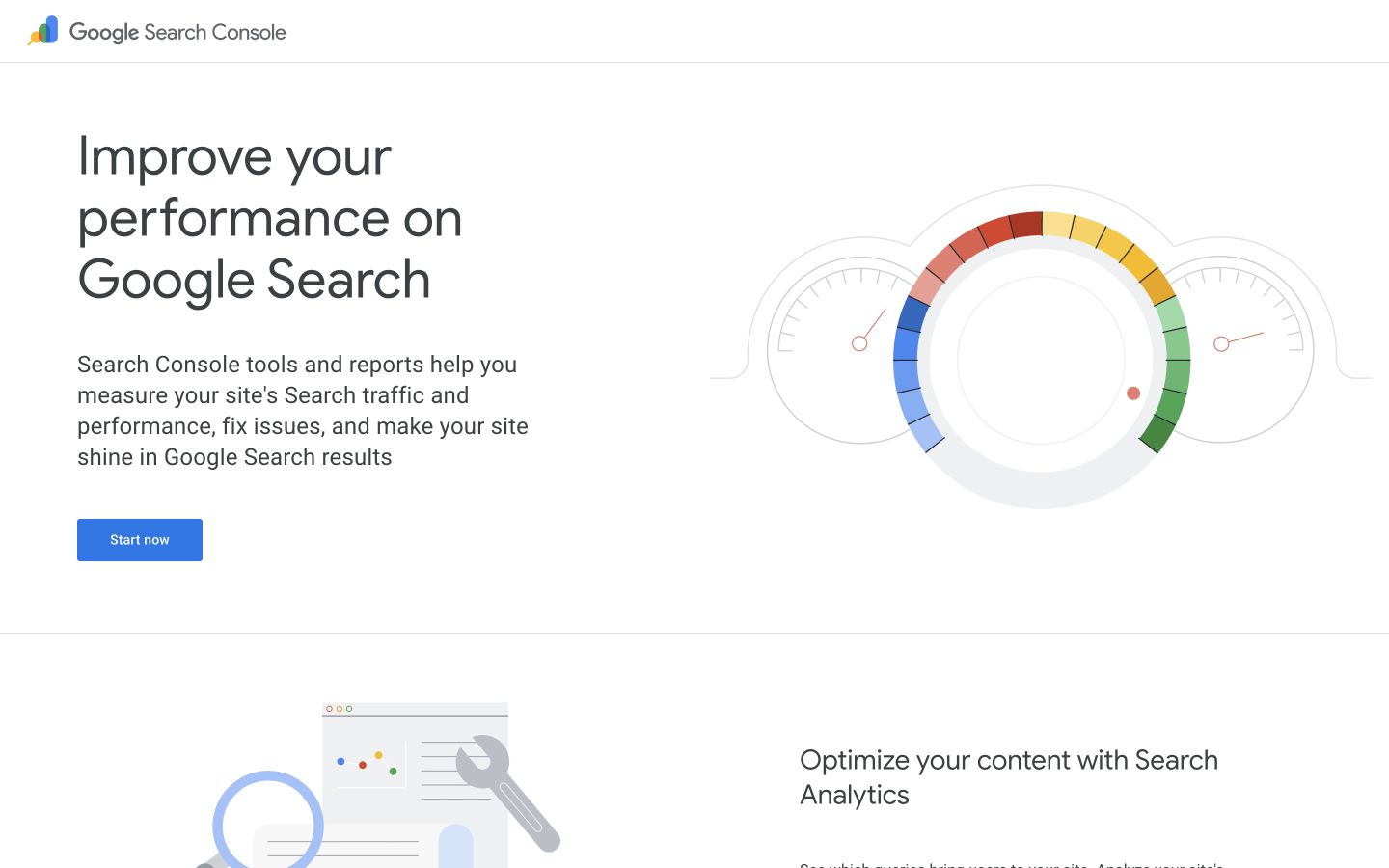
Search Console’s public overview describes reporting for your own property. It is not competitor account access or a complete cross-engine visibility tracker. Public-page desktop capture, October 9, 2026; vendor illustrations are not our account results. Source.
12. Similarweb: Best for market and audience context
Similarweb focuses on digital-market intelligence: traffic and engagement estimates, competitor context, audience information and acquisition research. It is useful when the question reaches beyond which keyword to put into the next article. Similarweb.
For example, an agency comparing a client's apparent acquisition mix with a competitor's can use market data to form a hypothesis about research priorities. It should then compare that hypothesis with the client's first-party analytics. Do not present competitor estimates as if you accessed their Google Analytics account.
Pricing and tradeoff: Product scope, geography, historical access, exports and seats affect the purchase. The reviewed public pricing page did not yield a reliable comparable payable amount; obtain the quote for the specific product and market you need.
Trial task: Pick an actual competitor and your target US segment. Ask which decisions the available data would change, whether smaller sites have useful coverage and what can be exported for a client report. Keep the data's estimated nature visible in your interpretation.
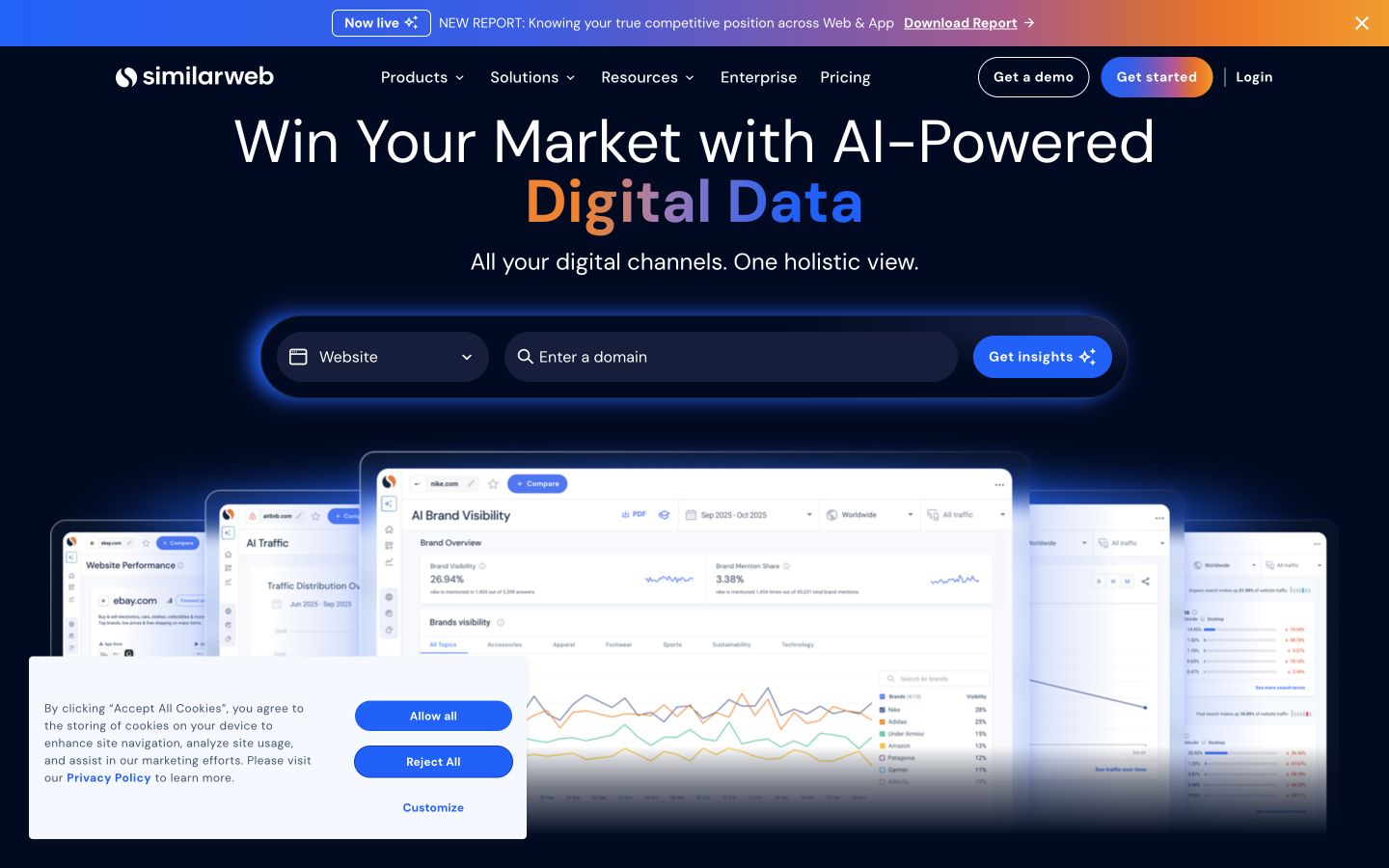
The public product page positions Similarweb around market intelligence. Its competitor estimates should inform hypotheses, with their scope and limitations retained. Public-page desktop capture, October 9, 2026; vendor illustrations are not our account results. Source.
Price a replacement stack using the actual jobs
A proposed stack of Rankauto at $49 per website per month and Ahrefs Lite at $129 per month totals $178 per month in software before tax, additional users or extras. That arithmetic does not prove it replaces the $199 Semrush One Starter bundle: the products include different reporting, content and AI visibility allowances.
Use a worksheet that makes those differences visible:
| Job | Current cost or allowance | Replacement | Still needed? |
|---|---|---|---|
| Competitor research | Record reports, exports and users | Chosen research tool | Confirm coverage on your sample |
| Blog production | Record software plus editor time | Rankauto or existing process | Count approved pages |
| Technical inspection | Record audit scope and owner | Suite audit or crawler | Preserve configuration and rechecks |
| AI visibility | Record engines, prompts and refresh rate | Dedicated plan or retained tool | Do not assume the bundle is included |
| Reporting | Record clients, seats and templates | Tool reports or current process | Rebuild only useful reports |
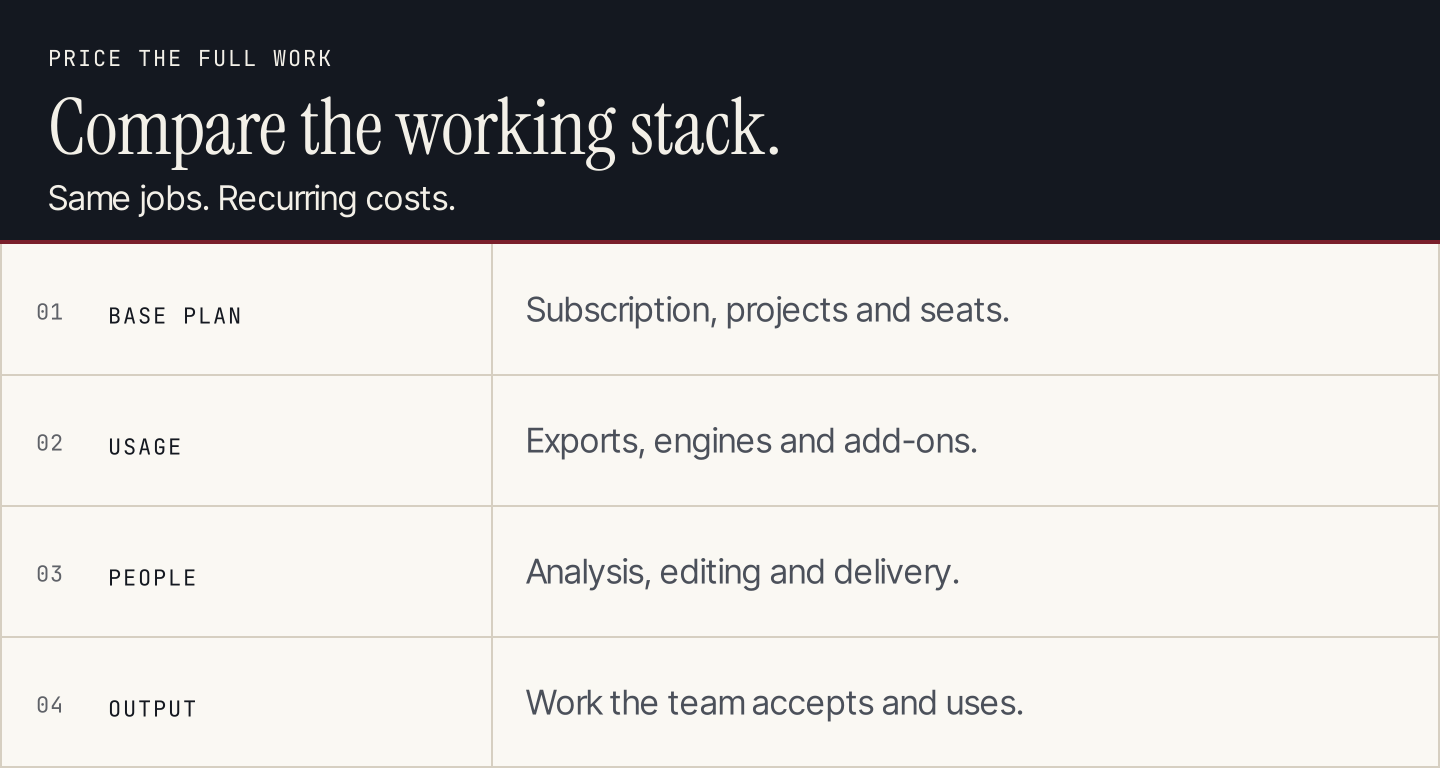
This is a proposed buying worksheet. Enter the recurring price and human work for the same set of jobs.
The useful comparison is the total cost of work your team completes and trusts. A cheaper subscription that adds manual exports, missing reports and editorial cleanup can be more expensive to operate. Conversely, a full suite may be unnecessary if its extra capabilities are rarely used.
A practical migration checklist
Before cancelling Semrush, inventory the projects, historical reports, tracked keywords, alerts, integrations and users that rely on it. Mark each item as replace, retain or retire. A report nobody reads does not need to be recreated just because it exists.
Run one representative workflow in parallel. Preserve the current report date, market and filters; perform the same task in the replacement; document the differences rather than forcing the numbers to match. Keyword difficulty, estimated traffic and authority metrics use vendor-specific methods.
For content, move one article through the entire chain: research, approved brief, source checks, draft, CMS preview and publication approval. For audits, verify one actual fix with the same crawl configuration. For client reporting, ask the person who uses the report whether it still supports a decision.
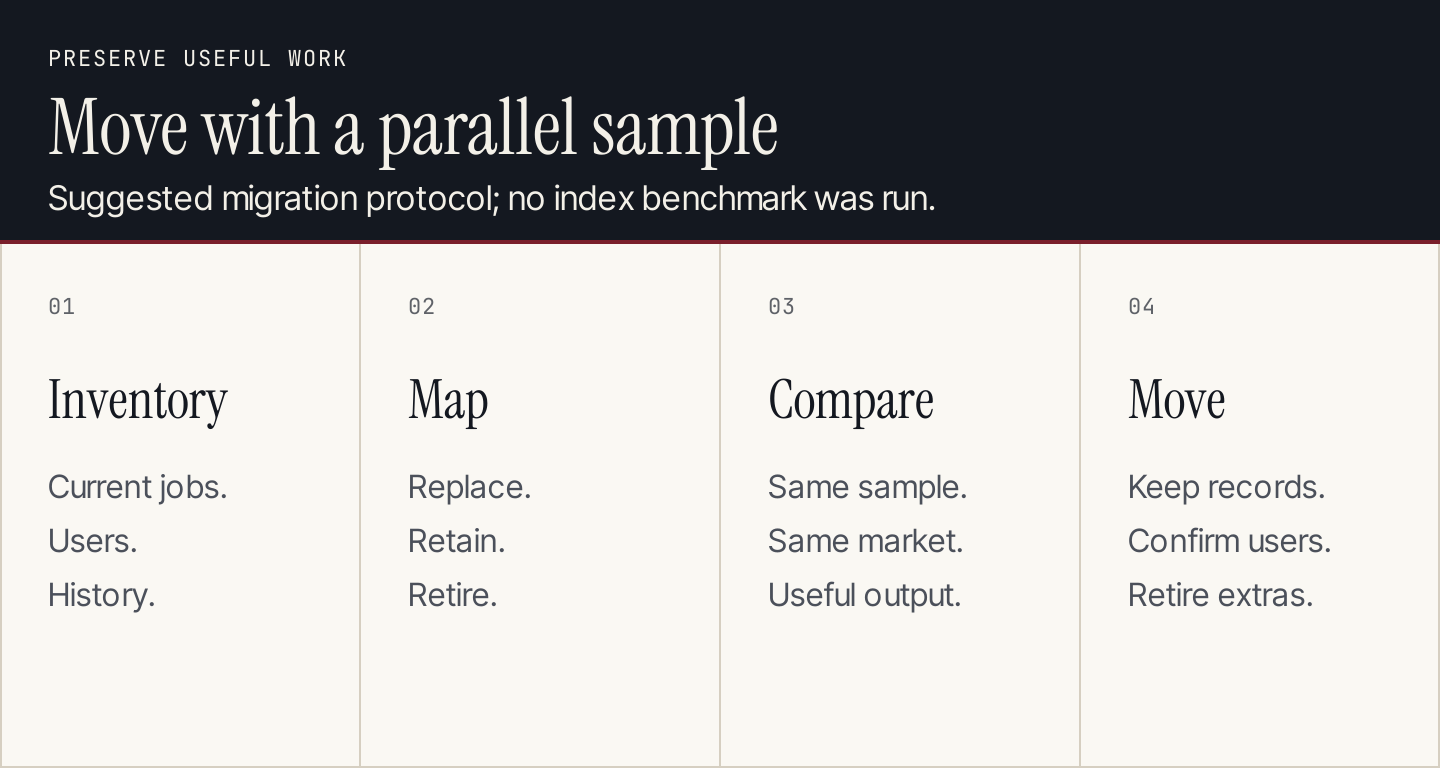
Suggested migration protocol. Preserve the work and reporting context before changing subscriptions.
Frequently asked questions
What is the best Semrush alternative for a small business?
Rankauto is our first recommendation when the recurring problem is producing and publishing useful SEO articles. For competitor keyword and backlink research, compare tools such as Ahrefs, SE Ranking or a focused research toolkit. The best purchase depends on which job is currently holding the business back.
Is there a free Semrush alternative?
Google Search Console is free and provides valuable data for your own verified website. It does not replace competitor research, paid-search investigation or every audit workflow. Start with its reports, then add paid software only for an identified gap.
Should an agency use one suite or several specialist tools?
Use the arrangement your team can operate reliably. A suite can simplify access and reporting; specialists can give particular roles a focused workflow. Count seats, clients, add-ons and the time spent moving information between products before choosing.
Can I cancel Semrush after buying Rankauto?
Only if the remaining Semrush jobs have been replaced or deliberately retired. Rankauto addresses content production; it is not documented as a full substitute for Semrush's competitor database or paid-search suite. Start with one reviewed article workflow, then decide what research and measurement you still need.
For a recurring publishing backlog, explore Rankauto's content plan and evaluate the quality of the approved pages your team receives.