12 Best AEO Tools for Answer Content and Measurement
Compare 12 AEO tools for answer content and measurement. See which job each tool does, what it costs and how to trial it on real customer questions.

A useful answer engine optimization tool should help you answer one of two questions: What should we improve on our website? Or how do answer engines currently represent us? The best purchase depends on which question your team cannot answer today.
Rankauto is our #1 recommendation for recurring answer-focused article production. Use it to move researched topics through drafting, review and CMS delivery. If you need evidence about brand mentions and citations, pair that production workflow with a dedicated measurement product.
This guide compares 12 AEO tools, explains their different responsibilities, and includes three source-backed answer examples you can apply to your own content. A monitoring subscription is useful when someone owns the decisions that follow it. A content subscription is useful when the resulting pages answer real questions accurately.
Disclosure and method: Rankauto publishes this guide. We reviewed public product documentation and pricing during October 8–10, 2026. Our screenshots show public pages and vendor illustrations. We did not test paid accounts or measure ranking, traffic or citation gains. Best-fit labels are editorial judgments for the stated job.
What an AEO tool should help you do
For this guide, AEO means researching customer questions, publishing reliable answers and investigating how those answers or your brand appear in search and AI assistants. Vendors also use GEO, LLM SEO and AI visibility for overlapping work. Evaluate the deliverable behind the label.
| Responsibility | Useful output | Relevant tools |
|---|---|---|
| Question discovery | A question set with audience and market context | AlsoAsked; your customer research |
| Answer production | Reviewed, sourced pages your audience can use | Rankauto, Frase, Profound, Conductor |
| Visibility monitoring | Saved responses, mentions and cited sources | Peec, OtterlyAI, Rankscale, Scrunch, HubSpot AEO |
| Broader investigation | Competitor patterns, technical context and action priorities | Semrush AI Visibility Toolkit, Ahrefs Brand Radar, Conductor |
Some products span several rows. That overlap makes a trial more useful than sorting tools into rigid categories.
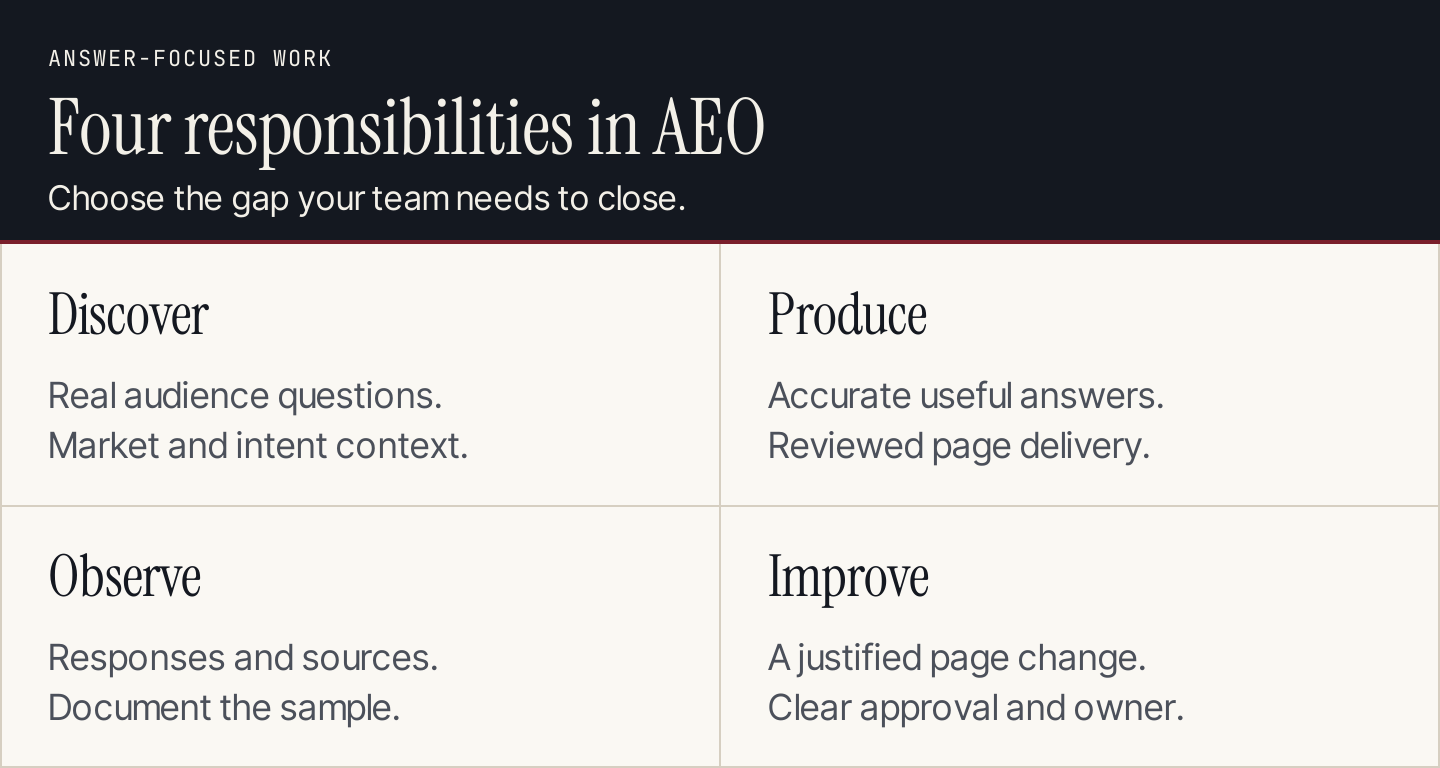
Assign an owner to the answer and another to the measurement. One person can own both, but neither responsibility should disappear.
Compare the 12 AEO tools
| # | Tool | Best fit | Buying check |
|---|---|---|---|
| 1 | Rankauto | Recurring answer-focused blog production | Source quality, review and CMS delivery |
| 2 | AlsoAsked | Google question discovery | Market, language and export needs |
| 3 | Frase | Content research, optimization and maintenance | Article, site and audit allowances |
| 4 | Profound | AI marketing workflows connecting evidence and content | Engines, production scope and current quote |
| 5 | Peec AI | Team visibility investigation | Actual responses, sources and selected engines |
| 6 | OtterlyAI | A small, defined monitoring baseline | Prompt limit and engine add-ons |
| 7 | Rankscale | Broader engine sampling | Credit consumption and usable recommendations |
| 8 | Scrunch | Visibility investigation with plan-specific page work | Core versus Enterprise capabilities |
| 9 | HubSpot AEO | Standalone entry monitoring or HubSpot-connected work | Beta scope and Marketing Hub distinction |
| 10 | Semrush AI Visibility Toolkit | AI visibility beside an SEO workflow | Standalone versus Semrush One allowance |
| 11 | Ahrefs Brand Radar | Broad discovery and custom-prompt tracking | Index versus custom-check pricing |
| 12 | Conductor | Enterprise content, intelligence and monitoring | Contract scope, ownership and implementation |
This is a shortlist ordered around our content automation recommendation, rather than a controlled performance ranking.
1. Rankauto: Best for recurring answer-focused articles
Rankauto fits a team that knows which questions its customers ask but needs a repeatable way to create useful pages. Supply approved product facts, sources and audience context, then review how the article answers the question before publishing.
The public plan lists $49 per website per month for 30 articles, with research, brand guidance, visuals, metadata and CMS publishing. Treat those articles as creation capacity; an editor still decides what is accurate and ready. Rankauto pricing.
Tradeoff: This is a production recommendation. The reviewed documentation does not establish a dedicated cross-engine citation tracker. Use a measurement product when the missing output is evidence about answer-engine visibility.
Evaluation task: Give the workflow a real, narrowly scoped customer question and three approved sources. Require a direct answer, a meaningful exception, an example and a cited source. Inspect the final CMS page, including links and images, before accepting it.
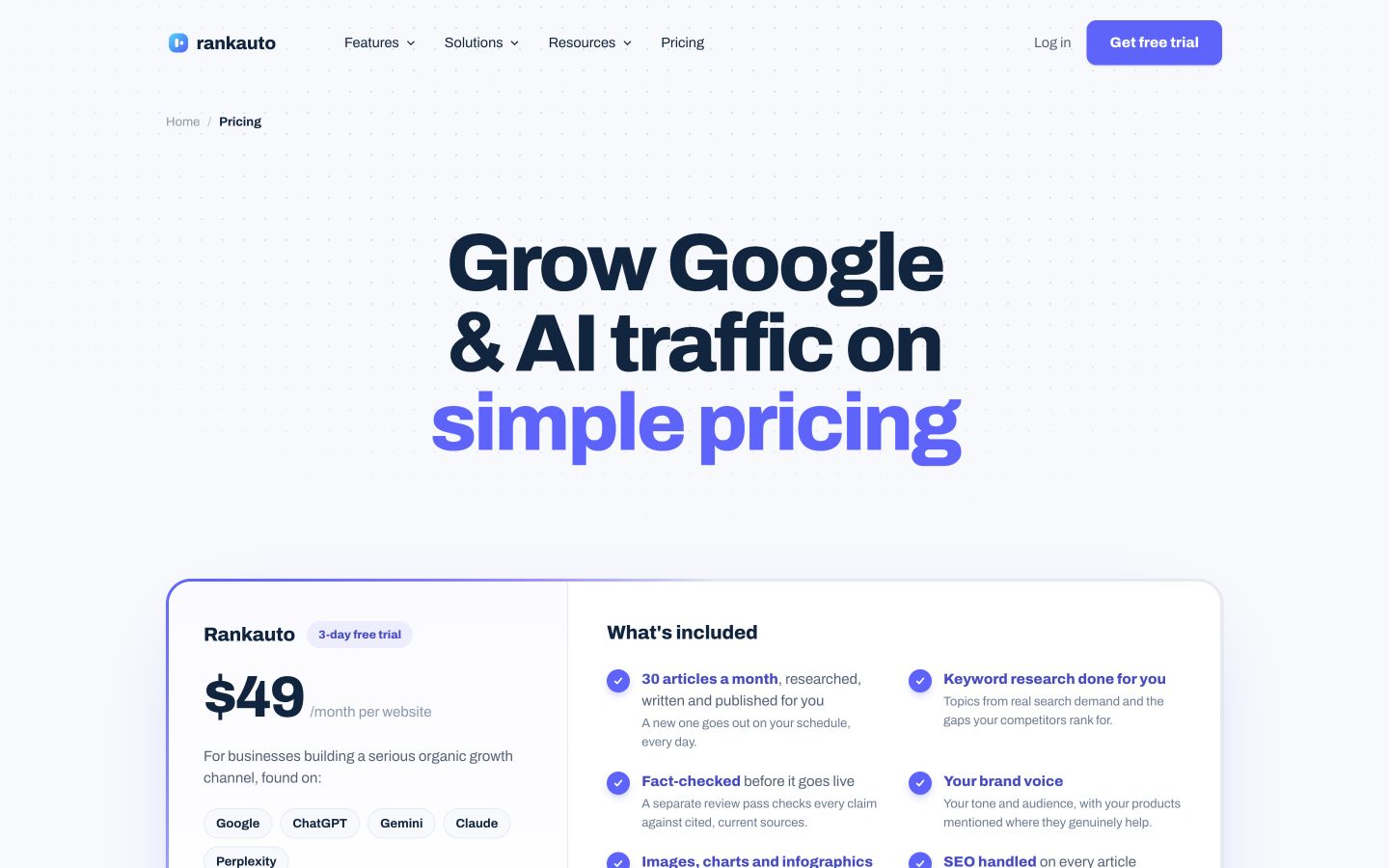
The public offer describes a recurring production workflow. Judge the reviewed answer and its publishing handoff. Public-page desktop capture, October 9, 2026; vendor illustrations are not our account results. Source.
2. AlsoAsked: Best for researching related questions
AlsoAsked maps Google People Also Ask questions. It is useful when a broad topic needs a more precise question structure, especially when you set the relevant country and language. The map can help identify follow-up concerns that an article should answer. AlsoAsked.
Pricing: The captured USD offer displays Basic at $12 per month with 100 monthly credits. Confirm the selected billing interval and export/API requirements for your use. Pricing.
Tradeoff: People Also Ask is Google question evidence. It is not measured ChatGPT prompt volume, and a question appearing in a map does not prove that it deserves a separate article.
Evaluation task: Research one US English buying question, inspect the branches, and compare them with actual sales or support questions. Consolidate closely related answers where one page can serve the reader well.
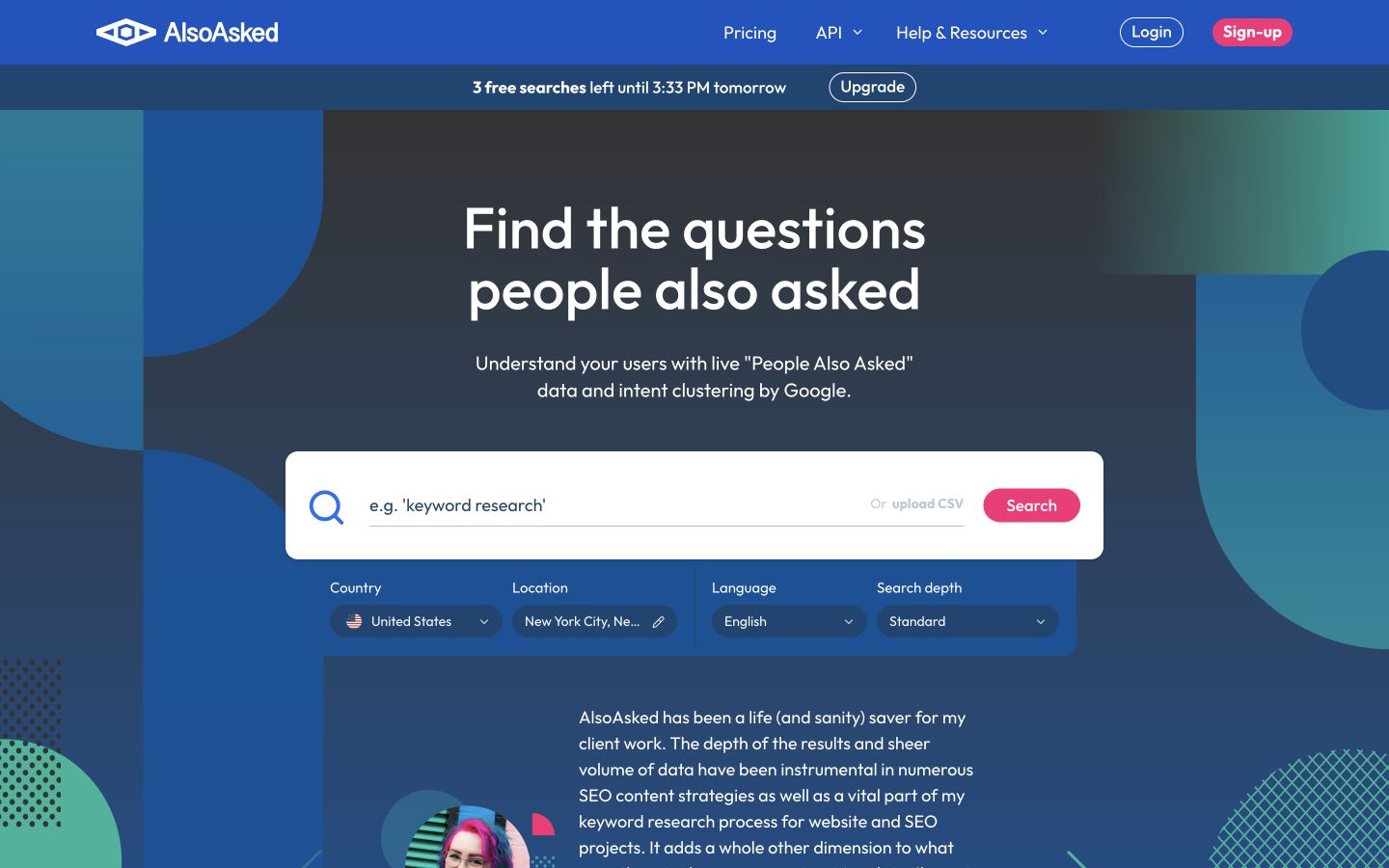
A question map helps expose related concerns. The research still needs an audience and an editorial decision. Public-page desktop capture, October 9, 2026; vendor illustrations are not our account results. Source.
3. Frase: Best for answer research and page maintenance
Frase combines research, content generation, optimization, publishing and maintenance workflows. Its current offer includes Content Guard and page auditing, so evaluating it only as a keyword-scoring editor would miss part of its scope. Frase.
Pricing: Starter is $49 month to month or $39 per month billed yearly. The reviewed entry tier lists 10 articles and a 50-page audit allowance. Confirm the relevant sites and maintenance actions. Pricing.
Tradeoff: Suggested terms and automated edits need judgment. A correct answer may need information absent from the current competing pages, especially for a new product or a recently changed policy.
Evaluation task: Refresh an existing answer whose underlying fact has changed. Check whether the revision updates the direct answer, removes the obsolete statement and preserves useful examples.
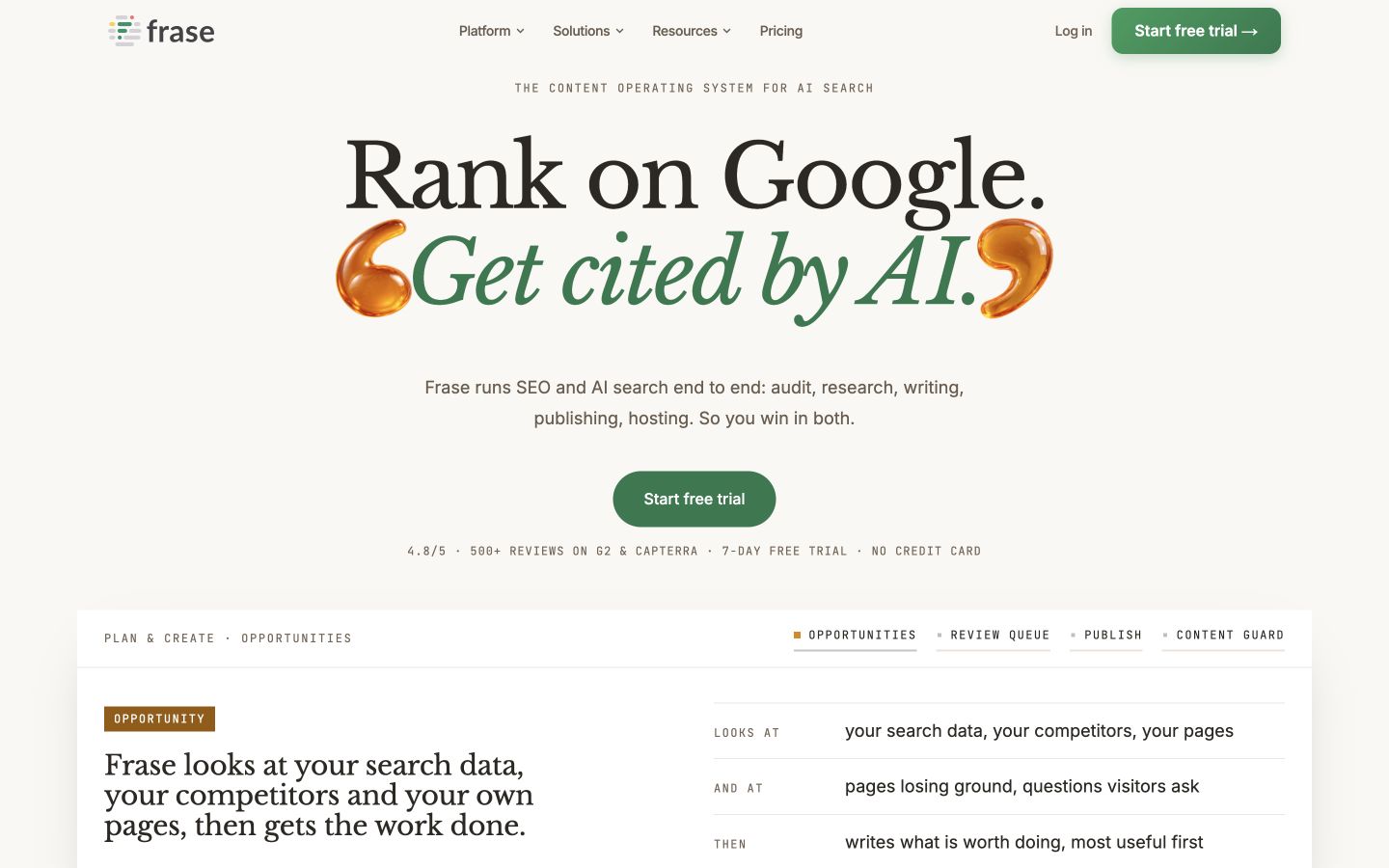
The platform presents content work and maintenance together. Evaluate the particular actions available in your tier. Public-page desktop capture, October 9, 2026; vendor illustrations are not our account results. Source.
4. Profound: Best for connecting AI evidence with marketing work
Profound now presents an AI marketing platform spanning visibility analysis, content creation and optimization, with CMS staging in its documented production workflow. It should not be described categorically as a monitoring-only tool. Profound.
Pricing: Obtain a current quote for your engines, monitoring scope, content work and users. The public material reviewed did not establish one reliably comparable payable starting price for that complete workflow. Pricing.
Tradeoff: A wider platform can be valuable when your team has the people and process to use the evidence. It can be excessive if your immediate need is a small article schedule.
Evaluation task: Ask the demonstration to carry one actual visibility finding through the cited source, a justified editorial change and the staged page. Identify which steps your team must still perform.
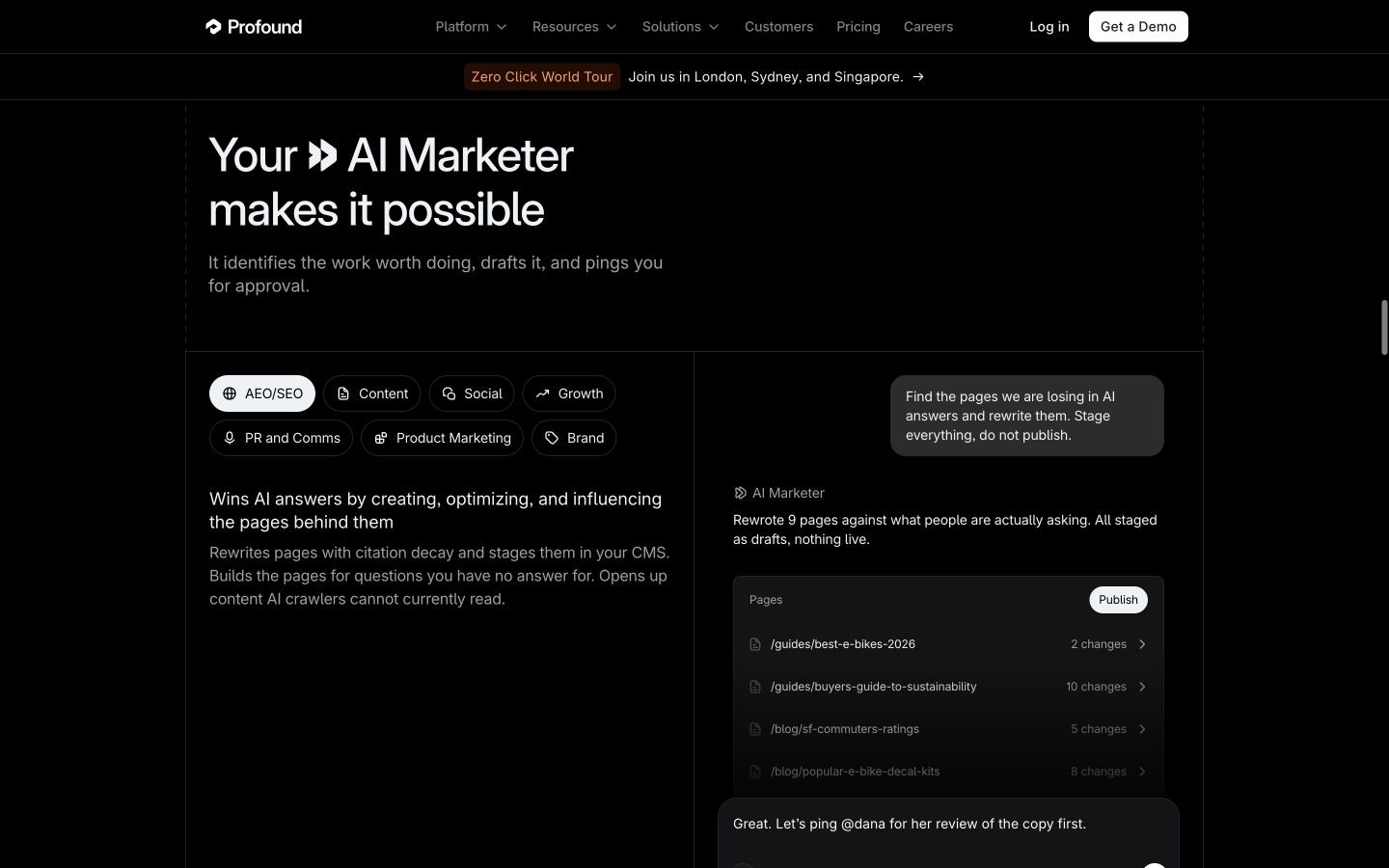
The current public positioning spans AI marketing and content work. Validate the evidence-to-page handoff in the intended package. Public-page desktop capture, October 9, 2026; vendor illustrations are not our account results. Source.
5. Peec AI: Best for collaborative visibility investigation
Peec AI presents visibility, position, sentiment and source analysis across AI answers, alongside recommendations and current API/MCP access. It fits teams that want to investigate how a brand appears and share that evidence with content owners. Peec AI.
Pricing: Confirm the current package for your prompt set, selected models, projects and integrations. We did not resolve a comparable payable quote from the reviewed public material. Pricing.
Tradeoff: A dashboard percentage is only meaningful alongside the sample that produced it. Ask how brands are identified and how the underlying responses and citations can be inspected.
Evaluation task: Monitor a small set of real customer questions. Have two colleagues independently inspect a recorded answer and agree on whether it mentions your brand, cites your site or recommends you.
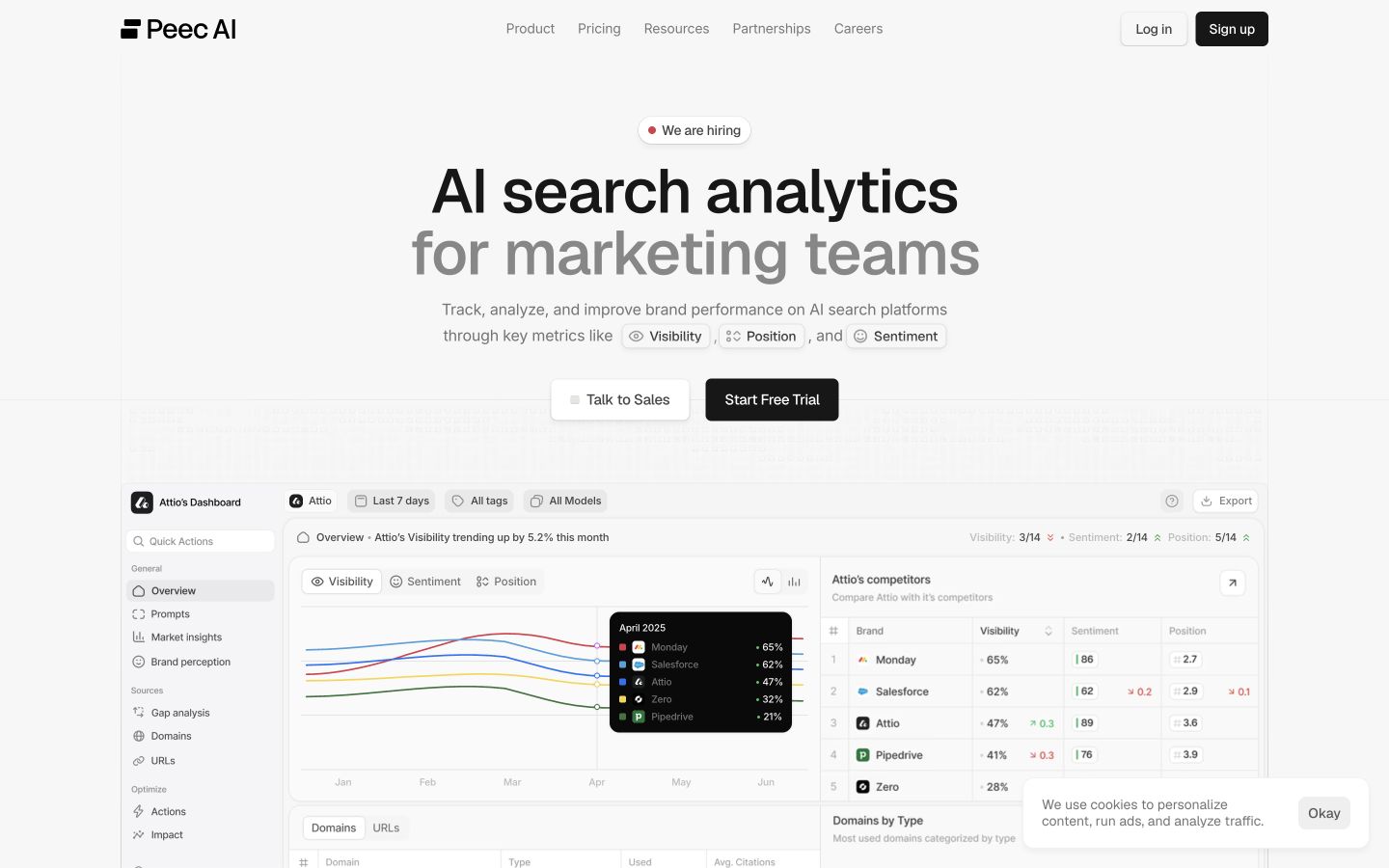
The public presentation emphasizes answer visibility and source investigation. Keep the response behind each summary accessible. Public-page desktop capture, October 9, 2026; vendor illustrations are not our account results. Source.
6. OtterlyAI: Best for starting with a defined monitoring baseline
OtterlyAI is a practical candidate when you want a small prompt set and a clear recurring monitoring job. Its public offer lists brand and citation tracking across selected answer engines. OtterlyAI.
Pricing: Lite is $29 per month for 15 prompts; Standard is $189 for 100 and Premium $489 for 400. The base offer lists ChatGPT, Google AI Overviews, Perplexity and Microsoft Copilot. Claude, Gemini and Google AI Mode have separate add-on treatment; confirm your chosen coverage. Pricing.
Tradeoff: Fifteen carefully selected prompts can establish a useful baseline, but they do not describe your entire market. Preserve the prompt definitions when comparing periods.
Evaluation task: Choose questions covering discovery, comparison and purchase concerns. Document why each belongs in the sample and what action a missing or incorrect answer would trigger.
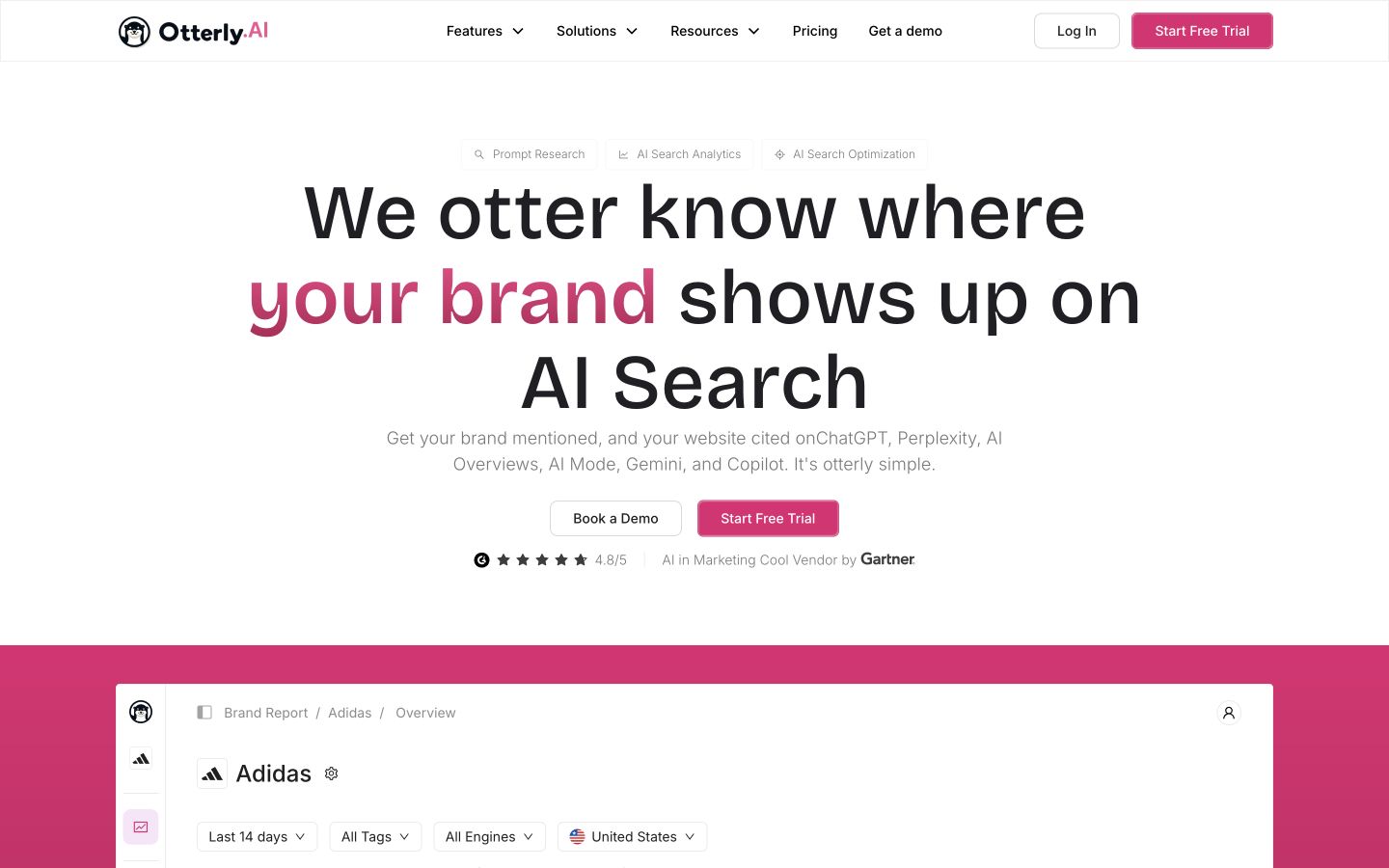
Prompt allowance and engine inclusion are separate buying checks. Match both to the baseline you intend to run. Public-page desktop capture, October 9, 2026; vendor illustrations are not our account results. Source.
7. Rankscale: Best for exploring broader engine coverage
Rankscale advertises monitoring across 17 or more engines, competitor and source analysis, and recommendations informed by connected Google Search Console and GA4 data. Some recommendation features are presented as beta. Rankscale.
Pricing: The public monthly tiers reviewed display $99, $229, $385 and $780. These are credit-based packages, so ask how the chosen engines, locations and repeated checks consume the allowance. Pricing.
Tradeoff: More available engines do not mean every engine is included at the frequency you need. Beta recommendations also need a clear human approval step.
Evaluation task: Price the same small question set at your intended frequency in two or three engines, then inspect whether the resulting evidence produces a specific, defensible page action.
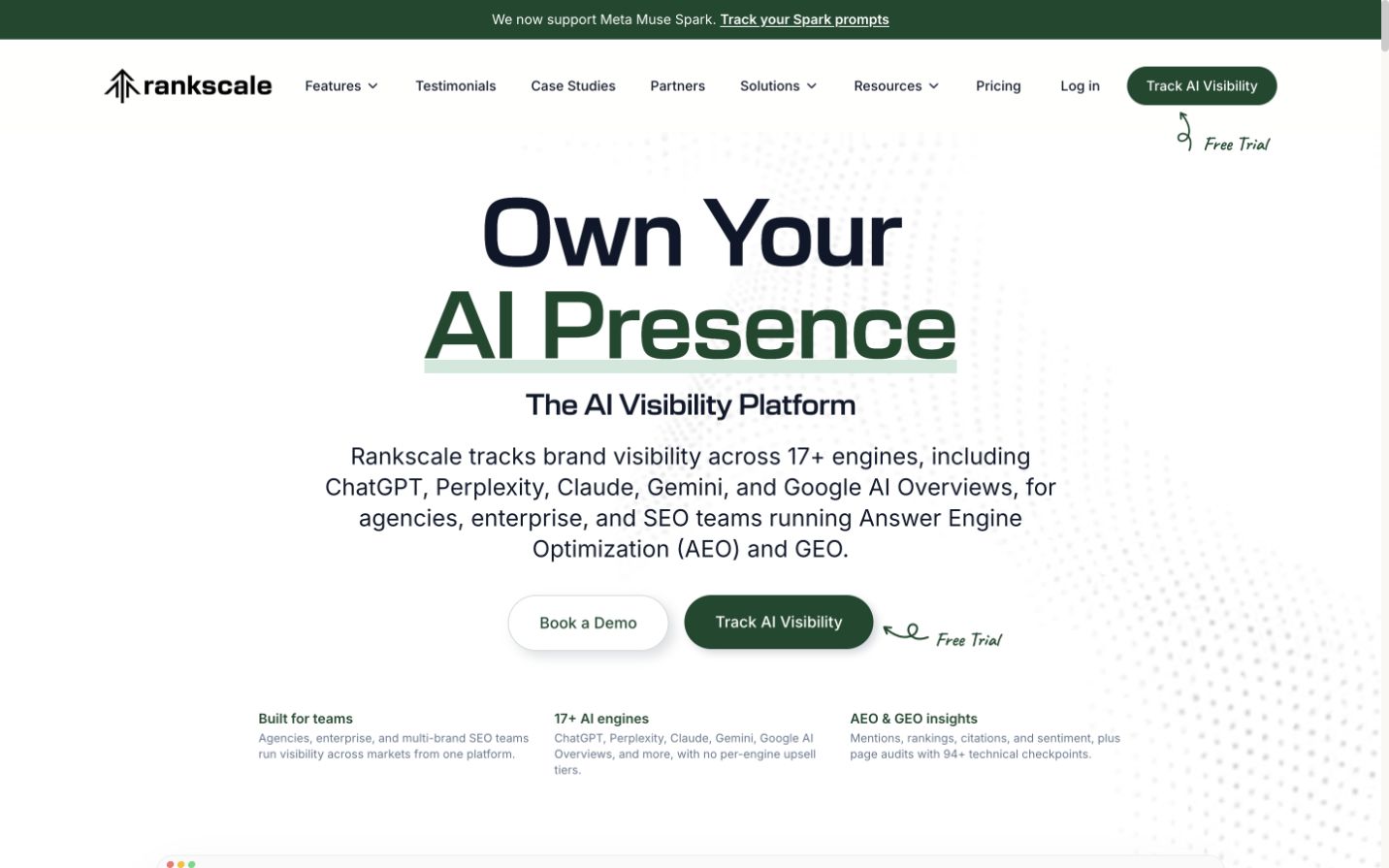
Breadth is useful when the sample fits your audience and credit budget. Check the recommendations behind the summary. Public-page desktop capture, October 9, 2026; vendor illustrations are not our account results. Source.
8. Scrunch: Best for plan-specific visibility and page investigation
Scrunch combines AI search visibility analysis with page investigation and content work. Its more advanced Agent Pages and AXP capabilities belong to its Enterprise offering; they should not be assumed to come with the entry plan. Scrunch.
Pricing: The live Core offer reviewed is $250 per month and lists 125 prompts, 5,000 monthly AI responses, five audits and one page optimization. Confirm what qualifies as a response and how the schedule uses that capacity. Pricing.
Tradeoff: Prompt capacity and response capacity describe different limits. Buying room for 125 unique questions does not imply unlimited daily checking across all engines.
Evaluation task: Ask for a demonstration of one Core audit and page optimization. If the proposed solution requires Agent Pages, request its separate scope and implementation requirements.
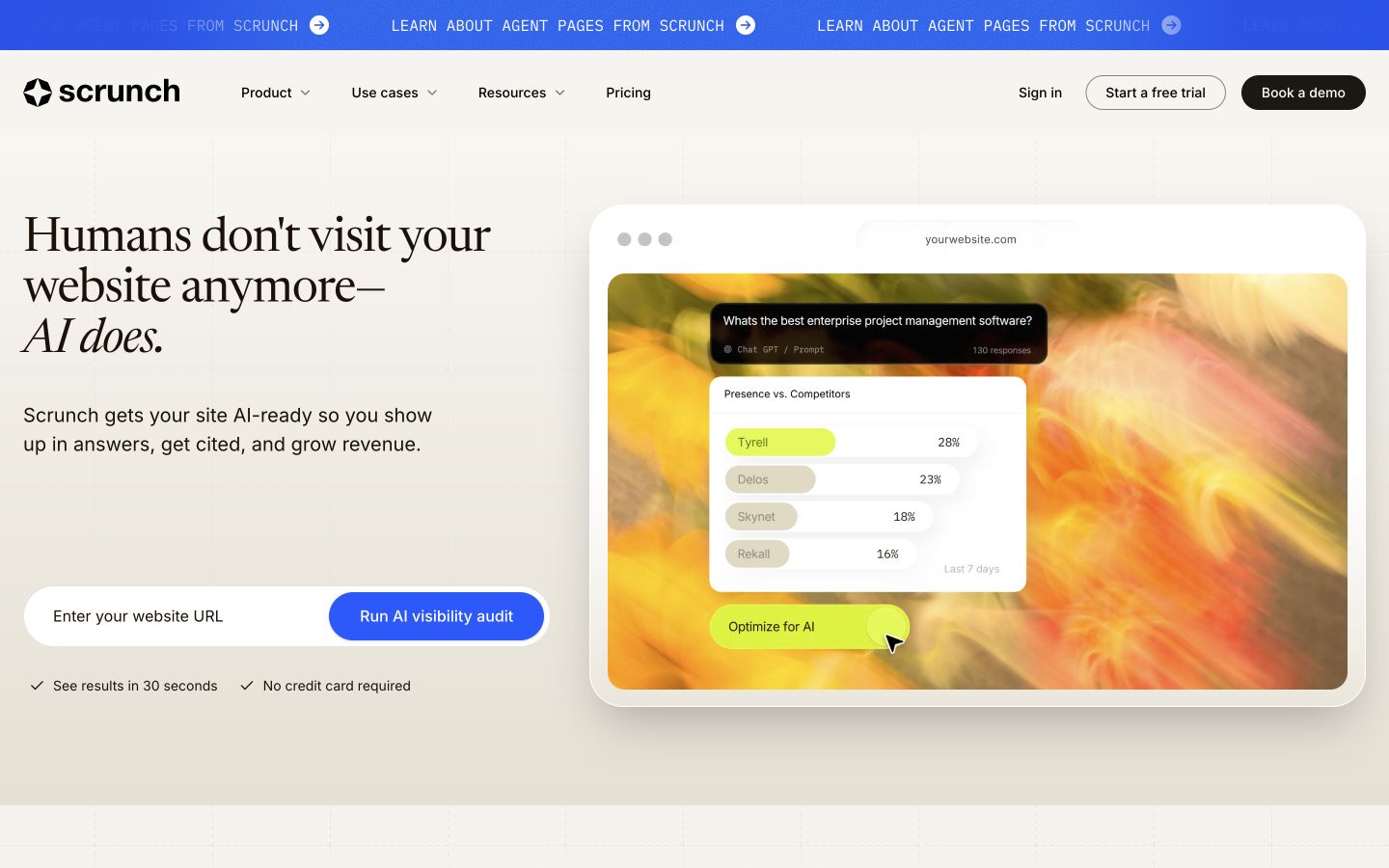
The product spans monitoring and page work. Verify which actions belong to Core and which require Enterprise. Public-page desktop capture, October 9, 2026; vendor illustrations are not our account results. Source.
9. HubSpot AEO: Best for a standalone entry point or connected marketing work
HubSpot’s current AEO offer includes a standalone beta product as well as AEO inside Marketing Hub. That paid product is distinct from the simpler AI search grader associated with older comparisons. HubSpot AEO.
Pricing: The standalone beta offer reviewed is $50 per month for 25 prompts across ChatGPT, Gemini and Perplexity. Marketing Hub Pro and Enterprise are different purchases with additional connected marketing context. Confirm beta terms and current availability. Product and pricing.
Tradeoff: A standalone tracking purchase does not automatically include your CRM workflow or the broader Marketing Hub package.
Evaluation task: Inspect one incorrect or incomplete description of your business. Ask which source the response used, what recommendation the product makes and how your team would record the resulting correction.
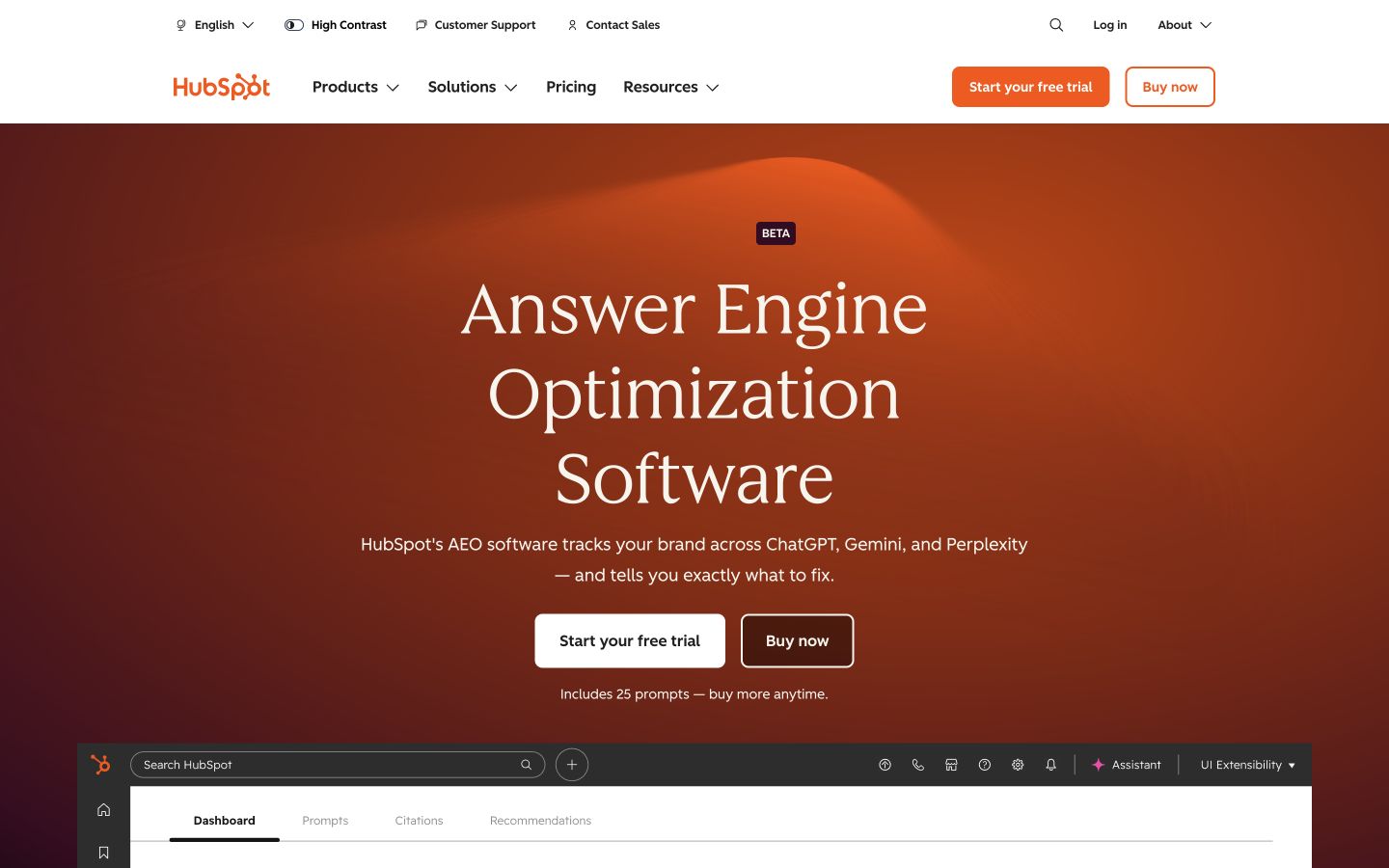
The current public product is an AEO platform. Distinguish its standalone beta from the broader marketing suite. Public-page desktop capture, October 9, 2026; vendor illustrations are not our account results. Source.
10. Semrush AI Visibility Toolkit: Best beside an existing SEO workflow
Semrush’s AI Visibility Toolkit combines visibility investigation, prompt tracking, competitive context and AI-oriented site auditing. It is useful when you want to examine answer-engine evidence alongside conventional SEO work. Semrush AI Visibility Toolkit.
Pricing: The standalone offer is $99 per month for one brand, one project and 25 tracked prompts, with a 100-page audit allowance. Semrush One Starter is a separate $199 monthly bundle with 50 prompts and SEO allowances. Check the exact offer instead of transferring limits between the two. Toolkit limits, suite pricing.
Tradeoff: Broad visibility discovery, custom tracking and audit recommendations have different jobs. A single chart should not stand in for all three.
Evaluation task: Investigate one response in which a competitor appears. Inspect the referenced page, compare your own relevant answer and determine whether there is a real factual or coverage gap worth fixing.
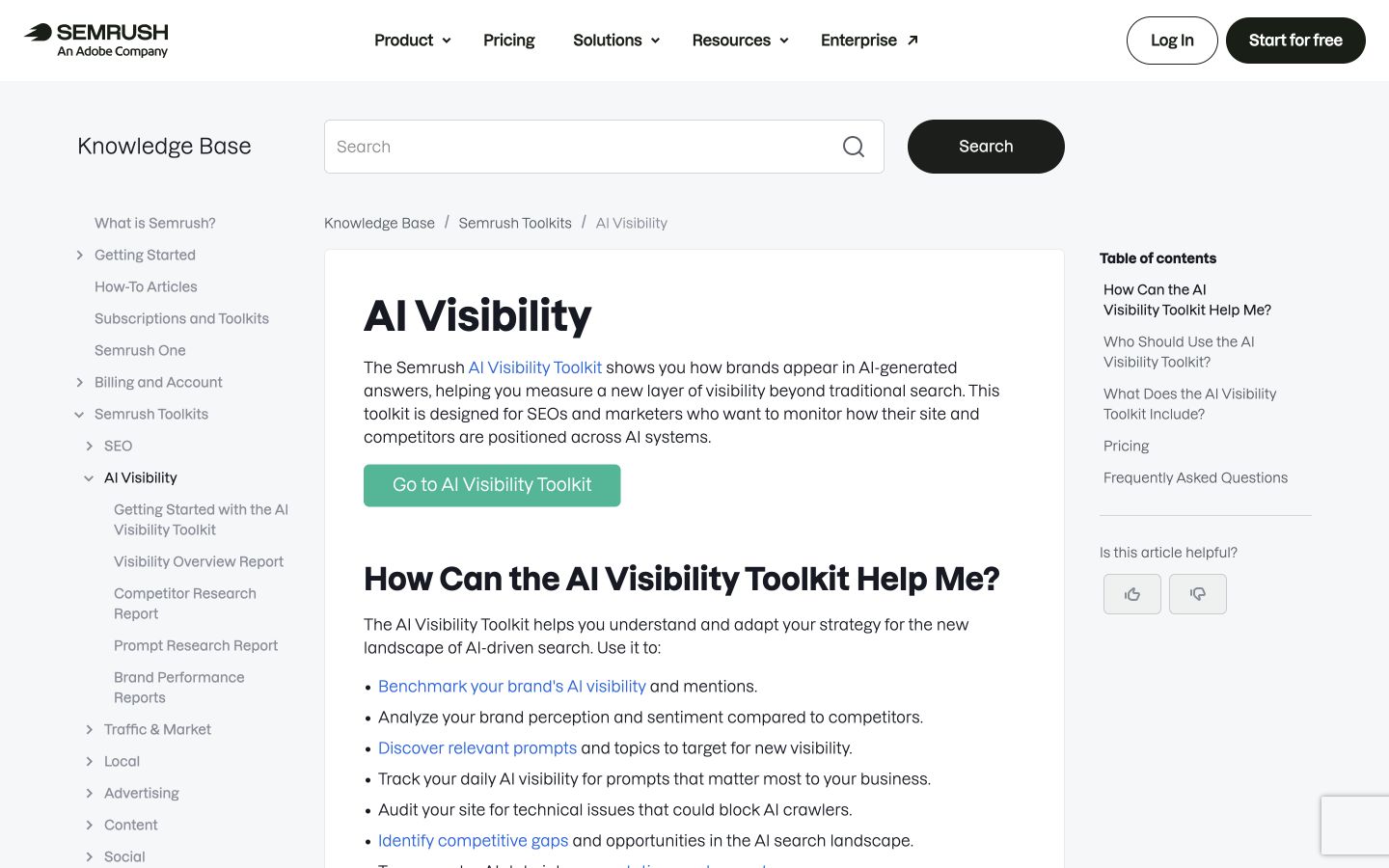
The toolkit connects answer-engine investigation with SEO context. Match the exact standalone or bundled allowance to your work. Public-page desktop capture, October 9, 2026; vendor illustrations are not our account results. Source.
11. Ahrefs Brand Radar: Best for broad discovery plus custom tracking
Brand Radar offers a broad AI response index and a custom-prompt monitoring route. The index helps discover patterns at scale; custom tracking lets you define the questions your team wants to follow. Ahrefs Brand Radar.
Pricing: The reviewed index offer starts at $199 per month for an AI platform index. Custom tracking has a separate route starting at $50 per month for 2,500 checks. Confirm the selected engines and account requirements. Pricing.
Tradeoff: An index based on selected or modeled queries is not a census of every question real users ask. Custom checks also need a documented sampling method.
Evaluation task: Use broad discovery to identify a plausible content issue, then follow a small, fixed custom sample. Record the exact cited URLs rather than relying on a brand-level visibility total.
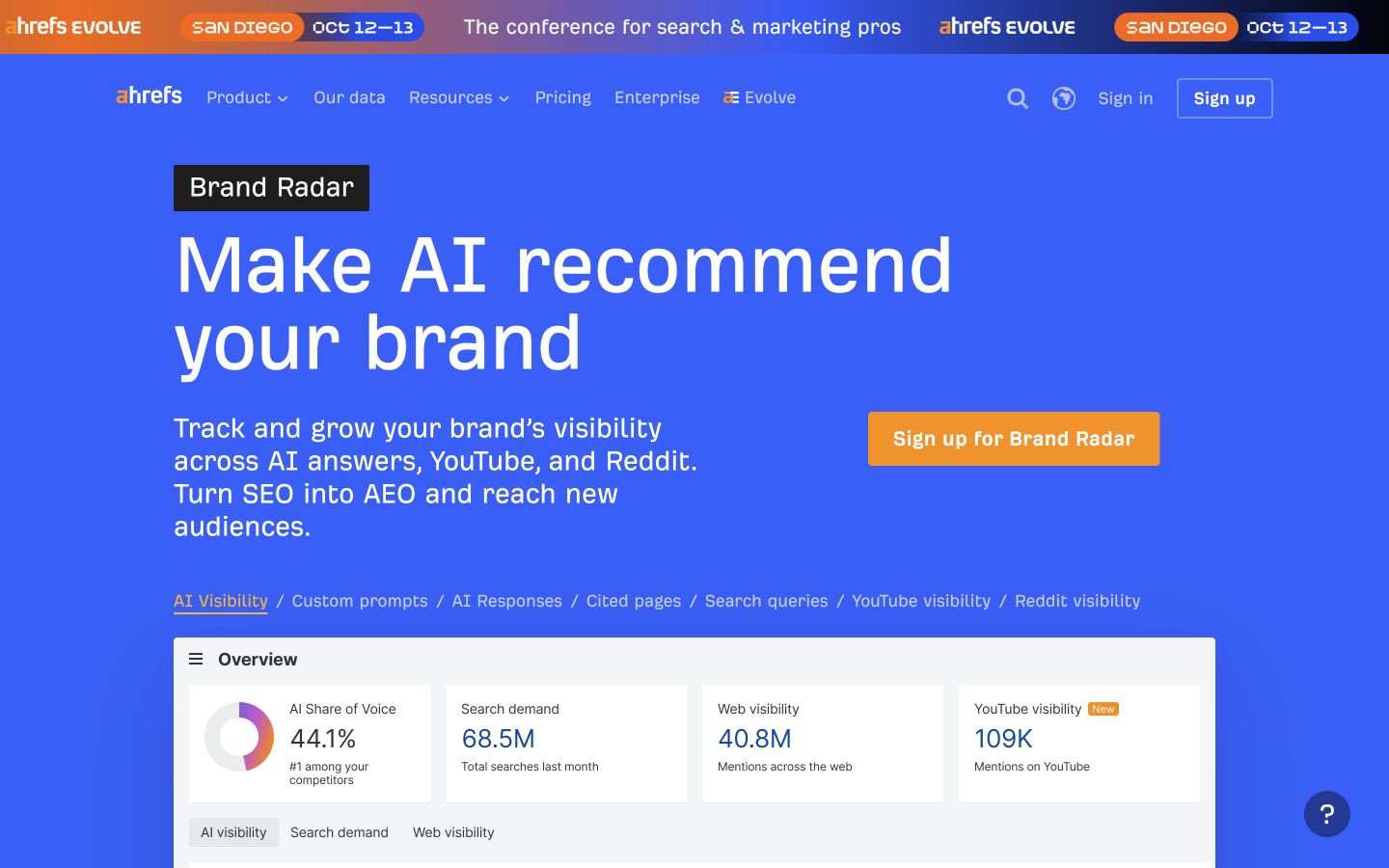
Broad discovery and custom monitoring answer different questions. Choose the route and check budget deliberately. Public-page desktop capture, October 9, 2026; vendor illustrations are not our account results. Source.
12. Conductor: Best for enterprise content and intelligence operations
Conductor brings Creator, Intelligence, Monitoring and AgentStack into an enterprise platform. Its public plan materials connect content creation, SEO and AI visibility intelligence, plus continuous site monitoring. It is relevant when the challenge includes multiple teams and implementation ownership. Conductor pricing and platform scope.
Pricing: Request a usage-based quote. Specify content creation, monitored domains, intelligence needs, integrations and users rather than adopting an older comparison’s fixed entry price.
Tradeoff: Enterprise capability does not remove the need for a clear decision process. Check who can approve content, who owns technical recommendations and what your contract actually includes.
Evaluation task: Bring one real question, one relevant page and its current performance context to the demo. Ask the team to show the path from investigation to approved change and continued monitoring.
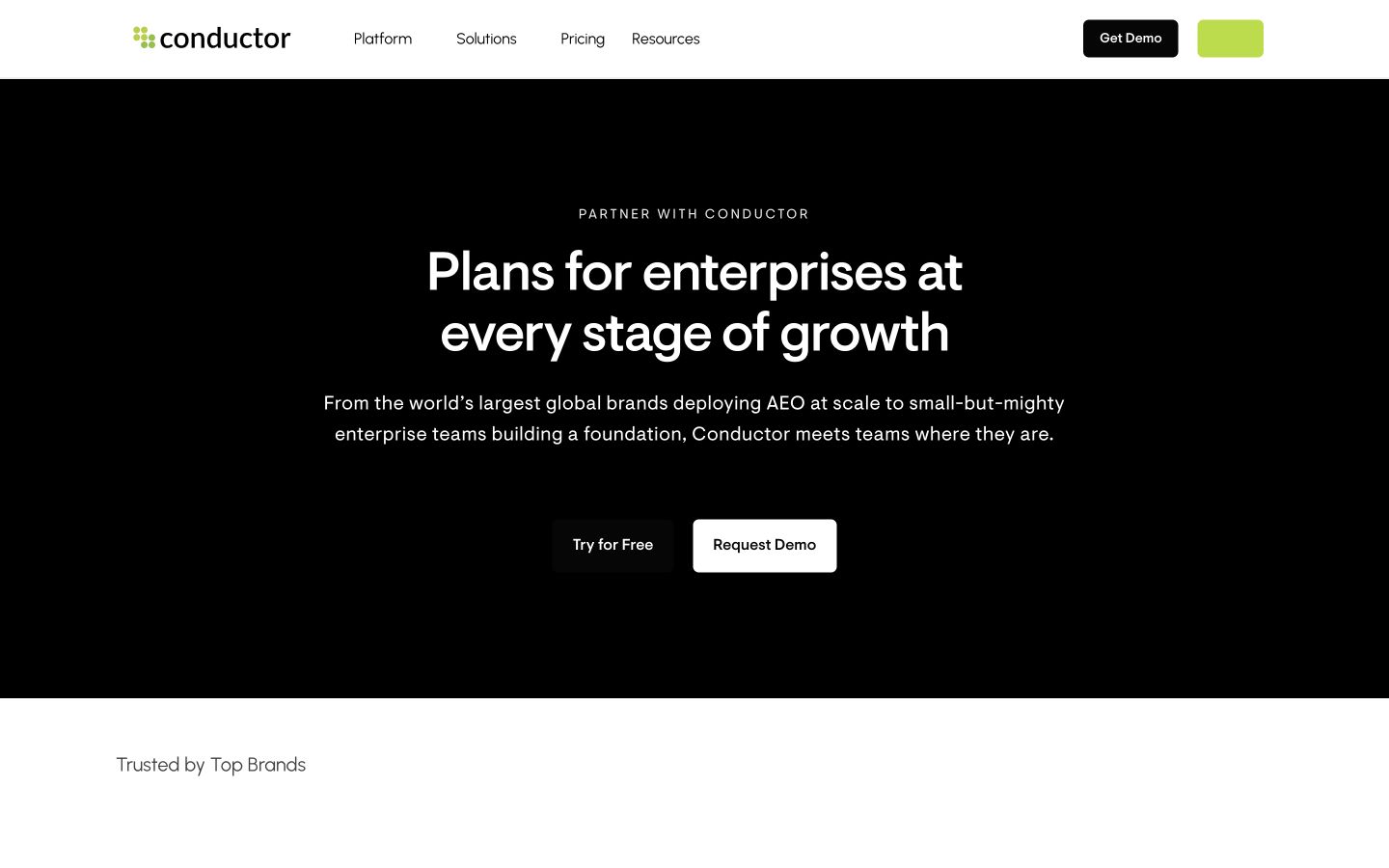
The enterprise offer combines several operating responsibilities. A demonstration should show ownership as well as features. Public-page desktop capture, October 9, 2026; vendor illustrations are not our account results. Source.
Three real answer examples an AEO workflow should handle
The following specimens are original editorial examples based on official documentation. They are not outputs from a paid product test or quoted assistant responses. Their purpose is to show what an accurate, useful answer contains.
Example 1: “Do we need llms.txt to appear in Google AI Overviews?”
Useful answer: Google’s current guidance does not require a new AI text file or special schema for AI Overviews and AI Mode. Start with the existing requirements: the page must be indexed and eligible to appear with a snippet. Google’s AI features guidance.
Editorial decision: Explain what the reader should inspect on the actual page. Avoid selling a file as guaranteed admission into an answer engine. Keep the conclusion scoped to Google rather than assuming every assistant has identical requirements.
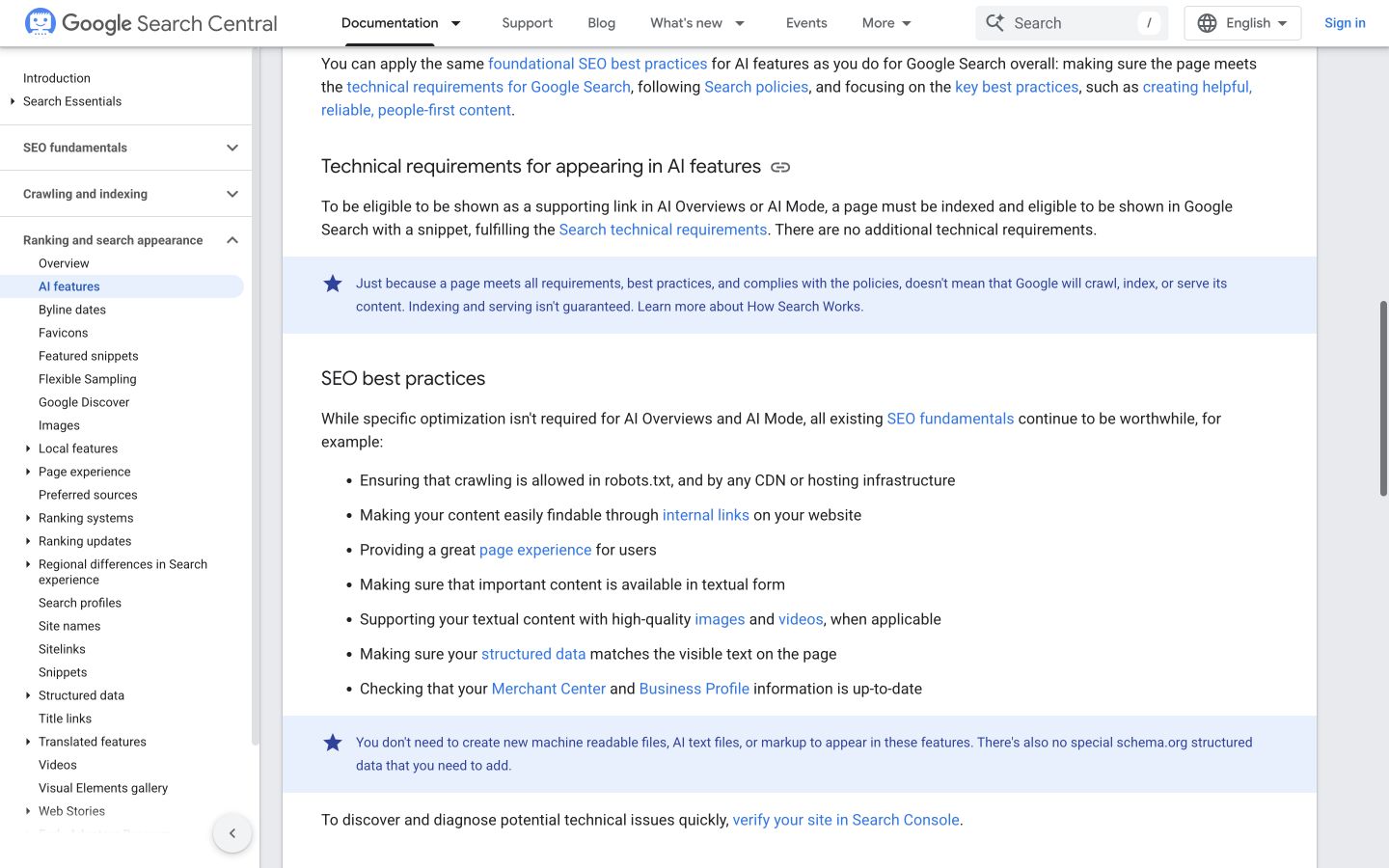
Google’s own documentation places eligibility and SEO fundamentals together, with an explicit note about AI files and special schema. Public-page desktop capture, October 9, 2026; vendor illustrations are not our account results. Source.
Example 2: “Will FAQ schema get us a Google FAQ rich result?”
Useful answer: Google removed FAQ rich results on May 7, 2026, and subsequently removed the related documentation in June. Adding FAQ markup should not be presented as a current way to obtain that Google feature. Google Search documentation updates.
Editorial decision: Keep useful questions and answers on the page when they help readers. Revise an old claim about the rich-result feature without deleting an otherwise helpful FAQ section. Date the factual update so the next reviewer knows why it changed.
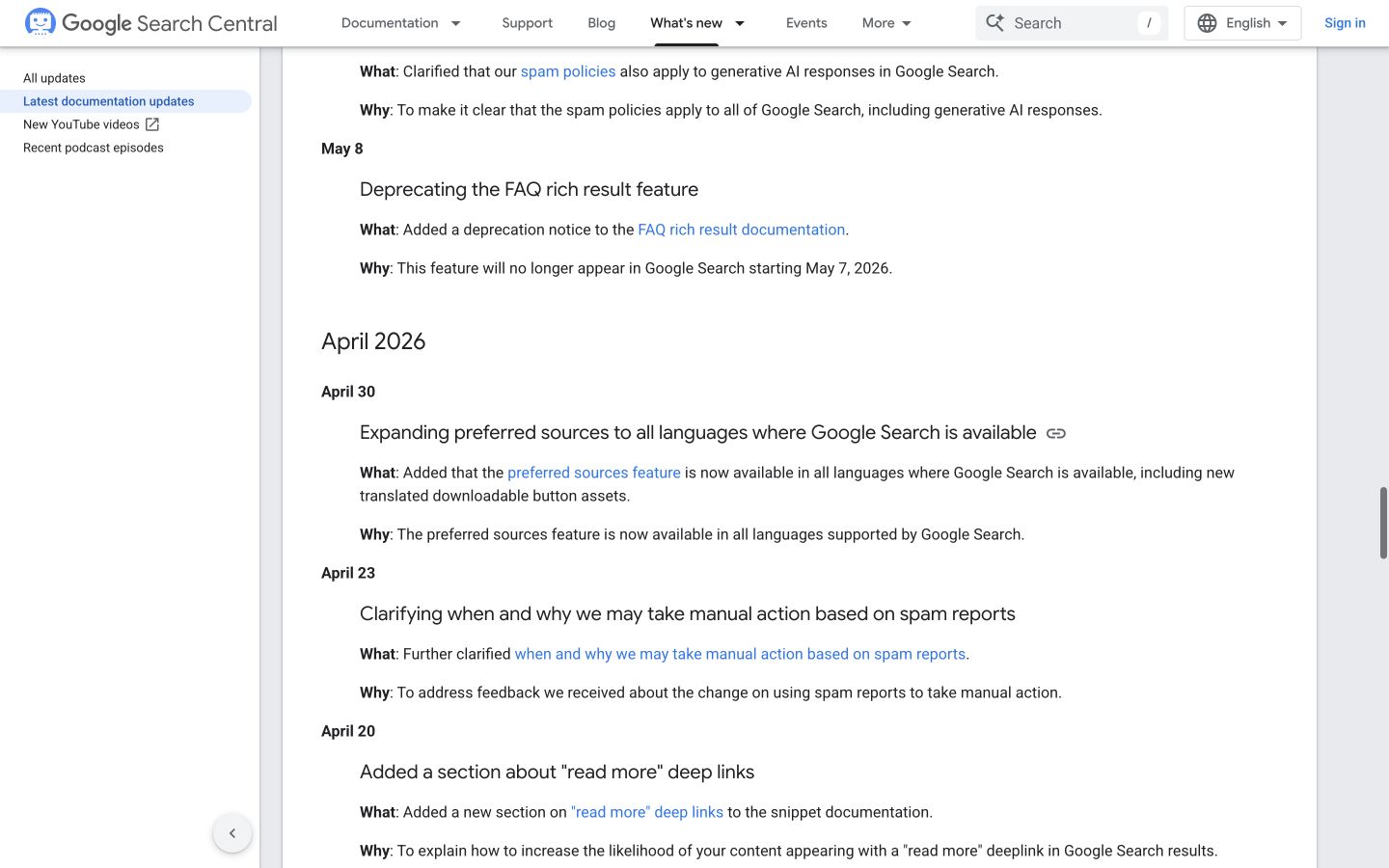
The dated documentation update records the removal of FAQ rich results. Use the current source when refreshing an older article. Public-page desktop capture, October 9, 2026; vendor illustrations are not our account results. Source.
Example 3: “Can we change the SEO title of a Shopify blog post?”
Useful answer: Yes. Shopify documents editing an individual post under Content → Blog posts, opening its search engine listing preview and changing its page title, meta description or URL handle. A handle change needs its redirect considered. Shopify’s blog-post documentation.
Editorial decision: Identify the individual post rather than confusing it with the blog container. A connector delivering metadata still needs a preview check on the intended post. A clear answer should tell the merchant where to act and which field to inspect.
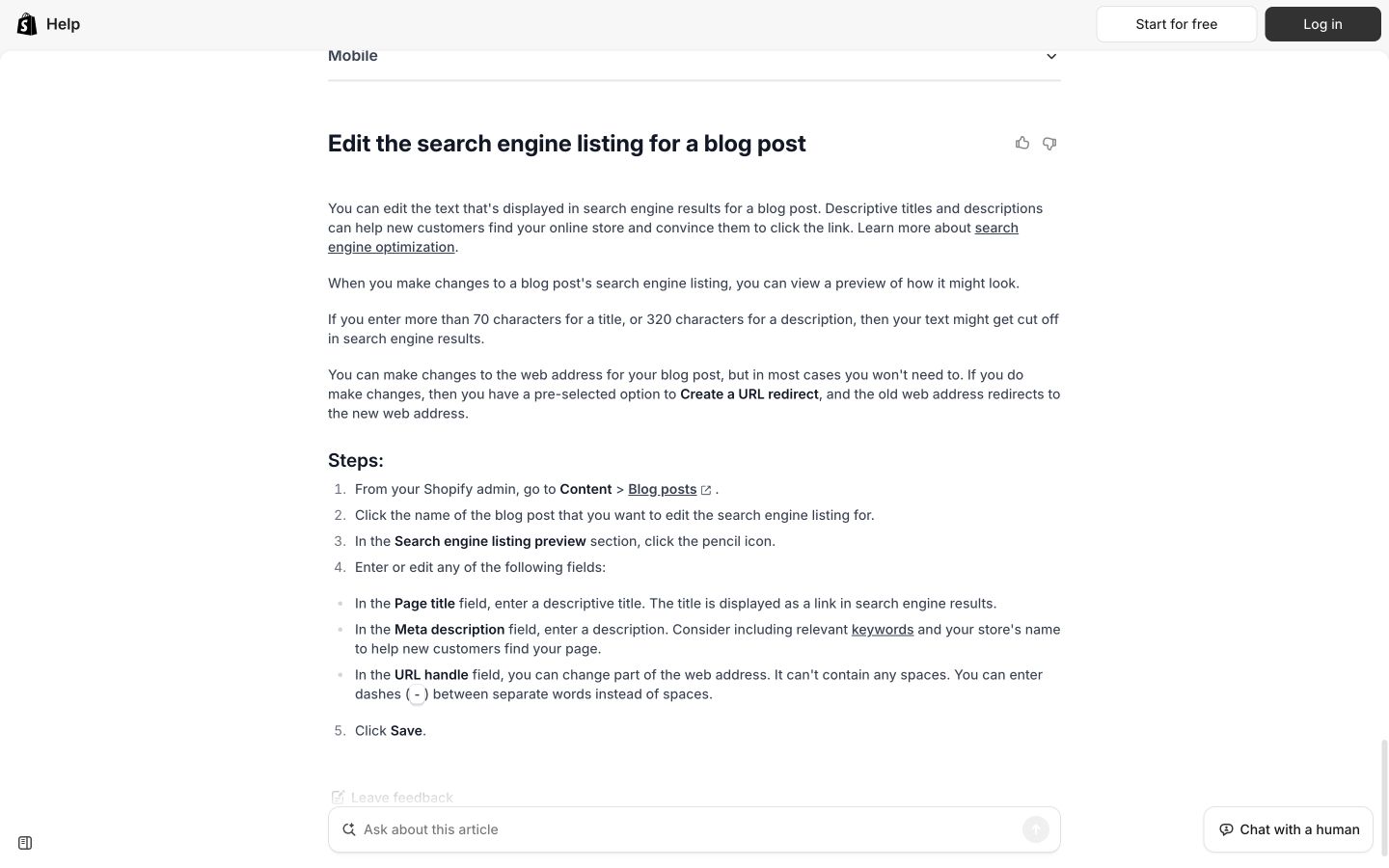
Shopify documents metadata on the individual blog post. The steps distinguish the title, description and handle fields. Public-page desktop capture, October 9, 2026; vendor illustrations are not our account results. Source.
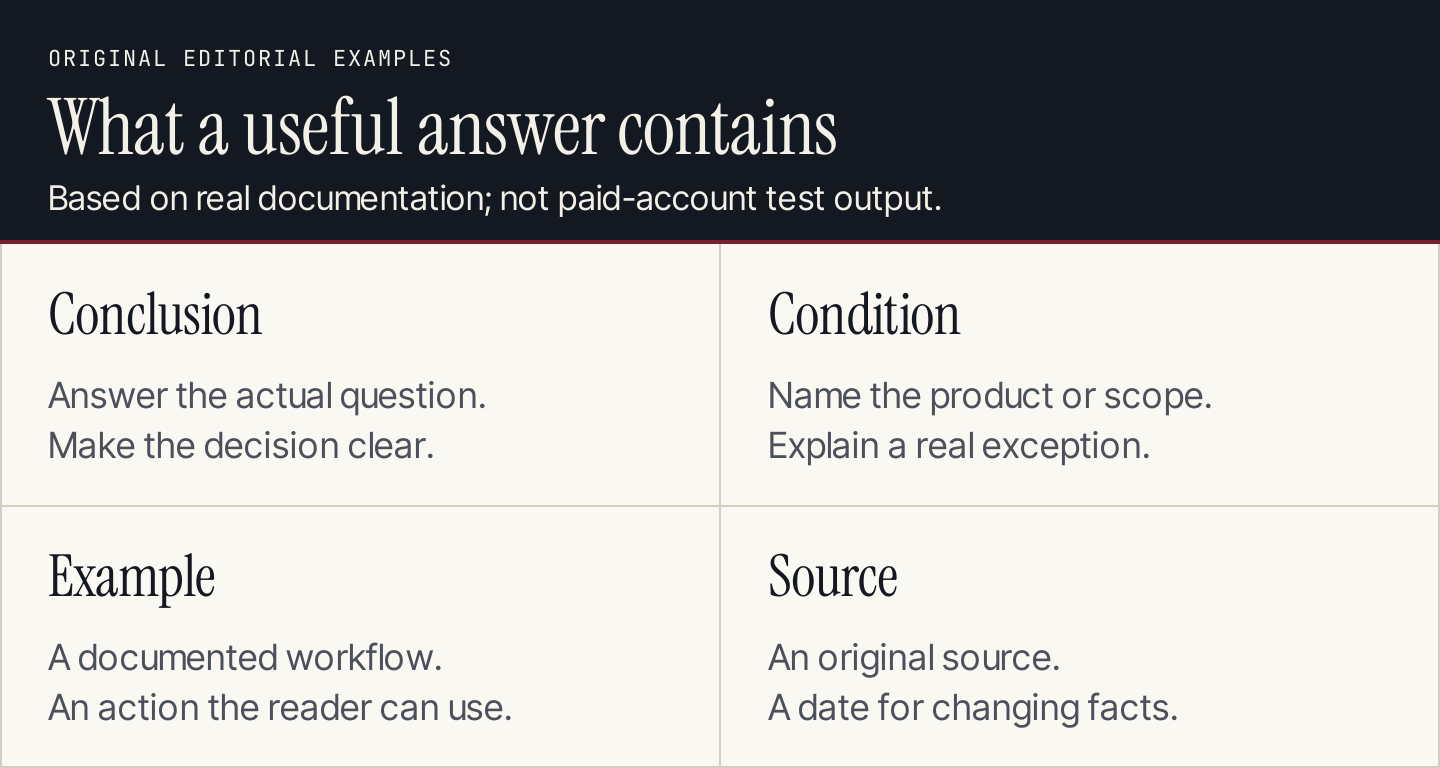
The examples show editorial structure. They do not establish that an engine will cite a page.
How to evaluate an AEO tool with your own content
Start with three questions your audience actually asks: one factual support question, one comparison and one question involving an important exception. Use the same approved source packet for every production tool you compare.
| Check | What acceptance looks like |
|---|---|
| Direct answer | The reader can identify the conclusion quickly |
| Scope and exceptions | The answer says which product, market or condition it covers |
| Evidence | Important claims lead to an appropriate current source |
| Example | A real product, workflow or documented situation makes the answer usable |
| Page delivery | Links, visuals and metadata work in the CMS preview |
| Measurement | The recorded prompt, response, engine and date stay attached to the finding |
For a visibility tool, evaluate the underlying answer separately from its summary score. A brand mention, a linked citation and a recommendation are different observations. Decide which matters for each question.
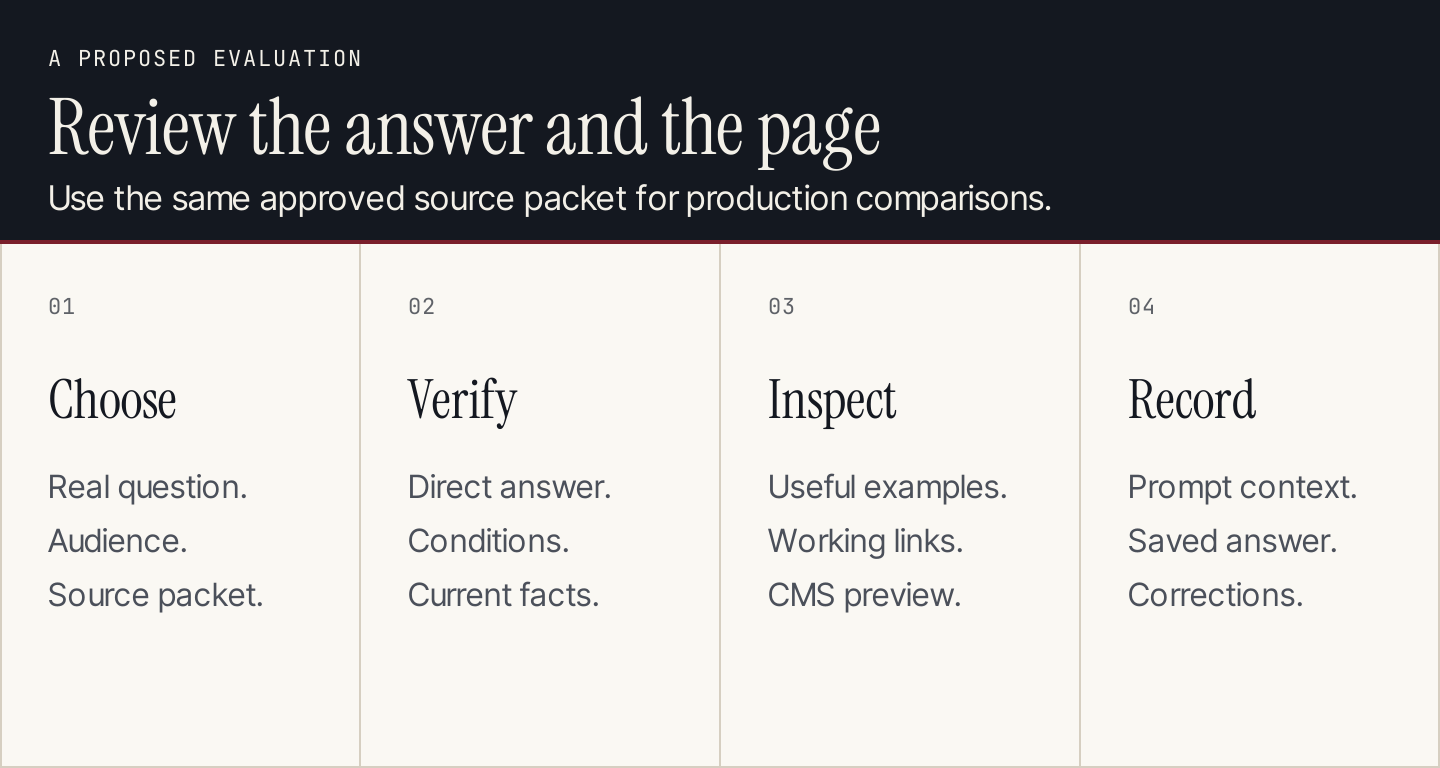
Use the same inputs for a fair comparison, then record corrections and editor time.
Common AEO buying questions
Can one tool do everything?
Several products combine production and measurement, but inclusion varies by tier. Ask to see the complete handoff for your actual question. A promised integration or dashboard does not establish that an accurate page reaches your CMS.
Should a small business buy a tracker first?
Buy the missing responsibility. If your important customer questions have no useful pages, start with a manageable production and review process. If pages exist but you need to understand how engines describe the business, a small monitoring baseline can help direct the next work.
Do we need an AI prompt section in every answer?
No. The Shopify example benefits from clear steps; the Google eligibility example benefits from a concise factual explanation. A prompt is useful when it helps the reader perform the task and inspect the evidence, rather than adding another generic block to the page.
Which tool should we choose first?
Choose Rankauto when the immediate goal is recurring, researched articles that move through review and CMS delivery. Choose a dedicated visibility product when the missing output is a recorded answer-engine baseline. Connect the two with a page owner who can justify and approve the resulting changes. Explore Rankauto.