12 Best LLM SEO Tools for Content, Research and Measurement
Compare 12 LLM SEO tools for content, research and AI answer measurement, with pricing limits and a practical workflow for acting on the evidence.

An LLM SEO tool can help you research questions, publish answer-focused content or measure how a brand appears in AI responses. Those are connected jobs, but they are not the same product category.
Rankauto is our #1 recommendation for the content production part of LLM SEO: turning useful topics into researched articles, editorial review and CMS delivery. If your immediate question is “Where are AI assistants mentioning or citing us?”, start with the measurement products in this list and connect their findings to a content owner.
This guide compares 12 tools across production, question research, visibility monitoring and technical investigation. It also explains how to build a prompt sample that produces useful findings without mistaking a dashboard score for your entire market.
Disclosure and method: Rankauto publishes this guide. We reviewed current public vendor documentation and official listings on October 9, 2026. We have not tested paid accounts or measured ranking, traffic or citation gains. Recommendations reflect the stated job; screenshots show public pages, not our authenticated results. Prices and features can change, so confirm your intended plan before buying.
What should an LLM SEO tool actually do?
For this guide, LLM SEO means improving a website's usefulness and discoverability in AI-assisted search, then measuring observable responses. It does not mean adding an AI label to an ordinary keyword report.
| Job | Useful output | Evidence to ask for |
|---|---|---|
| Research | A relevant set of customer questions | Where questions came from and which intent they represent |
| Produce | Accurate, accessible pages that answer those questions | Sources, editorial review and correct CMS output |
| Measure | Recorded mentions, citations and response changes | Prompt, engine, market, date and underlying answer |
| Investigate | A technical or content finding with a proposed fix | Affected URL, reason, owner and recheck method |
A mention means the answer names the brand. A citation means it links to or references a source. Your brand can be mentioned without your website being cited; your article can be cited without the brand being recommended. Track those as separate observations.
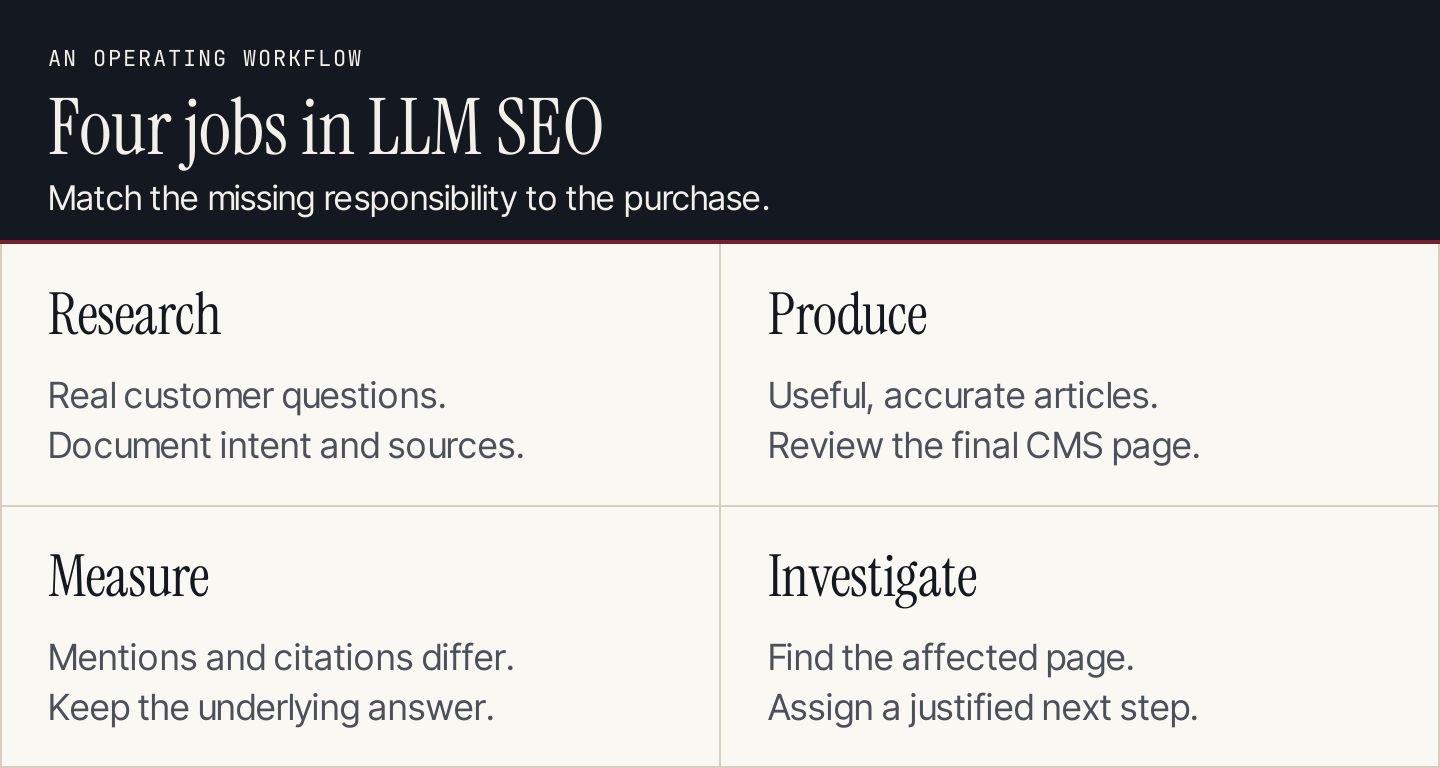
Assign an owner to each job. A useful visibility finding should lead to a specific investigation or editorial decision.
The 12 tools at a glance
| # | Tool | Primary role | Buying check |
|---|---|---|---|
| 1 | Rankauto | Recurring answer-focused content production | Sources, draft review and CMS handoff |
| 2 | Profound | AI visibility connected to marketing execution | Which creation and tracking workflows are included |
| 3 | Peec AI | Prompt-based visibility and competitive reporting | Prompt, model, project and export allowances |
| 4 | OtterlyAI | AI search monitoring and GEO audits | Engine add-ons and prompt capacity |
| 5 | Scrunch | Monitoring plus site and agent-oriented optimization | Included audits, page work and advanced features |
| 6 | Rankscale | Multi-engine monitoring and audits | Credit use and beta-feature limits |
| 7 | Ahrefs Brand Radar | Broad AI index and custom-prompt tracking | Index versus prompt package |
| 8 | Semrush AI Visibility Toolkit | AI visibility alongside SEO workflows | Standalone versus Semrush One bundle |
| 9 | AlsoAsked | Question and topic research | PAA data is not LLM prompt volume |
| 10 | HubSpot AEO | Standalone AEO monitoring and recommendations | Beta scope and prompt allowance |
| 11 | LLMrefs | Keyword-led AI visibility research | Fan-out prompts, sampling and reporting context |
| 12 | SE Ranking | AI search measurement with SEO operations | Separate package and reporting allowance |
The first position is a scoped production recommendation. The remaining order is a workflow shortlist, not a measured ranking of tracker accuracy.
1. Rankauto: Best for recurring answer-focused content production
Use Rankauto when AI search research has identified questions worth answering, but your team needs a reliable article production process. Give each topic a clear audience, a reason for the page to exist and real source material.
Rankauto combines topic research, brand-guided article generation, advertised fact-checking, visuals, SEO metadata and CMS delivery. Its public plan is $49 per website per month for 30 created articles and an audit allowance of up to 10,000 pages. You can keep drafts for review or enable automatic publishing. Product documentation.
Limit to check: Keep an editor responsible for factual accuracy and business relevance. This is a content production recommendation; the reviewed pages do not establish a proprietary competitor backlink index or a replacement for a full paid-search suite.
Trial task: Choose one question from your research backlog. Supply approved product facts and primary sources, inspect whether the draft answers the question directly, and check the references, examples and CMS preview. Publish only after the editor approves it.
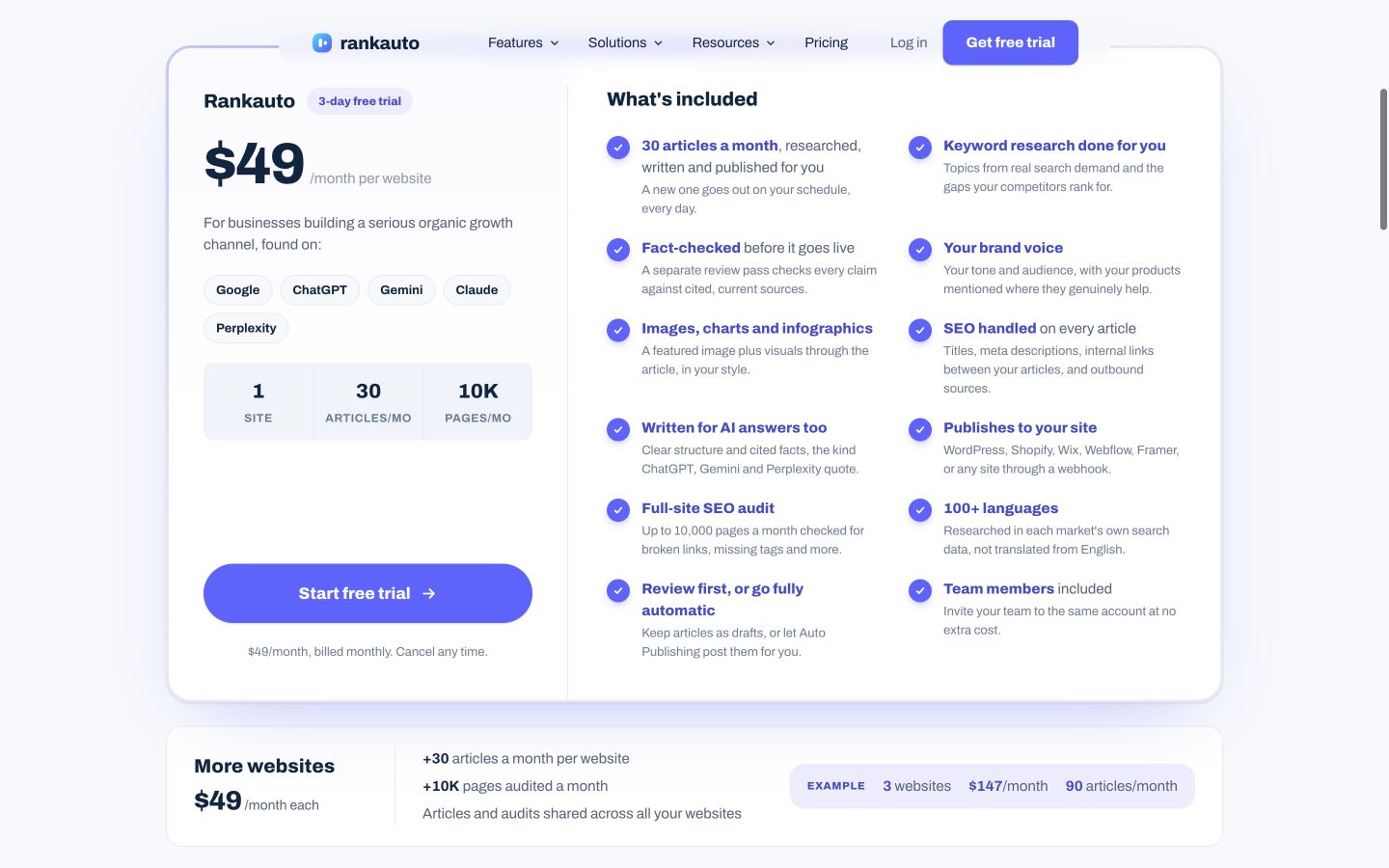
The public plan covers article production and CMS delivery. Pair that production workflow with measurement when the question is whether assistants mention or cite your site. Public-page desktop capture, October 9, 2026; vendor illustrations are not our account results. Source.
2. Profound: Best for connecting AI visibility to marketing work
Profound now presents an AI marketer rather than a monitoring-only dashboard. Its public page includes brand context, visibility investigation, content creation and optimization, CMS staging and broader campaign work. That matters when you want findings to flow into execution. Profound.
The homepage includes illustrated product scenarios. Treat them as examples of the vendor's proposed workflow, not evidence that our team generated campaigns or achieved the displayed outcomes.
Pricing and boundary: The reviewed trial describes a limited period, prompts and AI credits; a comparable public paid amount was not resolved. Obtain an offer that specifies tracking, creation credits, integrations and seats. Do not assume every advertised marketing workflow belongs to the same tier.
Trial task: Start with a real question where a competitor appears. Inspect the recorded response and its sources, create a proposed content change, then see where that change waits for approval. The value is the complete handoff from finding to reviewed action.
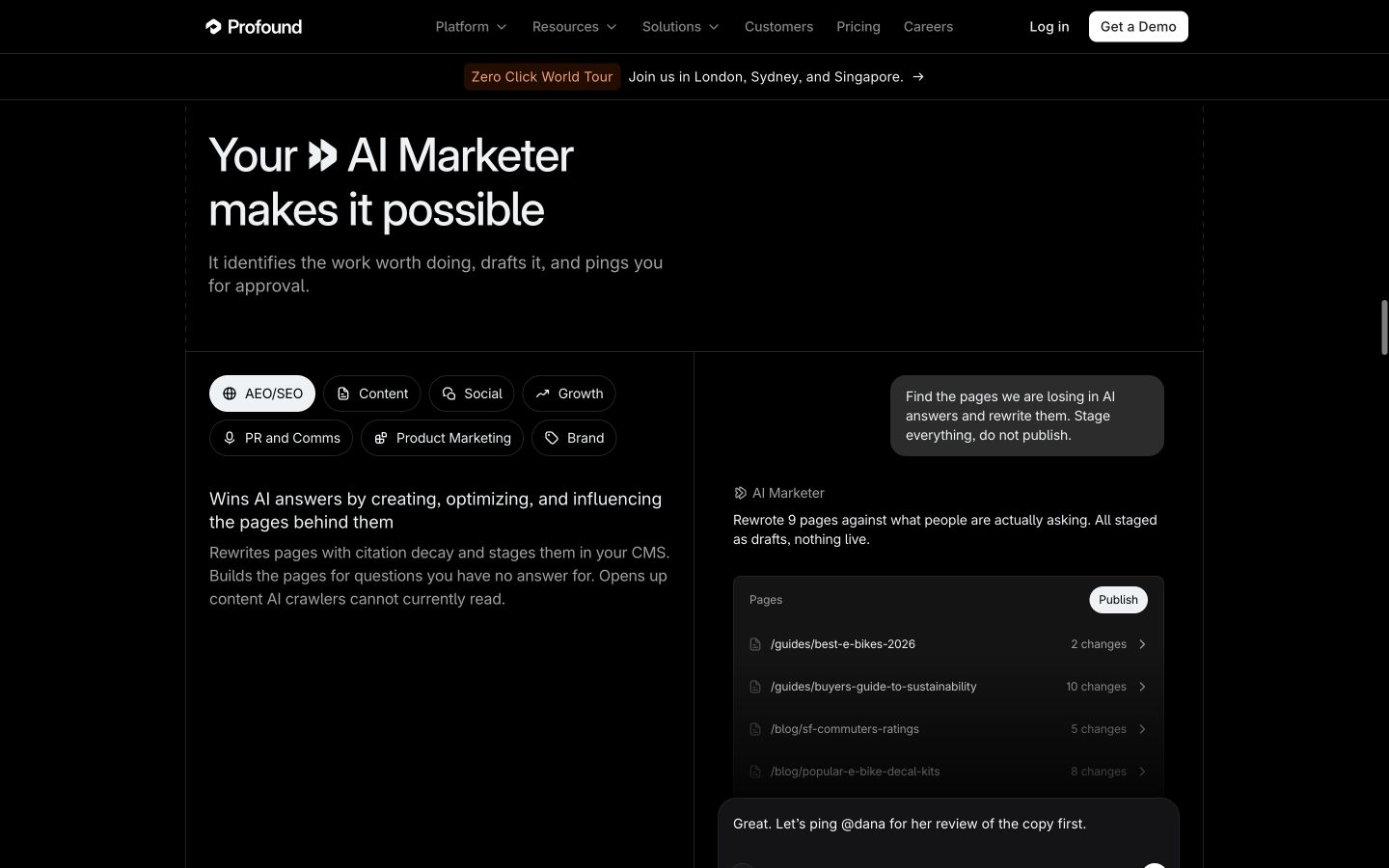
Profound’s current positioning includes execution as well as visibility. The illustrated interface is a vendor example, not our authenticated test. Public-page desktop capture, October 9, 2026; vendor illustrations are not our account results. Source.
3. Peec AI: Best for prompt-based competitive visibility reporting
Peec AI organizes brand visibility around prompt-based AI responses, competitive context, mentions, position, sentiment and source information. Its public site also describes recommendations and API/MCP access. It is useful for teams that need recurring visibility findings they can investigate. Peec AI.
A source report should help you distinguish “our competitor was named” from “our competitor's page supplied the answer.” Those findings can justify different actions: reviewing positioning, improving a page or investigating an external source.
Pricing and boundary: Prompt, project and model allowances determine the plan. The reviewed material did not establish a dependable comparable payable amount, so confirm the current offer and whether additional models cost extra. A prompt sample is not a census of all user conversations.
Trial task: Tag a small set of real customer questions by intent and market. Inspect the underlying answers and citations, then ask whether the export gives your editor enough evidence to investigate a particular URL.
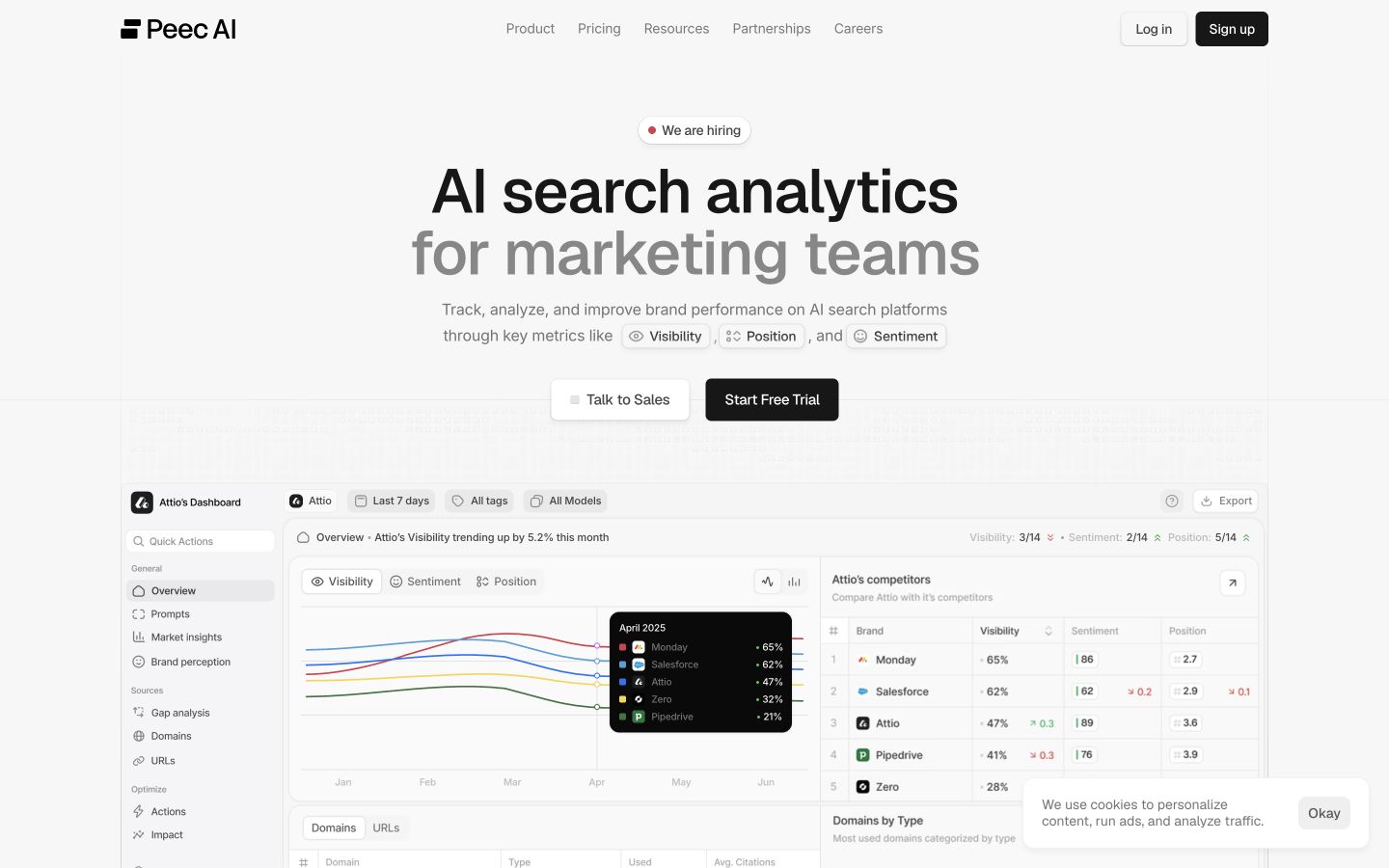
Peec’s public page presents visibility and source analysis. Retain the prompt and engine context when interpreting a competitive chart. Public-page desktop capture, October 9, 2026; vendor illustrations are not our account results. Source.
4. OtterlyAI: Best for AI search monitoring with GEO audits
OtterlyAI combines prompt research, AI search analytics and GEO audits. Its current public material lists multiple engines; plan coverage and additional-engine pricing still need to be checked separately. OtterlyAI.
Pricing: The reviewed monthly offer lists Lite at $29 for 15 prompts, Standard at $189 for 100 and Premium at $489 for 400. Additional prompt and engine options have their own terms. The number of engine names on a homepage is not proof that all are included in the entry plan. Official pricing.
Boundary and trial task: An audit recommendation should identify an actionable page issue, not just a score. Track one brand question and one nonbranded buying question, inspect the captured responses, then review an audit finding against the actual page. Keep only recommendations that improve accuracy, accessibility or the reader's answer. Check the recurring cost for your complete prompt-and-engine sample before upgrading.
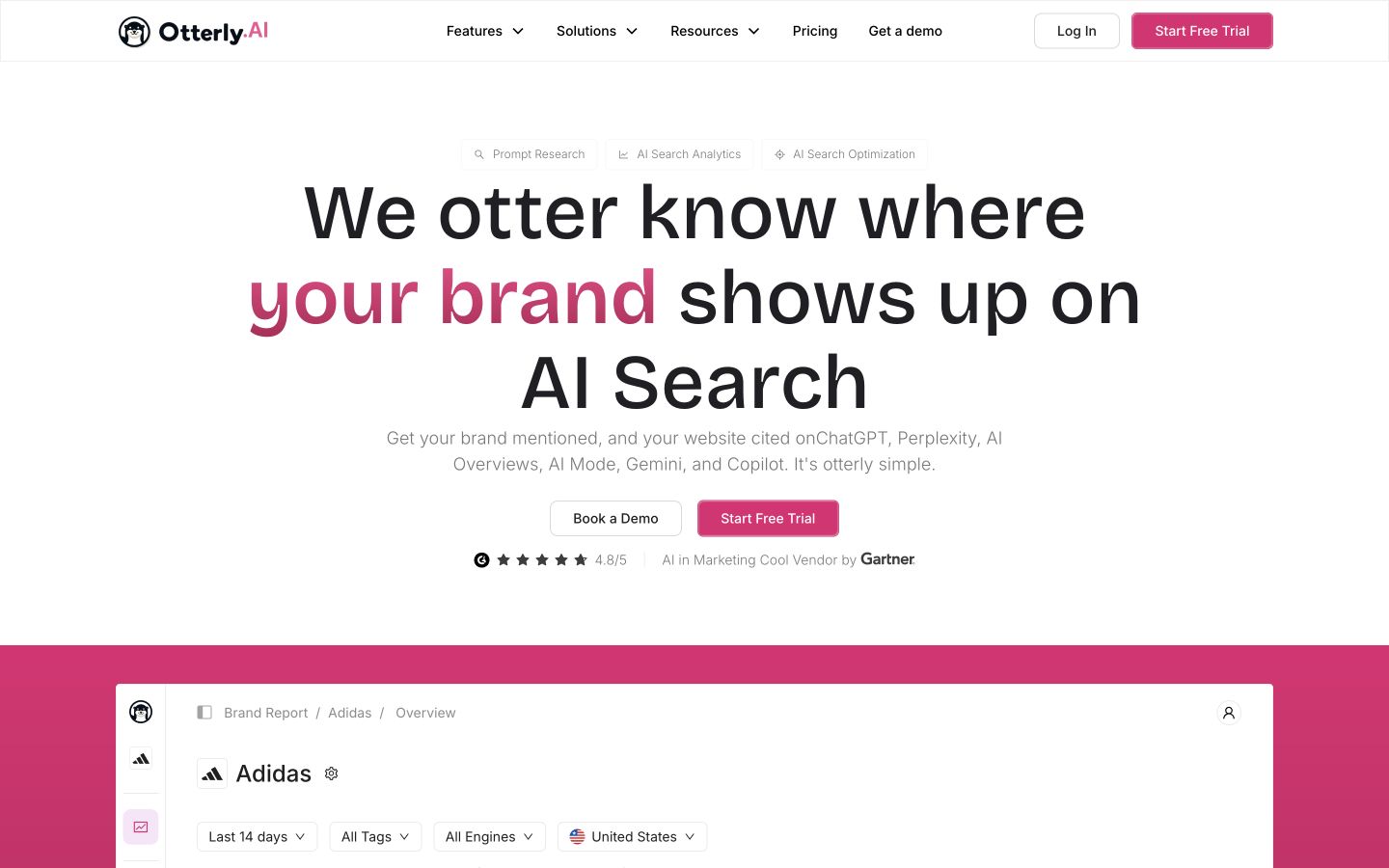
The public page connects tracking to audits. Evaluate the evidence behind a finding and confirm the engines included in the intended plan. Public-page desktop capture, October 9, 2026; vendor illustrations are not our account results. Source.
5. Scrunch: Best for combining visibility with site investigation
Scrunch covers AI visibility, source information, site audits and agent-oriented optimization. Its current pricing also lists basic content generation; describing it simply as a tracker would omit part of the offer. Advanced agent-facing infrastructure needs its own inclusion check. Scrunch.
Pricing: Core displays $250 per month, 125 unique prompts, 5,000 monthly responses, five site audits and one page optimization per month. Enterprise pricing requires a quote. Confirm how the included work relates to Agent Pages or any other advanced implementation you want. Scrunch pricing.
Boundary and trial task: Producing a recommendation and implementing a site change are separate responsibilities. Investigate one observed citation gap, identify the affected page and review the proposed change with the site owner. Check whether humans and crawlers continue to receive accurate, appropriate content. Use the included page allowance to assess a complete reviewed change rather than spreading it over unrelated experiments.
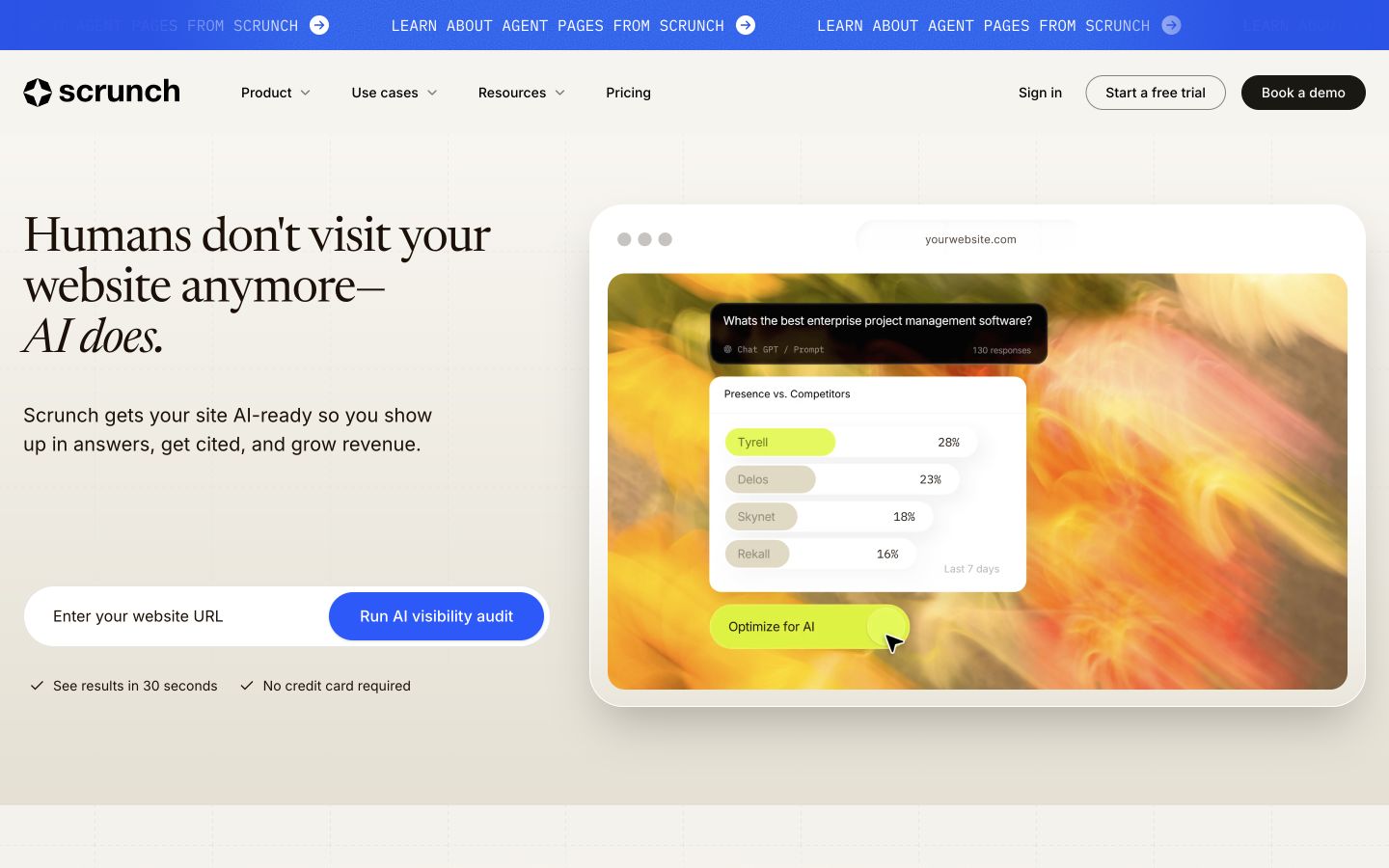
Scrunch’s public site includes monitoring and optimization. Verify the plan-level implementation scope before assuming every advertised feature is included. Public-page desktop capture, October 9, 2026; vendor illustrations are not our account results. Source.
6. Rankscale: Best for a multi-engine credit-based shortlist
Rankscale advertises monitoring across multiple AI engines, brand mentions, citations, sentiment and page audits. Its site labels some connected analytics and recommendation features as beta. Check those labels rather than treating every integration as an established production dependency. Rankscale.
Pricing: The current public monthly tiers reviewed include Pro at $99, Pro+ at $229, Growth at $385 and Enterprise at $780. Credits, run settings and additional work affect usable capacity; older comparisons with a much lower entry price should not be your budget source.
Boundary and trial task: A large engine menu does not automatically create a representative sample. Run the engines your customers actually use, inspect how credit consumption changes and export one underlying response with its source URL. If a beta integration is essential to your reporting, confirm its behavior before committing. Record the question, location and date so a teammate can interpret a later change correctly.
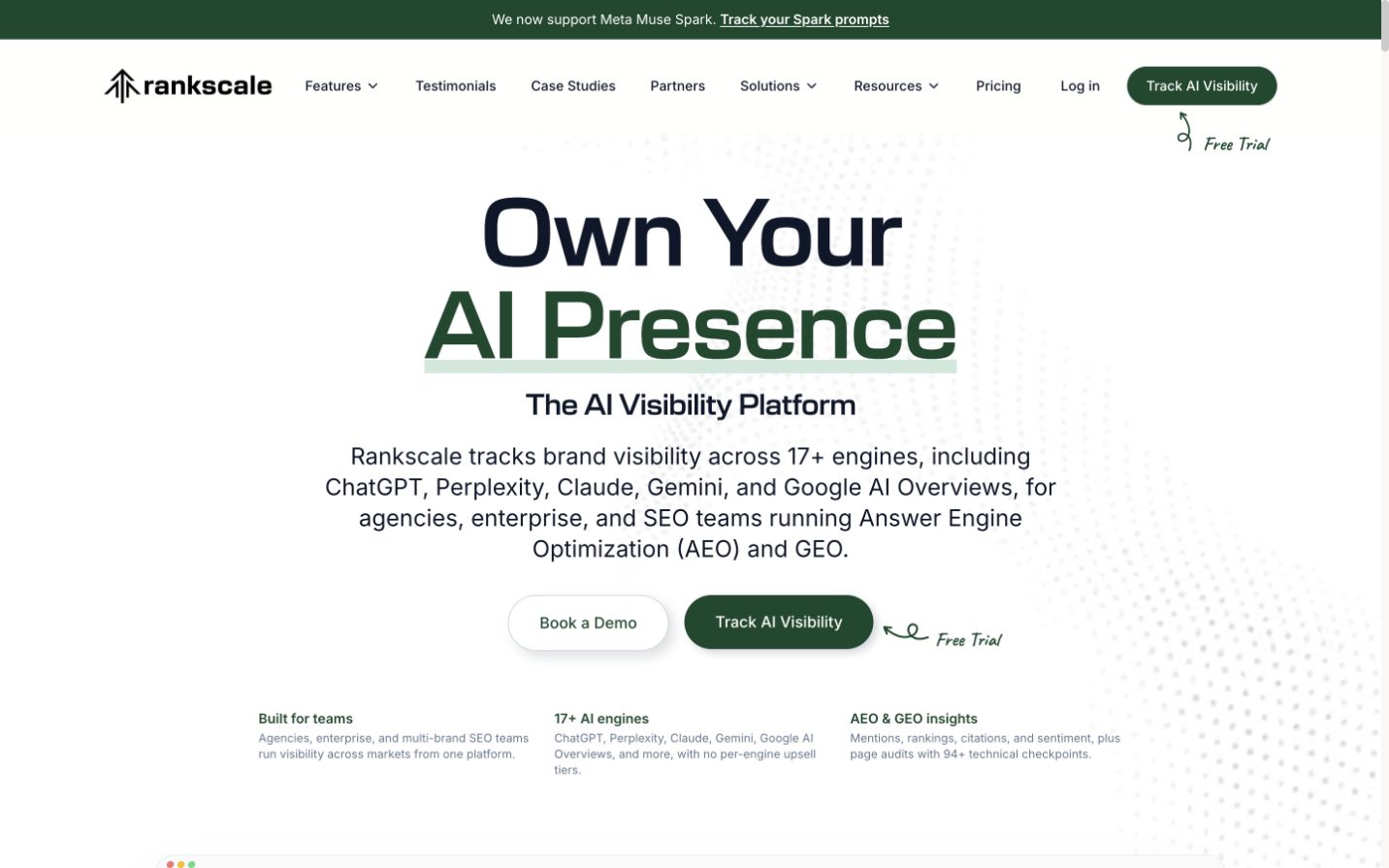
The public page displays multi-engine monitoring alongside audit and beta features. Compare the credit rules for your intended sample. Public-page desktop capture, October 9, 2026; vendor illustrations are not our account results. Source.
7. Ahrefs Brand Radar: Best for distinguishing broad-index and custom-prompt research
Brand Radar offers two different buying routes: an AI visibility index and custom-prompt tracking. The public page explains that its broad index uses prompts modeled from real search queries. That is useful research coverage, but it is not a complete log of actual assistant conversations. Ahrefs Brand Radar.
Pricing: The AI Visibility Index starts at $199 per month. Custom-prompt packages start at $50 per month for 2,500 checks, with additional terms; limited prompt access is also described for eligible Ahrefs subscriptions. Do not combine those prices or allowances as if they were one package.
Trial task: Write down whether you need broad discovery or recurring tracking of your own questions. For custom tracking, calculate checks by prompt, engine, location and update frequency. Inspect a saved answer and citation before relying on a summary metric. Confirm the package independently from the SEO suite you may already use.
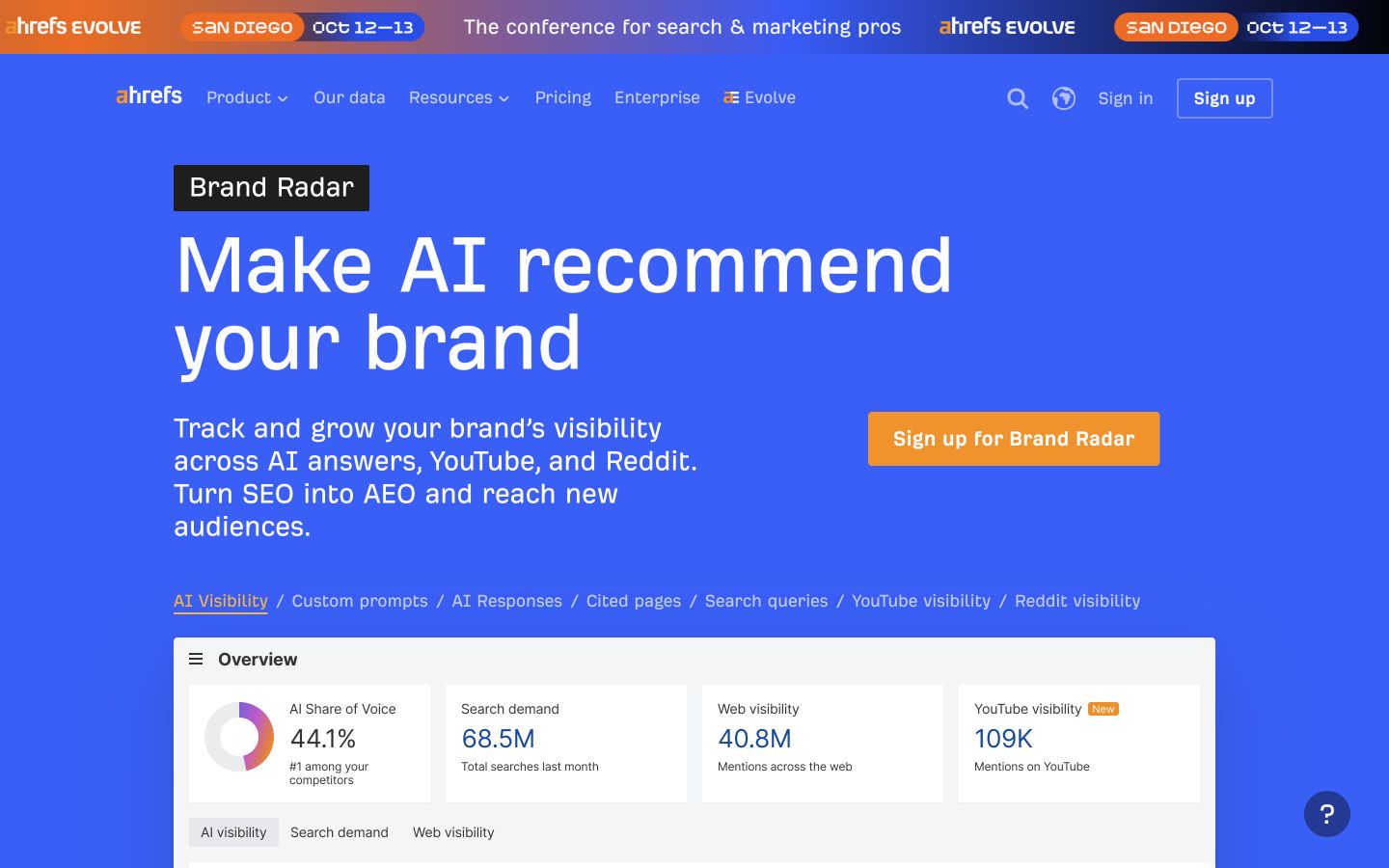
Brand Radar separates index research from custom prompts. The relevant unit for a tracking budget is a check, not simply a saved keyword. Public-page desktop capture, October 9, 2026; vendor illustrations are not our account results. Source.
8. Semrush AI Visibility Toolkit: Best for connecting AI visibility with SEO operations
The standalone AI Visibility Toolkit provides brand analysis, prompt tracking and AI-oriented site audits. It is distinct from Semrush One, which bundles SEO and AI search capabilities. This distinction matters if you already pay for Semrush and are comparing an add-on with a new combined plan. Toolkit documentation.
Pricing: The standalone offer is $99 per month for one project and one brand/domain, including 25 tracked prompts, a 100-page AI audit allowance and specified export limits. Its documentation says it does not have a standalone free trial. Extra prompt capacity, domains and user licenses have separate costs. The current Semrush One Starter offer is $199 monthly, with different allowances. Semrush pricing.
Trial task: Map one observed visibility issue to a specific page and compare its conventional SEO performance with the AI response evidence. Verify whether the plan you buy includes the tracking and audit scope you need rather than assuming an existing subscription contains everything.
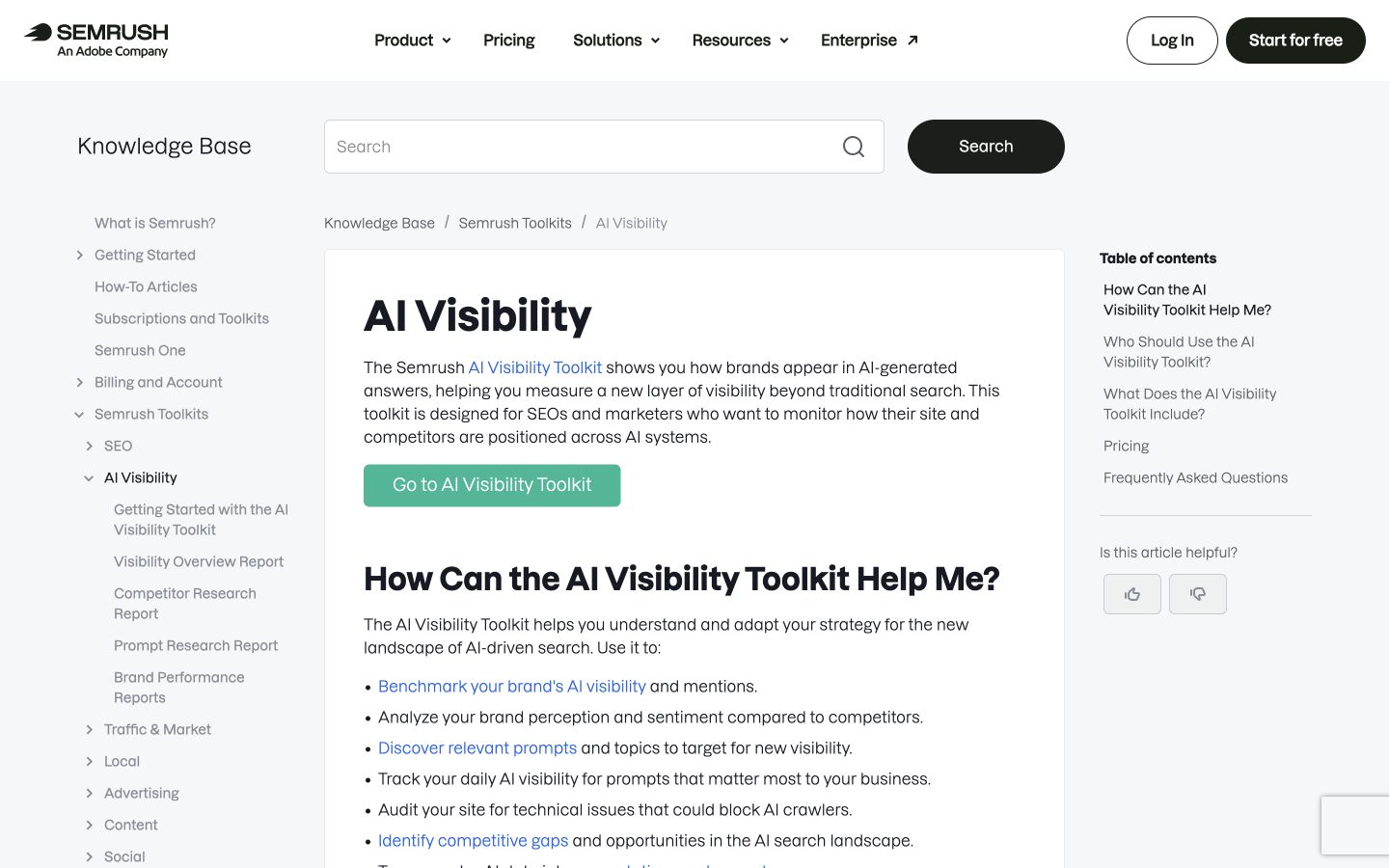
The official help page documents the standalone toolkit. Compare its included prompts and domain with the separate Semrush One bundle. Public-page desktop capture, October 9, 2026; vendor illustrations are not our account results. Source.
9. AlsoAsked: Best for researching connected customer questions
AlsoAsked maps Google People Also Ask questions. That makes it useful for designing an answer-focused content brief and understanding connected questions. The output is Google question research, not measured LLM prompt volume.
AlsoAsked gathers and clusters People Also Ask questions around a search. Its public interface exposes country, location, language and search-depth settings, which matter when you are planning content for US English readers. Product documentation.
Limit to check: Questions are research inputs, not an instruction to add every answer to one page. Select those that support the page's central purpose and verify answers using appropriate sources.
Pricing: The captured USD page displays Basic at $12 per month for 100 monthly credits, with a separate annual-billing saving. Check the selected billing interval and tax at checkout before treating the displayed figure as a month-to-month quote. Current pricing.
Trial task: Choose a real customer question and inspect the branches. Group questions that can be answered well on one page, separate different buying intents and assign a primary source to each factual explanation. Do not copy every branch into a heading just because it appears in a map.
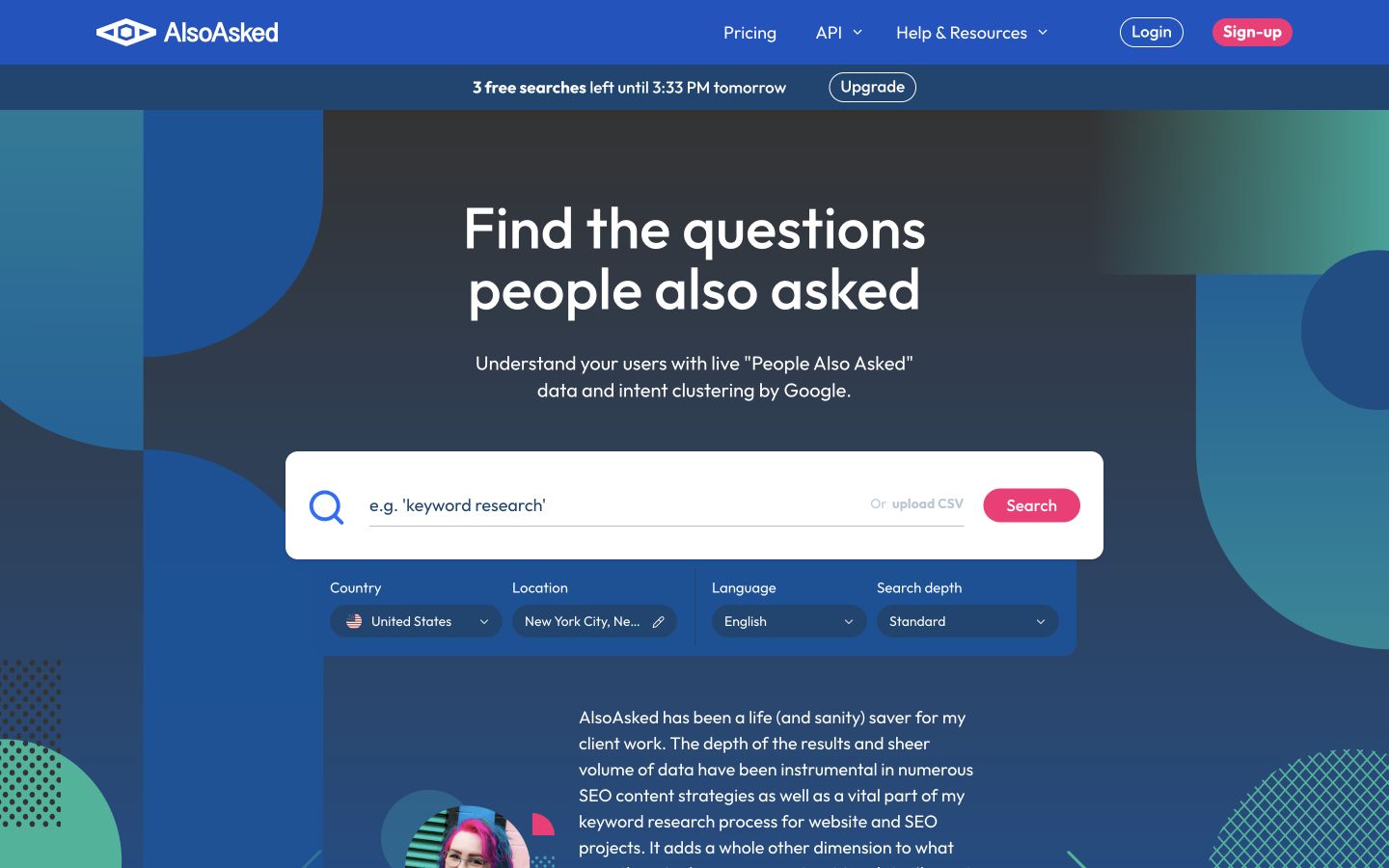
Question relationships can improve a brief. They do not establish how many people asked the same question in ChatGPT or another assistant. Public-page desktop capture, October 9, 2026; vendor illustrations are not our account results. Source.
10. HubSpot AEO: Best for a focused standalone AEO shortlist
HubSpot now offers a standalone AEO product in beta, separate from older references to its free AI Search Grader. Its page lists monitoring across ChatGPT, Gemini and Perplexity, with brand visibility, citations, competitor context and recommendations. HubSpot AEO.
Pricing: The displayed offer is $50 per month with 25 prompts. Check the beta scope, access terms and any limits relevant to your team before making it a reporting dependency.
Boundary and trial task: A visible recommendation is a lead to investigate, not proof that implementing it will cause a citation. Track one branded question and several nonbranded questions from your customer research. Check whether the captured answers, competitors and source information produce a useful action list. Assign an owner to each action and preserve a baseline before changing content. Do not assume the standalone product includes every Content Hub capability.
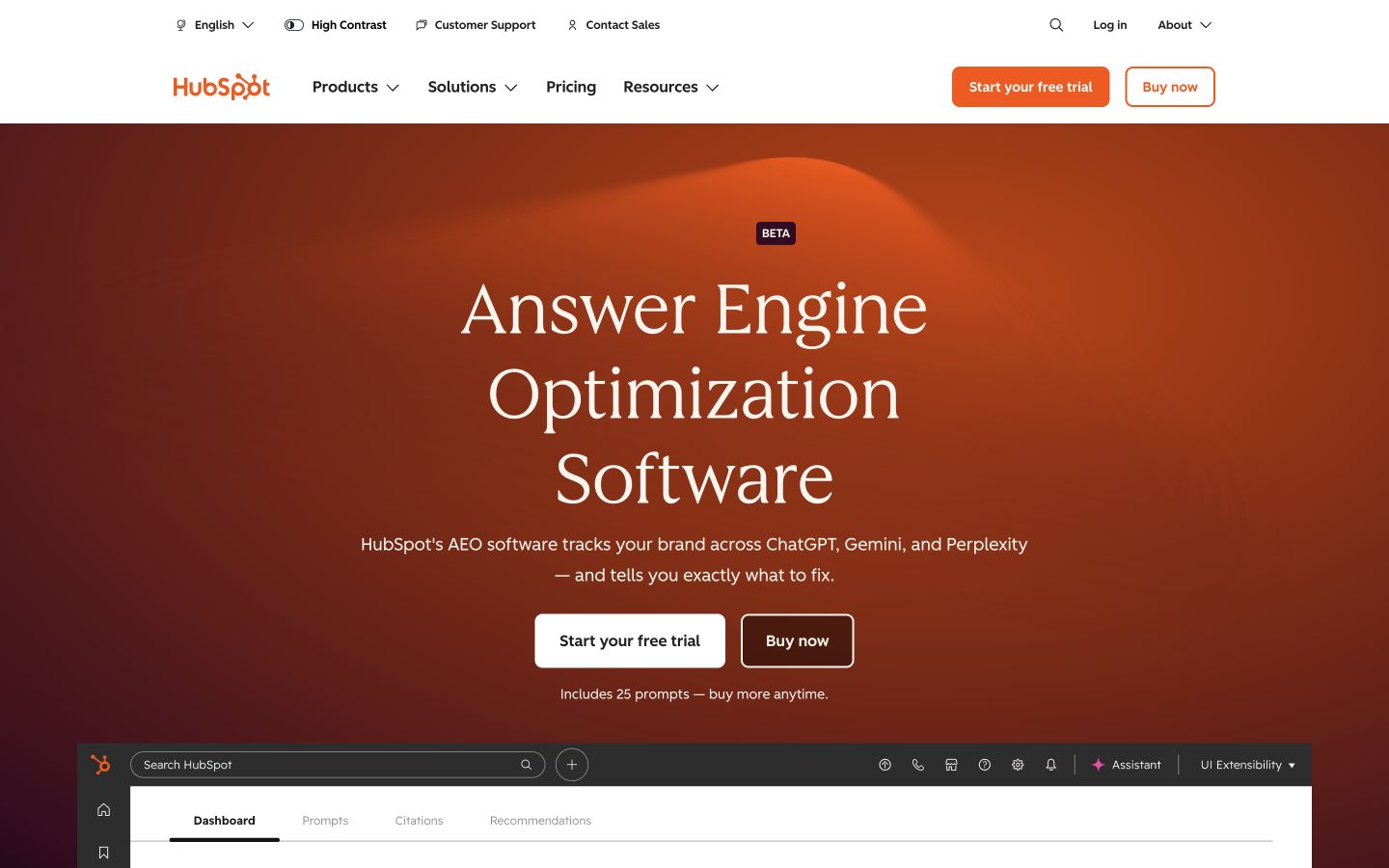
The current page is a standalone AEO beta offer. Compare that product directly instead of inheriting an older free-grader description. Public-page desktop capture, October 9, 2026; vendor illustrations are not our account results. Source.
11. LLMrefs: Best for keyword-led AI visibility research
LLMrefs begins with keywords, generates related fan-out prompts and groups visibility findings around the keyword. Its public site describes geographic and language targeting, recurring reporting and source/citation research. This can help teams connect existing SEO topic work with AI-response investigation. LLMrefs.
Pricing and boundary: Confirm the current paid keyword allowance, engine scope and refresh settings. A keyword that expands into several prompts is not directly comparable with a competitor's one-prompt tracking allowance. Public demo data illustrates the workflow; it is not our measured result.
Trial task: Choose a real keyword cluster and inspect the generated questions before accepting them. Remove questions that do not represent your audience, then inspect the underlying responses and sources. Compare the usefulness of the grouped report with the editorial decisions you need to make. Keep branded and nonbranded intent separate so a flattering brand question does not dominate the picture.
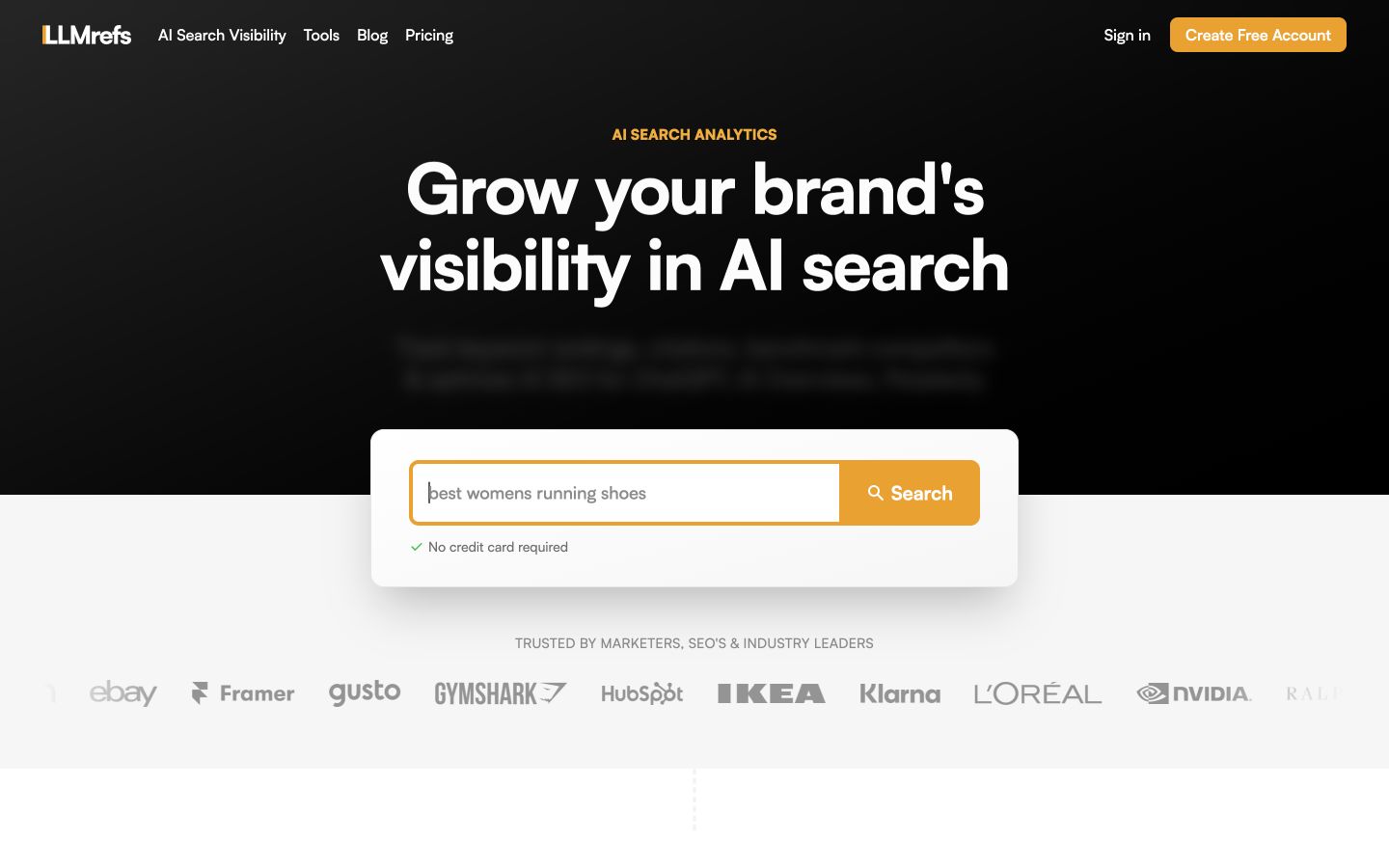
The public page shows a keyword-led workflow. Review the fan-out questions and reporting context rather than treating a keyword count as the full sample. Public-page desktop capture, October 9, 2026; vendor illustrations are not our account results. Source.
12. SE Ranking: Best for AI measurement alongside SEO client work
SE Ranking is relevant when your team already combines site audits, rankings, competitive research and client reporting. Compare its AI search offer as a defined package, with its own monitoring scope and costs.
SE Ranking's platform includes keyword and competitor research, backlink analysis, audits and rank monitoring, with content marketing and AI visibility capabilities also presented. Its site describes an Agency Success Kit and integrations with reporting and workflow tools. Product documentation.
Limit to check: Evaluate the package you need for your client count. Keyword, page, seat and add-on allowances can matter more than a headline monthly price, especially when reporting is part of the service you sell.
Pricing: The entry offer is displayed at $129 monthly or $103.20 per month billed annually. Agency and AI Search additions are priced separately, so budget for the client deliverables you need rather than assuming every module is included. Current pricing.
Trial task: Use the same customer questions and competitors as your other measurement shortlist. Confirm engines, locations, reporting frequency and whether the chosen plan supports the client-facing report. Check the cost of the AI package separately from the base SEO subscription.
An existing SEO workflow can make a connected AI package convenient. Verify the additional package rather than assuming base-plan feature parity. Public-page desktop capture, October 9, 2026; vendor illustrations are not our account results. Source.
A worked example: prompt count is not tracking capacity
Ahrefs defines a custom-prompt check by prompt, engine, location and update. Suppose your proposed evaluation uses 25 prompts, three engines, one location and 30 daily updates:
25 × 3 × 1 × 30 = 2,250 checks.
That arithmetic fits inside a 2,500-check allowance before additional runs or locations. Add a second location and the same proposed sample requires 4,500 checks. It does not mean another vendor's “25 prompts” plan uses the same billing method. Confirm each product's own rules. Brand Radar's package explanation.
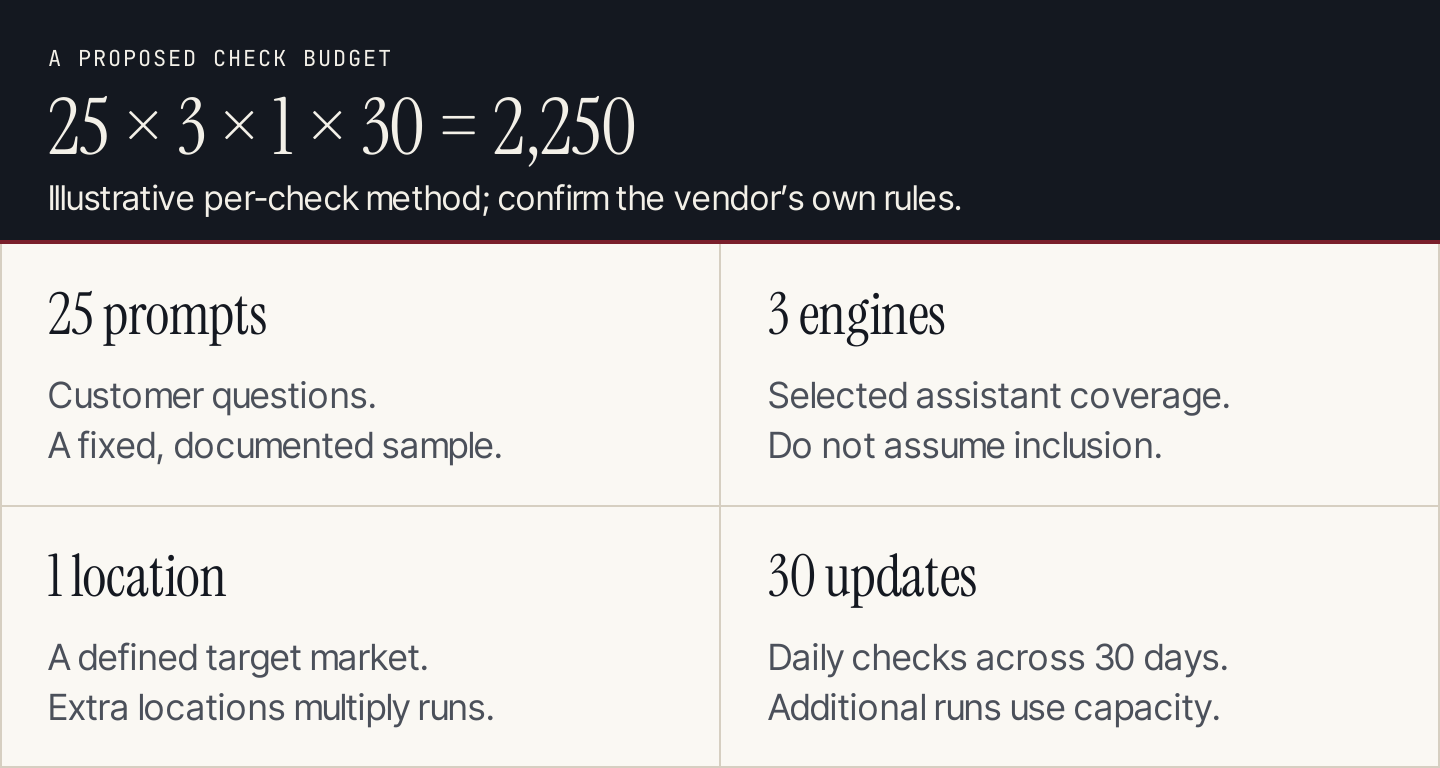
A proposed 25 × 3 × 1 × 30 sample requires 2,250 checks under the stated per-check method. It is an arithmetic example, not a campaign result.
Build a sample your team can interpret
Start with real inputs: sales questions, support questions, customer interviews, relevant search queries and the comparisons buyers actually make. Include more than “What is the best [your brand]?” A sample designed to flatter the company is poor research.
Use a small, documented set covering discovery, comparison, troubleshooting and branded verification. Record the exact question, market, language, engine and run date. Save the full answer and citations wherever the tool permits, and retain the sample when comparing later periods.
| Finding | Useful investigation | Avoid jumping to |
|---|---|---|
| Brand mentioned without your page cited | Which source supports the answer? | More blog posts automatically solve it |
| A page cited with inaccurate wording | Check the cited passage and other sources | Your page alone caused the error |
| Competitor appears on a comparison question | Inspect why its offering matches the question | A tracker score proves it is the better company |
| Answers vary between runs | Repeat a fixed sample and preserve evidence | One screenshot proves a permanent ranking |
| Technical audit flags a page | Verify the issue and assign a fix | Every warning is an urgent defect |
Choose a measurement tool that lets your team investigate, then use a production workflow to make justified improvements. A dashboard is more valuable when somebody owns the next decision.
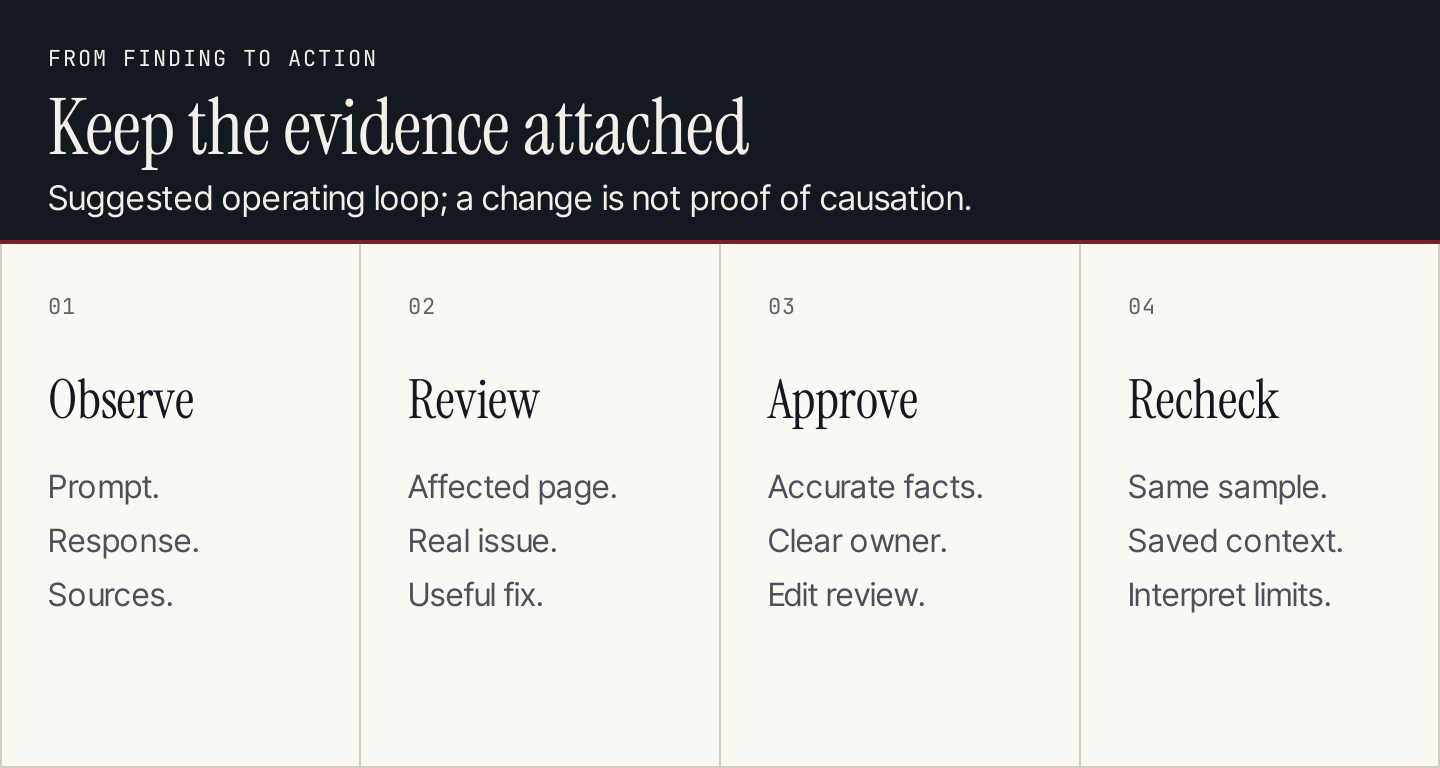
Suggested operating loop. Preserve the baseline, make a justified change and compare later observations without asserting causation.
What to ask before buying
Ask the vendor to show one underlying answer, its source URLs, the market settings and the available export. Then ask how the quoted allowance changes when you add models, countries, projects or users. Distinguish discovery indexes from custom tracking and beta integrations from dependencies you can rely on.
For production products, inspect the sources, substantive editing and CMS approval process. For technical products, identify who implements and rechecks a change. Budget for that human work rather than assuming the software recommendation completes it.
Frequently asked questions
Do I need an LLM SEO tool if I already use ordinary SEO software?
Only when there is an identified job your current stack does not cover. Some SEO suites now offer AI visibility packages. Compare the current package before adding another tracker; use content automation if the gap is producing and maintaining useful pages.
Can Rankauto track every AI mention of my brand?
The reviewed public pages establish content production and CMS delivery, not comprehensive assistant-response monitoring. Rankauto is first here for production. Pair it with a measurement product when you need a documented visibility sample.
Does improving content guarantee an AI citation?
No. Useful, accurate pages are a sensible investment, but a citation depends on the response and retrieval context. Review real evidence and avoid converting a vendor visibility score into a promise of future recommendations.
What is the difference between an LLM SEO tool and an AI visibility tracker?
A tracker records responses and visibility observations. The broader LLM SEO workflow also includes question research, content production and technical investigation. Buy the missing part of that workflow rather than assuming a tracker performs all four jobs.
If the next step is producing reviewed articles from your research, see Rankauto's content automation plan.