12 Best ChatGPT SEO Tools for Research, Content and Visibility
Compare 12 ChatGPT SEO tools for research, content and AI visibility. See which work happens inside ChatGPT and which needs a dedicated tool.

The best ChatGPT SEO tool depends on the result you need: reliable research inside a chat, a better article on your website, or proof that your brand appears in ChatGPT answers.
Rankauto is our #1 choice for recurring SEO article production. It is a dedicated publishing workflow you can use alongside ChatGPT. For live competitor data inside ChatGPT, consider Ahrefs MCP. For monitoring mentions and citations, compare the measurement tools below.
This guide compares 12 options, explains their relationship with ChatGPT, and gives you a way to evaluate them using your own pages. A prompt library, an API connection and a visibility tracker solve different problems; buying one does not automatically supply the other two.
Disclosure and method: Rankauto publishes this guide. We reviewed public product documentation and pricing during October 8–10, 2026. Screenshots show public pages, including vendor demonstrations. We did not test paid accounts or measure traffic, ranking or citation gains. Best-fit labels are our editorial recommendations for the stated task.
First, identify which ChatGPT SEO job you mean
| Your job | Relevant route | What you should receive |
|---|---|---|
| Research and edit in ChatGPT | ChatGPT, AIPRM, Ahrefs MCP | A response grounded in supplied or connected data |
| Turn a topic into a reviewed article | Rankauto, Frase, Surfer, Semrush Content Toolkit | A draft or page with an explicit editing and publishing handoff |
| Investigate your website | Screaming Frog | URL-level crawl findings and reviewed AI-assisted analysis |
| Discover related questions | AlsoAsked | A question map with market and language context |
| Measure ChatGPT visibility | Profound, OtterlyAI, Ahrefs Brand Radar | Recorded answers, mentions, citations and sampling settings |
Only some products operate inside ChatGPT. Others are standalone alternatives or supply research and measurement around it. Rankauto doesn't run inside ChatGPT; it is a separate content production workflow you use alongside it.
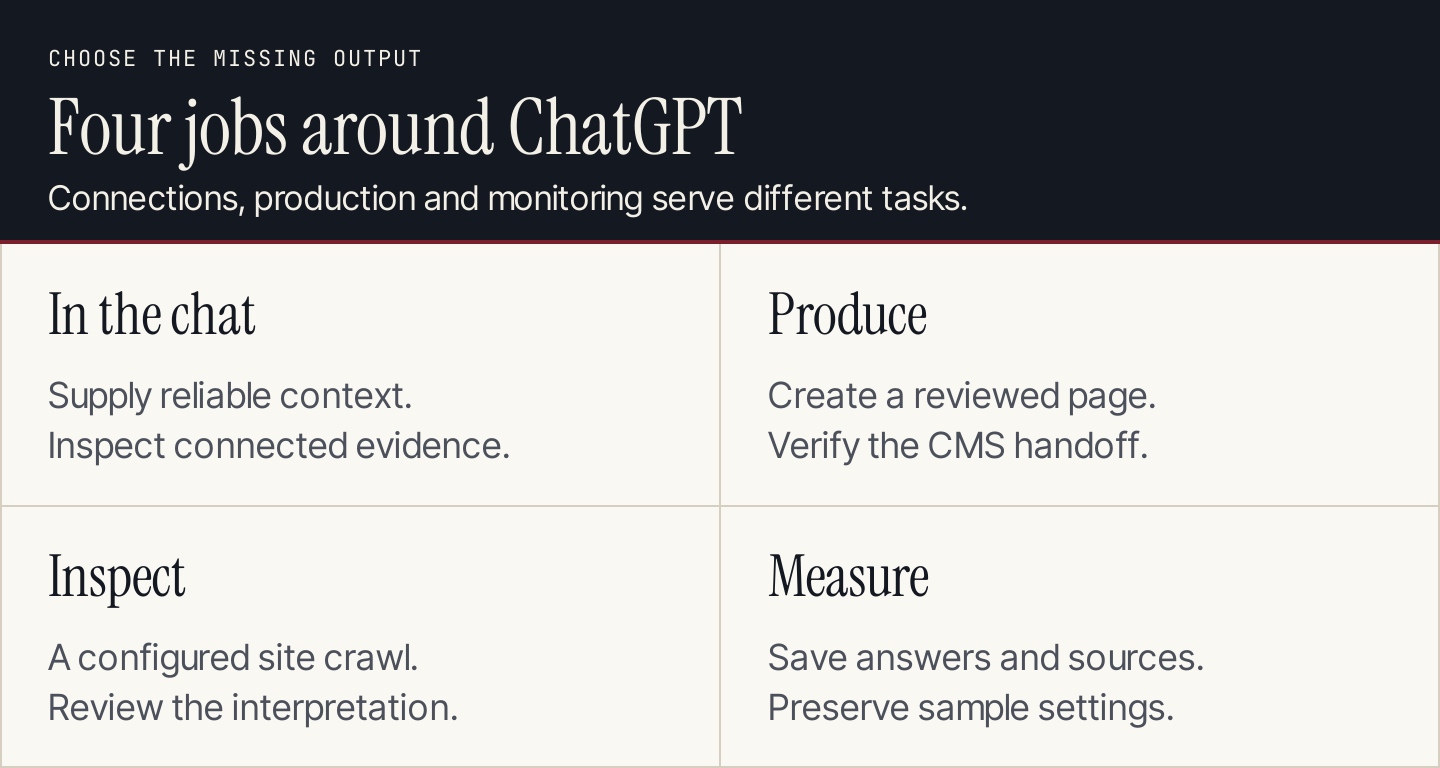
Choose the missing output before choosing a tool. These are workflow roles, not four interchangeable subscriptions.
The 12 tools at a glance
| # | Tool | Relationship with ChatGPT | Best fit |
|---|---|---|---|
| 1 | Rankauto | Standalone production workflow | Recurring researched blog articles |
| 2 | ChatGPT | The assistant itself | Flexible research, analysis and editing |
| 3 | Ahrefs MCP | Connects Ahrefs data to supported AI clients | Live keyword, backlink and competitor investigation |
| 4 | AIPRM | Prompt library for ChatGPT and other models | Reusable team instructions |
| 5 | Frase | Standalone content platform | Research, drafting and page maintenance |
| 6 | Surfer | Standalone platform with documented MCP connectivity | Content optimization and visibility workflows |
| 7 | Screaming Frog | Crawl software with AI/API workflows | Analysis across a defined URL set |
| 8 | Semrush Content Toolkit | Standalone content tools | Search-informed content creation |
| 9 | AlsoAsked | Question research you can bring into a chat | Google People Also Ask exploration |
| 10 | Profound | AI marketing and visibility platform | Connecting answer data with content work |
| 11 | OtterlyAI | AI search monitoring | A defined prompt baseline |
| 12 | Ahrefs Brand Radar | AI visibility research and tracking | Broad discovery or custom-prompt monitoring |
The ordering starts with our recommendation for content automation. It is not a performance score or a claim that each product replaces all the others.
1. Rankauto: Best for recurring SEO article production
Choose Rankauto when your team has good topics but struggles to move them through research, drafting, review and CMS delivery. That is a different buying decision from adding another prompt template to ChatGPT.
Rankauto’s public offer covers topic research, brand-guided articles, source checking, visuals, metadata and publishing. The monthly plan is $49 per website for 30 created articles. Keep drafts for review while establishing the workflow.
Tradeoff: This recommendation concerns production. Use a research database or visibility tracker when you need their data, and keep an editor accountable for accurate product claims.
Evaluation task: Take one approved ChatGPT-assisted brief, attach the original sources and product facts, and inspect the resulting article. Check the source behind each important claim, the relevance of the examples, and the final CMS preview. Count the pages you accept and the corrections you make, rather than treating the generation allowance as guaranteed publishable output.
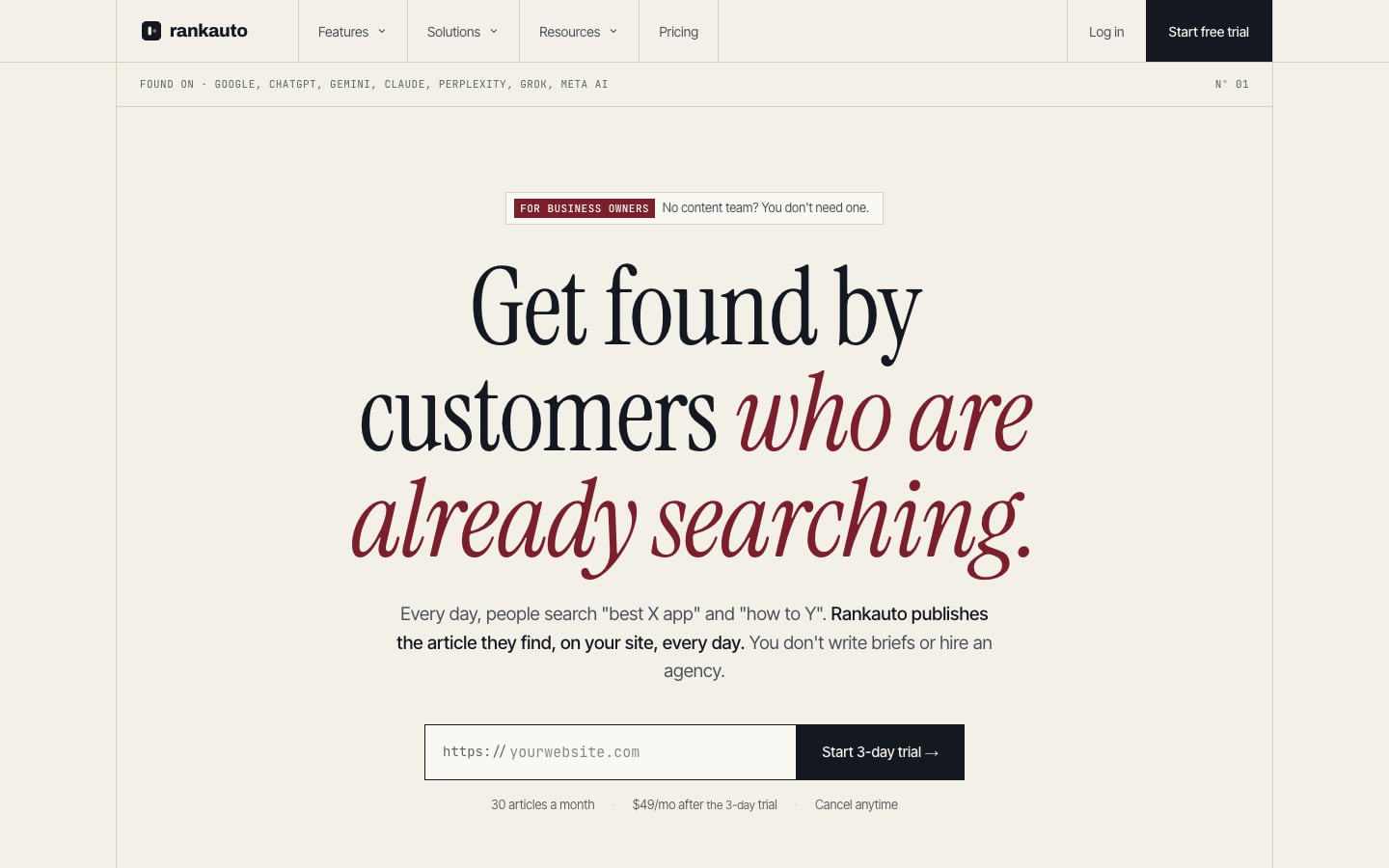
Rankauto's homepage: it finds the searches your customers make and publishes an article to your site every day, for $49 a month. It runs the article work end to end instead of inside a chat window. Source: Rankauto.
2. ChatGPT: Best for flexible research and editing
ChatGPT helps when you want a flexible workspace for analyzing a source packet, comparing outlines, investigating a question or editing a draft. Official documentation describes files, web search, projects and plugins as available ways to supply context and tools. Projects can preserve related sources and instructions across chats. Using ChatGPT, projects and chats.
Pricing: The official plan documentation lists Plus at $20 per month. Access, usage and connected-tool requirements vary by plan. API token billing is separate from subscription usage. Official plan documentation.
Tradeoff: A convincing answer is not measured keyword demand. Ask where a number came from and keep its date, country and source. ChatGPT can work with connected tools; judge the configured workflow instead of assuming every task starts from zero or that publishing is inherently impossible.
Evaluation task: Give it one page, its target audience and three approved sources. Request a sourced revision plan before a rewrite. Review whether the proposed changes preserve strong original material and distinguish facts from suggestions.
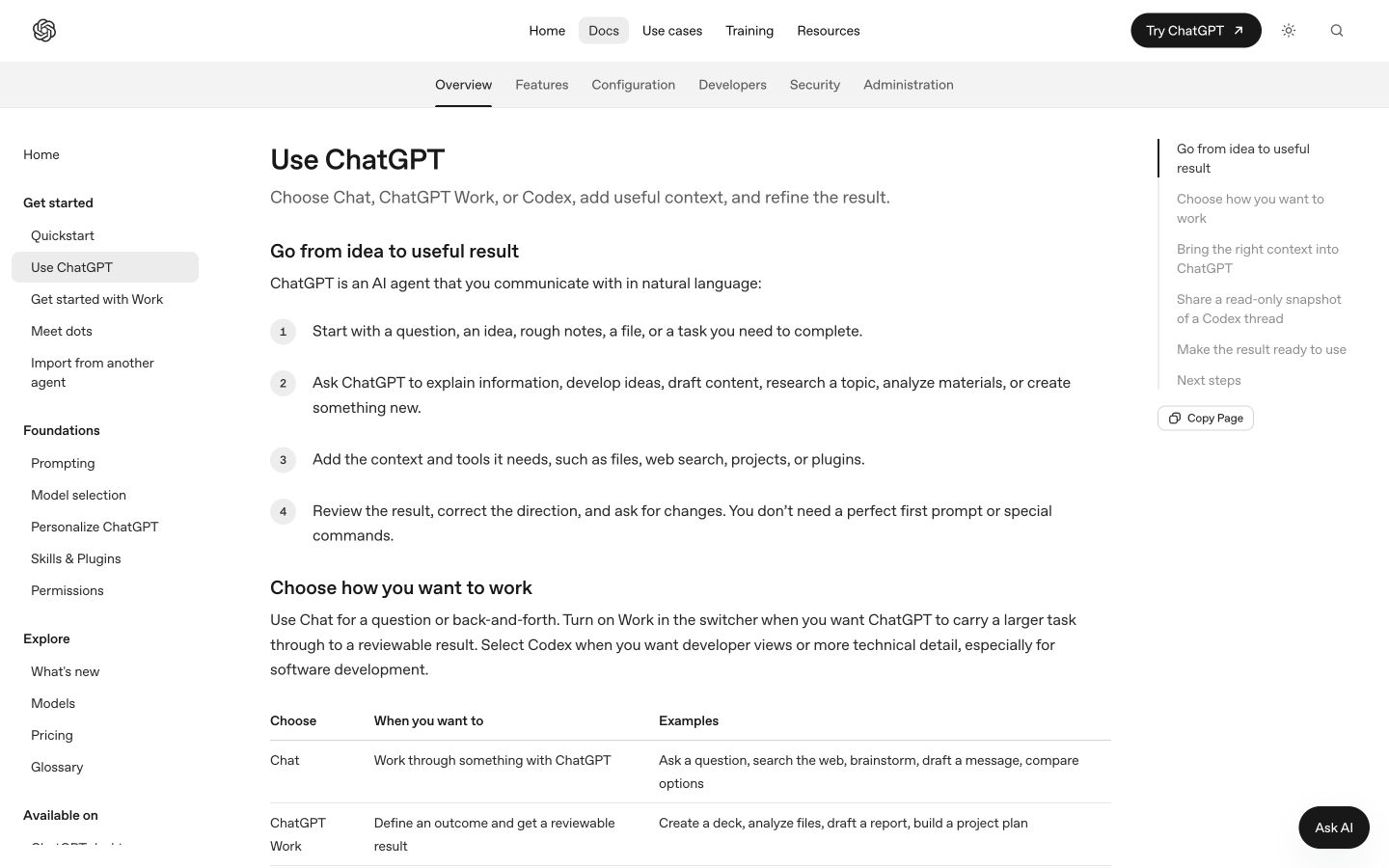
Official documentation shows how context and tools enter a ChatGPT task. Source: ChatGPT.
3. Ahrefs MCP: Best for live SEO data inside a supported assistant
Ahrefs MCP connects its SEO data to compatible AI assistants, including ChatGPT. It can support keyword, backlink and competitor investigation without manually moving every report into a chat. Its documentation describes access on Lite and higher plans, with API consumption and row limits. Ahrefs MCP, official usage documentation.
Pricing and tradeoff: Budget for the Ahrefs subscription and the assistant access you need. Ahrefs Lite’s reviewed monthly offer is $129. Confirm current API allowances in your account; public pages can disagree about quota values.
Evaluation task: Request a small report for one of your domains, with the United States market, a defined date range and named fields. Ask for a source row alongside the interpretation. An assistant’s summary should retain whether traffic is estimated and which report supplied a figure. Stop if it substitutes invented metrics for an unavailable response.
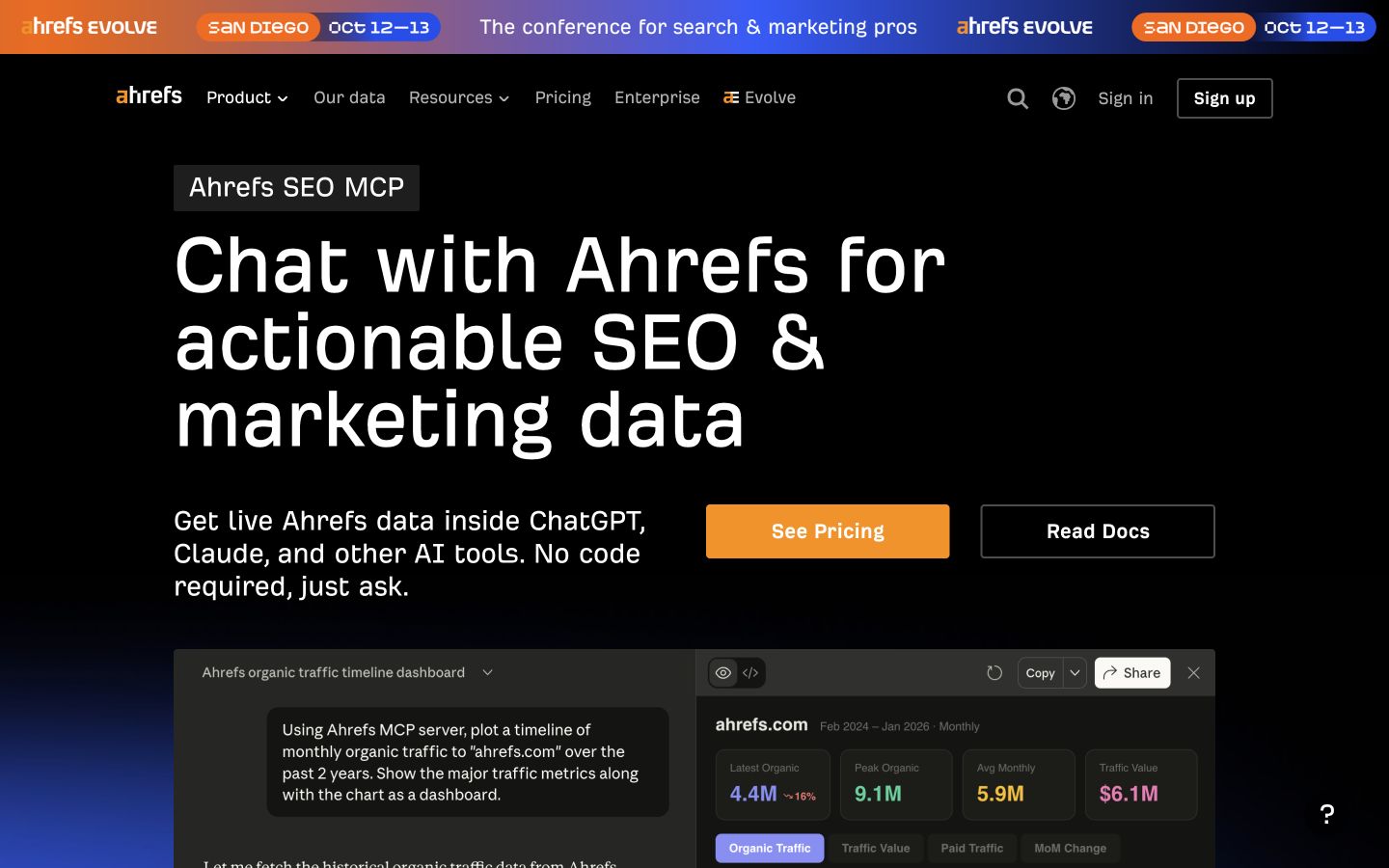
The public MCP page demonstrates the connection between SEO data and an assistant. Source: Ahrefs.
4. AIPRM: Best for reusable team prompts
AIPRM offers a public prompt library and private prompts for repeated use with ChatGPT and other models. It is relevant when a team keeps recreating the same research or editing instructions. AIPRM product overview.
Buying check: AIPRM’s free installation and paid organizational features are separate decisions. Confirm the plan for private storage, sharing and the underlying model access you require. We have not resolved a comparable payable team price from the reviewed homepage.
Tradeoff: A template can standardize instructions, but it cannot make an unsupported statistic accurate. Review prompts before adopting them, especially instructions that promise rankings or ask for data the model does not have.
Evaluation task: Turn your article-review checklist into a reusable prompt. Include source requirements, voice constraints and explicit permission to flag missing citations. Have two teammates apply it to the same draft, then compare whether the resulting suggestions support the same editorial decision. Change the prompt when it rewards unnecessary length or keyword repetition.
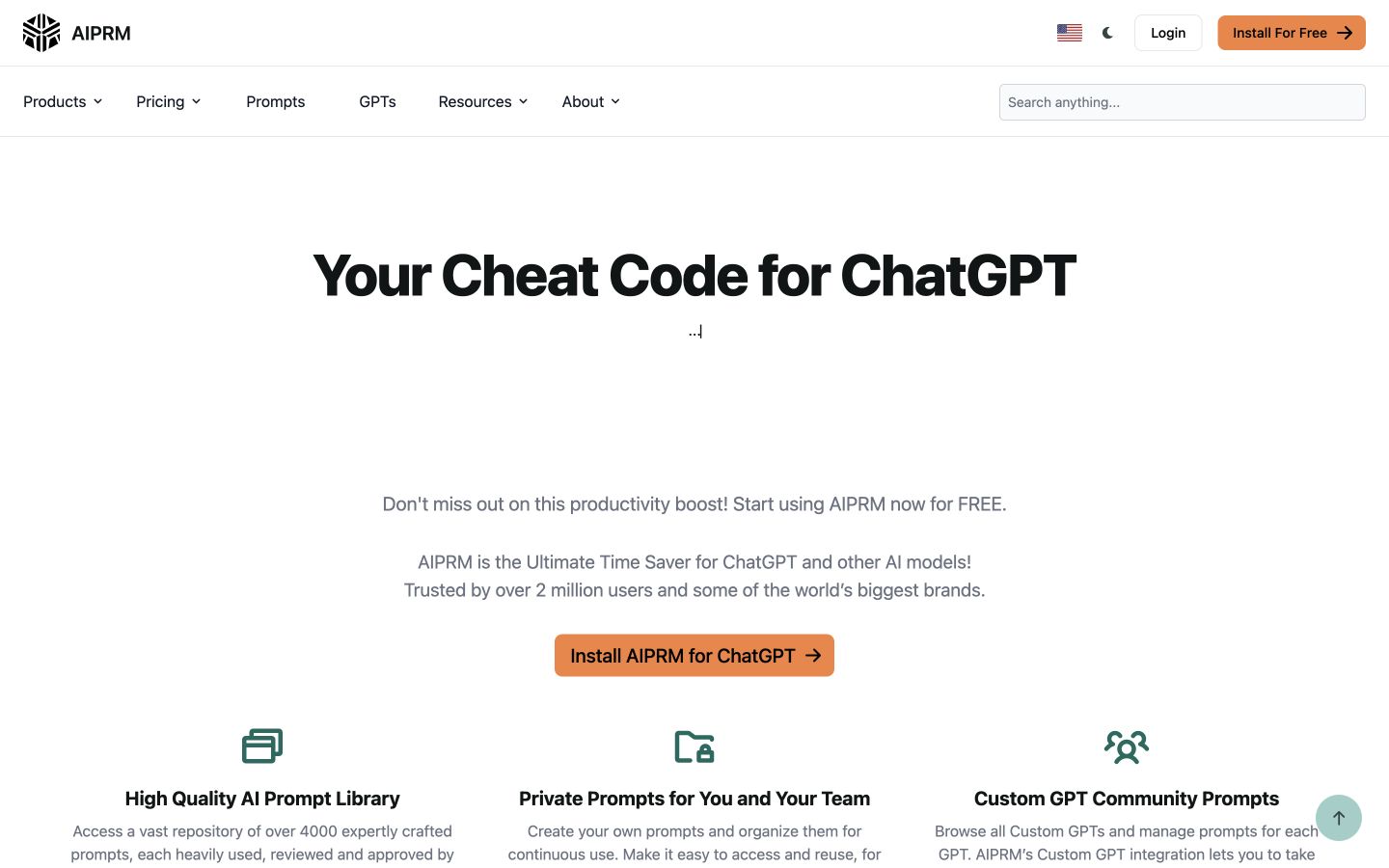
The page separates public prompt discovery from private reuse. A library entry is a starting point for instructions, not proof of a successful SEO workflow. Source: AIPRM product overview.
5. Frase: Best for an integrated research and maintenance workflow
Frase currently presents research, brand-context drafting, scoring, CMS publishing and Content Guard page maintenance. It is broader than an outline generator. Its documentation describes proposed revisions for approval and optional low-risk automatic fixes.
Pricing: The reviewed Starter offer is $49 monthly, or $39 per month with annual billing, with stated article and audit allowances. Confirm the limits for the workflow you want.
Tradeoff: You still need to decide which changes improve the page. Ask what qualifies as an automatic fix and which settings keep a revision in review.
Evaluation task: Use one new topic and one existing article. Compare the sources suggested for the brief, then inspect a proposed revision of the existing page. A good maintenance workflow should preserve your sources and let you reject a change without disturbing approved material. Keep the publication destination and approval owner visible in the test.
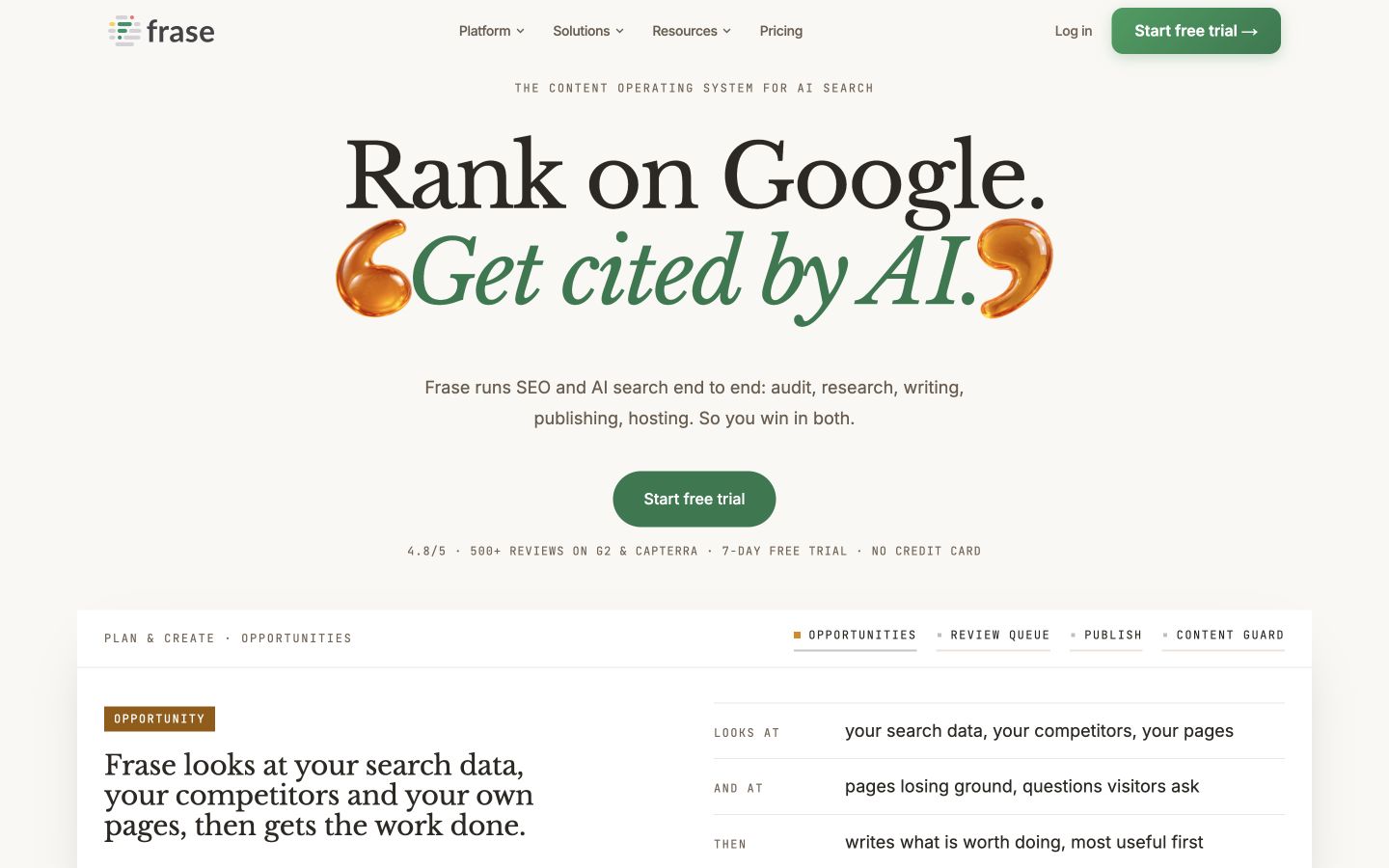
Frase’s public workflow includes maintenance and publishing. Check those controls alongside its research and drafting features. Source: Frase.
6. Surfer: Best for guided content optimization
Surfer’s public site now covers content optimization, brand context, AI visibility and MCP connectivity. Its Content Score can inform editing, but an article still needs accurate sources and a clear reader outcome.
Pricing and availability: The reviewed Standard offer is $99 per month billed annually, with a defined document allowance. Confirm the billing term and live functionality. The site labels Surfy Agent as “soon”; that announcement does not establish current access.
Evaluation task: Bring a draft with a defined query. Record three recommendations you accept and three you reject, with reasons. Adding a missing comparison may help the reader; adding every suggested term may make the writing worse. Compare the final source accuracy, clarity and completeness before looking at the score change. If you want to operate from an assistant, separately verify the MCP connection and the actions it supports on your plan.
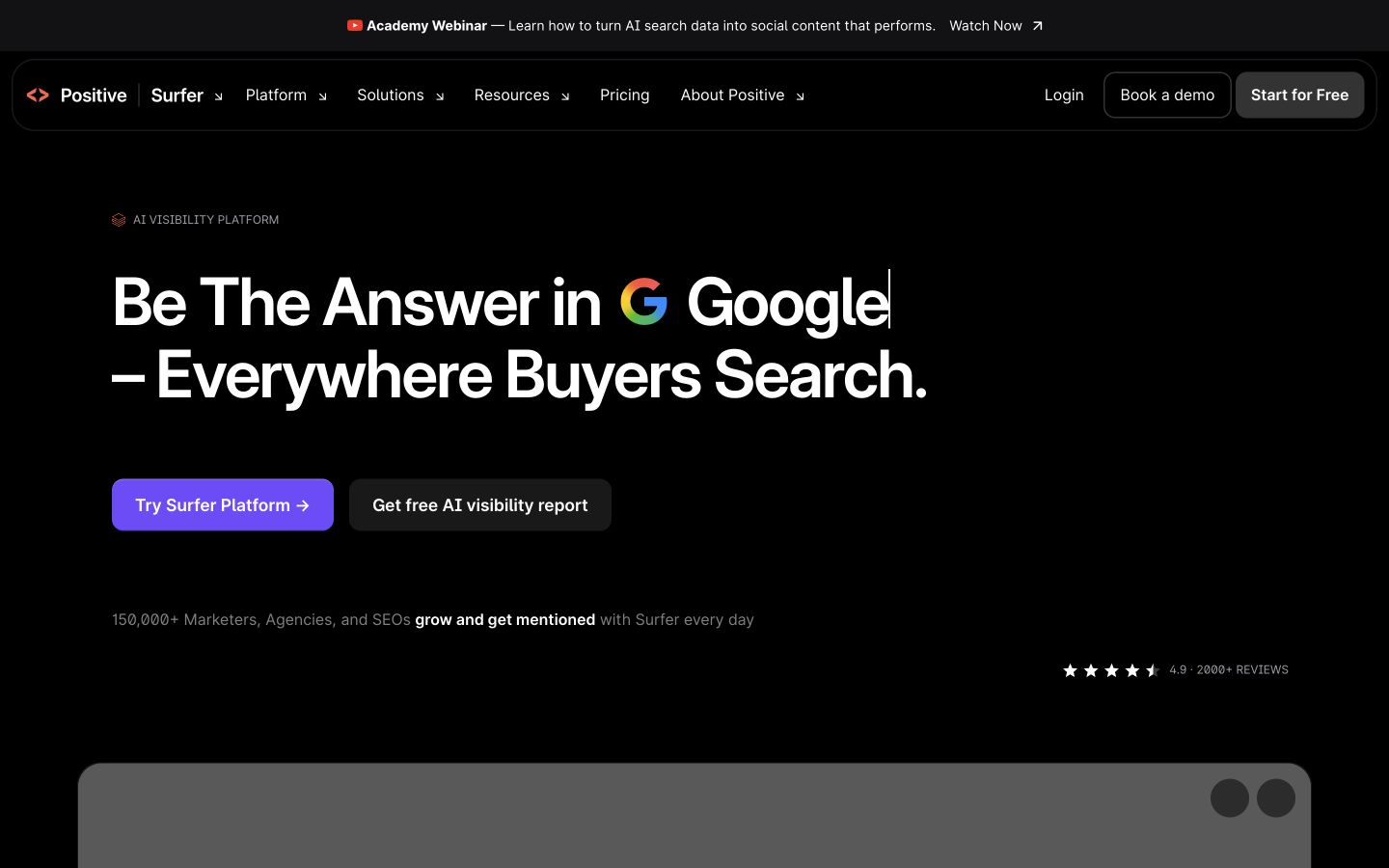
The public platform spans content and visibility. Availability labels and plan allowances matter when evaluating an assistant-connected workflow. Source: Surfer.
7. Screaming Frog: Best for AI-assisted investigation across URLs
Screaming Frog SEO Spider is a website crawler. Its current tutorial describes both Custom JavaScript and newer direct AI integration for applying prompts to crawl data. Custom JavaScript offers a more configurable route; direct integration can reduce setup for common tasks. Official AI workflow tutorial.
Pricing and tradeoff: The free crawler has a 500-URL limit. Advanced features and integrations require the appropriate license; model API usage is a separate cost. Do not assume a ChatGPT subscription pays for crawl-time API requests. SEO Spider feature and licensing overview.
Evaluation task: Select ten representative pages and one question, such as whether the title accurately describes the visible content. Review the result against each page before expanding the crawl. Record the prompt, input fields, model and configuration. Otherwise, a large batch simply repeats an unverified judgment more quickly.
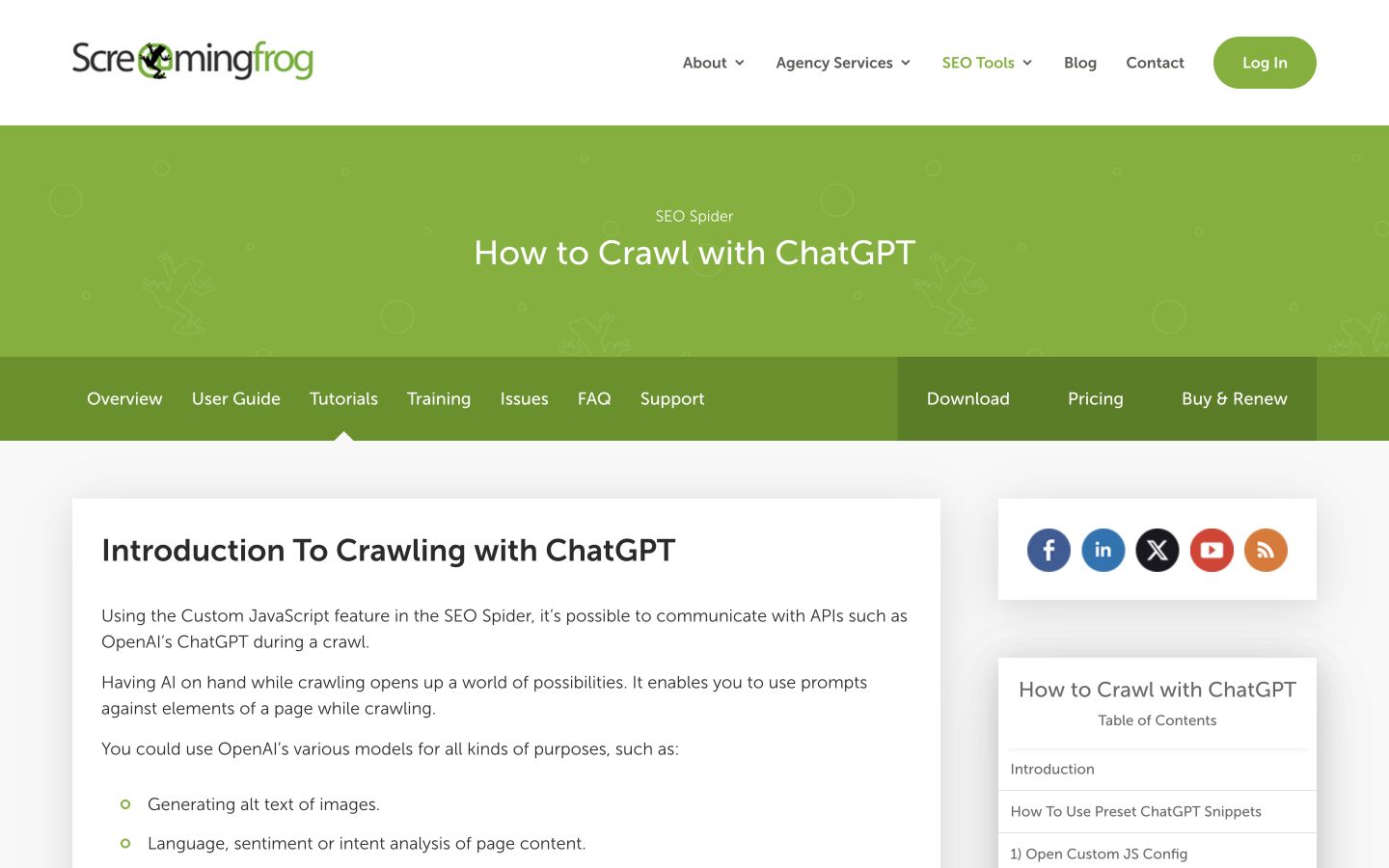
The official tutorial distinguishes flexible JavaScript from the newer direct AI integration. Its screenshots demonstrate the vendor’s setup instructions. Source: Screaming Frog.
8. Semrush Content Toolkit: Best for search-informed content work
Semrush Content Toolkit brings content creation and improvement into a research-oriented marketing platform. It is relevant when you want search context to inform a brief and draft rather than relying on an unconnected chat.
Pricing: Content Toolkit is $60 per month, with unlimited standard articles and five SEO-boosted articles monthly. Ten additional boosted articles cost $30 per month. WordPress export supports up to 100 connected sites. Keep these allowances separate from the SEO Toolkit, AI Visibility Toolkit and Semrush One. Content Toolkit pricing and limits.
Tradeoff: A feature’s presence somewhere in Semrush does not mean it belongs to the content subscription. Define what research, drafting and publishing work you need and verify each inclusion.
Evaluation task: Develop a brief for a genuine service or product topic. Check the proposed audience and intent against the current results, then review one generated section against the primary sources you supplied. Inspect how the draft moves into your CMS and whether that handoff needs another product, connection or manual step.
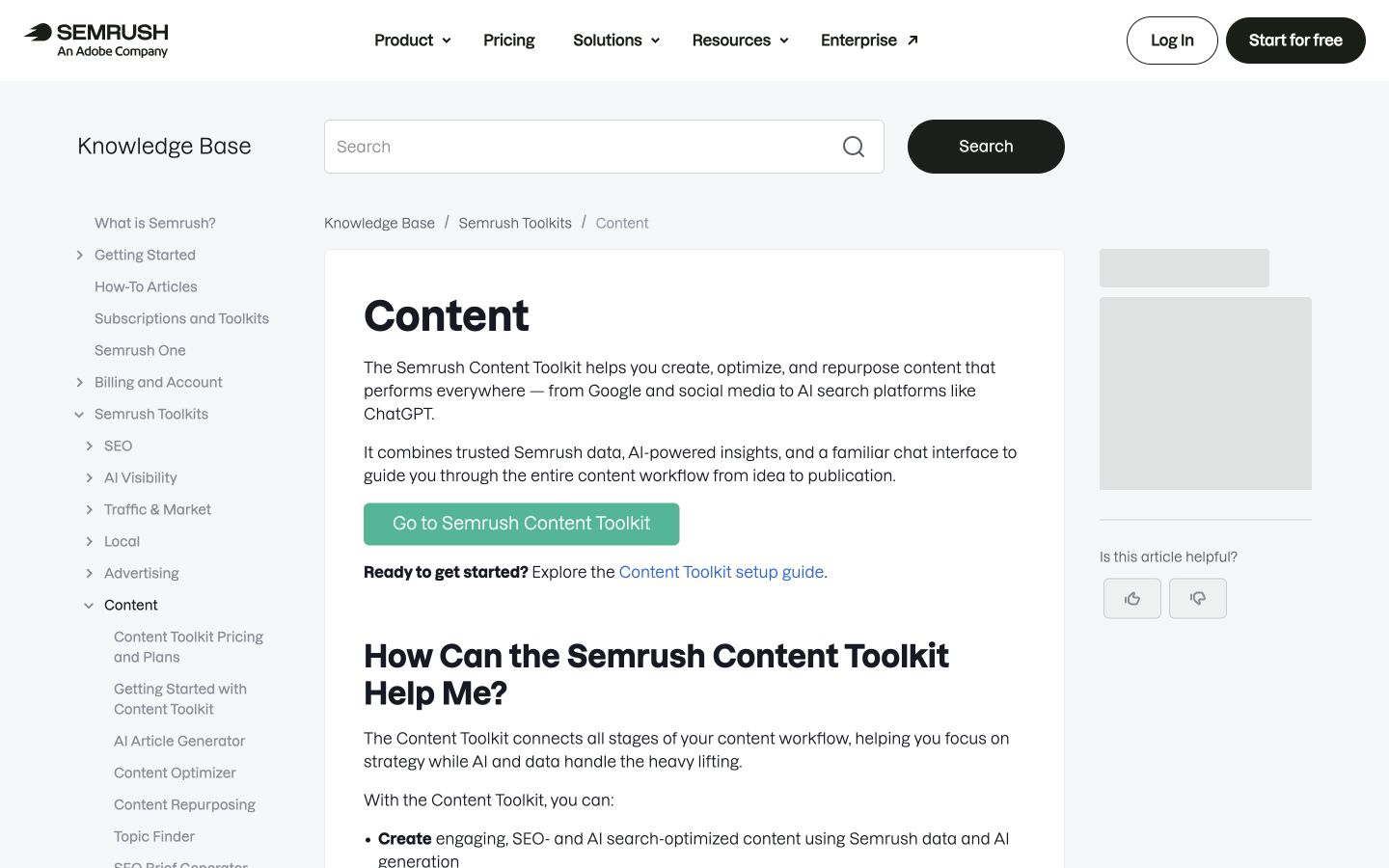
The public content product is one part of the wider Semrush platform. Compare the selected toolkit rather than treating all modules as one allowance. Source: Semrush.
9. AlsoAsked: Best for related-question research
AlsoAsked maps Google People Also Ask questions and exposes country, location, language and depth settings. These maps can improve a brief you later develop in ChatGPT. They are Google question research, not observed ChatGPT prompt volume.
Pricing: Its captured USD pricing page displays Basic at $12 per month for 100 credits. Confirm the selected billing period and current checkout terms.
Tradeoff: Related questions do not all deserve sections on the same page. Some represent troubleshooting, others a buying comparison or a basic definition.
Evaluation task: Run one topic with US English settings, then group the branches by reader decision. Bring only the relevant group into ChatGPT and request an outline with a source requirement for each factual answer. Keep other intents in separate briefs. You should finish with a focused article plan, not a large FAQ assembled from every available question.
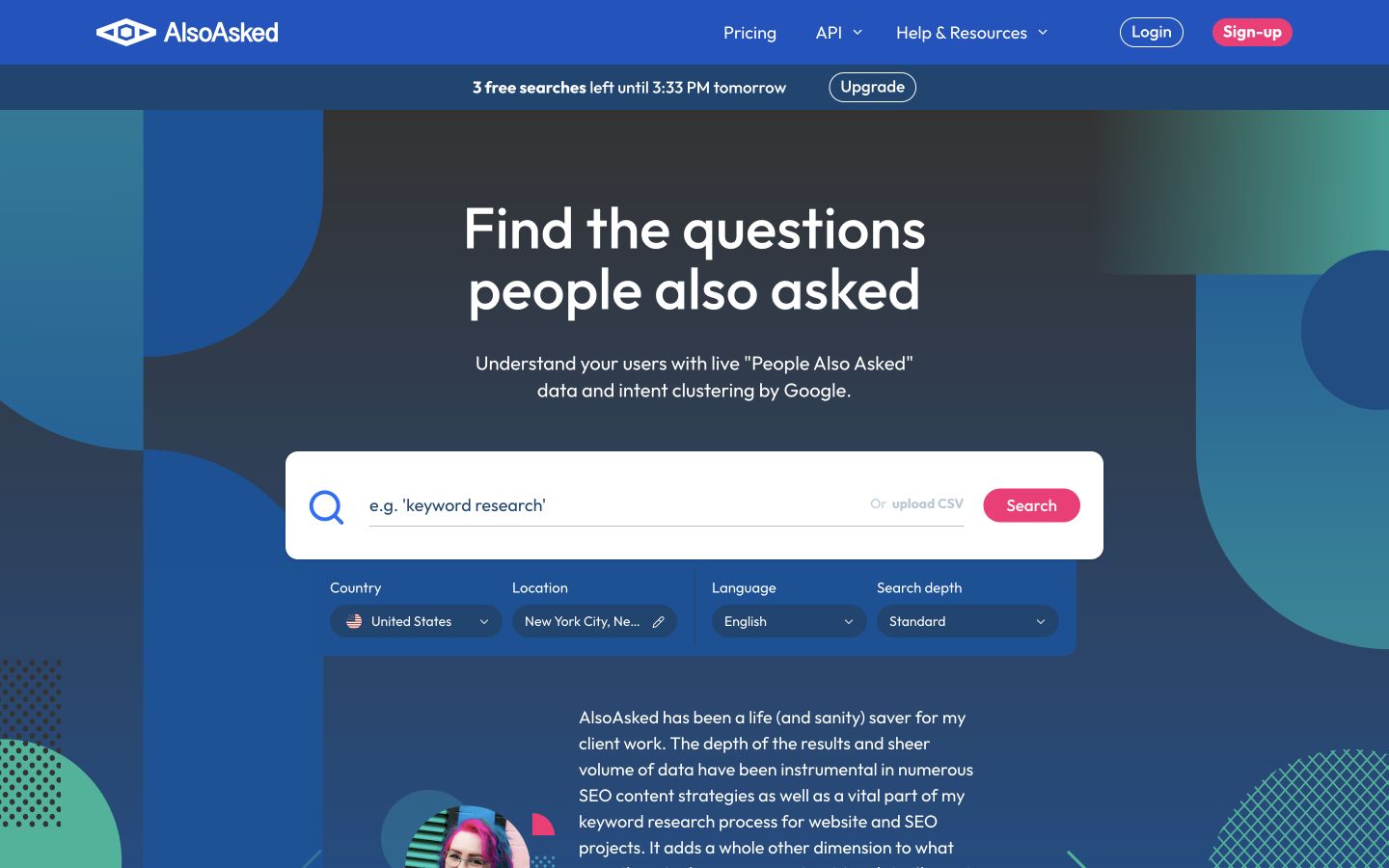
The question interface exposes market and language. Preserve these settings when moving research into a ChatGPT brief. Source: AlsoAsked.
10. Profound: Best for connecting AI visibility data with action
Profound’s current AI marketer positioning includes visibility investigation, content creation, optimization and CMS staging. It should not be dismissed as monitoring-only.
Buying check: Obtain the offer for your engine coverage, prompts, creation credits, seats and integrations. Our reviewed sources did not establish a reliable comparable paid price for that complete scope. A historical entry price from a roundup is not sufficient for a new purchase.
Tradeoff: A generated recommendation still needs fact-checking and approval. A visible mention does not establish that your page was cited, and a citation does not establish a sale.
Evaluation task: Pick one buying question. Inspect the saved answer and sources, identify a plausible content or positioning issue, and move a proposed correction into review. The purchase should make that handoff easier to understand. Ask where the draft is staged and who can approve it, rather than judging the tool from a headline visibility score alone.
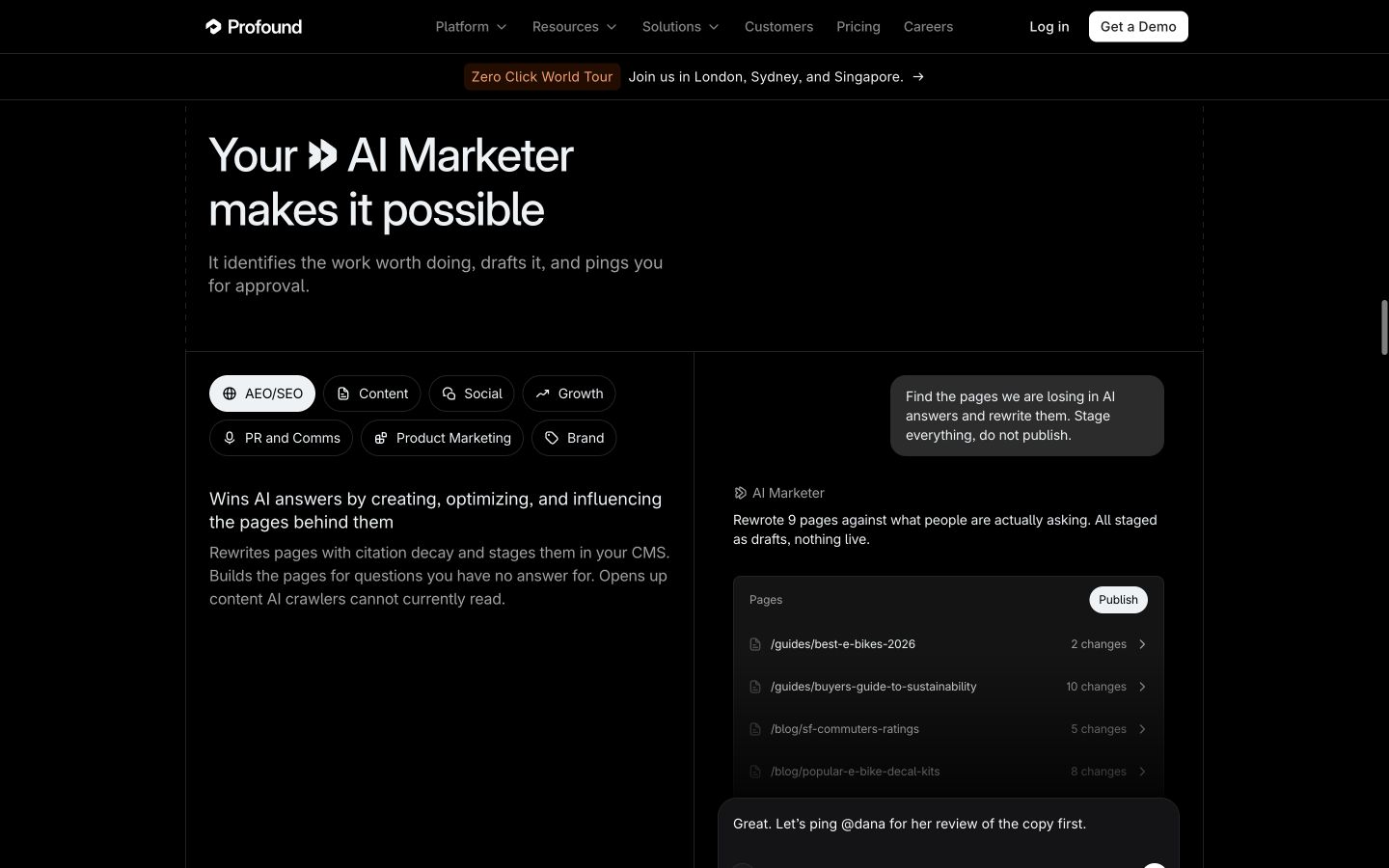
Profound now presents production and staging alongside visibility work. Source: Profound.
11. OtterlyAI: Best for a defined ChatGPT monitoring baseline
OtterlyAI covers prompt research, AI search analytics and GEO audits. It fits when you want to revisit a fixed set of business questions and inspect the responses and links.
Pricing: The reviewed monthly plans list $29 for 15 prompts, $189 for 100 and $489 for 400. Four base engines are listed; Claude, Gemini and Google AI Mode have separate add-on terms.
Tradeoff: Your selected questions define the sample. Monitoring fifteen prompts does not tell you how every potential customer uses ChatGPT.
Evaluation task: Include both a branded question and nonbranded buying questions. Inspect the answer, the cited URL and the date before interpreting a change. Record which finding would justify a page update, a new article or no action. Confirm the cost of the engines you will use; the homepage’s full engine menu is not the entry plan’s inclusion list.
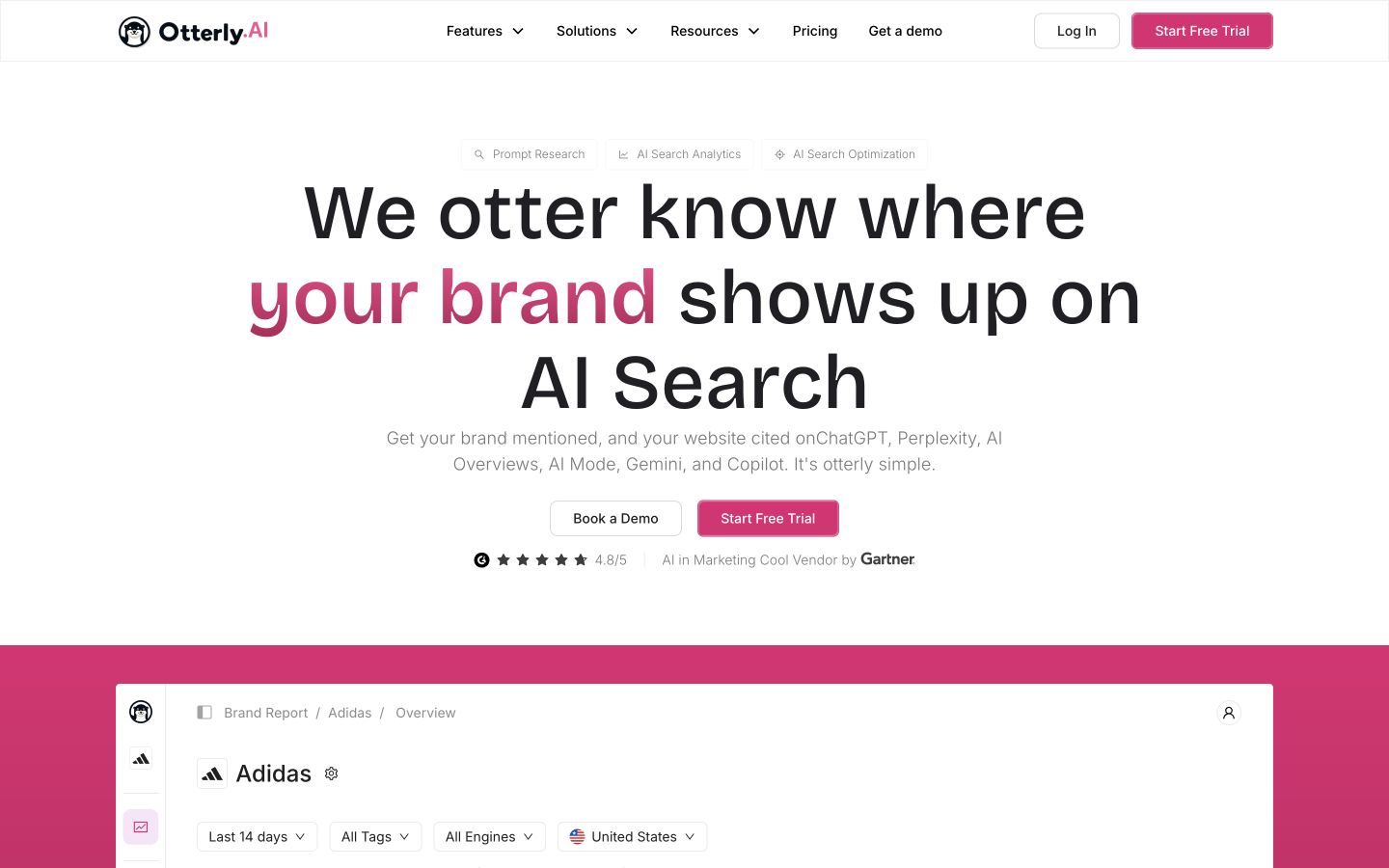
The public site describes analytics and audits. Use the underlying answer and plan coverage to interpret a visibility result. Source: OtterlyAI.
12. Ahrefs Brand Radar: Best for discovery and custom-prompt tracking
Brand Radar offers a broad AI visibility index and custom-prompt monitoring. Its public page explains that the index uses prompts modeled from search queries; that research coverage differs from a complete record of assistant conversations. Ahrefs Brand Radar.
Pricing: The reviewed AI Visibility Index starts at $199 per month; custom-prompt packages start at $50 for 2,500 checks. These are different buying routes. Confirm engine coverage, the required account and what is included in your subscription.
Evaluation task: Decide whether you need to discover topics or repeatedly monitor selected questions. For monitoring, calculate prompt × engine × market × update frequency, then check the vendor’s accounting. Open an underlying answer and verify the source URL before acting on a summary. Keep a large index’s discovery value separate from the repeatability of your own fixed sample.
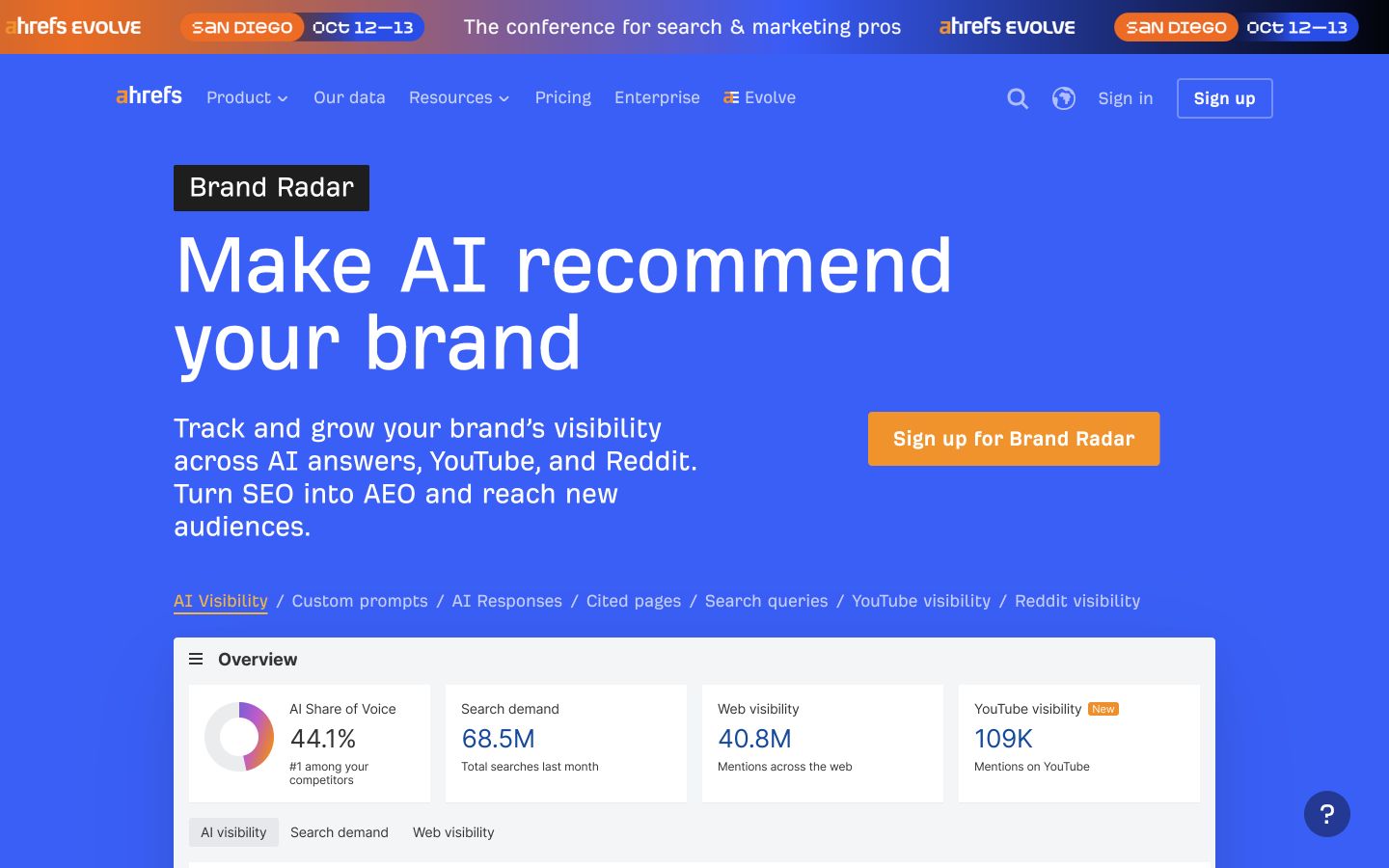
Brand Radar separates index research from custom prompts. Choose the route that matches your question before comparing the prices. Source: Ahrefs.
A source packet for ChatGPT SEO work
Use the documentation behind the page you are creating. For example, a brief about Shopify blog metadata can include Shopify’s SEO documentation, your existing article and the exact field requirements. A brief about WordPress publishing can include the connector documentation and the site’s established author and category rules. Shopify SEO documentation, Rankauto’s WordPress delivery documentation.
Your packet should contain the intended reader, one decision the article helps them make, approved facts, source URLs and dates, examples you can substantiate, and the planned destination. Label missing citations so the assistant can identify a gap instead of filling it with plausible text.
One instruction for a source-review task is:
Using only this source packet, identify unsupported statements in the draft. For each, show the statement, the supporting source if available, and whether to keep, narrow, verify or remove it. Preserve strong original examples. Do not invent keyword volumes, product features or test results.
This is a proposed instruction, not a record of a completed model test. Apply it where source review is the bottleneck; a tool shortlist does not need a prompt for every product.
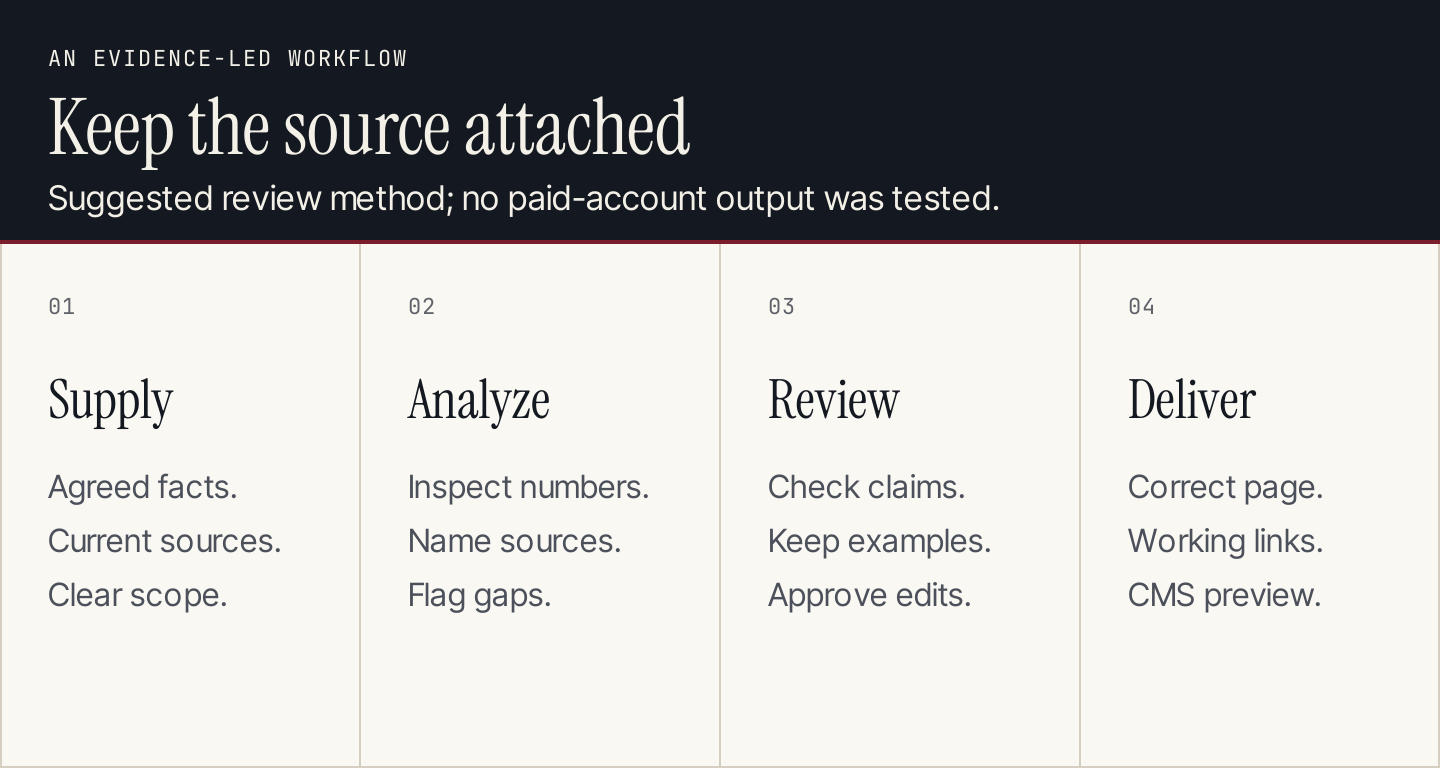
Suggested operating record. A good response preserves where its facts came from and what remains uncertain.
Compare total workflow cost
Keep four costs visible: the assistant subscription, connected data or API usage, specialist content or tracking plans, and human review. A $20 assistant plan and a $49 publishing subscription do not include the same work.
For a proposed setup with ChatGPT Plus and one Rankauto website, the listed software amounts total $69 monthly before extras and tax. That arithmetic does not establish compatibility, saved hours or equivalent output. Review the access and accepted pages.
| Record | What to measure in your evaluation |
|---|---|
| Research | Usable source rows, relevant market and cleanup time |
| Drafting | Claims that survive review and examples with sources |
| Publishing | Metadata, images, author, category and remaining manual work |
| Measurement | Questions, engines, dates and inspectable answers |
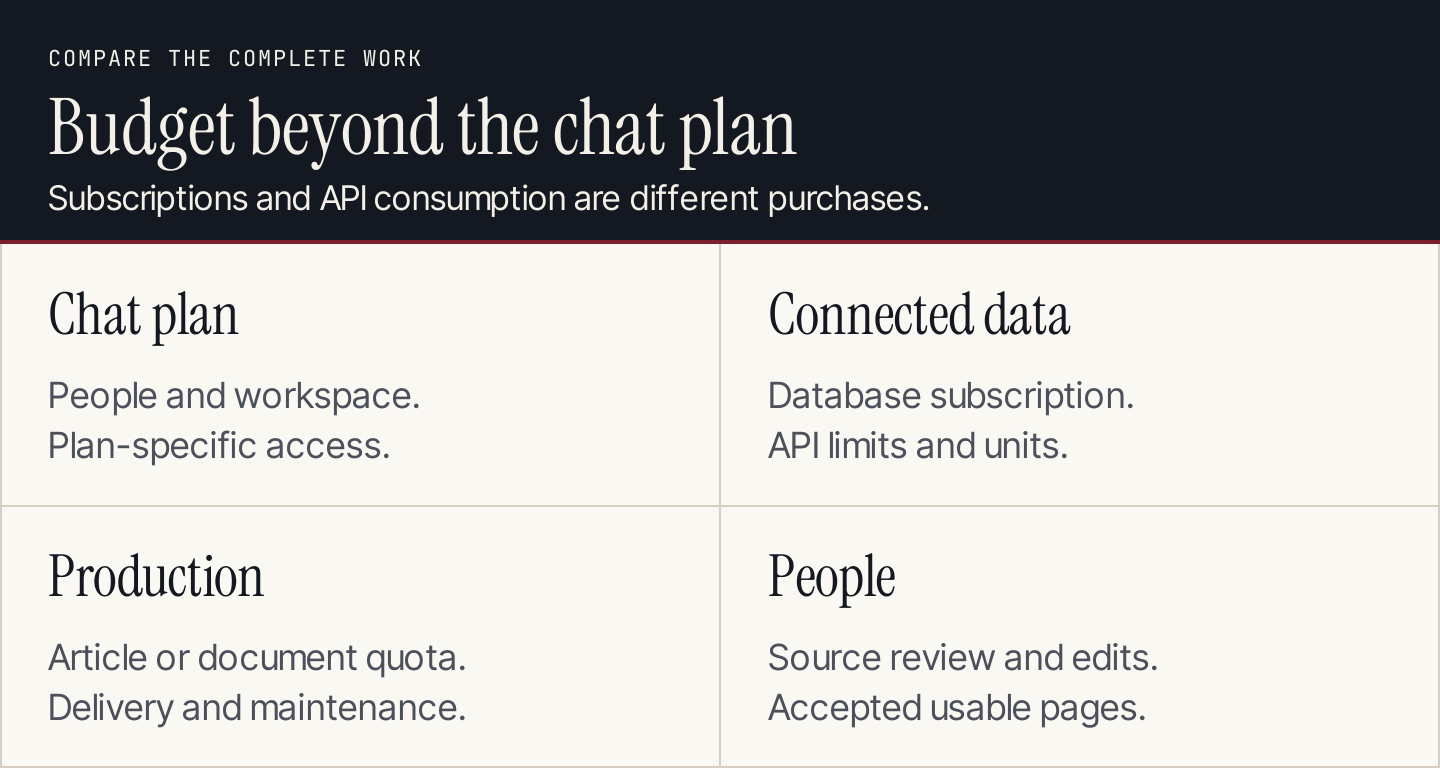
Compare the complete task. Keep subscription usage and API billing separate.
Frequently asked questions
Can ChatGPT replace an SEO research tool?
It can help interpret supplied or connected data. Without a documented data source, an estimated keyword volume in an answer is not a research measurement. Use an appropriate connection or export and retain its market and date.
Is Rankauto a ChatGPT plugin?
No. Rankauto doesn't run inside ChatGPT. We recommend it as a dedicated article production workflow alongside ChatGPT, with a clear CMS review step.
Which tool helps a business appear in ChatGPT answers?
Production tools help create pages; measurement tools record observed answers. Google’s AI search guidance emphasizes existing SEO fundamentals and does not require special AI files or schema. No tool can promise a citation from a particular article. Google’s AI features guidance.
What should I evaluate first?
Choose one task and inspect the complete output. If publishing is the missing step, review Rankauto’s content workflow. If reliable data or a monitoring baseline is missing, select that specialist role first.