Keyword Stuffing and Density: Edit Repetition Without a Target Score

Keyword stuffing uses keywords or numbers in ways intended to manipulate search rankings, often through unnatural repetition or out-of-context lists. Keyword density is a measurement of repetition under a particular counting rule. A percentage does not tell you whether a page is useful or whether it violates a spam policy.
To edit a page, read the language in context. Keep the words that identify the subject, explain the product, or help someone complete a task. Remove repetitions and lists that add no useful meaning.
This guide explains the policy boundary, demonstrates a checked density calculation, and works through an original editing exercise using facts from Basecamp’s public website. The deliberately weak paragraph is teaching copy, not text published by Basecamp.
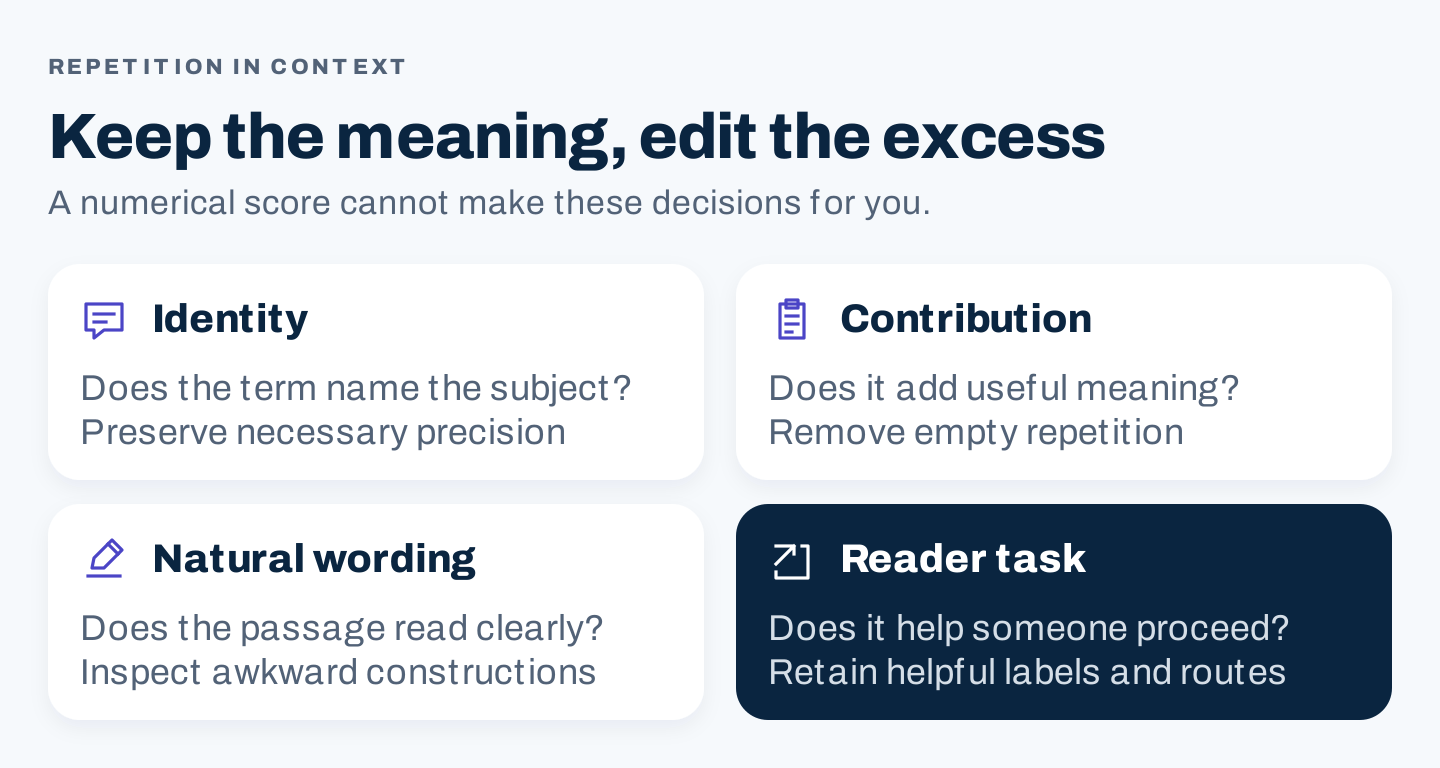
Original review framework: ask what the term identifies, what meaning it adds, whether the sentence sounds natural, and whether the passage helps the reader.
1. Recognize stuffing by purpose and context
Google’s spam policies describe keyword stuffing as filling a page with keywords or numbers to manipulate rankings. Examples include unnatural repetition and groups of terms without substantial useful context.
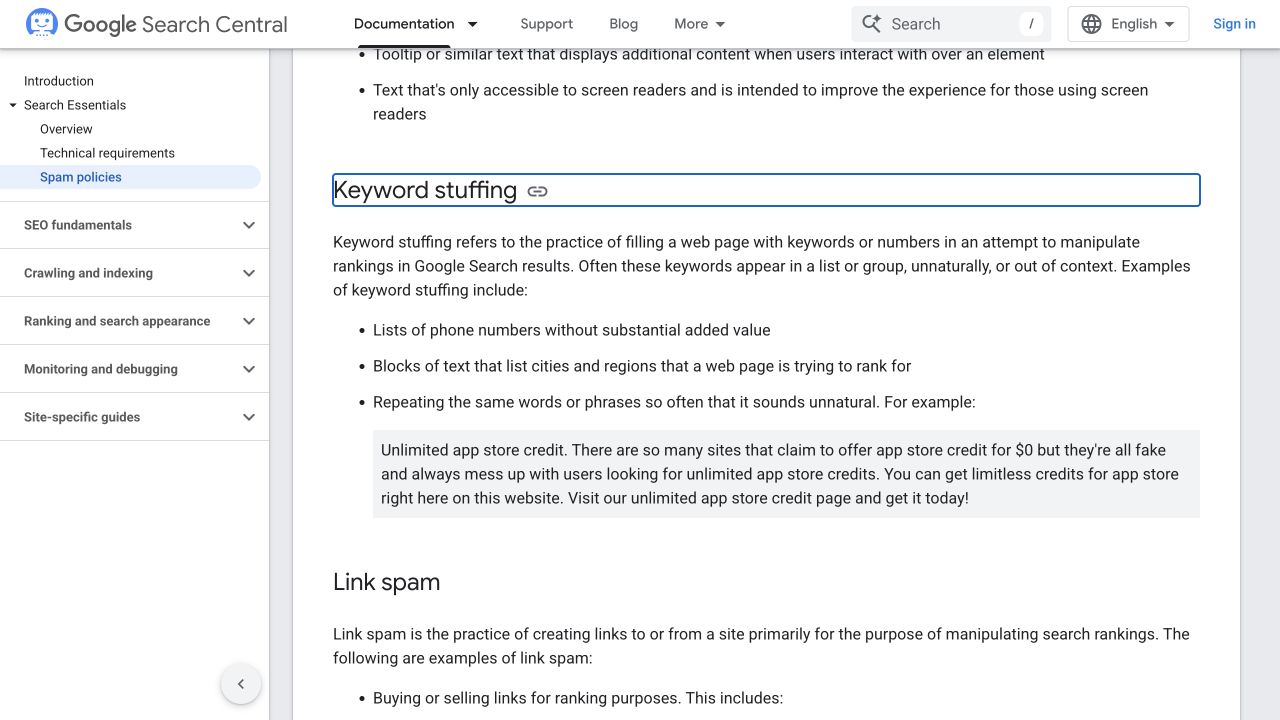
Google’s official policy describes the behavior and its purpose. It does not provide an ideal keyword-density score. Captured October 8, 2026.
The key question is what the words are doing. A list of actual branch locations can help customers choose a destination. A block of unrelated city names added to attract searches serves a different purpose. A product guide may need to repeat an interface label so that the instruction remains precise.
Review more than body paragraphs
Excessive repetition can appear in titles, headings, image descriptions, links, and sitewide templates. A page can have a low body-text percentage while its title is a string of nearly identical phrases.
Google’s title-link guidance recommends distinct, descriptive titles and advises against unnecessary repeated phrases. Write the title as a useful description of the page’s job.
Compare these original teaching titles:
| Title | Editing finding |
|---|---|
| Project Management Software, Project Software, Team Project Management Software | Variations accumulate without distinguishing the resource |
| How to Organize Project Tasks in Basecamp | Describes a specific task and product context |
The second title is a proposed guide title, not a claim about its ranking or an actual Basecamp article.
Distinguish hidden abuse from legitimate design
The same Google policy page distinguishes manipulative hidden text from legitimate accordions, tabs, and accessibility content. Do not remove screen-reader text or helpful expandable answers simply because they are not continuously visible.
Investigate the purpose and implementation. Hidden blocks of search terms need a different response from an accessible label that helps someone operate a control.
2. Calculate density only when it answers an editing question
A simple occurrence-based calculation is:
Density (%) = exact keyword or phrase occurrences
              ÷ total words in the defined text
              × 100
Define the phrase and the text scope before counting. Decide whether you are measuring the main article, a section, or a whole extracted page. Document whether the tool includes navigation, captions, tables, footers, and hidden or expandable content.
For a multiword phrase, the occurrence-based method above counts each exact phrase match once. Some tools instead count the words within matches or apply different tokenization rules. Their results will not necessarily be comparable.
A checked illustrative example
Suppose the exact phrase appears four times in a 200-word passage. Under the method above:
4 ÷ 200 × 100 = 2%If the same four occurrences appear in an 800-word passage:
4 ÷ 800 × 100 = 0.5%These are illustrative inputs, not observations from a business website. The lower percentage says the measured text is longer relative to the same number of occurrences. It does not tell you whether the answer improved.
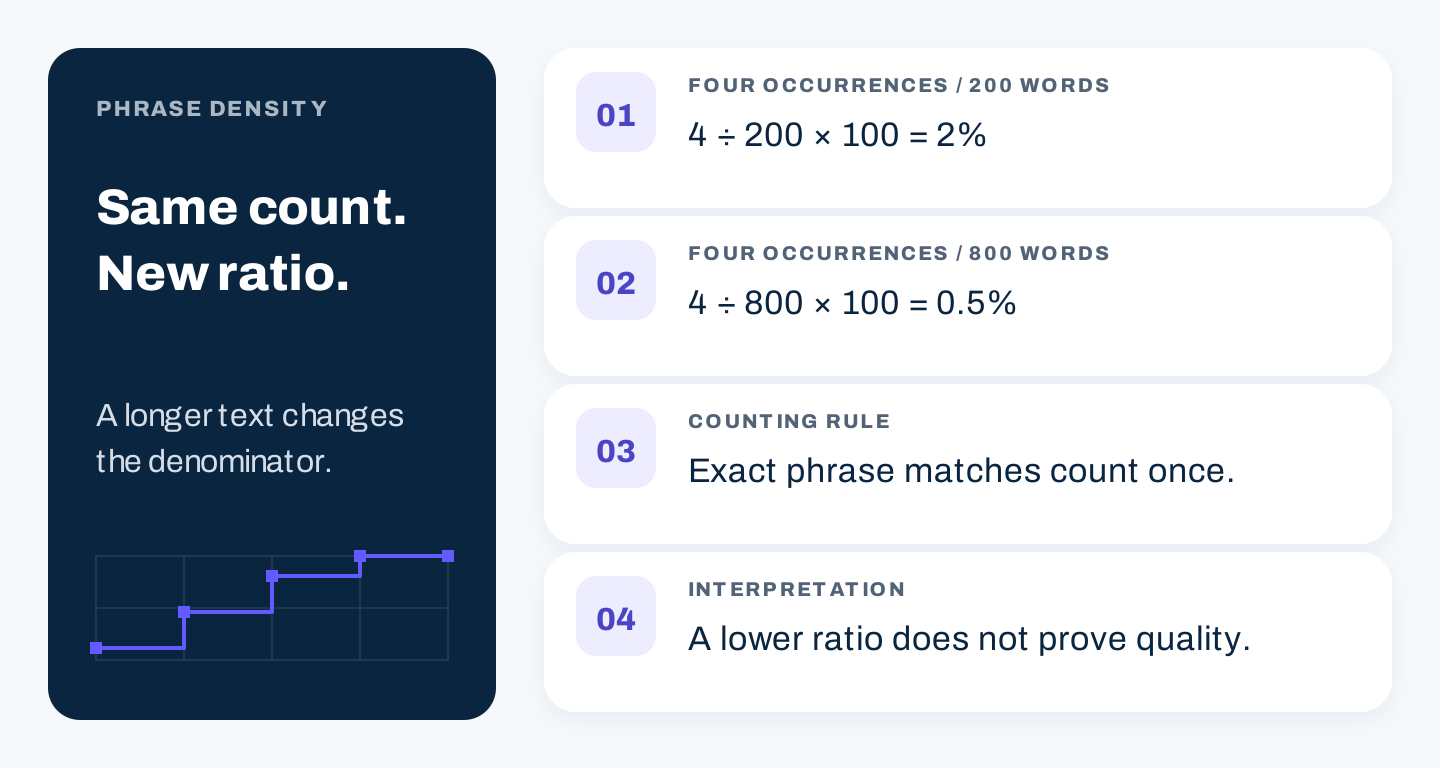
Original arithmetic example: 4/200 is 2%, while 4/800 is 0.5%. Changing the denominator changes the score without establishing better content.
This is why adding filler to reduce a percentage is a poor editing method. You can make the number smaller while making the page harder to use.
Compare measurements only under the same rule
Before comparing your page with another page, confirm the same phrase, extraction scope, tokenizer, and counting method. A tool that includes a repeated sitewide menu can report something different from a tool that analyzes only the main text.
Even a consistent comparison is descriptive evidence. It does not establish that the competitor’s percentage caused its ranking or that matching the value will improve yours.
Use a score to locate passages worth reading. Release an edit because the language and content fulfill the task, not because the number falls within an assumed ideal range.
3. Learn from Basecamp’s actual page context
Basecamp’s public pages show how category language and exact feature labels can do different jobs. These observations illustrate writing choices; they do not prove search performance or product effectiveness.
The homepage establishes the subject
The Basecamp homepage places the product in the context of projects and teams. Its example project names specific tools. The surrounding material helps a visitor understand what the page is about.
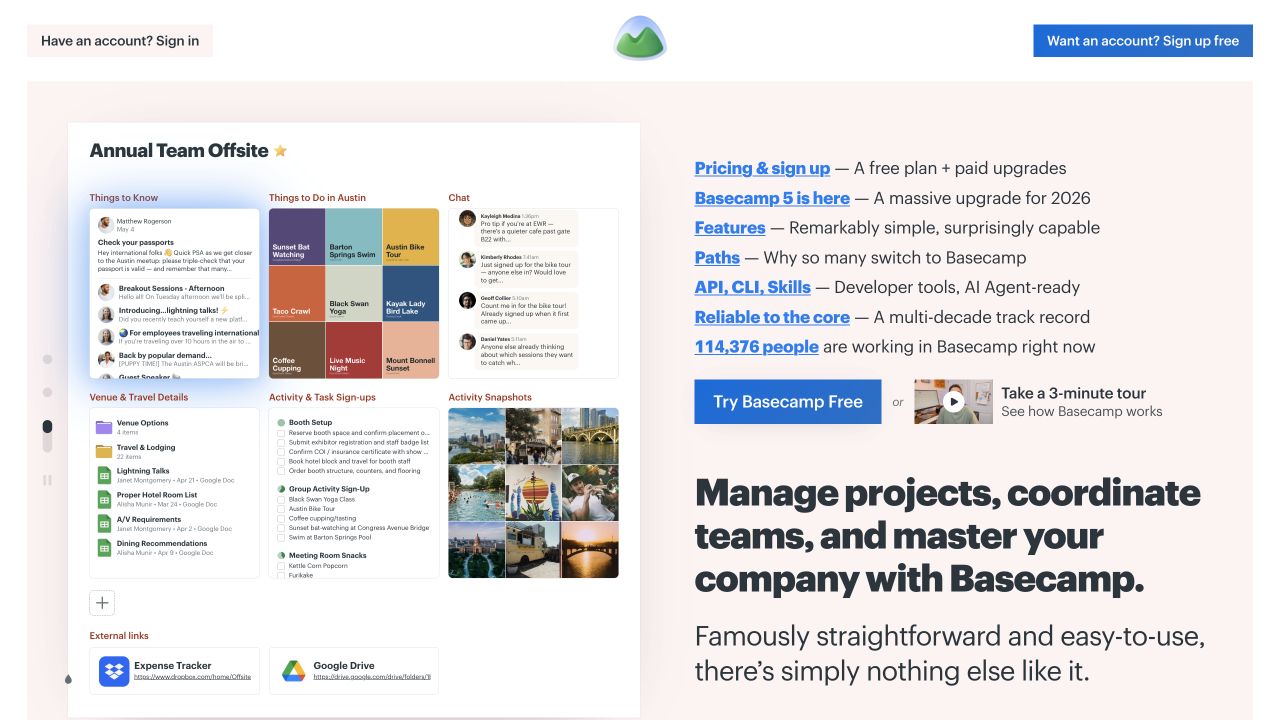
Basecamp’s public homepage, captured October 8, 2026. Terminology has a clear contextual job; popularity and outcome claims are not part of this analysis.
This gives an editor a useful question: if you remove the category language, does the visitor still understand the subject? Cleaning repetition should not remove the information that establishes relevance.
Feature names preserve precision
The features page names tools including Message Boards and To-do Lists. Its list description identifies assignment and due-date capabilities.
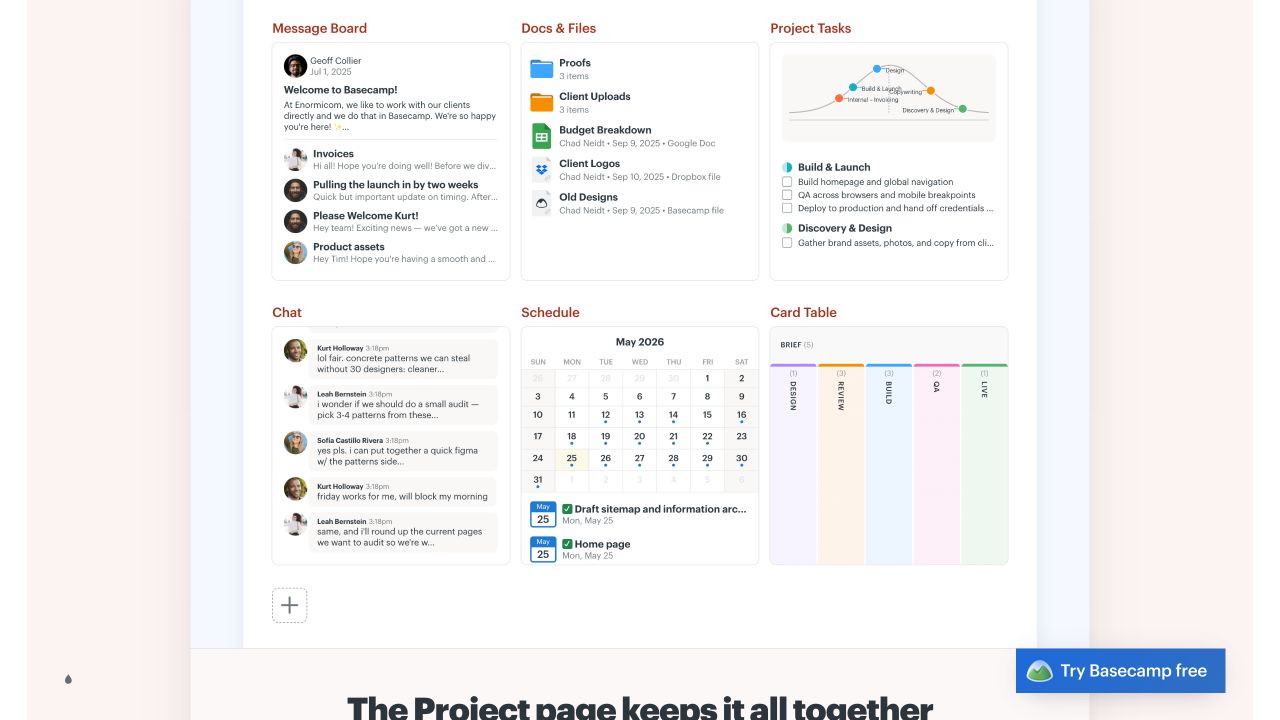
Specific feature labels distinguish the explanation. Replacing them with arbitrary synonyms could make a product instruction less precise.
In an instructional article, repeating “To-do Lists” can help someone follow the relevant route. Replacing it with several invented alternatives merely to reduce repetition can create ambiguity.
The same principle applies outside software. A service name, model number, material specification, or eligibility term may need consistent use. Judge whether the term helps the reader identify the right thing.
4. Edit an original repetition exercise
Here is a deliberately weak paragraph written for this guide:
Basecamp project management software is project management software for teams needing project management software. Use Basecamp project management software to manage project management tasks with project management tools for project management teams.
The paragraph repeats a broad category while telling the reader very little. It does not distinguish the tools or explain a useful task. This is not Basecamp’s published copy.
Step 1: Decide what the paragraph should explain
Choose one job: introduce how a project page organizes related work. That is narrower and more useful than repeating the category name.
Step 2: Mark the meaning that should remain
Keep the product identity, the project context, and supported examples of relevant tools. Remove the repeated category phrases that do not add a distinction.
Step 3: Write a supported replacement
Here is an original proposed revision:
Basecamp brings tools onto a project page. Message Boards organize announcements and discussions; To-do Lists let teams assign items and set due dates. Explain the tools relevant to the reader’s task rather than repeating the software category in every sentence.
The capability statements come from the public feature description. The final sentence is editorial advice. No account was used, and no improvement in rankings, engagement, or task completion was measured.
Step 4: Check the edit for lost meaning
| Check | Why it matters |
|---|---|
| Product identity remains clear | The reader knows what the paragraph concerns |
| Exact labels remain accurate | The explanation refers to real tools |
| Capability claims match the source | The edit does not create a new promise |
| Repetition adds useful meaning | Remaining terms explain distinctions or preserve clarity |
| No outcome claim appears | A cleaner paragraph is not proof of a business result |
This is a stronger editing process than removing every second occurrence of a phrase. It checks what the paragraph communicates.
Use this worksheet on your own page:
Passage and intended reader task:
Terms that identify the subject or exact feature:
Repetitions that add no meaning:
Claims and source references to preserve:
Proposed revision:
Meaning or conditions lost during editing:
Reviewer decision and reason:
If an AI editor proposes synonyms, check whether they are still accurate labels. If it removes a qualification to make the sentence smoother, restore the condition or rewrite the sentence. The human reviewer remains responsible for the meaning.
5. Check the places a body-text score misses
Review the complete page and any shared template that produces the same problem elsewhere.
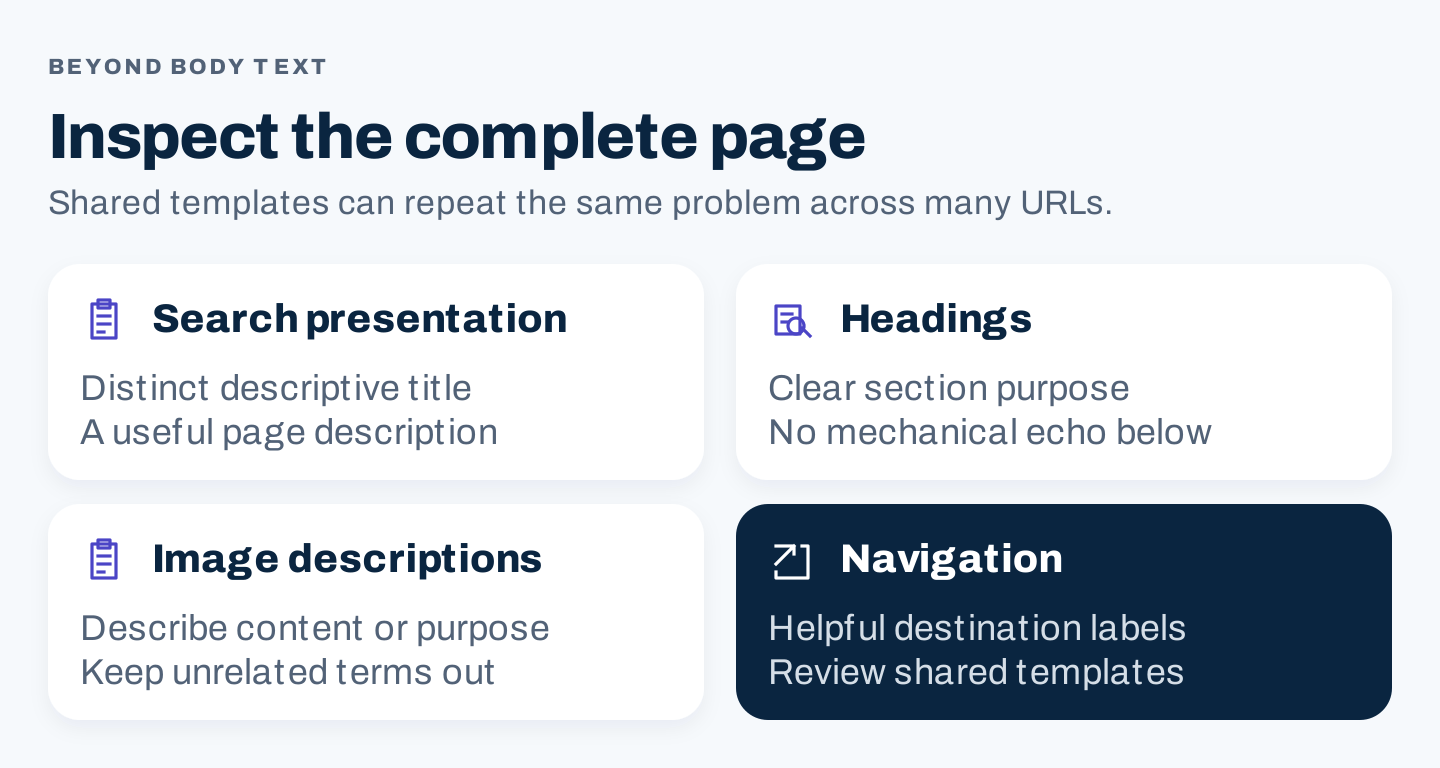
Original page review: inspect search presentation, headings, image descriptions, and navigation alongside the body copy.
Titles and descriptions
Read the title as a person choosing a result. Does it distinguish this page? Does it promise a task the page actually fulfills? Remove near-duplicate variants that do not add useful scope.
Write a description that summarizes the answer. Google’s snippet guidance explains that snippets may come from the page and vary by query. A list of keywords is a poor substitute for a clear description.
Headings and adjacent sentences
Review headings together with the first sentences below them. A heading can identify a section clearly without requiring the opening sentence to repeat the same phrase mechanically.
Keep a repeated label where it aids scanning or prevents ambiguity. Remove a repeated category phrase when the heading and paragraph merely echo each other.
Image descriptions
Describe the image’s relevant content or purpose. Do not append a list of unrelated target terms to alt text. If the image contains information essential to the task, also provide that information in readable page text.
For an actual software screenshot, identify what it shows. If it is only documentation evidence, do not label it as a completed product test or a business result.
Link text and shared navigation
Link labels should explain the destination. Necessary navigation terms can repeat across a site. Evaluate whether a label helps someone choose the route rather than treating every repeated menu item as stuffing.
If the problem comes from a shared footer or template, fixing one article body will not resolve it. Ask the responsible owner to inspect the template and check the affected page family after the change.
Location and service lists
Confirm that a list corresponds to actual useful coverage or choices. Provide enough context for a customer to understand what is available and where to go next. Remove irrelevant geographic terms added without a service or navigation purpose.
Avoid a universal safe count. A useful store directory and an out-of-context city block can contain similar terms while serving very different purposes.
6. Verify the correction before judging the outcome
Read the revised page aloud, then inspect the rendered desktop and phone versions. Check the title, opening, headings, figures, captions, descriptions, and useful next routes.
If you used a density tool to find the original passage, rerun it under the same extraction settings to confirm what changed. Keep the numerical result subordinate to the manual review.
Record the edit:
URL and prior version:
Problem identified and affected page areas:
Changes made:
Necessary terminology and conditions preserved:
Source checks completed:
Shared-template changes, if any:
Live-page review and date:
Outcome measure and comparison context:
If the site has a confirmed search-policy issue, involve the person responsible for that remediation and verify the specific issue. A repetition score alone cannot diagnose a manual action or determine a recovery timeline.
For ordinary editing, evaluate whether the page now communicates the intended answer accurately. Search performance can be reviewed over an appropriate period, with other changes and measurement limits recorded. A tidier paragraph does not establish that every later ranking movement came from the edit.
Questions about keyword stuffing
Is there an ideal keyword density?
Do not use a percentage as a universal release target. The relevant editorial questions are whether the language is natural, the subject is clear, necessary terminology is precise, and the page supplies a useful answer.
Can a product name appear many times?
Yes, when its use helps readers understand the explanation. Inspect the context. Exact feature names may need repetition in instructions, while broad category phrases repeated without meaning usually need editing.
Should we remove all keywords to be safe?
No. Google’s Search Essentials recommend words people use to find your content in descriptive locations. Use relevant language clearly and accurately. Removing the subject terms can make the page less understandable.