ChatGPT for SEO: Prompts, Limitations, and a Review Workflow

ChatGPT can help turn research, keyword exports, page content, and review notes into useful SEO work. The strongest tasks give it evidence to inspect and a result you can verify: a focused brief, proposed keyword groups, metadata variants, or an editing plan.
The weak version starts with “write an SEO article” and accepts the polished response as finished research.
Use the workflows below to make ChatGPT a useful part of the process. Each prompt defines the input, output, and review that remains. The prompts are original templates, rather than transcripts of tests performed for this article.
Using ChatGPT for SEO is different from appearing in ChatGPT
This guide covers doing SEO work with ChatGPT. Getting a business mentioned or cited in AI answers is a separate discovery and measurement task.
A good prompt can help you analyze a draft. It does not ensure that the published page will be cited in someone else’s conversation. Keep your production records separate from your visibility records.
Also check the capabilities available in your actual product. OpenAI’s current web search documentation explains web-assisted research, while its usage guide covers working with research and files. Availability depends on the product and workspace configuration.
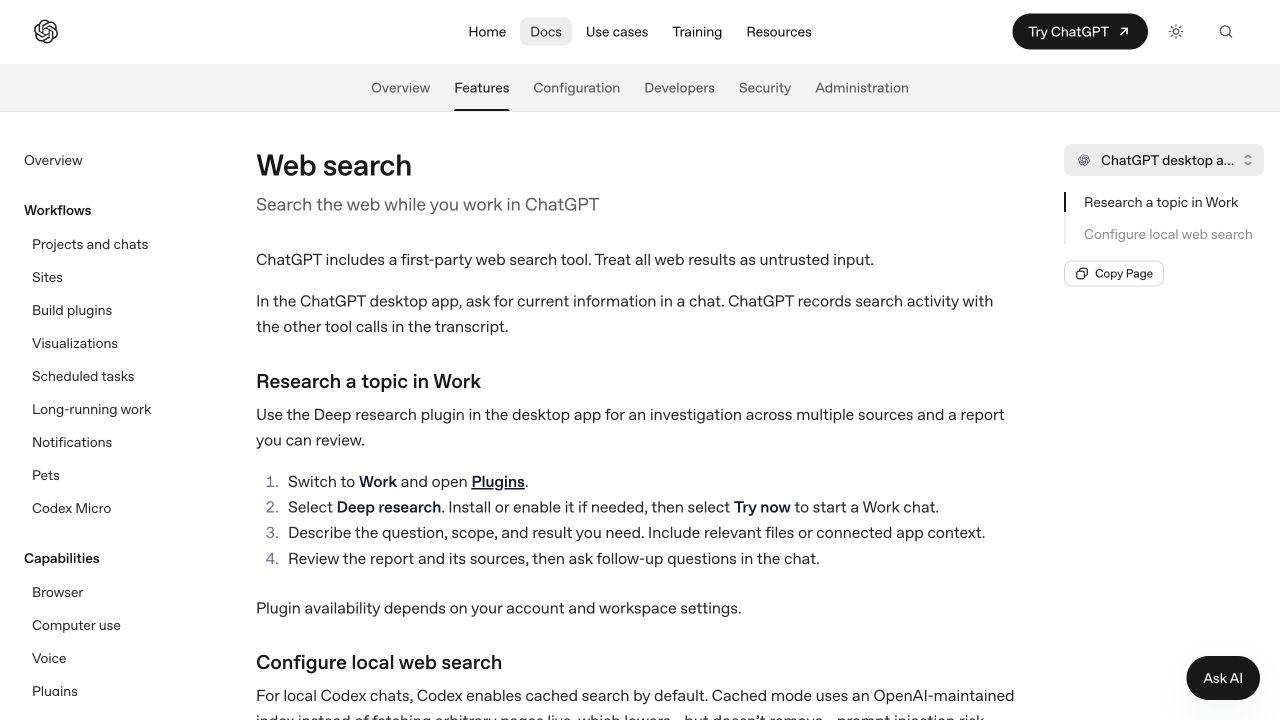
Public documentation, captured October 8, 2026, showing the desktop-app surface. It is not a screenshot of an SEO research session or a claim that every account has identical capabilities.
If you ask for current research, confirm that the answer actually used current sources. A request to browse is not proof that a specific page was opened or read. If a page cannot be accessed, supply authorized source material or record the gap.
Give ChatGPT a useful working brief
Before the individual tasks, define:
- Audience: who is making the decision and what they already know.
- Task: what the page or analysis should help them do.
- Evidence: source notes, actual URLs, data exports, and relevant dates.
- Limits: unsupported claims, excluded topics, and information that must remain unchanged.
- Acceptance: what the reviewer needs to see before using the result.
Use public or appropriately authorized material. Remove unnecessary private information from the input. Customer context can usually be represented as a general requirement without sharing an identifiable customer record.
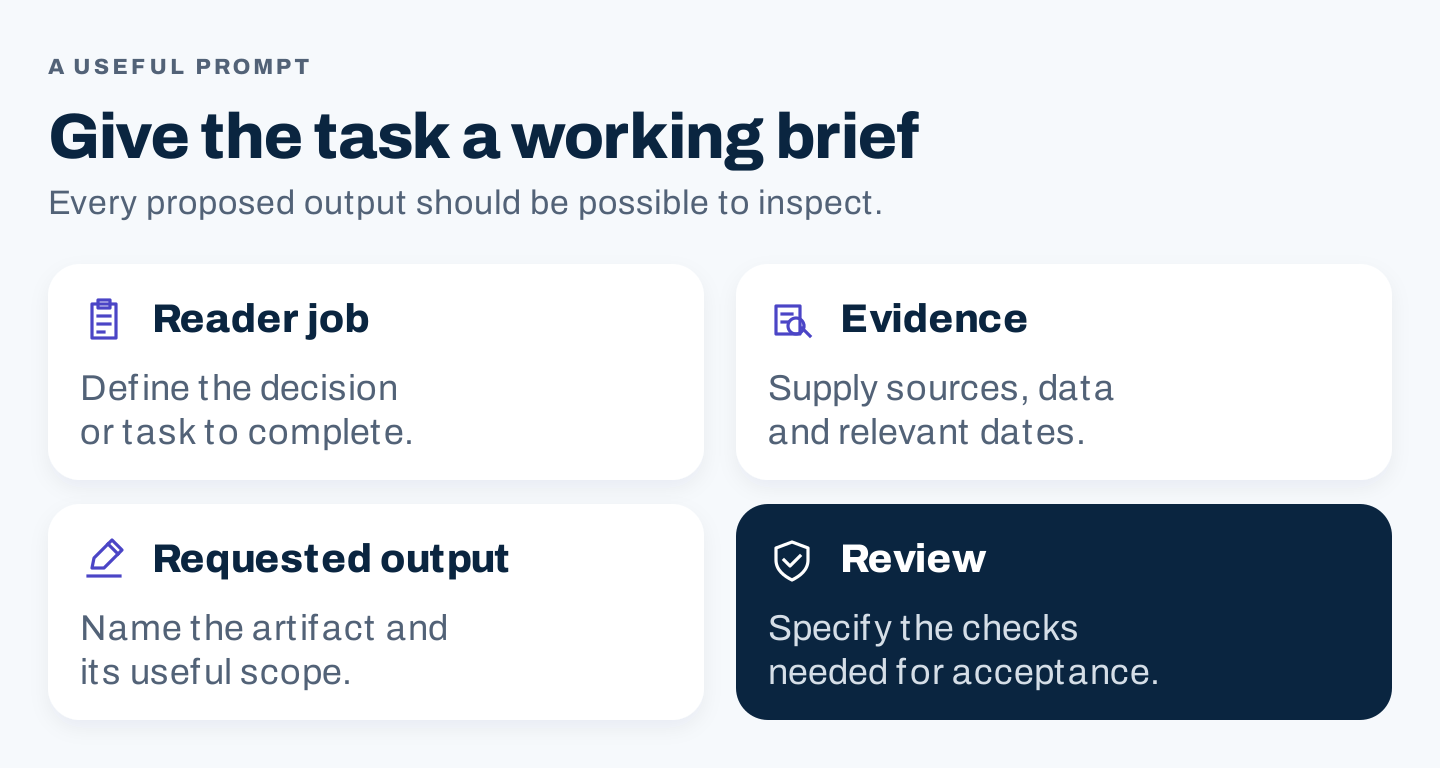
Original prompt framework. Clear inputs make the result easier to inspect and improve.
1. Generate keyword ideas without inventing demand
Use it for: exploring how someone might describe a problem, comparison, or buying condition.
Provide: the offer, audience, market, known customer questions, and topics already covered.
Help develop keyword ideas for this US English audience and offer.
Use the supplied customer questions and existing page list.

Group ideas by reader task: understand, compare, choose, or implement.
For each idea, explain the task and likely useful page format.
Separate ideas directly supported by customer notes from hypotheses.
Do not invent search volume, keyword difficulty, or traffic estimates.
Flag overlap with an existing page rather than proposing a duplicate.
Review: check the ideas against current keyword evidence and the actual search results for the intended market. A generated phrase may be useful without having measured demand; preserve that distinction.
If you obtain a keyword export, retain the provider, country, collection period, and metric definitions. Never let an AI-generated number silently replace a missing value.
2. Propose clusters from an actual export
Use it for: reducing a checked keyword list into candidate page groups.
Provide: rows with stable IDs, keyword text, supplied metrics, market, and any observed search-result notes.
Group these supplied keyword rows into candidate page clusters.
Preserve every row ID, keyword, and supplied metric exactly.
Use null for missing metrics; do not estimate replacements.

For each cluster, state the common reader task and proposed page type.
Flag rows where similar wording may hide a different intent.
List ambiguous rows separately and explain the evidence needed.
Return a reconciliation showing every input ID appears exactly once.
Do not claim that semantic similarity proves the same search intent.
Review: compare current search results for representative and ambiguous queries. Decide whether one page can genuinely complete the different tasks. “What is a CMS?” and “best CMS for an online store” share a subject but can require different content.
Also check row counts and duplicated IDs. An attractive summary can still lose part of the input. For large exports, process explicit batches and reconcile the complete list before accepting the clusters.
3. Turn a real page into a decision-focused brief
A useful brief specifies what someone needs to decide, rather than listing every subtopic associated with a keyword.
For a real example, REI’s backpacking sleeping bag guide organizes its introduction around temperature rating, sleep system, insulation, weight, and features. Those are distinct factors in the reader’s choice.
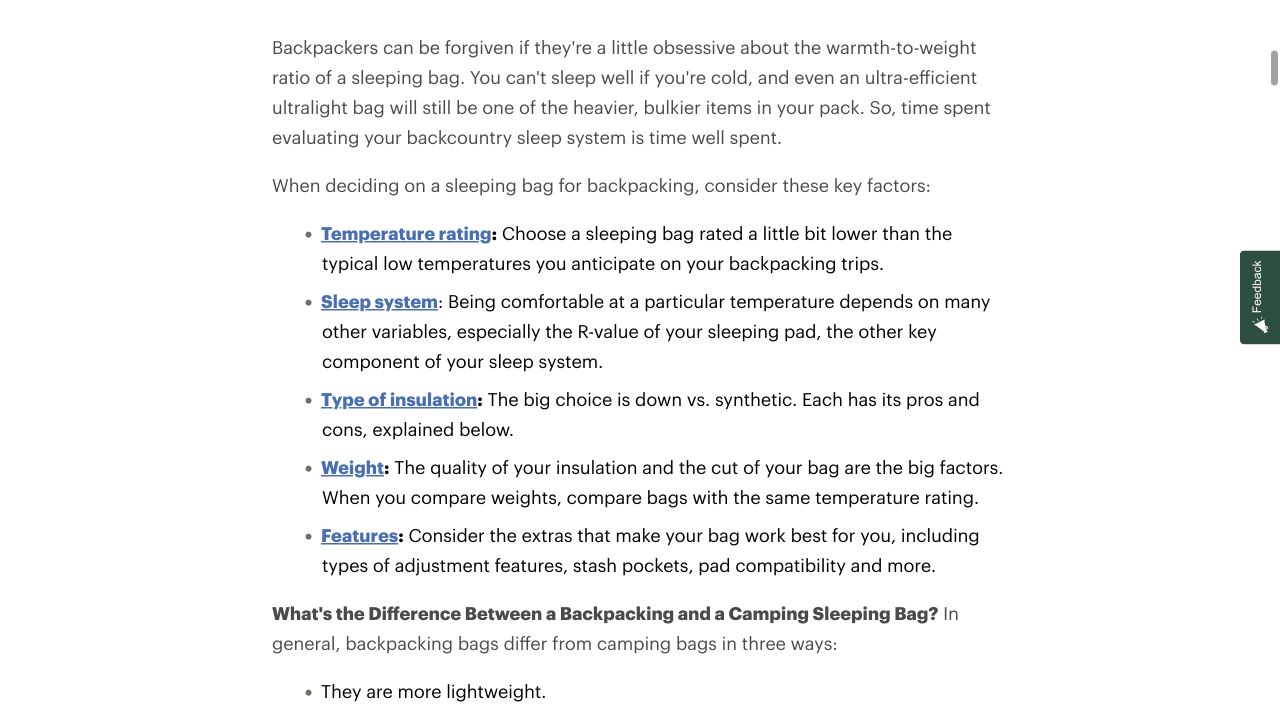
Public REI page, captured on desktop October 8, 2026. This is an analysis of its visible decision structure, without a claim about its rankings, AI citations, or commercial results.
The editorial lesson is to define the questions a useful article must settle. A vague brief such as “cover sleeping bags comprehensively” does not tell the writer which comparisons or conditions matter.
An original planning exercise for the same reader task could specify:
| Brief element | Proposed editorial requirement |
|---|---|
| Reader job | Compare the factors involved in choosing a backpacking sleeping bag |
| Key decisions | Explain how the documented factors affect the choice |
| Evidence | Current authoritative references for material product or technical claims |
| Useful visual | A comparison table whose conditions and sources are visible |
| Exclusions | Unsupported product rankings or claims of testing not performed |
| Completion | The reader can identify the next checks needed for their own situation |
This is our proposed brief, not REI’s internal brief and not an observed ChatGPT output. Do not copy the guide’s wording or turn its public structure into a claim of firsthand product testing.
Create an original content brief from the supplied sources and notes.
State one reader decision and the questions needed to complete it.
Map each material factual point to its supporting source.
Suggest an outline, useful real examples, and purposeful visuals.
Explain which details require additional evidence or expert review.
Exclude unrelated subtopics and unsupported product rankings.
Do not copy a source article's prose or imitate its entire structure.
Review: open the important sources, confirm their scope, and check that the proposed article contributes something useful. More headings alone do not make the brief stronger.
4. Draft titles and descriptions from the actual page
Use it for: generating accurate variants that describe a finished page.
Provide: the page text, primary reader task, site naming convention, and any practical CMS limits.
Write three title and meta-description options for this page.
Each option must describe what the supplied page actually delivers.
Keep the wording concise, distinct, and natural.
Do not add claims of testing, savings, ranking, or completeness
unless the page contains evidence for them.
Explain the difference in reader emphasis between the options.
Report character counts as editing information, not ranking rules.
Google’s title-link guidance calls for descriptive, concise titles and explains that title links can be generated from several page signals. Its snippet guidance explains that snippets can come from page content and sometimes the meta description. Google does not specify a universal hard character limit for either; display truncation depends on the presentation.
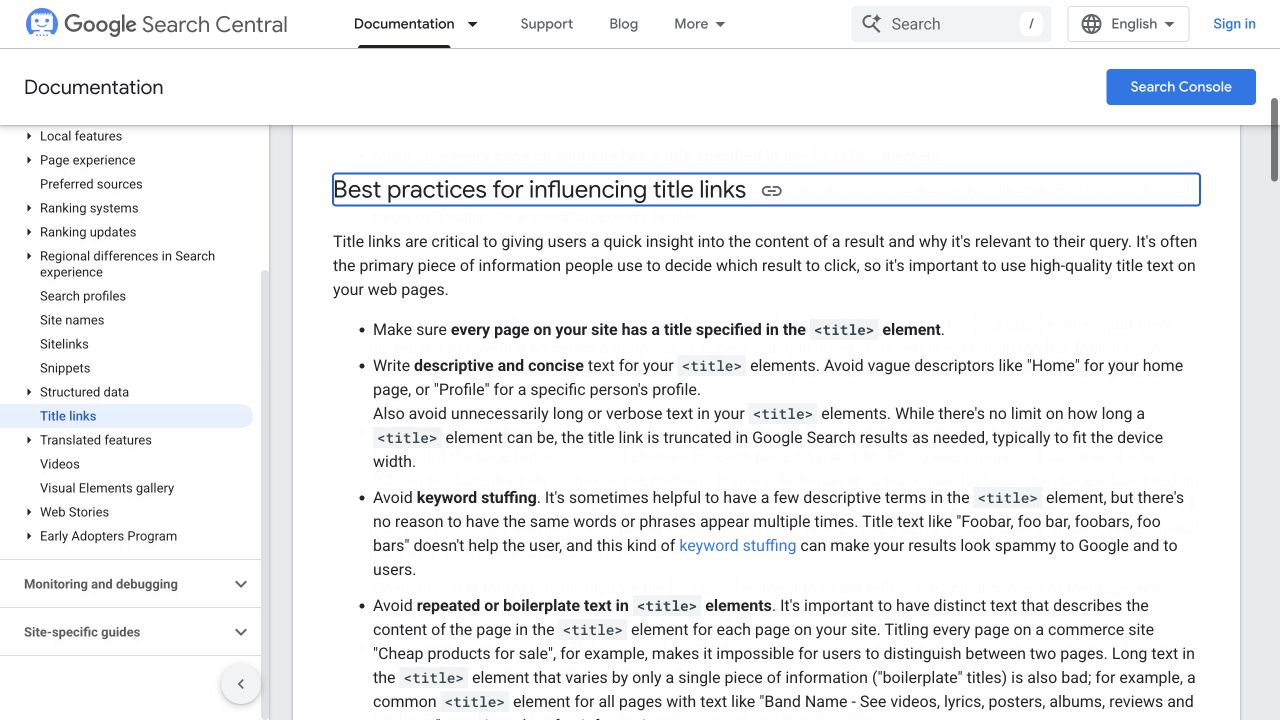
Public Google documentation, captured October 8, 2026. Use the actual guidance when reviewing metadata rather than treating a suggested character count as a hard search rule.
For the REI reader task, two original editorial title variants might be:
- “How to Choose a Backpacking Sleeping Bag”
- “Backpacking Sleeping Bags: Compare the Factors That Matter”
The first emphasizes the task; the second emphasizes comparison. Neither adds “tested,” “best,” or “guaranteed” to material that has not established those claims. These are teaching examples, not a request to replace REI’s metadata or a record of AI-generated results.
Review: compare the chosen title with the H1, article scope, and competing pages on your own site. Check the rendered metadata in the actual CMS. A generated option is not implemented merely because it appears in a chat.
5. Find internal-link opportunities within a verified URL list
Use it for: proposing useful connections between related pages.
Provide: the draft plus a checked list of your existing URLs, page topics, and destination tasks.
Suggest internal links for this draft using only the supplied URL list.
For each suggestion, give the exact passage, natural anchor wording,
allowed destination URL, and the reader's reason to follow it.
Reject destinations that only share a keyword without helping the task.
If the ideal destination is missing, list a content gap separately.
Do not invent URLs or assume a page exists from its title.
Review: open each destination and confirm it still serves the proposed task. Check that the anchor gives a fair expectation of the destination and that the placement does not interrupt the explanation.
Do not accept a long list merely because every URL exists. A relevant link should offer the next useful detail at the point where the reader needs it.
6. Analyze an export without turning correlation into a cause
Use it for: organizing Search Console or analytics records, comparing defined periods, and flagging candidates for investigation.
Provide: the actual export, metric definitions, date ranges, filters, and known website or campaign changes.
Analyze this export using only its supplied rows and definitions.
First list the date ranges, filters, units, and missing data.
Calculate changes with the original values visible.
Separate observed changes from possible explanations.
Identify pages that warrant investigation and cite their row IDs.
Do not infer traffic causes, AI referrals, or revenue from metrics
that do not establish those events.
Return any calculation you cannot complete as unresolved.
Review: verify representative calculations and the treatment of zero or missing values. A rise from zero does not support an ordinary percentage-growth calculation. A decline in clicks may have several possible explanations; the export alone may not identify which one applies.
Check the underlying report before taking action. A filter change, partial period, or altered event definition can create a difference unrelated to page quality.
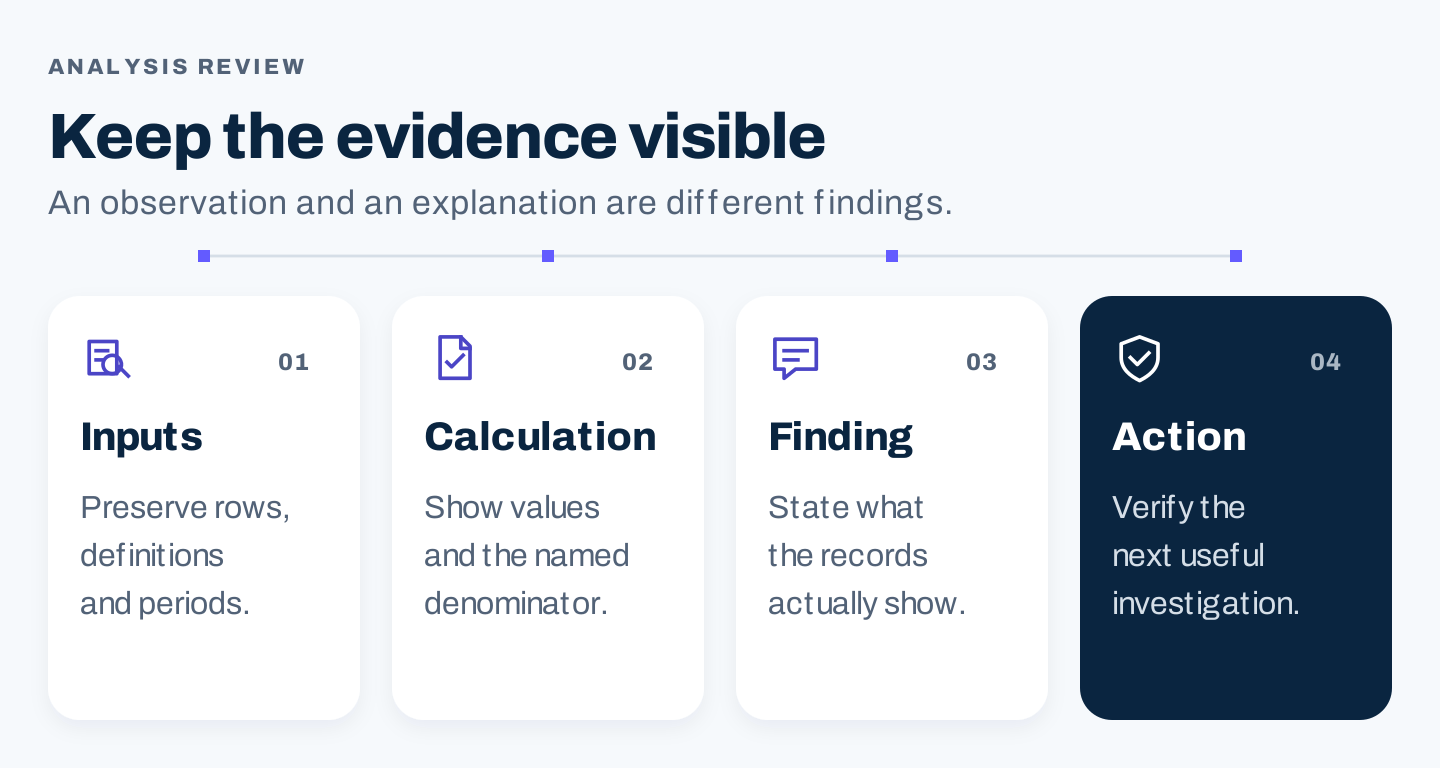
Original analysis-review sequence. An explanation should remain distinguishable from the observation that prompted it.
7. Improve a section without fabricating experience
Use it for: removing vague language, clarifying conditions, and making a supported explanation more usable.
Provide: the section, intended reader task, source notes, and claims or terminology that must remain unchanged.
Review this section against the supplied reader task and evidence.
Identify vague advice, missing conditions, repetition, and claims
that the sources do not support.
Propose a clearer version while preserving supported facts.
Add examples only from the supplied verified material.
Do not invent customer stories, personal experience, tests,
statistics, quotes, or results.
List substantive changes and anything still requiring review.
Review: compare the revision with the sources and original meaning. A confident sentence can become inaccurate when a qualification disappears.
For the REI example, an editor could ask whether a passage clearly explains the comparison being made and the conditions that affect it. The editor should obtain evidence for missing technical detail rather than asking ChatGPT to manufacture a test story.
Google’s generative AI content guidance emphasizes factual review and user value. A smooth rewrite does not replace that review.
Use technical assistance as a proposed change
ChatGPT can help explain a diagnostic record or propose a way to inspect an issue. Supply the actual configuration and ask it to state assumptions, expected behavior, and verification steps.
Keep the output as a proposal until the responsible implementer checks it in the appropriate environment. For example, Google’s robots.txt introduction distinguishes crawl management from keeping a page out of search results or securing private content. A generated robots rule should be reviewed against the actual goal.
For structured data, use the supported page facts and current feature requirements. Do not mark up invented reviews or add a content type merely because a generated template contains it.
Build a repeatable review and handoff
Use one record per accepted task:
Task and reader outcome:
Inputs and source dates:
Prompt or workflow version:
Actual product capabilities used:
Proposed output:
Reviewer checks and corrections:
Unresolved evidence or implementation issues:
Accepted output version:
Destination and implementation owner:
Completion check: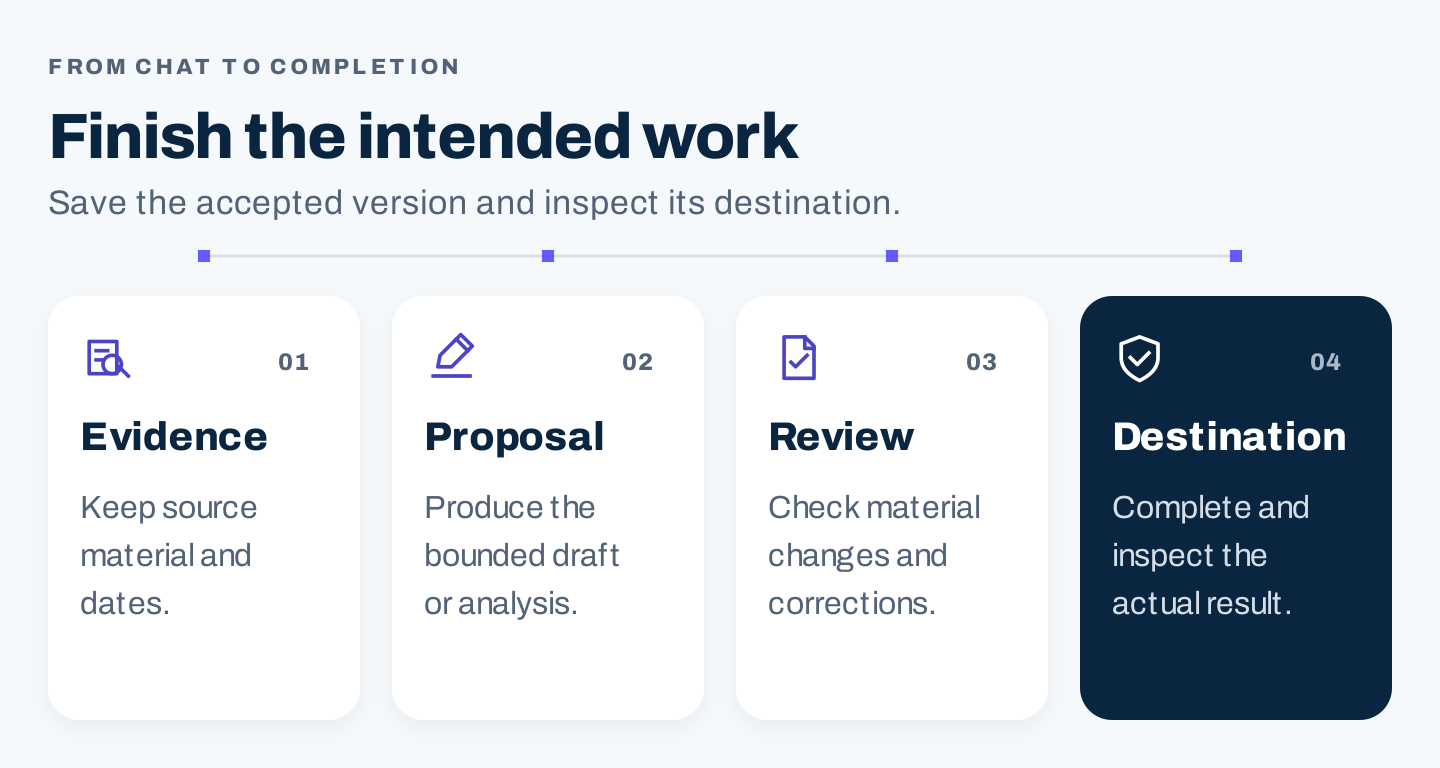
Original handoff sequence. A reviewed chat response becomes useful work when the intended artifact or page is completed and checked.
Preserve important input files and the accepted output. If the task uses several batches, retain the reconciliation. If the output becomes a page change, inspect the final page after implementation.
ChatGPT is most useful when the work stays connected to evidence and a clear next action. Give it a focused task, review the material changes, and measure the completed result rather than the fluency of the response.