Is SEO Dead? What AI Search Changes for a Business Website

SEO remains useful when it connects relevant customer demand with a website that helps people evaluate or complete a task. AI search changes where answers appear and when people click. It makes a business’s old traffic targets worth reviewing, but it does not make every search opportunity equally valuable or equally obsolete.
The practical question is whether your current SEO work supports useful customer outcomes at an effort you can sustain. That requires looking at the pages, questions, and business events behind the totals.
This guide gives founders, marketing teams, and agencies a way to assess those changes without relying on a prediction that applies to every industry.
Why the question has become more urgent
An answer displayed in a search result can satisfy a simple question before a person visits the source. A website built around short definitions may therefore have a different traffic opportunity from one offering a product trial, a detailed comparison, or a local booking route.
There is evidence that click behavior differs when AI summaries appear. Pew Research Center studied browsing data from 900 US adults in March 2025. Users clicked traditional result links on 8% of visits with an AI summary, compared with 15% without one. Links inside the summary received clicks on 1% of visits. These figures describe that historical sample. Pew Research Center’s study
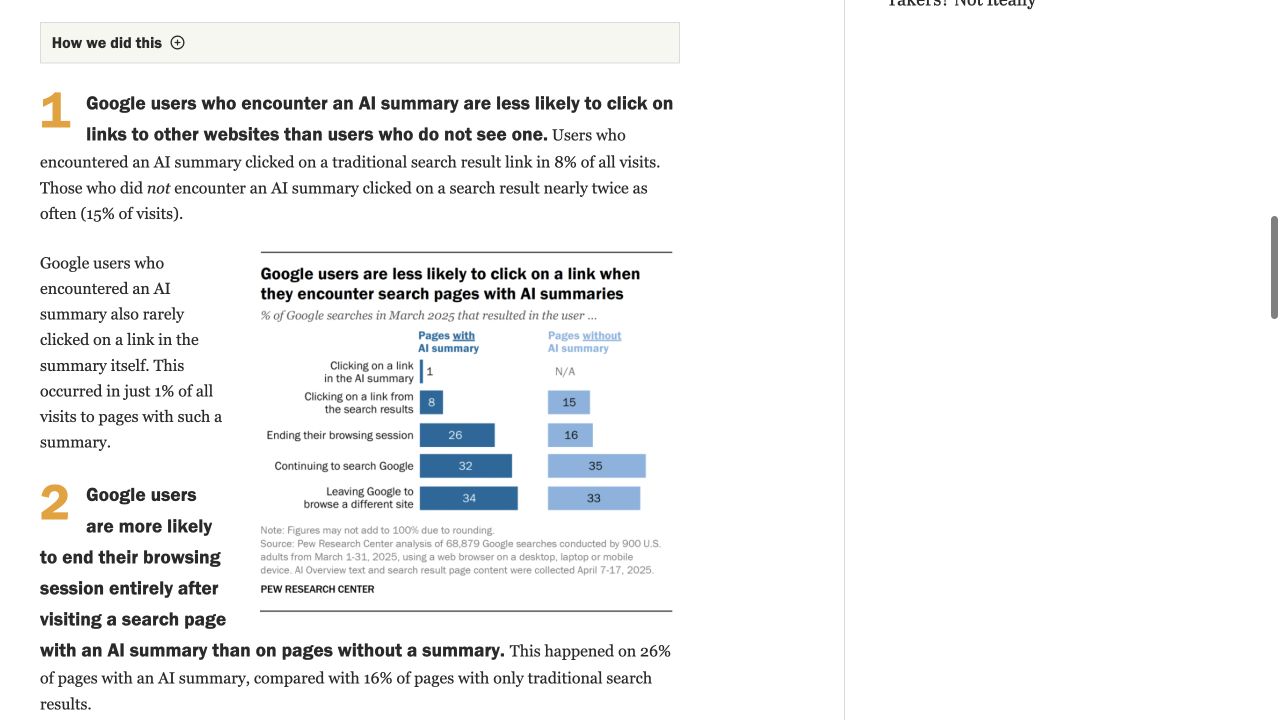
Pew’s chart reports March 2025 browsing behavior. It does not forecast the traffic or revenue of a particular business in 2026. Source. Desktop capture, October 8, 2026.
The study was observational, not a randomized experiment. Researchers collected the result pages in April, so their AI-summary classification could differ from what participants originally saw. It supports investigating changing click behavior; it does not establish a universal percentage loss for your website.
Do not turn a difference in click rates into the same percentage reduction in sales. Those are different measurements with different denominators.
SEO still contributes to AI search
Google’s current documentation describes its AI features as rooted in core Search systems, using retrieved information to ground responses and related searches to explore a question. Its advice keeps established SEO relevant. A website still needs useful content and the appropriate access and eligibility. Google’s AI optimization guide
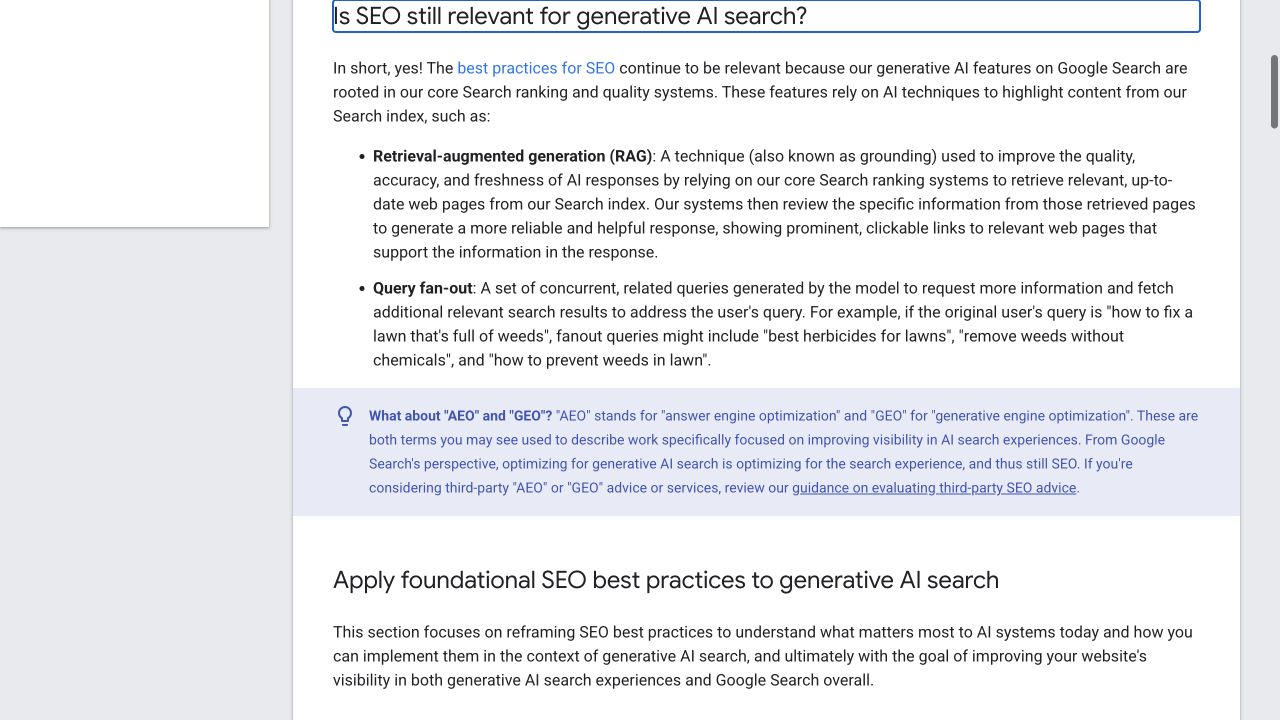
Google’s guide explains how its AI search experiences relate to core Search. It does not promise inclusion for an individual website. Source. Desktop capture, October 8, 2026.
That continuity matters operationally. Fixing a broken service page, documenting a useful comparison, or making current product information easier to understand can support the website’s purpose across several discovery paths.
A new label on a proposal does not tell you whether the work is worthwhile. Ask which customer question it addresses, what evidence supports it, and what completed change you will be able to inspect.
Separate your search opportunities by customer task
Review page groups rather than treating the site as one traffic bucket. The following is an editorial planning framework, not a claim that a particular group will gain or lose a fixed amount of traffic.
| Customer task | Typical destination | What to assess |
|---|---|---|
| Learn a basic fact | Definition or introductory article | Is there useful depth beyond a short answer? |
| Compare options | Buying guide, service comparison, category page | Are the tradeoffs and evidence specific? |
| Complete a task | Tool, template, integration, tutorial | Can the person actually use the resource? |
| Choose a local provider | Location or service page | Are availability, scope, and contact routes clear? |
| Find a known business | Brand, product, login, or contact page | Can the person reach the correct destination? |
These groups can overlap. A tutorial may introduce a product and help complete a task. Label the primary job so your team can compare similar pages.
A founder can start with the pages that generate meaningful inquiries. A marketing team can create groups by product or use case. An agency should agree on the classification and outcome definitions with each client rather than reuse a generic dashboard unchanged.
Diagnose a decline before changing the whole strategy
Lower organic visits are a finding. They are not yet an explanation.
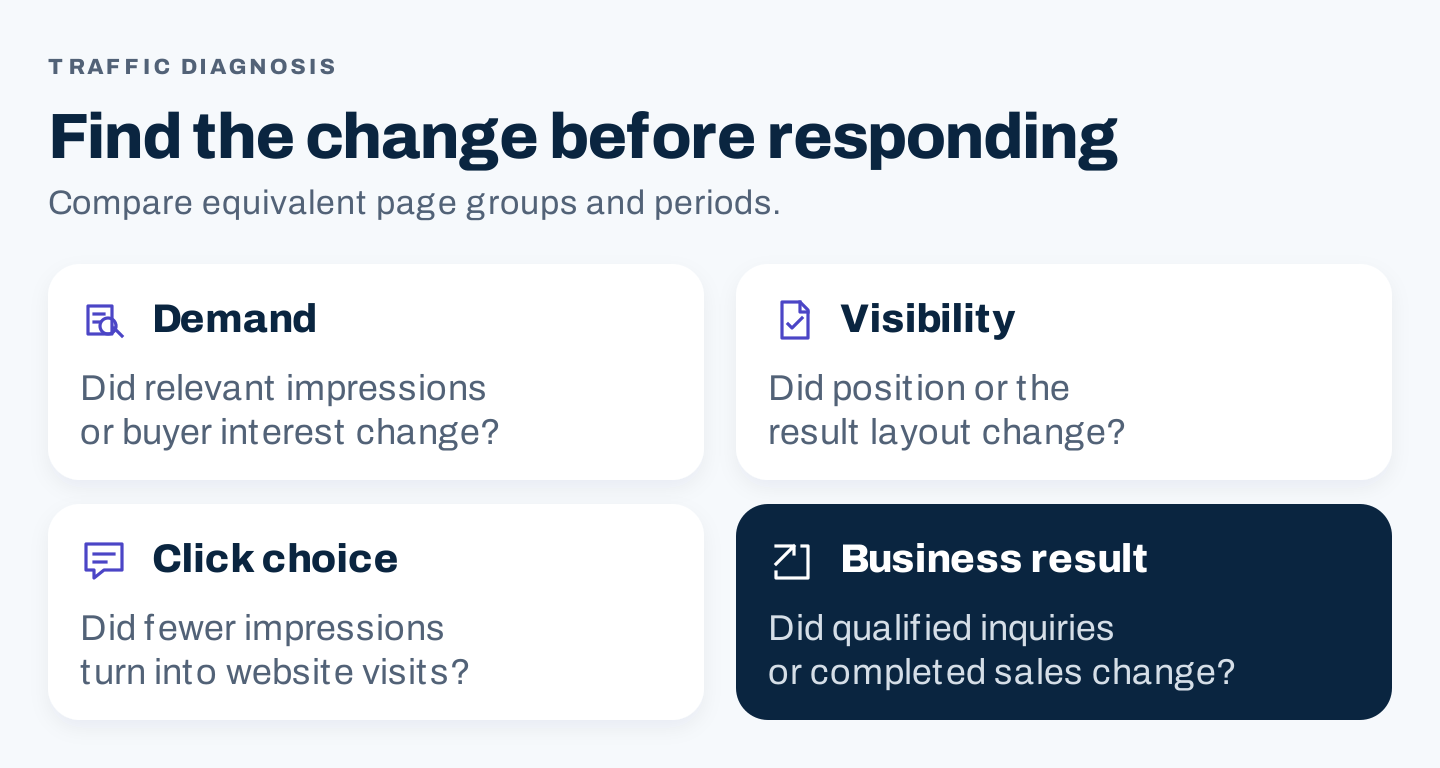
Original diagnosis framework: inspect demand, visibility, click choice, and business results before choosing a response.
1. Check that you are comparing equivalent data
Confirm the date range, market, device mix, page group, and measurement setup. Look for tracking changes, site migrations, changed URL definitions, or missing conversion events. Compare seasonally relevant periods when the business has seasonal demand.
Record how the data was collected. A third-party estimate, a Search Console impression, an analytics session, and a CRM inquiry do not represent the same event.
2. Investigate demand and visibility
For the affected pages, review relevant query impressions and available position information alongside the live result environment. Did the topic receive less interest? Did the page become less visible? Did the result layout change? Did a competing page become a better answer?
Treat averages carefully. An apparent improvement in average position can occur while the query mix changes. Inspect representative queries and pages before concluding that rankings stayed stable.
3. Inspect the page itself
Open the actual destination. Check for errors, unintended redirects, missing content, outdated availability, broken links, and a poor mobile experience. Verify that recent releases did not alter important templates or contact routes.
A decline after a site change deserves a technical investigation before a broad conclusion about AI search. Preserve the change date and affected URLs so the investigation can be repeated.
4. Check what happened after the visit
Review whether qualified inquiries or completed sales changed alongside visits. A page may receive fewer low-fit visitors while serving a similar number of useful customers. Another page may keep traffic but lose inquiries because its offer or form no longer works.
Use a diagnosis register:
| Finding | Supporting record | Competing explanation | Next check | Owner |
|---|---|---|---|---|
| Visits declined in a defined page group | Equivalent analytics periods | Demand, ranking, layout, or tracking changes | Inspect queries and recent releases | Named analyst |
| Inquiry quality changed | Agreed CRM qualification fields | Offer mismatch or sales handling | Review a representative inquiry set | Marketing and sales |
| Important information is missing | Live page and source record | Template or publishing error | Confirm and repair the destination | Page owner |
Fill this table with observed evidence. Its example rows are investigation instructions, not a fabricated business case.
Give the reader a reason to visit
A strong destination helps the reader do something that a short answer cannot finish. That may be comparing options against specific constraints, accessing an asset, completing a workflow, or contacting the right local team.
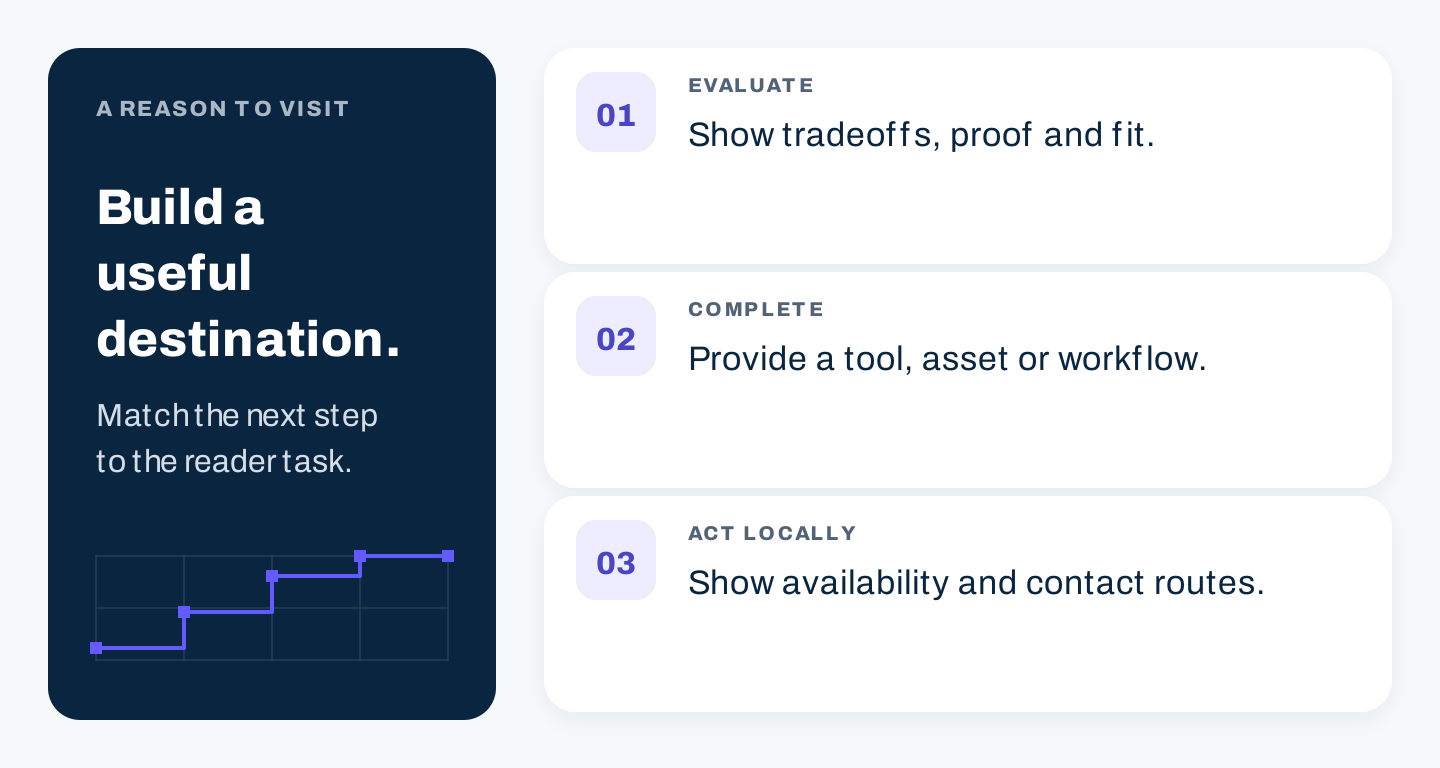
Original destination framework: make the next step useful for the customer’s task.
A real example: Zapier’s Gmail and Slack page
Zapier’s public Gmail–Slack page names a specific application pair and presents integration tasks with trigger and action choices. It gives a visitor a route toward a workflow rather than stopping at a definition of automation. Zapier’s Gmail and Slack integrations
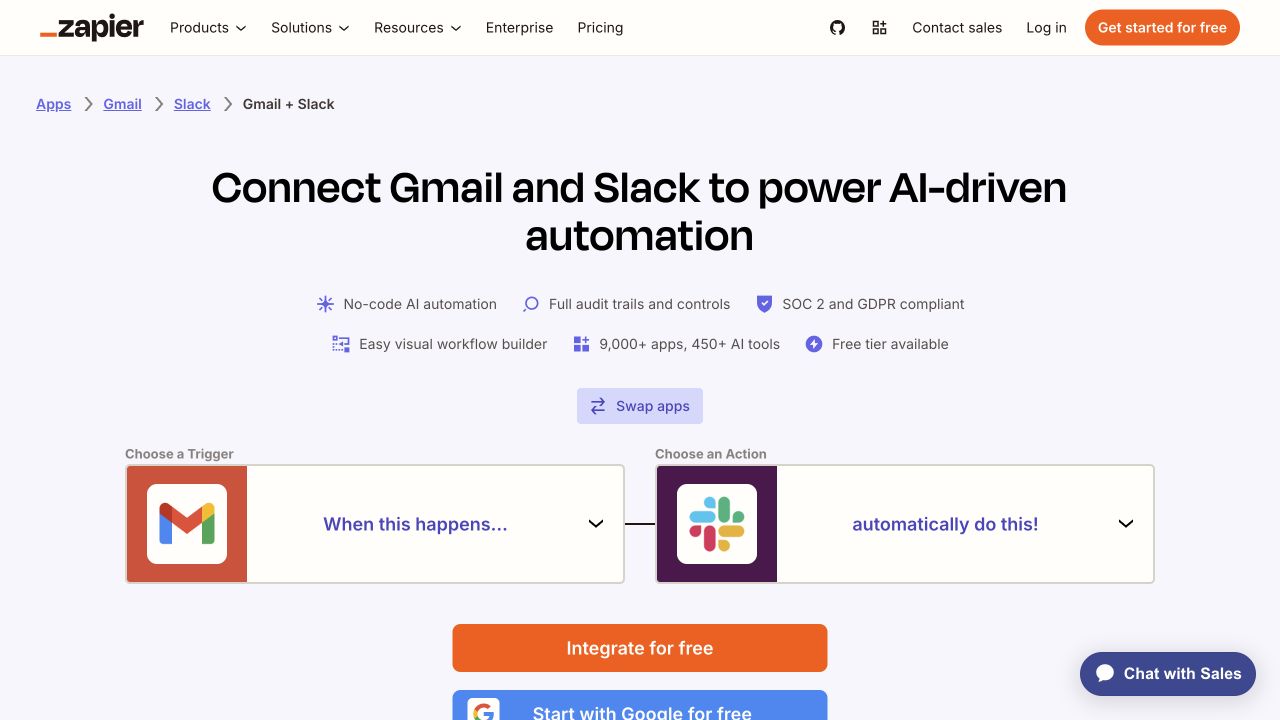
The public page illustrates a task-oriented destination. No integration was run, and no traffic or conversion result was inspected. Source. Desktop capture, October 8, 2026.
The transferable question is: what can someone complete on your page? A professional service can explain scope and provide the information needed to request an estimate. A software business can show compatibility and an evaluation route. An agency can publish a usable planning worksheet backed by a clear method.
Choose the destination for your actual offering. Adding a calculator that uses unsupported inputs is not an improvement simply because it is interactive.
Review the economics without confusing activity and value
Break the path into measurable stages:
Observed website visits
× observed qualified-inquiry rate
× observed customer win rate
= attributed new customers for the defined cohort
For ecommerce, use the relevant purchase path instead. State how you define qualified demand and what attribution can actually establish.
This decomposition is a diagnostic tool. It is not proof that SEO alone caused every sale in the cohort. Customers may interact with several channels, and some discovery will not create a directly attributable visit.
Keep time and money visible too. Record research, specialist input, production, implementation, review, and maintenance. A page that attracts useful inquiries may still be too expensive to maintain in its current format. Conversely, a valuable service page may need a one-time repair rather than a constant stream of new articles.
Review the work’s contribution against the business goal and the alternatives available to your team. Avoid comparing an SEO impression with a paid campaign’s completed sale as if the two metrics were interchangeable.
Use AI visibility as an additional observation
A generated answer can mention your business without citing your website. A cited page can appear without receiving a visit. A referral visit can occur without creating a qualified inquiry.
Save these as different events. For manual checks, record the question, platform, date, response, and source destinations. Repeat agreed conditions before interpreting a pattern. A single favorable response is a weak basis for increasing the budget.
Google’s current generative AI report adds impressions for AI Overviews and AI Mode. Read its scope and aggregation rules before combining it with other reports. It does not measure every AI platform or every unlinked brand mention. Google’s generative AI performance report
Use the companion AI visibility tracking guide when you need a fuller collection and reporting method.
Decide what to retain, change, or reduce
Treat the decision as a review of specific work rather than a vote on SEO as a whole.
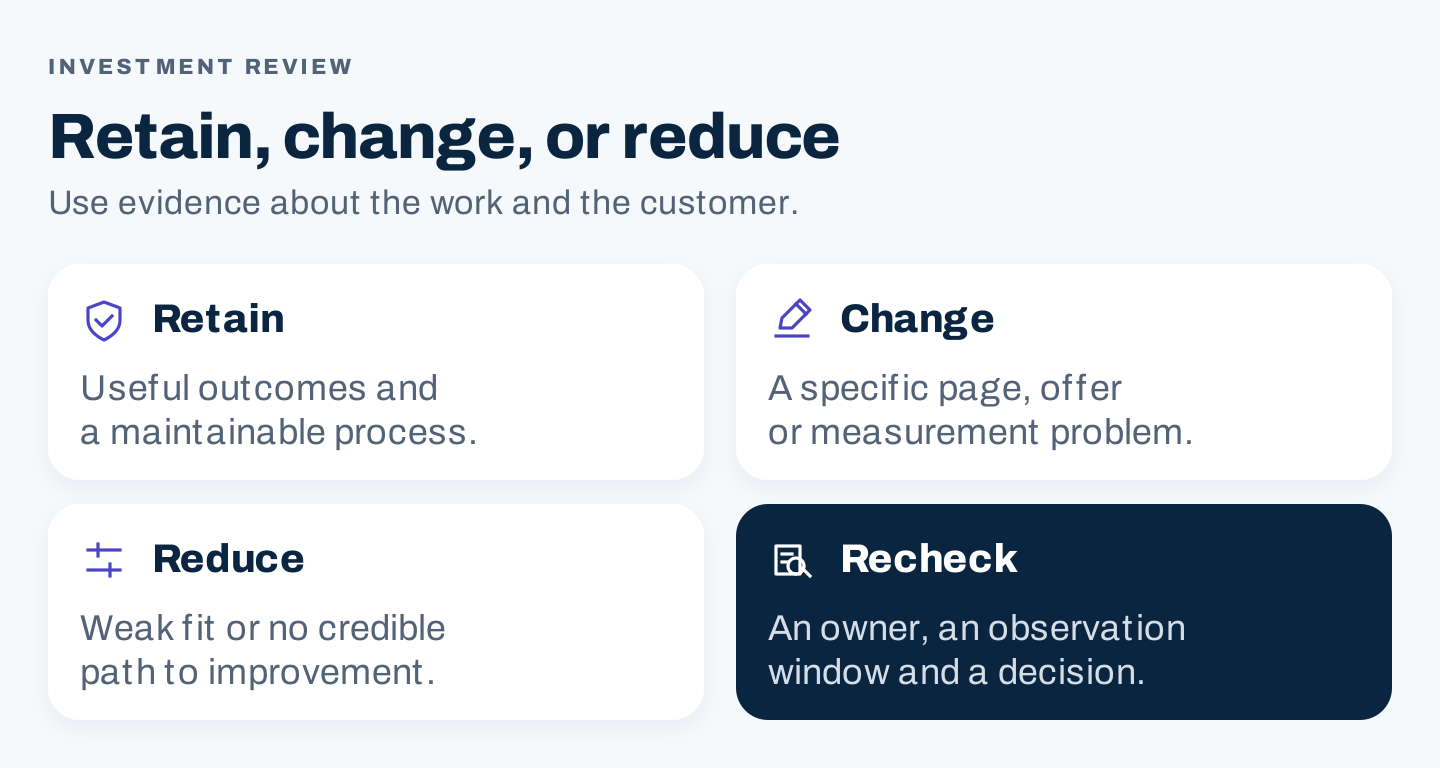
Original review framework: each decision needs supporting evidence, a responsible owner, and a follow-up point.
| Decision | Supporting situation | Useful next action |
|---|---|---|
| Retain | Relevant outcomes and a maintainable process | Preserve the effective pages and keep facts current |
| Change | A diagnosable access, answer, offer, or measurement gap | Complete a focused repair or refresh |
| Reduce | Weak audience fit or no credible path to useful outcomes | Stop the low-value work and document the reason |
| Investigate further | Data is incomplete or explanations conflict | Assign the missing check before reallocating broadly |
“Reduce” can apply to a particular content series while core service pages remain a priority. “Change” can mean reallocating from generic articles to comparisons or useful resources. Neither decision requires rebuilding the whole website.
An agency should make the proposed change concrete: affected pages, evidence, expected deliverables, dependencies, cost, and observation plan. The client can then review actual work rather than a promise of AI visibility.
A practical 30-day assessment
Use the first week to define page groups, verify tracking, and save equivalent baseline data. In the second week, investigate the largest material changes and inspect representative destinations.
During the third week, complete one focused improvement with clear acceptance criteria. In the fourth, review whether the work was delivered correctly and identify which outcomes need a longer observation period.
Save a decision log with:
- The business question and relevant page group.
- The finding and its supporting records.
- Alternative explanations still under consideration.
- The completed or proposed change.
- The effort required and responsible owner.
- The next observation date and decision criteria.
A month is enough to organize an assessment and complete some changes. It is not a universal deadline for search results.
Questions business owners ask
Should we stop writing blog articles?
Review each article’s reader task and business relevance. Keep publishing when you have useful evidence, a distinct contribution, and a reason for the intended audience to use the page. A content calendar that exists only to hit a volume target deserves revision.
Should we replace SEO with GEO?
Inspect the proposed work behind each label. Page access, clear answers, accurate facts, and useful evidence often overlap. Platform-specific controls and observation methods should be named explicitly. Avoid paying twice for the same undefined work.
Can AI citations replace website traffic as the main goal?
They can support an awareness objective, but the measurement should match that objective. Citations and mentions are not automatically sales. Keep customer outcomes visible and acknowledge attribution gaps.
What should a small team do first?
Check the pages closest to an important customer decision. Confirm the facts, inspect the contact route, and resolve the largest documented gap. A completed improvement provides a stronger basis for the next decision than another general prediction about search.