Why Most AI-Written Content Gets Flagged, and How to Avoid It


Paste the same article into three AI detectors and you can get three different verdicts. One calls it human. Another says it is 60% AI-generated. The third highlights the most factual paragraph on the page.
That inconsistency is not unusual.
AI detectors estimate authorship from patterns in language. They do not inspect a document's creation history, interview the writer, or prove which tool touched the draft. A high score can be wrong.
It can also be useful feedback.
If a detector reacts to a page, a reader may be reacting to some of the same surface patterns: identical paragraph shapes, safe generalizations, predictable transitions, and sentences that sound polished without saying much. The detector cannot prove who wrote the article. It can expose prose worth another look.
The goal is not to beat the machine. It is to remove the reasons a human reader would call the article AI slop.
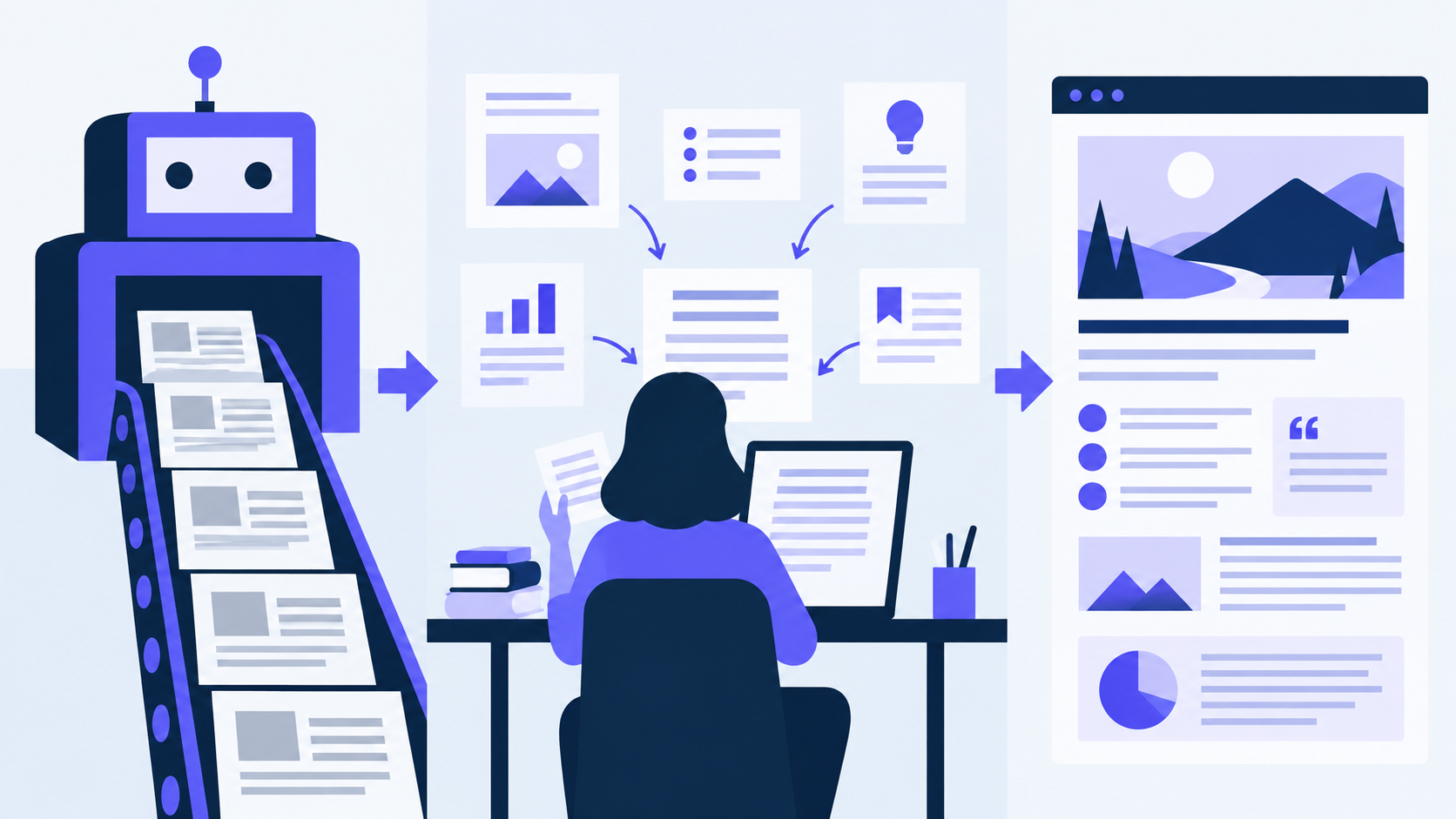
The fix begins with better material and stronger judgment, not a synonym pass at the end.
Start by separating detection from quality
OpenAI retired its own classifier in July 2023 because it was not accurate enough. In the published evaluation, the tool correctly identified 26% of AI-written text and incorrectly labelled 9% of human text as AI-written. OpenAI's archived classifier announcement states plainly that AI-written text cannot be identified reliably in every case.
False positives are not evenly distributed. Stanford researchers tested several detectors on essays written by non-native English speakers. In one dataset, 61.22% of the human-written TOEFL essays were classified as AI-generated. The Stanford HAI summary explains how predictable word choices can be mistaken for model output.
These limitations rule out several uses. A school should not accuse a student based on one percentage. A publisher should not reject a freelancer's work without examining evidence. A company should not rewrite an accurate sentence into a worse one merely to move a score.
Still, a content team can treat the result as a smoke alarm. It tells an editor where to inspect. It does not identify the fire.
What “AI-written” sounds like to a reader
Bad machine-assisted content rarely fails because of one forbidden word. It fails as a pattern.
Consider this opening:
Choosing the right SEO strategy is essential for businesses looking to improve their online visibility. With the digital landscape constantly evolving, companies must stay ahead of the curve. By using the right tools and techniques, businesses can drive traffic, increase engagement, and achieve long-term success.
The grammar is fine. The paragraph communicates almost nothing.
“Right strategy,” “online visibility,” “stay ahead,” “tools and techniques,” and “long-term success” could appear in an article about any company. The sentences all perform the same move: state importance, widen the claim, promise benefits.
A more useful opening names the problem:
A page can rank in Google and still be absent from a ChatGPT answer. Search ranking and AI citation are related decisions, not the same decision.
Now the reader knows what the article will resolve.
Uniformity is the biggest tell
Model drafts often arrive in neat blocks. Each section contains a definition, three benefits, three best practices, and a conclusion. Paragraphs sit at roughly the same length. Transitional phrases announce relationships the reader already understands.
The pattern feels wrong because human attention is not evenly distributed. A difficult caveat may need five paragraphs. An obvious definition may need one sentence. A good editor gives space to the hard part.
Read the article aloud and mark where the pace never changes. Look for repeated starts such as “This means,” “It is important,” “Additionally,” and “By doing so.” Check how often a paragraph ends by repeating its first sentence in softer language.
Do not force random variation. A one-word sentence dropped into every section becomes another template. Let the material control the rhythm.
Generic content begins before the writing prompt
A thin brief produces thin prose even when the model follows it perfectly.
“Write 2,000 words about email marketing” gives the draft no audience, decision, evidence, or business knowledge. The model has to fill the space with material common enough to be plausible.
A useful brief is narrower:
Explain how a three-person SaaS team should set up its first onboarding email sequence. The reader has fewer than 1,000 trial users a month, uses a product-led signup flow, and needs to decide which five emails to send before building advanced segmentation.
Now the draft can make choices. It can explain timing, message purpose, activation events, and where the simple sequence stops being sufficient.
The same principle applies to SEO articles. Start with the decision and the reader. The keyword describes demand. It does not supply the point of view.
Build an evidence pack, not a pile of tabs
Research should leave behind usable material.
For each consequential claim, capture the source, exact finding, date, scope, and any limitation that changes the interpretation. Separate official facts from commentary. Add product knowledge from the business: current capabilities, real customer questions, workflow constraints, and examples the company is allowed to discuss.
An evidence pack for a CMS comparison might contain official API documentation, current publishing states, field requirements, migration concerns, and notes from a real integration. It should not be ten competitor articles paraphrasing one another.
This changes the model's role. Instead of asking it to invent a credible explanation, ask it to organize verified material into a useful one.
Research also gives the article unevenness in the best sense. One platform may deserve a detailed warning because its content model behaves differently. Another may need only a short note. The structure follows reality, not symmetry.
Specificity does more than any “humanizer”
Tools marketed as AI humanizers often alter sentence structure and swap words. They can make accurate prose awkward without adding knowledge.
Specificity works differently. It improves the article.
Instead of “Businesses should consider their goals,” write: “A team running one marketing site needs a different plan from an agency dividing 90 monthly articles across three clients.”
Instead of “Use authoritative sources,” write: “Use the platform's API documentation for field behaviour, then link the exact page beside the implementation claim.”
Instead of “Results may vary,” name what causes the variation: market, date, sample, plan, model, or user context.
These details cannot be sprinkled on at the end. The writer needs them before drafting.
Brand voice is not a list of adjectives
“Professional, friendly, and confident” describes thousands of brands. It does not tell a writer how the company thinks.
A useful voice guide includes decisions:
- Does the brand make a recommendation quickly or present all options first?
- How does it handle uncertainty?
- Which claims require proof before publication?
- Does it use technical language with specialists or translate it immediately?
- What kinds of humour, if any, fit the product?
- Which popular industry claims does the company reject?
Examples help more than labels. Show a paragraph that sounds right and explain why. Show one that sounds wrong and name the problem.
Rankauto's voice, for example, is strongest when it is precise and quietly confident. It should explain the system, admit the limit, and avoid theatrical claims. That preference shapes the argument, not just the vocabulary.
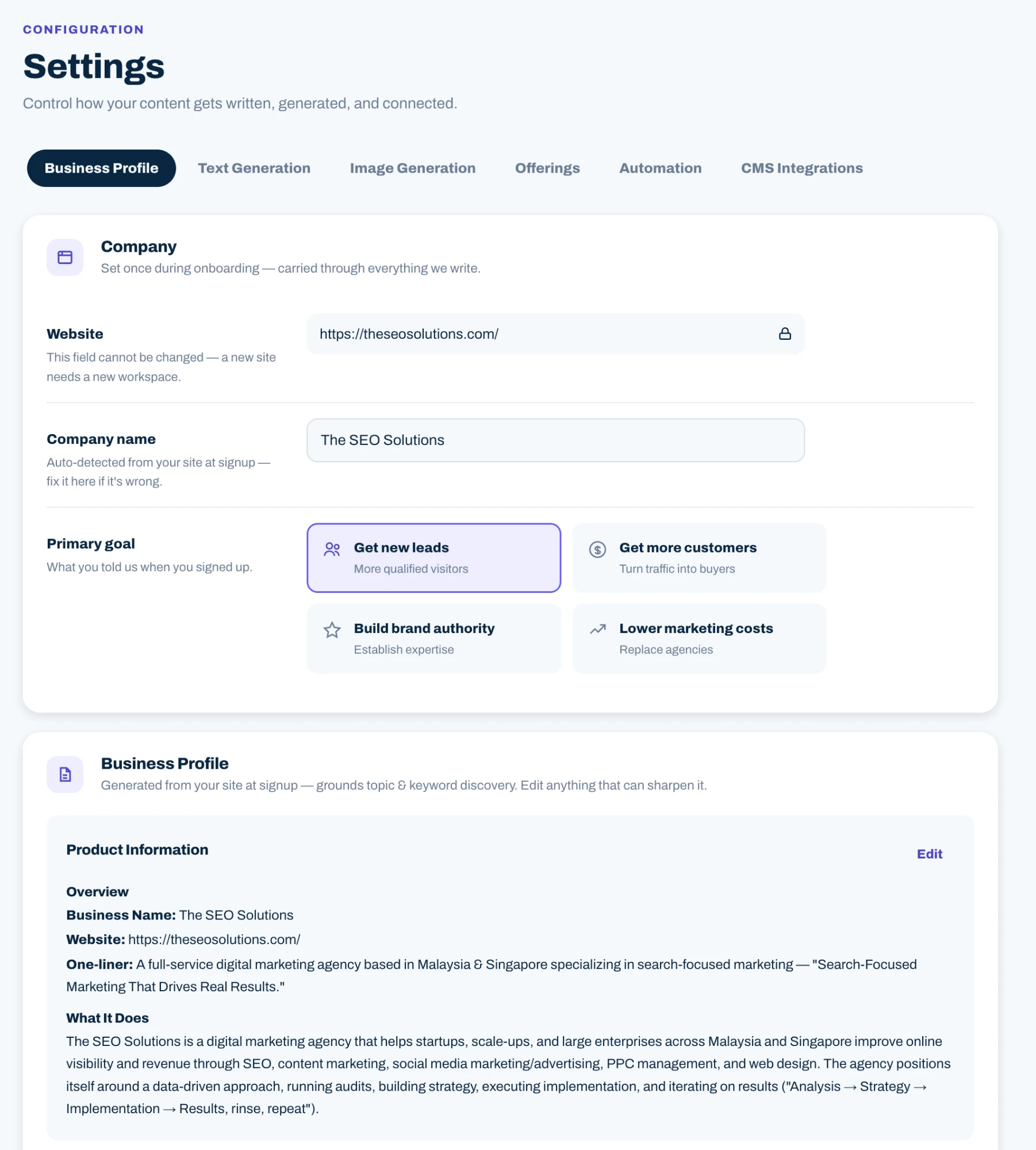
Voice starts with business context. A system needs to know what the company sells, who it serves, what it believes, and which outcome the content should support before it can sound specific.
Edit for thought, then edit for sound
The first editing pass should ignore detector scores.
Check the reasoning. Does the conclusion follow from the evidence? Did the article answer the question it opened with? Is a recommendation missing the condition that makes it true? Does the business actually know what the page claims to know?
Then inspect the prose.
Cut the opening sentence if the second one starts the article faster. Remove a summary that merely repeats the section. Replace abstract nouns with the actual object, person, price, action, or limitation. Split the sentence carrying three different ideas. Combine the three short sentences that sound like a checklist read aloud.
Look closely at quoted facts. A cleaner sentence is not better if it changes the meaning.
Finally, read several pages from the same publishing system together. Repeated structure is easier to hear across articles than within one.
Use a before-and-after test
Here is a typical generated paragraph:
There are several factors to consider when choosing a content automation platform. These include pricing, features, ease of use, integrations, and customer support. By carefully evaluating these factors, businesses can select the best solution for their needs.
The rewrite should not merely replace “several” with “multiple.” It should make a decision:
Start with the bottleneck. If the team already knows what to publish but cannot produce it consistently, compare article capacity, review controls, and CMS support. If the team does not know which market or topic to pursue, buying more publishing capacity will scale the wrong work.
The second version has a position. A reader can disagree with it, which is often a sign that the sentence says something real.
Keep an editorial record
For important pages, record who commissioned the article, which source set was used, what the business contributed, who checked the claims, and when volatile details should be reviewed.
This record is more useful than a detector score. It gives the publisher evidence of responsibility and makes updates safer. When a product changes, the editor can find the affected claims instead of regenerating the entire article and hoping nothing else breaks.
The public page may also need an author, reviewer, methodology note, or update date. The right level depends on the topic. Sensitive advice and original research need more transparency than a basic product glossary.
What Google actually cares about
Google's spam policies address scaled content abuse, which can involve automation, people, or both. The problem is producing many pages primarily to manipulate rankings while adding little value.
Its people-first content guidance asks publishers to consider the audience, expertise, focus, and purpose of the site. None of those questions can be answered by an AI detector.
A detector may call a useful page artificial. It may call an empty page human. Search performance is not decided by the badge.
Questions content teams ask
Can Google tell that AI wrote an article?
Google does not publish an authorship detector for ranking decisions. Its guidance focuses on quality, purpose, and spam behaviour. The practical risk is not an invisible AI label. It is inaccurate, unoriginal, or scaled low-value publishing.
Should we reject anything with a high Grammarly score?
No. Review the highlighted prose and the underlying article. Verify authorship through the workflow, not a probability. Use the score to identify passages that may be repetitive, generic, or overly predictable.
Can a human edit make any AI draft good?
Not efficiently. A draft with no evidence or point of view may require a complete rewrite. Editing works best when the brief already contains the right sources, examples, scope, and business facts.
Should writers deliberately add mistakes?
No. Typos, fragments, and awkward wording do not create authenticity. They lower quality. Natural writing comes from specific thinking and considered editing.
What detector score should a company target?
None. Track factual accuracy, source quality, originality, reader usefulness, conversions, and performance. If a detector repeatedly flags the same house style, inspect the pattern, but do not turn the percentage into a publishing KPI.
The test that matters
Ask what the article knows that a generic model response would not know.
Then ask where that knowledge came from, who checked it, and how it helps the reader decide or act.
If the answers are weak, lower detector scores will not make the page worth publishing. If the answers are strong, the article has substance even when a classifier guesses wrong.