AI SEO and Content Creation Tools: Compare the Full Workflow

AI SEO tools can help with research, drafting, optimization, visibility monitoring, and production workflows. The right choice depends on which part of the work is slowing your team down, and whether the tool’s output survives review.
A writing assistant cannot replace a crawl of your website. An AI visibility dashboard cannot establish that an article is accurate. A content score cannot decide whether a reader has enough information to make a purchase.
Use this guide to build a focused shortlist, compare eight useful workflow options, and run a representative evaluation before committing to a larger setup.
Start with the job you need to finish
List the tasks your team performs between identifying a topic and maintaining the published page.
| Workflow stage | Useful output | Evidence of completion |
|---|---|---|
| Demand research | A prioritized set of reader questions | Recorded data source, market, period, and business fit |
| Content planning | A brief that resolves one reader task | Checked sources, scope, examples, and acceptance criteria |
| Drafting and editing | Accurate, useful copy | Reviewed claims, honest examples, and a readable final draft |
| Technical inspection | A list of actual site issues | Crawl or report records tied to specific URLs |
| Publishing | An approved page in the intended state | Verified CMS fields, assets, links, and rendered destination |
| Measurement and maintenance | An owned action plan | Repeatable observations and recorded follow-up |
Choose the bottleneck before choosing the software. If articles stall because nobody can approve technical claims, a faster draft generator may create a larger queue rather than more accepted articles.
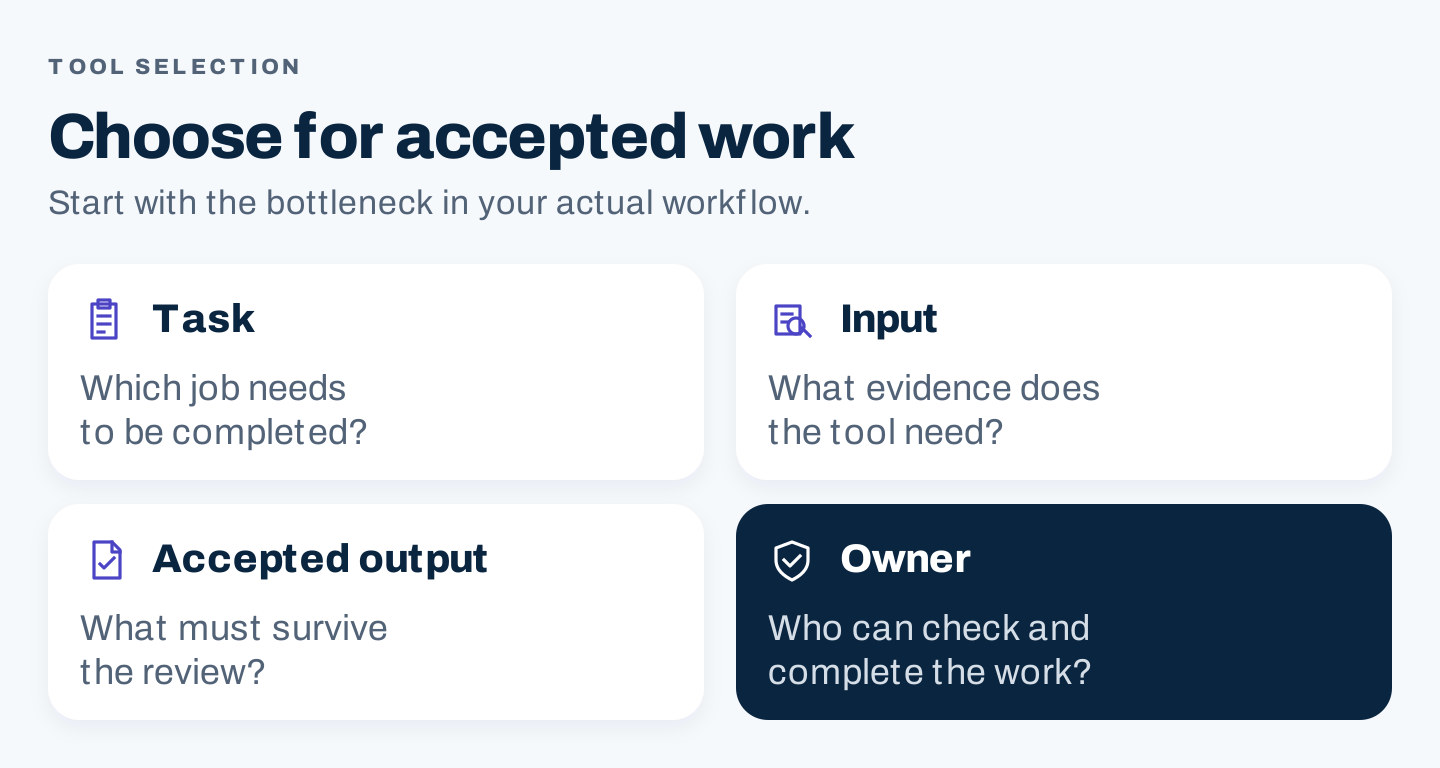
Original tool-selection framework. Define the useful result and who can accept it before comparing features.
This comparison is based on public product pages and documentation inspected October 8, 2026. Screenshots show public examples. It is not an authenticated, side-by-side performance test, and no tool is declared a universal winner. Plans, integrations, and availability should be checked for your actual setup.
Eight options to compare by workflow
The list includes AI products and essential measurement or technical companions. That distinction matters: some of the most useful checks in an AI-assisted workflow do not require generative AI.
| Option | Role in the workflow | Representative evaluation question |
|---|---|---|
| ChatGPT | Source-bounded planning, analysis, and editing | Can it preserve supplied facts and make uncertainty visible? |
| Semrush Content Toolkit | Topic planning, article generation, and optimization | Does the brief and reviewed draft solve the chosen task? |
| Surfer Content Editor | Content guidelines and assisted editing | Which suggestions improve the page, and which need rejection? |
| AirOps | Coordinating repeatable content work | Can the proposed process preserve review and recovery? |
| Ahrefs Brand Radar | AI visibility discovery and prompt tracking | Can you inspect the sample, exact answers, and cited URLs? |
| Screaming Frog SEO Spider | Technical crawling and repeatable site checks | Can it collect the needed evidence within your crawl configuration? |
| Google Trends | Relative demand and seasonality context | Are comparisons using consistent terms, geography, and time? |
| Google Search Console | Google visibility evidence | Does the available report answer the question being asked? |
1. ChatGPT: bounded research and editing tasks
ChatGPT is useful to evaluate when your bottleneck involves organizing notes, drafting briefs, classifying supplied rows, or editing a passage. OpenAI’s current usage documentation describes working with research and files, while actual capabilities depend on the available product and workspace configuration.
Give it material to work from, a defined output, and explicit limits. For keyword work, distinguish ideas it generates from metrics supplied by a verified dataset.
Evaluate: provide a short source pack and ask for a brief with claim-to-source references, missing evidence, and a focused outline. Check whether it invents claims or overlooks decision-changing qualifications.
Keep in mind: a polished answer is not proof of accurate research. Inspect its sources and calculations. If it cannot read an input, it should say so instead of inferring the contents.
2. Semrush Content Toolkit: connected planning and production
The public Semrush Content Toolkit page lists Topic Finder, SEO Brief Generator, AI Article Generator, Content Optimizer, and repurposing tools. That makes it a relevant option for evaluating several connected content tasks.
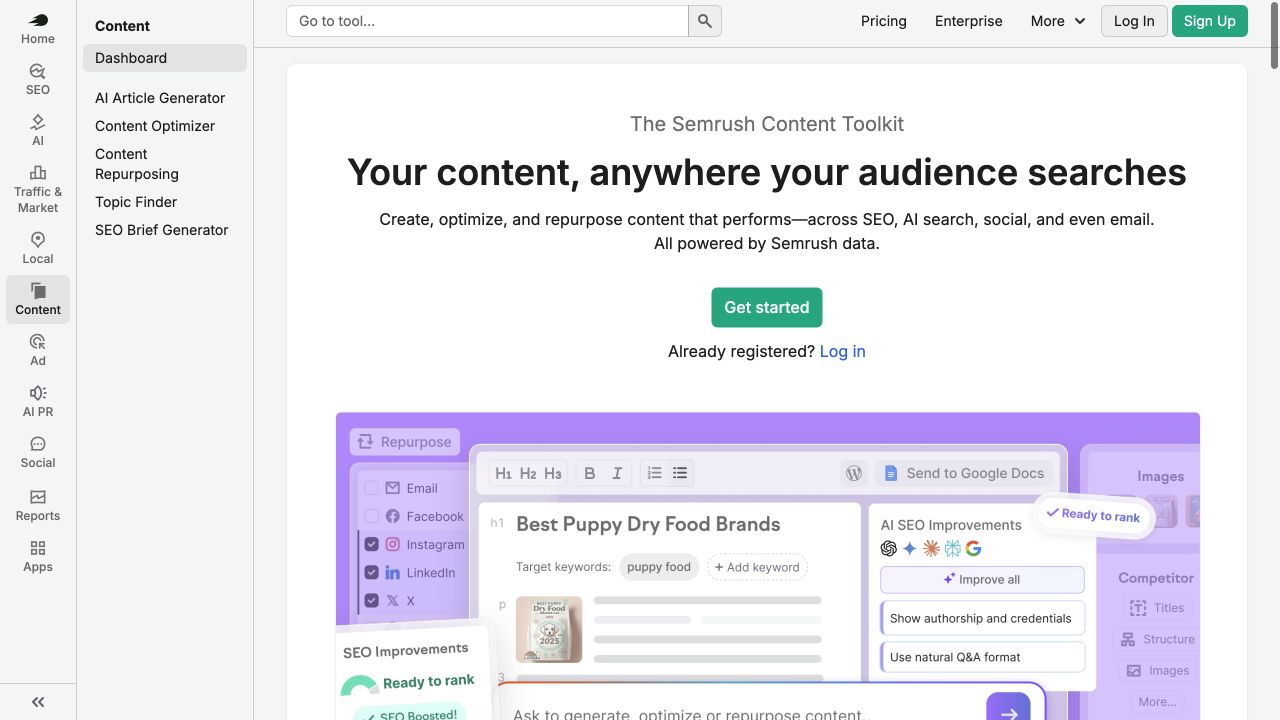
Public product page, captured on desktop October 8, 2026. The displayed interface is vendor promotional material; no authenticated article-production test is claimed.
Evaluate: follow one topic through a brief, draft, and review. Record what information the tool supplied, what your team added, and which errors or omissions remained.
Keep in mind: feature coverage does not establish the quality of a finished article. Ask which capabilities your plan includes and whether exports preserve sources, images, and required metadata.
3. Surfer Content Editor: suggestions with editorial review
Surfer’s Content Editor presents content guidelines, a Content Score, and assisted editing capabilities. Its public page shows recommendations involving headings, words, paragraphs, images, and terms.
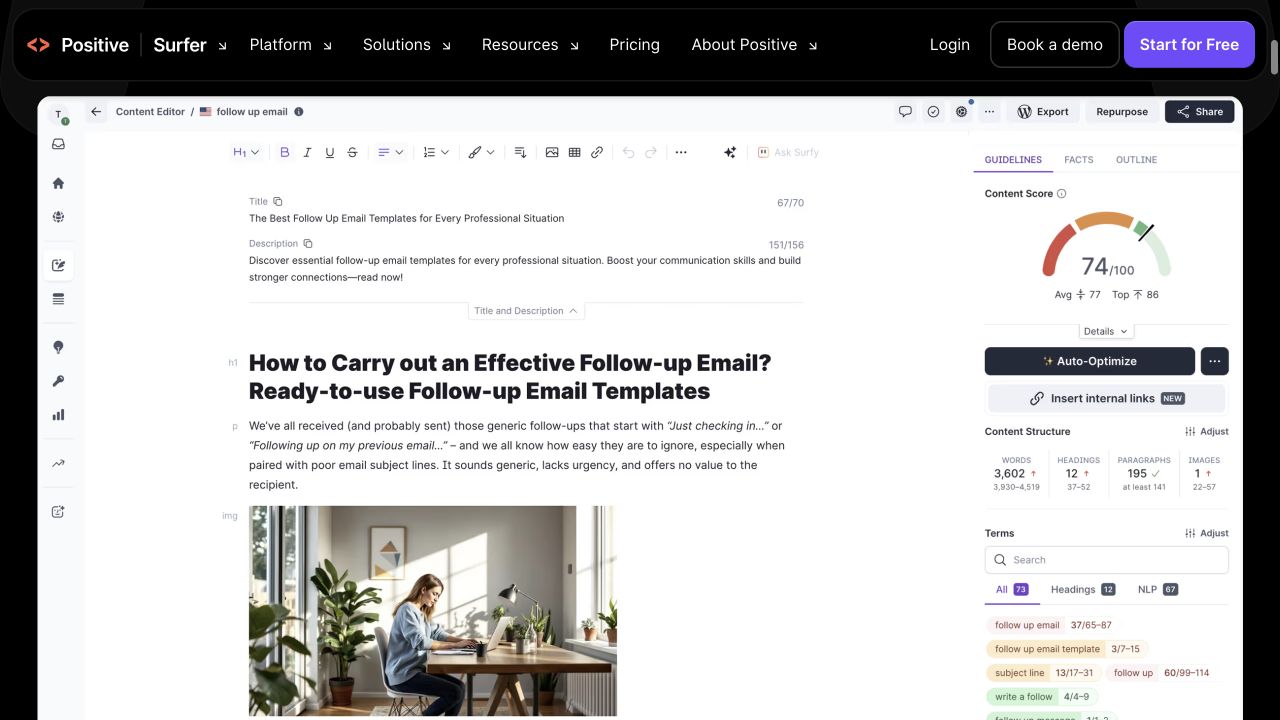
Vendor demo displayed on the public page, captured October 8, 2026. The visible score belongs to the demo and is not a Google quality grade or an observed result for this article.
Evaluate: review each suggested addition against the reader task. A missing explanation may improve the page; repeating a term or expanding an already complete section may not.
Keep in mind: optimization targets need interpretation. Accept changes that improve accuracy, coverage, or clarity. Do not treat a higher proprietary score as an instruction to add irrelevant material or unsupported claims.
4. AirOps: coordinating a repeatable process
The public AirOps website positions its platform around content strategy and production workflows, including creation and refresh work. It is a relevant option when the challenge extends beyond individual prompts to coordinating recurring tasks.
Evaluate: map one proposed process from inputs through draft, review, and delivery. Ask for a demonstration of the actual permissions, export destinations, approval steps, and failure recovery that your process needs.
Keep in mind: a workflow platform creates value when a team has a clear workflow to operate. Undefined acceptance rules can be repeated at scale just as easily as good ones. Confirm the exact capabilities in the plan and implementation being proposed.
5. Ahrefs Brand Radar: understanding sampled AI presence
Ahrefs Brand Radar separates broad AI visibility discovery from custom prompt tracking. That distinction helps you decide whether you need market context, a repeatable question panel, or both.
Evaluate: inspect exact answers and cited destinations, then compare the tool’s classifications with a manual review. Record the prompt source, platform, refresh frequency, and metric definition.
Keep in mind: a visibility measure describes its dataset. It does not establish all customer exposure or prove that a cited page generated revenue. Keep mentions, citations, referrals, and business events separate.
6. Screaming Frog SEO Spider: evidence about the website
The SEO Spider feature comparison distinguishes the free 500-URL crawl limit from licensed capabilities. It is a technical companion for checking the pages your content workflow creates and maintains.
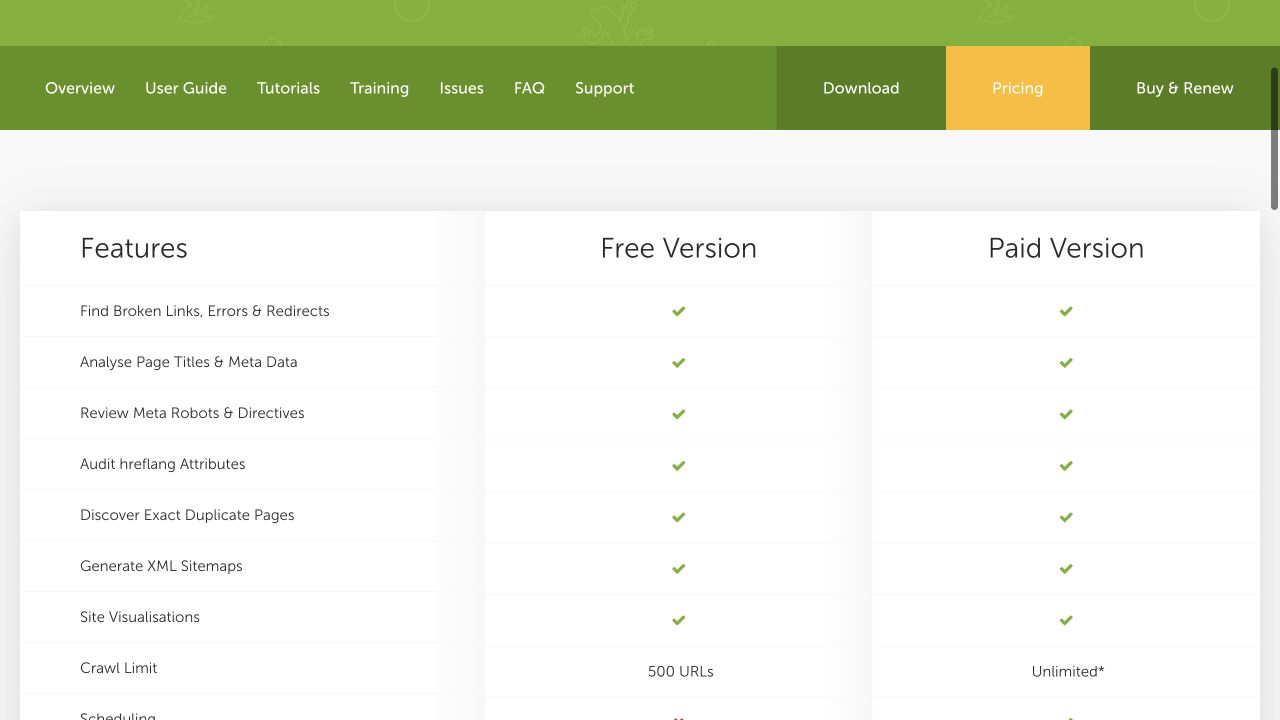
Public feature table, captured October 8, 2026. Crawl scope and licensed capabilities need to match the proposed job; no crawl was executed for this comparison.
Evaluate: run an authorized, representative crawl and inspect the findings for important URLs. Check whether the chosen configuration can observe the page content and fields your team needs.
Keep in mind: a detected issue still needs diagnosis, an owner, and a verified fix. Crawling a page does not repair it, and a crawl configuration that misses content can produce misleading reassurance.
7. Google Trends: context for relative interest
Google’s Trends data explanation says its data is sampled, normalized, and scaled from 0 to 100. It is useful for relative interest and timing, rather than as a source of absolute monthly search counts.
Evaluate: compare relevant terms or topics using the same geography and period. Check whether apparent demand depends on seasonality or a short-lived event.
Keep in mind: a value of 100 is a relative peak within the selected comparison, not 100 searches or a universal score. Preserve the settings when reporting a chart.
8. Google Search Console: platform-owned visibility evidence
Search Console can complement third-party estimates. Google’s generative AI performance report documentation describes impressions for AI Overviews and AI Mode, subject to availability and reporting conditions.
Evaluate: identify the available report, relevant pages, and comparison period. Confirm what each measure and aggregation represents before drawing a conclusion.
Keep in mind: impressions do not establish visits or sales. An absent report also does not automatically establish zero AI presence. Combine visibility observations with a separate review of website outcomes.
Build a small stack around your bottleneck
A founder with limited capacity might evaluate a research source, one drafting or editing tool, and existing measurement reports. The value comes from completing a focused process, rather than owning every category of software.
A marketing team producing substantial content may need more structured briefing, source management, and editorial review. In that situation, test how information survives handoffs between the research, writing, and publishing tools.
An agency should include multi-client governance in the evaluation: correct website routing, client-specific guidance, approvals, ownership, exports, and access recovery. These are acceptance questions, not claims that every listed product supports the same controls.
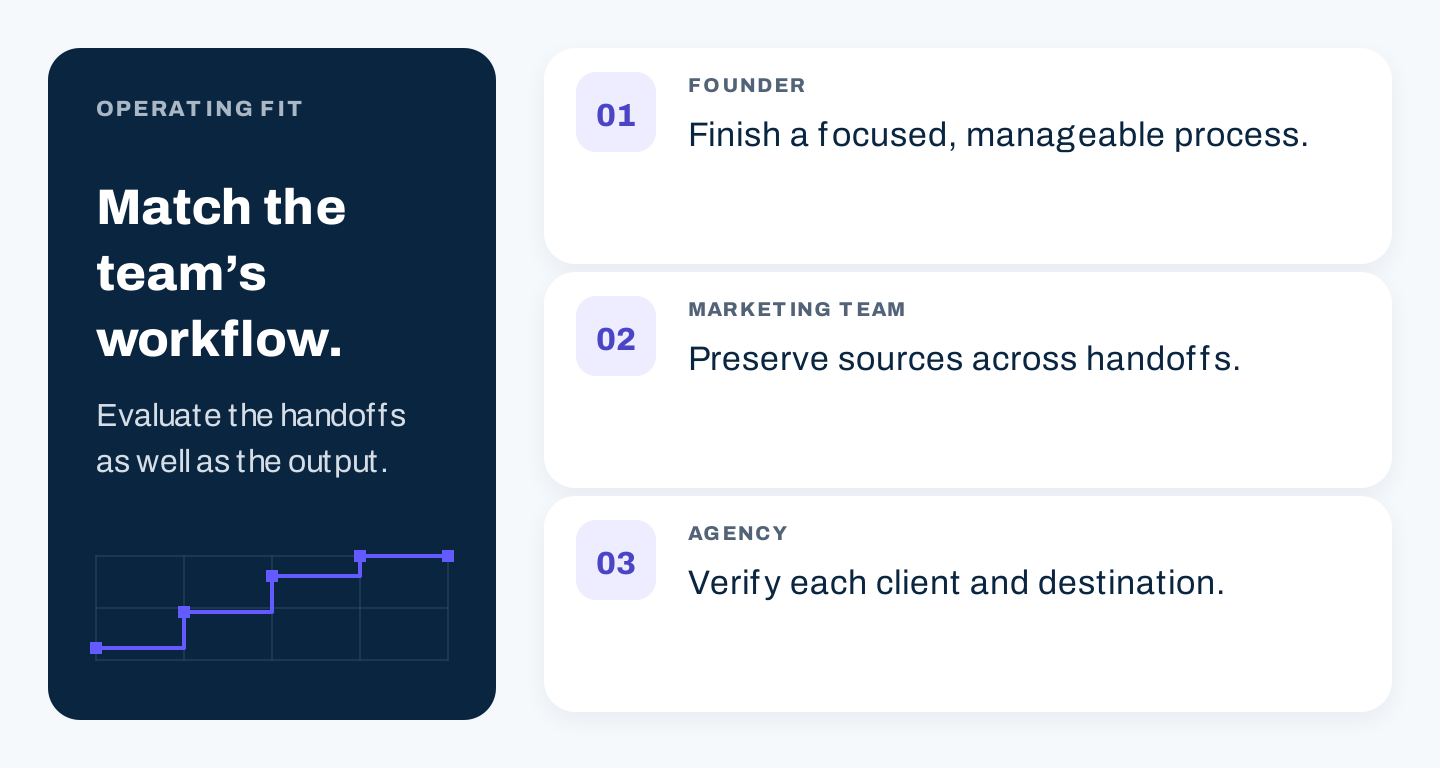
Original operating-fit framework. Team size changes the coordination problem, but every setup still needs an accepted result.
Avoid buying two overlapping products before confirming which one solves the bottleneck. More dashboards can also create more reconciliation work when their datasets and definitions differ.
Run a representative evaluation
Use the same brief for shortlisted products. Select work that resembles your real backlog, rather than an easy topic chosen to flatter a tool.
A proposed evaluation exercise could use an existing product education page and a verified set of customer questions. Ask each candidate to produce a focused brief or improve a selected section. Supply the same source pack, tone requirements, and limits. Do not ask it to copy a competitor article and change the brand names.
Give reviewers the outputs without promotional summaries. Review:
| Criterion | Evidence to inspect |
|---|---|
| Task fit | Does the output resolve the promised question? |
| Factual accuracy | Can material claims be verified in the source pack? |
| Useful originality | Does it add a meaningful method, explanation, example, or decision aid? |
| Review effort | How much correction is required before acceptance? |
| Production fit | Are needed fields, images, links, and sources preserved? |
| Recovery | Can a failed or incorrect run be identified and corrected? |
Record rejected outputs as well as accepted ones. Otherwise, a tool that produces many unusable drafts can look faster than a tool that produces fewer drafts requiring less correction.
Use three separate time records: setup, recurring work, and rework. A first trial may involve configuration that will not repeat, while recurring review is a real continuing cost.
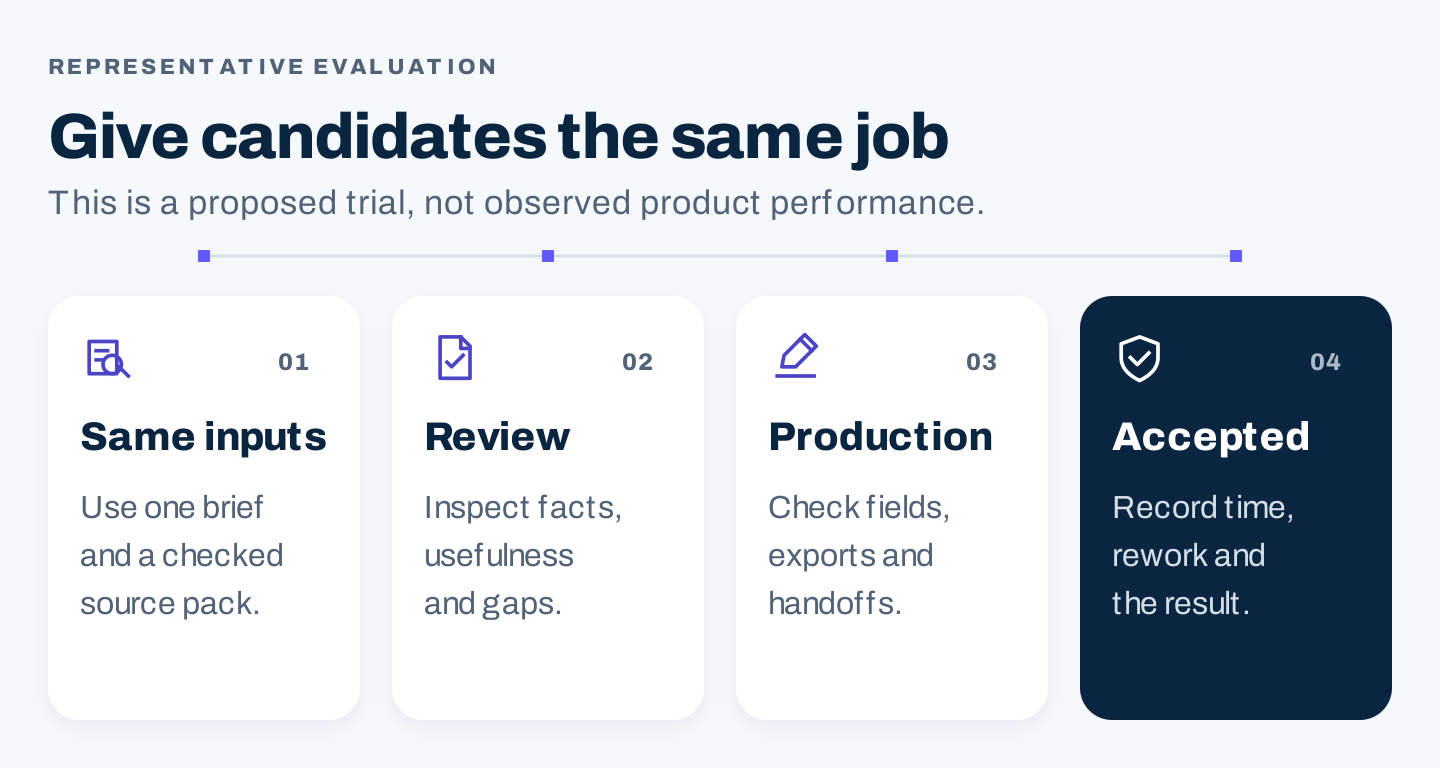
Original trial sequence. This is a proposed evaluation method, rather than a completed performance test of the products above.
Compare the full cost of accepted work
Use your current quotes and actual trial records. Include:
- Subscription fees, seats, credits, and required add-ons.
- Setup and integration work.
- Research and evidence collection outside the tool.
- Editorial review, specialist input, and corrections.
- Publishing checks and recurring maintenance.
Then calculate:
Cost per accepted deliverable =
(all relevant fees + setup allocation + working time cost)
÷ number of deliverables that passed the agreed review
Choose a period for allocating setup and use it consistently across candidates. Keep currency, tax treatment, and paid usage assumptions visible. A headline subscription price is insufficient when plans meter articles, crawls, prompts, or workflow runs differently.
Do not manufacture a cost-per-article figure before a representative trial. Until you have accepted-output and time records, keep the comparison as a planning estimate with explicit assumptions.
Questions to ask before committing
Ask the vendor to demonstrate the exact setup you need. Save the answer and date for questions involving:
Data: Where do estimates and recommendations come from? Can you see market, freshness, and missing values?
Evidence: Can you export exact answers, sources, drafts, and review records?
Control: Can the workflow produce a draft for review before publication? Who can change destinations or approve output?
Usage: Which limits, credits, seats, and integrations apply to the proposed workload?
Exit: Can you recover your content and records in a usable format if you change products?
A vendor’s general “integrates with your CMS” statement should lead to a specific demonstration: the intended site, fields, asset handling, and publication state.
An optional prompt for comparing trial records
Use AI to organize results after collecting the evidence:
Compare these tool trial records using only the supplied material.
Use the same acceptance criteria for every candidate.
Separate documented features from capabilities actually tested.
List accepted outputs, rejected outputs, setup time, recurring time,
rework, and missing evidence. Preserve original units and dates.
Do not invent pricing, scores, rankings, or performance improvements.
Explain which candidate addresses the stated bottleneck and what
still needs to be demonstrated before a purchasing decision.
The strongest choice is the tool your team can use to finish valuable work reliably. Define the task, inspect a representative output, and compare the complete effort needed to accept and maintain it.