12 Best AI Visibility Tools for Tracking Mentions and Citations
Compare 12 AI visibility tools that track brand mentions and citations in ChatGPT, Perplexity and Google AI answers. Check prompts, engines and price.

The best AI visibility tool is the one that can show which answers mention your brand, which sources they cite, and what changed on a consistent set of relevant questions. A visibility score without those underlying records is difficult to act on.
For a small team starting a fixed prompt panel, shortlist Otterly.AI and Peec AI. For broader engine coverage, inspect Rankscale. For an enterprise measurement program, compare Profound, Evertune and Conductor. If your team already works in Semrush or Ahrefs, evaluate the relevant AI product before adding another reporting system.
This is an editorial comparison of public product documentation and pricing pages checked on October 10, 2026. It is not a paid-account benchmark or a claim that one vendor captures every customer's AI conversation. This guide is published by Rankauto.
Compare the 12 tools by the decision you need to make
| Tool | Main reason to evaluate it | Important scope check |
|---|---|---|
| Otterly.AI | A small, repeatable prompt panel | Base engines versus paid engine add-ons |
| Peec AI | Brand comparison across selected models | Number of models, projects and countries |
| Profound | Enterprise AI search analysis | Trial restrictions versus contracted access |
| Scrunch | Monitoring alongside site audits | Core limits versus Enterprise engines |
| Rankscale | Broad engine monitoring | Credit consumption and actual refresh schedule |
| AthenaHQ | Credit-based monitoring and analysis | Responses, not just saved prompts |
| Semrush AI Visibility | Adding AI reporting to a marketing toolkit | Domain scope, billing period and separate SEO tools |
| Ahrefs Brand Radar | Market discovery plus custom monitoring | Indexed queries versus your tracked prompts |
| SE Ranking SE Visible | A dedicated AI visibility workflow | Distinguishing engine-specific metrics |
| Evertune | Brand perception across a sampled question set | Definition and denominator of its brand index |
| LLM Pulse | Reading mentions, positions and citation sources together | Visible citations versus background sources |
| Conductor | Connecting enterprise visibility analysis with content work | Required modules and operational handoffs |
The order groups useful buying routes; it does not represent a measured accuracy leaderboard. Below, each entry identifies what the official material establishes and what your own evaluation should resolve.
Know what an AI visibility dashboard measures
Three useful observations are different:
Mention: the answer names your brand. It may never link to your site.
Citation: the answer exposes your page or another source as supporting material. A publisher's article might mention you while your own domain receives no citation.
Recommendation: the answer presents your brand as an option for the user's task. A passing reference or a negative comparison should not automatically count as an endorsement.
Keep visits and leads in a separate measurement stream. A sampled answer panel can describe discoverability in those observations; it cannot establish the number of real people who saw the same answer.
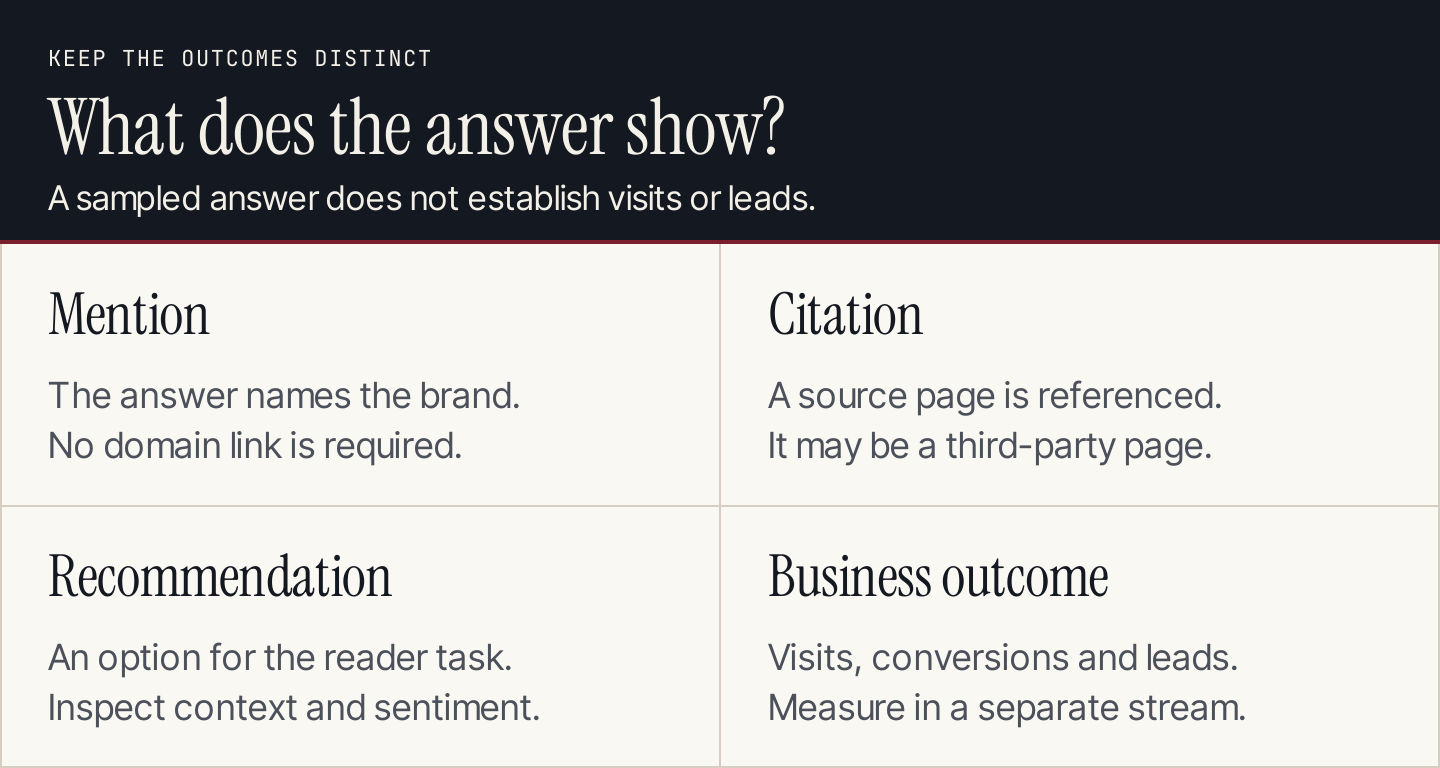
Keep sampled answer observations separate from visits and leads.
1. Otterly.AI: best starting shortlist for a small fixed prompt panel
Otterly.AI's pricing page lists Lite at $29 per month for 15 prompts, with daily monitoring across four base engines: ChatGPT, Google AI Overviews, Perplexity and Microsoft Copilot. Claude, Google AI Mode and Gemini are add-ons. Standard lists $189 monthly for 100 prompts; API and MCP access start at Standard. Annual billing uses different effective monthly prices.
For a small team, the main appeal is an understandable initial scope. Fifteen carefully selected buyer questions can be easier to maintain than hundreds of loosely related prompts. The tradeoff is whether your audience uses engines outside the base bundle.
Proposed evaluation: choose five discovery questions, five comparison questions and five buying questions. Check the original answers and cited pages, then price the exact engines you intend to monitor. Do not compare its four-engine base price with another vendor's larger engine bundle without adjusting scope.
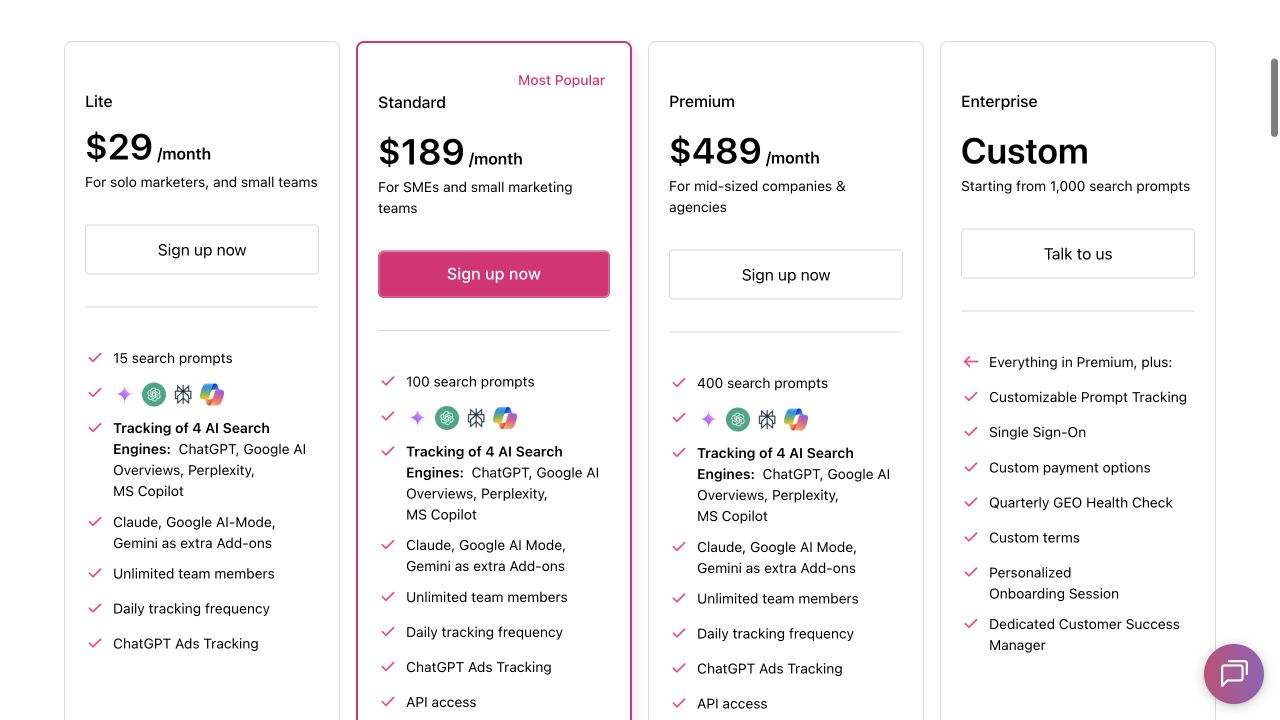
Otterly.AI's public pricing page. Check the billing toggle and distinguish base engines from add-ons. Desktop capture, October 10, 2026; public vendor material, not our account results. Source.
2. Peec AI: best for brand comparisons across selected models
Peec AI lists Starter at $95 per month for 50 prompts, three selected models and one project, with daily tracking and unlimited users. Its available choices include Google AI Overviews and AI Mode. Higher tiers expand prompt and project capacity. Confirm the billing period and chosen model bundle at checkout.
Model choice changes the comparison. If you select AI Overviews and AI Mode, you have already used two of the three Starter model selections. That may fit a Google-heavy program, but it leaves a different mix than a team prioritizing conversational assistants.
Proposed evaluation: build the panel around the decisions your buyers make, then select models. Inspect a source page behind a competitor mention and ask whether the dashboard helps identify a correctable content gap. Keep branded prompts separate so repeated questions containing your brand do not inflate the apparent discovery picture.
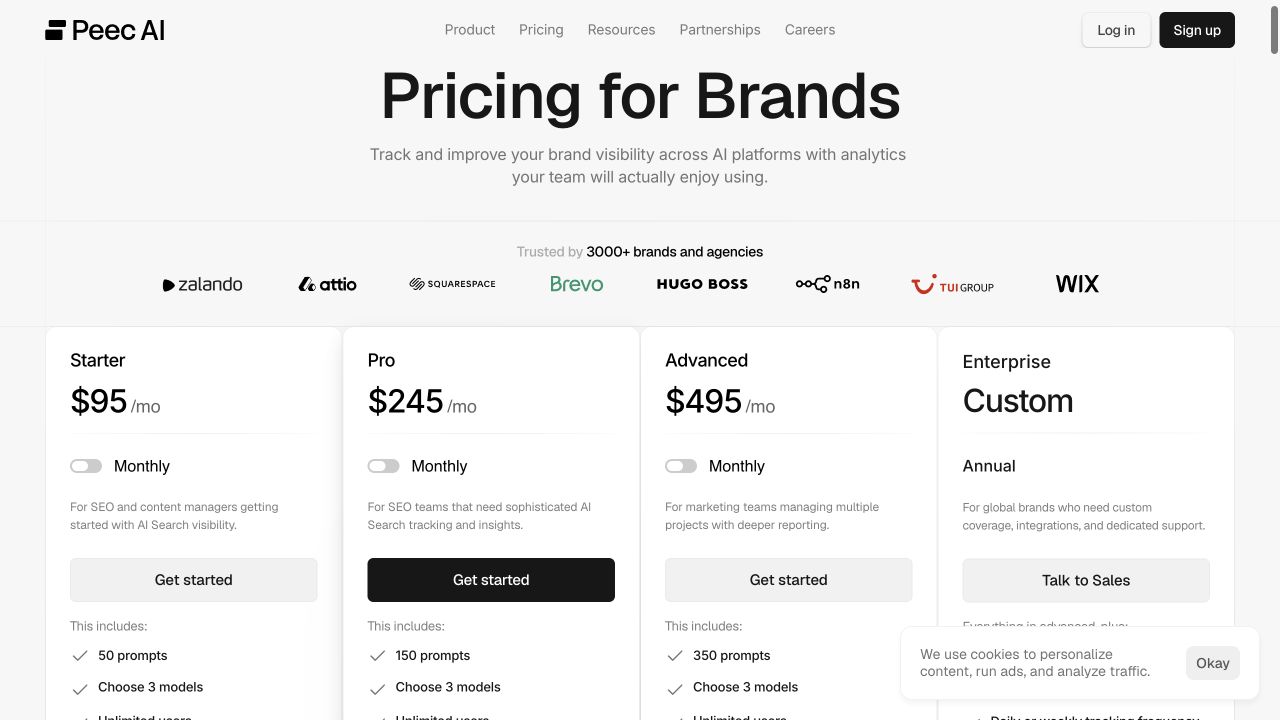
Peec AI's public pricing page shows model and project allowances. Confirm the final plan price and selected models directly. Desktop capture, October 10, 2026; public vendor material, not our account results. Source.
3. Profound: best for an enterprise evaluation with explicit trial boundaries
Profound's current public pricing presents a free seven-day trial and custom Enterprise packages. The trial uses 50 recommended daily prompts across ChatGPT, Gemini and Google AI Overviews; prompt editing, historical access and exports are restricted in the trial. Enterprise scope is tailored and offers broader engine coverage.
A recommended-prompt trial can introduce the reporting interface, but it is not a controlled test of your own question panel. Procurement should separate what can be inspected during the trial from what requires a demonstration or contracted access.
Proposed evaluation: take your actual buying questions to the sales conversation. Ask to trace one observed recommendation through its answer, cited source, prompt configuration and exported record. Confirm which countries, engines, retention periods and team permissions are included in the quote. A broad platform needs a precise operating scope.
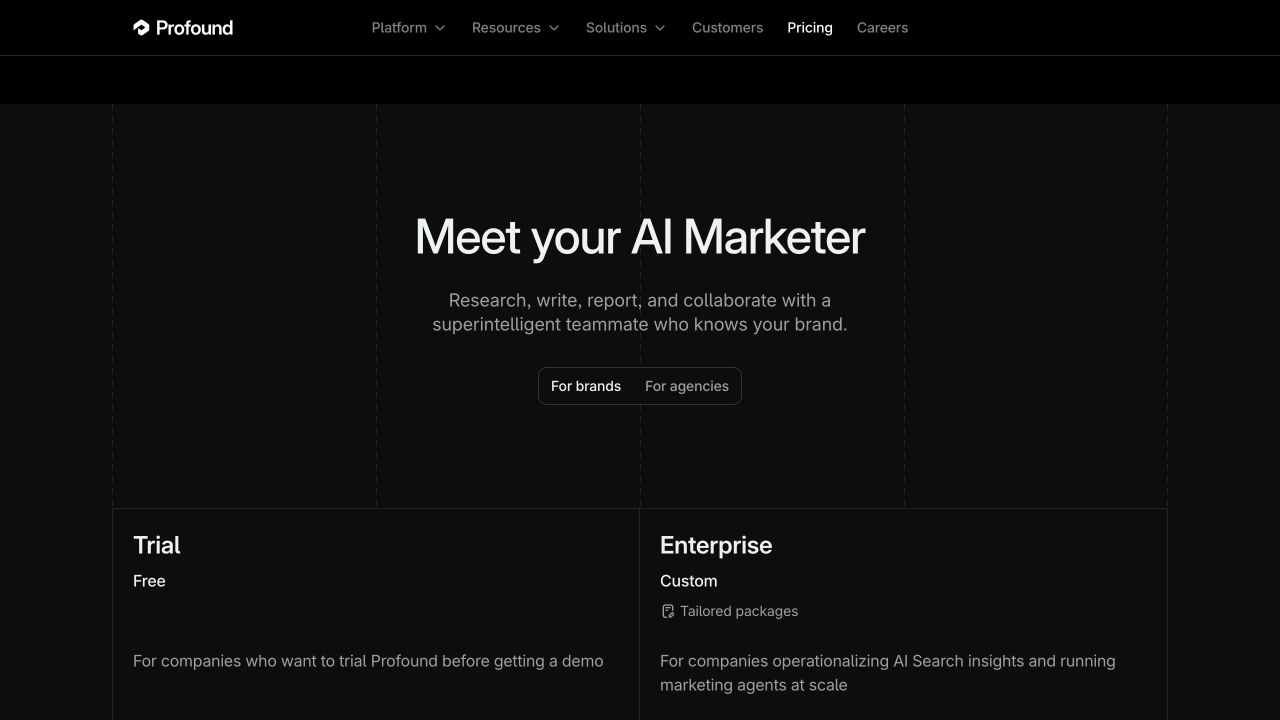
Profound's public pricing page separates the limited trial from custom Enterprise access. Desktop capture, October 10, 2026; public vendor material, not our account results. Source.
4. Scrunch: best for combining monitoring with website audits
Scrunch's live pricing page lists Core at $250 per month, with 125 unique prompts, 5,000 monthly responses, five site audits, one workspace and five users. Core covers ChatGPT, Perplexity, Google AI Overviews and Copilot. Enterprise adds broader engines, API access and expanded scope. These are the current Core figures, not an older Starter package described in some comparisons.
The distinction between stored prompts and collected responses is valuable. A program can have enough room for all its questions and still exceed the response budget once it adds engines, repeated observations or markets.
Proposed evaluation: calculate the collection budget before adding every possible variation. Ask to connect one visibility observation to a specific audit finding and a verifiable fix. Confirm whether the finding concerns access, content accuracy or answer selection; those issues need different owners and evidence.
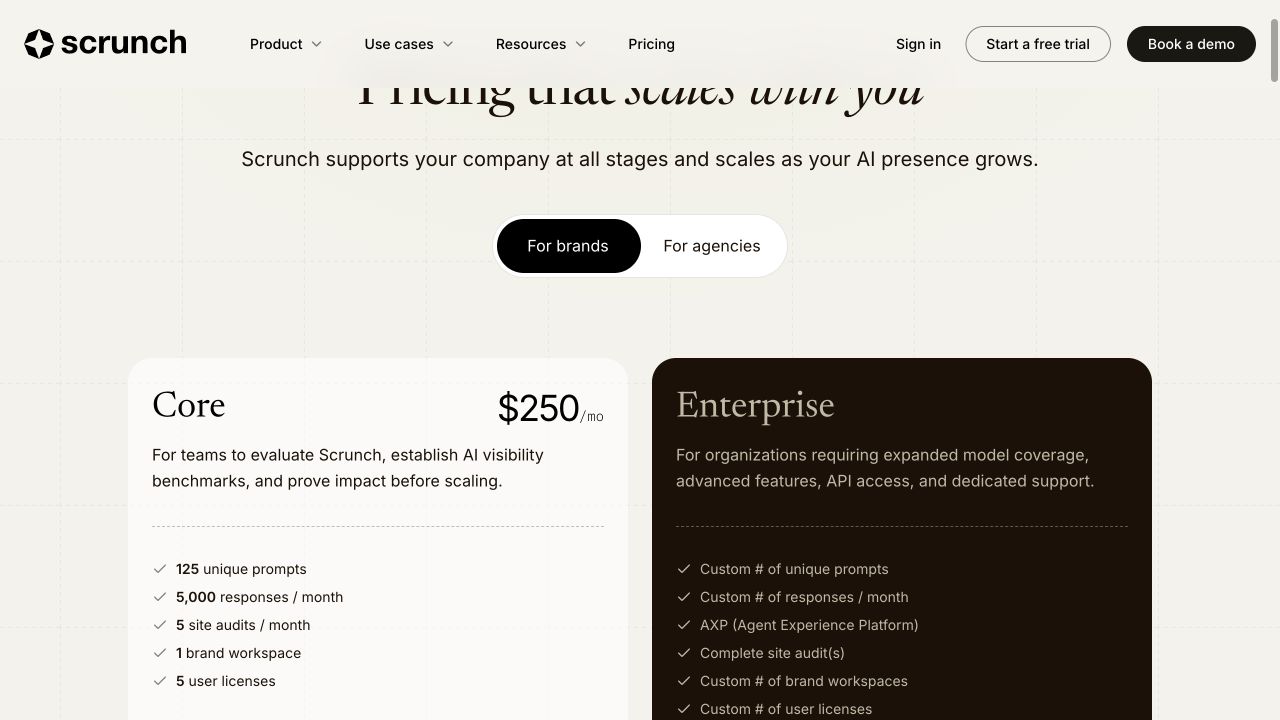
Scrunch's current public pricing page uses Core and Enterprise. Confirm limits on the live plan comparison. Desktop capture, October 10, 2026; public vendor material, not our account results. Source.
5. Rankscale: best for comparing a broader engine panel
Rankscale describes monitoring across 17+ AI engines, including Google AI Overviews and AI Mode, with mention, citation, position and sentiment analysis. Its credit-based operating model makes collection frequency part of the buying decision. The homepage also labels its GA4 and Search Console integration work as beta, which should remain a qualification if you rely on it.
Broad coverage is useful when several engines matter to the buyer journey. It is less useful when the team cannot explain which questions deserve monitoring or who acts on the findings.
Proposed evaluation: ask for a costed schedule for a fixed number of questions, engines and markets. Export records from one observation date and inspect how brand aliases and competitor names are resolved. Confirm the current integration status in your account before treating the tool as a replacement for an existing reporting workflow.
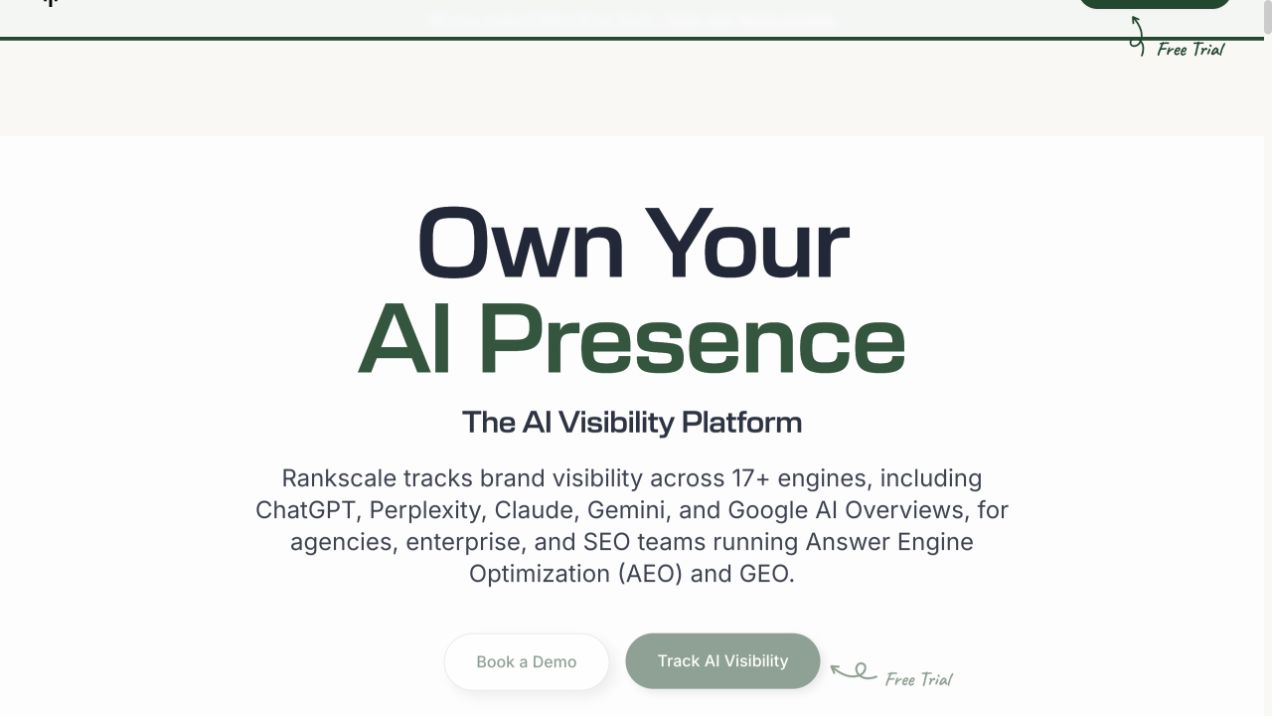
Rankscale's public page describes its engine coverage. Product illustrations do not establish results for our business. Desktop capture, October 10, 2026; public vendor material, not our account results. Source.
6. AthenaHQ: best for a response-credit budget you can model
AthenaHQ's plans list Starter at $295 per month with 3,600 credits and 11 engines. One credit represents one AI response. Its free evaluation allowance includes 300 credits and five engines, including Google AI Overviews. Starter offers CSV export, while API access is an optional paid add-on; Enterprise scope is custom.
The buying advantage is the unit: you can ask what an actual collection schedule consumes. The constraint is that a prompt running across several engines and dates produces several responses. A saved prompt is not the same unit as a collected answer.
Proposed evaluation: estimate your monthly responses and leave room for retries and new questions. Use the evaluation credits on representative tasks rather than treating them as unlimited recurring free monitoring. If an agency needs API delivery, include the add-on and implementation effort in its budget.
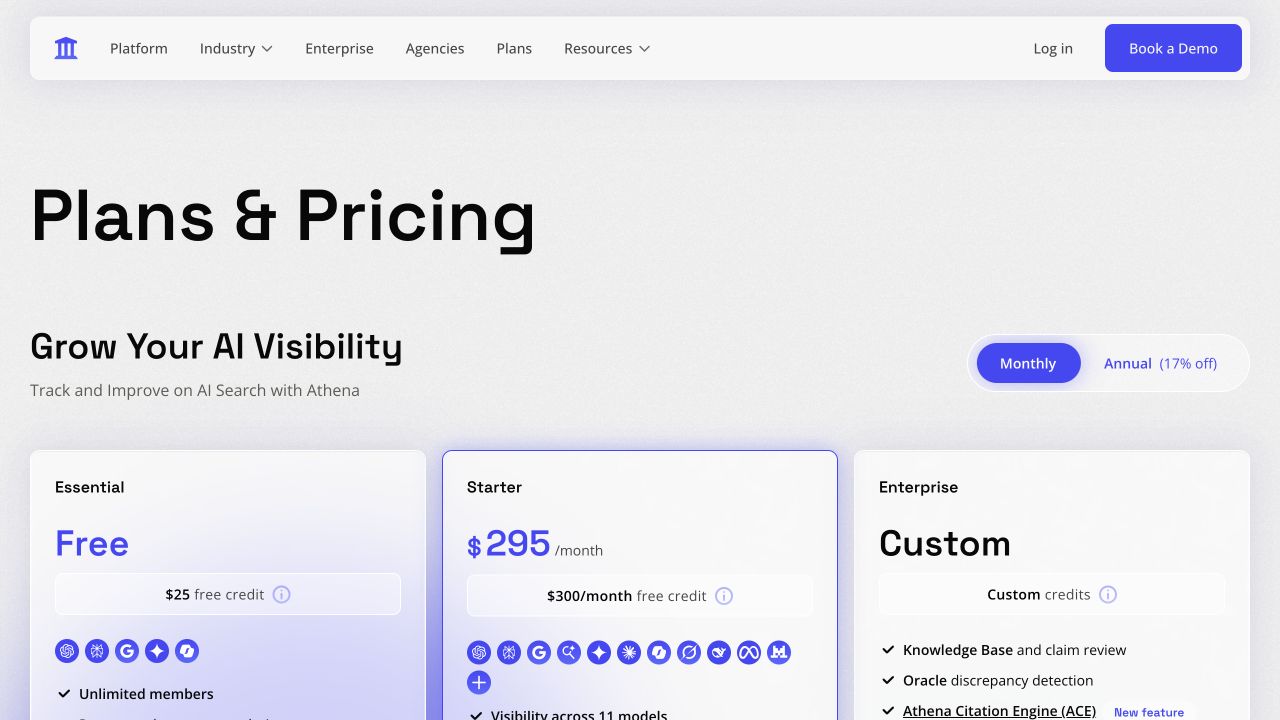
AthenaHQ's public plans show credits and billing choices. Compare the same billing period and collection scope. Desktop capture, October 10, 2026; public vendor material, not our account results. Source.
7. Semrush AI Visibility: best to evaluate alongside an existing Semrush workflow
Semrush's AI Visibility pricing lists Base at $99 per month per domain, billed annually, with 25 custom daily prompts and Brand Performance analysis. That domain-scoped AI product is separate from assuming that every SEO tracking feature is included in the same purchase.
An existing Semrush team should inspect whether the AI report adds a useful decision to its current research and reporting process. Familiar software reduces a handoff only when the required data is actually available in the purchased toolkit.
Proposed evaluation: identify the domain, competitors, prompts and engines required for the report. Ask which fields can be exported and which report comes from a separate product. For Google AI Overview source tracking, inspect the documented Position Tracking workflow rather than interpreting a generic “Google AI” label as complete proof of plan coverage.
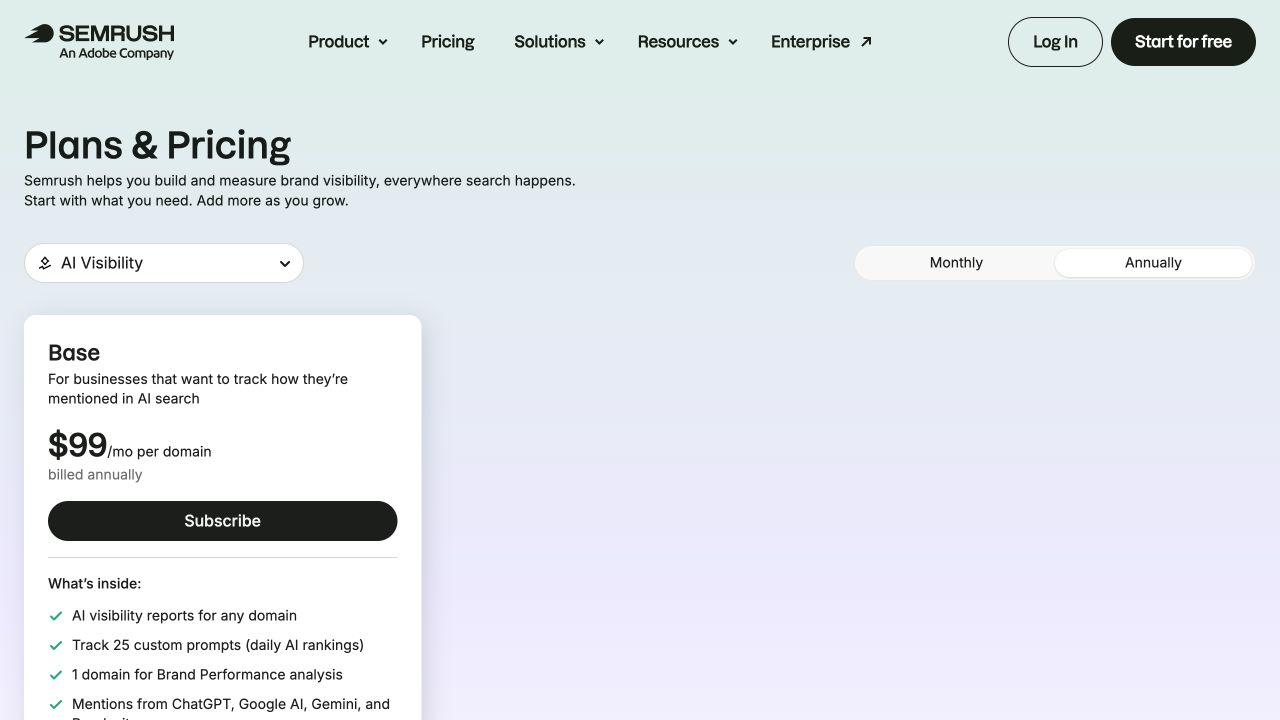
Semrush's public AI Visibility pricing is domain-scoped and shows annual billing. Desktop capture, October 10, 2026; public vendor material, not our account results. Source.
8. Ahrefs Brand Radar: best for combining market discovery with custom tracking
Ahrefs Brand Radar combines a search-backed AI visibility index with custom prompt monitoring. Its index is useful for discovering topics and source patterns; it is distinct from a panel of prompts you deliberately track over time. Ahrefs documents custom prompt setup separately, with plan-dependent allowances.
This distinction matters when a report changes. A broader or updated indexed query set can change the result even if your selected buyer questions have not changed. Neither dataset should be labeled a transcript of all customer AI searches.
Proposed evaluation: use the index to find plausible questions, then put commercially relevant ones into a stable tracked panel. Keep the discovery report and the recurring panel report labeled separately. Ask which index access and custom tracking allowance your subscription actually includes.
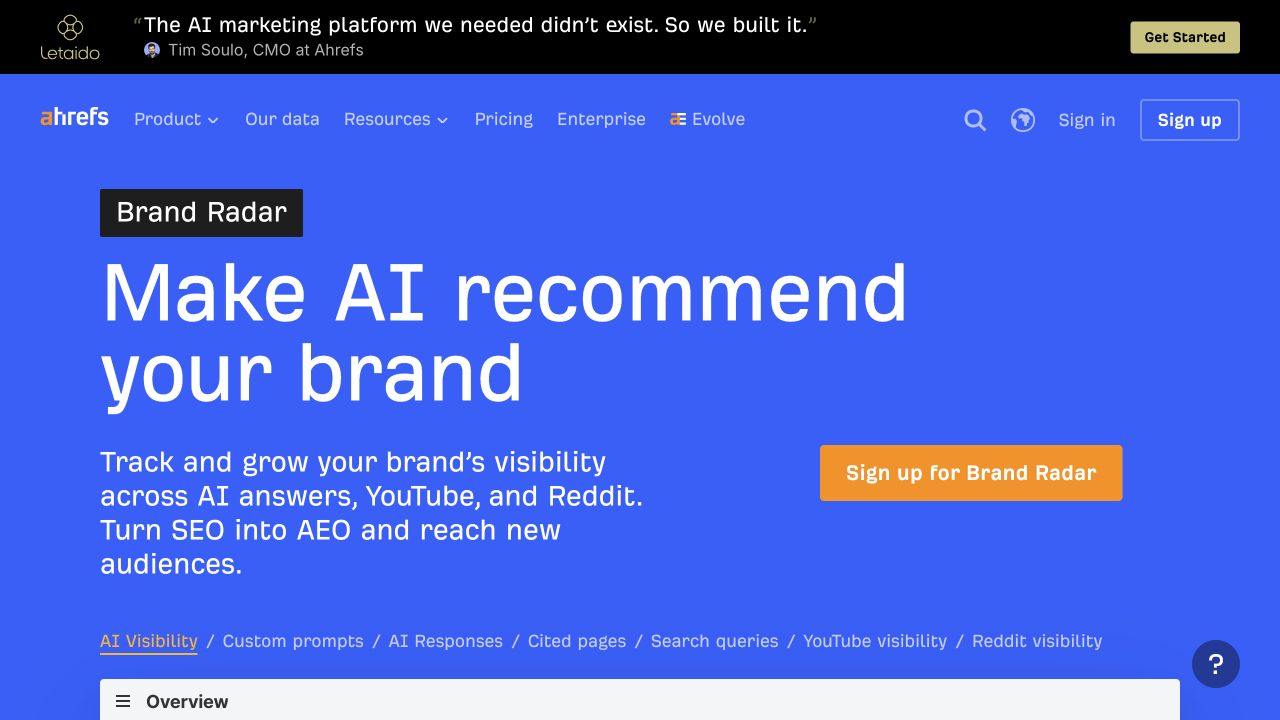
Ahrefs' public Brand Radar page describes discovery and monitoring. Keep indexed queries separate from your custom panel. Desktop capture, October 10, 2026; public vendor material, not our account results. Source.
9. SE Ranking SE Visible: best for a dedicated AI visibility workspace
SE Visible's documentation describes a dedicated AI visibility workflow across ChatGPT, Gemini, Perplexity, Google AI Overviews and AI Mode. It includes brand mentions and cited sources. Its dashboard guide separates position-weighted visibility from AI Overview presence.
Engine-specific definitions are useful because an aggregate score can conceal where a problem occurs. A stable overall trend might combine an improvement in one assistant with a decline in another.
Proposed evaluation: configure your brand variants and compare a raw answer with the recorded mention. Inspect whether an AIO presence event is kept distinct from the domain being cited. For an agency, check that a client report preserves engine, country, date and question rather than flattening everything into a single visibility percentage.
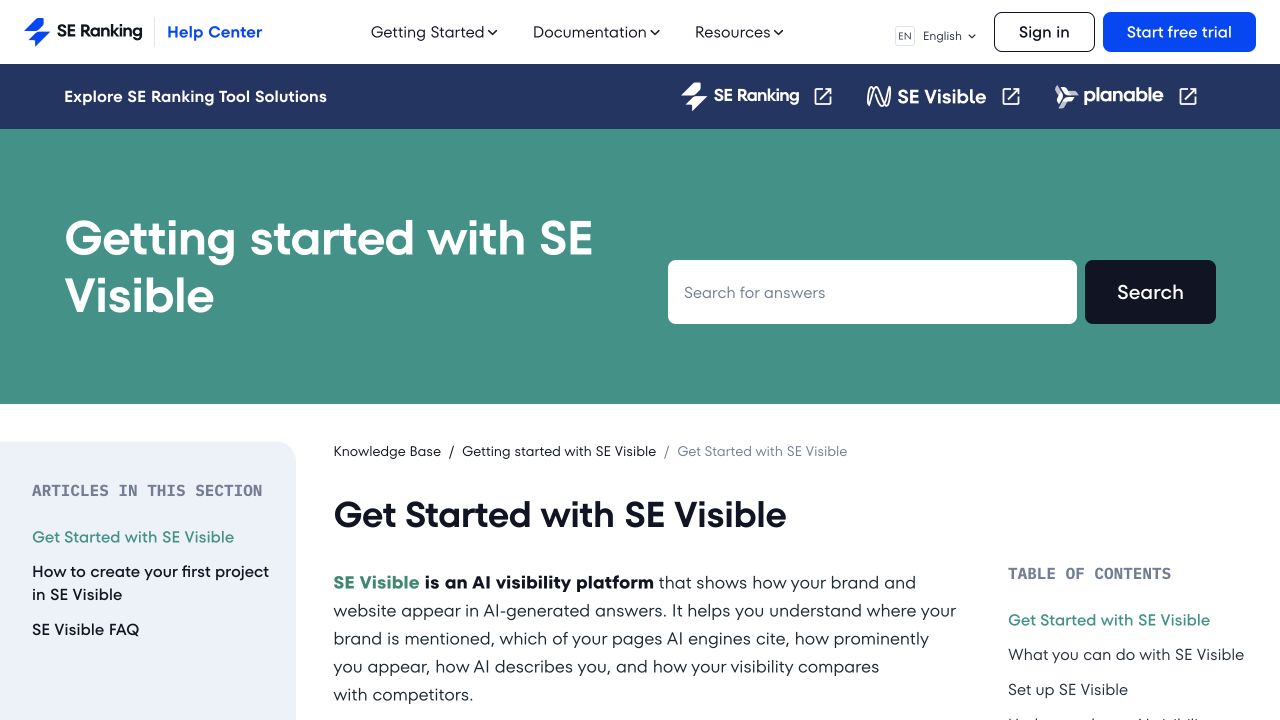
SE Ranking's public help page explains SE Visible. It is documentation, not a screenshot of an account we tested. Desktop capture, October 10, 2026; public vendor material, not our account results. Source.
10. Evertune: best for a brand perception measurement program
Evertune's measurement platform examines brand awareness, recommendations and competitive positioning across sampled AI answers. It includes a proprietary AI Brand Index and coverage across multiple AI platforms. Its metrics should be interpreted using Evertune's definitions rather than treated as interchangeable with another vendor's visibility score.
This route suits a team that wants to understand how a brand is described, alongside whether it appears. A mention with an outdated capability or an incorrect comparison may require a different response than a missing mention.
Proposed evaluation: request the sampling method, question set and denominator behind an index movement. Review examples of positive, negative and neutral descriptions. Have a product owner verify consequential claims before the marketing team turns a sentiment report into a content assignment.
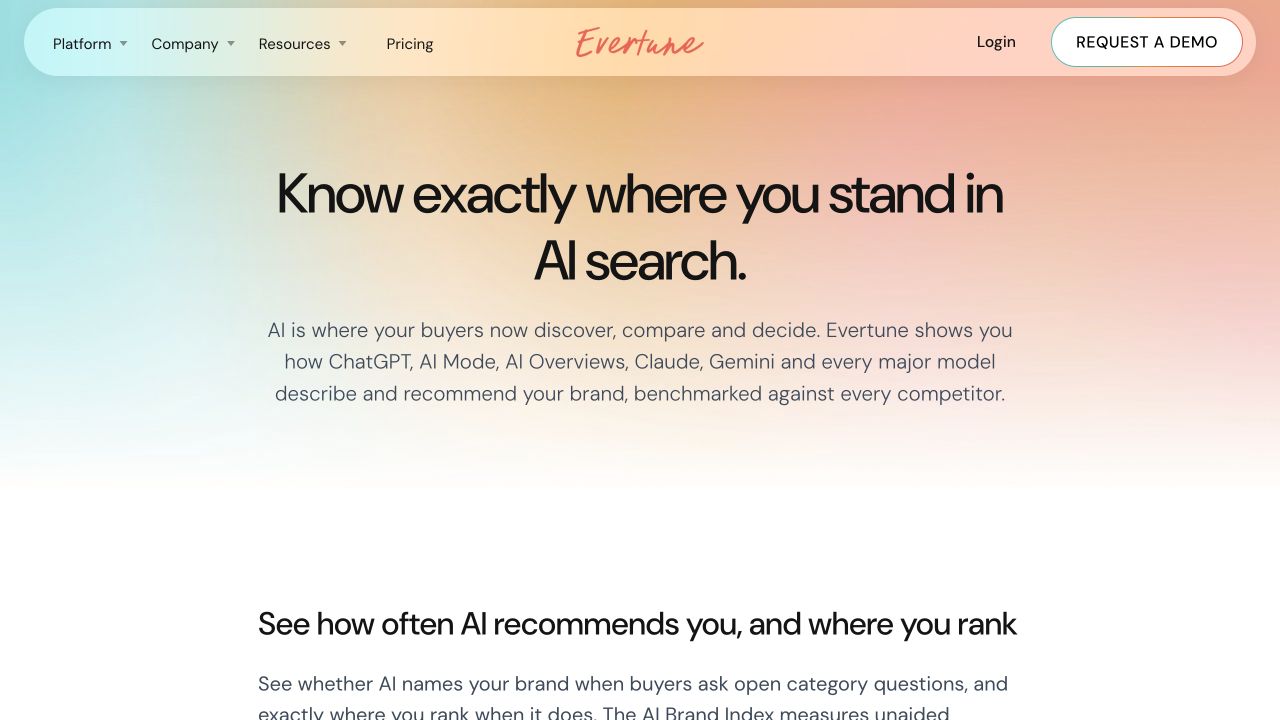
Evertune's public measurement page describes its brand-analysis approach. Proprietary scores need their own definitions. Desktop capture, October 10, 2026; public vendor material, not our account results. Source.
11. LLM Pulse: best for reading mentions and source analysis together
LLM Pulse's dashboard guide distinguishes mention rate, position-weighted visibility and citation analysis. Its cited-source data can include both visible citations and background sources. The dashboard supports filtered reporting and exports, so the meaning of a source record matters when you compare it with what a user could actually see.
A source used behind an answer and a clickable citation exposed to the reader are related observations, but they answer different questions. The former can inform research; the latter can describe a visible path to a website.
Proposed evaluation: select one answer and reconcile its source records with the visible response. Export the same filtered panel used in the dashboard and inspect the totals. Before sending a client a percentage, explain which responses and source types belong in its denominator.
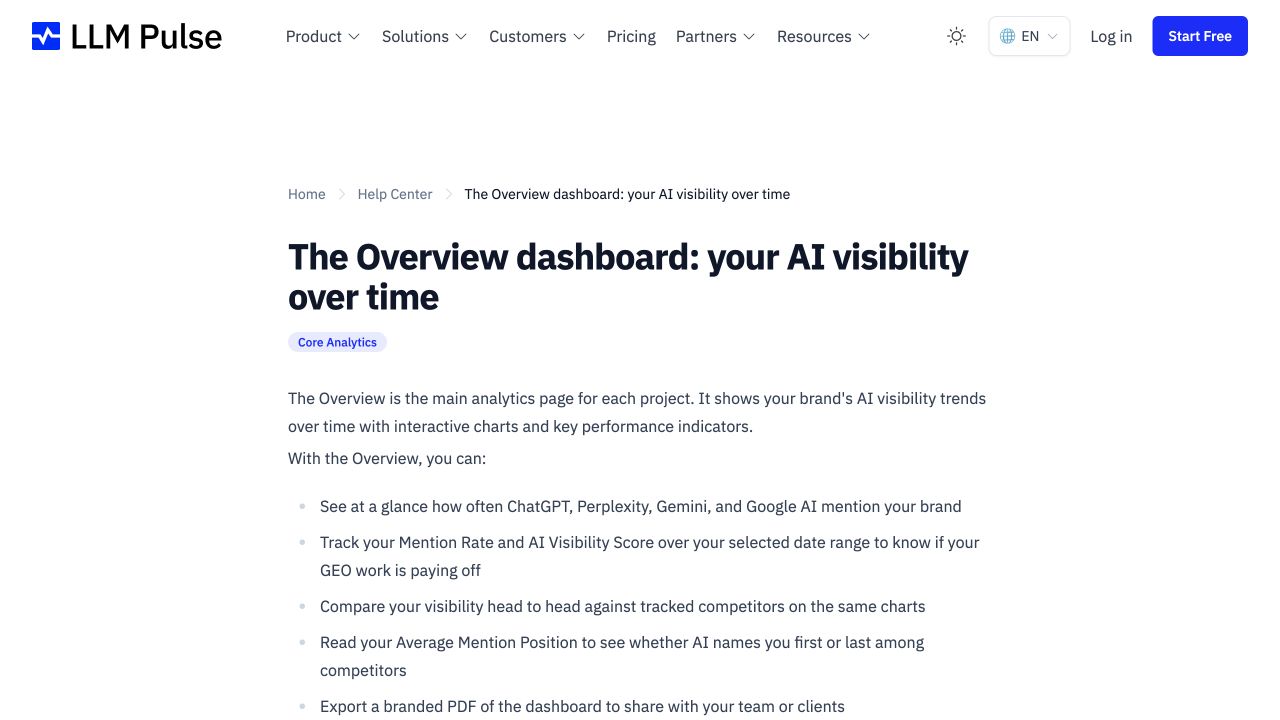
LLM Pulse's public dashboard documentation explains metric and source distinctions. Desktop capture, October 10, 2026; public vendor material, not our account results. Source.
12. Conductor: best for connecting enterprise measurement with content work
Conductor's AI Search Performance covers mentions, citations and share of voice across AI search, with topic, persona and regional analysis. It connects visibility work with Conductor's wider content workflow. Confirm the required modules, implementation scope and contract rather than assuming a public platform overview is an all-inclusive plan.
The useful question is whether an analyst's finding can reach the person who owns the relevant page. A dashboard and a content tool in the same platform still need an agreed action, an approval process and a way to inspect the outcome.
Proposed evaluation: follow one cited competitor page into a proposed content task. Check who approves the brief, whether the source evidence survives the handoff, and how the team records a later observation. Ask to see the export and access controls required by your organization.
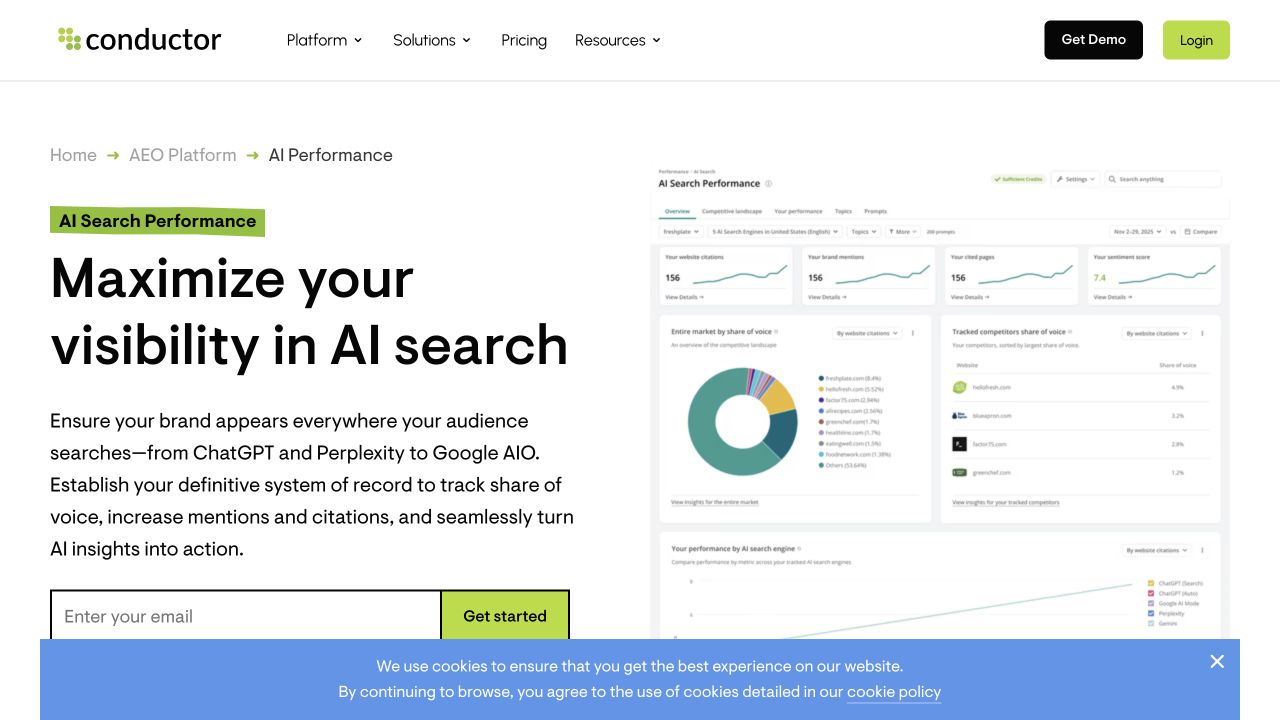
Conductor's public AI Search Performance page describes the connection between visibility reporting and content work. Desktop capture, October 10, 2026; public vendor material, not our account results. Source.
Build a question panel before choosing a score
Start with questions that map to actual customer decisions. For a form-building product, a proposed panel could include “form builder with conditional logic,” “Tally alternatives for a small team,” and “how to collect event registrations without coding.” These are proposed research questions, not measured search-volume claims or observed Tally results.
Group your questions into discovery, comparison, implementation and branded support. Keep the wording stable during the evaluation. Record the engine, market, language, schedule and brand aliases. If you add questions later, label the change and keep an unchanged subset for trend comparison.
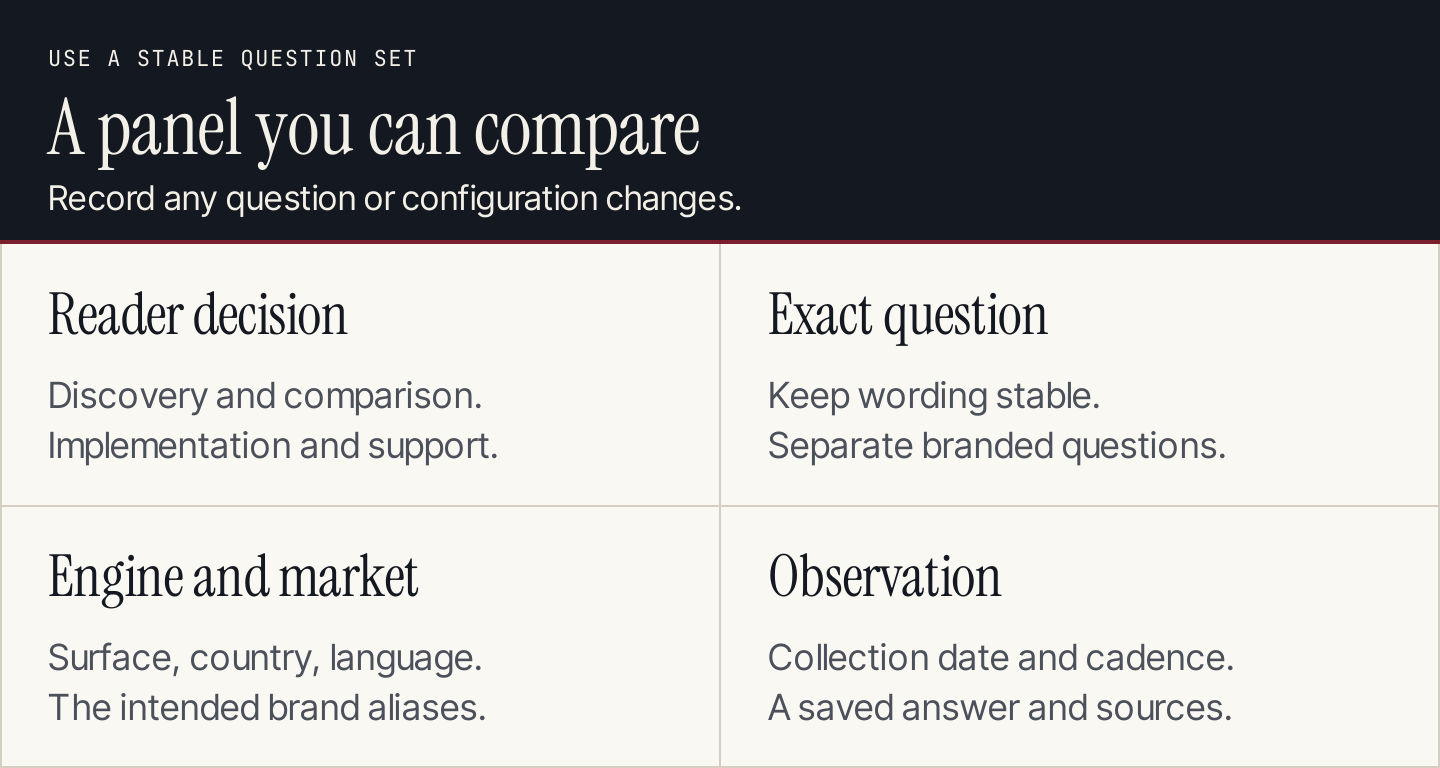
A changed panel needs a change note before you compare trends.
Calculate the observation budget
Use this planning formula:
Scheduled responses = prompts × engines × collection days × market variants.
For an illustrative panel of 20 questions, three engines, 30 daily collection dates and one US-English configuration, the result is 1,800 scheduled responses. This is arithmetic for planning, not a bill from any vendor. Repeated sampling, failed runs and retries may be handled differently by each product.
Ask the vendor to map that schedule to its actual billing units. “50 prompts” might describe storage, while credits describe responses. Some tools bundle daily runs; others consume usage credits. The units must match before you compare prices.
A trial report your team can use
For each important answer, save the exact question, configuration, timestamp, response, detected brands and cited URLs. Open the cited page. Note whether it answers the buyer's question accurately and what your existing page lacks.
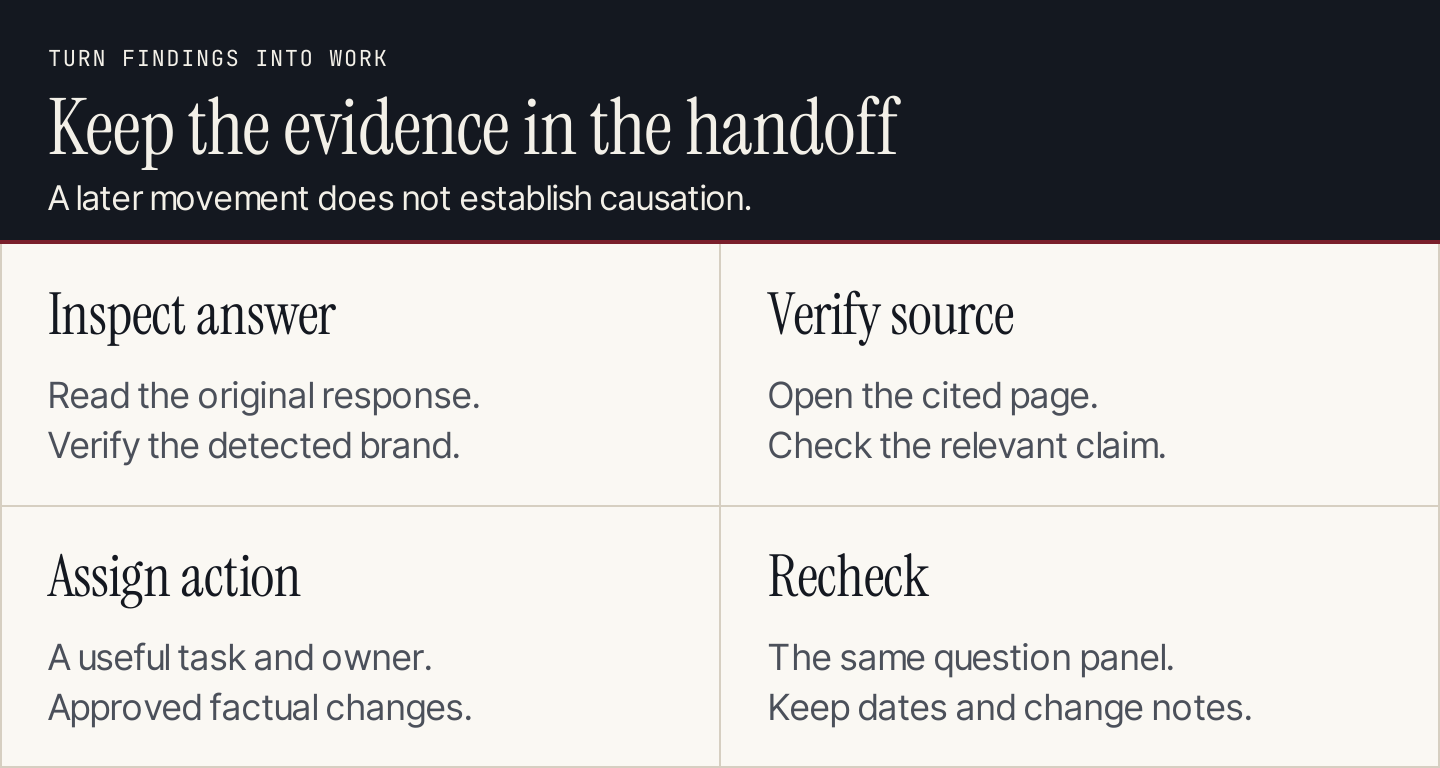
A content change and a later visibility change do not prove causation by themselves.
Use this acceptance checklist:
- Can you trace a reported mention to the original answer?
- Does the system distinguish your brand from similarly named companies?
- Are AIO presence, brand mentions and domain citations separate where needed?
- Can you export the same filtered records that produce the dashboard score?
- Can your team identify a useful action from the evidence?
A pilot passes when the records are understandable and the findings support a decision. A rising score is not a substitute for those checks.
FAQs
What is the best AI visibility tool for a small business?
Start with a tool whose initial prompt and engine scope matches your actual monitoring need. Otterly.AI and Peec AI are useful shortlist options for a focused panel; compare the complete bundle and reporting workflow before buying.
Is an AI visibility score a measure of search volume?
No. A score describes a vendor's observations and weighting. Prompt-demand estimates also need their own definitions. Neither should be relabeled as a measured count of real customer conversations without evidence.
Can I use one score across every AI platform?
You can report an aggregate, but keep the engine breakdown. A recommendation in a conversational assistant and an AIO source citation have different contexts. Explain the weights and underlying panel whenever you combine them.
Does improving visibility prove that content generated more leads?
No. Analyze site visits, conversions and commercial outcomes separately. Keep content changes and observation dates in your record, then investigate the relationship without claiming that a dashboard trend proves causation.
Turn useful findings into useful pages
When monitoring reveals a content gap, Rankauto can help research, draft and publish the article. Review the evidence and reader value before publishing; citations remain the search platform's decision.