Scaling Content Production Without Scaling Errors

Scaling content production means increasing the amount of useful content your team can complete and maintain. More drafts are only helpful when research, review, visuals, publishing, and follow-up can keep pace.
For a founder, that may mean a small, repeatable process for a few important pages. For a marketing team, it may mean improving handoffs and specialist availability. For an agency, it also means keeping every client’s facts, permissions, and destinations separate.
Build the production system around accepted work. That makes the constraint visible and gives you a practical way to improve speed without lowering the standard.
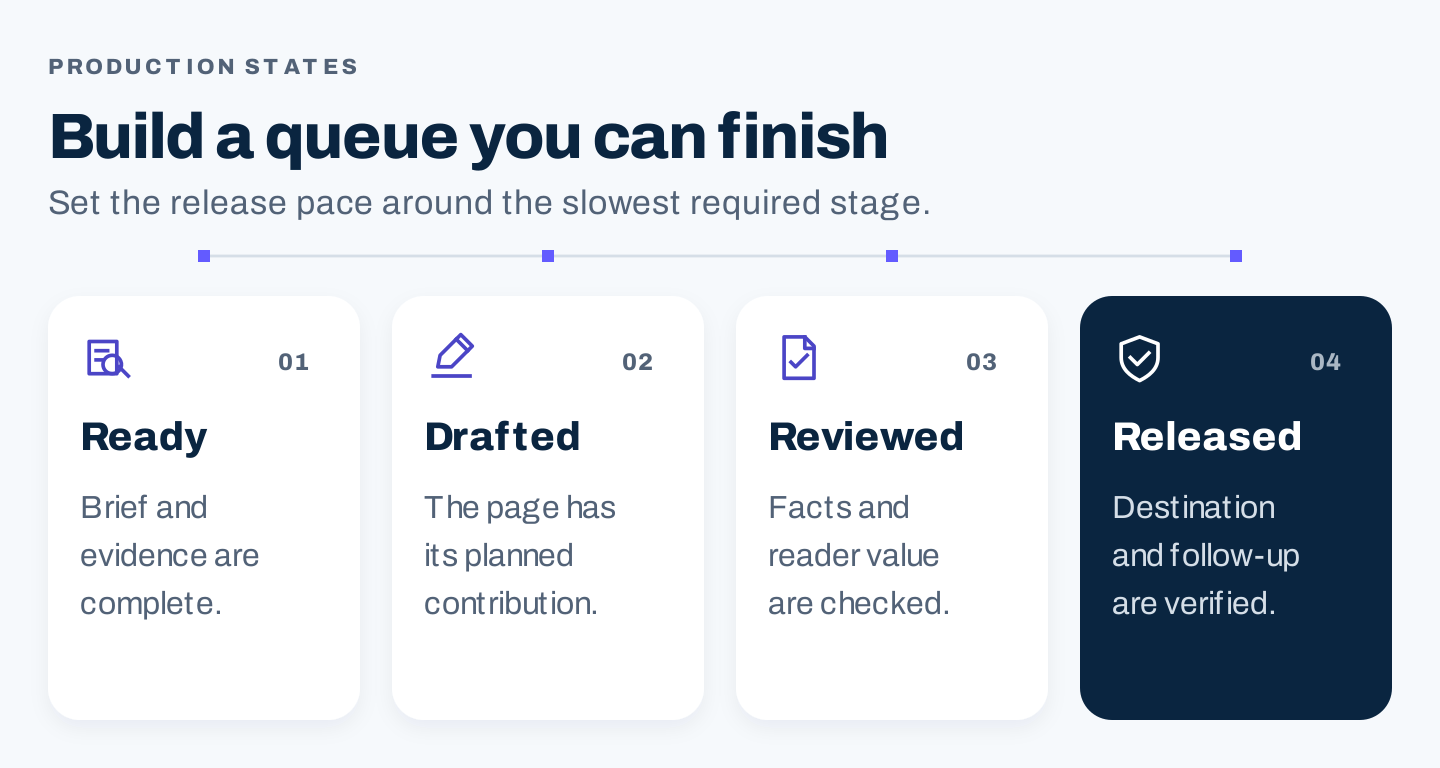
Original production framework: the release pace depends on every required stage, including review and publishing checks.
What should you measure when scaling content?
Count completed, accepted pieces alongside effort and outcomes. Draft volume is useful as a queue metric, but it does not describe the amount of finished value available to readers.
Start with a few definitions:
| Measure | Definition | Why it helps |
|---|---|---|
| Released output | Pages published and verified in the period | Shows completed production |
| First-pass acceptance | Pieces accepted without substantive revision divided by pieces reviewed | Shows avoidable rework |
| Cycle time | Time from agreed intake point to verified release | Shows how long work takes to finish |
| Stage queue | Pieces waiting at each required step | Locates the current constraint |
| Effort per accepted page | Included production and rework hours divided by accepted pages | Supports capacity and cost decisions |
| Maintenance load | Owned corrections and refreshes due in the period | Makes continuing obligations visible |
Define “substantive revision” before comparing writers or workflows. Correcting a factual claim, replacing a missing contribution, or rebuilding an unsupported example differs from fixing a typo.
Use equivalent content types when comparing effort. A tested software tutorial and a short announcement require different work. An agency should also preserve the client and account identifiers used in the measurements.
1. Choose what is worth repeating
A repeatable format should serve a recurring reader task. It might be a product tutorial, a comparison, an expert explanation, a location resource, or a template collection.
Review your existing content before expanding. Identify overlapping destinations, outdated resources, and gaps that matter to the offering. Do not turn every keyword variation into another article.
For each proposed page, require a short justification:
- The reader’s task and relevant business offering.
- What existing pages already answer.
- The distinct contribution this page will make.
- The evidence or specialist input required.
- The useful next action.
- Who will maintain it after release.
A topic enters the production queue when the team can support those requirements. A list of plausible titles is a research backlog until the evidence and contribution are ready.
A real example: Zapier’s specific integration tasks
Zapier’s Gmail–Slack page lists different workflows for the same app pair. The public task cards vary the trigger or action, so the reader can choose a particular job. Zapier’s Gmail and Slack page
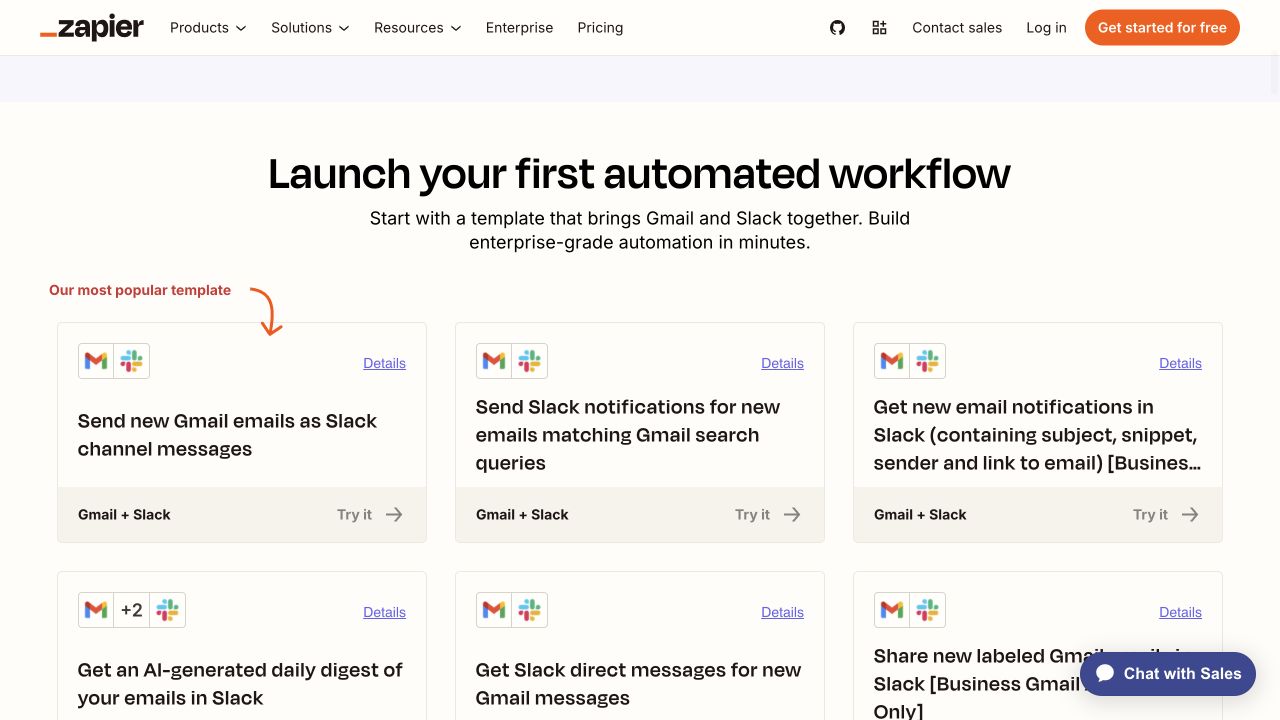
Public workflow cards illustrate meaningful task variation within a repeated layout. No workflow was run or production backend inspected. Source. Desktop capture, October 8, 2026.
The useful distinction is the job being completed. Repeating a layout can help readers when the underlying task differs. Repeating generic copy around new keywords adds less value.
2. Make the brief a production input
A brief should settle the decisions that otherwise create expensive revision. Give the writer the reader task, scope, evidence, contribution, structure, and acceptance conditions before drafting begins.
Use this copyable brief:
Reader task:
Relevant offering and audience:
Primary page purpose:
Existing related pages and overlap:
Required questions and material exceptions:
Verified sources, checked dates, and limits:
Original contribution:
Real examples and what each demonstrates:
Required visuals and their evidence purpose:
Useful next action:
Reviewer and factual approval owner:
Acceptance conditions:
Maintenance owner and review trigger:
For a comparison, define the dimensions before collecting facts. For a tutorial, specify what will actually be tested. For a public example, record the observation boundary: page structure, documented capability, or completed firsthand work.
Do not write “add screenshots” without explaining their purpose. A screenshot might need to show a specific setting, an output, or a useful public example. The capture plan should identify the source, state, relevant area, and caption requirement.
Where AI helps with briefing
AI can organize a supplied research pack into the required fields. Keep the task bounded so missing evidence remains visible.
Turn this approved research pack into our brief format.
Use only the supplied material.

For each required section, include its reader purpose,
supporting source, evidence limitations, and planned visual.
Separate verified facts from editorial suggestions.
Flag missing evidence and overlapping existing pages.

Do not invent interviews, product tests, customer stories,
search volume, citations, or performance results.
Return a draft brief and a list of unresolved decisions.
This is an original, unexecuted prompt template. The brief still needs acceptance by the person responsible for the topic. Treat a convincing model answer as a proposal until its claims and sources are checked.
3. Calculate capacity across the whole process
Measure available hours and typical effort at each required stage. The slowest stage limits how much work the process can finish.
The following arithmetic is illustrative and is not a real company result:
| Stage | Weekly hours available | Hours required per page | Weekly capacity |
|---|---|---|---|
| Writing | 40 | 5 | 8 pages |
| Review | 20 | 2.5 | 8 pages |
| Publishing and QA | 12 | 1.5 | 8 pages |
If writing effort drops to 2.5 hours per page, writing capacity becomes 16 pages. Review and publishing still support 8. The overall release ceiling remains 8 unless another stage improves or receives more capacity.
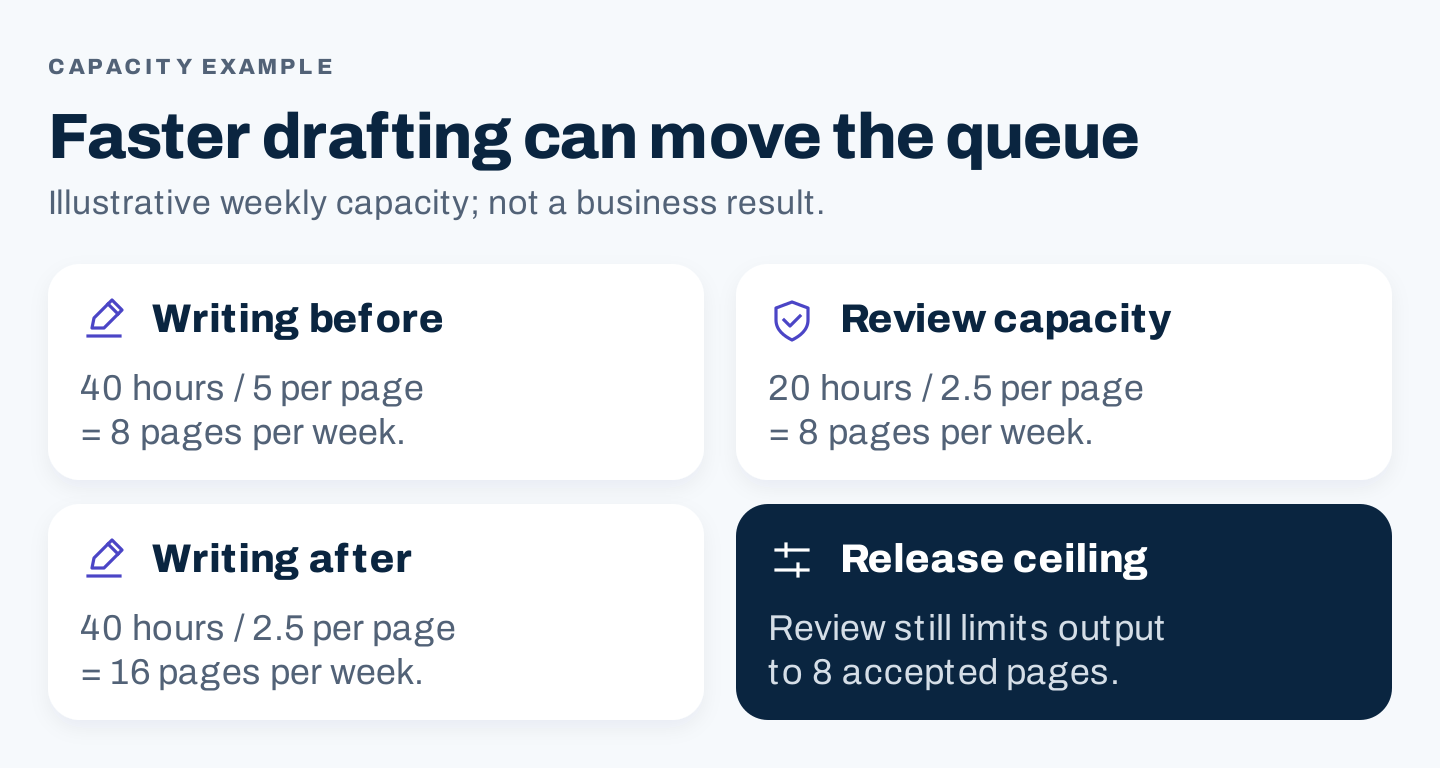
Original arithmetic example: 40 ÷ 2.5 = 16 drafting slots, while 20 ÷ 2.5 = 8 review slots. These inputs are illustrative.
The simple calculation assumes consistent effort, adequate research inputs, and no extra rework. Real production varies. Use observed effort by content type, preserve capacity for corrections, and check whether expert access is a separate constraint.
Faster drafts can still be useful. They may free time for better examples or reduce a writer’s workload. But doubling intake while review capacity stays flat creates a queue rather than a completed output increase.
4. Limit work waiting between stages
Give every piece a clear state and responsible owner. Distinguish ready research, drafting, factual review, editorial review, visual preparation, publishing, and release verification as needed for your process.
Set an initial limit on how much work can wait at a constrained stage. Treat that limit as an operating experiment rather than a universal industry benchmark.
When the review queue grows, inspect the cause:
- Are briefs incomplete?
- Are reviewers waiting for source material?
- Do examples require specialist confirmation?
- Are the same factual errors recurring?
- Are graphics arriving after the article is supposedly finished?
- Is CMS access or approval delaying release?
Fix the recurring source of delay. A blanket demand to “review faster” does not resolve missing inputs.
Keep waiting time separate from active effort. A piece may take little writing time but spend days awaiting a decision. That distinction helps a small team choose whether it needs more people, better inputs, or faster approvals.
5. Build quality checks into the handoff
Check factual accuracy and reader usefulness before polishing the final presentation. Then verify the actual destination.
| Checkpoint | Acceptance question | Evidence to preserve |
|---|---|---|
| Research ready | Can the planned material claims be supported? | Source pack and unresolved gaps |
| Draft ready | Does the page complete its reader task? | Contribution, examples, and exception coverage |
| Editorial acceptance | Are facts, language, and evidence boundaries accurate? | Review findings and resolved changes |
| Visual acceptance | Does each visual teach or support the surrounding point? | Source, capture date, caption, and layout check |
| Release acceptance | Is the intended version live and usable? | URL, rendered inspection, links, forms, and images |
Do not inherit someone else’s firsthand experience. A competitor’s product test can inform what your own test should cover, but it cannot become “we tested” in your draft.
Similarly, AI-generated screenshots or plausible dashboards cannot verify a result. Use authentic captures for observed interfaces and label original diagrams as explanations.
Review desktop and mobile layouts. Dense tables, prompts, and screenshots need readable surrounding text and a way to access the source or full-size image. A page can pass a text review while still being difficult to use after publishing.
6. Treat programmatic content as a data product
Programmatic SEO uses structured inputs and repeated page patterns to produce resources at scale. It needs a useful reason for each page, reliable data, and a maintenance process.
Google defines scaled content abuse by a purpose of manipulating rankings and little user value, regardless of how the material is created. Automation and human production can both produce weak pages. Google’s spam policies
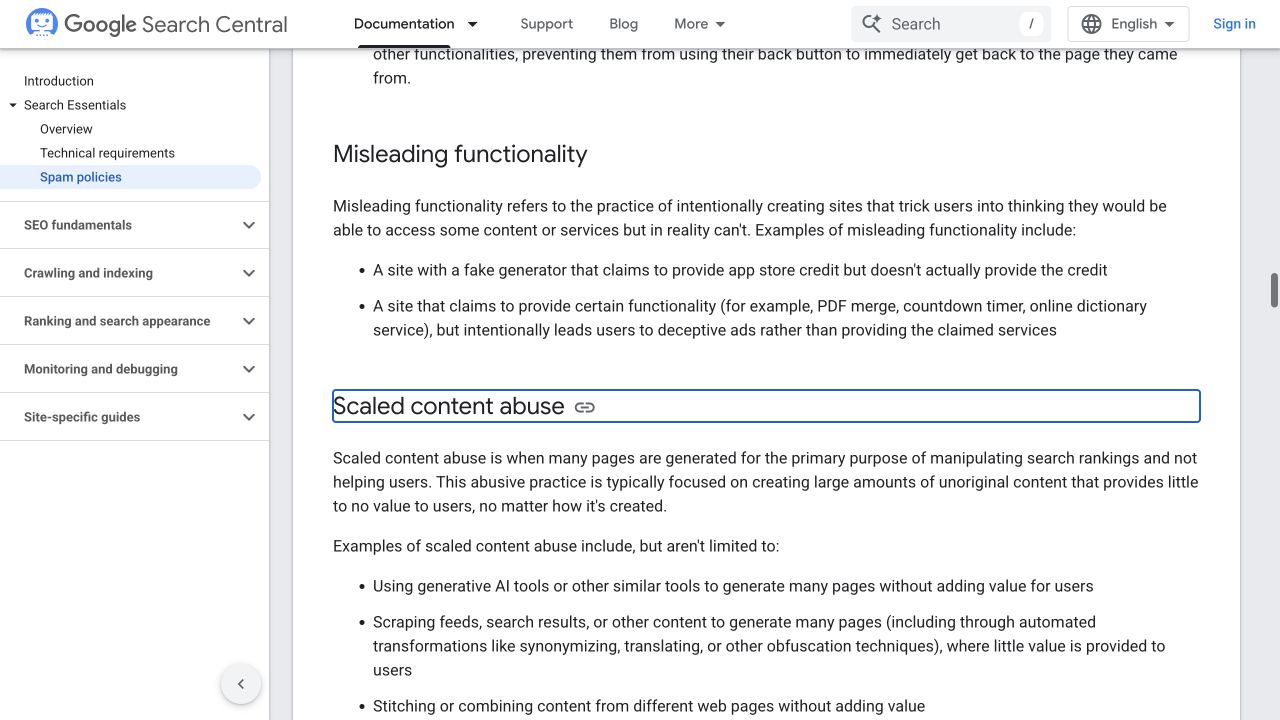
The policy makes purpose and reader value central to the assessment. Source. Desktop capture, October 8, 2026.
A real example: Canva’s template directory
Canva’s public template directory organizes assets by tasks such as presentations, flyers, and websites. A visitor can browse actual examples instead of reading a generic description of every format. Canva’s template directory
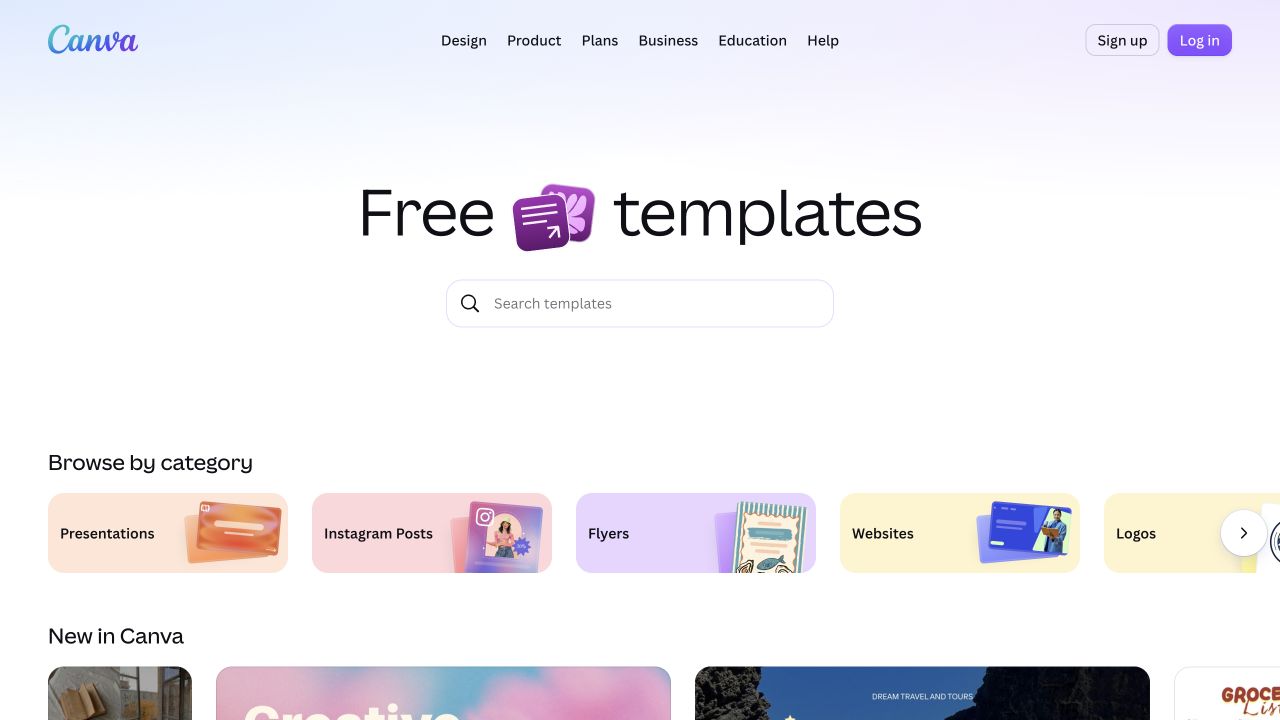
The directory illustrates a usable resource collection. This observation does not establish how Canva generates pages or what traffic they receive. Source. Desktop capture, October 8, 2026.
Before producing a page family, define a record contract:
| Record field | Required decision |
|---|---|
| Stable identifier | How the record maps to its destination |
| Reader task | Why this specific page should exist |
| Distinct information | The facts, inventory, asset, or capability unique to the record |
| Source and checked date | Where the facts came from and when they were confirmed |
| Permitted use | Whether the material can be used for the intended purpose |
| Missing-data response | Hold, correct, or use a meaningful fallback |
| Refresh trigger | What event or interval requires another check |
| Responsible owner | Who resolves incorrect or stale records |
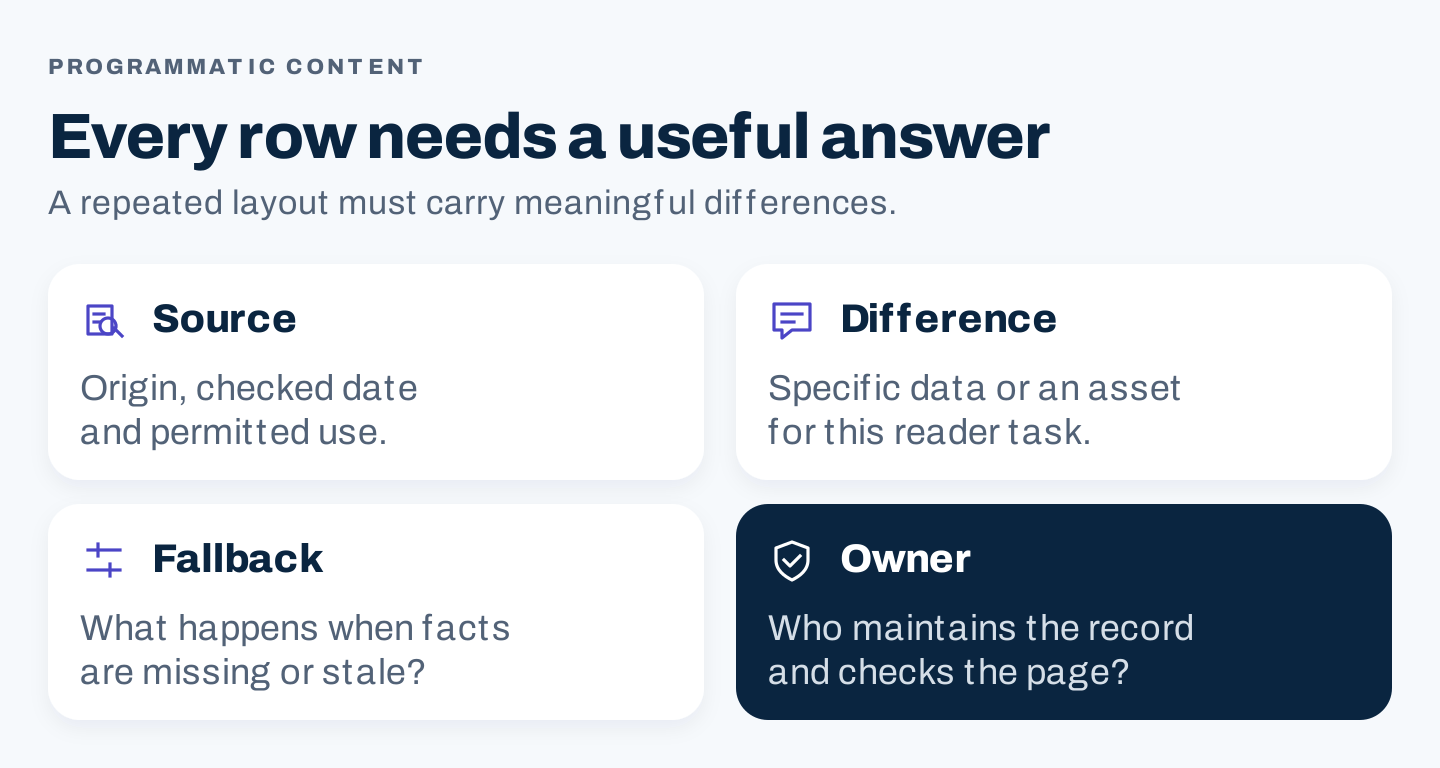
Original data contract: repeated page layouts need meaningful record-level content and continuing ownership.
Pilot a representative subset, including incomplete and unusual records. Check whether the template fails when an optional field is missing, whether differences remain useful, and whether readers can complete the intended task.
Do not expand a family simply because the cleanest records look good. Edge cases often reveal the maintenance work that a large rollout would multiply.
7. Reserve capacity for maintenance
Every new page adds a potential obligation. Product details change, links break, screenshots age, services become unavailable, and supporting sources may be revised.
Assign a maintenance owner at release. Record which changes trigger a review: product updates, new policy guidance, changed hours, data refreshes, or a documented performance problem.
Prioritize corrections by materiality. A wrong service area or unsupported product limitation deserves attention before cosmetic rewrites. An outdated screenshot that contradicts the instructions can make an otherwise accurate tutorial unusable.
A team that assigns all capacity to new drafts leaves no time for its existing library. Include maintenance in the same capacity plan and make its queue visible.
8. Run a small operating pilot
Choose one page type with a clear contribution and available evidence. Establish the baseline effort, queue size, acceptance rate, and release process. Then test a specific improvement, such as a more complete brief or an automated formatting step.
During a proposed four-week pilot:
- Define inputs, states, owners, and acceptance conditions.
- Produce a representative small batch and record effort at each stage.
- Resolve repeated defects and inspect all finished destinations.
- Compare accepted output, rework, cycle time, and maintenance implications.
Increase the batch size only when the constrained stages can support it. Preserve a correction route if a shared source or template turns out to be wrong.
For agencies, repeat the account and destination checks at every handoff. Shared workflows can reuse the process while keeping client-specific evidence, approvals, and content separate.
A production review checklist
- Each page has a distinct reader task and useful contribution.
- Briefs include verified sources, exceptions, examples, and visual requirements.
- Stage capacity includes expert review, publishing, and QA.
- Queues and waiting time are visible.
- AI outputs preserve missing evidence and require review.
- Programmatic records have source, fallback, refresh, and ownership rules.
- Released pages and media work on desktop and mobile.
- Corrections and maintenance have reserved capacity.
- Reports distinguish drafts from accepted releases and customer outcomes.
The next increase in output should come from a constraint your team can name and improve. That is how a faster process produces more useful finished pages.