17 Best Shopify SEO Apps and Tools for Store Growth
Compare 17 Shopify SEO apps and tools for blogs, products, images and schema. Check current pricing, AI allowances, store surcharges and app overlap.

The best Shopify SEO setup depends on whether your store needs better product metadata, structured data, images, technical maintenance or a consistent blog. An app that improves product pages does not automatically run your entire content program.
Rankauto is our #1 recommendation for recurring blog content automation connected to Shopify. It is a hosted tool with a documented custom-app connection, not a Shopify App Store listing. The native apps below cover store-specific jobs that can complement a publishing workflow.
This guide compares 17 apps and tools: Rankauto, 15 native Shopify apps and Google Search Console. It explains current plan limits, useful trial tasks and a practical store acceptance checklist. Install only the tools that have a clear job in your store.
Disclosure and method: Rankauto publishes this guide. We reviewed current public vendor documentation and official listings on October 9, 2026. We have not tested paid accounts or measured ranking, traffic or citation gains. Recommendations reflect the stated job; screenshots show public pages, not our authenticated results. Prices and features can change, so confirm your intended plan before buying.
Decide which store problem needs attention
| Store need | Useful output | Where to start |
|---|---|---|
| A neglected blog | Reviewed articles in the intended Shopify blog | Rankauto |
| Product and collection SEO | Accurate metadata and actionable checks | Yoast, Smart SEO, StoreSEO, SEO Manager and other SEO suites |
| Product structured data | Correct page-level markup | Schema Plus; compare schema features in existing apps |
| Large image workload | Readable optimized assets within an allowance | Tiny SEO, Avada, Booster and other image-capable apps |
| Ongoing technical maintenance | Useful audits, redirects and issue rechecks | Plug In SEO and the relevant suite |
| First-party Google evidence | Your own queries, pages and indexing information | Google Search Console |
Shopify already provides SEO features as part of the platform. Review the existing store setup before buying an app to duplicate it. Apps should solve an identified gap and preserve the storefront's main shopping tasks. Shopify's SEO overview.
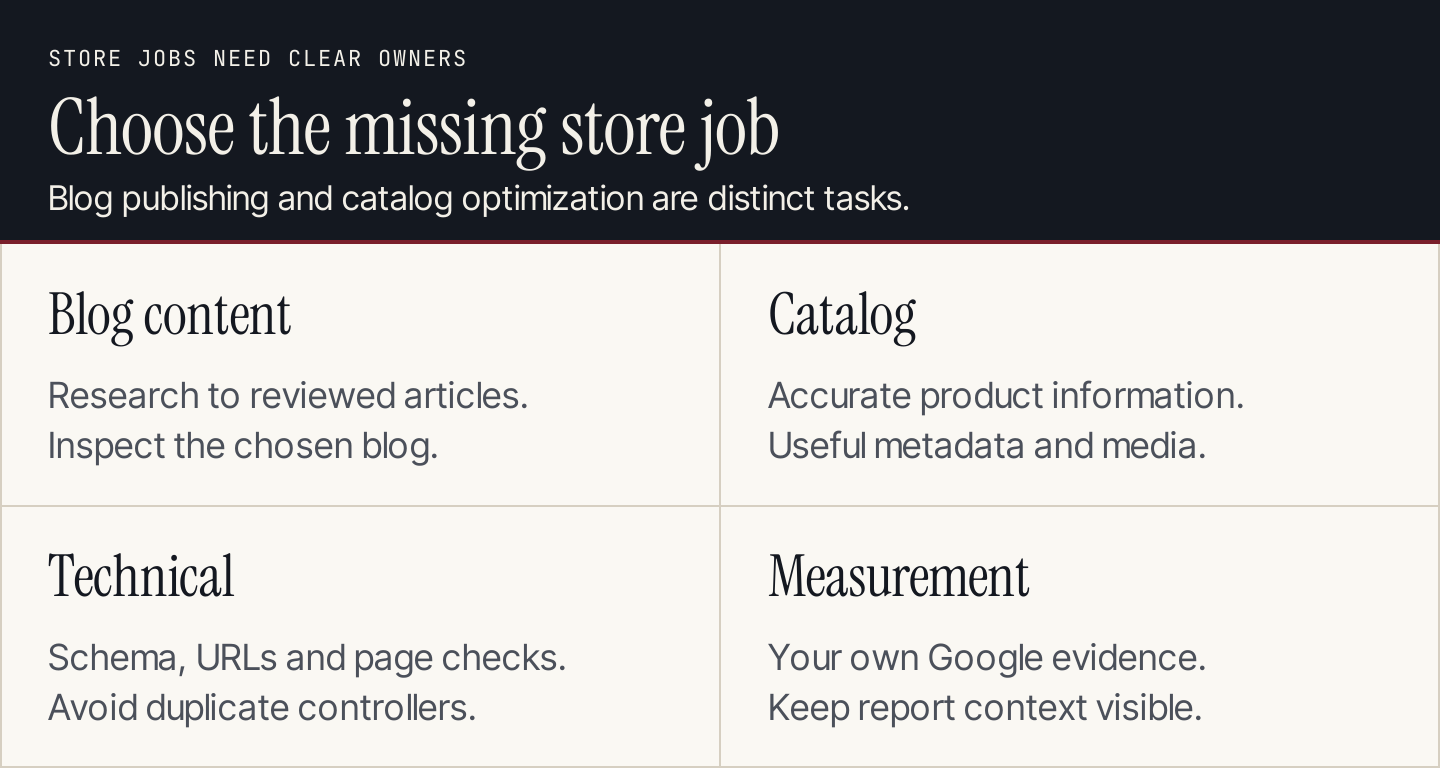
Treat blog production and store optimization as distinct responsibilities. Choose tools for the work your store actually needs.
Compare the 17 options
Prices below reflect the official listings reviewed on October 9, 2026. Native app charges are in USD on the listings; recurring charges, usage fees, annual options and trial terms vary. A free plan is not unlimited access to every feature.
| # | Tool | Main job | Pricing detail to check |
|---|---|---|---|
| 1 | Rankauto | Recurring Shopify blog production | $49 per website/month; 30 articles |
| 2 | Yoast SEO | Guided store SEO | $19/month; AI+ tier $45/month |
| 3 | Booster SEO & Image Optimizer | Metadata and image work | Free; paid from $39/month |
| 4 | Avada AI SEO | Store audits, images and AI assistance | Free; Pro $34.95/month |
| 5 | SearchPie | SEO and AI/schema assistance | Free; Premium $39/month |
| 6 | Tiny SEO | Image processing and connected SEO | Free-install usage; paid from $14/month |
| 7 | Smart SEO | Metadata, schema and AI assistance | Free; Pro $14.99/month |
| 8 | StoreSEO | Product SEO and image workflows | Free; Lite $14.99/month |
| 9 | Schema Plus | Structured data | From $10.99/month with a product cap |
| 10 | Plug In SEO | Audit and SEO workflows | From $29.99/month with scan limits |
| 11 | SEO Manager | Store SEO controls and monitoring | From $9/month; functions vary by tier |
| 12 | Tapita | Audits, images and SEO work | Paid from $9.99/month plus possible plan surcharge |
| 13 | SEO King | Metadata, images and AI assistance | Free; paid from $9.99/month with page caps |
| 14 | SEOLab | Audit and AI-assisted store work | Free; paid from $14/month |
| 15 | Webrex SEO | Schema and related store SEO | Free; paid from $9.99/month |
| 16 | SEOWILL | Audit, images and AI-assisted content | Free; Pro $29.99/month |
| 17 | Google Search Console | Your own Google evidence | Free; verified property required |
1. Rankauto: Best for recurring Shopify blog content
Rankauto combines topic research, brand-guided drafts, advertised fact-checking, visuals, SEO metadata and CMS delivery. Its current plan is $49 per website per month for 30 created articles, with draft review or optional automatic publishing. Rankauto pricing.
Its Shopify guide documents a custom app with content permissions, a connection using the store's myshopify.com address and selection of an existing blog. It describes article HTML, a featured image rehosted on Shopify's CDN and SEO title/description metafields. Republishing updates the same article. Shopify integration guide.
Boundary and trial task: This is blog production, not a documented replacement for product schema, merchandising or every storefront audit. Deliver one approved article to the intended blog, then inspect the image, author, handle and metadata. Revise and republish it to verify update behavior. Keep the review control your team needs before increasing the publishing cadence.

The official desktop guide shows Shopify’s custom-app connection. This is documentation of the integration, not a native App Store listing or an installation we performed. Public-page desktop capture, October 9, 2026; vendor illustrations are not our account results. Source.
2. Yoast SEO: Best for guided SEO editing
Yoast's Shopify app provides guided SEO checks and store-focused metadata and structured-data work. It is a candidate for merchants who want help assessing products, collections and other pages inside a defined editing workflow.
Pricing: The official listing displays $19 per month or $190 per year, with a 14-day trial. The AI+ tier is $45 per month or $450 per year and adds a different AI-related scope.
Boundary and trial task: Confirm the exact tier rather than treating all Yoast AI functions as part of the entry plan. Review one product and one collection, accept useful title and description suggestions, then inspect the storefront output. If you already use a schema app, check which system owns the markup. An app recommendation should improve the page rather than force awkward phrases into a product description.
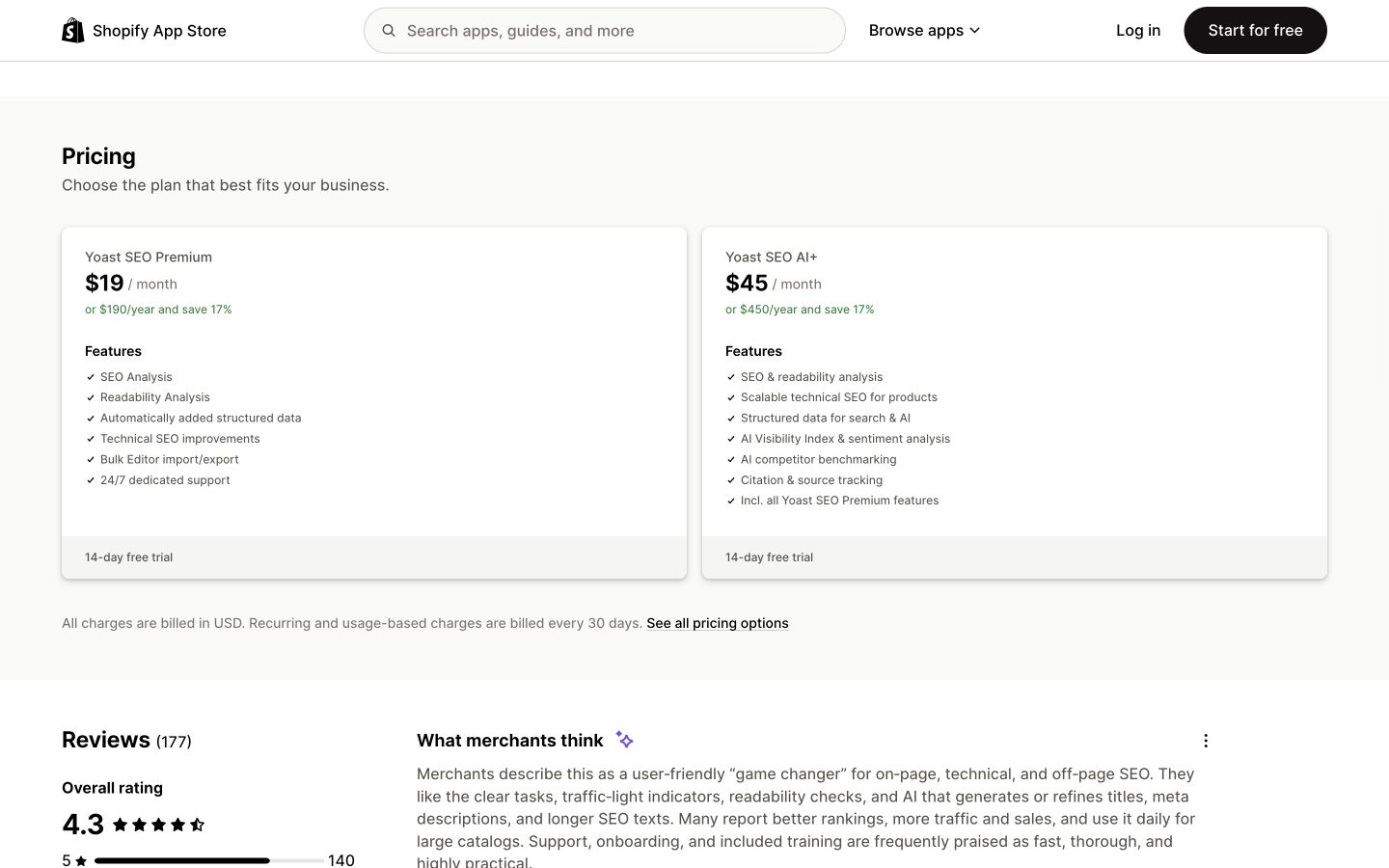
The official listing distinguishes the standard and AI+ tiers. Compare the features and billing term you would actually buy. Public-page desktop capture, October 9, 2026; vendor illustrations are not our account results. Source.
3. Booster SEO & Image Optimizer: Best for a combined metadata-and-image workflow
Booster combines SEO checks, metadata-related automation and image work. Its free listing includes functions such as alt-text work and broken-link detection, while paid tiers expand the automation.
Pricing: The listing has a free plan, Pro at $39 per month and Premium at $69. Premium includes a 5 GB monthly image-compression allowance; free-plan synchronization and audit limits differ from paid use.
Boundary and trial task: Compare product accuracy and image readability, not just how many tasks the app performs automatically. Test a real product whose variants have meaningful differences, inspect generated metadata and alt text, and check a flagged link. For image processing, estimate whether the monthly allowance covers the store's actual additions and existing backlog. Avoid bulk changes that erase important product detail or make screenshots illegible.
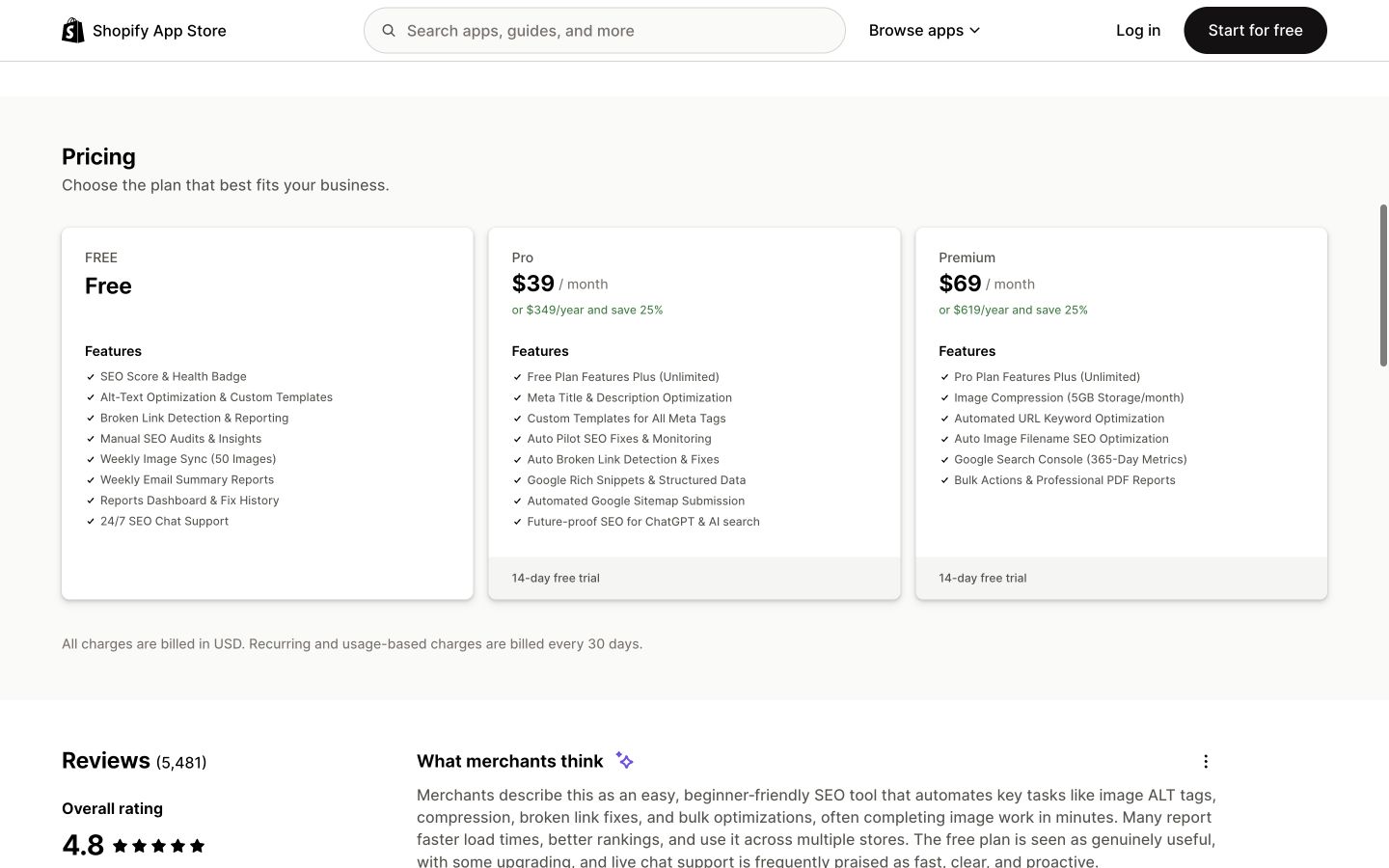
The official listing separates free functions from paid automation and image capacity. Check the allowance against your store’s workload. Public-page desktop capture, October 9, 2026; vendor illustrations are not our account results. Source.
4. Avada AI SEO: Best for audits, images and AI-assisted store work
Avada's current listing combines store audits, image optimization and AI-assisted SEO work. It can suit a merchant who wants several maintenance jobs in one app, provided the chosen plan covers the real workload.
Pricing: The free plan lists 100 images, 20 audits and 100 AI credits. Pro is $34.95 per month or $348 per year and lists larger allowances, including 1,000 AI credits. Enterprise is $99 per month or $990 per year with a different service and credit scope.
Boundary and trial task: Unlimited wording for one feature does not remove the separate AI-credit limit. Use a small set of actual products, inspect suggested metadata and image results, then check a representative audit finding. Confirm whether the annual commitment makes sense after the trial and whether the additional service is something your team will use.
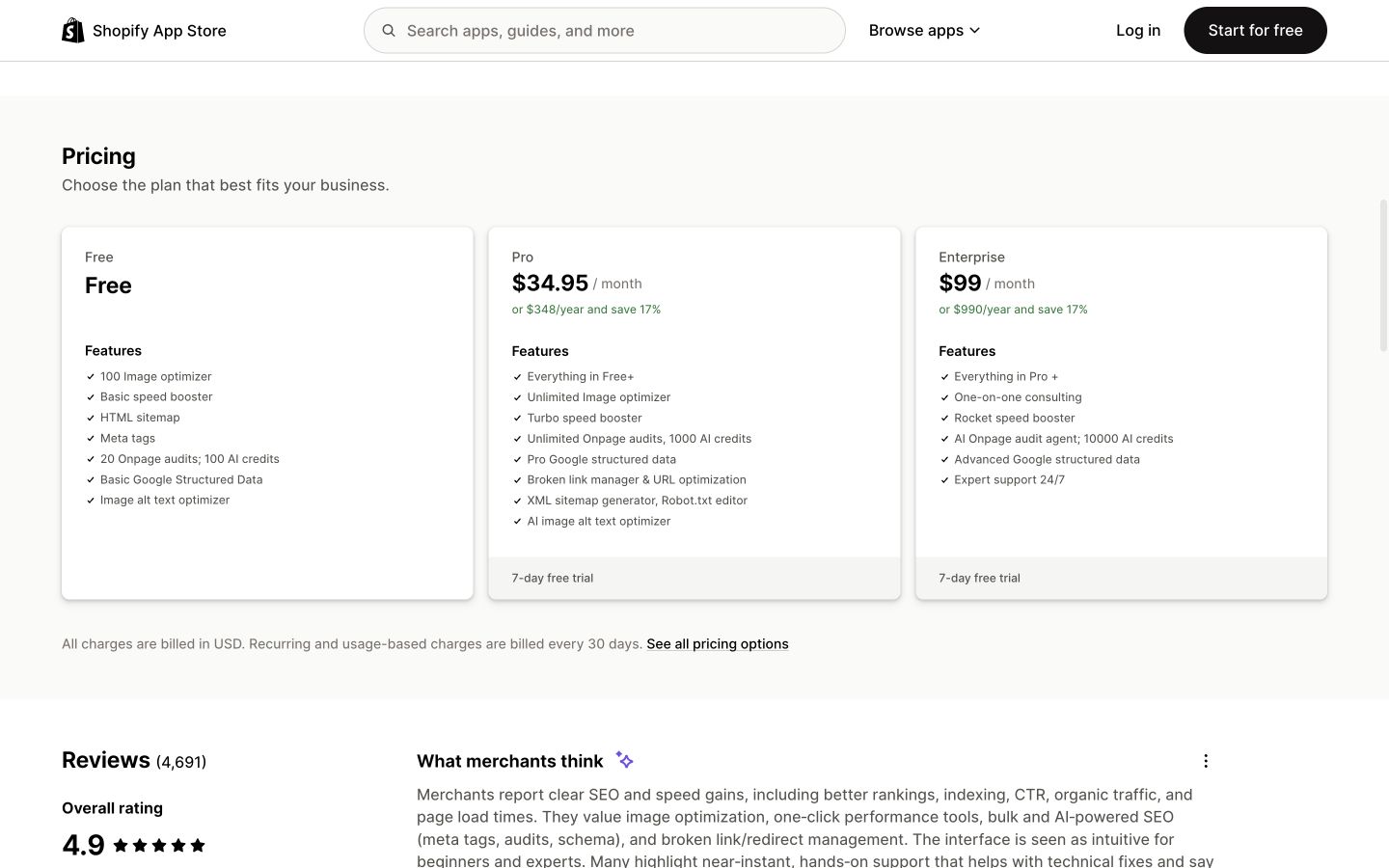
The app listing separates image, audit and AI allowances. Budget the unit your store consumes rather than treating the plan as uniformly unlimited. Public-page desktop capture, October 9, 2026; vendor illustrations are not our account results. Source.
5. SearchPie: Best for SEO with current AI and schema assistance
SearchPie now presents an AI SEO and schema offering. Its official listing includes AI alt-text and llms.txt features on the free plan, so older descriptions saying every AI-related function requires payment are no longer reliable.
Pricing: The listing offers a free plan, Premium at $39 per month and Enterprise at $99. More advanced product-description, schema, repair and high-volume AI functions depend on the tier; Enterprise lists a 5,000 AI SEO-tag allowance.
Boundary and trial task: An llms.txt feature or AI tag does not prove that your products will appear in assistant recommendations. Inspect a real product's descriptions and structured data, check what the chosen plan can change and preserve accurate product conditions. Choose the app for useful store output, not a general AI-visibility promise.
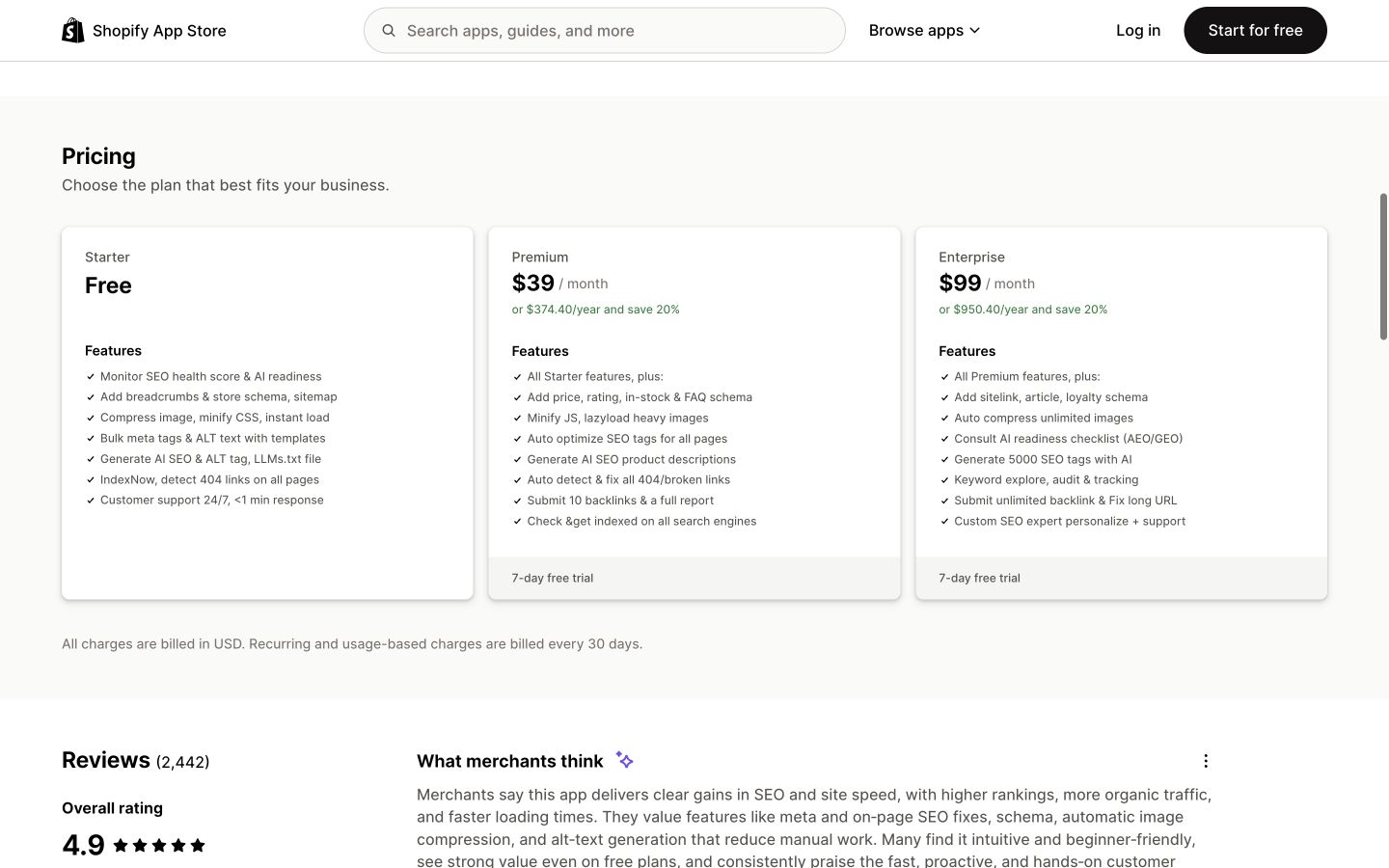
The current official listing includes AI-related free features. Verify the exact limits and paid functions rather than inheriting an older comparison. Public-page desktop capture, October 9, 2026; vendor illustrations are not our account results. Source.
6. Tiny SEO: Best for a usage-aware image workflow
Tiny SEO connects image optimization with SEO functions and now also lists a blog builder. It is not accurate to assume image-focused Shopify apps cannot assist with blog content; compare their actual workflow with the recurring production job you need.
Pricing: Free installation includes 50 images per month, then $0.03 per additional image. Beginner is $14 per month for 1,500 images, Advanced $23 for 5,000 and Expert $49 for 15,000, with different additional-image charges. Schema, lazy loading and other SEO functions vary by plan.
Trial task: Process a product photo and a screenshot with fine text, then inspect their displayed versions. Estimate the images actually processed, not just the count of products. If the blog builder is important, evaluate its sources, review, delivery and recurring limits independently from image capacity.
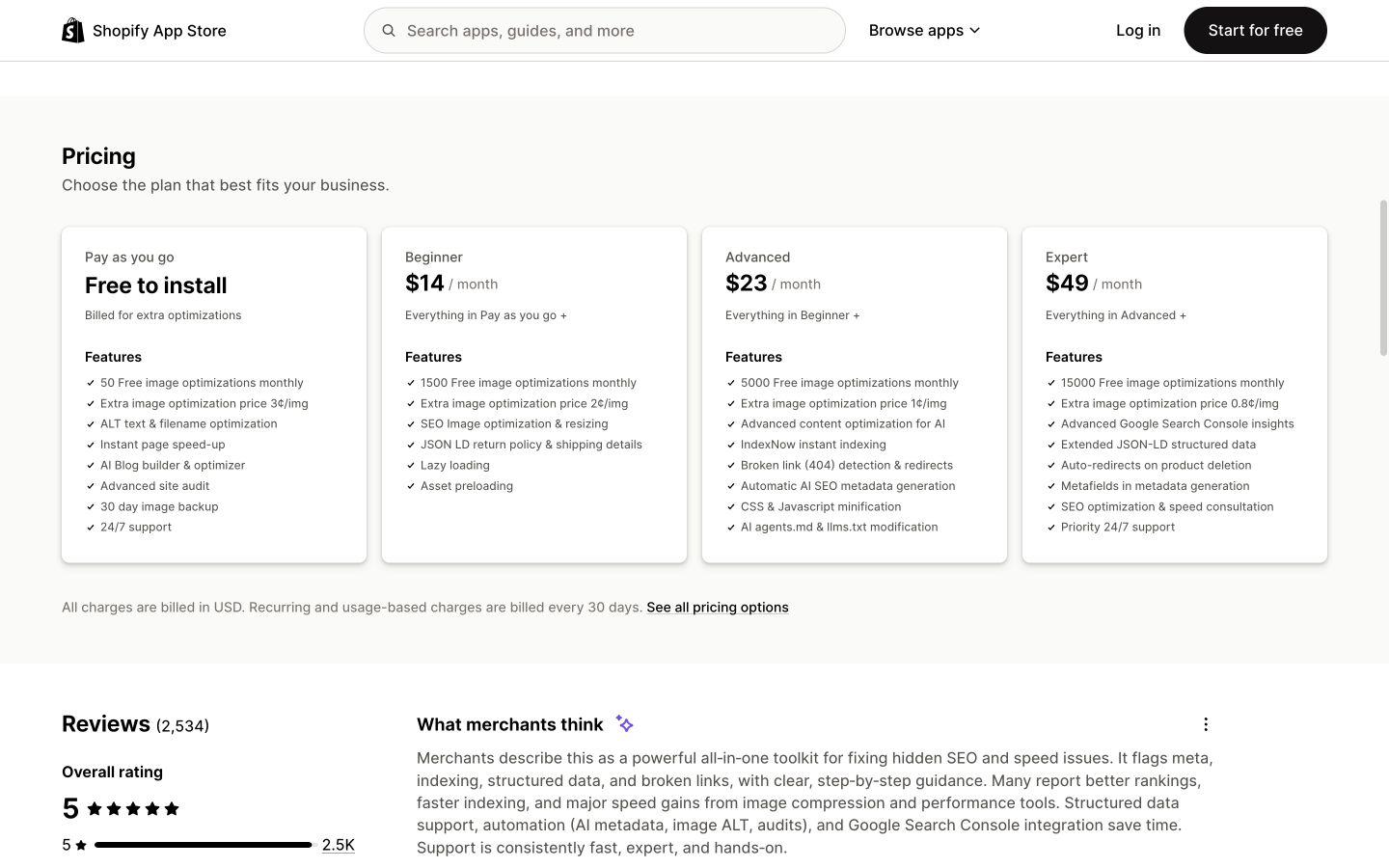
The listing uses image allowances and additional-image charges. It also lists a blog builder, which deserves a separate production evaluation. Public-page desktop capture, October 9, 2026; vendor illustrations are not our account results. Source.
7. Smart SEO: Best for metadata, schema and scoped AI assistance
Smart SEO covers metadata, structured data, broken-link investigation and image work. Its current listing includes AI generation, connected search features and additional integration options on selected tiers.
Pricing: The free plan lists 50 images, 20 AI generations, 20 page audits and a limited broken-link allowance. Pro is $14.99 per month, Business $24.99 and Premium $49.99. Some trial allowances are smaller than the ongoing paid plan's allowance. Premium's own-key AI option can still incur external model costs.
Boundary and trial task: Review one actual product and collection, inspect generated metadata and schema, then record the AI and image allowance used. If you need multilingual or advanced integrations, confirm the tier. Do not infer unlimited total cost from an own-key option or use a trial's restricted capacity as the paid plan's full limit.
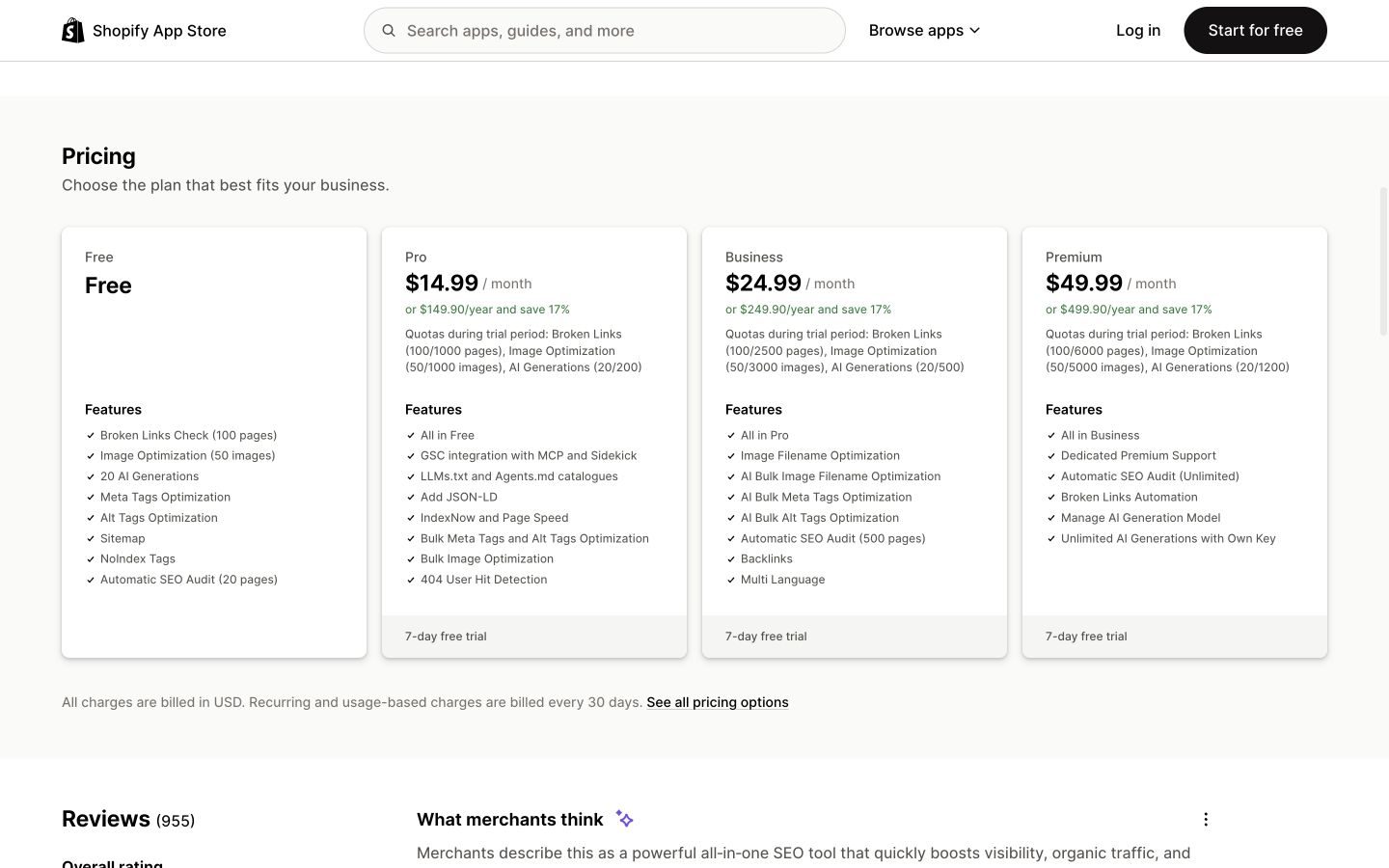
The official listing distinguishes plans, trial allowances and AI options. Compare your intended ongoing configuration. Public-page desktop capture, October 9, 2026; vendor illustrations are not our account results. Source.
8. StoreSEO: Best for product SEO with clear catalog limits
StoreSEO brings product-focused SEO guidance, metadata and image work into a connected app. Its current listing also describes AI-related and connected features; verify the plan-level scope for the one you intend to use.
Pricing: Free lists 25 products, 25 images, 200 AI credits and five keywords. Lite is $14.99 per month with 100 products, 500 images and 1,000 AI credits. Essential is $39.99 with 250 products, while Advanced is $249.99 with much larger catalog and usage allowances.
Trial task: Choose products with different templates or information needs, then inspect their title, description, image and structured-data output. Compare the number of products you need actively handled with the plan's cap. If a connector or MCP workflow matters, confirm its inclusion rather than assuming a homepage mention belongs to the entry plan.
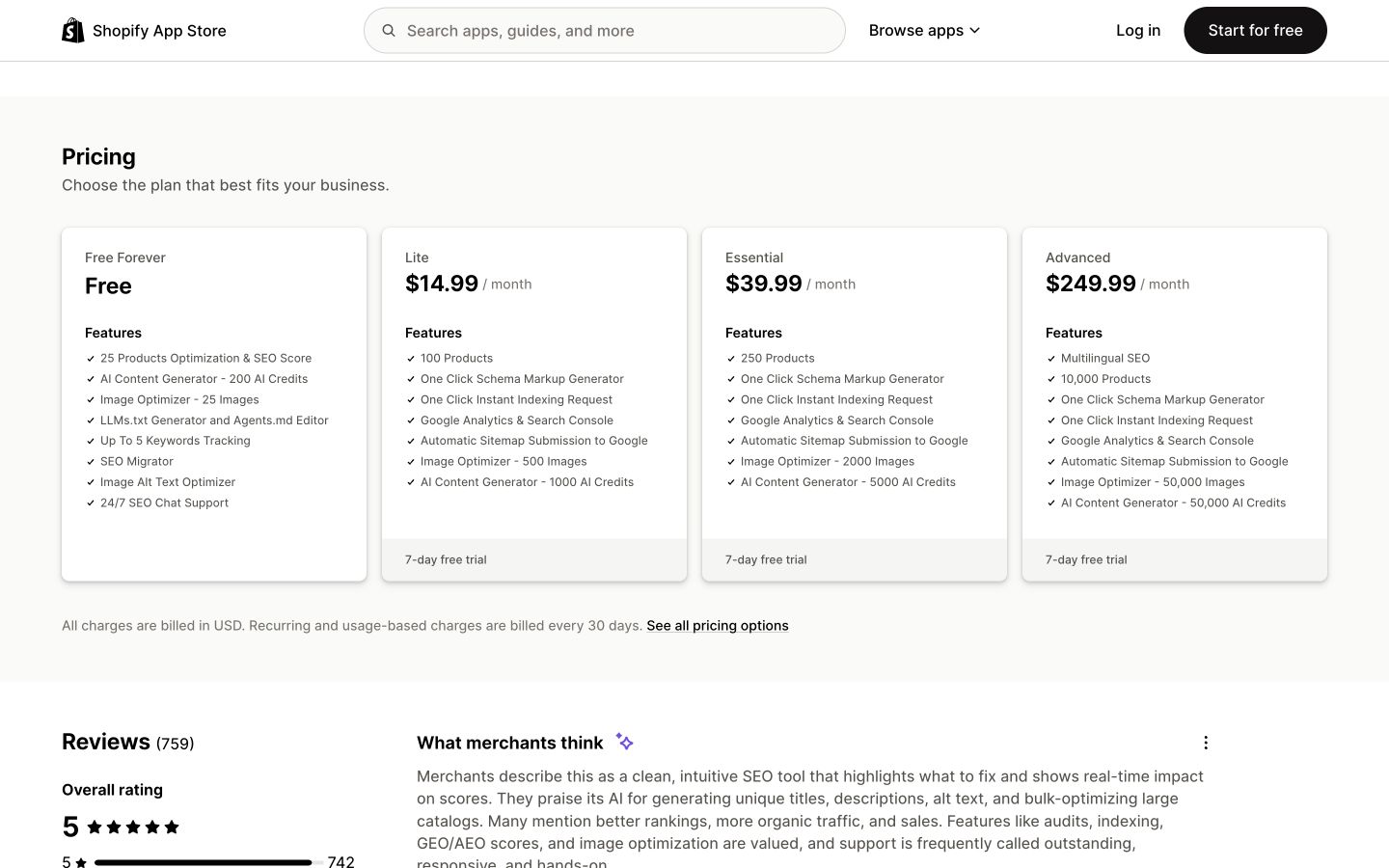
The listing makes product, image and AI limits visible. Match the catalog size to the plan instead of comparing price alone. Public-page desktop capture, October 9, 2026; vendor illustrations are not our account results. Source.
9. Schema Plus: Best for a focused structured-data workflow
Schema Plus concentrates on structured data for store pages, including product information and additional supported types. It is a specialist choice when markup quality is the identified gap and your other SEO workflow already works.
Pricing: Lite is $10.99 per month for five products, Essential $20.99 for 250 and Premium $34.99 for unlimited products. The plans list different markup functions, with a 14-day trial.
Boundary and trial task: Structured data makes page information machine-readable; it does not guarantee a rich result or an AI citation. Inspect a real product with variants and accurate shipping/return information. Check the markup against the visible page and look for duplication from the theme or another app. Upgrade because the product cap or needed types justify it.
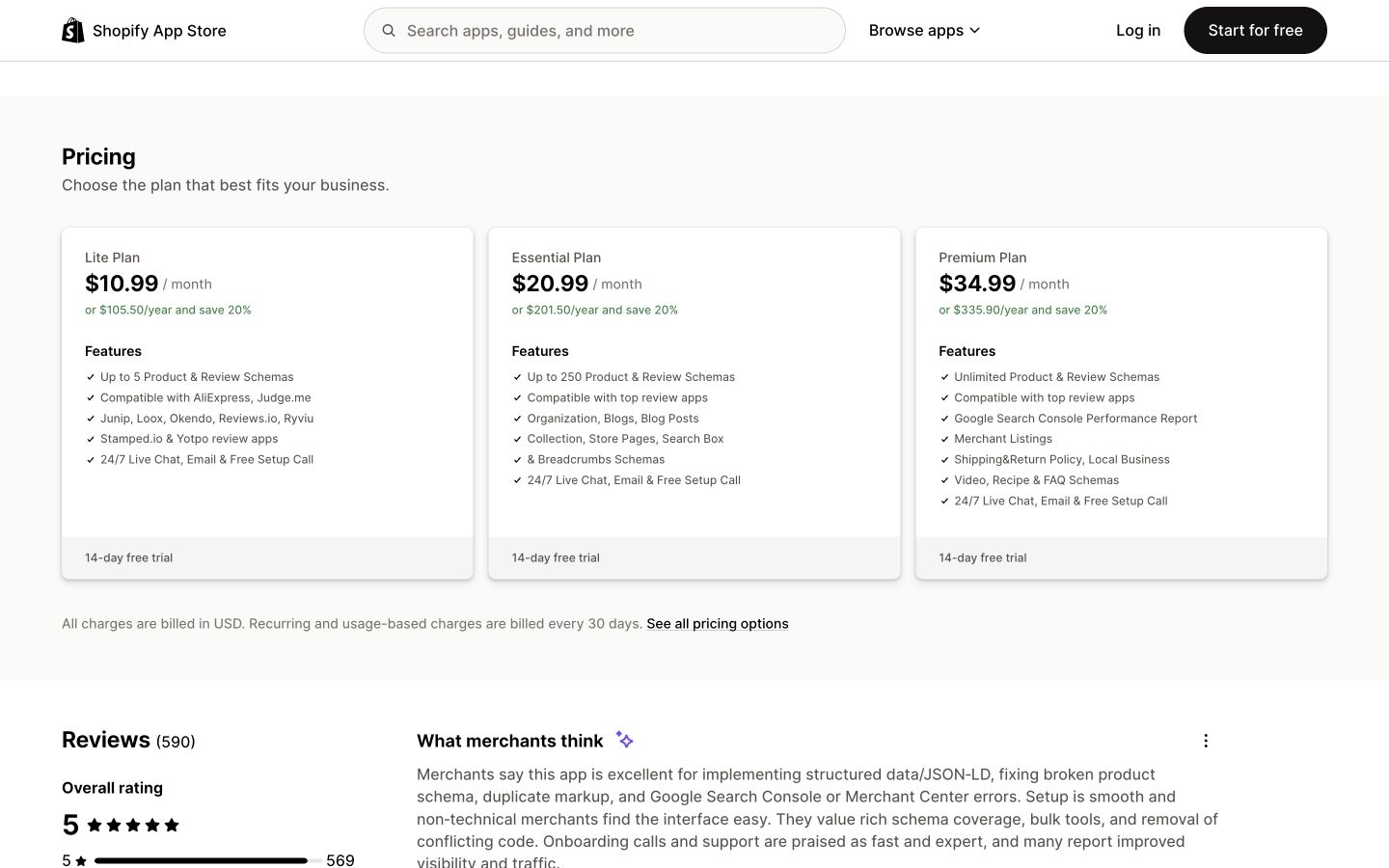
The official listing distinguishes product limits and schema scope. Inspect the actual markup and visible product information. Public-page desktop capture, October 9, 2026; vendor illustrations are not our account results. Source.
10. Plug In SEO: Best for a store audit and maintenance workflow
Plug In SEO combines site checks and maintenance-oriented SEO work, with additional AI research and assistance in its current plans. It is useful when you want an issue list that can become a repeatable store-maintenance process.
Pricing: Plans start at $29.99 per month with a 200-page scan limit. The $49.99 plan lists 2,000 scan pages; the $79.99 tier lists unlimited scanning while other allowances remain separate. The listing offers a seven-day trial.
Trial task: Run the representative store templates you care about, inspect one substantive issue and confirm who can fix it. Check the plan's AI research and audit frequency separately from the scan limit. A large scan should not create hundreds of unprioritized tasks; useful findings need an affected page, a reason and a recheck.
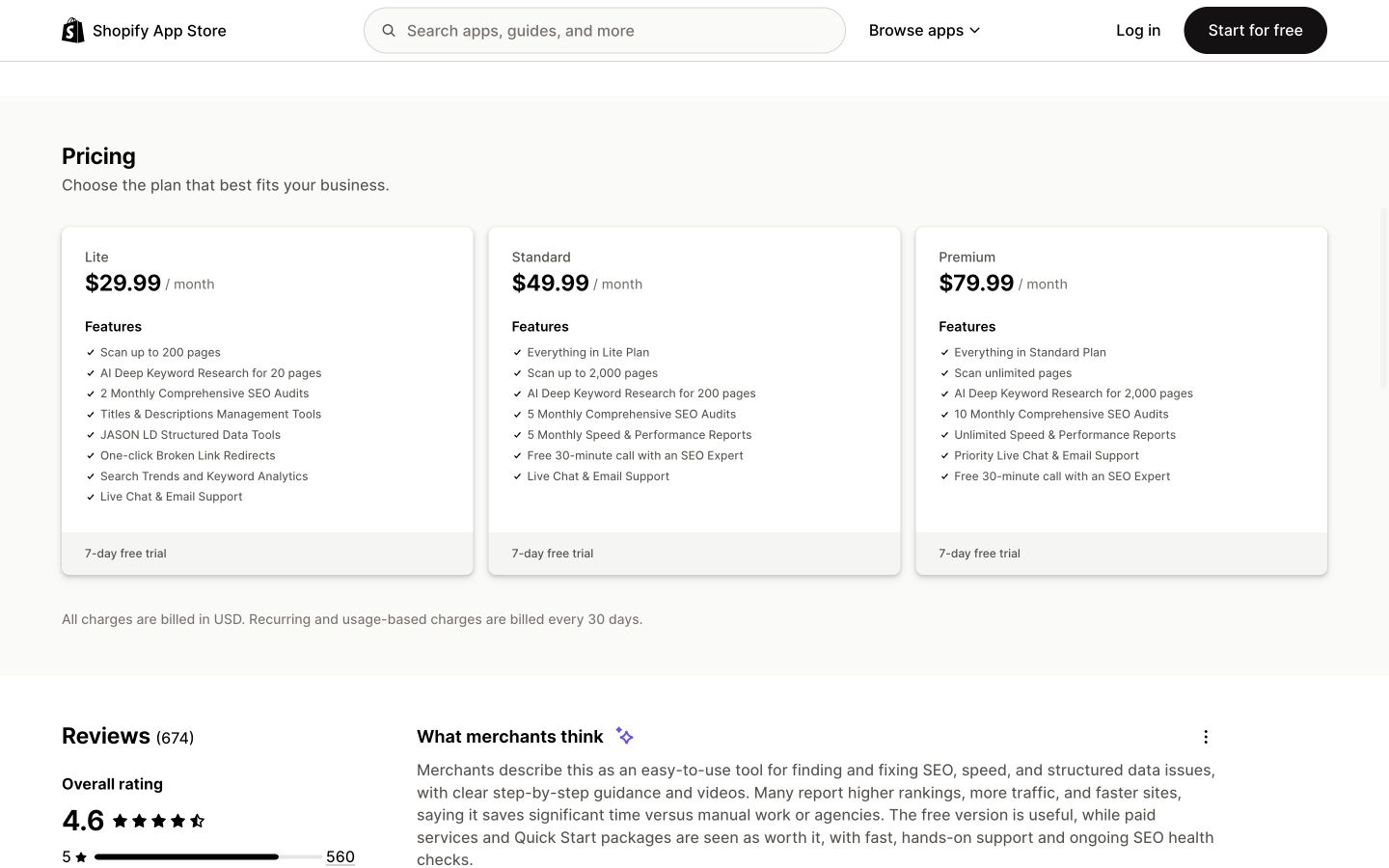
The listing separates scan capacity and other usage limits. Evaluate the maintenance handoff, not just the number of pages scanned. Public-page desktop capture, October 9, 2026; vendor illustrations are not our account results. Source.
11. SEO Manager: Best for tiered store SEO controls
SEO Manager combines store SEO testing and monitoring with metadata, redirect and AI-related functions across different tiers. It is worth comparing when you need a clear upgrade path from monitoring to more active page work.
Pricing: Starter is $9 per month, Essential $29 and Pro $59, with a seven-day trial. Starter lists monitoring and broken-link tracking; redirect management and broader controls belong to higher tiers. Pro includes additional AI copy and linking functions.
Trial task: Identify whether you need a finding, a control or an implementation. Review one product page and a genuinely changed URL. Confirm that the tier you buy can perform the intended action, not merely report it. Inspect AI suggestions against real product details and test the resulting storefront page.
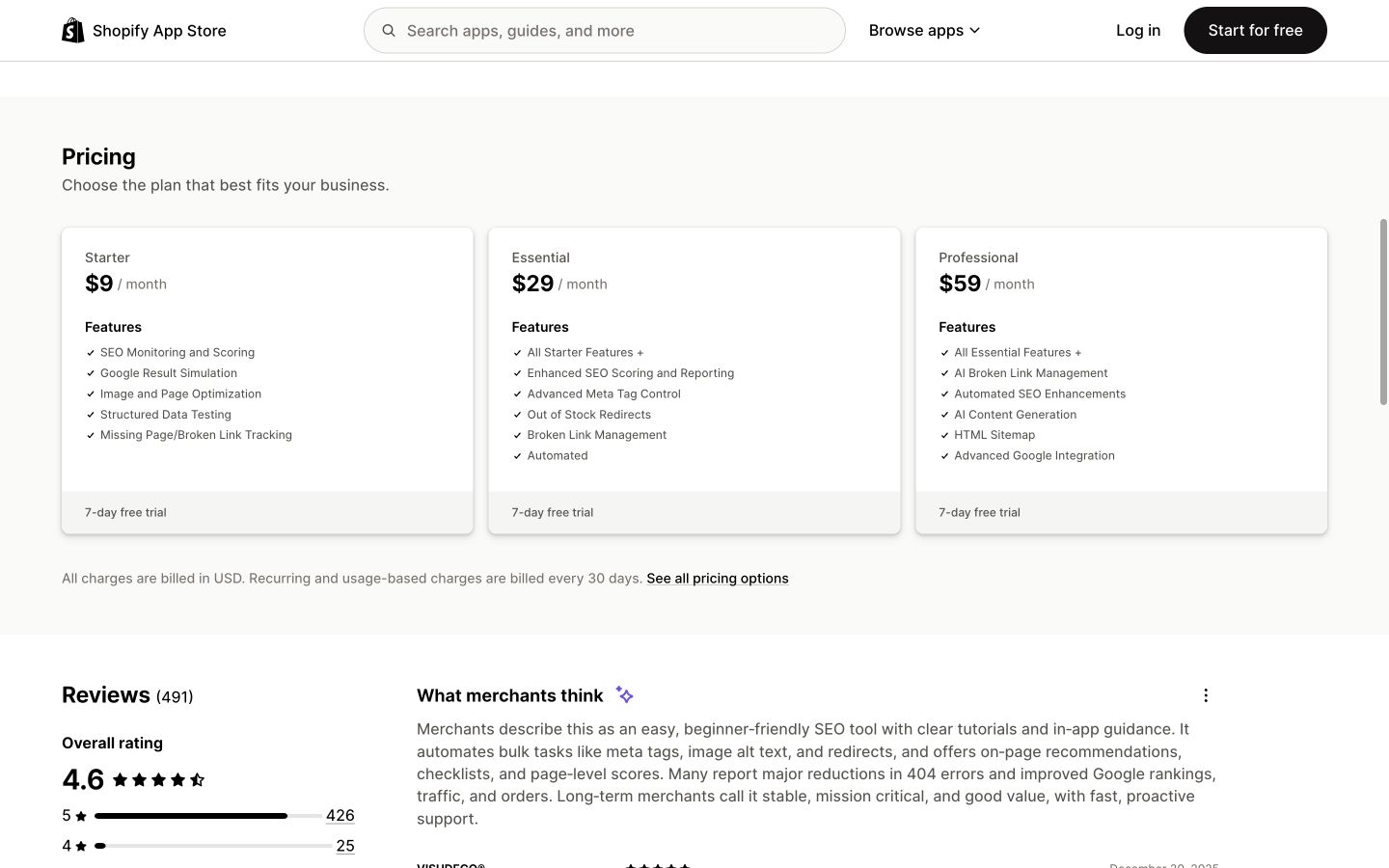
The official listing distinguishes monitoring from higher-tier controls and AI work. Price the action you need completed. Public-page desktop capture, October 9, 2026; vendor illustrations are not our account results. Source.
12. Tapita: Best for a combined store optimization shortlist
Tapita includes audits, images and SEO assistance, with additional functions on paid tiers. It deserves a close price check because the base amount can change according to your Shopify plan.
Pricing: The free listing includes an image allowance and audits. Business is $9.99 per month and Premium $49.99, with Shopify-plan surcharges displayed for paid use: Grow +$5, Advanced +$30 and Plus +$60. Usage and AI allowances also have their own terms.
Trial task: Confirm the payable amount for your actual Shopify subscription, then test a product, a collection and an image batch. Inspect the changed page and record allowance use. A store on Shopify Plus should not budget only the $9.99 headline Business price; the listed surcharge changes that starting total before additional usage or tax.
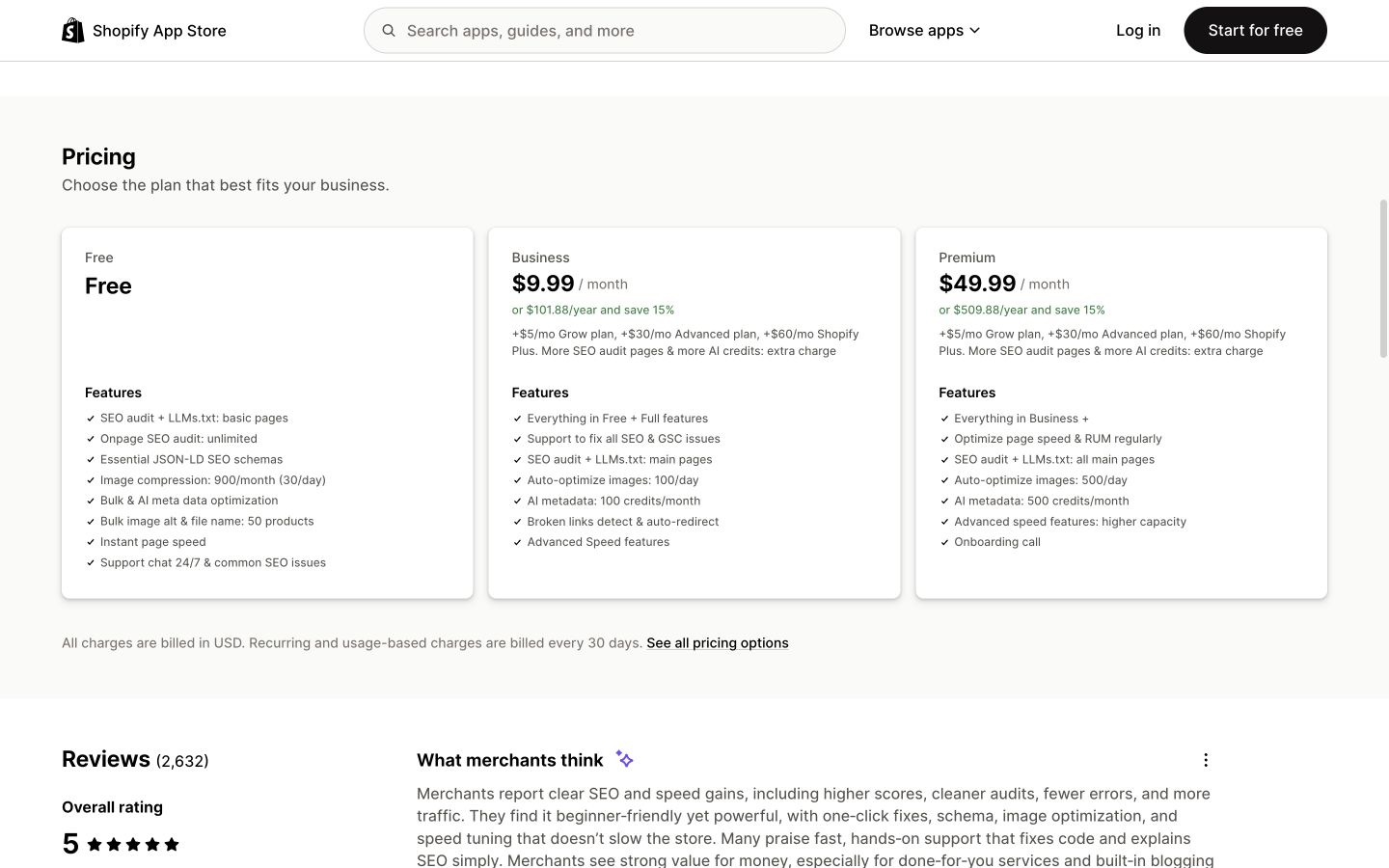
The official listing displays Shopify-plan surcharges. Compare the actual store-specific total, not only the base plan amount. Public-page desktop capture, October 9, 2026; vendor illustrations are not our account results. Source.
13. SEO King: Best for page-capped metadata and AI work
SEO King combines metadata, image-related work and AI assistance. Its listing includes a free manual workflow and paid options with page caps, making the scope of the store important to the buying decision.
Pricing: Paid tiers display $9.99 per month for 500 pages, $13.99 for 5,000 and $16.99 for 20,000. The listing describes unlimited text AI within the paid page allowance; premium translation and image-related services can have additional terms.
Trial task: Count the pages the app will manage, including relevant store content beyond the product count. Inspect metadata and generated text on a product with material conditions or variants. Unlimited text generation does not remove a page cap or make every supplementary service free. Keep the product facts and editor's acceptance criteria intact.
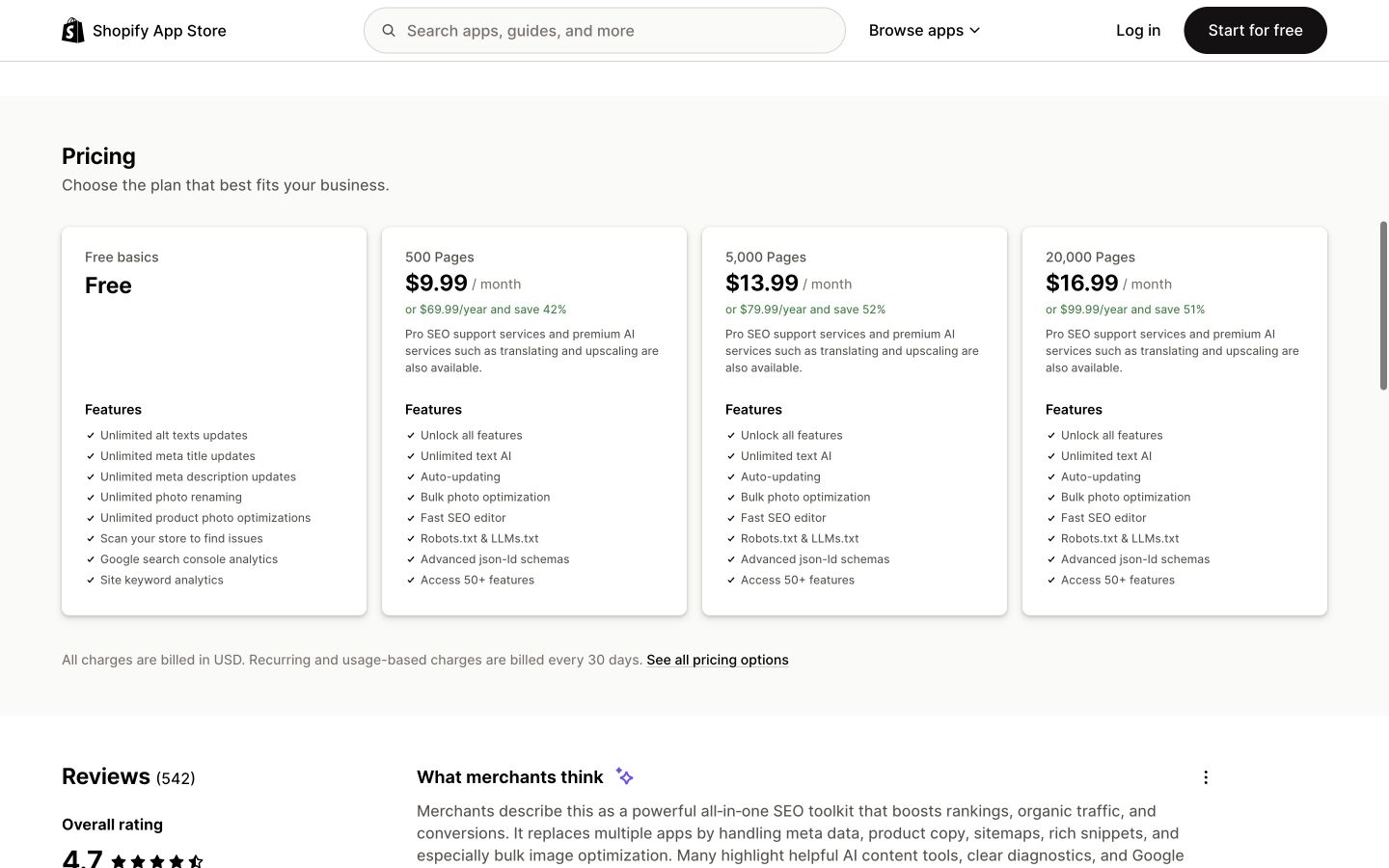
The listing combines page limits with generation allowances. Check both dimensions of the offer. Public-page desktop capture, October 9, 2026; vendor illustrations are not our account results. Source.
14. SEOLab: Best for a limited free pilot before paid expansion
SEOLab provides audits and AI-assisted store SEO work. Its current official listing includes paid tiers, correcting older comparisons that describe it as entirely free.
Pricing: The free plan lists limited SEO checks, audits, AI credits and page-related work; it includes 30 AI credits and specified 100-page limits for some functions. Beginner is $14 per month, Advanced $29 and Enterprise $59.
Boundary and trial task: Use the free allowance to inspect a real store task, then confirm the tier needed for normal operation. Do not call the free plan unlimited or assume the paid tiers solve every technical issue. Check a suggested meta change, an actual image and a substantive audit finding. Verify the storefront result and the limits used before deciding whether the upgrade earns its recurring cost.
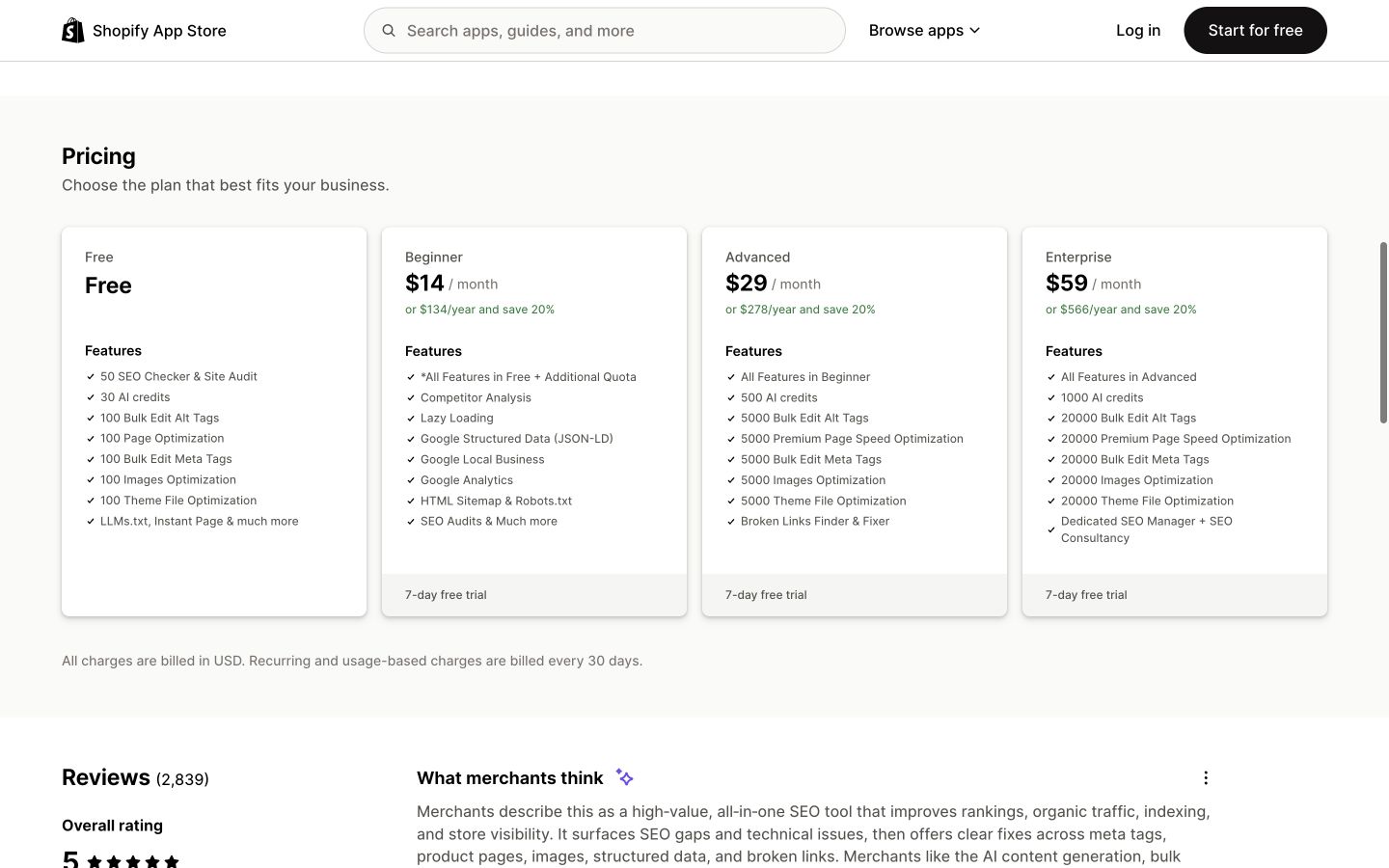
The current listing has free and paid tiers. This is a material change from older “fully free” descriptions. Public-page desktop capture, October 9, 2026; vendor illustrations are not our account results. Source.
15. Webrex SEO: Best for schema with selected store SEO controls
Webrex's current app listing emphasizes schema and related SEO work. The free plan lists supported types including product, organization, breadcrumb and blog/article markup, while paid tiers add further functions.
Pricing: The reviewed listing displays Free, Growth at $9.99 per month and Pro at $29.99. Growth includes additional schema and country-related scope; Pro adds functions such as duplicate removal, monitoring and support. A higher tier cited in an older comparison was not listed in the current offer.
Trial task: Inspect a real product and blog page for correct, nonduplicated structured data. Compare the visible shipping, return and product information with the markup. Confirm who owns schema between the theme, Webrex and other apps. Choose a paid feature for a specific gap, rather than assuming more structured-data types guarantee richer search presentation.
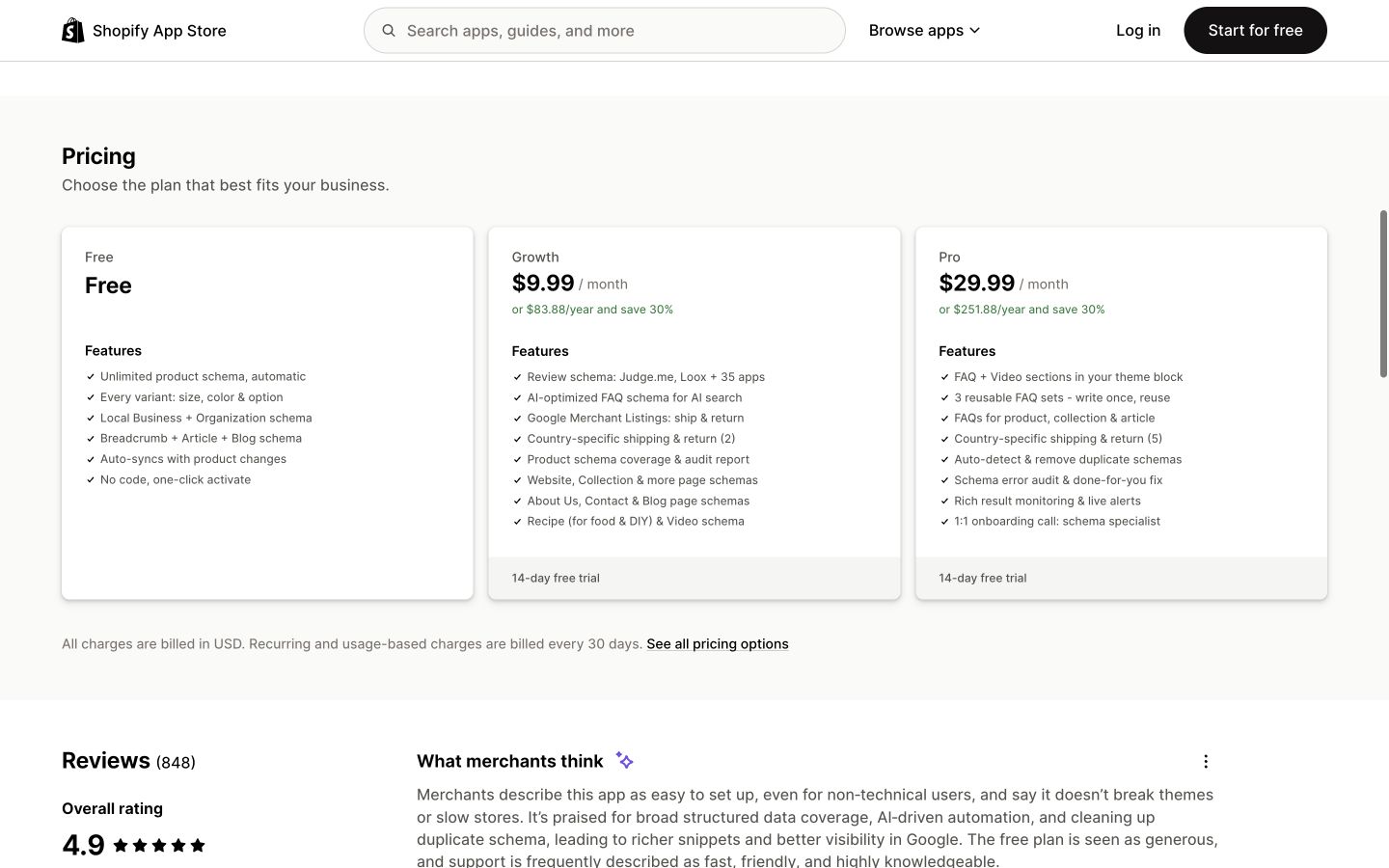
The current official listing has three displayed tiers. Verify supported types and duplicate handling against the store’s actual page output. Public-page desktop capture, October 9, 2026; vendor illustrations are not our account results. Source.
16. SEOWILL: Best for audits and AI-assisted content options
SEOWILL, formerly SEOAnt, combines audit, image and AI-assisted content workflows. Its current listing includes blog-related credits, so it should not be described as incapable of supporting content creation.
Pricing: Free includes limits such as 50 images, 30 AI-content credits and a smaller page-audit allowance. Pro is $29.99 per month with larger image, AI and audit limits; Premium is $59.99 with another usage and feature scope.
Trial task: Evaluate a real product and, if relevant, a blog draft independently. Check factual accuracy, sources, output and the editor's remaining work. Inspect one audit issue against the live template. Compare the complete recurring production process with Rankauto rather than assuming that any included blog credit represents the same research-to-publish service.
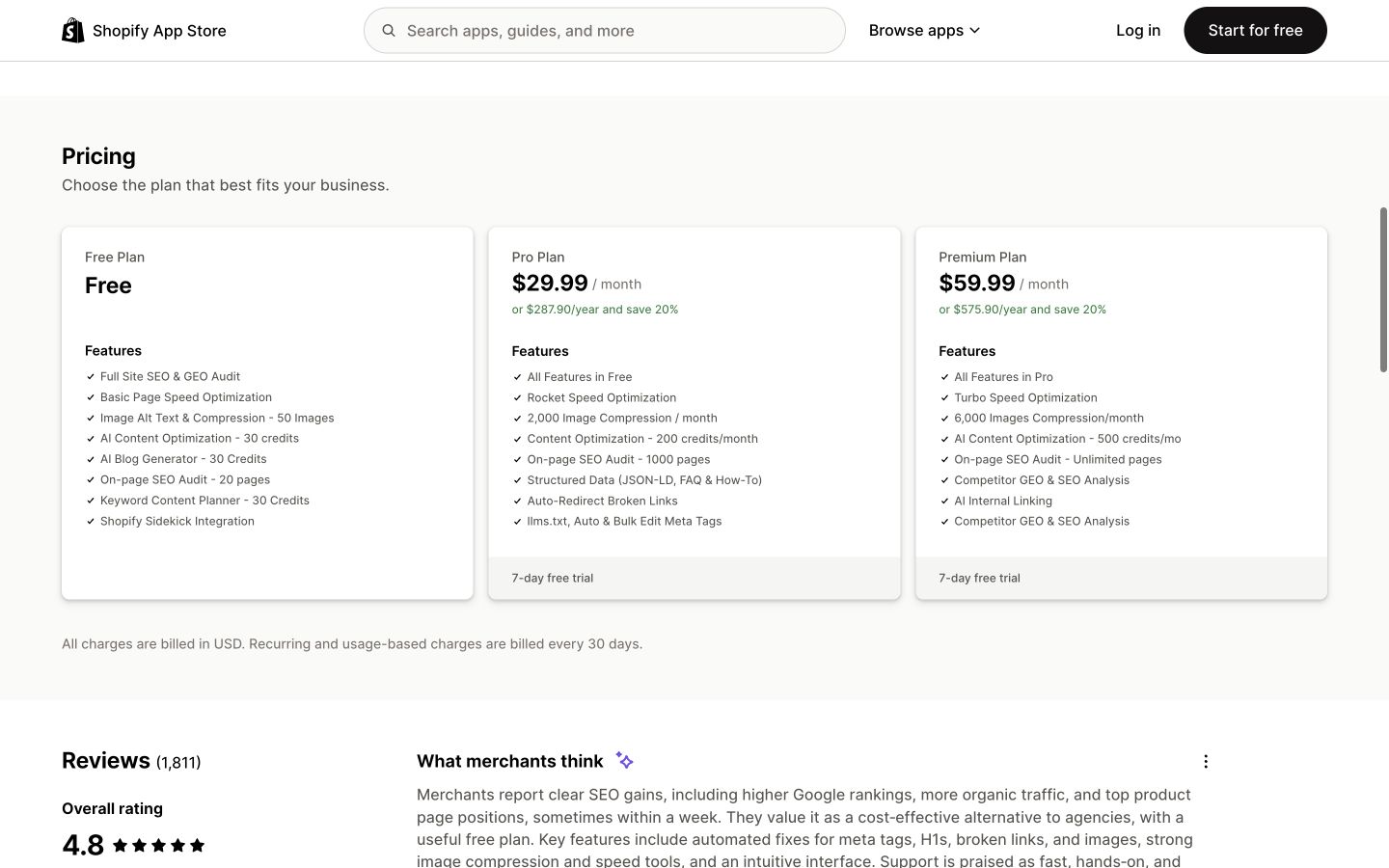
The current listing includes AI content and blog-related allowances. Evaluate that workflow directly alongside store-maintenance features. Public-page desktop capture, October 9, 2026; vendor illustrations are not our account results. Source.
17. Google Search Console: Best for first-party Google evidence
Search Console provides useful first-party search and indexing information for your verified store. It belongs in the stack because app scores alone do not tell you which pages earn relevant search impressions and clicks.
Search Console provides query and page performance for a verified site, including impressions, clicks and average position. It also supports sitemap submission, indexing information and URL inspection. Product documentation.
Limit to check: It does not expose a competitor's private Search Console reports. Use it to diagnose your own visibility and validate priorities, with another research source when you need competitor estimates or backlink discovery.
Trial task: Inspect a real collection, product or blog URL with its date, country and search-type filters recorded. Use query data to investigate customer intent and indexing reports to inspect important pages. Keep the filters with the export so the next report is comparable.
Search Console measures your own verified website. Pair those reports with store checks rather than using an app score as the outcome metric. Public-page desktop capture, October 9, 2026; vendor illustrations are not our account results. Source.
A real pricing example: Tapita’s Shopify-plan surcharge
The reviewed Tapita listing displays Business at $9.99 per month and a +$60 surcharge for Shopify Plus. Under those listed terms, the proposed base calculation for a Plus store is:
$9.99 + $60 = $69.99 per month, before any additional usage charges or tax.
That is not a checkout we completed. It shows why the official app listing is a better budget source than an older roundup's starting-price row. Repeat the same check for product caps, images, AI credits, page scans and annual commitments in your other shortlisted apps. Tapita's current listing.
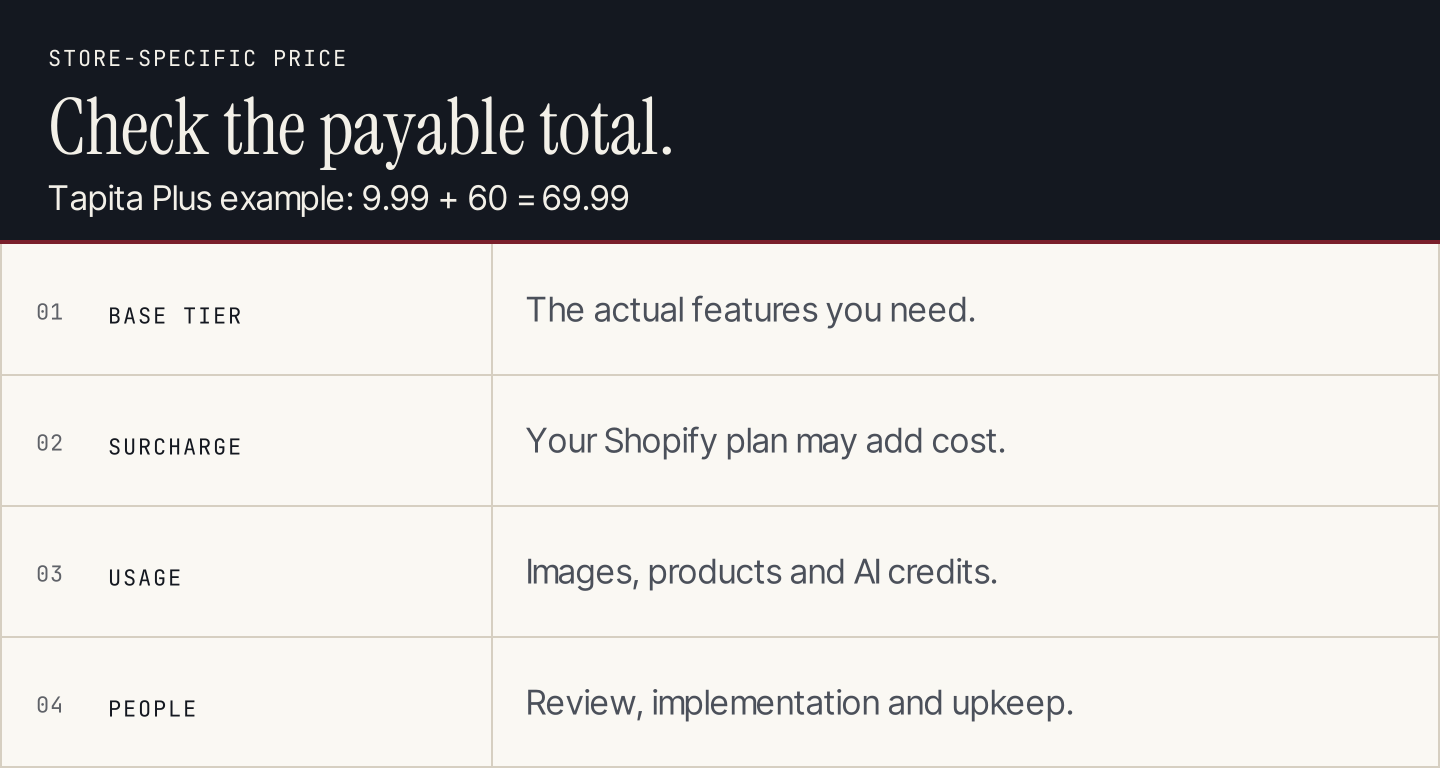
Check the store-specific payable total. The Tapita example uses published amounts for arithmetic, not a purchase or campaign outcome.
Check the complete Shopify publishing handoff
Rankauto's integration guide describes publishing into a selected existing blog, using the myshopify.com store address and authorized custom-app credentials. The article's featured image is rehosted on Shopify's CDN, and SEO title/description values map to Shopify metafields. The guide also documents updating the same article when republished. Rankauto Shopify guide.
Use these proposed acceptance checks before scaling:
| Check | What to inspect |
|---|---|
| Destination | The selected existing blog, not another content section |
| Body | Headings, tables, links and formatting in the storefront theme |
| Image | Correct featured image with legible content |
| Author | The intended byline; review the optional author setting |
| Handle | The intended article URL and any later change |
| Metadata | SEO title and description values in the intended fields |
| Update | A revised article updates the same item |
| Review control | Your editor retains the chosen approval process |
For product-oriented apps, use a similar check on a product, collection and any important alternate template. Test the final storefront, including purchase options and mobile navigation, after changes. Preserve an owner for each function, especially schema and redirects.
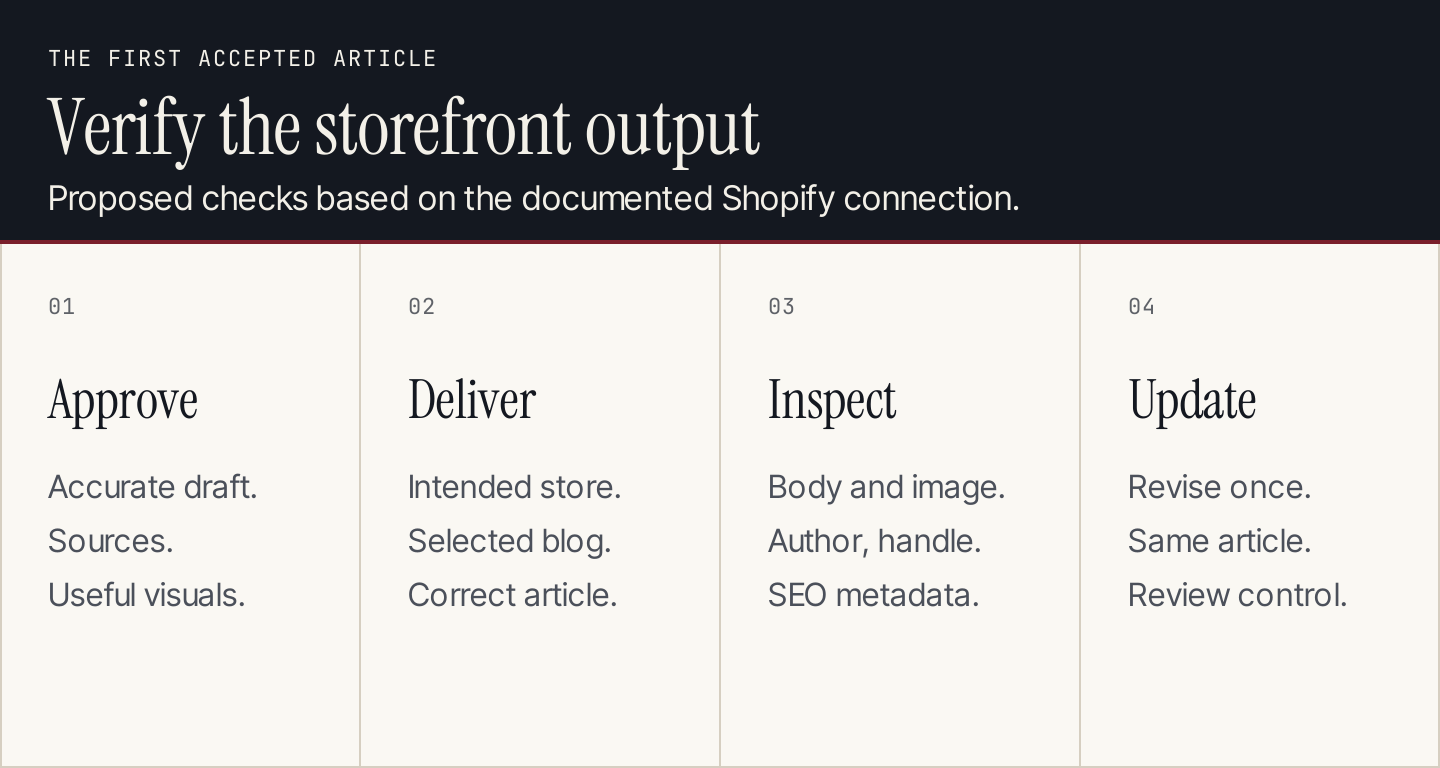
Suggested first-article check based on the documented integration. Inspect the final storefront rather than assuming a successful connection proves correct output.
Choose a stack your team can maintain
A store with a working core SEO app may only need Rankauto for its blog and Search Console for performance evidence. An image-heavy store may need a defined optimization allowance. A store with inconsistent product markup may justify a schema specialist. Choose from the problem, not from the number of apps competitors install.
Before replacing an app, inventory the settings and generated output it owns. Check whether uninstalling removes or leaves behind changes, and verify the vendor's current procedure. Avoid moving several overlapping functions at once because a later error becomes harder to attribute.
Review the first accepted outputs with the person who maintains the store. Useful automation removes repetitive work while preserving accurate product information, editorial control and a working storefront.
Frequently asked questions
Is Rankauto a Shopify SEO app?
Rankauto is a hosted content automation tool with a documented Shopify custom-app connection. It is first here for recurring blog production. The native apps in this guide handle other store SEO jobs and may complement it.
Which Shopify SEO app is best for a small store?
Choose by the first missing job and the actual catalog size. A free or entry plan can be sufficient for a limited pilot, but check product, page, image and credit caps. If the gap is a neglected blog, evaluate Rankauto's full reviewed production workflow.
Do I need a separate schema app?
Only if the existing theme and SEO setup leave an identified gap. Several SEO apps already output structured data. Inspect actual pages and choose a clear schema owner before adding another generator.
Can Shopify SEO apps write blog posts?
Some current apps include blog builders or AI content credits. Tiny SEO and SEOWILL are real examples. Compare sources, review, delivery and recurring capacity rather than assuming every blog feature is the same production service.
Can an app guarantee better rankings or AI citations?
No. Use app findings to make justified improvements, then examine first-party performance and any defined AI-response evidence. Schema, AI tags and audit scores are not guarantees of a particular search result.
For a recurring store blog, review Rankauto's Shopify integration and current content plan.