How to Write a Customer Case Study in 13 Steps
Write a customer case study in 13 steps. Use real published examples, interview questions, a claim-checking worksheet, and a customer approval process.

A customer case study explains a real situation, the work performed, and an outcome the customer can substantiate. Its purpose is to help a prospective buyer judge whether your experience is relevant to their problem.
The most useful stories make the work understandable. They show the starting conditions, the customer's choices, what changed, and the limits of the evidence. A logo and a large percentage don't establish those details on their own.
This guide provides thirteen production steps, an interview plan, a claim-checking worksheet, and three real published examples. Use it for service businesses, software companies, or agencies preparing a story with a client's permission.
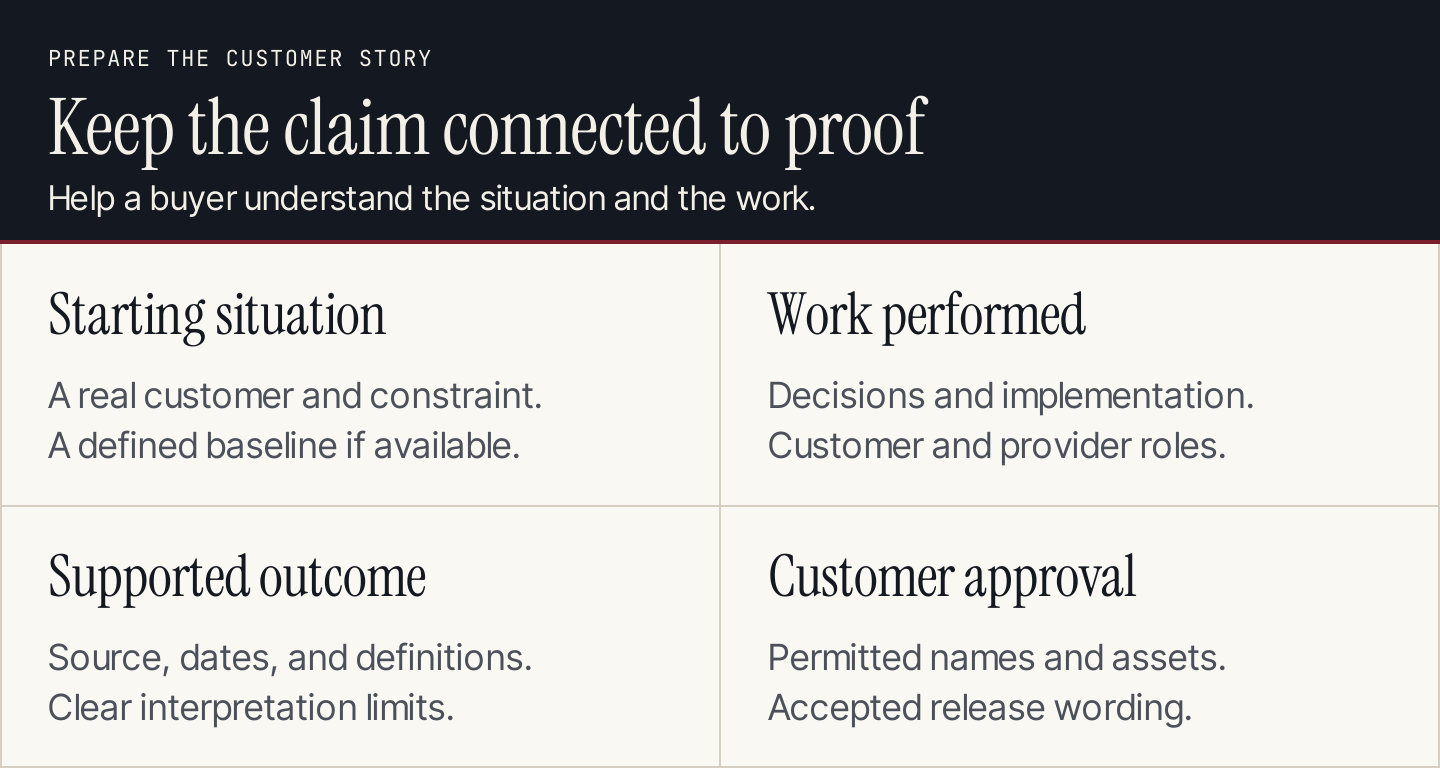
Keep the situation, intervention, result, and permission connected throughout the story.
What makes a marketing case study useful?
A useful case study answers the questions a suitable buyer would ask: what problem did this customer have, why did they choose this approach, how was it implemented, and what evidence supports the result?
Give readers enough context to assess similarity. Industry alone is insufficient. Team size, constraints, existing process, rollout conditions, and the specific task often matter more.
The case study can support a website, a sales conversation, a proposal, or customer education. Choose its intended use before choosing the format. A short summary and a detailed account can share the same approved evidence while helping readers at different stages.
Write a customer case study in 13 steps
1. Name the buyer decision the story should help
Choose one question the reader needs to resolve. Examples include whether a service suits their situation, how a migration works, or what a team must contribute to implementation.
Write the intended reader and decision in the brief. This keeps the story focused when an interview generates interesting details that belong elsewhere. A relevant operational explanation can be more valuable than the most impressive statistic available.
2. Select a customer with relevant evidence
Look for a customer whose situation matches the intended decision and whose experience can be documented. Check whether someone involved in the work can explain it and whether the important outcome has supporting records.
A recognizable name can attract attention, but an inaccessible customer or an unsupported claim creates production problems. Choose a story the customer can participate in responsibly. An agency should agree with its client on which end customer or campaign can be discussed publicly.
3. Agree on participation and permitted use
Explain the subject, format, intended channels, reviewers, and proposed timeline. Agree on use of names, logos, quotations, screenshots, and any private figures before collecting material for publication.
Separate permission to participate from approval of the finished version. A customer may accept an interview while requiring internal review of figures or quotations. Keep those conditions attached to the assignment in your content calendar.
Use your organization's appropriate permission process. Don't promise exposure, backlinks, or financial benefit as a guaranteed result of participation.
4. Review the existing records
Gather the project brief, agreed scope, milestones, relevant reports, and approved deliverables. Mark what can be used publicly and who can verify it.
Keep a source beside every material detail. “The account team remembers this number” is a lead to investigate, not final evidence. If the records conflict, resolve the difference before drafting around the more attractive figure.
Remove private details that don't help the reader assess the work. The story should contain necessary context, not an indiscriminate export of project data.
5. Establish the starting conditions
Describe the original process and problem in concrete terms. Record the period, population, and definition for any baseline metric.
For a workflow story, ask what people did, where work stalled, and what an affected employee observed. For a numerical comparison, check whether the same metric was measured consistently before and after the change.
If no usable baseline exists, choose a claim the evidence supports. You can document a rollout or an approved deliverable without inventing a before-and-after improvement.
6. Interview someone close to the work
Ask open questions that invite a sequence, a decision, or a specific example. Avoid leading the customer toward the result you want to advertise.
Capture the interview using the agreed method and permission. Distinguish the person's experience from the organization's approved factual statement. A participant can accurately describe their own use while lacking authority to approve a revenue figure.
Use the question set below as a starting point, then tailor it to the task and the evidence gaps.
7. Reconstruct what actually changed
Write the sequence: decision, preparation, implementation, adaptation, and ongoing use. Identify the customer's work as well as your contribution.
Readers need to understand the mechanism. “We implemented the solution” hides the work they may need to perform themselves. Explain a relevant handoff, configuration decision, training activity, or operational change.
Keep the level of detail appropriate to the buyer. Link to implementation guidance when the case study doesn't need to become a technical manual.
8. Verify the outcome and its limits
For a metric, record the exact value, units, dates, denominator, source, and verifier. Identify other changes that could affect interpretation.
An observed improvement after implementation doesn't automatically prove the product caused the whole change. Describe the result at the level the evidence supports. Distinguish the customer's reported experience, a measured comparison, and an independently established causal effect.
If the story covers an older period, keep that period visible. Don't present historical company size, revenue, or product behavior as current facts.
9. Create a claim-checking worksheet
List every material claim before writing the headline. Include numbers, comparison language, implementation details, and quotations.
Assign a source and an approver. Flag claims that require a narrower description or further evidence. This turns factual review into a manageable task and helps prevent unsupported wording from spreading into a graphic, email, or sales deck.
The worksheet below includes a real public example and blank fields you can copy for your own case.
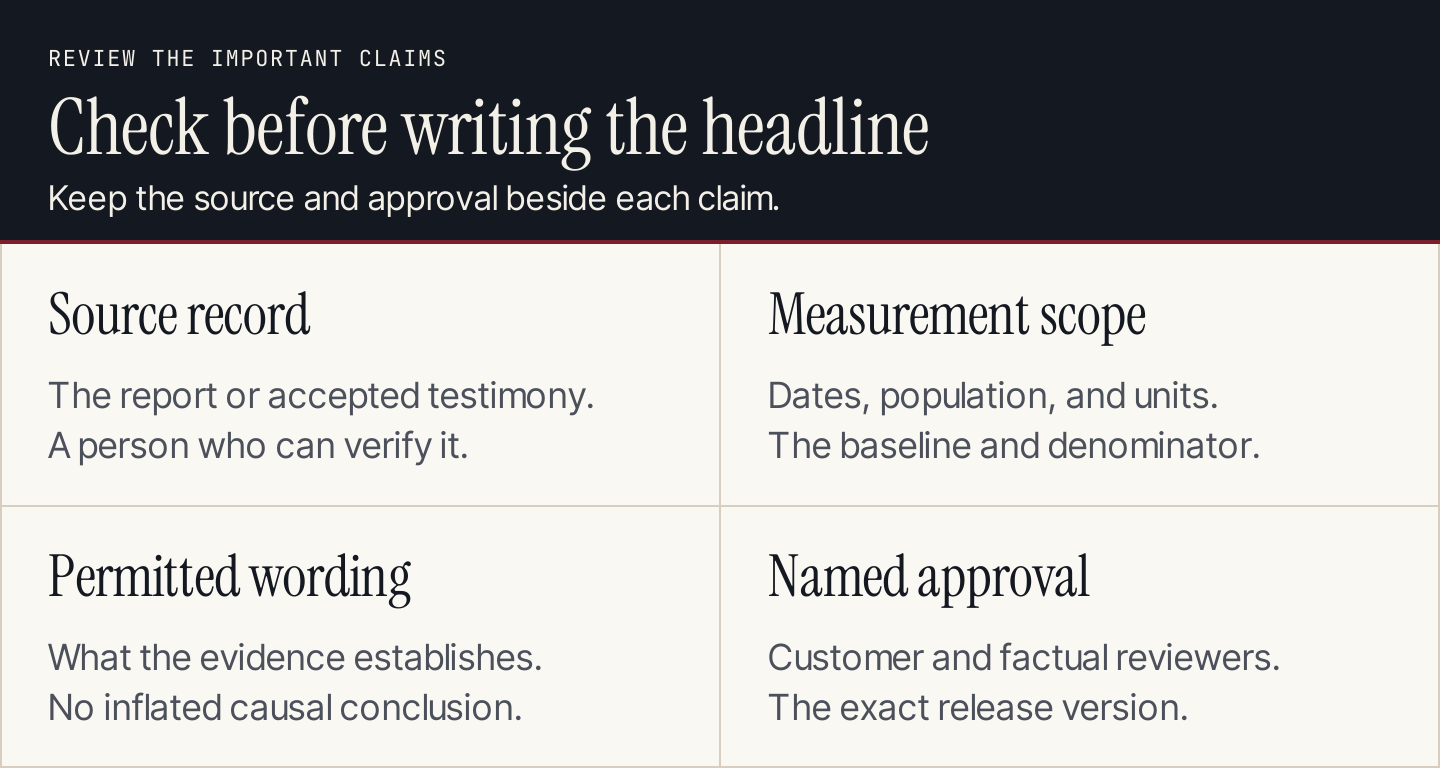
Check the evidence and permitted wording before placing a result in the headline or a graphic.
10. Draft around the customer decision
Lead with the relevant situation and supported outcome. Then explain the challenge, the choice, the implementation, and the result in an order the prospective buyer can follow.
Write a concise summary for readers deciding whether to continue. Develop the main story with the specific work and customer perspective. Keep the customer central while making your contribution clear.
Use headings that describe the actual problem and action. Repeated labels such as “challenge” and “solution” can help navigation, but they shouldn't substitute for an explanation.
11. Add visuals that demonstrate something
Choose evidence that helps the reader understand the process or result: an approved deliverable, a labeled workflow, or a chart with a clear measurement scope.
Use actual permitted screenshots for a real interface. Use an original diagram to explain the process. If a chart uses customer figures, show the dates, units, and relevant comparison conditions in nearby text.
Don't manufacture a dashboard, quotation, or testimonial. If sensitive data cannot be shown, explain the supported finding in prose or use a clearly labeled illustrative exercise for a separate teaching purpose.
12. Obtain approval of the release version
Ask the customer to review the exact text, quotations, figures, and images intended for publication. Resolve material changes and record the accepted version.
Keep an approval trail for adaptations too. A quotation approved in context may become misleading when shortened for a social graphic. Check whether the participation agreement covers those uses and whether the shortened wording remains accurate.
Before release, verify the title, links, mobile readability, image descriptions, and next step. Approval of the story doesn't replace checks of the actual page.
13. Distribute and maintain the story
Give sales and marketing a short explanation of when the case is relevant. Share it with the audiences and channels agreed in the brief. Track the intended action without assuming every reader becomes a buyer.
Assign an owner and review triggers. Revisit the story when the customer withdraws permission, the product changes materially, a linked resource disappears, or the historical context becomes easy to misread.
Use the same approved claim record for later updates and adaptations. A case study becomes harder to maintain when every channel has an independently edited version of the result.
Eight interview questions that uncover the work
- What task were you trying to complete, and what made the existing approach difficult?
- Can you walk through a specific instance of that problem?
- Which constraints or criteria shaped your choice of approach?
- What did your team and the provider each do during implementation?
- What changed in the way the task was performed?
- How was the outcome measured, over which period, and who can verify it?
- What else changed during that period, and what remains uncertain?
- What would a similar team need to prepare or understand before starting?
Follow up when the answer is general. Ask for the relevant sequence, record, or example rather than a stronger adjective. A customer's hesitation can identify a claim that needs more careful wording.
Three real case studies and the lesson in each
Shopify and Gymshark: keep the result's period visible
Shopify's Gymshark case study explains a platform change and separates the challenge, solution, and results. It reports £41 million in sales during 2017.
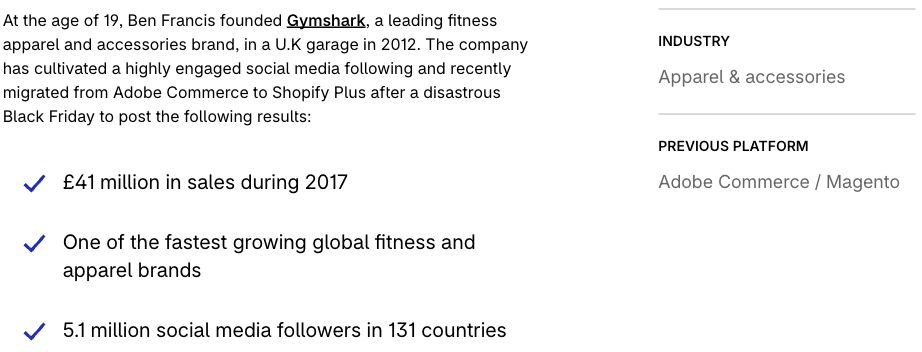
The Gymshark story attaches its reported sales figure to 2017. Source: Shopify.
The lesson is to preserve the historical scope when summarizing a result. The page provides a useful story structure; it doesn't establish today's Gymshark revenue or prove that the platform alone caused all reported sales.
Slack and IBM: identify who is speaking
Slack's IBM customer story identifies Jenn Booth and her role alongside the opening testimony. The story then develops concrete sales and support workflows.

Slack connects the opening testimony to a named person and role. Source: Slack.
For your own story, establish why the speaker can explain the work and give the quotation enough context. Keep the attribution with any permitted excerpt. A named quotation is a customer's testimony, with a different evidentiary role from a controlled measurement.
Asana and Figma: explain the rollout
Asana's Figma case study describes testing the tool with one team, expanding its use, and preparing training and documentation. That sequence gives readers implementation context beyond the result headline.
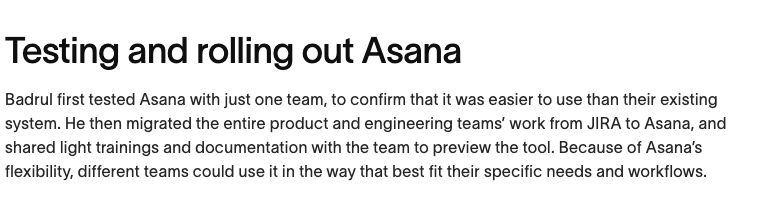
Asana's Figma story explains the testing and rollout sequence. Source: Asana.
Apply this by showing what a prospective customer would need to contribute. Explain the pilot, responsibilities, and transition. Treat company figures in an older story as historical until separately verified as current.
Copy this claim-checking worksheet
The first row demonstrates a cautious reading of a public case. The remaining rows are fields for your own approved evidence, not invented customer results.
| Claim | Source and scope | Safe use | Missing check |
|---|---|---|---|
| Gymshark reported sales figure | Shopify case study; £41 million during 2017 | Describe it as a historical figure reported in the case | Don't infer current revenue or sole causation |
| Customer baseline | [Record, metric definition, period, population] | [Exact supported wording] | [Verifier and unresolved difference] |
| Work performed | [Project record and participant] | [Customer and provider responsibilities] | [Public-use permission] |
| Outcome | [Report, calculation, dates, denominator] | [Measured or reported outcome with scope] | [Other changes; interpretation limits] |
| Quotation | [Approved interview excerpt and speaker role] | [Exact accepted wording in context] | [Release-version approval] |
| Visual | [Original file, source, and owner] | [What it demonstrates] | [Usage permission and factual review] |
Copy this writing outline
| Section | What it should answer |
|---|---|
| Title and summary | Which customer, problem, and supported outcome? |
| Starting situation | Who needed to do what, under which conditions? |
| Decision | Why did they choose this approach? |
| Implementation | What happened, in what order, and who contributed? |
| Outcome | What does the evidence establish, over which period? |
| Customer perspective | What did a named participant experience? |
| Fit and limitations | Which similar situations might benefit; what cannot be concluded? |
| Next step | What should a suitable reader do next? |
If AI helps organize the interview, give it only material approved for the chosen tool and use. Ask it to connect proposed sentences to source excerpts and flag gaps. Check every quotation against the accepted wording. It should never fill missing results or combine several customers into a supposedly real case.
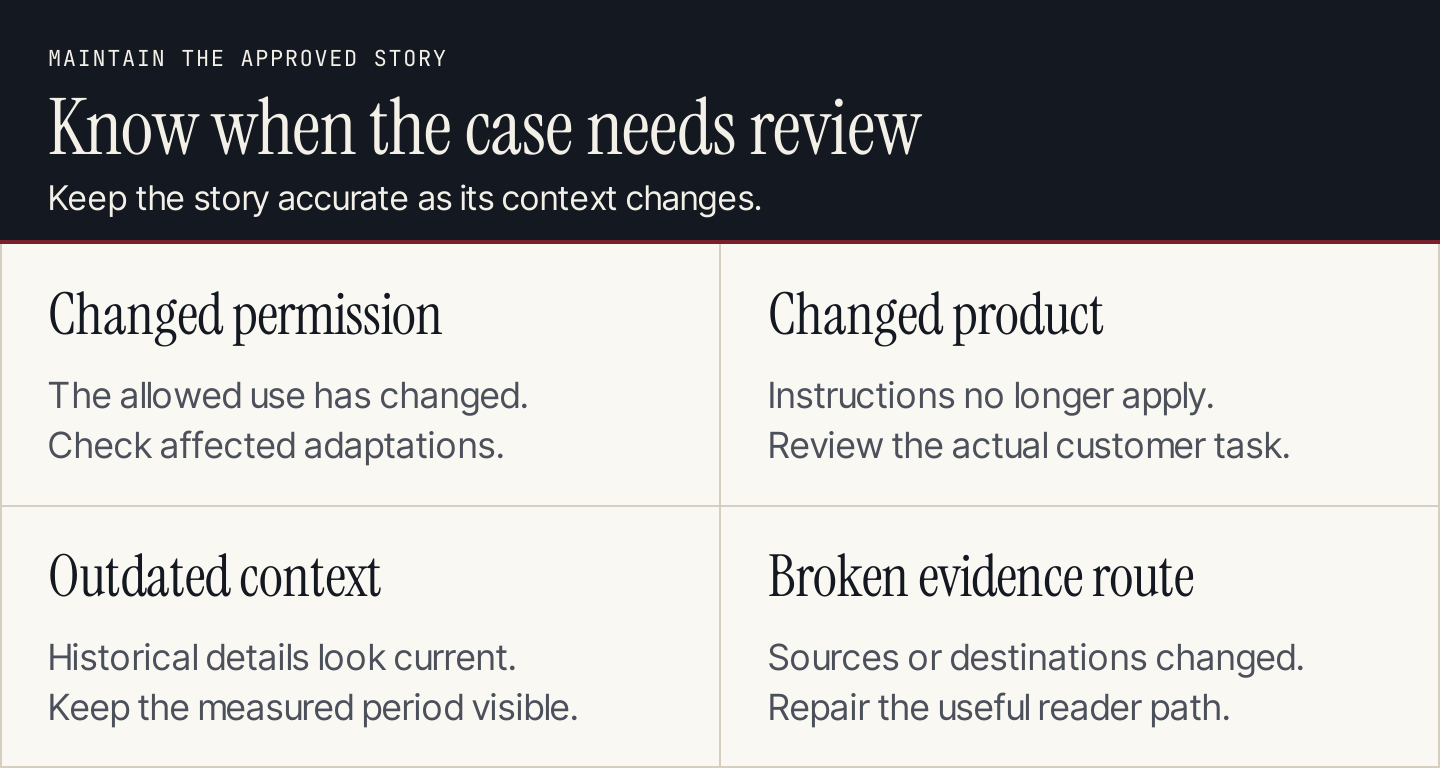
Keep the approved story usable as permissions, products, and surrounding context change.
Make the first case useful before making it long
Start with a suitable customer, the buyer decision, and a source record for the important claims. Agree on the interview and review process, then build the story around what the evidence establishes.
Rankauto can support the researched blog articles around your case study, with writing in your brand voice, fact checks, images, and SEO fields. It saves drafts by default. Your team must provide and approve private customer evidence, quotations, and permissions before those details appear in a published article.
Customer case study FAQs
How long should a case study be?
Use enough detail to explain the situation, work, and supported result. A summary can help a buyer assess relevance quickly, while the fuller story provides the context. Don't add paragraphs simply to reach a target length.
Can we publish a case without a percentage improvement?
Yes. A documented implementation, an approved deliverable, or a specific customer account can be useful. State what the evidence supports and avoid inventing a numerical baseline or outcome.
Can a customer remain anonymous?
If the permitted-use agreement allows it, explain the relevant context without identifying details. Keep the internal evidence and approval record. An anonymous account still needs a real customer and supported claims; it should not become a fictional business presented as fact.