Content Marketing Strategy: 13 Steps and a Template
Build a content marketing strategy in 13 steps. Use real REI, HubSpot, and Shopify examples, a one-page template, and clear investment decisions.

A content marketing strategy decides which customer problems your content will help solve, how people will encounter it, and what business outcome will justify the work. Your publishing schedule comes after those decisions.
The useful test is simple: can you explain why the next piece deserves your team's time? A strategy should answer that question before someone starts writing, filming, or designing.
This guide gives you thirteen decisions to make, three real examples of different content investments, and a one-page template you can copy. It works for founders, marketing teams, and agencies planning content across a website, email, social media, video, and useful tools.
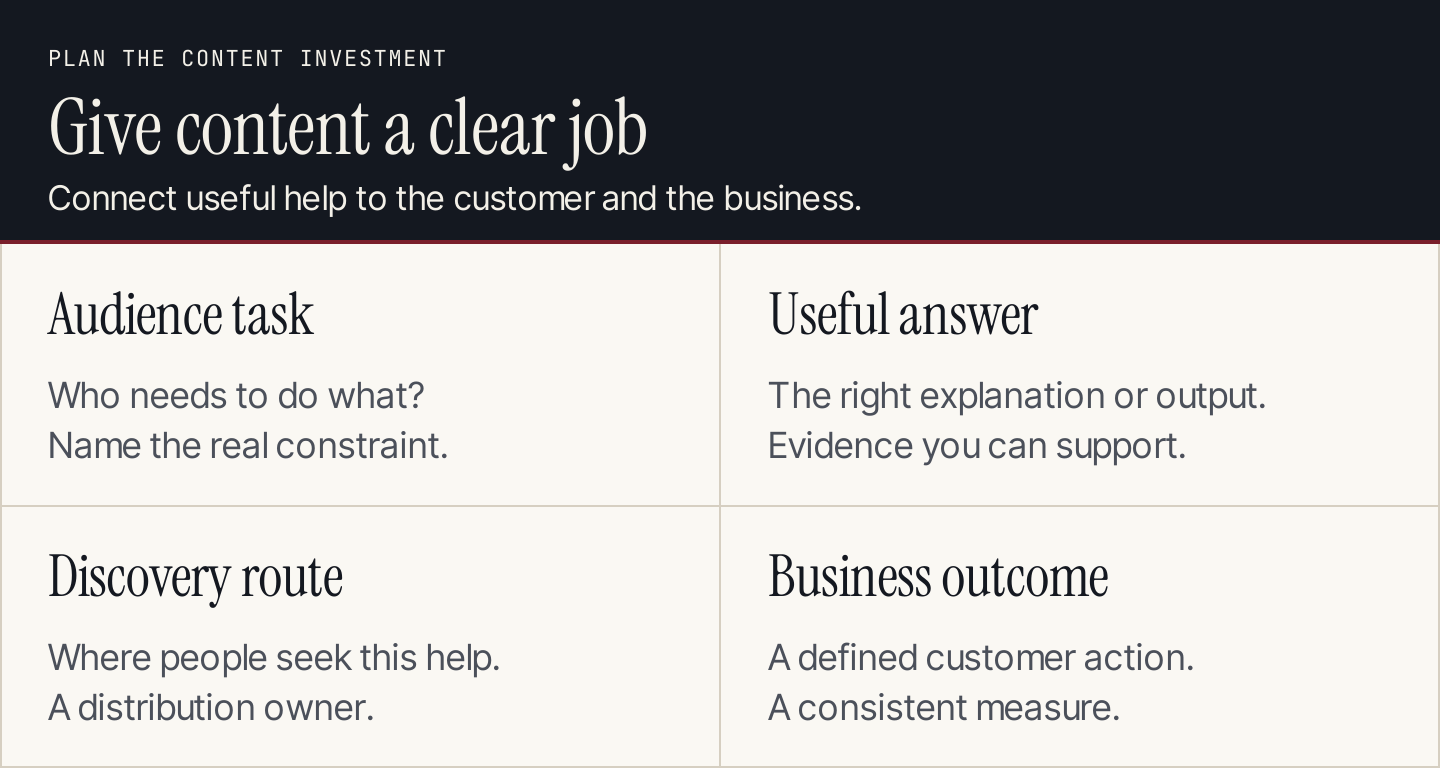
Connect the customer's task to a useful answer, a way to find it, and a business outcome.
What belongs in a content marketing strategy?
Your strategy needs an audience, an outcome, a topic focus, a useful content format, a distribution plan, and a way to evaluate the investment. It also needs limits: what you can support accurately and what your team can maintain.
A marketing plan covers the broader mix of campaigns, offers, channels, and spending. A content strategy explains the role of content within that plan. A content calendar turns those choices into assignments and dates.
| Document | Main decision | Useful output |
|---|---|---|
| Marketing plan | How will the business reach and serve customers? | Priorities, campaign choices, budget, ownership |
| Content marketing strategy | Which information or experiences will help those customers? | Audience tasks, topic priorities, formats, discovery routes |
| Content calendar | Who will produce and release each piece? | Assignments, deadlines, review status, publish dates |
| Content brief | What must this individual piece accomplish? | Questions, evidence, demonstrations, acceptance checks |
If your strategy only lists keywords and a monthly article target, add the missing business and customer decisions. Search can supply valuable demand evidence, but customers also learn through conversations, newsletters, videos, communities, and AI answers.
Build your content marketing strategy in 13 steps
1. Choose the business decision content should support
Pick a concrete outcome: more suitable inquiries, more completed purchases, better onboarding, or fewer avoidable support questions. Describe the action that would show progress.
For a service business, “more leads” is incomplete. Define a qualified inquiry using service need, location, budget fit, and timing. For an agency, agree on that definition with the client before building the report. Otherwise, publishing can look successful while sales receives inquiries it cannot help.
Write the outcome and its current baseline. If tracking is missing, the first assignment is to establish measurement. A traffic goal can support the plan, but it doesn't replace the customer action.
2. Select one audience situation to start with
Describe a person doing a task under a constraint. “Small business owners” is a market. “Owners comparing bookkeeping options before hiring their first employee” is a content situation.
Use your target audience research, sales questions, support requests, and interviews. Record the original language people use, where the question came from, and whether it appeared more than once. A specific situation makes format and topic choices easier than a persona filled with irrelevant lifestyle details.
You can serve other situations later. The starting point should be narrow enough for the team to demonstrate something useful.
3. Map the questions that block progress
List what people need to understand before, during, and after their decision. Include uncertainty about suitability, alternatives, implementation, cost, and ongoing use.
For each question, record the desired output. Does the reader need a comparison, a checklist, an example, an explanation, or a calculation? “Explain the subject” often produces a generic article. “Help the buyer identify which option fits their constraints” produces a more useful assignment.
Keep questions tied to the actual offer. A popular topic with little connection to your business can absorb substantial production time without serving the intended outcome.
4. Decide what evidence you can contribute
Inventory the material your team can responsibly share: an expert explanation, a product demonstration, an approved customer story, a reproducible calculation, or original observations with a documented method.
Identify the factual reviewer before committing to a difficult topic. If an article requires customer results you don't have permission to publish, change the demonstration or postpone it. AI can help organize supplied evidence; it cannot supply missing customer experience.
This is also where you decide what will make the piece worth reading alongside existing answers. More paragraphs alone won't answer that question.
5. Review existing content before commissioning more
Open the pages and assets your team already owns. Ask whether an existing answer can be improved, linked, or adapted for the task.
Use a small inventory with five fields: asset, audience task, useful evidence, current problem, and proposed action. Keep useful material even when it needs a different introduction or better examples. Create a new destination when the reader needs a meaningfully different answer.
For a larger library, use a content audit. The strategy meeting should establish investment priorities, rather than become a line-by-line rewrite session.
6. Inspect competing answers for missing help
Read the answers your audience is likely to encounter. Compare how they explain the task, demonstrate the process, acknowledge constraints, and help the reader act.
A useful review note sounds like: “This guide explains the options but doesn't show how to choose when the budget is limited.” That gives your writer a concrete assignment. “Write something better” doesn't.
Record strengths as well as gaps. If the existing answer has a good diagram or interview example, your piece must provide equally useful help through original material. Don't copy the wording, rename the business, or reproduce another publisher's argument as your own.
7. Choose a small set of topic commitments
Group related audience questions into themes you can cover credibly. Define what each theme includes and excludes.
A theme is a continuing promise to help with a particular area. It should be specific enough to guide choices without forcing every idea into a rigid category. For each theme, write the customer task, the connection to your offer, the evidence available, and the owner who can keep it current.
When several themes compete for attention, prioritize the one with a clear customer need, a useful business connection, and available evidence. Search volume is one input to that decision.
8. Match the format to the task
Use text for explanations people need to scan or revisit, video for actions that are easier to see, and a tool when the reader needs a personalized output. Sometimes the best starting asset is an interview, workshop, or checklist.
| Reader need | Suitable starting format | What it must demonstrate |
|---|---|---|
| Compare options | Guide or comparison table | Criteria, tradeoffs, fit |
| Perform a visible process | Video with written instructions | Inputs, actions, expected result |
| Learn a skill over time | Lesson sequence | Progression and practice |
| Calculate or generate an output | Tool with an explanation | Inputs, assumptions, result limits |
| Assess a provider's experience | Customer case study | Situation, work performed, supported outcome |
Choose the smallest format that fully helps. A tool also creates maintenance work: broken outputs or outdated assumptions damage the experience even when the launch looks impressive.
9. Plan discovery and distribution before production
Write down where the intended audience already seeks this information. Combine customer reports with observable behavior: recurring community questions, website visits, newsletter replies, or relevant search demand.
Assign an initial distribution action and an owner to every major asset. A public guide might be shared in a relevant email, used by sales during a real conversation, and linked from a related resource. A community contribution needs to answer the conversation and follow that community's rules.
Our content distribution guide covers channel choices in detail. At strategy level, choose routes the team can maintain and explain why they fit the audience.
10. Set capacity and a realistic budget
Count research, interviews, writing, design, review, publication, distribution, and maintenance. A founder's time belongs in the capacity estimate even when no freelance invoice exists.
An illustrative team with twelve hours available each week might reserve eight for production, two for distribution, and two for corrections and coordination. Those are planning inputs, not recommended industry averages. If one well-supported guide needs the full production allowance, don't schedule three because a competitor publishes daily.
Name the bottleneck. A writer can finish a draft while a subject expert still has no review time. Schedule the whole route to publication.
11. Define the standard for a finished piece
Specify what readers must be able to do and what evidence is required. Include brand voice, source quality, useful examples, visual accessibility, and a working next step.
Use a content brief for individual assignments. Give reviewers a clear responsibility: factual accuracy, customer permission, editorial clarity, or release checks. One person may hold several roles, but “everyone reviews” is an unreliable deadline.
AI assistance should follow the same standard. Keep claims traceable, inspect generated calculations, and remove unsupported anecdotes. A polished sentence doesn't establish an accurate claim.
12. Build a manageable pilot
Choose a small group of assets that helps one audience situation. A pilot might combine a decision guide, a customer story, and an implementation checklist. Each should have a different job.
Set production dates, review dates, and distribution tasks. Preserve a stable identifier for each asset so costs, revisions, and results can be connected later. The first cycle tests whether you can produce and distribute useful work, as well as whether customers respond.
Leave room to correct what you learn. A packed calendar with no maintenance capacity creates an expanding queue of outdated promises.
13. Agree on the next investment decision
Choose when to review results and what would justify continuing, improving, or stopping an activity. Match the review window to the buying process and the time your audience needs to use the content.
Separate operational evidence from business evidence. Completing assignments shows the workflow functions. Qualified inquiries, purchases, or successful onboarding show progress toward the outcome. Likes and visits can help explain what happened, but don't automatically establish financial return.
Use content marketing ROI when enough cost and outcome data exists. If it doesn't, report the observable progress and the missing measurement rather than inventing a return.
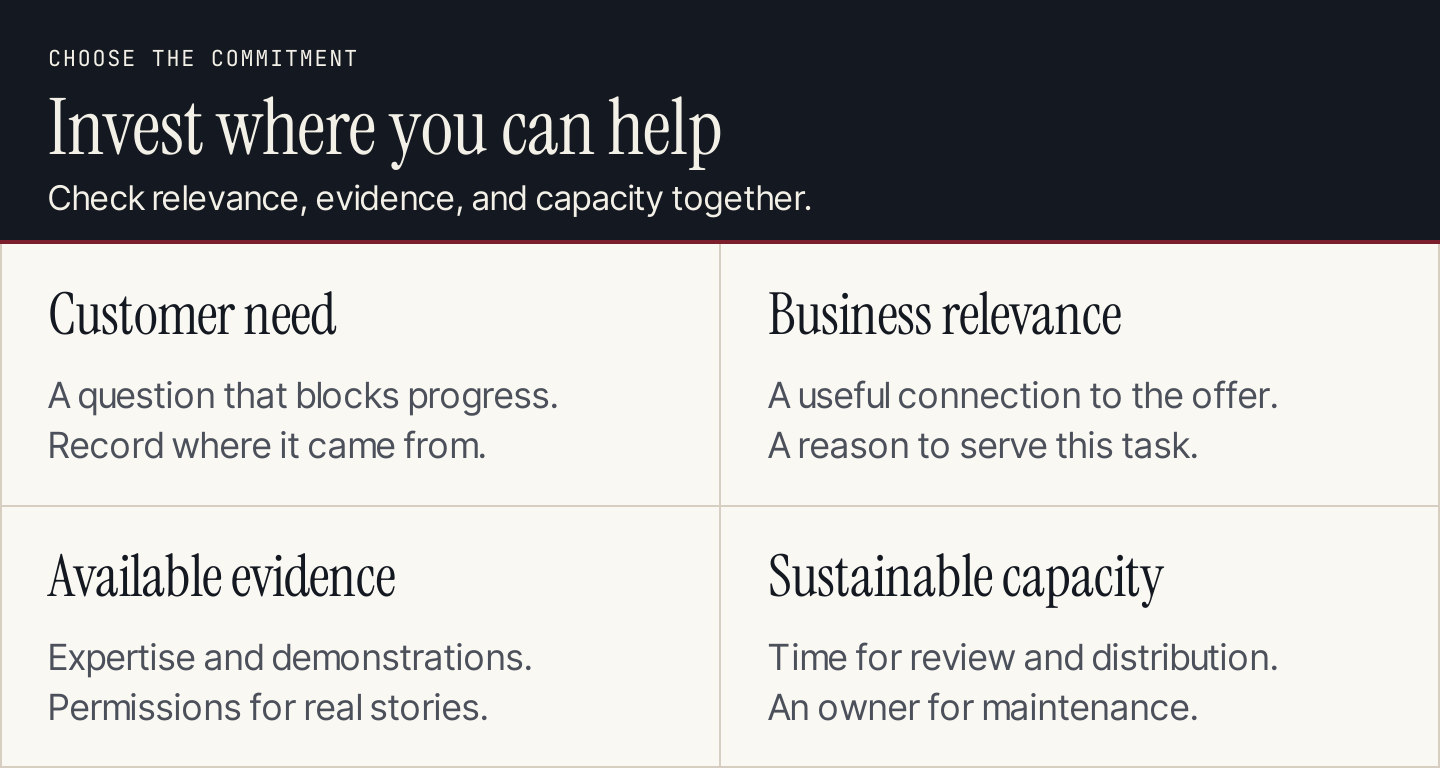
An attractive topic still needs a business connection, credible evidence, and enough capacity to support it.
Three real examples of different content investments
These public pages show observable choices. They don't reveal the companies' private strategy or prove that the same approach will deliver your results.
REI: help people choose and use gear
REI Expert Advice organizes resources around outdoor activities and distinguishes skills content from gear guides. Its visible article labels also distinguish staff picks from tested selections.

REI makes the basis of different gear recommendations visible in its article titles. Source: REI.
The adaptable choice is to separate learning a task from choosing equipment, then connect the answers where that helps. A small retailer could start with one use guide and one evidence-based selection guide. Explain who evaluated the products and how, instead of applying a “tested” label to research alone.
HubSpot Academy: teach a continuing skill
HubSpot Academy presents courses and certifications across marketing, sales, service, and software. The homepage offers a route into structured learning.
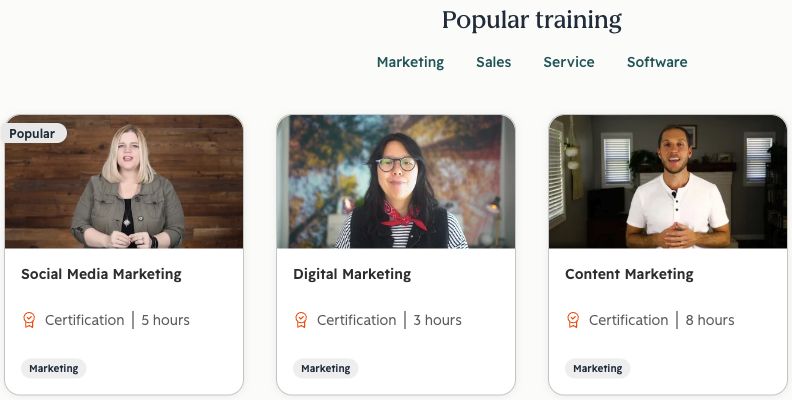
HubSpot Academy organizes training into named skills and shows the time each course requires. Source: HubSpot Academy.
For an agency, the practical adaptation is a short lesson sequence around one client skill. Define the prerequisite knowledge, a practice task, and a completion outcome. Start with a manageable series before committing to a large academy or inventing a credential.
Shopify: give the reader an immediate output
Shopify's business name generator asks for a description of the business and offers generated name ideas. The surrounding page connects naming to starting a business.
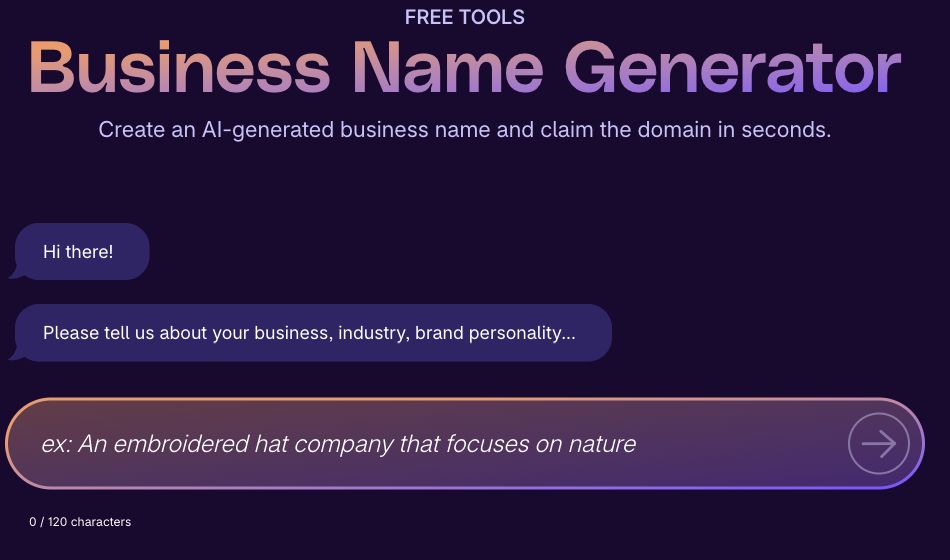
Shopify turns an early business question into an interactive task. Source: Shopify.
A smaller business can apply this with a focused worksheet or calculator before building software. Define the input, the useful output, and the limitations. An attractive form is only worthwhile when the result helps a real decision.
Copy this one-page strategy template
Complete it in plain language. If you can't fill a field, assign the research or decision it needs.
| Field | Your decision |
|---|---|
| Business outcome | The customer action we want to support; current baseline |
| Audience situation | Who is trying to do what, under which constraint? |
| Priority questions | Questions that block progress; source of each |
| Offer connection | How our business can help with this task |
| Original contribution | Expertise, demonstrations, approved stories, or documented research |
| Topic commitments | Themes we will support; subjects we will postpone |
| Formats | Format for each task and why it fits |
| Discovery routes | Where people seek this information; supporting evidence |
| Distribution | Initial action, owner, and destination |
| Capacity and cost | Production, review, distribution, and maintenance allowance |
| Acceptance standard | What the reader must achieve; required proof; factual reviewer |
| Pilot | The first connected assets and their separate jobs |
| Review decision | Date or trigger; what would justify continuing or changing course |
Optional AI prompt for reviewing the plan
Use this when you have real research notes and a completed template. It can expose missing decisions; it isn't audience research by itself.
Review the content strategy and evidence notes below.
Use only the supplied information.

For each planned asset, identify:
1. The audience task and intended business outcome.
2. Whether the format and distribution route fit that task.
3. The evidence required before publication.
4. Overlap with another planned or existing asset.
5. A missing owner, dependency, or measurement definition.

Return specific questions and suggested corrections.
Label every inference. Do not invent customer needs, search
volumes, conversion rates, quotations, or performance forecasts.

Strategy: [paste completed template]
Evidence: [paste approved research notes]
Existing assets: [paste inventory]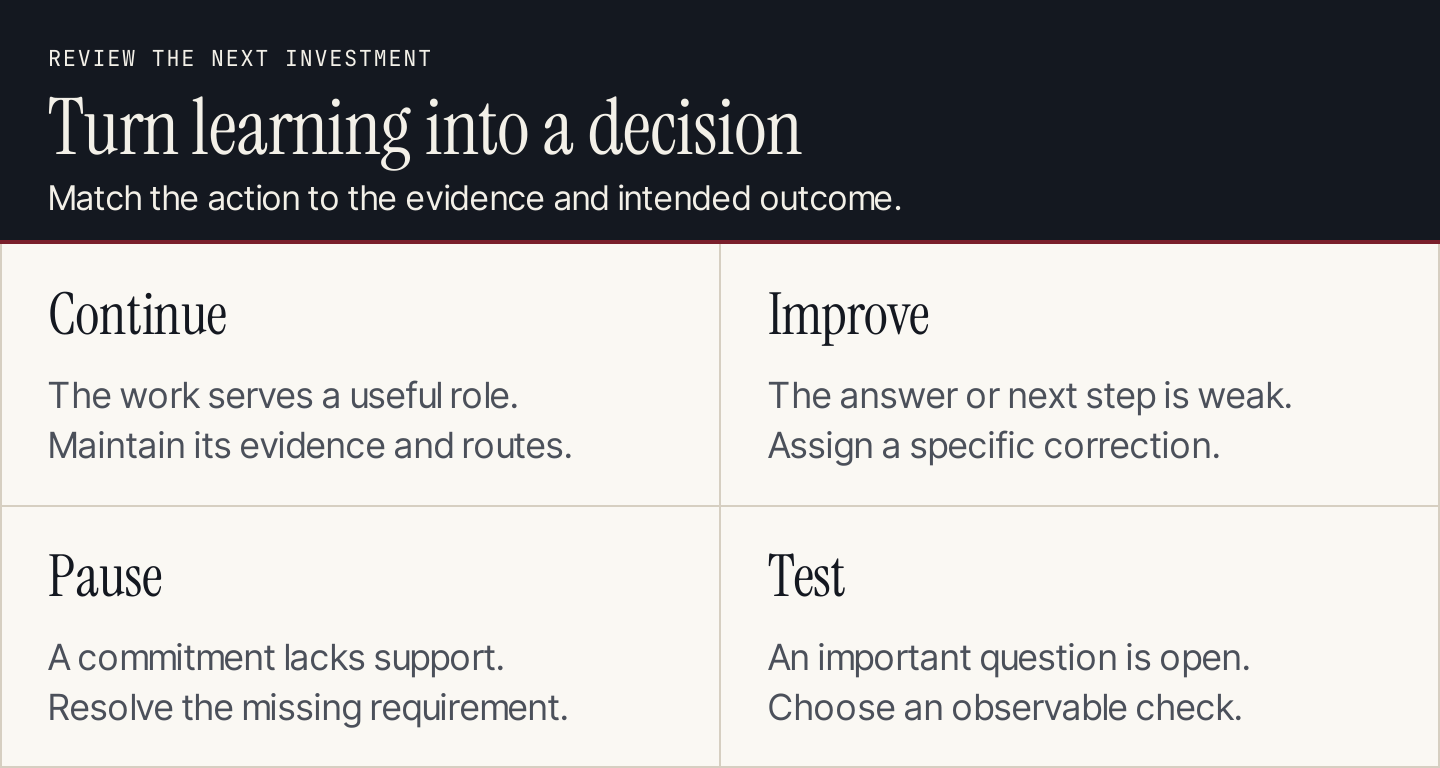
Use each review to make a concrete investment decision and assign the next action.
Put the strategy into production
Start by approving the audience situation, the pilot assets, and the review capacity. Transfer those decisions into the calendar, then prepare a brief for the first assignment.
When blog production is the bottleneck, Rankauto finds relevant customer searches, researches and writes articles in your brand voice, checks facts, and adds images and SEO fields. Articles save as drafts by default. Your team still owns the wider content strategy, customer permissions, and the email, social, or video work around it.
Content marketing strategy FAQs
How often should we update the strategy?
Review it when the offer, audience, available capacity, or evidence changes. Keep a regular decision meeting as well, with a window long enough to observe the intended customer behavior. Rewriting the whole document every time one post performs poorly obscures what you are trying to learn.
Should a small business use every content channel?
Choose channels where you have audience evidence and a workable production and distribution process. Add another when it serves a distinct need and the team can support it. A channel count is not a measure of strategic quality.
Does every piece need to sell directly?
No. Education, onboarding, and useful explanations can serve different parts of the customer relationship. Give each piece a defined role and a suitable next step. Judge it against that role rather than assuming every reader should immediately book a sales call.