Marketing Plan Template: Goals, Campaigns, Budget, and Review

A marketing plan should tell your team what to do, why it matters, who owns it, and how to judge the result. If the document only lists channels and publishing dates, it leaves the most consequential decisions unresolved.
Use the template below to connect an audience need with an offer, a small set of campaigns, a realistic budget, and a review process. It works for founders, marketing teams, and agencies managing a defined business or client scope.
The real examples show public pages from Buffer, Slack, and Merry Maids. They demonstrate planning decisions, not those companies’ private plans or results. The filled Buffer exercise is an original proposed campaign based on observable pages.
Copy this marketing plan template
Start with a summary you can review quickly. Keep detailed research and campaign records behind it rather than cramming everything into one page.
MARKETING PLAN
Business / client and offer:
Planning period and plan owner:

1. BUSINESS OUTCOME
Baseline, source, and measurement date:
Desired outcome, target, and review date:
Constraints and assumptions:

2. AUDIENCE AND OFFER
Serviceable audience, situation, and buying roles:
Customer task and evidence:
Offer, relevant difference, and supporting proof:
Important conditions and exclusions:

3. CAMPAIGNS AND CHANNELS
Priority campaigns and why they matter:
Discovery routes and each route's role:
Destination, promised value, and next action:
Follow-up, sales, or service owner:

4. RESOURCES AND EXECUTION
Cash budget and included cost categories:
Available hours and required skills:
Deliverables, dependencies, owners, and dates:
Launch checks and response coverage:

5. MEASUREMENT AND DECISIONS
Outcome metrics and exact definitions:
Diagnostic signals and quality checks:
Cohort, observation window, and attribution limits:
Keep / improve / stop decision rules:
Review dates and change log:
Fill the baseline from an actual record. If you cannot measure it yet, assign an owner and a measurement task. An unknown baseline is a gap to resolve, not permission to invent a growth percentage.
A longer annual plan can include market analysis, pricing, positioning, partnerships, and several campaign summaries. A short quarterly plan can concentrate on one offer and its clearest constraint. Choose the length that supports the decisions.
Marketing strategy, plan, campaign, and calendar
These documents have different jobs:
| Document | Main question | Useful output |
|---|---|---|
| Strategy | Where will we compete, and why should buyers choose us? | Audience, offer, positioning, and important tradeoffs |
| Marketing plan | What will we do with the available resources? | Priorities, budget, owners, timeline, and measures |
| Campaign brief | How will one initiative work? | Message, assets, destinations, delivery, and campaign decisions |
| Content calendar | When will approved material move through production and publication? | Asset dates, status, owners, and dependencies |
A calendar cannot decide whether the offer fits the audience. A strategy statement cannot tell a designer which asset is due next. Connect the records so changes in direction flow into execution.
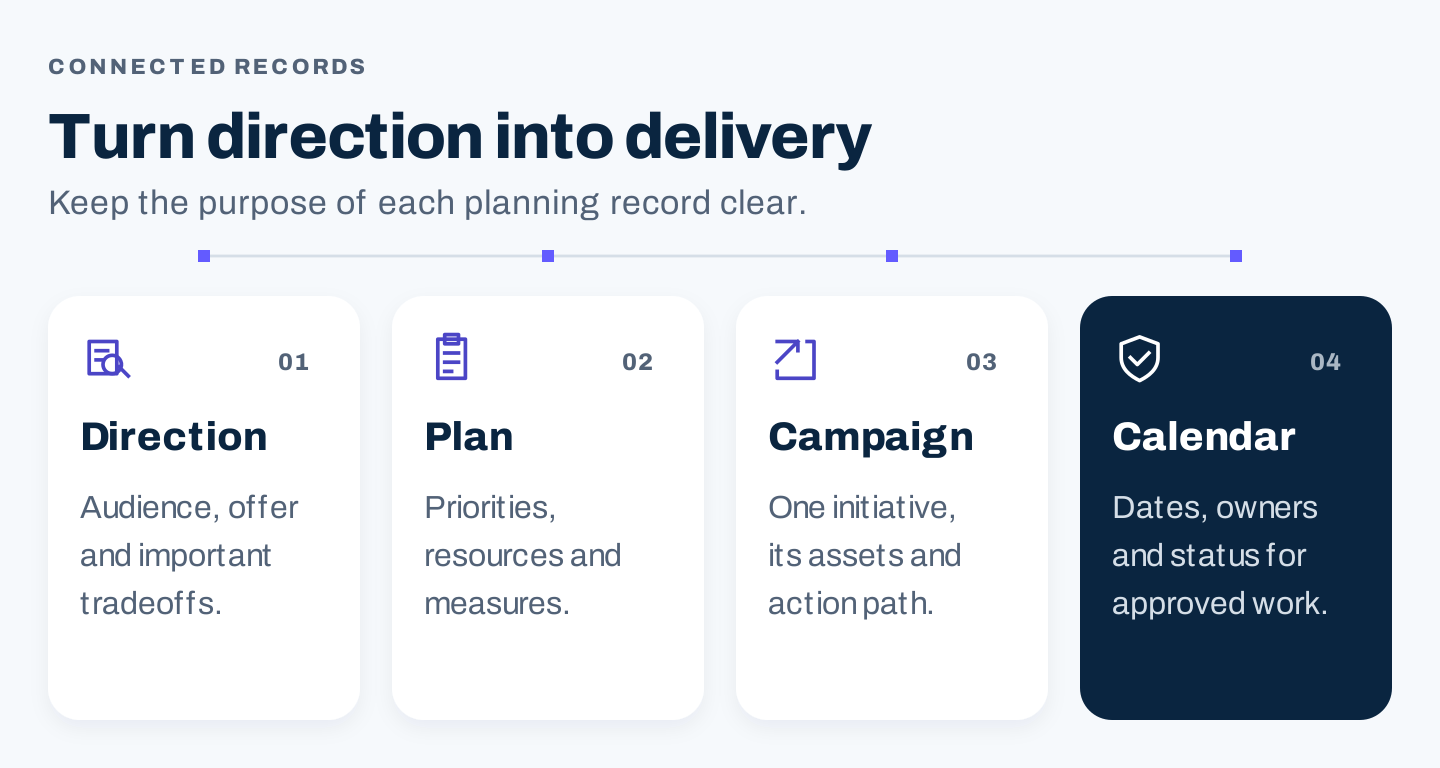
Original planning framework. Each record resolves a different decision and informs the next.
How to fill out the plan
1. Define the outcome and baseline
Choose a meaningful business outcome before selecting channels. Depending on the offer, that could be suitable inquiries, completed purchases, successful product adoption, or repeat service bookings.
Specify the population, source, and observation window. “Increase qualified inquiries” needs a qualification definition and a starting count. “Improve retention” needs a customer group and a relevant repeat-use or renewal event.
Use this goal structure:
For [defined offer and audience], change [measured outcome] from [verified baseline] toward [chosen target] by [review date], within [resource and delivery constraints].
A target is a management choice, not a forecast. Check it against available capacity, historical results, and the buying cycle. If evidence is limited, use the first period to establish a baseline and test a specific uncertainty.
Keep diagnostic objectives separate. Relevant traffic, resource use, or completed setup can help explain progress without becoming interchangeable with revenue.
2. Summarize audience, offer, and the alternatives
Record the situation that makes the offer useful. Include the roles that affect the decision: user, researcher, approver, payer, or service requester.
Then compare the alternatives a buyer could reasonably choose. Those can include another provider, an internal process, a different product, or postponing the work.
Use a small research table:
| Decision question | Evidence to gather | Planning implication |
|---|---|---|
| What triggers the need? | Recent inquiries and customer conversations | Which question should lead the campaign |
| What matters in the comparison? | Objections, alternatives, and decision notes | Which proof and tradeoffs to explain |
| Who can we actually serve? | Product requirements, scope, geography, and capacity | Which audience and requests fit |
| Why would someone choose another route? | Lost opportunities and relevant interviews | What to clarify or change |
Competitor pages reveal their public messages and available actions. They do not establish which tactics are profitable. Third-party traffic or ad estimates can suggest research questions; they cannot substitute for your own economics.
Use the target audience brief if the audience description still rests on assumptions. Add a concise situation analysis: what the business does well, what limits delivery, which opportunity is evidenced, and what external change could affect the plan. Turn each important finding into a decision or monitoring task.
3. Choose campaigns around the current constraint
A campaign should address a specific gap in the path from discovery to useful business. Examples include an unanswered comparison question, a confusing service page, weak product setup, or unsuitable inquiries.
Prioritize by reader value, commercial relevance, evidence, effort, and delivery readiness. Record the reason for the choice. Avoid treating a numeric priority score as objective when its inputs are guesses.
Commit only to the work you can produce, check, distribute, and support. Keep other ideas in a backlog with their rationale. A plan that promises activity on every platform may hide an impossible workload.
4. Give each channel a role
Choose routes based on audience access and the job they perform. The same campaign can need discovery, evaluation, action, and follow-up destinations without launching several acquisition channels at once.
| Route | Possible role | What to confirm before committing |
|---|---|---|
| Search and helpful articles | Answer existing questions | Topic relevance, useful destination, and uncertain discovery timing |
| Organic social or community | Introduce and discuss a useful answer | Relevant participation, platform fit, and reply capacity |
| Requested email | Continue an existing relationship | Audience expectations, delivery, and useful next content |
| Paid search or social | Test a defined audience and offer | Budget controls, eligibility, destination, and outcome tracking |
| Partners or events | Reach a relevant established audience | Audience overlap, responsibilities, and access arrangements |
| Service or product pages | Explain fit and enable action | Scope, evidence, conditions, and functioning contact path |
| Customer support and follow-up | Help people realize value | Owner, coverage, and the appropriate success event |
Name the destination and next action alongside each route. “Facebook” is not a complete campaign plan. Record the audience, message, creative requirement, destination, action, budget, owner, and review measure. Verify current platform settings when implementing; this template is not an Ads Manager walkthrough.
Real examples: connect the plan to the actual action
Buffer: connect a planning question with a relevant product task
Buffer’s calendar guide presents calendar options and a contextual product action. Its content-planner page explains organizing ideas into posts and includes a public interface illustration.
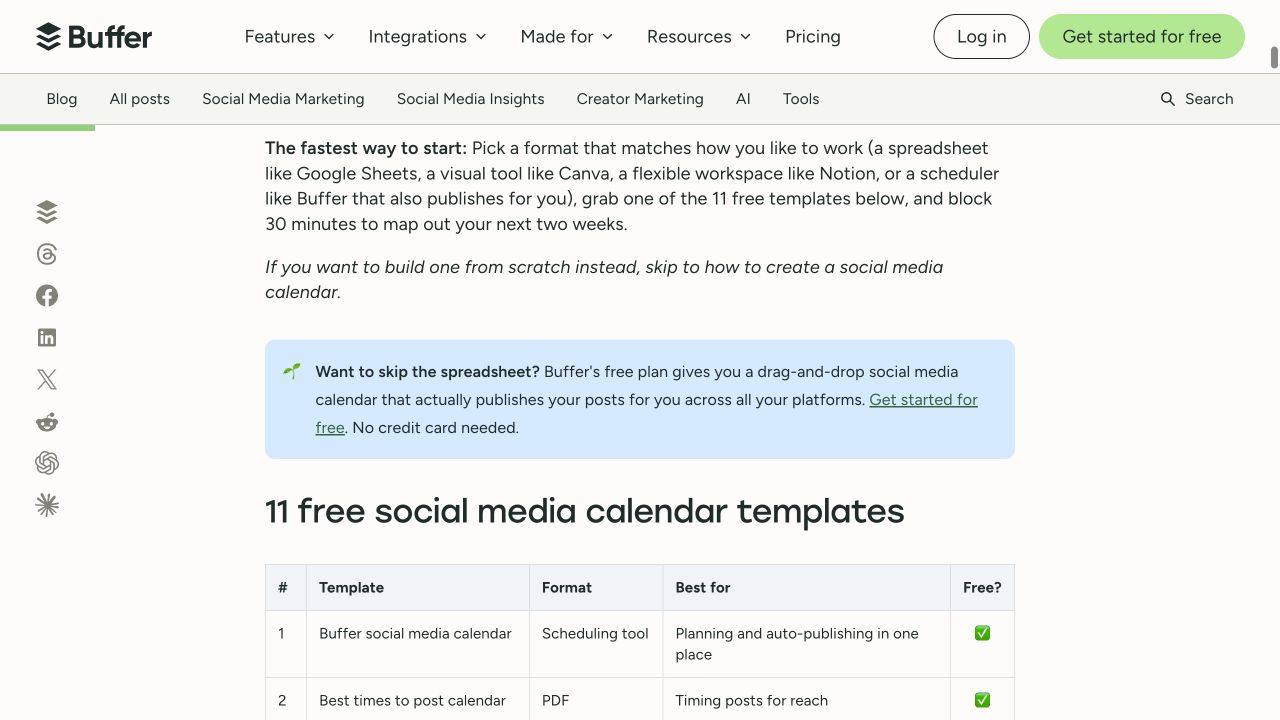
Source: Buffer calendar guide. Authentic desktop capture preserved from October 7, 2026.
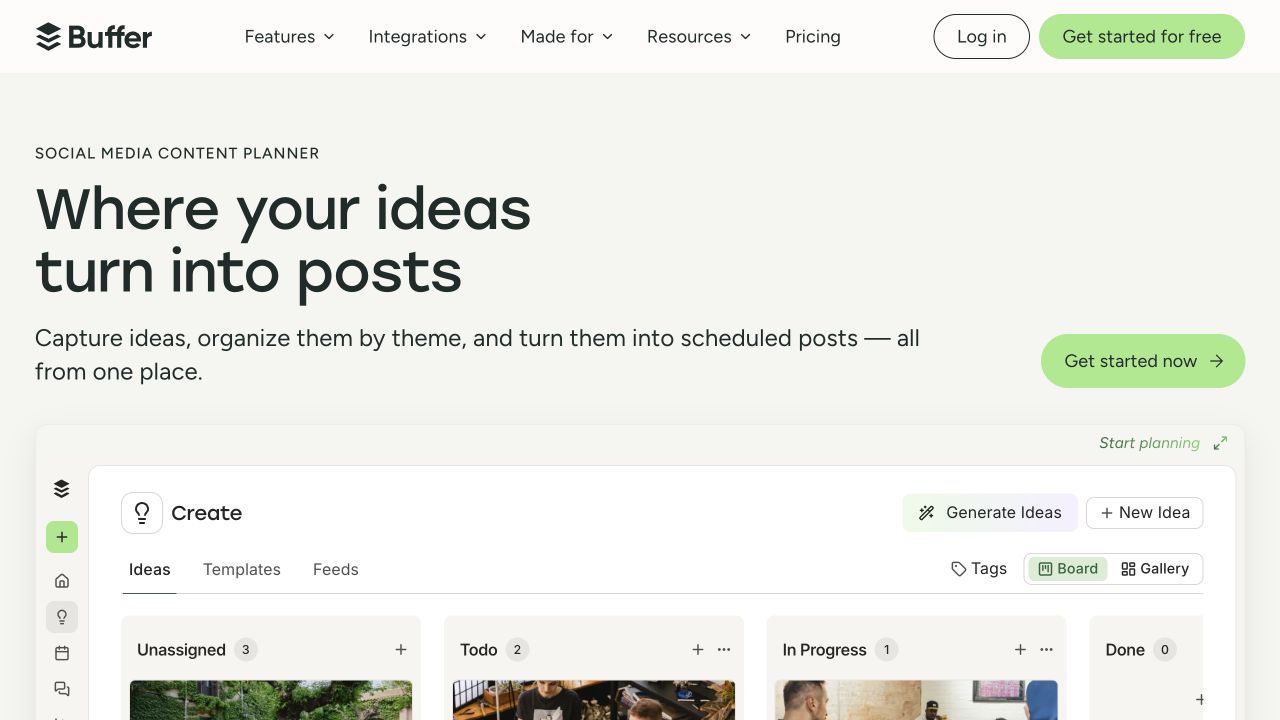
Source: Buffer content planner. Public page illustration; authenticated product use was not tested.
Planning lesson: the resource and product page can support related tasks. Your plan should explain the connection, then distinguish reading the guide, choosing a method, creating an account, and completing useful product work.
Here is a filled planning exercise, not Buffer’s actual campaign plan:
| Planning field | Proposed decision | Evidence boundary |
|---|---|---|
| Audience situation | People organizing social content who need a workable calendar | Derived from the public resource’s task; validate specific buyer groups separately |
| Reader outcome | Choose a calendar approach and organize initial content | Proposed useful result |
| Commercial hypothesis | Readers who need a product workflow may evaluate the planner | Hypothesis, not a measured relationship |
| Core asset | Existing calendar guide | Public destination observed |
| Next destination | Planner explanation for people considering that approach | Public destination observed |
| Discovery | Test one relevant route already accessible to the team | Route and audience access need confirmation |
| Work | Review the guide-to-planner promise, prepare one introduction, check access and setup expectations | Proposed campaign work |
| Owners | Content owner, distribution owner, and product-support owner | Roles to assign; no claim about Buffer’s staff |
| Timing | Prepare, check, launch, and review within an agreed pilot period | Suggested sequence; dates depend on capacity |
| Resources | Estimate production, review, distribution, and follow-up hours before commitment | Private budget and capacity are unknown |
| Measures | Relevant resource use, planner visits, and completion of a defined first task | Requires actual analytics and a product event definition |
| Review decision | Continue only if the route attracts relevant use and the next task works | Proposed decision rule; no result asserted |
The plan is filled where public evidence supports a decision and explicit where operational inputs remain unknown. An agency should obtain those inputs from the client before treating the exercise as an approved execution plan.
Slack: a sales request needs an owner and a response process
Slack’s public sales form collects contact and organization context. The preserved desktop capture shows the United States selection.
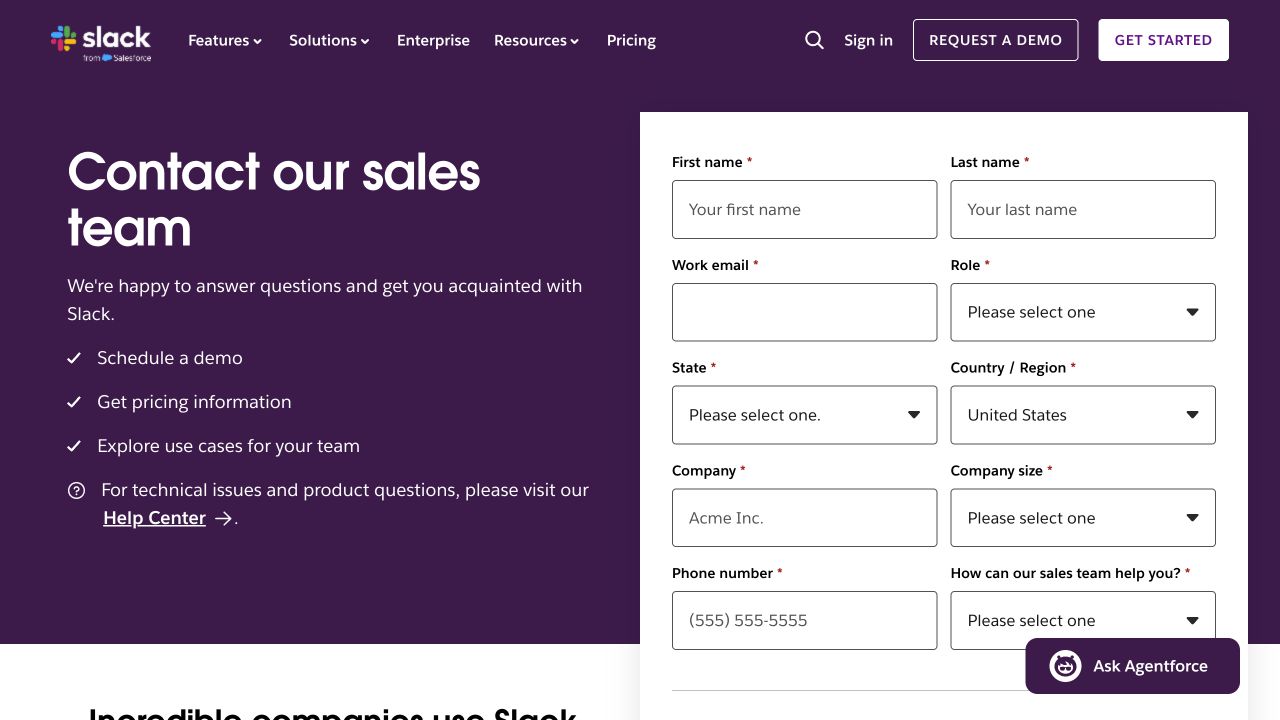
Source: Slack contact sales. No information entered or request submitted.
Planning lesson: a sales campaign needs qualification and response ownership alongside creative work. Record who receives the request, which fields support routing, and what response the page promises. Measure accepted opportunities separately from submissions.
Merry Maids: local serviceability belongs in the plan
The captured Merry Maids quote entry asks for the service location first. Later steps and appointment confirmation were not tested.
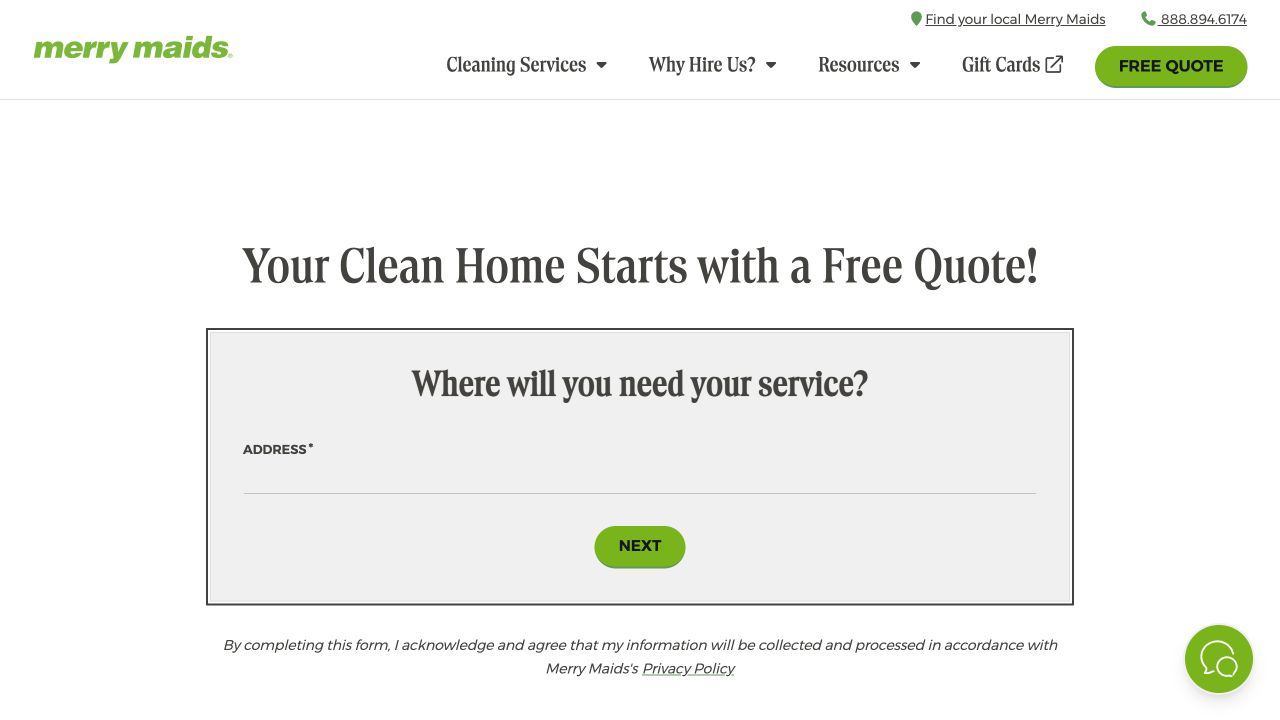
Source: Merry Maids quote entry. First address step only; no request submitted.
Planning lesson: match campaign geography to actual coverage, and match promotion to appointment capacity. A quote request and a completed service are separate outcomes. Your budget review should follow the request far enough to judge the intended commercial result.
Budget for both cash and time
Estimate the work before approving the channel mix. Include research, production, review, assets, distribution, tools, tracking, and response work where applicable. List existing commitments separately from incremental campaign costs.
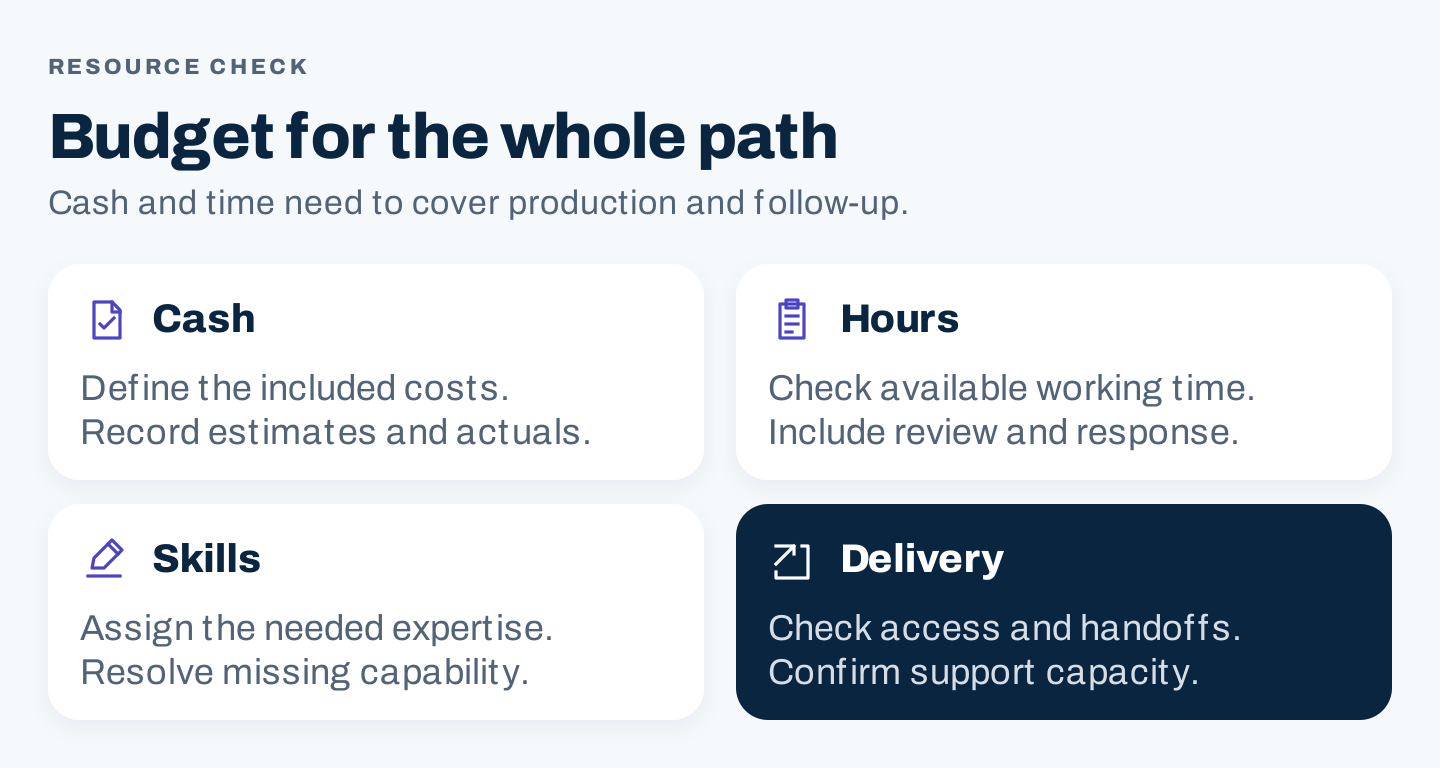
Original resource framework. A campaign needs capacity throughout production and follow-up.
Use this budget record:
| Work item | Cash estimate | Hours | Owner | Dependency | Cost basis |
|---|---|---|---|---|---|
| Research and brief | [Amount] | [Hours] | [Role] | Evidence access | [Internal or external] |
| Content and visuals | [Amount] | [Hours] | [Role] | Approved brief | [Incremental or allocated] |
| Review and launch checks | [Amount] | [Hours] | [Role] | Finished assets | [Defined scope] |
| Distribution | [Amount] | [Hours] | [Role] | Working destination | [Media, partner, or labor] |
| Follow-up and measurement | [Amount] | [Hours] | [Role] | Usable records | [Defined scope] |
For illustrative capacity arithmetic, suppose a team can allocate 40 hours to a pilot. Research and briefing require 6 hours, production 16, review and access checks 6, distribution 5, and follow-up/reporting 5. That totals 38 hours, leaving 2 hours unallocated. The estimates are hypothetical; they illustrate why output quotas need a resource check.
If the team also expects to launch another campaign requiring 10 hours, the combined commitment is 48 hours. Reduce scope, move dates, or add verified capacity before promising delivery. Assigning the same person more owner labels does not create more time.
Budget against the whole path. If an illustrative campaign costs $1,500 and produces 15 qualified inquiries under agreed rules, cost per qualified inquiry is $100. That does not establish profitability: you still need downstream customers, value, delivery costs, and attribution limits.
There is no universal marketing-budget percentage that resolves these choices for every business. Start with affordable resources, relevant unit economics, and a bounded test.
Assign owners, dates, and launch dependencies
Give every deliverable one accountable owner, even when several people contribute. An owner is responsible for completion and escalation, not necessarily every production task.
| Phase | Deliverable | Dependency | Completion check |
|---|---|---|---|
| Prepare | Approved audience, offer, brief, and baseline | Evidence and operating facts | Key assumptions identified |
| Build | Content, visuals, destination, and tracking | Approved scope and resources | Facts, links, and message agree |
| Check | Tested action and receiving record | Finished destination | Access, confirmation, and ownership work |
| Launch | Selected distribution and covered response | Launch checks complete | Live placements match the promise |
| Review | Outcome, quality, cost, and learning record | Sufficient observation | Next decision has an evidence basis |
For a quarterly schedule, assign dates to these phases and leave room for maintenance and response work. Do not schedule an invitation before the promised resource or booking path is ready.
Keep the publishing calendar linked to the campaign. Useful fields include campaign ID, audience task, asset, channel, owner, draft date, review date, publication date, destination, status, and measurement reference. Update reused calendar dates rather than assuming an old template has the correct weekdays.
Review the plan without chasing every fluctuation
Use a short operational check during execution and a deeper review at the agreed milestone. A weekly check can resolve missing assets, broken access, overspend, or unanswered requests. A quarterly review can reassess priorities and resource allocation.
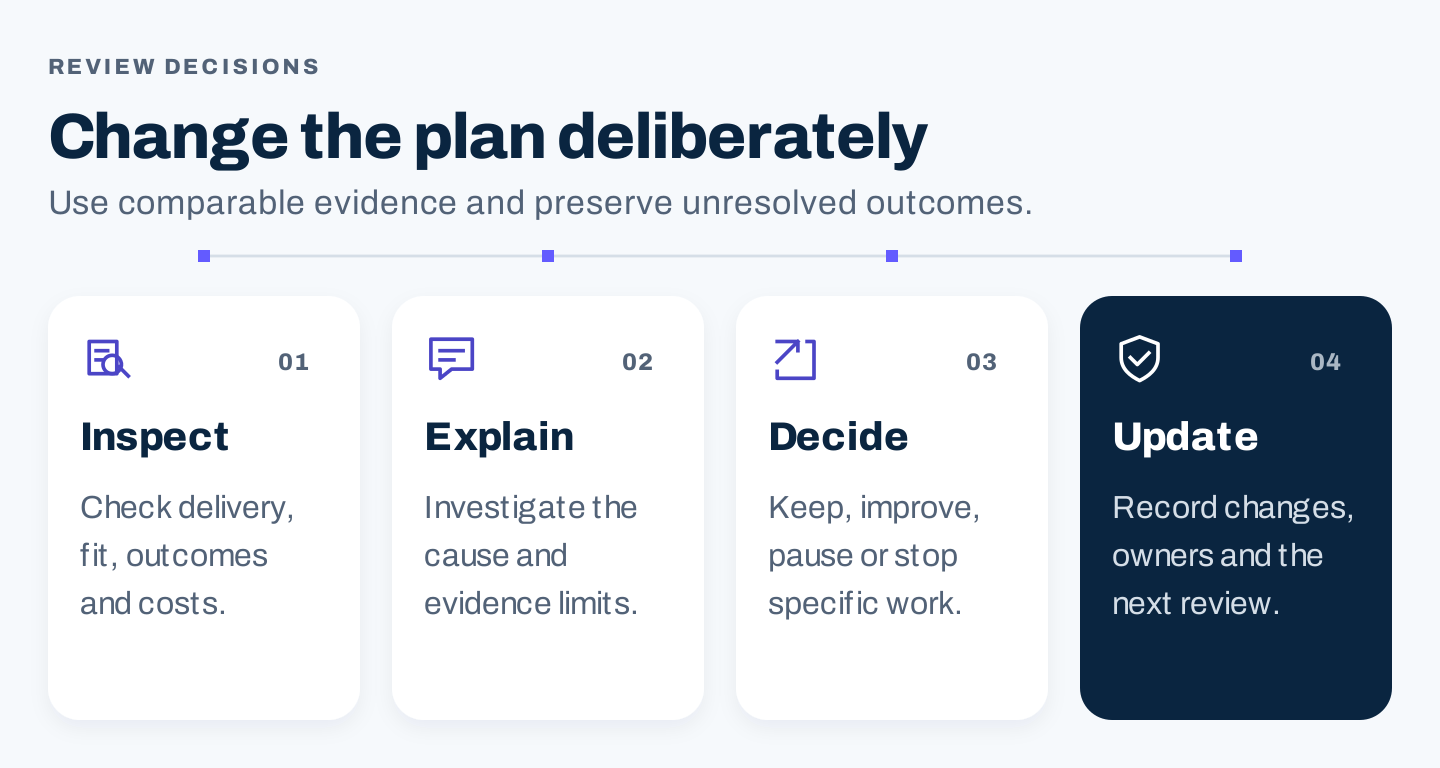
Original review loop. Record the evidence and change the plan deliberately.
Ask:
- What was delivered, and what remains blocked?
- Did the intended audience encounter and use the material?
- Did suitable people take the named action?
- Did the response or delivery work?
- What outcome has matured, and what is still unresolved?
- What did the campaign cost on the agreed basis?
- What should we keep, improve, pause, or stop?
Compare consistent populations and periods. This month’s visits and this month’s closed sales may come from different cohorts. Keep activity reporting separate from following a defined group through later outcomes.
Use diagnostic reasons before changing channels. Poor qualification may come from an unclear scope statement; missed sales may come from weak response coverage. More impressions would not resolve either cause.
Maintain a change log with the date, observation, decision, owner, expected effect, and next review. If the audience, message, offer, and destination all change together, do not claim you isolated which change caused the result.
Frequently asked questions
Can a marketing plan fit on one page?
Yes, as a decision summary. Keep detailed evidence, budgets, and campaign records available behind it. Readability and usability matter more than forcing every detail onto one physical page.
Does every plan need paid ads or every social platform?
No. Select routes that fit audience access, the offer, and delivery capacity. A plan should explain why a channel is included and what it must accomplish.
Do you need AI to create a marketing plan?
No. The template and evidence are enough to begin. AI can help organize an approved brief, but it cannot supply your real baseline, budget, customer needs, or team availability. Review any proposed choices against those inputs.
Start by filling the outcome, audience, and resource sections. Then use the marketing funnel guide to connect reader decisions and the lead quality guide to define suitable inquiries. Commit to campaigns only after their delivery and measurement responsibilities are clear.