Brand Positioning: 6 Real Examples and a Practical Framework

Basecamp emphasizes simplicity within project management. Wit & Craft names manufacturers and a problem with competing on price. Hiut Denim connects its product to the people and place behind its making.
Each gives a buyer a way to understand the business and decide whether to investigate further. That is the job of brand positioning: establish who the offer fits, what buyers should compare it with, and why its difference matters.
This guide examines six real businesses, with desktop screenshots and practical lessons. Then it shows how to build an evidence brief, turn it into a positioning statement, and apply it across your website and content. Six AI prompts help you organize the research and develop candidate messages.
The examples use public pages captured on October 7, 2026. Website messaging shows what a business communicates; it does not reveal its complete internal strategy or establish conversion performance. One example also uses an attributed consultant case study, clearly separated from the business's current page.
What is brand positioning?
Brand positioning defines how an offer should be understood by a particular buyer in relation to the alternatives they consider. It brings together the buying situation, category, relevant difference, benefit, and reason to believe.
For a founder, it helps explain why the business deserves consideration. For a marketing team, it supplies a shared basis for campaigns and content. For an agency, it helps the client and delivery team agree on the offer before creating variations of the message.
Keep four related outputs distinct:
| Output | Question it answers | Useful output |
|---|---|---|
| Positioning | Who should consider us, in what situation, over which alternatives? | Internal strategy brief |
| Value proposition | What useful benefit does this offer provide? | Offer explanation |
| Messaging | How should we communicate that value to this reader? | Pages, campaigns, sales language |
| Tagline | What short phrase should people remember? | Public brand expression |
A tagline can express a position. The research underneath it determines whether the position fits the customer and the business.
Six real brand positioning examples
Use these examples to examine different decisions, from category clarity to the evidence supporting a brand promise.
| Business | Decision to study | What you can inspect |
|---|---|---|
| Basecamp | Category plus a point of emphasis | Project-management message and public project demonstration |
| Calendly | Immediate task before the wider story | Scheduling headline and account-start actions |
| Wit & Craft | Audience plus a buying tension | Manufacturing focus and price-competition message |
| First District Designs | Customer experience and service context | Current homepage alongside a published positioning case |
| Hiut Denim | Craft connected to an observable process | Factory story, named makers, and repair offer |
| Patagonia | Values supported by business decisions | Ownership explanation and stated purpose |
1. Basecamp: give the buyer a clear comparison category
Basecamp's homepage includes “project management without all the nonsense.” The category gives visitors a familiar starting point; the second part establishes simplicity as a point of emphasis. A public project demonstration sits beside the message.
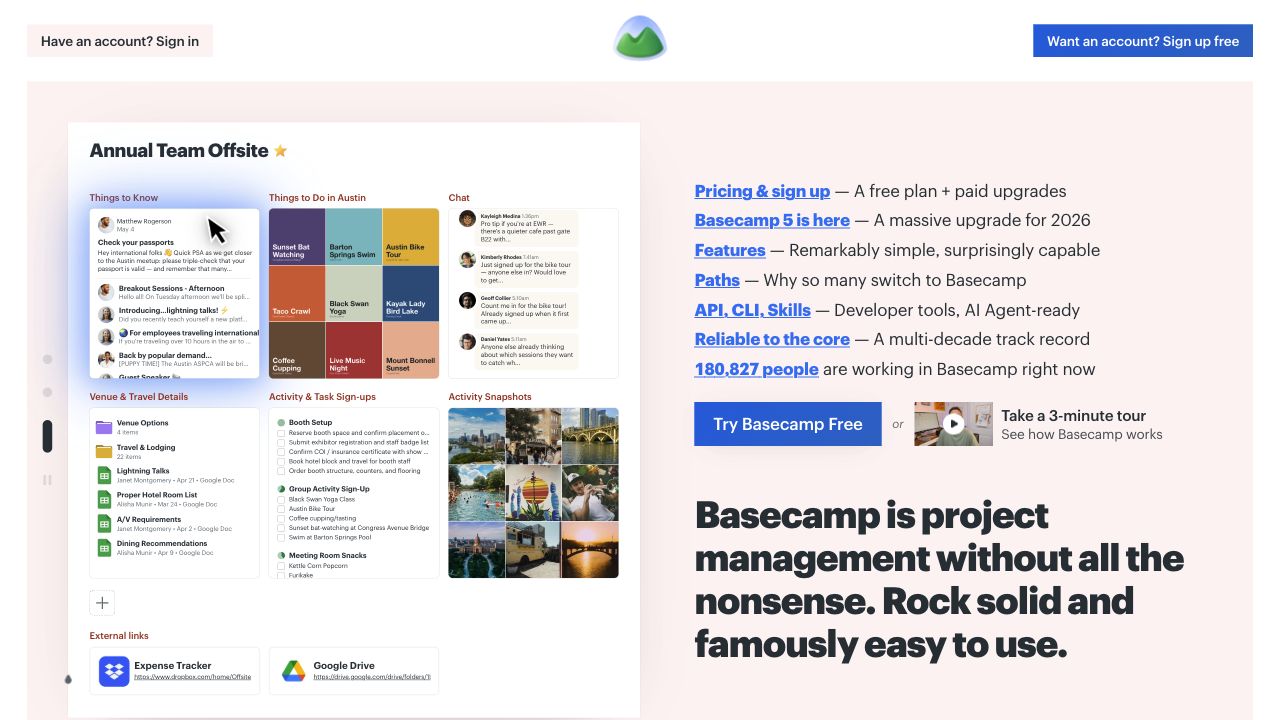
Source: Basecamp, captured October 7, 2026 at 1280 × 720. The project panel is the brand's public demonstration.
The lesson: Name what buyers should compare before asking them to appreciate your difference. A recognizable category makes the rest of the explanation easier to interpret.
Apply it: Write your category in language a prospective customer would use. Then show the feature, process, or experience behind your chosen emphasis. If your service is easier to manage, explain how the work is organized and what the customer must do.
Simplicity in a headline is a positioning signal. To claim that your offer is easier than another option, you need a relevant comparison of the actual experience.
2. Calendly: orient visitors around an immediate job
The captured Calendly homepage says “Easy scheduling ahead.” Nearby account-start actions make the next step visible. An announcement introduces a broader meeting-work story while the headline retains a recognizable task.
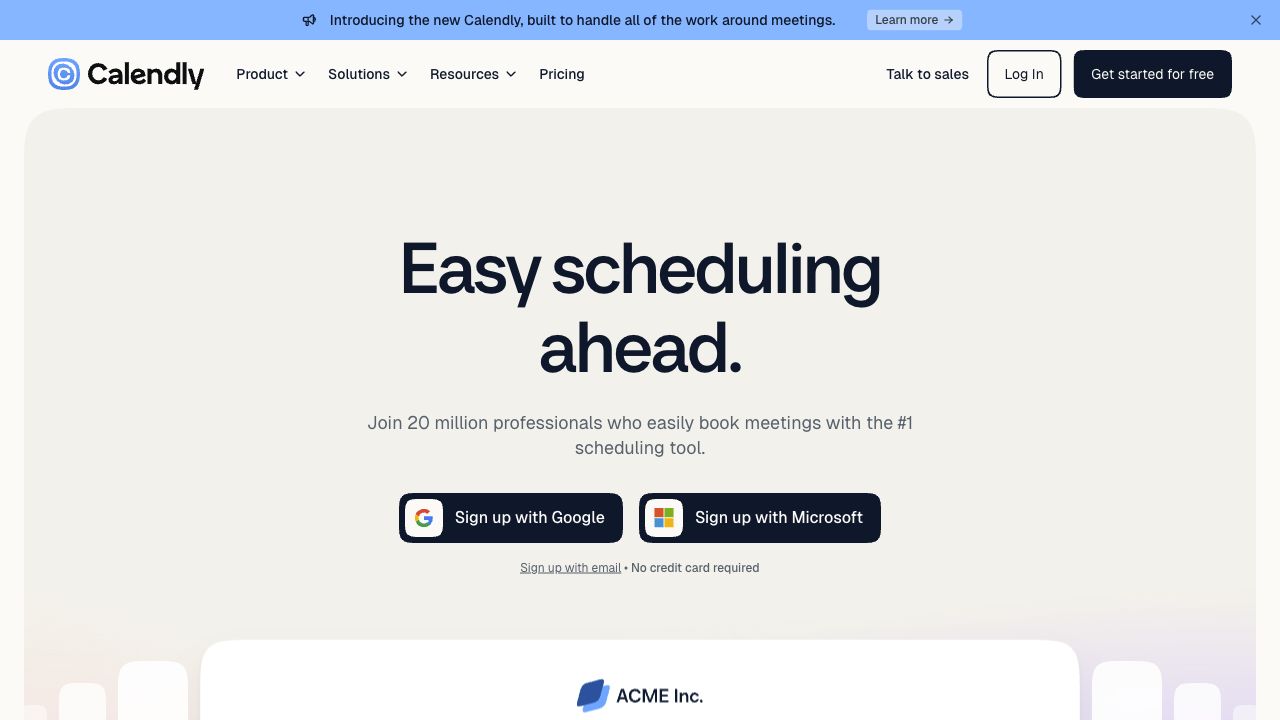
Source: Calendly, captured October 7, 2026 at 1280 × 720 after declining optional cookies. This is one observed page presentation.
The lesson: A business with several capabilities still needs an entry point a new visitor can understand.
Apply it: Identify the task that triggers the buyer's search. Lead with that task, then explain the wider offer where it becomes relevant. A marketing agency might organize a service page around a particular campaign need, while keeping its wider capabilities available elsewhere.
Check the entry point with prospective customers. If they expect a service you do not provide, the familiar label has created the wrong expectation.
3. Wit & Craft: connect specialization to a buying problem
Wit & Craft's homepage names its agency category, manufacturing audience, and tension around competing on price. The message identifies both who the work is for and the commercial issue it addresses.
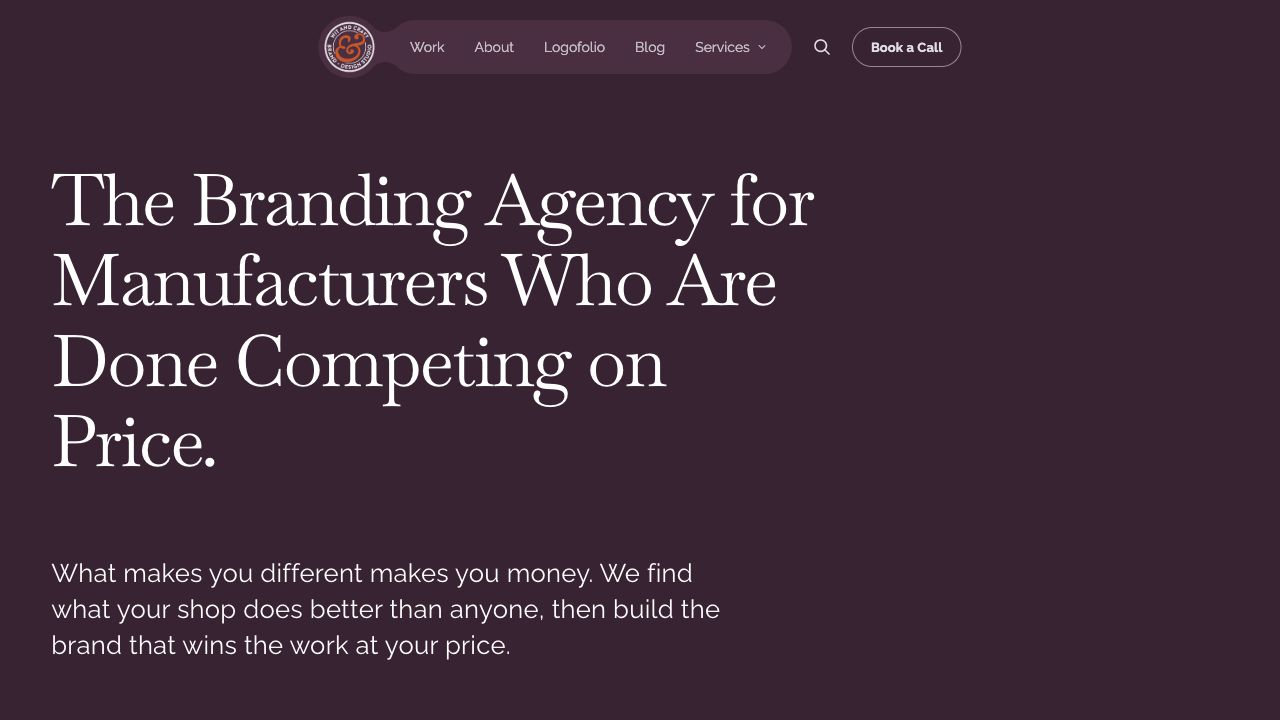
Source: Wit & Craft, captured October 7, 2026 at 1280 × 720. Performance promises visible on the page are the agency's own claims.
The lesson: An industry label becomes more useful when connected to a situation the buyer recognizes.
Apply it: Look at your best-fit accounts. What triggers their search? Which questions recur in proposals? What delivery requirements do they share? Use those observations to decide whether a specialization creates a meaningful fit.
A label such as “for manufacturers” should be reflected in your examples, process, and service scope. The homepage alone cannot establish that an agency delivers better results or has an advantage no other provider can match.
4. First District Designs: make the desired experience concrete
The current First District Designs homepage uses “Warm, welcoming, and designed for real life.” Supporting text describes livable homes and identifies its service area around Washington, D.C., Maryland, and Virginia.
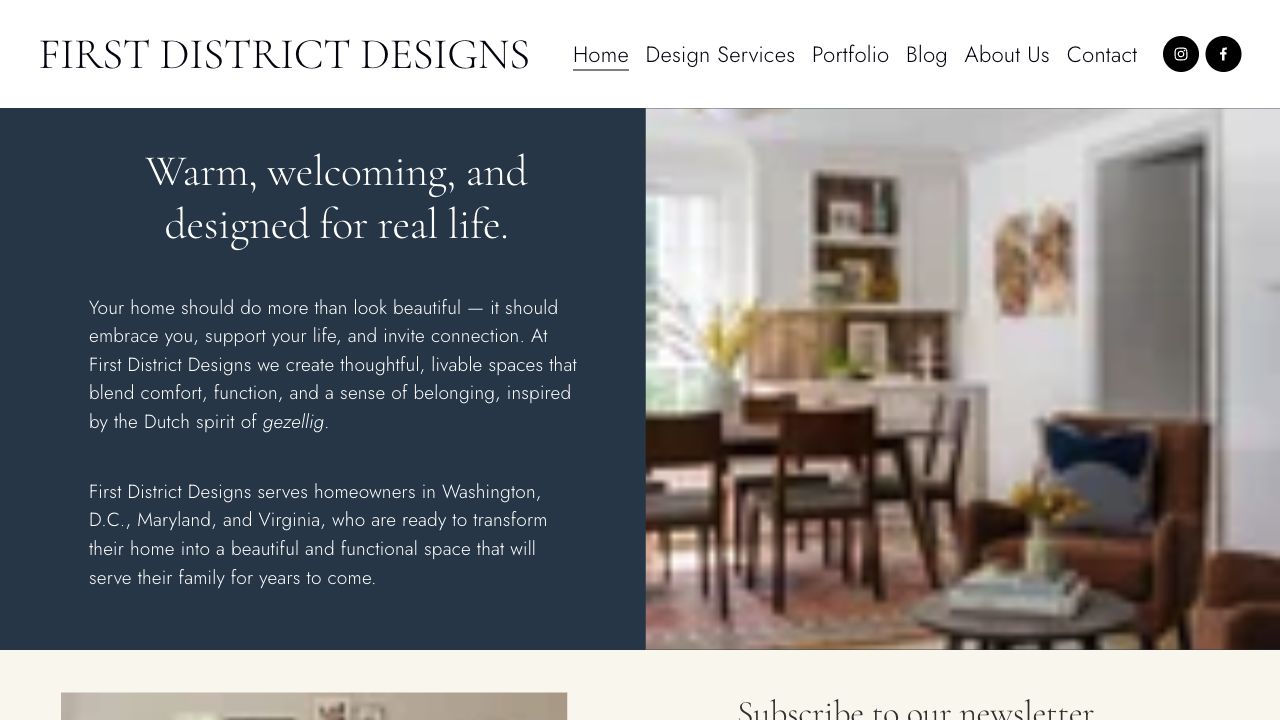
Source: First District Designs, captured October 7, 2026 at 1280 × 720. The room photograph and text are part of the public page.
A Wit & Craft case study, based on a September 2024 client interview, describes an earlier positioning direction focused on guided service for people hiring an interior designer for the first time. That is the consultant's account; it is not the wording currently displayed on the homepage.
The lesson: A service can be described through the customer's experience as well as the deliverable. Keep historical positioning and current public messaging distinct.
Apply it: Investigate where buyers need guidance, reassurance, or control. Translate that need into something specific they can inspect: a walkthrough, a clear decision process, or an explanation of responsibilities. Customer interviews can establish which experience matters; a process description shows how you intend to provide it.
5. Hiut Denim: connect craft to the people and process behind it
Hiut Denim's story page identifies a family-owned denim company in Aberteifi, Wales. It explains its own factory and a making process that includes a maker's signature. Its homepage also presents an ongoing repair offer.
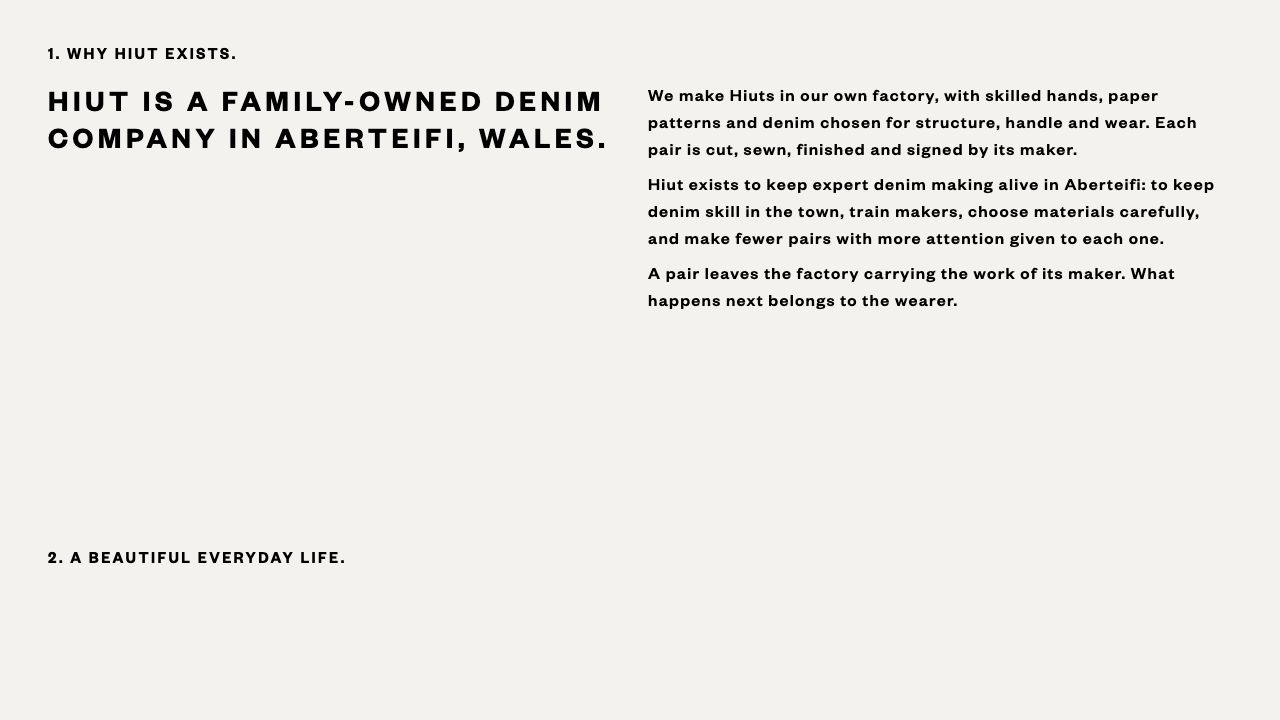
Source: Hiut Denim, desktop excerpt captured October 7, 2026 with a 1280 × 720 viewport. The capture begins at the first story section.
The lesson: Craft becomes easier to evaluate when a business identifies who does the work and how it is done.
Apply it: Replace a generic quality claim with a documented process, a named responsibility, or an inspectable detail. A maker could show construction steps; a service firm could show who reviews the work and what the review covers.
These are the brand's descriptions. Checking the product and service experience is a separate step. The fuller evidence brief below shows how to keep those distinctions visible.
6. Patagonia: connect values to business choices
On its ownership page, Patagonia explains its environmental purpose and the ownership arrangements intended to preserve it. The page links a values message to decisions about the business itself.
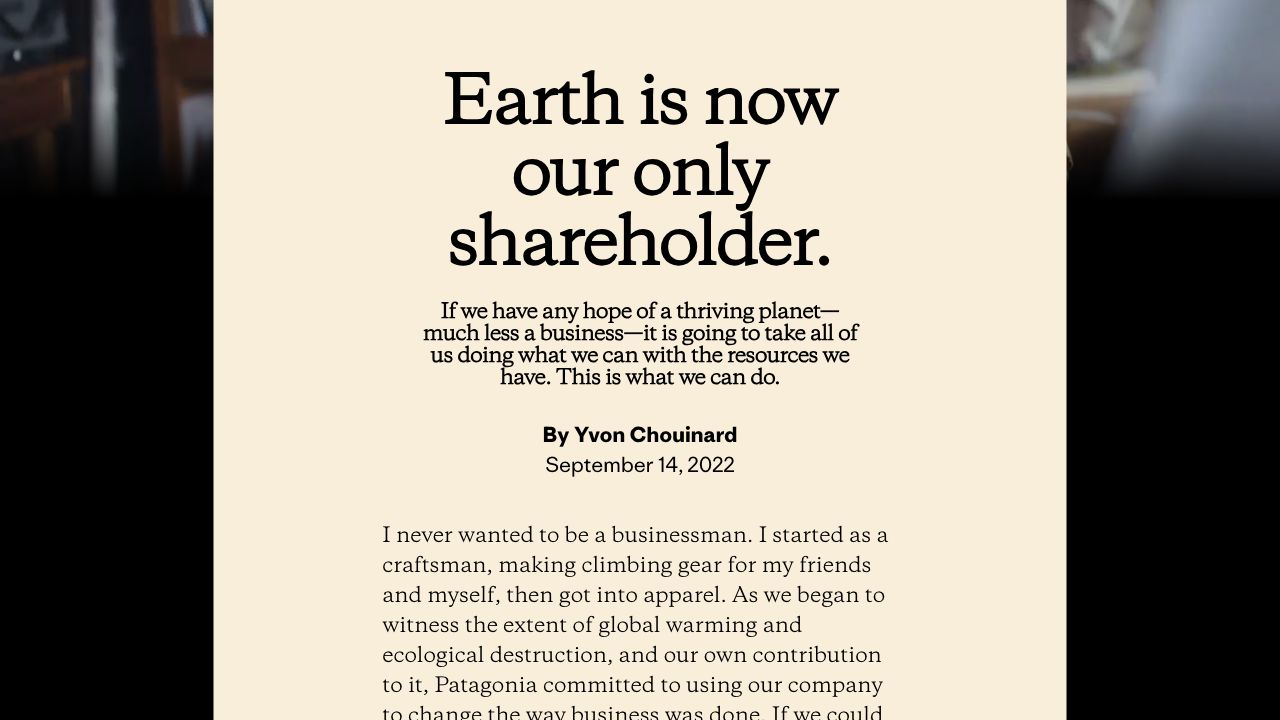
Source: Patagonia, desktop excerpt captured October 7, 2026 at 1280 × 720 after dismissing the cookie notice. The letter is dated September 14, 2022.
The lesson: A values-based position becomes more substantial when customers can investigate what the business does to support it.
Apply it: Identify the operational choice behind a value: sourcing, repair, accessibility, hiring, or service design. Explain its scope and provide relevant documentation. A small business can make a modest, precise commitment that fits its operations.
Do not infer that customers share the value or prefer your business because of it. Those are research questions. A stated commitment and its described mechanism give you something to investigate, not proof of a universal customer response.
A practical framework for brand positioning
Build a brief around six decisions: buyer situation, alternatives, category, relevant difference, evidence, and boundaries. Work back and forth between them as the research changes your understanding.
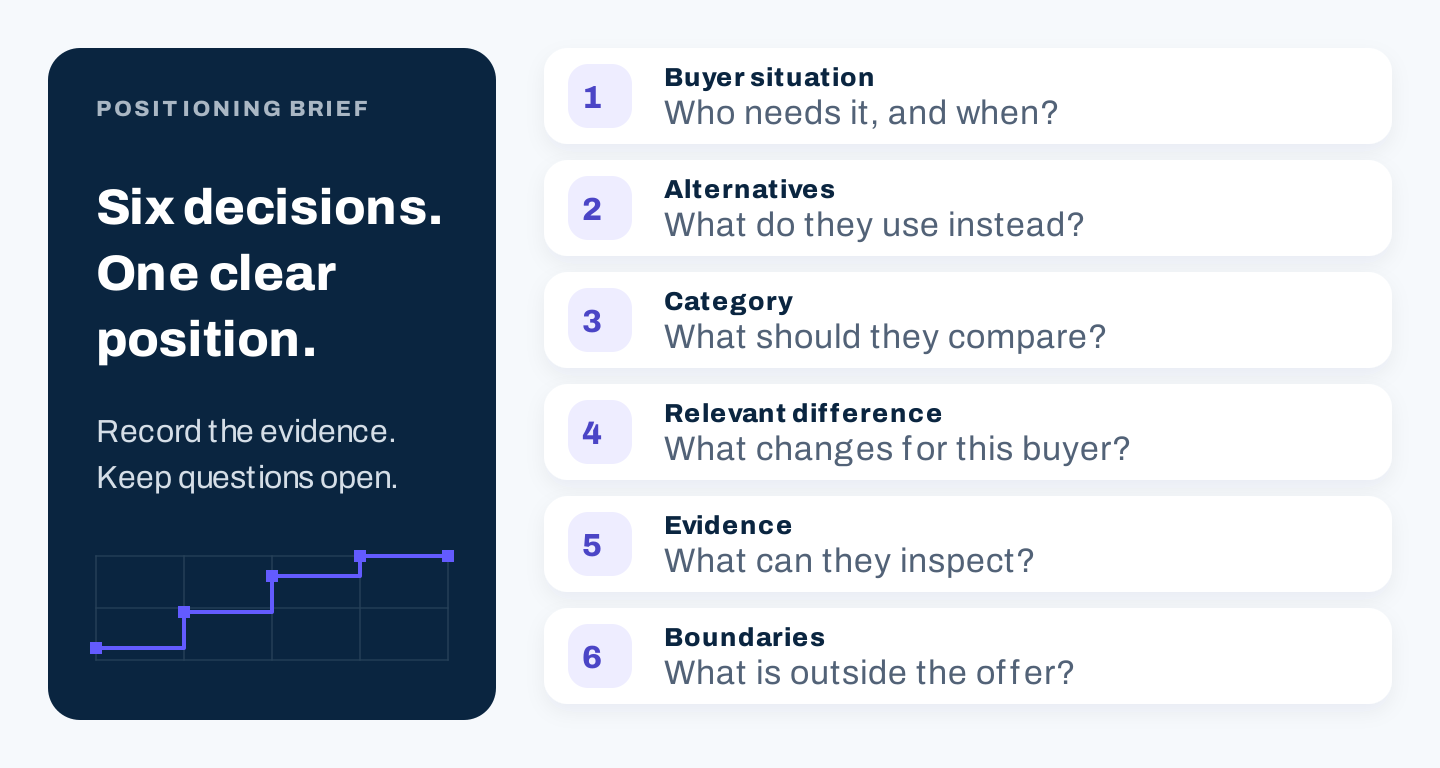
Original framework. Record an evidence source or a research question for each decision before summarizing the position.
1. Describe the buying situation
“Small businesses” describes a broad market. Add what makes the offer useful now: a stalled project, a new location, a first purchase, or a process the buyer wants to change.
Ask about a recent decision. What triggered the search? What did the buyer try first? Who participated? What almost stopped the purchase? Use the customer's words and record the source.
The distinction in the First District Designs case is useful here: someone hiring a designer for the first time may need a different explanation from someone who already understands the process. Whether that difference matters in your business requires your own research.
2. Compare the alternatives buyers actually consider
April Dunford's discussion of competitive alternatives includes the customer's current way of handling the problem. Keeping a spreadsheet, using an internal team, or postponing the project may compete with your offer.
Start with actual sales conversations and customer decisions. Public research helps investigate a known alternative; it does not tell you which options are on the buyer's shortlist.
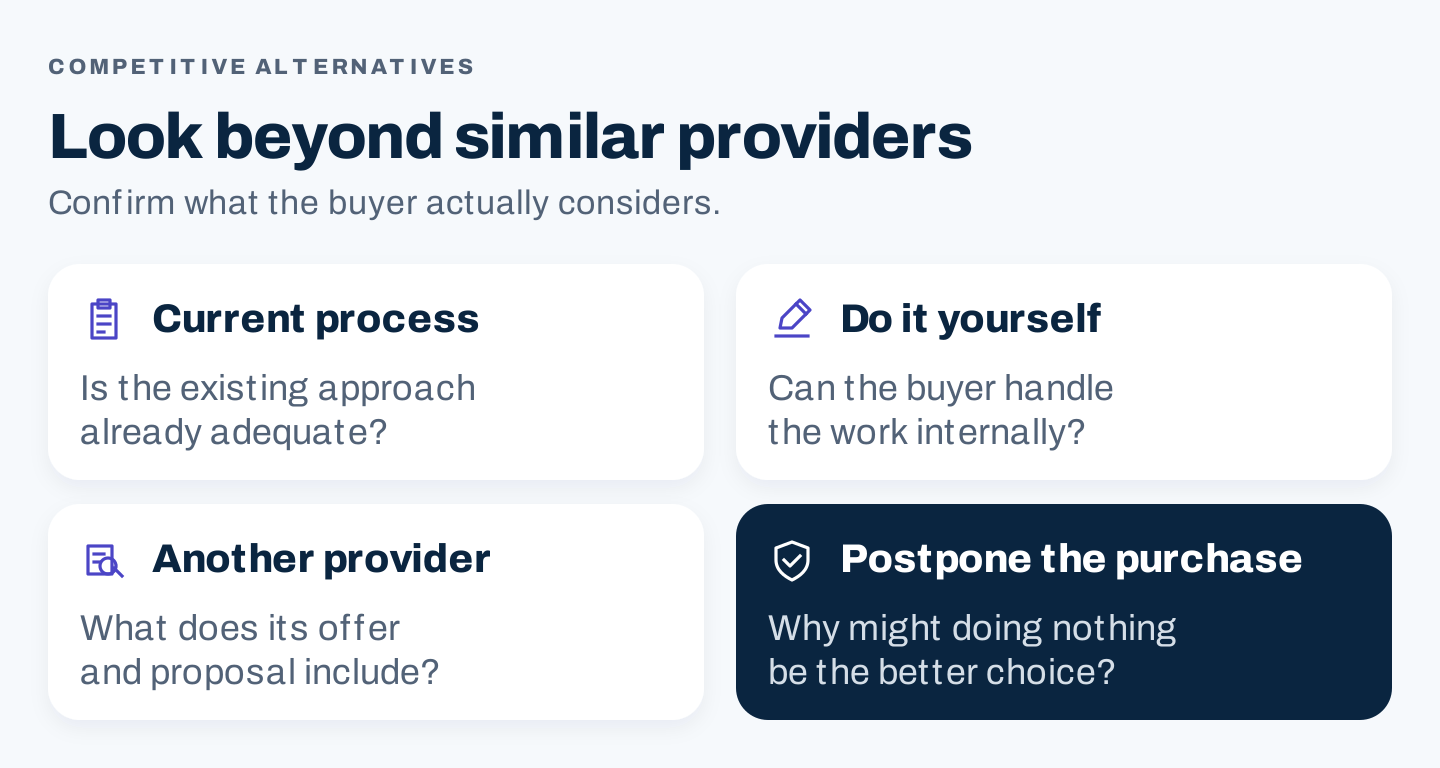
Original comparison guide. Confirm which options buyers consider; the diagram is not a researched shortlist for any featured brand.
For each alternative, record why the buyer might choose it, its relevant strengths, your proposed difference, and the evidence needed for that comparison. A competitor's silence about a capability does not establish that it lacks the capability.
3. Choose a category that creates appropriate expectations
April Dunford's quickstart guide explains how category affects expectations and how positioning components depend on one another.
Test whether your label prepares the buyer for the offer you deliver. Basecamp's project-management category and Calendly's scheduling task give visitors useful context. A broad “business transformation” label would require more explanation.
Ask prospective customers what they would expect from the category. If an agency provides a website project, a label suggesting ongoing campaign management may invite the wrong inquiries. Revise the category or the offer before trying to repair the mismatch with a slogan.
4. Connect the difference to a relevant benefit
Write the capability first, then its practical consequence. Identify who cares about that consequence and why.
Semrush's positioning guide emphasizes customer needs, functional and emotional benefits, and reasons to believe. Keep those questions separate: what can the customer do, what experience matters, and what supports the promise?
Feeling reassured may matter to a buyer. A documented process can show how your service works; customer research is needed to establish how people experience it. Avoid turning your intended emotional benefit into a claim about every customer.
5. Attach evidence to the exact promise
Choose evidence that answers the buyer's question. A demonstration can explain a process. A specification can support a scope claim. A documented customer result needs context about what happened and how it was measured.
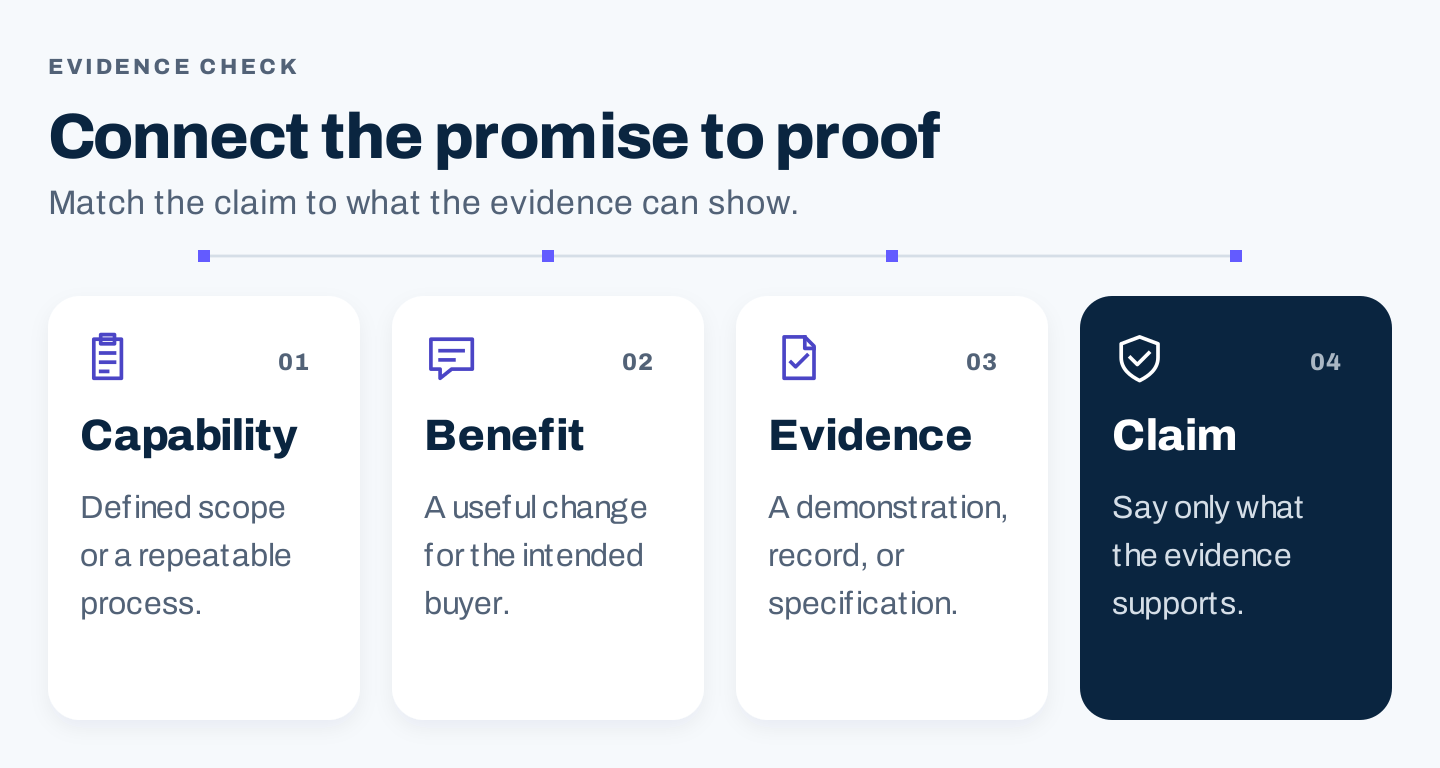
Original evidence chain. Support the promise you make; a process demonstration does not establish a sales outcome.
The maker signature described by Hiut supplies an identifiable detail behind its craft story. It does not, by itself, establish superior durability against every other brand. Match the claim to what your evidence can actually show.
6. Record the boundaries
State which situations fit poorly, what the offer excludes, and which comparisons remain unresolved. These details help sales qualification and prevent writers from expanding the promise.
For an agency, have the client and delivery owner confirm the scope. For an internal team, assign an owner and version date to the brief. Update it when the product, service, or evidence changes.
Build an evidence brief from a real example
Here is a public-material brief for Hiut. It organizes observations and questions; it is our analysis, not a published internal positioning document from the company.
| Decision | Public material supports | Still needs research |
|---|---|---|
| Category | Denim company | How customers classify the offer in a buying decision |
| Capability | Brand-described factory process and maker identification | Direct inspection of the delivered product and process |
| Service | A publicly described repair offer | Current conditions and the actual service experience |
| Candidate benefit | A way to investigate making and ongoing care | Which details affect customer choice |
| Audience | A potential interest in craft and continued use | Buyer interviews; no specific segment established here |
| Alternatives | No actual shortlist established by these pages | Which other purchases or actions buyers consider |
Sources: Hiut story, Hiut homepage.
This brief exposes the next decisions. The company descriptions supply useful inputs, while customer relevance and comparative advantage remain open. Use the same approach on your own business: record the capability, identify the customer consequence, and gather the missing comparison.
Write the positioning statement after the research
Use a short internal summary once the brief is settled:
For [buyer in a particular situation], [business] is a [recognizable category] that helps them [achieve a relevant benefit] through [supported capability]. Compared with [actual alternative], the reason to choose it is [verified difference]. The evidence is [inspectable support].
The fields are research prompts. You can leave an unresolved comparison in the brief while developing candidate wording.
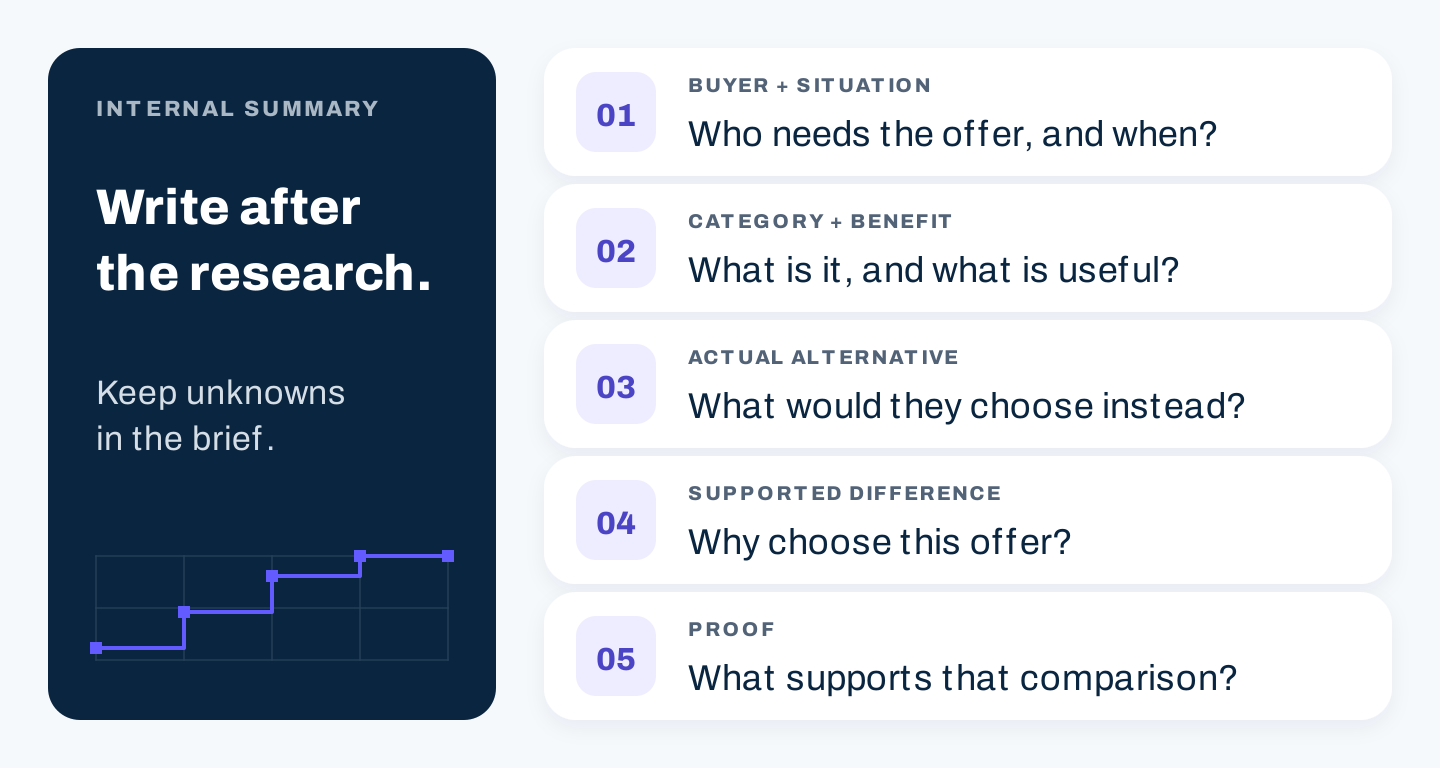
Original statement structure. Complete it from your evidence; it is not a statement attributed to a featured brand.
For Hiut, the public pages allow a limited editorial summary: the brand presents denim through its place of making, identifiable craftspeople, and ongoing care. They do not establish a particular buyer segment or superiority over that buyer's alternatives. An internal statement would need those missing inputs.
Keep the evidence and exclusions beside the sentence. When the summary gets shorter, the supporting facts should remain available to the team using it.
Six AI prompts for positioning research and messaging
Give AI numbered source material, current offer facts, and a specific task. Inspect its output against the originals. A model without browsing access needs the page text supplied; one with browsing access still needs its observations checked.
AI prompt 1: find the buying situation in customer research
Analyze the supplied interviews, reviews, and sales notes for [business].
Use only these sources. Keep exact customer wording separate from interpretation.

Return a table: source ID; buying trigger; problem; desired outcome;
alternative considered; hesitation; unanswered question.
Identify recurring patterns with supporting source IDs. Describe sample limits.
Do not invent quotes or treat a small sample as representative of the market.

Sources: [paste numbered material]
Check the patterns against individual records. A useful theme needs context, including where buyers disagree.
AI prompt 2: investigate actual alternatives
Our customer research identifies these alternatives: [list with source IDs].
Compare them using [URLs or supplied page text] and our approved offer facts.

Record observed category, scope, benefit, visible evidence, and relevant terms.
Separate observed facts, vendor claims, and your interpretation.
If a page cannot be accessed, mark it unavailable.
Do not infer a missing capability from silence or invent a buyer shortlist.
List the comparisons that need a proposal, product check, or customer interview.
Open the sources and verify important scope details before treating a difference as established.
AI prompt 3: organize an evidence brief
Build a positioning brief from the supplied research and approved offer facts.
Cover buyer situation, actual alternatives, category, capabilities, practical
benefits, relevant emotional needs, evidence, and exclusions.

Label each input confirmed, assumption, or unknown. Attach source IDs.
Separate a documented capability from a proposed customer benefit.
List the next research question and decision owner for every unresolved input.
Do not invent exclusivity, prices, guarantees, customer results, or testimonials.

Material: [paste numbered sources and offer facts]
A “confirmed” label should reflect the evidence for that particular claim. A company description confirms what the company says, rather than independently verifying delivery.
AI prompt 4: develop candidate positions
From this reviewed brief, propose three candidate positions with different
emphasis. For each, state buyer and situation, category, benefit, considered
alternative, supported difference, evidence, and exclusions.

Keep assumptions visible. Explain which research finding would support or
weaken each candidate. Do not claim we are the only or best provider.
Do not produce a final recommendation where an essential comparison is missing.

Reviewed brief: [paste brief]
Compare the options on relevance, evidence, and delivery fit before choosing the most memorable sentence.
AI prompt 5: turn the approved position into marketing content
Use this approved position to draft a homepage headline and supporting line,
three useful blog questions, one campaign angle, and a sales introduction.

Preserve audience, category, offer scope, evidence, and exclusions.
Explain which buyer question each item addresses. Identify the real evidence
asset needed beside each promise. Keep new facts out of the proposed copy.

Approved position and available assets: [paste material]
Review the headline alongside the page explanation and demonstration. A short line cannot carry the complete offer on its own.
AI prompt 6: audit the rollout for unsupported claims
Compare these drafts with the approved positioning brief and evidence.
Return a table: draft statement; supporting source; mismatch or missing proof;
required correction or owner decision.

Check audience, category, offer terms, comparative claims, guarantees,
customer outcomes, and the match between actions and their destinations.
Flag contradictions across website, campaign, content, and sales material.
Do not resolve a missing fact by inventing a replacement.

Drafts: [paste material]
Approved brief and sources: [paste material]
Have the business owner or relevant delivery lead resolve factual gaps before approving the copy.
Apply the position across your website and content
Keep the underlying offer steady while adapting the format to the reader's task. The homepage introduces it, a service or product page explains it, and an article helps the reader investigate a relevant decision.
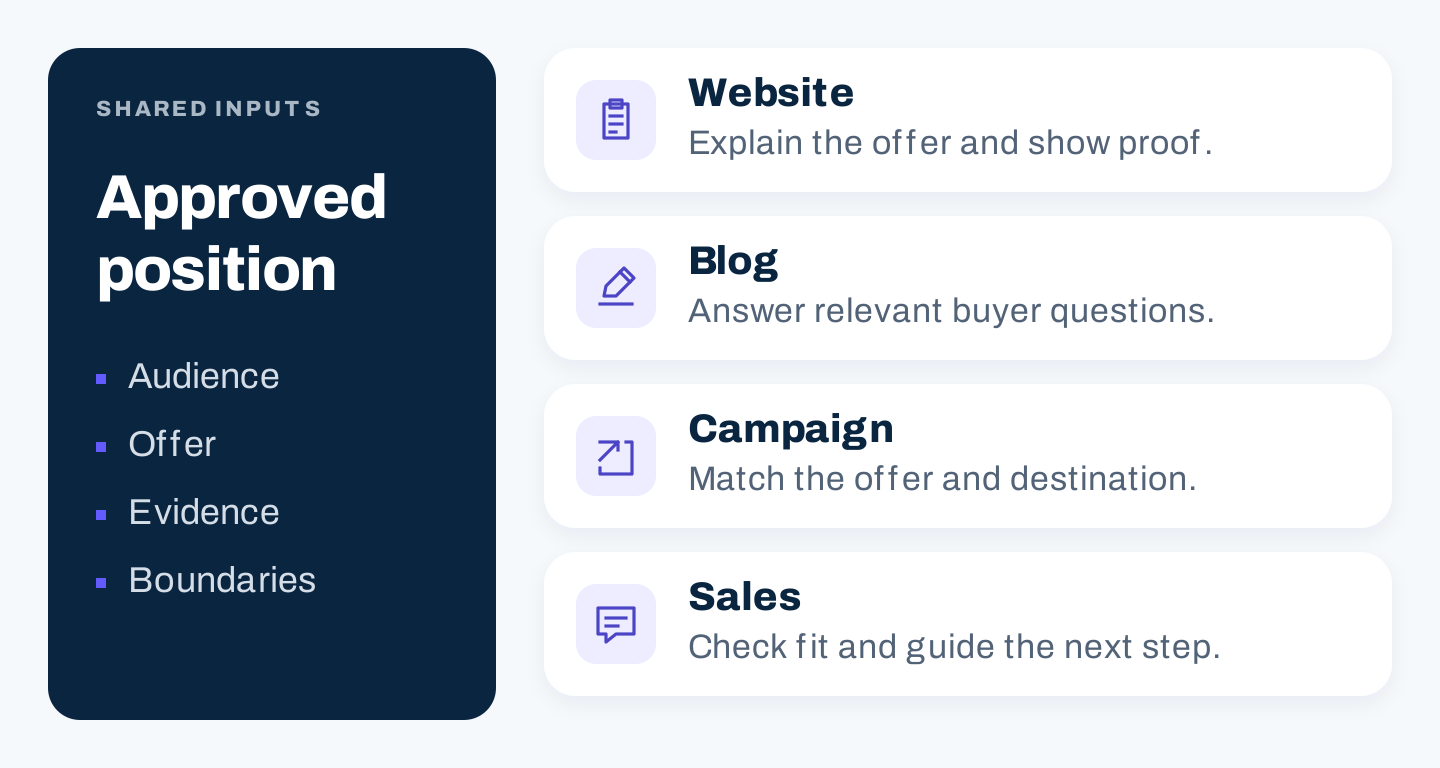
Original content map. Adapt the format while preserving the audience, offer, evidence, and boundaries.
Hiut's public making and care material suggests potential editorial questions about maker identification, denim care, and the repair process. Those are proposed topic directions from our analysis, not a claim about the company's actual content strategy.
Use the same planning check for your business:
| Format | Job for the reader | Check against the brief |
|---|---|---|
| Homepage | Recognize the category and reason to investigate | Is the offer understandable on the first screen? |
| Product or service page | Evaluate scope, proof, and conditions | Can the reader inspect what supports the promise? |
| Blog article | Answer a question connected to the offer | Does it help the intended buyer make a decision? |
| Campaign | Introduce a relevant reason to visit | Does the destination explain the same offer? |
| Sales introduction | Establish fit and guide the next discussion | Can the team explain the difference consistently? |
For a marketing team, maintain one approved brief rather than rewriting the underlying promise for each channel. For an agency, get scope changes agreed with the client and delivery team before circulating new variants.
Test understanding, relevance, and delivery
Show a candidate page to people who resemble the intended buyer. Ask what they think the business offers, when they would consider it, what they would do instead, and what they would need to verify. Record their responses before explaining your intention.
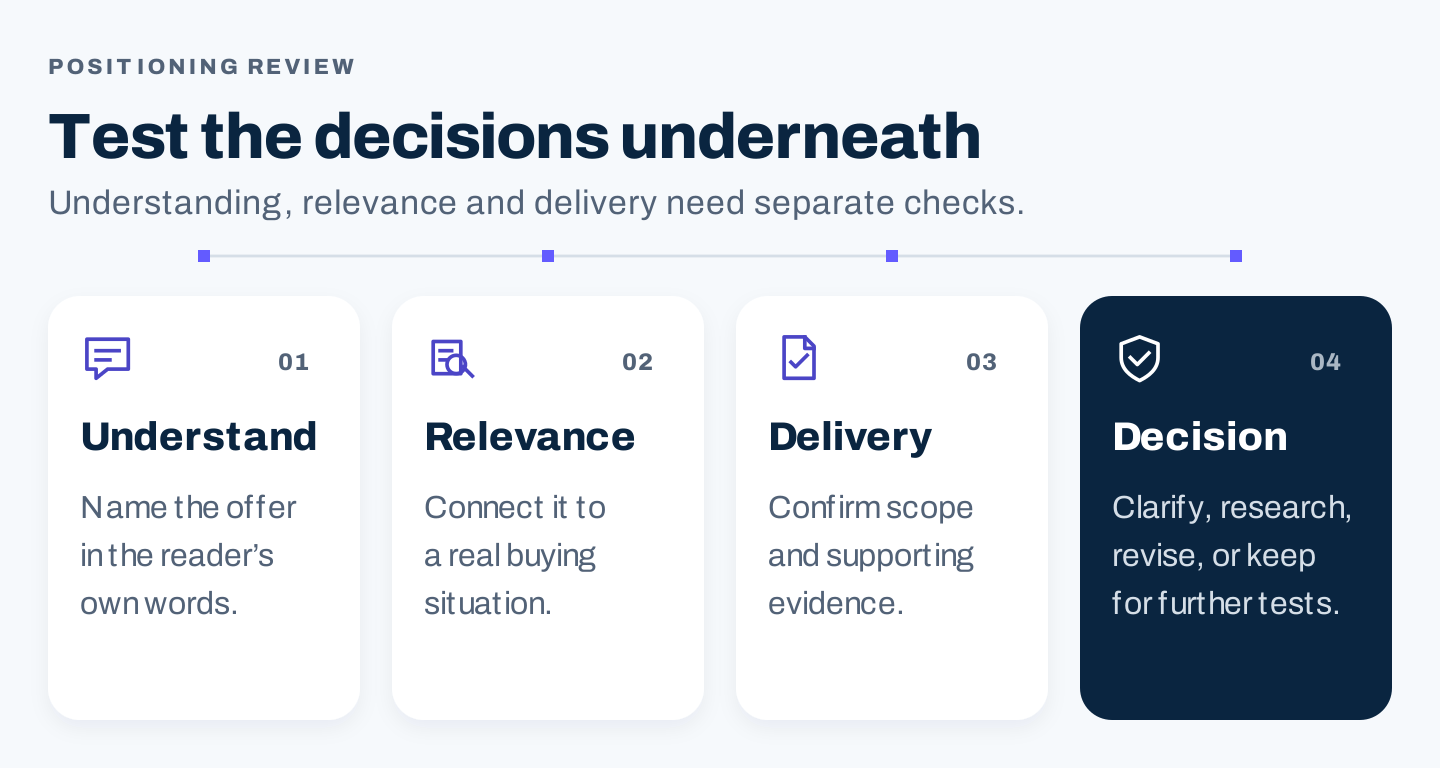
Original review sequence. Use the findings to choose a next action; the diagram does not represent completed interviews or tests.
Separate three questions. Can people understand the offer? Does the difference matter in their situation? Can the business support and deliver the promise? One favorable reaction cannot answer all three.
If readers expect the wrong service, clarify the category. If the proposed benefit matters little, investigate the audience or offer. If a promise attracts interest but lacks support, collect the evidence or narrow the claim.
A campaign test needs a defined audience, outcome, allocation, sample plan, and decision rule. Choose an outcome useful to the business, such as qualified inquiries or completed purchases. A change in raw clicks alone may leave the positioning question unresolved.
Review the brief when customer explanations change, new alternatives enter actual deals, the service changes, or delivery no longer supports the promise. Assign the review to a named owner.
Brand positioning worksheet
Copy this into your working document. Mark each answer confirmed, assumption, or unknown, and record what that status rests on.
| Decision | Your answer | Evidence or next action |
|---|---|---|
| Buyer and situation | Who needs the offer, and what triggers the search? | Interview or sales record |
| Alternatives | What do they use now or consider instead? | Actual shortlist and current process |
| Category | Which familiar label sets suitable expectations? | Buyer interpretation and scope check |
| Capability | What does the business actually do? | Specification, demonstration, or delivery record |
| Relevant difference | How does it compare with the actual alternative? | Verified comparison |
| Functional benefit | What useful consequence does the capability provide? | Supported explanation or measured evidence |
| Emotional need | What experience or concern matters to the buyer? | Customer wording and context |
| Reason to believe | What can the buyer inspect? | Relevant evidence asset |
| Boundaries | Who fits poorly, and what is excluded? | Approved offer scope |
| Rollout and review | Who owns the brief and unresolved decisions? | Version date, owner, and next action |
Before approving it, confirm the scope with a delivery owner, check that the category creates suitable expectations, and verify each comparison. Keep missing evidence visible.
Frequently asked questions
Does a small business need a unique product to have clear positioning?
It can investigate a relevant combination of audience, scope, process, and experience. A feature may reassure buyers without distinguishing the business. Establish both relevance and comparative difference before treating it as the reason to choose you.
Is a positioning statement public website copy?
It is usually an internal summary of the strategy. Public copy expresses the offer in a format suited to the page or campaign. Keep the brief available so shorter messages retain accurate meaning.
How many examples should I study?
Choose examples that answer different questions about your offer. Category clarity, audience fit, evidence, and experience provide useful comparison dimensions. Repeating similar headlines adds less insight than investigating another decision.
Can AI create a brand positioning strategy?
AI can organize supplied research and propose candidate wording. Your team must establish the customer situation, alternatives, capabilities, and proof, then test whether the candidate is understood and relevant. Review the evidence before approving the sentence.