Web Copywriting: 6 Real Examples and 8 AI Prompts

Buffer tells visitors what its product is. Mailchimp puts a likely objection in the headline. Shopify pairs a creative slogan with a specific product description.
Those choices give us something useful to study: the words a real business uses, the question those words answer, and the information surrounding them.
This guide breaks down six real website examples, with desktop screenshots and lessons you can apply to your own pages. It also includes eight copy-and-paste AI prompts to help you research customers, develop messages, and review a draft.
The examples show published messaging captured on October 6–7, 2026. They are observations of public pages; we do not have the brands’ conversion data. Treat each pattern as an idea to evaluate for your audience.
What is web copywriting?
Web copywriting is writing website text that helps a reader understand an offer and take a relevant action. Headlines, product descriptions, service pages, button labels, pricing explanations, and form instructions all contribute to that job.
Marketing copywriting carries the message into other channels, including ads and emails. SEO copywriting also considers the language people use to search and the information they need on the destination page.
For a small business owner, useful copy makes the service easier to understand. For a marketing team, it connects the promise in a campaign to the page that explains it. For an agency, it gives the client and writer a shared account of the offer, evidence, and next action.
Before choosing a formula, check whether your page answers five questions:
- What is this?
- Why would I want it?
- What makes the promise believable?
- What might stop me from proceeding?
- What happens next?
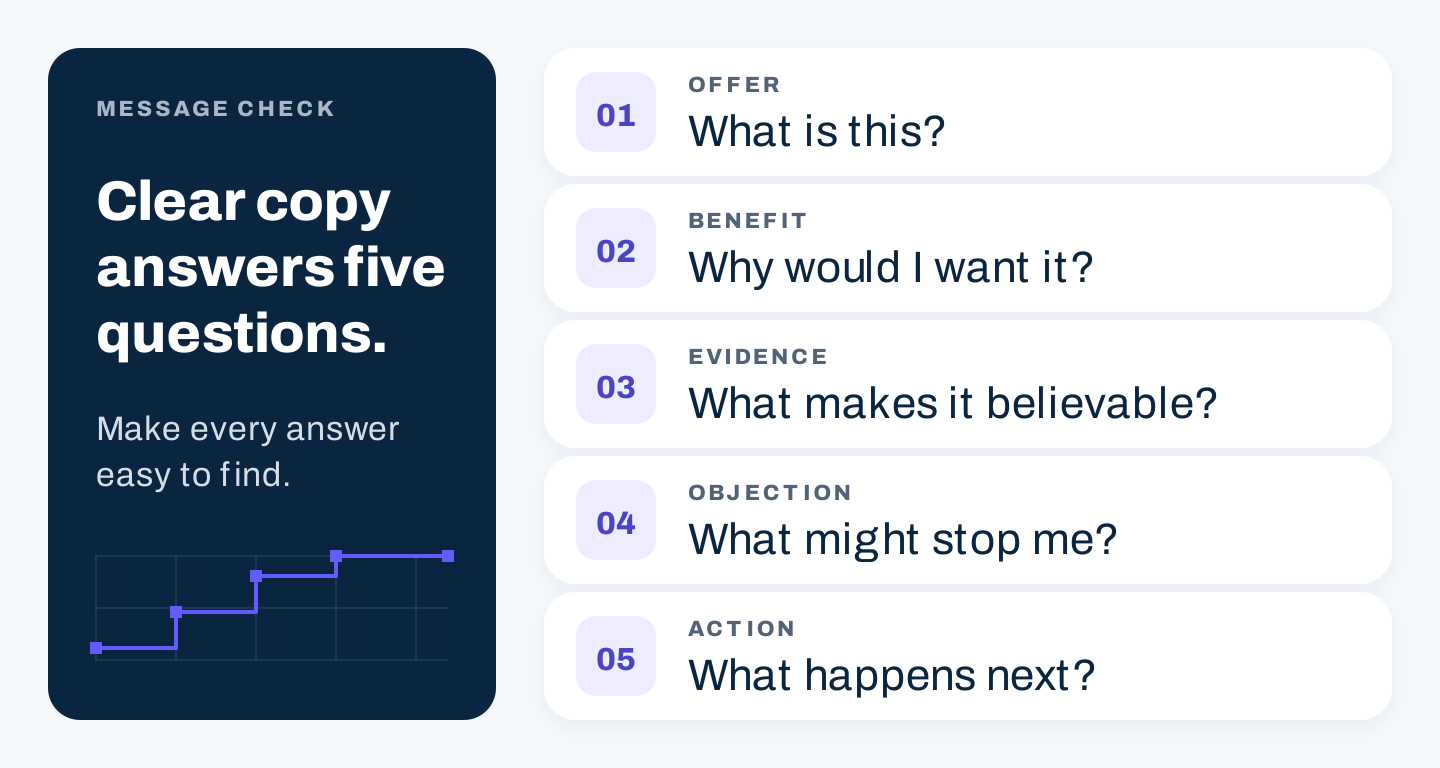
Original planning diagram. Use these questions to identify missing information before polishing the wording.
Six real web copywriting examples
Each example below examines a different decision. You can use the table to find the part of your page that needs attention.
| Brand | Copywriting decision | Useful when your page has… |
|---|---|---|
| Buffer | Identify the category | A slogan that could describe almost any business |
| Dropbox | Connect an outcome to a visible product | Benefits that feel detached from the offer |
| Mailchimp | Address a likely objection | A reader who may hesitate over setup or effort |
| Stripe | Explain how an ambitious promise relates to the product | A broad outcome with little supporting explanation |
| Slack | Offer different next steps | Visitors with different levels of readiness |
| Shopify | Pair expressive language with a precise category | A memorable headline that needs context |
1. Buffer: make the category easy to recognize
Buffer’s homepage uses “Your social media workspace.” The category is immediately visible; nearby platform icons reinforce the subject. An email field and free-start button put the next action in the same section.
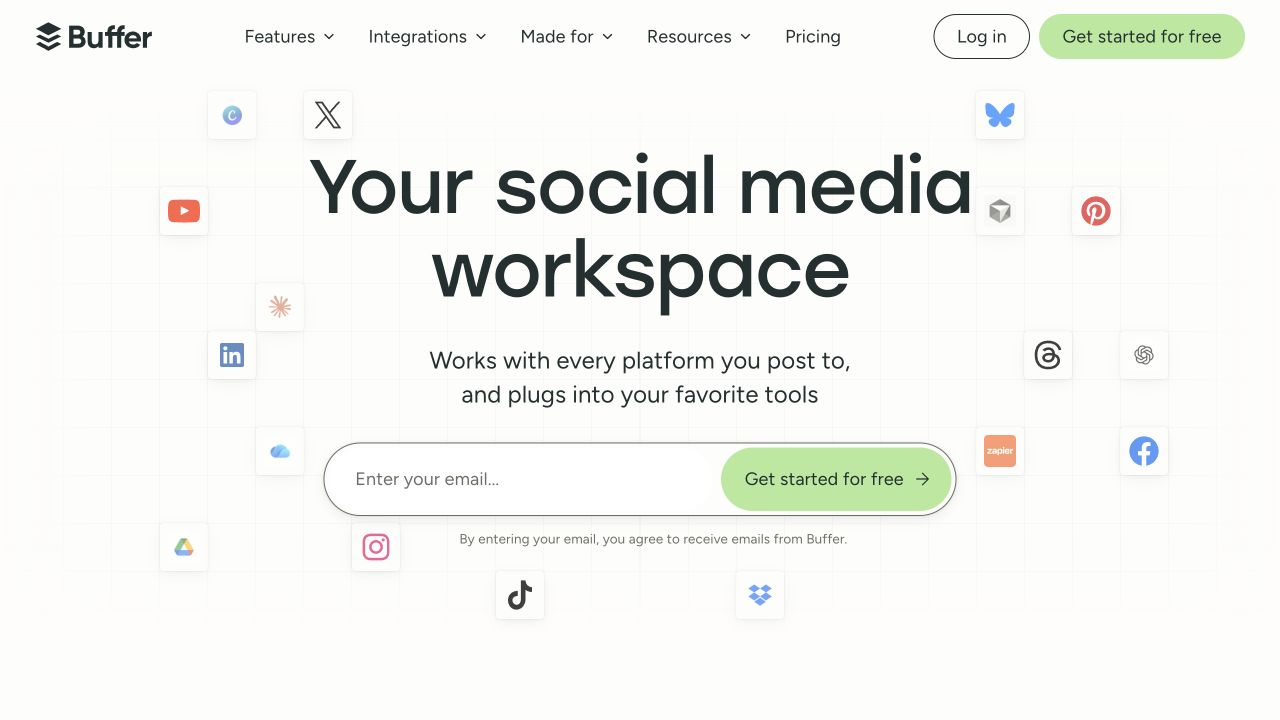
Source: Buffer, captured October 6, 2026. The screenshot is an unchanged public-page capture.
What to notice: The headline gives a new visitor a way to classify the offer. The surrounding elements add context without making the headline carry every detail.
How to apply it: Write the category in ordinary language before adding a distinctive angle. Ask a person unfamiliar with your business what they think you sell after reading the first screen. If they cannot tell, clarify the headline or supporting line.
Where the pattern needs care: A recognizable category is a starting point. Your page still needs to explain why this particular offer fits the reader.
2. Dropbox: connect a benefit to something readers can see
Dropbox’s homepage leads with “Get to work, with a lot less work.” The adjacent product image shows files, folders, and device screens. The supporting paragraph connects the promise to collaboration and moving work forward.
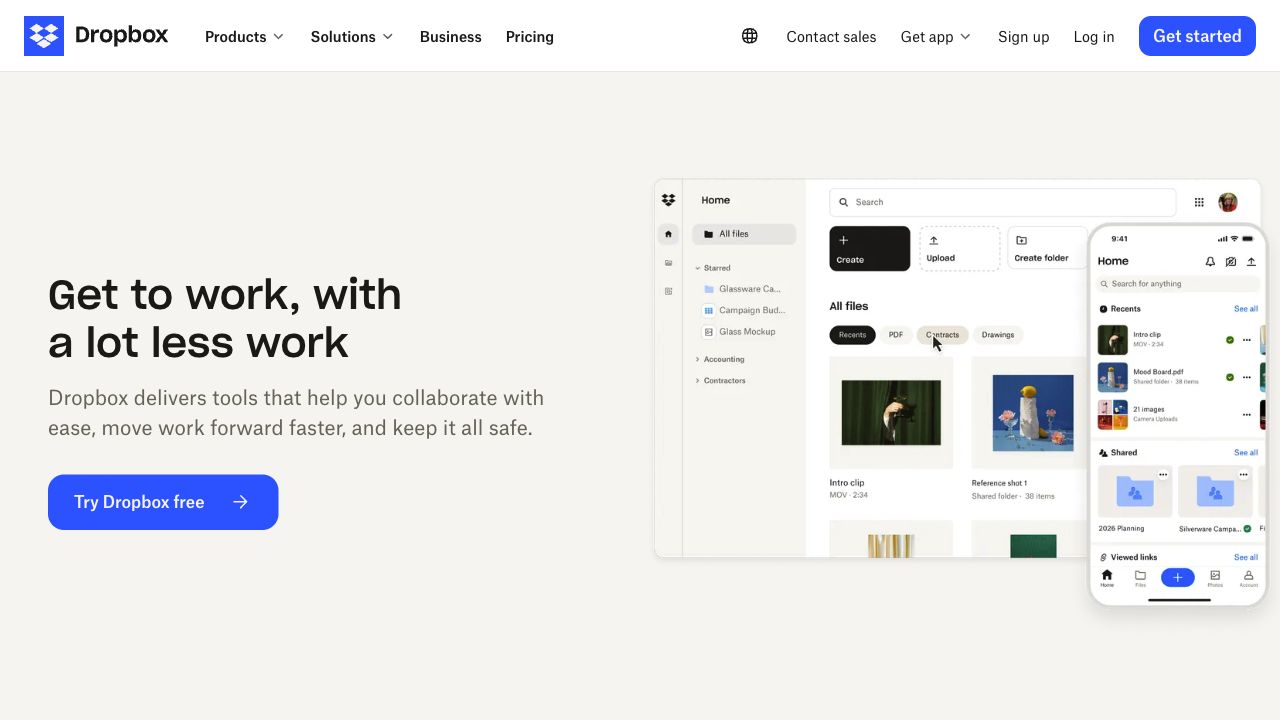
Source: Dropbox, captured October 7, 2026. The interface illustration belongs to the brand’s public marketing page.
What to notice: The headline describes a desirable change, while the image supplies product context. The two elements share the explanatory work.
How to apply it: Place a relevant demonstration close to the benefit. A service business could show an actual sample deliverable; a retailer could show a product detail; a software company could show the task being completed.
Where the pattern needs care: A screenshot establishes what is visible in that image. It does not, by itself, prove a time saving or a general customer result.
3. Mailchimp: bring a hesitation into the message
The captured Mailchimp homepage says “Email & SMS marketing minus the learning curve.” It names the activity and adds reassurance about the effort involved. A signup action appears beneath the explanation.
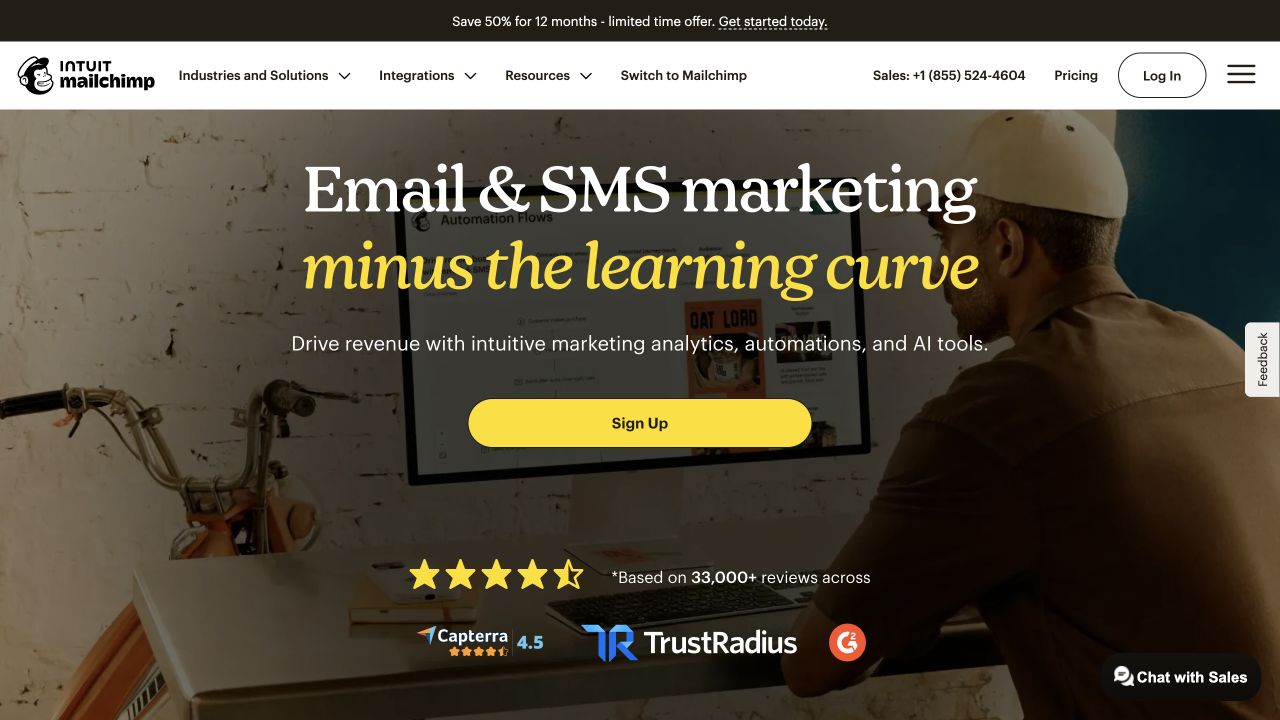
Source: Mailchimp, captured October 6, 2026. Promotional offers and review figures visible in the image are outside this analysis.
What to notice: The message speaks to a possible barrier as well as the product category. That makes the headline a useful starting point for studying objections.
How to apply it: Look for repeated questions in real customer conversations. Then explain the relevant process, support, or requirement on the page. If setup is a concern, show what setup actually involves.
Where the pattern needs care: We cannot infer Mailchimp’s customer research or testing results from its headline. Your own objection should come from evidence about your readers.
4. Stripe: give the promise a practical explanation
Stripe’s US homepage uses “Financial infrastructure to grow your revenue.” The text that follows identifies payment acceptance, business banking, and revenue models. It moves from a broad business aim toward concrete product areas.
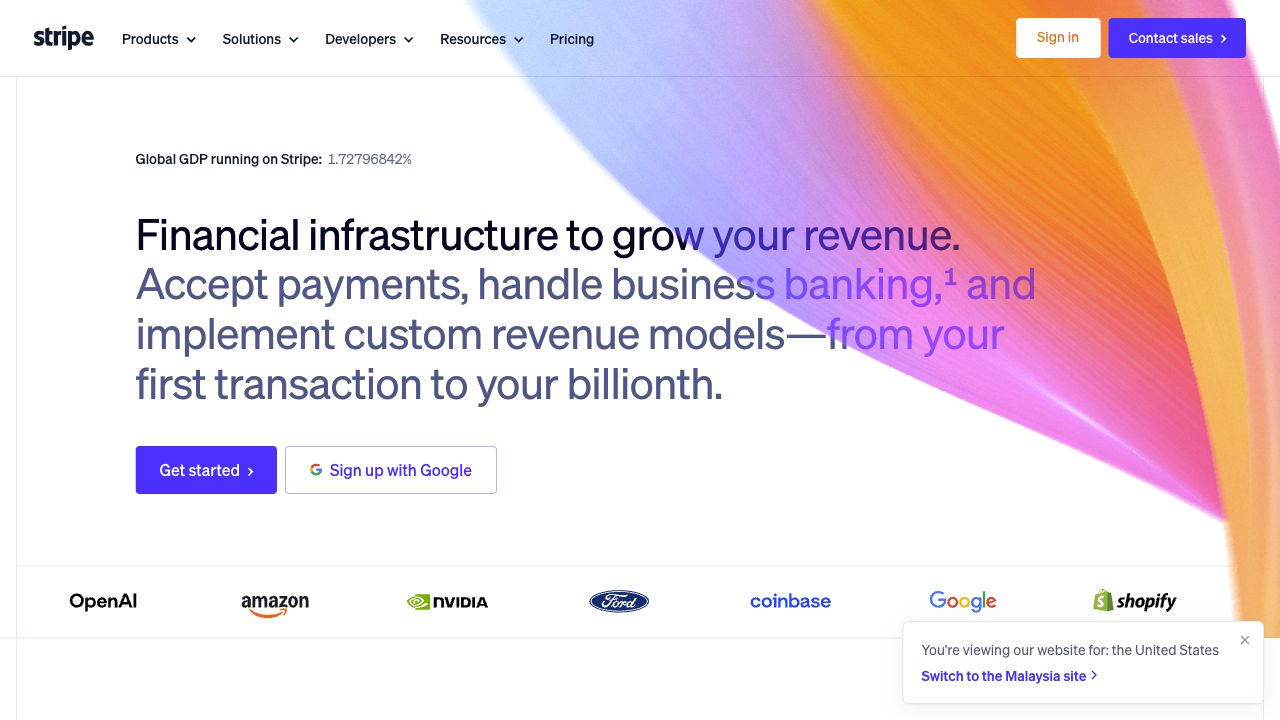
Source: Stripe, US English page captured October 7, 2026. The screenshot includes the brand’s own qualification marker; this is an analysis of message structure.
What to notice: The supporting text does substantial explanatory work. Readers get more than an attractive outcome.
How to apply it: Follow your benefit with the actual mechanism: the service performed, the product capability, or the process the customer uses. Place any conditions where readers can find them while evaluating the claim.
Where the pattern needs care: Naming a mechanism does not establish that every customer achieves the outcome. Keep results claims tied to evidence for the specific result.
5. Slack: give visitors a next step that fits their readiness
The captured Slack homepage places “Get started” and “Find your plan” beneath its introduction. The navigation also offers a demo request. These are distinct ways to proceed.
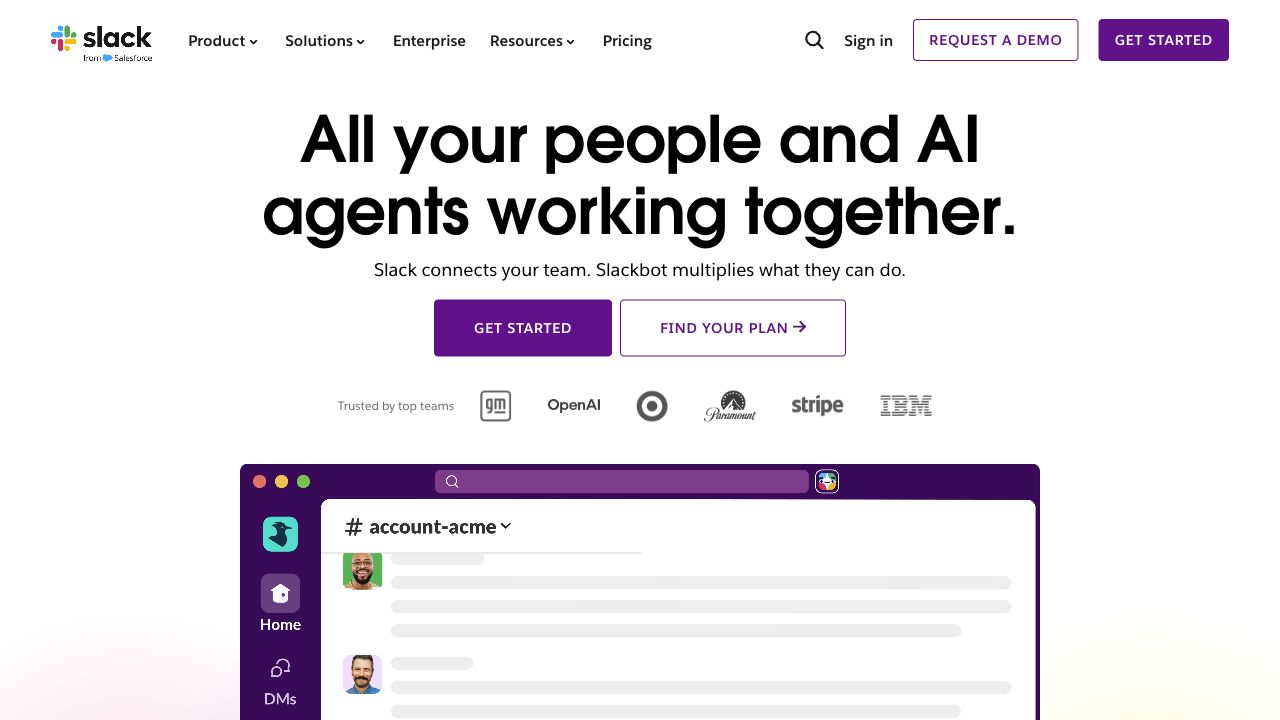
Source: Slack, captured October 7, 2026. This capture shows the public website and its marketing demonstration.
What to notice: A visitor ready to begin and a visitor still comparing plans can choose different routes. The labels describe those routes more clearly than a generic instruction to click.
How to apply it: Decide which action matters most, then add a secondary route only when it serves a real reader need. Check the destination before choosing the label: a demo button should lead to a demo process.
Where the pattern needs care: Several actions are not automatically better. If choices distract from the page’s main purpose, simplify them.
6. Shopify: keep the creative line and clarify the category
Shopify’s website builder page uses “Your vision, our canvas.” Above it, a category label identifies the ecommerce website builder. The supporting line explains store creation, and the button invites visitors to start building.
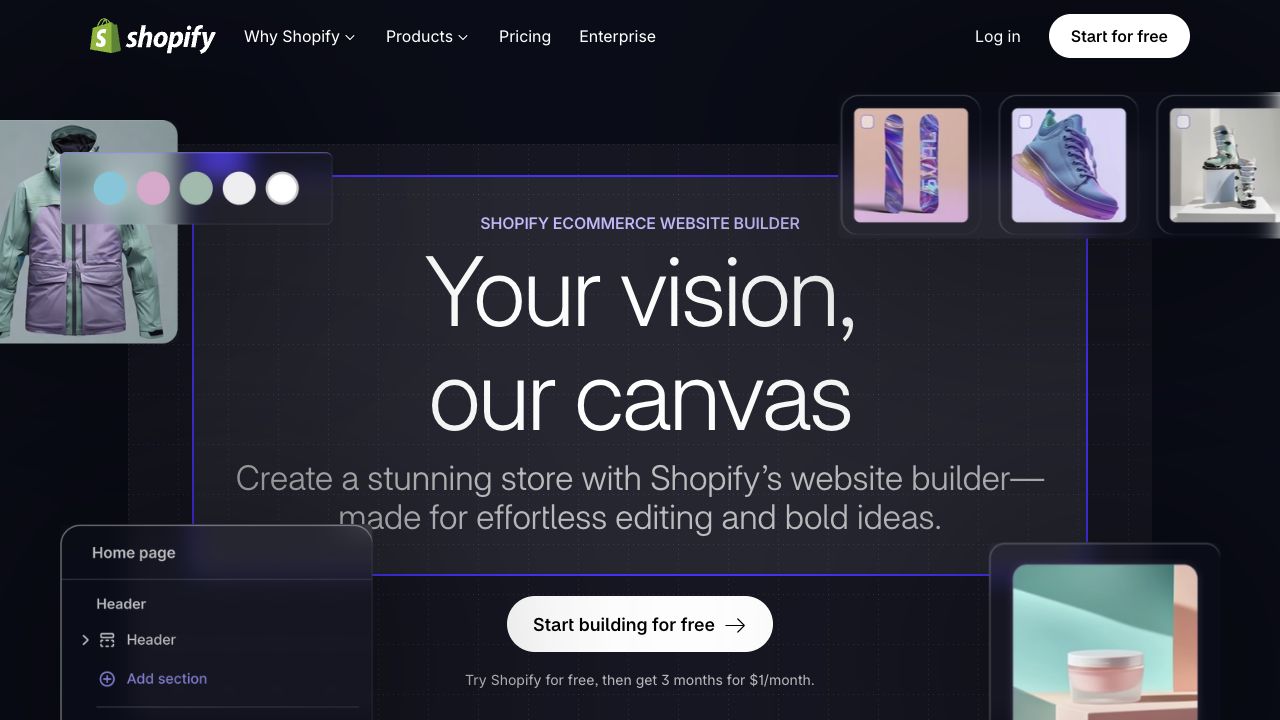
Source: Shopify, USA English page captured October 7, 2026. Trial terms shown in the capture may change.
What to notice: The creative phrase sits inside a clear context. The category label, explanation, product imagery, and action help readers interpret it.
How to apply it: Review the complete first screen. An expressive headline can work alongside a precise label or supporting sentence. Keep the practical explanation visible and readable on a phone.
Where the pattern needs care: This example does not establish a search ranking. Naming the category helps describe the page; search performance needs its own evidence.
Use AI to research before you ask it to write
An instruction such as “write high-converting copy for my business” leaves the model to fill in the audience, offer, objections, and proof. Those are the decisions you need to supply or investigate.
Start with material you can inspect: current product information, customer reviews, permissioned interview notes, support questions, and sales objections. Give each item an ID so you can trace the draft back to it. Remove private customer details before putting research into a tool your team has not approved for that information.
AI prompt 1: extract customer language from your research
Use this when you already have transcripts, reviews, or notes. Paste the source material after the prompt.
Analyze the customer research below for [product/service] and [audience].
Use only the supplied material. Do not invent customer quotes or fill gaps.

Create a table with:
- Source ID and date, when supplied
- Exact customer wording
- Situation or trigger
- Desired outcome
- Question or hesitation
- My next research question

Keep quotations separate from your interpretation. Identify recurring themes
with the source IDs supporting each one. Describe the limits of this sample.
If a detail is missing, mark it unknown.

Research: [paste numbered sources]
Check a few entries against the original material before using the table. A recurring phrase is useful input, but its frequency in a small collection does not tell you how common it is across the market.
AI prompt 2: examine competitor messages with sources
Use this for discovery and comparison. A model with browsing access may retrieve pages; a model without it needs the page text or captures supplied by you.
Compare the public messaging on these pages: [URLs or supplied page text].
The reader I want to understand is [audience in a specific situation].

For each page, record the URL, access date, product category, stated benefit,
visible evidence, questions answered, and available next actions.
Distinguish observed wording from your interpretation.

If you cannot access a page, say so and request its contents. Do not infer
missing features from a page's silence. Do not infer conversion performance.
Summarize reusable patterns and unanswered reader questions. Explain the
patterns in original language, keeping each example attributed to its brand.
Open the original pages and verify the observations you plan to use. Compare how the businesses explain the offer, then investigate which questions matter to your customers.
AI prompt 3: turn the research into a copy brief
The brief should settle the writing inputs before generating variations.
Build a one-page copy brief from the source-backed research below.

Include: reader and situation; page purpose; offer and category; approved
capabilities; practical benefits; evidence; conditions or exclusions;
questions to answer; primary action and its actual destination; brand voice.

Attach source IDs to factual statements. Keep assumptions in a separate
section. List decisions that the business owner must confirm before drafting.
Do not invent prices, turnaround times, guarantees, testimonials, or results.

Research and approved offer facts: [paste material]
Review the brief with whoever owns the offer. A writer can improve how a service is described; the operations team must confirm what that service includes.
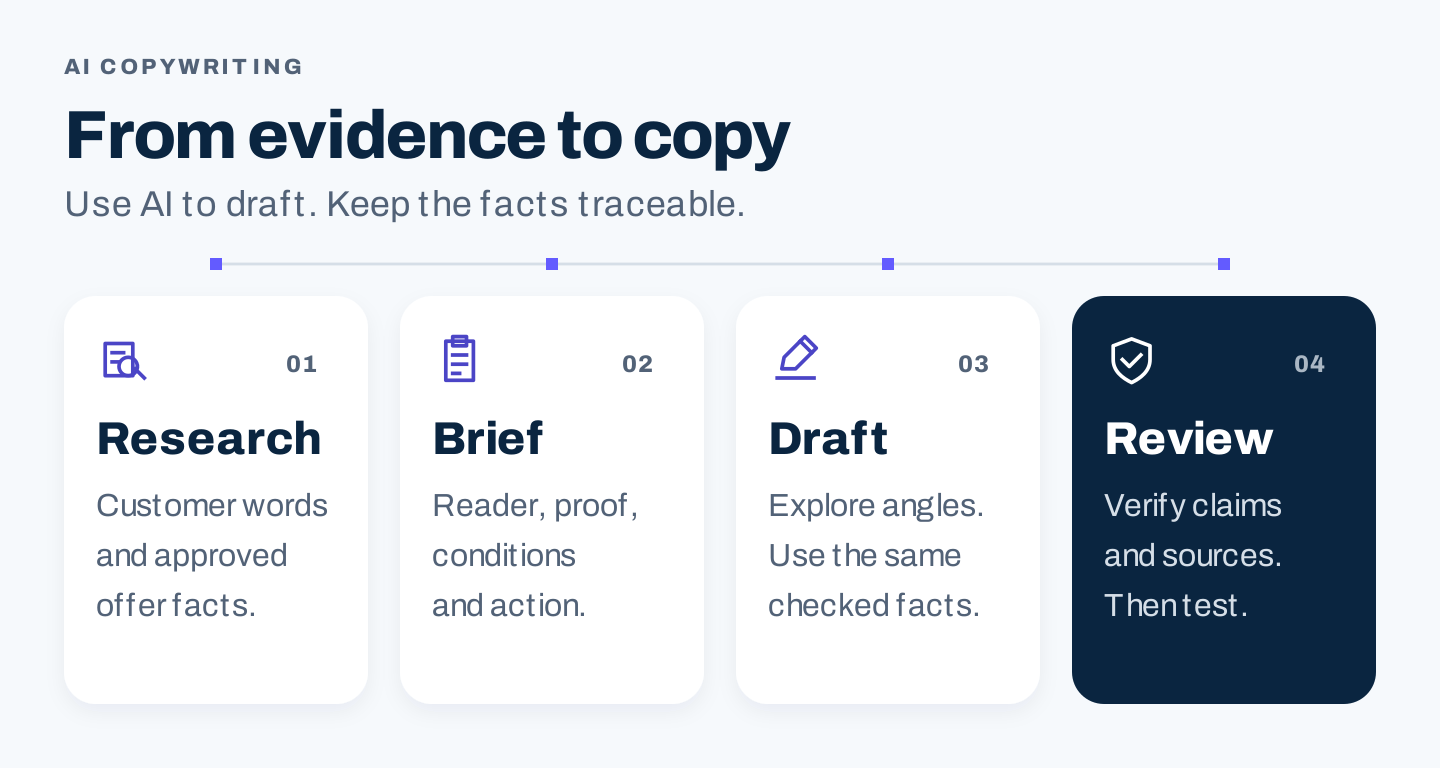
Original workflow. Keep the source material available through every stage so a polished draft remains checkable.
Use AI to develop copy from approved facts
Once the brief is settled, ask for variations that explore different reader questions. This produces more useful options than repeatedly asking the model to make the same sentence more persuasive.
AI prompt 4: write headline options with different emphasis
Using this approved brief, write six headline-and-supporting-line pairs:
two that lead with the category, two with the practical benefit, and two
with an evidenced customer hesitation.

Use plain US English. Keep headlines under 12 words as a drafting constraint.
Identify the source IDs supporting each pair and the reader question it answers.
Do not invent urgency, superiority, numerical outcomes, or offer terms.
Flag any option that still needs product context from an image or category label.

Approved brief: [paste brief]
The word limit is a way to explore concise versions, not a requirement for an effective headline. Compare options on meaning: can the reader identify the offer, and is the emphasis relevant to the situation?
AI prompt 5: connect a feature to a useful consequence
Review these approved features for [audience and situation].
For each feature, propose a practical consequence to explain, the evidence
needed, and one sentence of copy that stays within the approved facts.

Separate documented capability from a proposed benefit. Flag any benefit
that requires research before it can be stated as a fact.
Do not turn a possibility into a guarantee or assign an invented time saving.

Approved features and evidence: [paste source-backed list]
Read the result as a reasoning exercise. If the useful consequence is unclear, return to customer research. If it is clear but unsupported, find evidence or narrow the wording.
AI prompt 6: assemble a page around the buying decision
Draft a page outline and concise copy from the approved brief below.
Order the sections around the reader's decision, explaining your choices.

Cover: offer and category; practical benefit; relevant demonstration or
evidence; scope and conditions; important questions; next action.
Specify the real evidence asset needed beside each factual promise.
Use descriptive headings. Give the primary button a label that matches
its supplied destination. Use a secondary action only if the brief supports it.

Do not invent testimonials or results. Put unresolved questions in review
notes outside the proposed page copy.

Approved brief and available assets: [paste material]
Review the outline before writing a longer page. A demonstration may answer a question more directly than another paragraph. A qualification may belong beside the promise it limits. Give each section a job, and remove sections that repeat the same information.
Make the page useful for search and AI-assisted research
When someone arrives from a search result or an AI-assisted research session, the page still needs to explain the offer accurately. Keep the category, useful details, and supporting information available as page text.
Start by examining the actual results for the query you want to serve. Are people comparing providers, learning a process, looking for a product, or trying to reach a particular business? Use that observation to decide what the page needs to do. A broad category phrase alone does not settle the intent.
Build a short search brief with the target query, the reader’s likely task, observed result types, and unanswered questions. Validate search volume in your chosen keyword data source; an AI-generated number is not measured demand.
Then check the page itself:
- Use a descriptive title and headings that accurately introduce the content.
- Explain the relevant specifications, service scope, or purchase conditions.
- Answer questions with information your business can verify.
- Use screenshots to support explanations, with useful alt text and adjacent captions.
- Include essential details in readable text rather than only inside an image.
Google’s guidance emphasizes useful content created for people, and its AI features documentation says existing SEO practices remain relevant. Neither publishing an AI-written draft nor adding a prompt section establishes visibility. Google’s helpful content guidance, Google’s AI features guidance.
Review the draft before testing it
Check the facts first, then edit the wording. A shorter unsupported promise remains unsupported.
AI prompt 7: audit claims and message consistency
Audit this draft against the approved facts and sources below.
Do not use your background knowledge to fill missing evidence.

Create a table: draft claim; source ID; supported, partially supported, or
unsupported; missing condition; recommended action.
Check numbers, comparisons, guarantees, availability, pricing, testimonials,
and the match between each button label and its destination.

Also compare any supplied ad, email, and landing-page copy for conflicting
offer terms. Flag discrepancies without inventing a replacement fact.

Draft: [paste copy]
Approved facts, sources, and destinations: [paste material]
For a campaign, compare the actual email or ad with the destination page. Readers should be able to find the offer that earned the click. If an offer has conditions, carry those conditions through the relevant stages.
AI prompt 8: edit for clarity without changing the offer
Edit this fact-checked draft for [audience] in US English.
Preserve the offer, factual meaning, conditions, and source references.

Flag vague phrases, repeated points, unexplained terminology, and sentences
that ask the reader to infer what the business does.
Return an edited version and a table of substantive changes with reasons.
Do not add facts, testimonials, claims of uniqueness, or sales pressure.
If meaning is ambiguous, ask a focused question in separate review notes.

Draft and approved brief: [paste material]
Read the edited version aloud and inspect it on a phone. Check whether the headline, explanation, evidence, and action still work together when the layout stacks vertically.
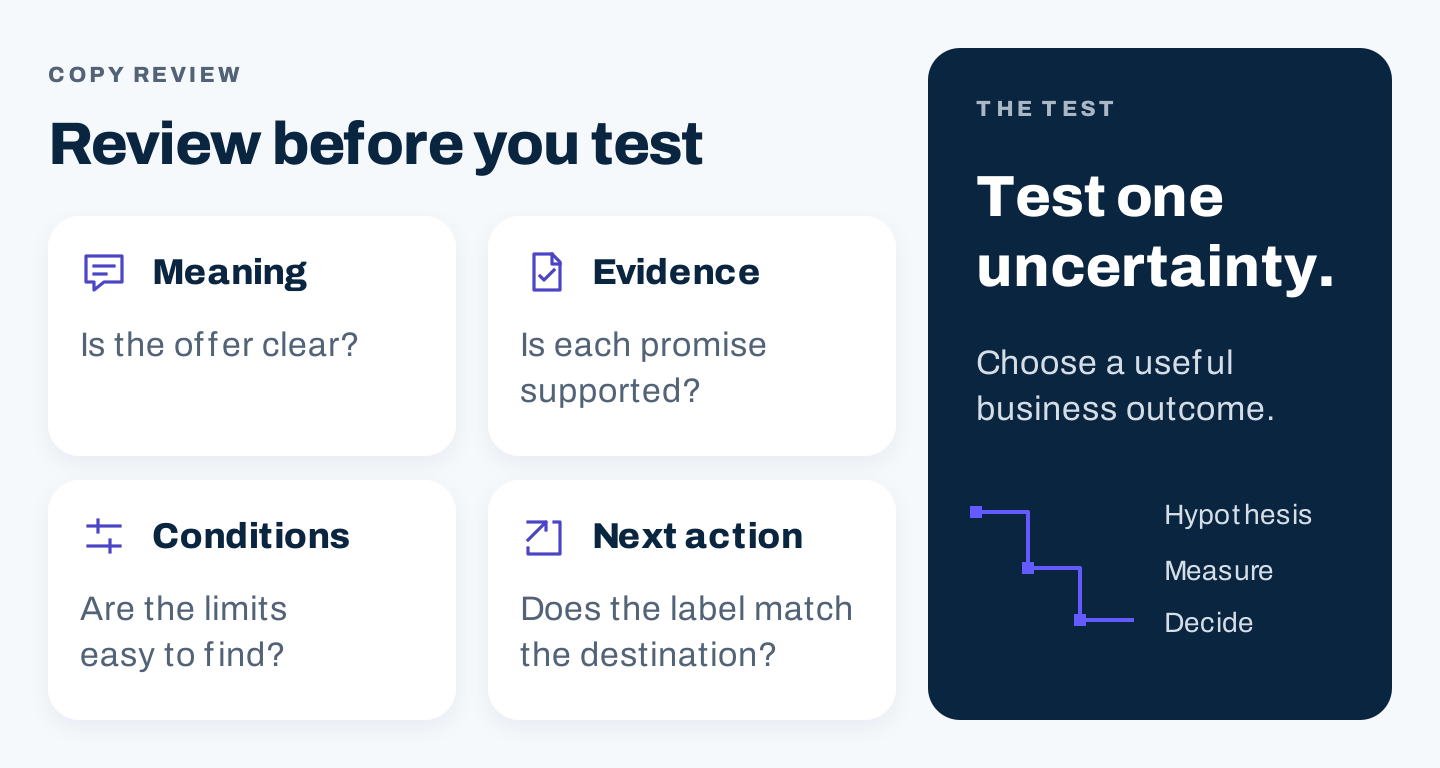
Original review checklist. Complete the factual and usability checks before drawing conclusions from a test.
Turn the revision into a useful test
Choose one uncertainty to investigate. That could be whether readers understand the category, whether an important question is answered, or whether a clearer action attracts suitable inquiries.
For an early clarity check, show the page to people who resemble your audience. Ask them what the business offers, who it suits, and what they expect after clicking the main button. Record their interpretations before explaining your intention.
If you run an A/B test, define the hypothesis, audience, primary outcome, allocation, sample needs, and decision rule in advance. Keep the offer and other major page elements consistent when testing a wording change. Use an outcome that matters to the business: completed purchases or qualified inquiries may be more informative than button clicks alone.
| Decision | Record before the test |
|---|---|
| Uncertainty | What do we need to learn about the current copy? |
| Revision | Which wording or explanation will change? |
| Evidence | Which approved facts support the revision? |
| Primary outcome | What useful action will we measure? |
| Quality check | Could more actions also mean more unsuitable inquiries? |
| Decision rule | What evidence would justify keeping, revising, or rejecting the change? |
An inconclusive test leaves the question open. Keep the observations and plan the next investigation instead of declaring a winner from a small difference.
Frequently asked questions
What makes website copy persuasive?
It helps the intended reader understand a relevant offer, evaluate the evidence, resolve important questions, and take a suitable next step. Memorable wording can help, but it needs an accurate offer behind it.
Can AI write website copy?
AI can help organize supplied research, propose alternatives, and review drafts. Give it approved facts and an explicit task, then verify the output. A confident sentence is not evidence that the promise is true.
Should I use AIDA or PAS?
AIDA organizes copy around attention, interest, desire, and action. PAS organizes it around a problem, agitation, and solution. Either can help you explore a draft, but choose a structure that fits the reader’s decision. Avoid intensifying a problem beyond what your research supports.
How long should website copy be?
Long enough to answer the questions needed for the next decision. Start with the offer, explanation, evidence, conditions, and action. Add detail where readers need it, then remove repetition.
How do I learn from another brand’s copy?
Identify the job each part performs, then write from your own customer research and offer facts. Keep real examples attributed to the real business. Study the relationship between the headline, explanation, evidence, and action; use that understanding to build your own message.