SEO Copywriting: Match Search Intent and Help the Reader Decide

SEO copywriting starts before the first sentence. You need to decide what the searcher is trying to do, which page should answer that task, and what evidence the page can offer.
The writing then makes the answer easy to understand and the next step appropriate. Keywords help describe the subject, but they cannot rescue a page that answers the wrong question or makes unsupported promises.
This guide uses Todoist’s public homepage, team page, and glossary to explain different page purposes. It includes an original editing exercise, a source-based copy brief, an optional AI review prompt, and a release checklist.
The proposed copy is an editorial exercise, not Todoist’s published wording or a tested improvement. No ranking or conversion result is inferred from the examples.
1. Start with the query-to-page decision
Before drafting, complete this sentence: The reader wants to ___, and this page will help by ___.
Then inspect the current results for the intended query and market. Look at the destinations, the tasks they serve, and the questions left unanswered. Read the pages rather than relying on the search-result headline alone.
A keyword tool’s intent label is a starting point. The same phrase can cover learning, comparison, or purchase depending on context. A page can address several related questions, but it needs a coherent main purpose.
| Reader task | Likely page job | Copy needs to establish |
|---|---|---|
| Understand a concept | Explain or define | Direct answer, examples, relevant limits |
| Learn a process | Help complete the task | Starting conditions, steps, result, troubleshooting |
| Evaluate a product | Support comparison or fit | Audience, capabilities, evidence, exclusions |
| Choose a plan or service | Support a commercial decision | Scope, conditions, differences, appropriate action |
| Find a named destination | Orient and navigate | Clear identity and route to the requested information |
These are planning patterns, not claims that a particular format always ranks. Mixed results may indicate more than one need. Choose the task your business can answer well rather than trying to include every possible intent in one page.
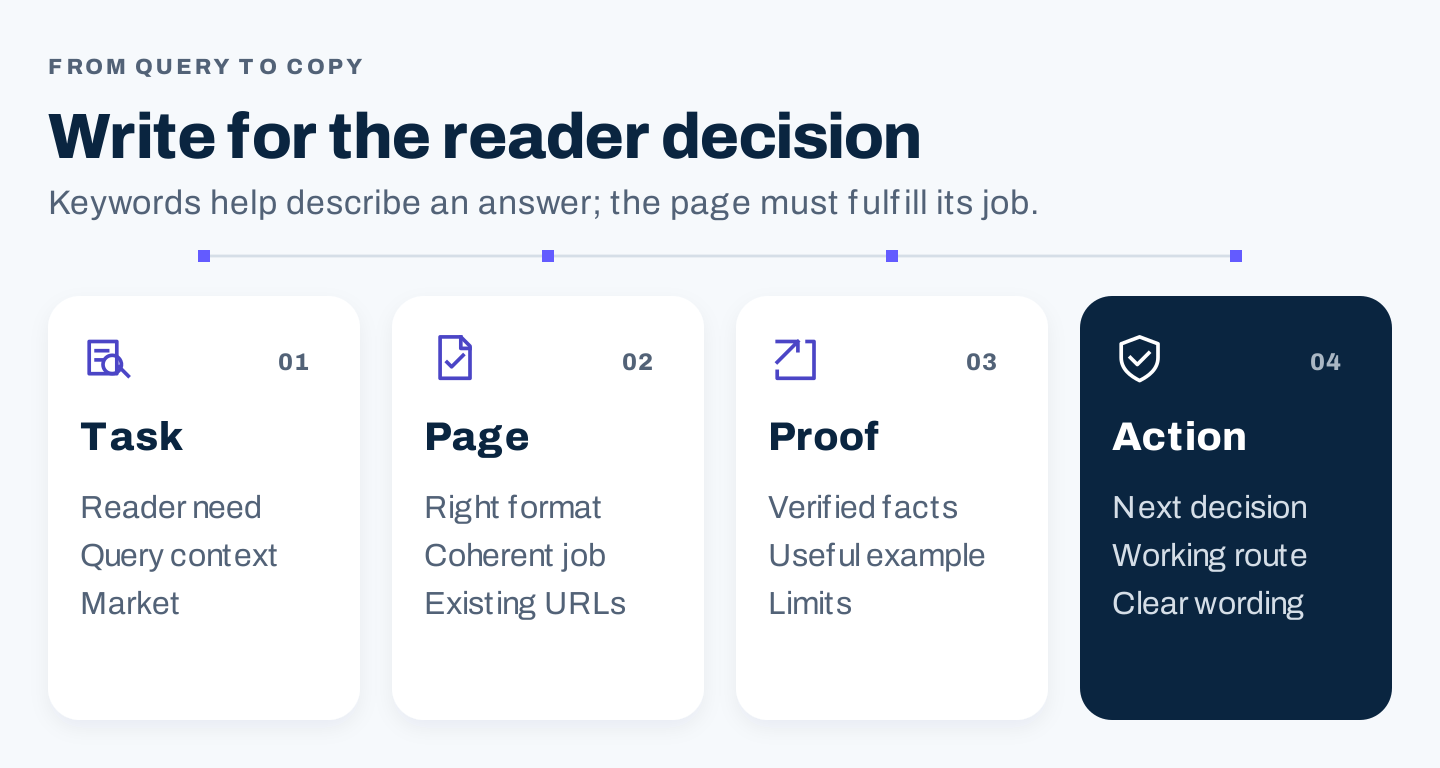
Choose the reader’s task and the page’s job before selecting evidence and wording.
Check the site’s existing destinations. If a current guide already answers the question, improve it rather than creating a second version for a near-identical phrase. If the query requires a tool or interactive task, a long article may not be the right answer.
2. What Todoist’s public pages teach about context
Real examples are useful when you identify what is visible and explain the decision it illustrates. They do not establish why the page ranks or how well it converts.
A short headline can rely on adjacent category context
The Todoist homepage leads with “Clarity, finally.” Nearby text identifies the to-do-list category, and the product imagery shows task organization.
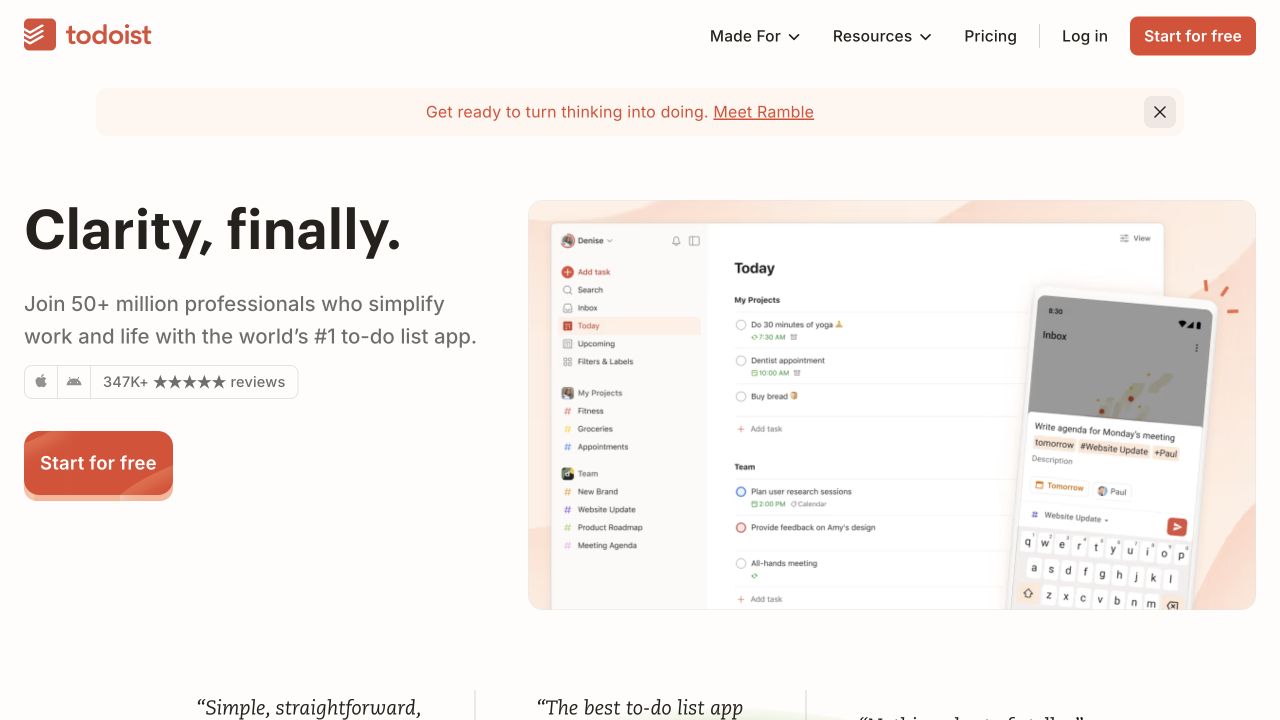
The headline and nearby context work together. The screenshot is a public page capture from October 8, 2026, not a product test or performance study.
The lesson is to read the whole opening block. A short headline can be clear when the surrounding copy and visual identify the offer. Removing that context would change what a new visitor understands.
For your own page, ask a reader unfamiliar with the business to explain what it offers from the opening section. If they cannot, improve the category or task explanation before making the headline more creative.
Do not borrow the brand’s popularity claims as proof for your product. The example here concerns presentation and purpose.
A team page narrows the audience’s problem
The teamwork page frames the page around team work and leadership. Its body presents a shared workspace, responsibility assignment, and comments and files.
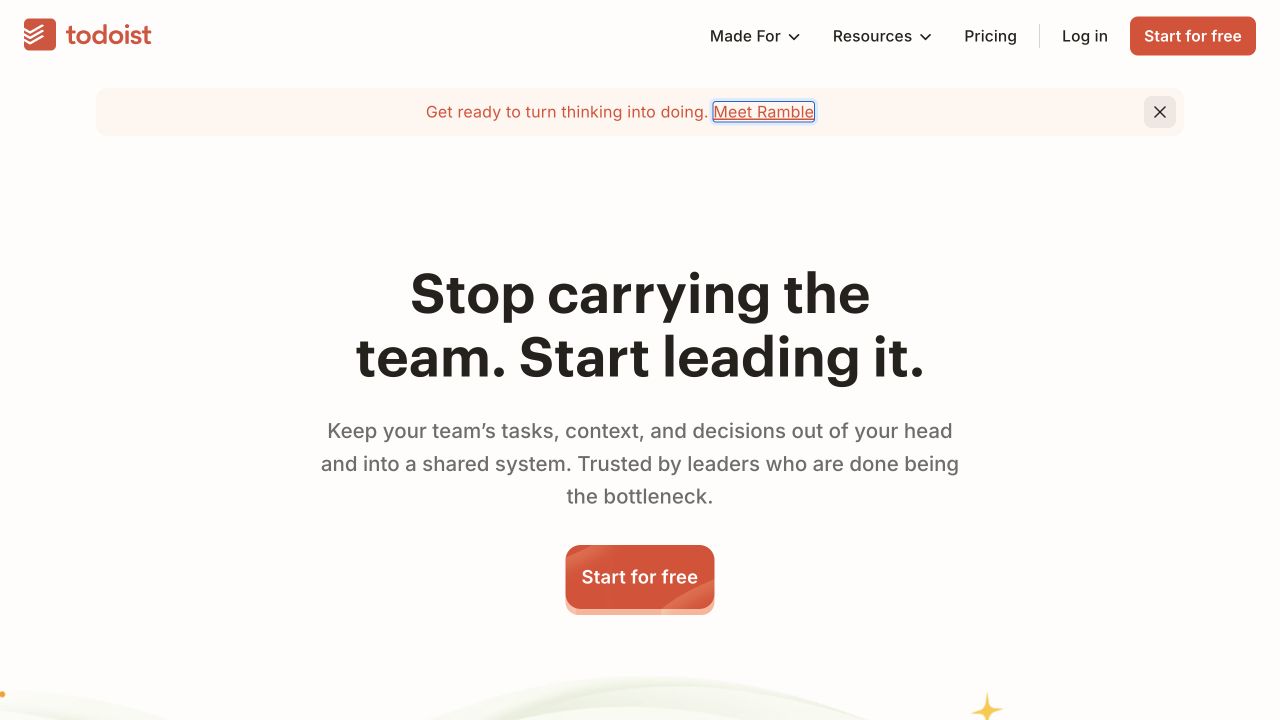
The page narrows the use case. Later capability explanations give the writer factual material beyond the headline.
For a commercial destination, identify the reader’s decision. Are they checking fit, understanding a capability, or comparing plans? Put the relevant answer beside evidence and a next step that matches it.
Avoid assuming that a benefit is established merely because a feature exists. A shared workspace is a capability. A specific reduction in meetings would require its own evidence, conditions, and attribution.
A glossary does a different job
The Todoist glossary explains terminology, links related help, and notes that some features depend on the plan.
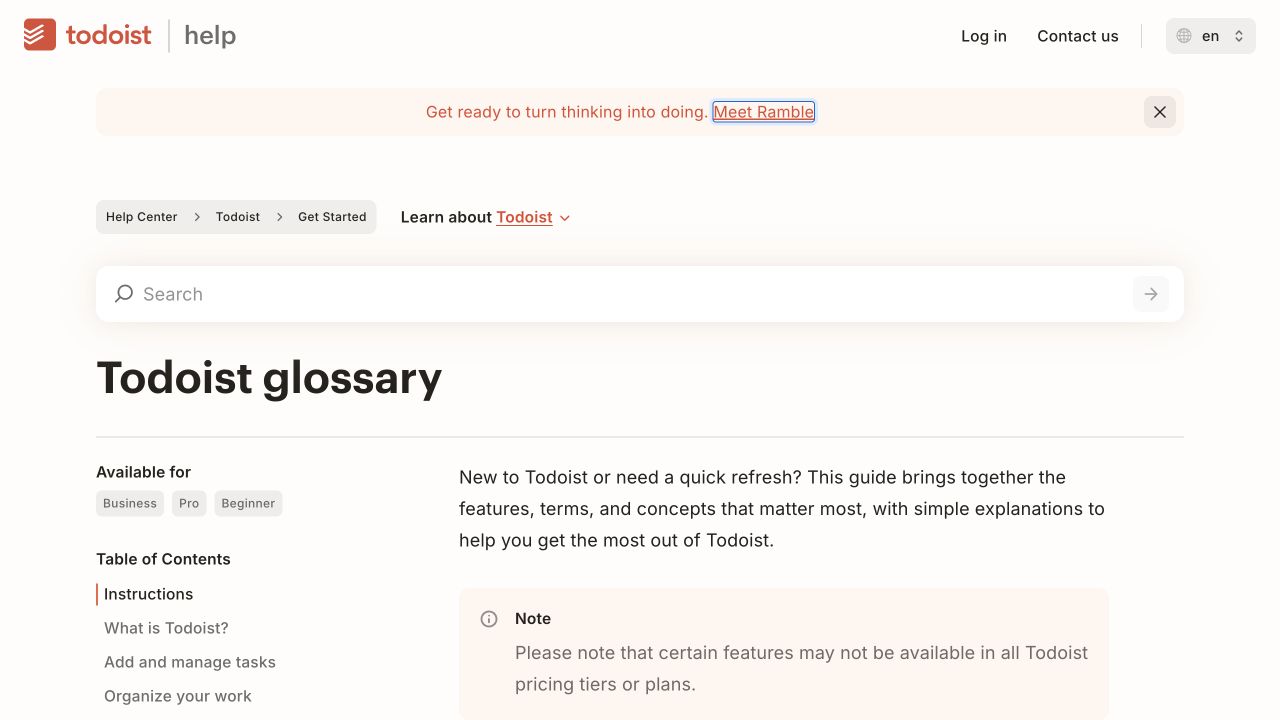
An educational destination can answer a definition task without reproducing the commercial page’s opening.
Its usefulness comes from helping someone understand terms and find the right instructions. On your own site, definitions, product evaluation, and task help may deserve connected but distinct destinations.
This page family shows why “add the keyword everywhere” is an incomplete copywriting instruction. Each destination needs language appropriate to its job.
3. Build the brief from evidence and reader questions
Collect the materials the writer can safely use: current product or service facts, approved demonstrations, actual customer questions, and reliable external sources where necessary.
Keep customer language distinct from proof. A customer’s description of a problem can reveal useful terminology; it does not verify a universal claim about the product or market.
Do not copy competitor paragraphs and replace the business name. Read competitors to identify reader needs, useful formats, and unanswered questions. Build the explanation from your own sources and analysis.
Use this brief:
Reader and task:
Primary query / market / research date:
Related questions that belong on this page:
Expected page type and reason:
Existing destination and overlap check:
Verified facts with source IDs:
Original evidence or demonstration available:
Important limitations and exclusions:
Questions the reader must resolve:
Appropriate next action:
Fact reviewer and change triggers:
Include questions that affect the decision. A commercial page may need to explain who can use a feature, whether a plan is required, or what setup involves. A tutorial may need prerequisites and an expected result. An informational guide may need a clear definition and a useful example.
Choose visuals while planning the brief. A genuine screenshot can show where an action occurs. An original diagram can explain a decision sequence. Neither should be added solely to make the page look longer.
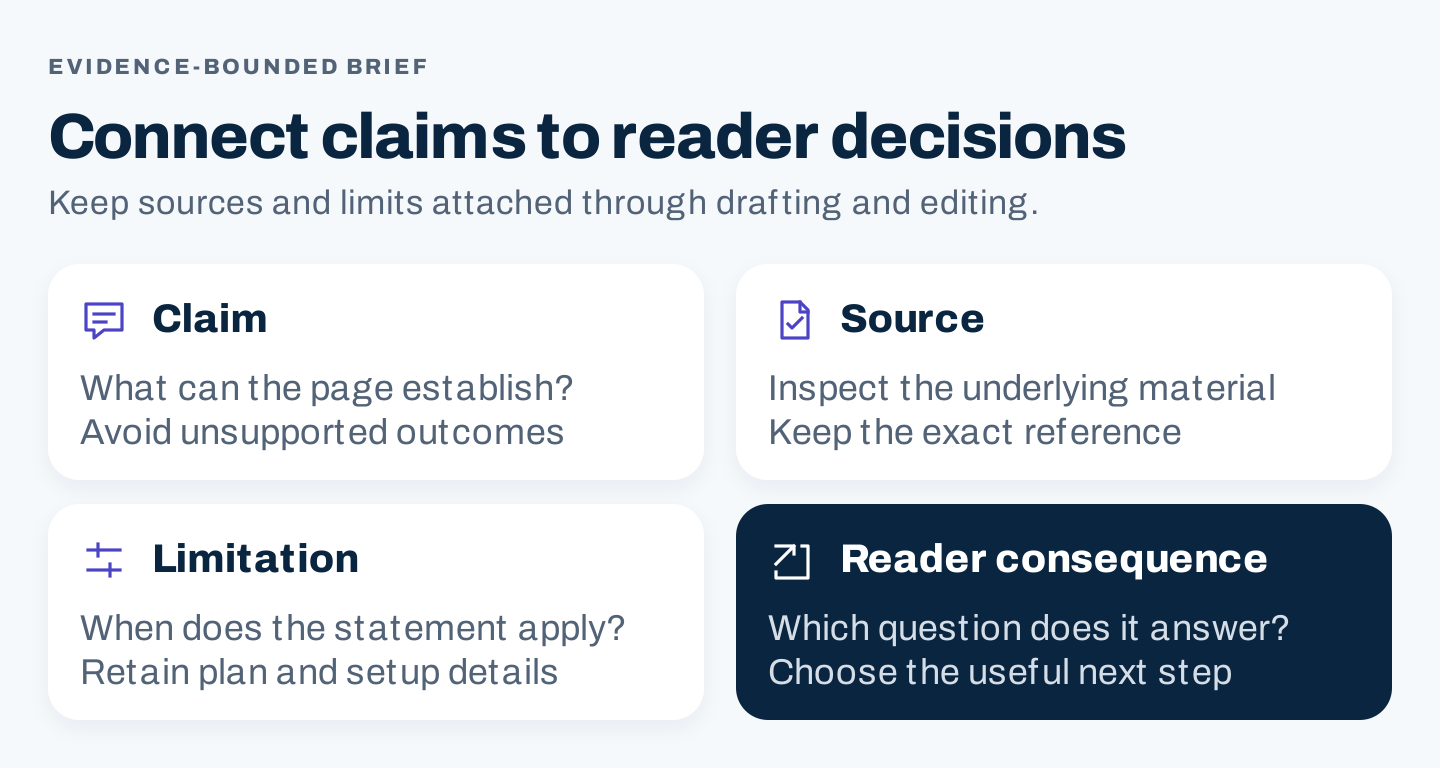
The brief connects each material claim to a source and the decision it helps the reader make.
If evidence is missing, make the gap explicit before writing. Narrow the statement, conduct the demonstration, ask the responsible expert, or remove the claim. Confident phrasing is not a substitute for verification.
4. Work through a real-brand editing exercise
Suppose an editor is preparing a team-task-management page using the public Todoist material above. The phrase is an illustrative planning target here; its search volume and Todoist’s rankings were not measured for this exercise.
The team page’s current headline is “Stop carrying the team. Start leading it.” It addresses a leadership problem. Whether to retain that headline or make the category more explicit depends on the page brief and audience evidence.
The following exercise demonstrates editing against verified capabilities. The weak draft is deliberately constructed for teaching; it is not text found on Todoist’s website.
| Element | Constructed weak draft | Proposed editorial alternative |
|---|---|---|
| Page title | Best team task management productivity software | Team task management with Todoist |
| Main heading | The ultimate productivity solution for every team | Keep team tasks in a shared workspace |
| Opening explanation | Transform collaboration and guarantee better results instantly. | Organize team projects in Todoist, assign responsibility, and keep comments and files with the work. |
| Supporting section | Everything your company could ever need | Explain shared projects, task responsibility, and collaboration, with current plan conditions |
| Next-step context | Start now | Review the team capabilities and current plan details before choosing how to begin |
The alternatives are proposed copy, not an endorsement, published change, or tested outcome. They use the page’s public capability descriptions without promising a performance result.
Three edits matter.
Make the category or task identifiable. The title describes the page. The heading helps the visitor orient. They can complement each other without becoming identical strings.
Replace outcomes you cannot prove with supported actions. The proposed paragraph says what the team can organize and where context can live. It does not assert a measured productivity gain.
Retain conditions near the decision. A feature may depend on the current plan or setup. Check those details before publishing, then link the appropriate current source. Do not attach “free” to every capability because the product has an entry plan.
The same method works for a service business. Replace vague superlatives with the actual service, scope, process, evidence, and limitations. For a tutorial, replace commercial persuasion with the steps and conditions needed to complete the task.
5. Edit titles, headings, and snippets for clarity
Write a descriptive, distinct title that fits the page’s actual purpose. Avoid stacking similar phrases or calling every destination “the ultimate guide.”
Google’s title-link documentation explains that Google uses several sources to generate the displayed title link. A title element influences the result; it does not guarantee the exact wording shown. Display also depends on available width, so a character target is a drafting aid rather than a universal rule.
The main heading should orient the visitor. Subheadings should help them locate answers. Read the headings alone: do they describe a useful sequence, or do they merely repeat the keyword?
Write a meta description that accurately summarizes the destination. Google’s snippet documentation explains that snippets primarily come from page content, with meta descriptions sometimes used. The result can vary by query.
Do not promise that your preferred description will always appear. Avoid treating a fixed character count as a ranking requirement.
Use relevant terms naturally where they clarify the subject. There is no reason to repeat a phrase until a density meter reaches a target. Google’s spam policies address unnatural keyword stuffing.
For internal links, name the destination clearly. Link where the reader needs related information, such as instructions, evidence, or current conditions. A paragraph should not become a sequence of keyword-rich links that distracts from the answer.
For images, describe what the visual actually shows. Place the explanation beside the relevant text and provide a source when the image comes from a real public page. An image of an interface should not imply that you executed a task you only read about.
6. Use AI for an evidence-bounded editing pass
AI can help identify vague language, repeated phrases, unsupported claims, and gaps between the brief and the draft. It is particularly useful when the editor has already collected a clear source packet.
Use this optional prompt with public or approved material:
Review this draft against the supplied page brief and sources.
Reader task and intended page type: [paste]
Verified facts with source IDs and limits: [paste]
Draft: [paste]

Return a table: passage / issue / proposed edit / source ID.
Flag unsupported outcomes, superlatives, missing conditions,
repeated keywords and answers that belong on another page.
Preserve the meaning of verified facts and customer quotations.
Do not invent features, statistics, citations or test results.
Mark UNKNOWN when the sources cannot settle a statement.
Suggest title, heading and description alternatives that match
this page's purpose. Do not promise rankings or exact display.
Check each proposed edit against the cited source. A model can preserve a source ID while changing the meaning of the claim. If it turns “can” into “will,” removes an exclusion, or broadens the audience, restore the boundary.
Ask the human reviewer to resolve unknowns. The model’s fluent answer is not a factual approval. If a source is outdated, update the evidence before refining the prose.
You do not need an AI prompt in every article. Here the prompt serves a specific editing task and produces a review table the writer can check.
7. Release the page with a copy and outcome record
Before publishing, read the opening, headings, evidence blocks, and next action as a complete journey. The promise in the title should be fulfilled by the body.
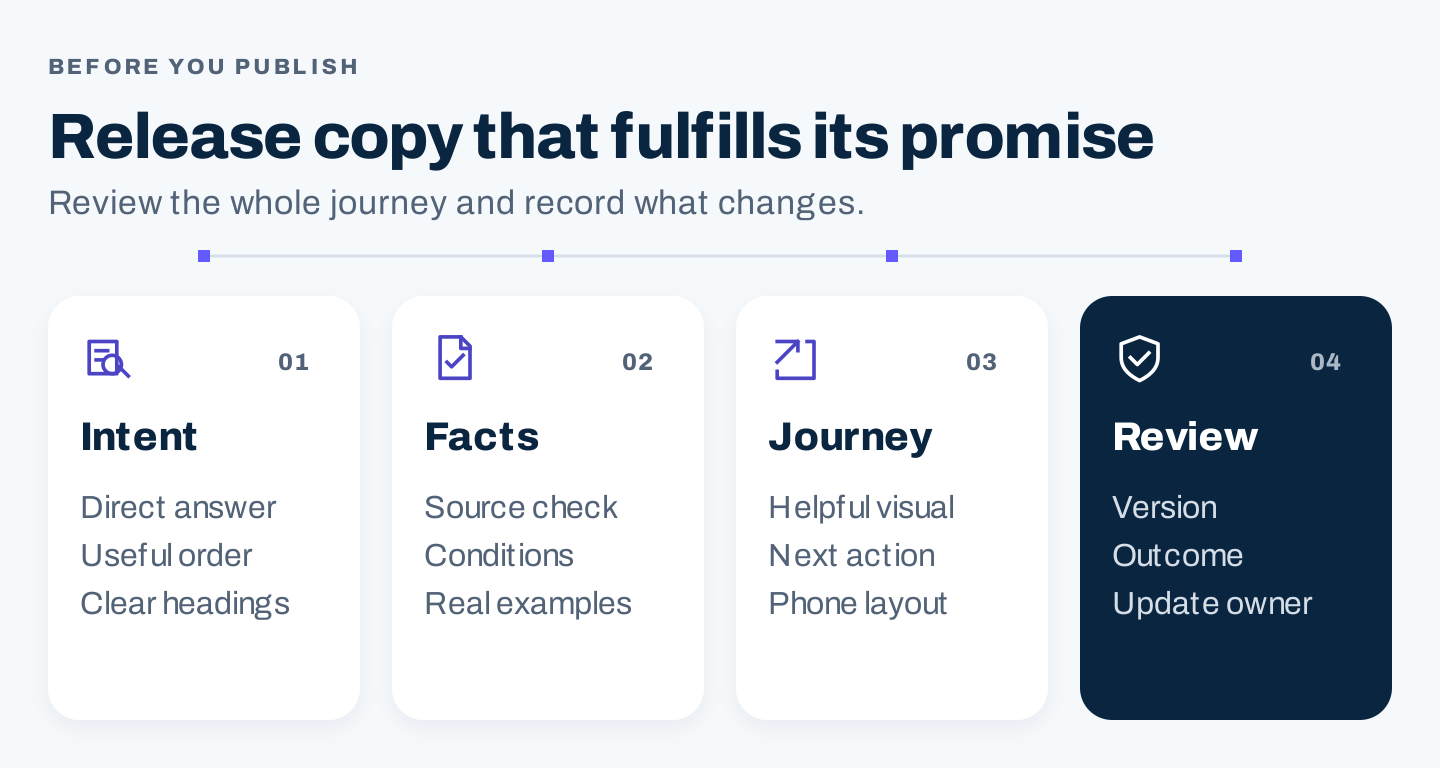
Release requires a coherent answer, verified claims, a usable next step, and a record of what changed.
Use this checklist:
- The page answers the reader’s task early enough to be useful.
- Important claims have current sources and necessary conditions.
- Examples are real observations or explicitly labeled editorial exercises.
- Headings, tables, and visuals help someone understand or decide.
- The next step works and matches the page’s purpose.
- A phone reader can use the page without broken layout or unreadable templates.
- A named owner can update product facts and links when they change.
Google’s helpful-content guidance says there is no preferred word count. Stop when the page has completed its task, rather than expanding it to match a competitor’s length.
After release, separate search discovery from the page’s business outcome. Impressions and clicks show exposure and visits. A product inquiry, signup, completed task, or later sale needs its own definition and reliable collection.
For an editing change, record the URL, prior version, revision date, and hypothesis. Compare relevant query and page data over appropriate periods while noting promotions, seasonality, technical changes, and collection gaps. A before-and-after difference is not automatically a causal result.
If impressions rise but visitors misunderstand the offer, review the opening and audience fit. If readers complete the informational task, do not call the page unsuccessful merely because it has fewer direct purchases than a commercial destination.
Common SEO copywriting questions
Does every heading need the primary keyword?
No. Use the phrase where it describes the subject naturally. Headings also need to tell readers which answer or decision appears next.
Do we need to mention every topic competitors cover?
No. Preserve the questions necessary for your page’s task, then add evidence or analysis you can support. Unrelated completeness can make a page harder to use.
Does AI-friendly writing require a separate version?
A clear, source-backed answer is useful to human readers and can be easier to interpret. That does not guarantee an AI citation. Keep claims and their conditions together rather than producing a second page of decontextualized assertions.
Start with the reader’s decision, collect the evidence, and edit until the page fulfills its promise. That process gives keywords a useful role within copy people can trust and act on.