26 UGC Statistics and 6 Real Examples for Marketers
Explore 26 UGC statistics with survey context and six real brand examples. Use a campaign brief to plan permissions, honest testimony, and measurement.

User-generated content (UGC) is content people contribute about a product, experience, or community: reviews, photos, videos, stories, and useful shared resources. It can answer questions that a brand's own description leaves open, such as how something looks in use or what a customer found difficult.
The useful question is what evidence your audience needs. A gallery of attractive photos serves a different purpose from a detailed product review or a community template someone can actually use.
This guide brings together 26 statistics from three research publishers, six real examples, and a campaign brief you can copy. The statistics describe their stated samples and questions. They aren't 26 independent studies or a forecast of what your campaign will earn.
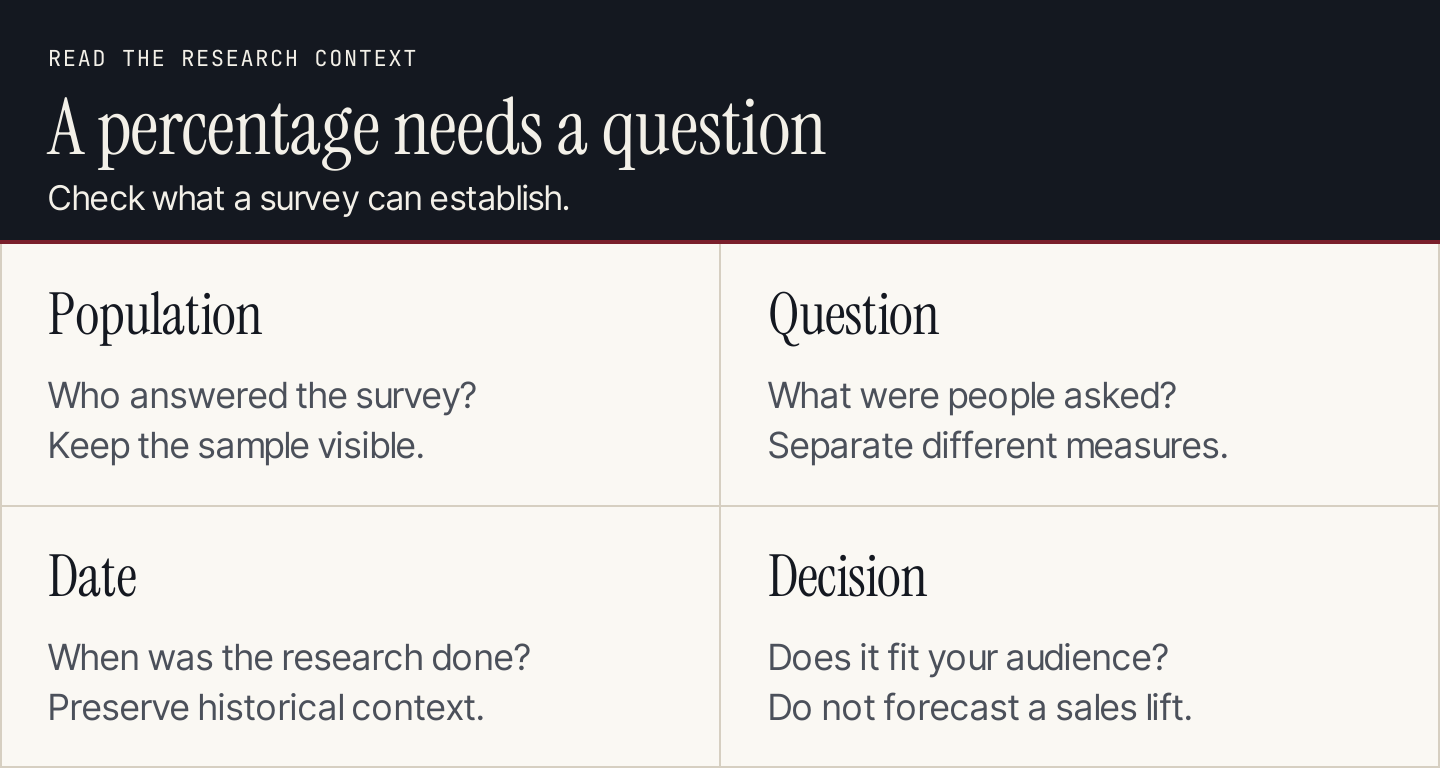
Read the survey context before using a percentage to justify a campaign.
What counts as UGC?
A customer's spontaneous photo, an invited review, and a paid creator's video can all look like customer content. Their relationships with the brand differ, and that difference matters when you publish them.
| Content type | Useful role | Record before reuse |
|---|---|---|
| Organic customer post | Show an actual experience | Creator, source, permission, and relevant product context |
| Invited review | Explain satisfaction and difficulties | Collection policy, incentives, and how moderation works |
| Commissioned creator content | Demonstrate a specific use | Commercial relationship, agreed uses, and disclosures |
| Employee contribution | Explain a task with internal experience | Employment relationship and factual review |
| Community resource | Help another user complete work | Creator credit, access conditions, and the resource's license |
UGC doesn't automatically mean free, unbiased, or available to repost. A public post is a discovery route; it isn't your permission record. Synthetic customer testimony also doesn't become UGC because it resembles an ordinary phone recording.
26 UGC statistics, with dates and survey context
Consumer reviews: 11 observations from PowerReviews
PowerReviews reports June 2025 consumer surveys: 21,279 respondents for rows 1–3; more than 19,000 for rows 4–11 on review volume and recency. The summaries don't establish US national representativeness.
| # | Reported observation | Share |
|---|---|---|
| 1 | Regularly read product reviews | 95% |
| 2 | Would buy with zero reviews | 43% |
| 3 | Name ratings/reviews the most influential factor | 96% |
| 4 | Consider recency at least regularly | 90% |
| 5 | Usually read 6–10 reviews | 42% |
| 6 | Less likely to buy without reviews | 85% |
| 7 | Review quantity matters more for unfamiliar products/brands | 78% |
| 8 | Trust stars alone less than stars plus text | 69% |
| 9 | Read more reviews for expensive products | 96% |
| 10 | More likely to read reviews for unfamiliar products | 99% |
| 11 | Choose fewer new reviews over more old ones | 60% |
These are reported preferences and habits, not measured conversion lifts. Different questions explain apparently conflicting answers; don't combine them into a single purchase probability.
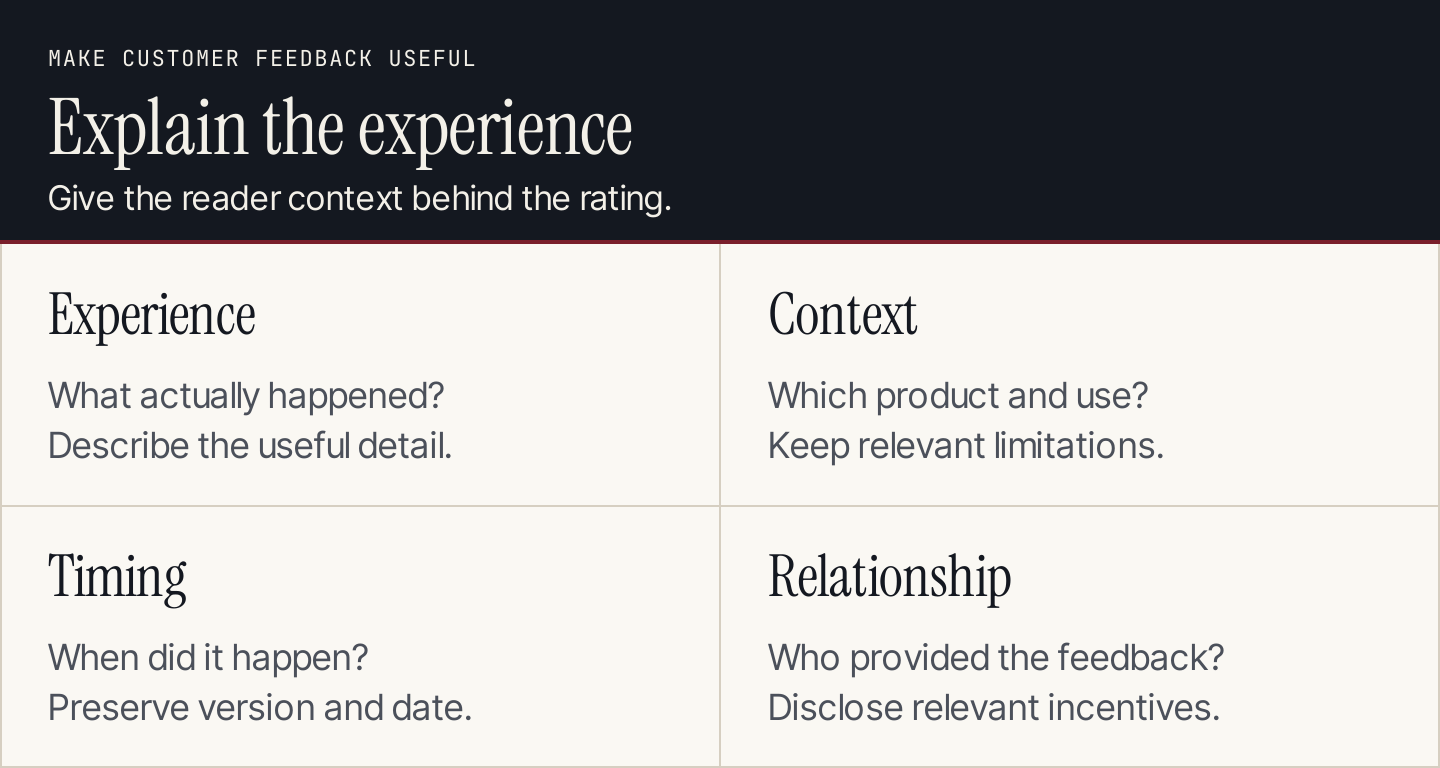
Review content should help a reader understand the experience behind a rating.
For your own review program, inspect whether customers can understand the experience behind the rating. Check dates, product versions, and substantive feedback. A star average without context may leave the buyer's real question unanswered.
Visual content: 14 observations from Nosto
Nosto's visual UGC research surveyed 202 ecommerce marketers on July 3–5, 2023, across the UK and North America. Their retailers had annual revenue above $50 million, and all already used visual UGC. These are marketer opinions, not shopper responses or small-business benchmarks.
| # | Marketers reporting the following | Share |
|---|---|---|
| 12 | Difficulty creating distinctive visuals | 90% |
| 13 | Difficulty maintaining fresh visuals | 87% |
| 14 | Difficulty representing diversity | 83% |
| 15 | Professional/influencer visual costs challenging | 84% |
| 16 | UGC eases campaign launch/scaling | 87% |
| 17 | UGC resonates more than professional/influencer visuals | 81% |
| 18 | UGC authentically represents diversity | 87% |
| 19 | UGC minimizes visual-production costs | 85% |
| 20 | Identifying/sourcing UGC is challenging | 84% |
| 21 | Pick UGC as most trusted visual type | 33% |
| 22 | Pick professional visuals | 24% |
| 23 | Pick influencer visuals | 18% |
| 24 | Pick AI-generated visuals | 16% |
| 25 | Pick stock visuals | 8% |
Rows 21–25 are alternatives within one question; rounding explains their 99% total. The research doesn't demonstrate savings or a causal trust advantage for your business.
Product-page priorities: one observation from Salsify
In Salsify's 2026 consumer research, nearly 3,000 consumers across the US, UK, and Canada were surveyed.
| # | Reported observation | Share |
|---|---|---|
| 26 | Identify customer ratings, reviews, and UGC among the most important product-page elements for a purchase decision | 57% |
This describes a stated priority within a combined category. It doesn't isolate customer photos from written reviews, and it isn't a 57% sales increase.
Six real UGC examples and what to learn
The examples below show observable participation and publishing choices. Their public pages don't establish the campaigns' private performance. Each adaptation is our recommendation, rather than a claim about the brand's internal strategy.
1. GoPro: make the contribution process clear
GoPro Awards organizes participation around shooting, submitting, and possible rewards. Its submission route accepts several kinds of visual work, rather than treating every contribution as the same social post.
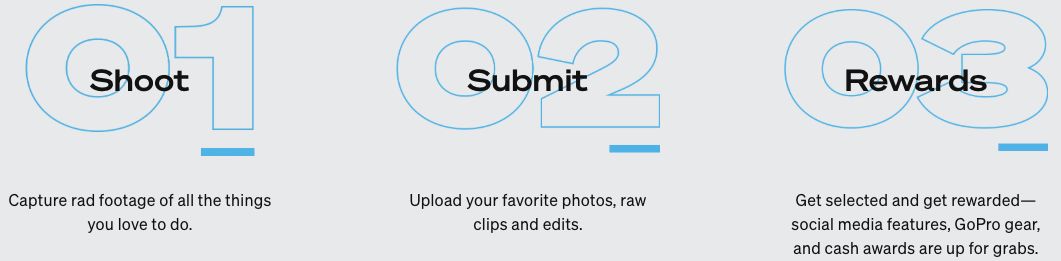
GoPro explains the contribution journey before asking people to participate. Source: GoPro Awards.
For a smaller program, write one precise request: the situation to show, acceptable formats, where to send the file, and how selection works. Give an example of a suitable submission. Define compensation and possible rewards separately so contributors understand the arrangement.
The first useful measure is whether the request produces usable, permitted material. Counting every hashtag mention can obscure that question.
2. LEGO Ideas: give contributions a visible destination
LEGO Ideas invites fan creations, challenges, and support for creators, with a route through which an idea could become a real set. Submission isn't a promise of production.

LEGO connects participation to a stated possibility and a process explanation. Source: LEGO Ideas.
Adapt the clarity of the destination. If customers share workflow improvements, explain whether you will feature selected tips, discuss them with product teams, or incorporate them into a resource. Don't imply that posting a suggestion obliges your business to implement it.
Give participants a way to learn what happened to their contribution. A submission form without follow-up can become a collection mechanism that offers little value to the community.
3. Apple: connect customer work to product capability
Apple's April 2022 Shot on iPhone Macro Challenge announcement presented ten winners, credited photographers, and described where their images would appear. This is a historical campaign, rather than a currently open contest.

The dated announcement connects a specific camera feature to photographers' work. Source: Apple Newsroom.
Choose a contribution that demonstrates the product's relevant use. For software, that might be an approved customer-created workflow; for a physical product, an actual use situation. Keep the creator's identity and the conditions needed to understand the result beside the work.
A visually impressive result still needs context. Don't suggest every purchaser will produce the same outcome, or silently present older product capabilities as current ones.
4. Coca-Cola: use a participation idea people can understand
Coca-Cola's March 2025 Share a Coke announcement brought names on packaging back into a program built around personal connection. The product gave people a concrete object around which to share a moment.

Share a Coke builds its invitation around a recognizable personal connection. Source: The Coca-Cola Company.
The transferable choice is a simple creative idea. Ask for a specific moment or use, rather than a broad instruction to post about your brand. Check whether someone can explain the request without reading a long campaign document.
A small business doesn't need personalized packaging to make participation relevant. It needs a reason the contribution matters to the person making it and to the audience who will see it.
5. Figma Community: make contributed work useful
Figma Community organizes community-made resources such as libraries, plugins, and icon sets. Contributions can help other users do work, rather than simply display satisfaction with a brand.

Figma gives shared resources a practical discovery route. Source: Figma Community.
For a business audience, consider whether customers already create useful checklists, configurations, or templates. A small collection with clear instructions can be more valuable than a large gallery. Review each resource's access conditions and license; a community listing doesn't make every file free for any commercial use.
Measure whether someone can use the contribution for its stated task. Resource downloads alone won't tell you whether the instructions work.
6. Aerie: state the creative boundary
Aerie's public site links to its #AerieREAL participation route and states a no-retouching, no-AI-generated-people-or-bodies position. That communicates a recognizable standard for how the brand presents people.

Aerie makes its representation standard explicit. Source: Aerie.
Define your own boundary in terms a contributor can follow. For a product demonstration, require the actual product and prohibit changes that misrepresent its behavior. For a customer story, preserve the customer's meaning when editing.
A creative standard is only useful if your review process applies it. Record who checks the original material and who accepts the final version. Don't turn a brand's authenticity statement into a claim that every contribution is unpaid or unedited.
Build a UGC campaign you can actually maintain
Start with one audience question. If customers struggle to judge size, invite examples showing the product in a relevant setting. If buyers need to understand a workflow, invite an actual walkthrough with sensitive information removed before submission.
Use this campaign brief before asking for contributions:
| Field | Decision to record |
|---|---|
| Audience and question | Who needs what evidence? |
| Contribution | The specific experience, visual, review, or resource requested |
| Participation route | Where people submit and what happens next |
| Eligibility | Who can participate and the applicable campaign conditions |
| Relationship | Organic, compensated, gifted, employee, or another connection |
| Permission | Exact channels, adaptations, duration, and permitted uses |
| Creator credit | How identity and attribution will appear |
| Review | Who checks facts, authenticity, privacy, and disclosures |
| Selection | The published criteria and handling of unsuitable material |
| Release | The accepted text, assets, destinations, and responsible person |
| Support | Who handles questions, corrections, and removal requests |
| Measurement | What useful audience action and program costs you will track |
Treat the permission field as a requirement to resolve with appropriate terms, rather than a ready-made legal agreement. Reusing someone else's music, likeness, or third-party assets can require additional rights beyond the contributor's consent.
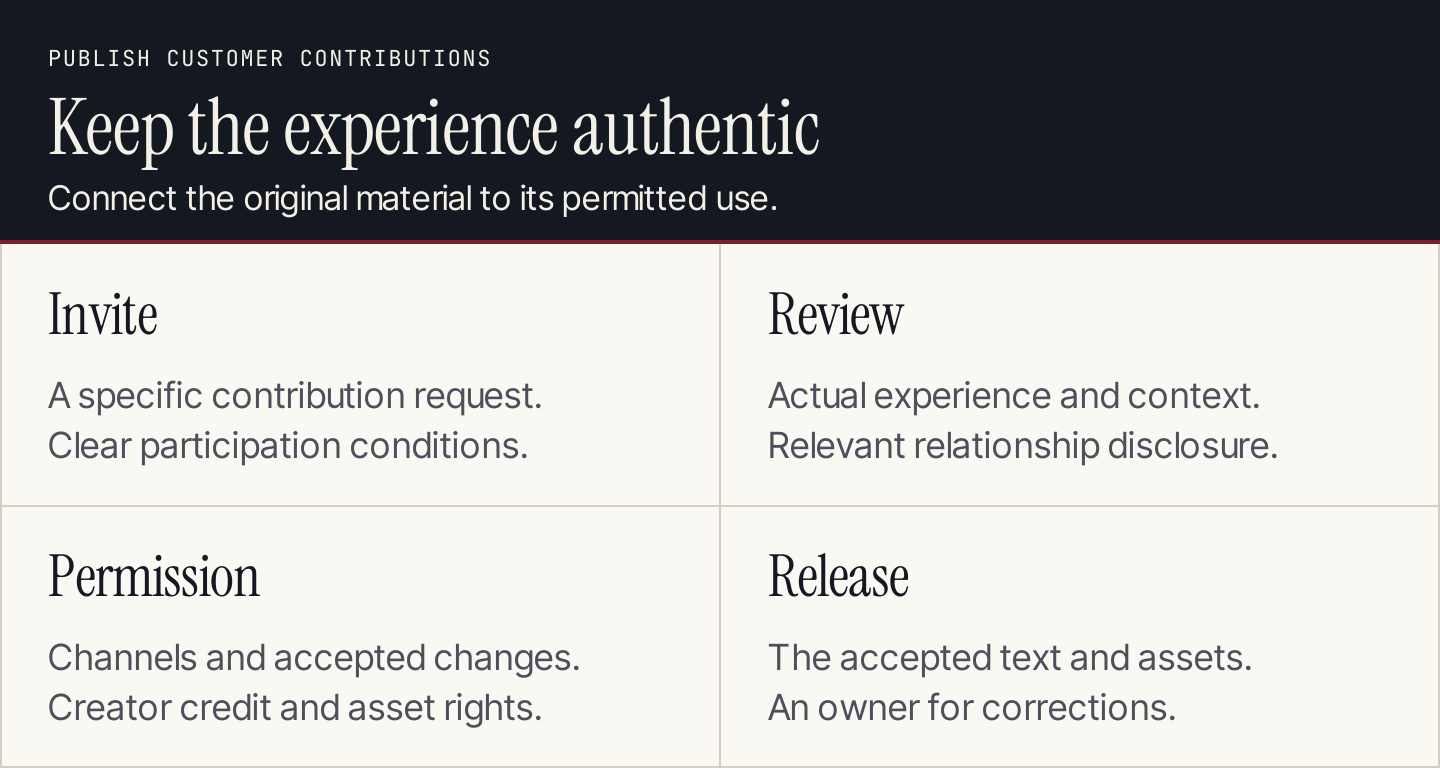
Keep the final permitted use connected to the original contribution and review decision.
Preserve honest testimony and meaningful disclosures
The FTC's endorsement guidance explains that endorsements must reflect honest experience and that relevant relationships or incentives need clear disclosure. It rejects incentives conditioned on a positive review and warns against selectively soliciting only happy customers when that skews the overall picture.
Apply that to the work people actually see. Retain necessary disclosures when adapting a creator's post into another placement. Don't change a customer's wording to remove a material qualification, or replace missing testimony with generated praise. Review-platform policies can impose additional conditions.
Measure the role you chose
Use a small report that distinguishes participation from audience outcomes:
- Supply: contributions received, usable submissions, permissions resolved, and review time.
- Use: approved assets released and the questions they answer.
- Audience action: product-detail engagement, resource use, qualified inquiries, or another defined next step.
- Cost: collection, compensation, review, production, and maintenance.
Define the denominator for every rate. Usable contributions divided by submissions received answers an operational question; purchases after exposure answer a different one. A sales comparison also needs a credible design before you attribute the difference to UGC.
Keep a correction route open after release. Product changes can make a formerly accurate demonstration misleading. A withdrawn permission or revised customer statement should trigger review of every adaptation that uses it.
Frequently asked questions
Can a B2B business use UGC?
Yes. Customer-created templates, community answers, approved workflow demonstrations, and substantive reviews can help another business evaluate or use a service. Choose the evidence a buyer or user needs, and protect confidential information before it reaches your collection process.
Should AI create our UGC?
AI can help organize a brief or identify questions in supplied material. It shouldn't invent customer experience, generate a testimonial presented as real, or substitute synthetic people for a campaign's stated authenticity standard.
Is the highest percentage the best statistic to cite?
Use the statistic whose question and sample fit your decision. Put the source year and population beside it. A large percentage from established retailers' marketers doesn't describe your customers' preferences.
Connect customer evidence to the rest of your content
UGC works best when someone can find it at the moment it answers a real question. Plan that role alongside your content strategy, and turn substantial approved experiences into customer case studies when the evidence supports a fuller story.
Rankauto researches, writes, and fact-checks blog articles in your brand voice, adds images and SEO fields, and publishes them to your site. Articles save as drafts by default. Your team still owns customer contributions, permission, and campaign review. Use approved evidence to support helpful articles without outsourcing the authenticity of the customer story.