The Real Cost of an SEO Agency vs. Automating It


An SEO agency might quote you $1,000 a month. Rankauto Growth costs $79 a month. The difference is easy to see on an invoice. The harder question is what work each option will actually take off your plate.
If your team knows its audience and needs to publish useful articles consistently, content automation may be enough. If traffic dropped after a site migration, or you need someone to build the SEO strategy and coordinate fixes with developers, an agency could be worth the higher fee.
This guide shows what each option can include, what still falls to your team, and how to compare a real agency proposal with an automation plan.

An agency supplies people and judgment. Automation supplies a repeatable system. Both leave responsibilities with the client.
What an SEO agency retainer can include
“SEO agency” is not one standard service.
One provider may deliver technical audits and a monthly report. Another may assign a strategist, writer, editor, digital PR specialist, and account manager. Content, links, development, and international work may sit inside the retainer or appear as separate charges.
In a 2024 survey of 439 SEO providers, $500 to $1,000 was the most common monthly retainer band for agencies. Many charged more. The $1,000 agency quote below is an example. Your quote and deliverables will depend on the agency and scope.
Before comparing prices, ask the agency to separate:
- strategy and planning
- technical diagnosis
- implementation
- keyword and market research
- writing and editing
- digital PR or link acquisition
- CMS publishing
- reporting and analysis
- meetings and stakeholder management
Ask how many articles, audits, fixes, and review rounds you will receive each month. The proposal should also name who will do the work.
What automation actually buys
An automation platform is strongest when the workflow is known and repeated often.
It can research keyword opportunities, build article plans, create drafts, apply defined checks, schedule publishing, and crawl the site for recurring issues. The monthly cost buys predictable throughput without adding a coordinator for each step.
Rankauto Growth costs $79 a month for one site. It includes up to 30 articles and 10,000 audited pages a month. Larger plans add capacity for more sites, but one site is enough for the cost example in this article.
Those limits describe capacity. They do not mean the business should publish every available article. Nor do they include a strategist who decides which market to enter, a developer who fixes a JavaScript rendering problem, or a lawyer who approves a regulated claim.
Software lowers the cost of execution. It does not remove ownership.
Compare the capabilities before the invoices
| Work | Agency | Automation platform | Who still owns the decision? |
|---|---|---|---|
| Market and positioning strategy | Often available at higher service levels | Uses the priorities supplied to it | Business leadership |
| Recurring keyword research | Analyst-led within the agreed scope | Finds and prioritises topic opportunities | Marketing owner |
| Article production | Depends on writer and editor capacity | Predictable monthly capacity | Marketing or subject reviewer |
| Technical audit | Diagnosis and interpretation may be included | Repeated crawling and issue grouping | Developer or site owner |
| Technical implementation | Sometimes included, often separate | Not a substitute for development | Developer |
| CMS publishing | May be included | Available through supported integrations | Site administrator |
| Stakeholder management | A strong agency can lead it | Not a software function | Internal sponsor |
| Reporting | Presented and interpreted by people | Dashboards and recurring data | Marketing owner |
The final column is the one buyers overlook. A company can outsource work, but not every decision.
A simple cost example for one website
Suppose you are choosing between Rankauto Growth and an agency that quotes $1,000 a month.
Rankauto Growth costs $79 a month, or $948 over a year. It provides keyword research, an allowance of up to 30 articles a month, site audits, and publishing tools. Your team still chooses priorities, checks important claims, and acts on technical issues the audit finds.
The agency quote costs $1,000 a month, or $12,000 over a year. That fee might cover strategy, a set number of edited articles, technical advice, reporting, and meetings. It might cover only some of them. Ask for a written list of deliverables before treating the quote as a complete SEO service.
The invoice difference is $921 a month in this example. That does not tell you which option will bring more customers. Start with the work you need done. If consistent article production is the main gap, automation may solve it at a lower cost. If you need experienced people to diagnose, implement, and lead the work, read the agency proposal against those needs.
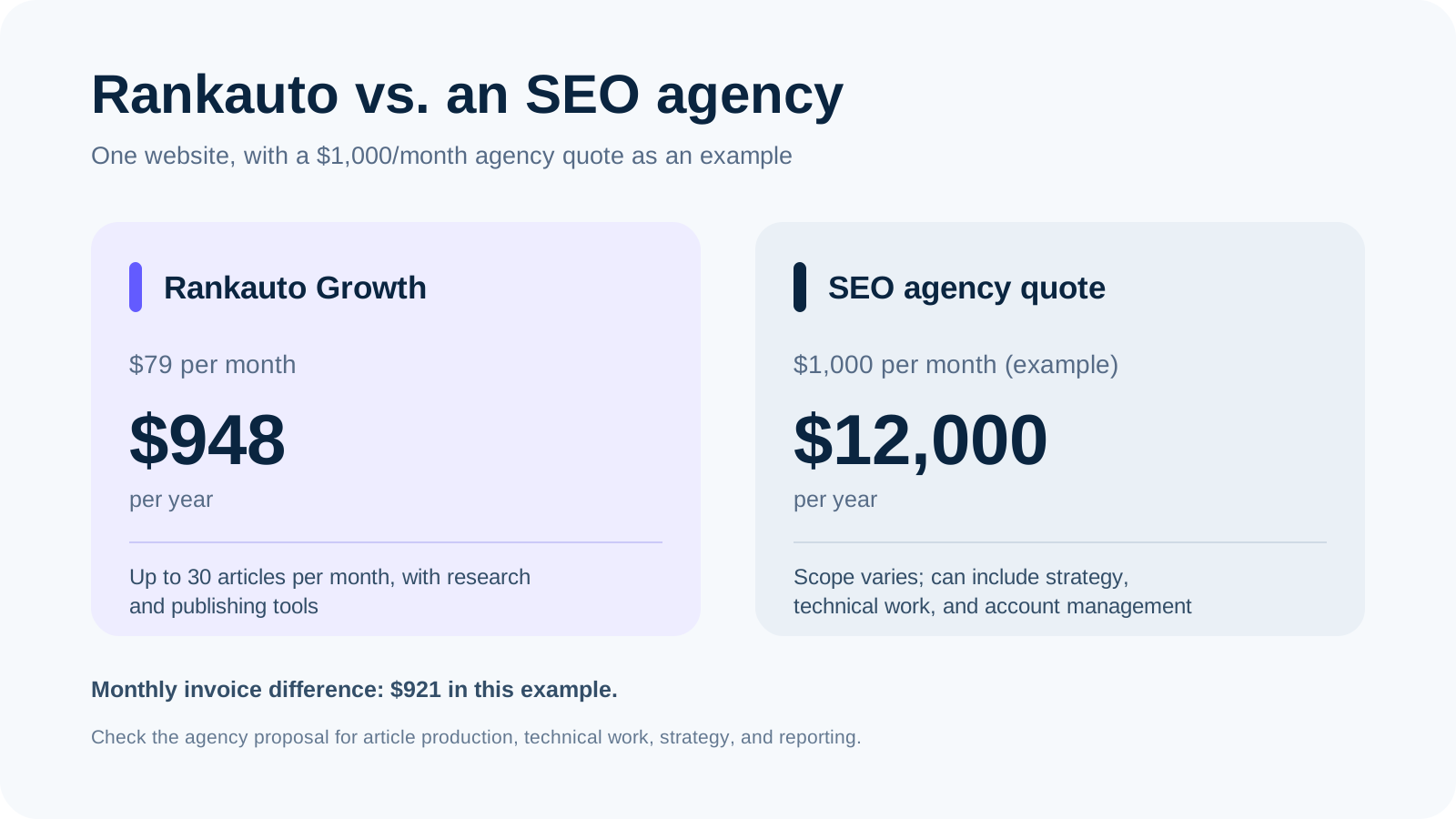
The $1,000 agency fee is an example, not a market average. Agency fees and deliverables vary. Rankauto's 30 articles are a monthly allowance, not a promise that every article should be published.
Price the work hidden from the invoice
Both models require internal time, just in different places.
With an agency, someone has to explain the product, grant access, answer questions, review claims, attend meetings, coordinate developers, and approve publication. A poorly managed agency can create more internal work through revisions and status calls.
With automation, someone has to set priorities, supply brand knowledge, review sensitive material, deal with exceptions, and interpret performance. Technical audit findings still need implementation. A broken canonical does not repair itself because a dashboard found it.
Estimate the monthly hours honestly and multiply them by an internal cost. Do not pretend a founder's evenings are free. Do not price every minute of a marketer's review as new work either, because product input and approval would still be needed with an agency.
The useful question is: which model consumes scarce attention, and what valuable work could that person do instead?
Three companies, three different answers
The founder with one site
The founder understands the customer but cannot sustain weekly publishing. The site has no known technical crisis. An agency can solve the workload, but a full retainer may buy coordination and strategy the business does not need yet.
Automation is likely the better starting point if the founder can review product claims and spend a focused block each week on priorities. If even that time does not exist, the platform will not operate itself in the meaningful sense. It may publish, but nobody will protect the strategy.
The in-house marketer with developer access
This company already owns positioning, analytics, approvals, and the CMS. Content throughput is the constraint. Automation fits because the team can judge topics and act on audit findings.
A specialist still makes sense for a migration, a penalty investigation, a difficult international expansion, or digital PR. There is no reason to pay that specialist to copy metadata between tools.
The company in a regulated market
Medical, financial, legal, and safety content changes the calculation. Claims may need qualified review. Entering a new country adds regulation, language, and local search behaviour.
An experienced agency or consultant may justify the premium because the scarce resource is judgment. Automation can prepare research and routine drafts, but it should work inside an approval system rather than act as the final authority.
Where agency costs hide
Scope gaps are the main source of surprise.
A technical audit may identify a slow template without including the developer who fixes it. Content pricing may exclude subject interviews, images, or CMS entry. Link building may carry separate minimums. The contract may limit revisions or roll unused deliverables into nothing.
Long commitments matter too. A twelve-month agreement reduces flexibility if the relationship underperforms. Ask about notice periods, ownership, handover, and access to working files.
Do not assume a high retainer includes senior attention. Find out who performs the work after the sale, how many accounts they handle, and who reviews the final output.
Where automation costs hide
Bad inputs scale quickly. A vague positioning document can shape 30 vague articles. An incorrect product limit can appear across several pages before anyone notices.
Integrations need care. CMS credentials, field mapping, retry behaviour, and publication states should be tested. A platform can create the content while a malformed template, blocked crawler, or broken internal link weakens the result.
There is also a maintenance cost. Prices change. Screenshots age. Search intent moves. A publishing system needs a review queue, not just a creation queue.
These are manageable costs, but they belong in the comparison.
Use a full-cost worksheet
Run the numbers across six or twelve months.
For an agency, include the retainer, setup fees, extra content, link costs, developer work, required tools, internal meetings, and exit or handover work.
For automation, include the subscription, internal review, subject-expert checks, developer fixes, usage add-ons, maintenance, and exception handling.
Then track:
- cost per approved article
- cost per published and indexed page
- cost per qualified organic visit
- cost per assisted conversion
- time from approved topic to live page
- percentage of work requiring substantial revision
Cost per word is easy to calculate and rarely useful. A short page that converts can be worth more than a 4,000-word guide that answers no real question.
The hybrid model often wins
Use automation for work that benefits from consistency: recurring research, first drafts from approved sources, metadata, routine checks, publishing, and site crawling.
Use specialists where uncertainty is expensive: strategy, migrations, technical architecture, recovery, high-stakes review, original research, and relationship-led promotion.
This division also improves the agency brief. Instead of paying experts to operate a content calendar, pay them to solve problems the internal team cannot solve alone.
Questions to ask before buying either option
Can automation replace an SEO strategist?
It can execute parts of a defined strategy. It cannot decide the company's position, negotiate internal priorities, or accept responsibility for an unfamiliar high-risk market.
Is an agency always more expensive?
The invoice usually is because people are included. The total cost depends on scope, internal workload, technical work, and the value of the result.
How many articles should we publish each month?
Only as many as the team can research, review, connect, maintain, and use. A software limit is capacity, not a publishing target.
When should a business hire an agency?
Hire specialist help when the constraint is diagnosis, market strategy, implementation, authority building, or alignment rather than production volume.
Who owns the work after cancellation?
Confirm ownership of content, research, accounts, data, and integrations before signing. The business should retain access to published assets and understand how long the provider stores its data.
Buy the constraint you need to remove
An agency buys judgment and coordinated labour. Automation buys repeatable capacity.
If the company cannot explain which constraint is slowing growth, either purchase can disappoint. Diagnose that constraint first. Then compare complete operating models, not two numbers pulled from different products.