SEO vs GEO: What Actually Changes When AI Reads Your Content


Your article ranks on Google. Then you ask ChatGPT or Perplexity the same question and a competitor gets cited instead.
Nothing necessarily went wrong. The two systems made different decisions.
A conventional search result decides which pages deserve a prominent position. An AI answer has another job after retrieval: it must choose which pieces of those pages are useful enough to build into a response. Ranking gives a page visibility. Citation gives a claim influence.
This is the practical difference between search engine optimization and generative engine optimization. SEO helps a page get discovered and ranked. GEO improves the chance that the page's information will be retrieved, understood, and used in an AI-generated answer.
The overlap is substantial. Crawlability still matters. Good sources still matter. Thin content does not become valuable because it has tidy headings. Google's own guidance says its AI search experiences use the same core SEO foundations and quality systems as Search. GEO is an additional publishing discipline, not a replacement for SEO.

The same page can feed two discovery paths: a ranked result and a cited AI answer.
SEO gets the page into consideration. GEO affects what gets used.
The distinction becomes clearer when we follow one example.
Imagine a payroll software company publishes a guide to hiring remote employees in Malaysia. For Google, the page competes with government sites, employment guides, law firms, and other software companies. Its title, relevance, links, site quality, usability, and many other signals affect where it appears.
Now someone asks an AI search tool: “What do I need to handle when hiring my first remote employee in Malaysia?”
The system may search for several things behind the scenes. It needs the legal basics. It may look for payroll deductions, employer registration, common employment costs, and a practical setup sequence. The final answer can combine material from multiple pages.
The payroll company's guide does not have to be the best page on every subtopic. It might still become the preferred source for one useful passage, such as a current checklist of payroll setup steps with links to official documentation.
That creates two related competitions:
| Question | SEO asks | GEO adds |
|---|---|---|
| Can the system find the page? | Is it crawlable and indexable? | Can the answer engine's search crawler access it too? |
| Is it relevant? | Does it satisfy the query and intent? | Does it answer the original question or a useful follow-up question? |
| Is it trustworthy? | Does the page and site show credible quality signals? | Can the specific claim be checked and attributed? |
| Is it useful? | Will a searcher choose and use the page? | Is there a passage worth carrying into the generated answer? |
| Did it work? | Did it earn impressions, clicks, and conversions? | Did it earn citations, accurate mentions, and influenced visits? |
Most of the work serves both columns. The difference sits in the final mile.
One prompt can turn into several searches
Search marketers are used to mapping a page to a keyword or a cluster of closely related queries. AI search makes that mapping less predictable because a system can break a question into smaller searches before writing the answer.
Google calls this query fan-out. Its guidance for AI search experiences explains that an AI feature may issue multiple related searches across subtopics and data sources. The original query is only the starting point.
Take a question like “Which CRM is best for a five-person property agency?” A useful answer may require searches about price, seat limits, WhatsApp support, lead routing, mobile apps, property integrations, and local availability. A generic page targeting “best CRM” may rank well yet contribute nothing distinctive to those narrower searches.
This changes the brief. Search volume for the main phrase is no longer enough. A good brief also asks:
- What decision is the reader trying to make?
- Which facts would change that decision?
- What follow-up questions appear once the obvious answer is removed?
- Which of those questions can this business answer better than existing sources?
- Which claims need a primary source, a date, or a limitation?
The point is not to stuff every possible subtopic into one enormous article. It is to cover the decision properly and know where supporting pages are needed.
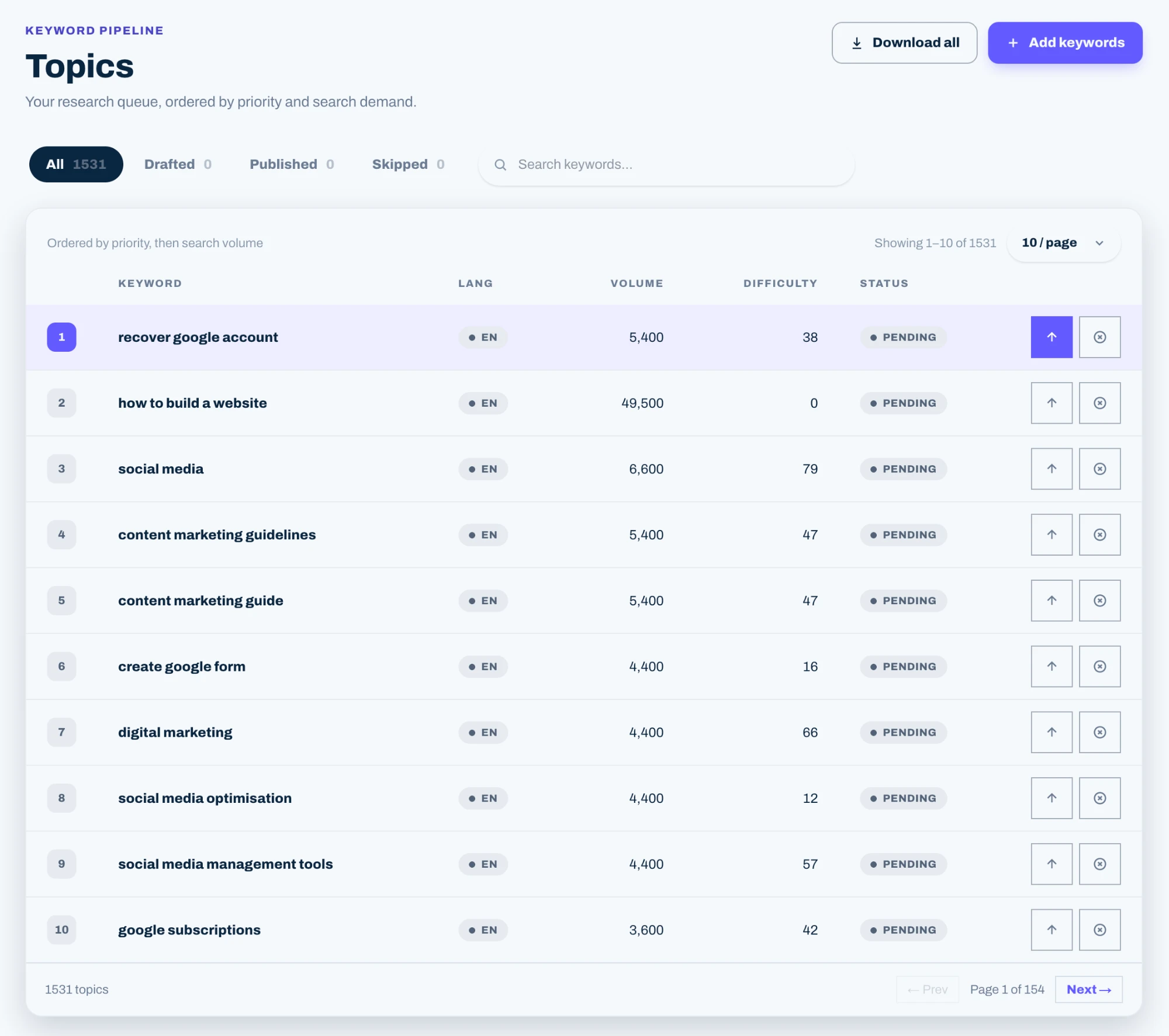
A keyword list is more useful when it becomes a research queue. Volume and difficulty help prioritise the work, while the brief still has to account for the decision behind the search.
Clear passages help, but chopped-up prose does not
GEO advice often turns into a writing formula: answer every heading in one sentence, keep every paragraph short, add a list, repeat. The result is easy to scan and painful to read.
An extracted passage does need to make sense. If a section says “This is better for them because of that,” it loses meaning outside the surrounding paragraphs. The fix is usually simple. Name the subject. State the condition. Keep the evidence next to the claim.
Compare these two sentences:
It is usually the best option because it offers more flexibility.
WordPress is usually the stronger choice for an editorial team that needs custom post types, plugin-level SEO controls, and direct access to its publishing API.
The second sentence survives extraction. It also helps a human reader. That is the standard to aim for.
Do not turn the whole article into disconnected answers. Context still matters. A recommendation needs its assumptions. A statistic needs its population and date. A comparison needs a consistent set of criteria. Good GEO writing is not fragmented writing. It is precise writing.
Evidence has to sit where the claim is made
Many pages look researched because they have a source list at the bottom. That is not enough when the reader cannot tell which source supports which number.
Place a link beside the claim it supports. Prefer the original research, official documentation, regulatory notice, or first-party dataset where one exists. If the source is secondary, say what it adds rather than allowing it to impersonate the original evidence.
Specificity matters here. “Research shows” is weak. Name the researcher, the sample, and the finding that matters. “Prices increased” is incomplete. State which prices, in which market, over which period.
AI systems can still misread a perfectly sourced page. Publishers do not control the final answer. Precise attribution simply removes avoidable ambiguity.
Original evidence is even stronger. A software company may have aggregated workflow data, product benchmarks, survey responses, or direct experience from customer support. Publish the method and its limits. A number with no method is a marketing claim. A number with a clear sample and collection process can become a source.
Technical access now includes more than Googlebot
A page blocked from crawling cannot be retrieved, no matter how good the writing is.
The conventional checks still apply: successful status code, indexable canonical page, useful internal links, readable HTML, stable rendering, correct redirects, and a sensible sitemap. GEO adds a check for the search crawlers used by answer engines.
OpenAI's publisher guidance tells sites that want to appear in ChatGPT search to allow OAI-SearchBot. A permissive robots.txt file is not the end of the test. A firewall or bot-protection service can still return a 403 response. Test the live request path.
Crawler policies are business choices. A company may allow search discovery while blocking other forms of model access. The important part is to make the choice deliberately and verify that the infrastructure follows it.
No, there is no secret GEO schema
Structured data helps Google understand supported page types and can make a page eligible for rich results. It should match the visible page and use documented properties.
It is not a citation switch.
Google says its AI search features do not require special structured data. There is no official “AI optimized” Schema.org type. Adding made-up markup or hiding claims in structured data gives search systems less reason to trust the implementation, not more.
Use Article, Product, Organization, LocalBusiness, FAQPage, or another appropriate type when the page genuinely qualifies. Validate the output. Then return to the harder work: making the visible information accurate and useful.
The same caution applies to llms.txt. It may be an interesting convention for some services, but Google says it does not use the file for Search visibility. Treat emerging techniques as experiments. Do not let them displace technical SEO.
What good SEO already gets right
The arrival of GEO did not repeal the fundamentals.
A site still needs a clear purpose. Each page needs a real audience and a reason to exist. Internal links should show how topics relate. Titles should describe the page rather than bait the click. Important pages should not be buried behind scripts, forms, or orphaned navigation.
Authority still takes time. A new article does not become credible because its paragraphs are quotable. The site has to publish accurate work, earn references, update old information, and avoid wandering into subjects it cannot cover responsibly.
Google's people-first guidance remains a useful test: would the intended audience find the page valuable if it arrived directly, without a search engine in the middle? That question also works for GEO. A page with nothing worth reading has nothing worth citing.
What GEO genuinely changes
Three changes deserve attention.
First, a page may compete at passage level. The article still needs to work as a whole, but one section can earn visibility for a narrow follow-up query.
Second, citation selection makes evidence placement more important. The system needs to connect a claim to its source without guessing what the publisher meant.
Third, measurement becomes messier. A generated answer can influence the reader without sending a click. It can also mention a company accurately, mention it inaccurately, cite it for a minor fact, or use its evidence as a central part of the answer. Those are not equivalent outcomes.
None of this calls for a separate AI version of the website. Maintaining two copies creates more chances for facts to drift. Improve the canonical page.
Measure citations without pretending they are rankings
One favourable prompt is not a performance report. Answers vary by model, search mode, location, wording, and date.
Build a small prompt set from real customer questions. Keep a stable core so results can be compared over time. Record the answer engine, date, cited pages, wording of the brand mention, and the role each source played.
It helps to classify the result:
- The page is absent.
- The brand is mentioned without a citation.
- The page supports a minor fact.
- The page supplies an important comparison or recommendation.
- The answer sends a qualified visit or prompts a branded follow-up search.
For SEO, keep tracking impressions, rankings, clicks, indexed pages, and conversions. For GEO, add citation coverage, cited URLs, answer accuracy, AI-search referrals where identifiable, and assisted conversions.
Do not combine everything into a mysterious visibility score. A score can simplify reporting, but it should not hide the underlying events.
A practical 90-day plan
Start with access. Check indexability, canonicals, internal links, rendering, sitemaps, and crawler rules. Fix those before rewriting dozens of articles.
Then choose one topic cluster close to the product. A cluster is easier to evaluate than a random publishing calendar. Define the main decision page, its supporting questions, and the original information the business can contribute.
During the next publishing cycle, improve how claims are written and sourced. Put direct answers near the questions they address. Add dates to volatile facts. Replace vague claims with observable details. Link related pages where the reader genuinely benefits.
After enough pages are indexed, test a fixed group of search queries and AI prompts. Look for patterns, not isolated wins. If a page ranks but is never cited, inspect the passages competitors are supplying. If it is cited inaccurately, narrow the claim or place the qualification closer. If neither channel finds it, revisit the topic, access, and authority before polishing individual sentences.
Rankauto runs this as one production workflow: research the opportunity, plan the article, write from current sources and brand knowledge, check factual and SEO requirements, then finish and publish through the connected CMS. The value is consistency. The publishing standard still belongs to the business.
Questions people ask about SEO and GEO
Does GEO replace SEO?
No. AI search still needs discoverable source material. Technical SEO, information architecture, useful pages, and credible references remain the foundation. GEO pays closer attention to what happens when a system extracts and combines information from those pages.
Do articles need to be shorter for AI search?
No fixed length wins. The page should be long enough to complete the reader's task and short enough to avoid padding. A detailed comparison may need several thousand words. A factual definition may need only a few paragraphs.
Should every heading be phrased as a question?
Only when that wording helps the reader. Descriptive headings work too. The section beneath the heading should make its subject and conclusion clear.
How quickly can GEO work?
There is no dependable timeline. Crawl access, indexing, competition, site authority, source quality, model behaviour, and freshness all affect visibility. Judge a coherent body of work over repeated tests, not one page after one week.
The useful way to think about it
SEO asks, “Can this page earn the visit?”
GEO adds, “Is there something here worth carrying into the answer?”
The first question gets a page into the conversation. The second forces the publisher to examine the value of each claim. Answer both well and the content is better prepared for Google, AI search, and the person who eventually lands on the site.