SEO Budget: Allocate Costs to the Work Your Website Needs

An SEO budget should pay for a defined set of useful jobs: diagnosing important problems, completing improvements, creating relevant resources, and checking what happens afterward.
A monthly retainer or software subscription tells you what you will spend. It does not tell you whether the website’s main constraint will be resolved. Start with the business goal and current evidence, then price the work needed to make progress.
This guide includes a cost ledger, a proposal comparison method, and an illustrative break-even worksheet. It is designed for founders, marketing teams, and agencies planning work on a US-facing website.
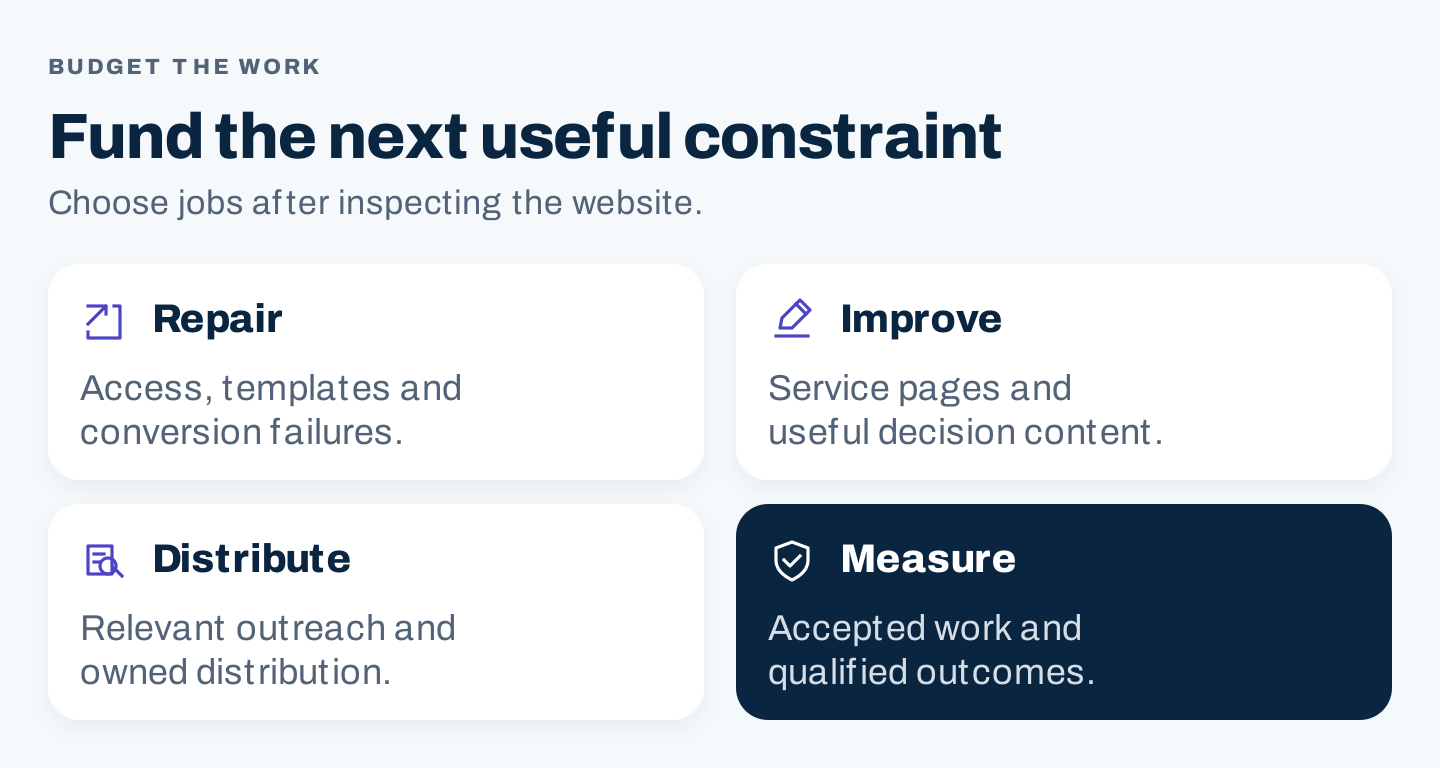
Original allocation framework: fund the work that addresses the website’s next useful constraint.
How much should you spend on SEO?
There is no single monthly amount that fits every website. The appropriate budget depends on the work required, the people who can complete it, the market you serve, and the amount of uncertainty the business can sustain.
A small site with clear service pages may need targeted expertise and a few corrections. A site migration can require technical planning, implementation, and verification across templates. A large content library creates ongoing review and maintenance obligations.
Get current quotes for your actual scope rather than importing a historical industry price range into your plan. Ask what each quote includes, which dependencies remain with your team, and what constitutes completed work.
Google’s hiring guidance recommends examining experience, communication, expected results, and measurement. It also cautions against guaranteed rankings and advises initial read-only Search Console access for an audit. Google’s guidance on hiring an SEO
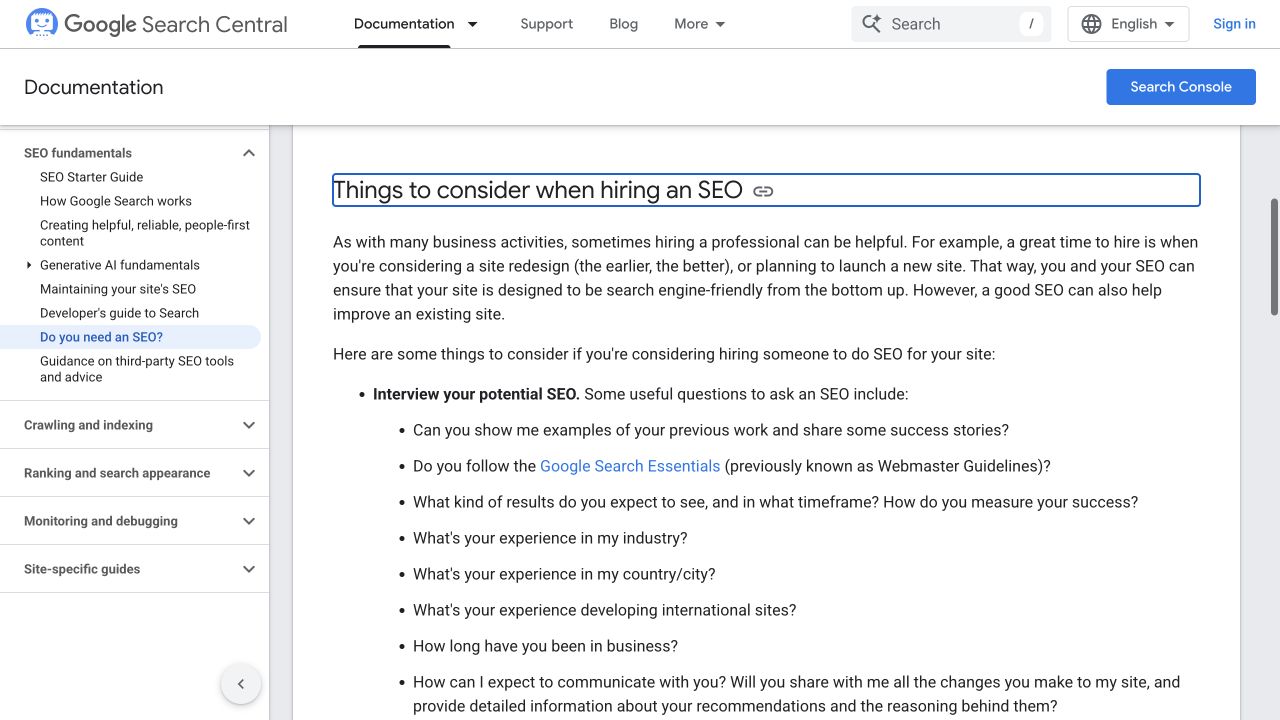
Google’s hiring questions help turn a proposal into an inspectable scope. Source. Desktop capture, October 8, 2026.
1. Define the business goal and baseline
Name the outcome before choosing deliverables. “More SEO” is too broad. A useful goal identifies a customer group, offering, and measurable event.
For a service business, that event may be a qualified estimate request. For software, it may be an appropriate trial or sales inquiry. For ecommerce, it may be completed orders and their contribution after variable costs.
Agree on what qualifies. A form submission from outside the service area is different from an inquiry the business can serve. Save the definition so future reports use the same standard.
Record the baseline:
| Baseline item | What to collect |
|---|---|
| Priority offering | The product or service the work supports |
| Audience and market | Who can become a useful customer |
| Existing destinations | Current service, product, category, and supporting pages |
| Search evidence | Relevant queries and page performance, with dates and source |
| Business events | Qualified inquiries, purchases, or other agreed outcomes |
| Known constraints | Access problems, missing answers, poor contact routes, limited capacity |
If outcome measurement is missing, include the work to establish it. Do not build a confident ROI forecast on events your team cannot currently count.
2. Identify the constraint that changes the work plan
An audit is useful when it turns findings into prioritized actions. Ask what prevents the most important pages from serving the customer well.
Common jobs include repairing an unintended access issue, completing a service explanation, improving a confusing comparison, fixing a broken form, or refreshing outdated product facts.
Distinguish dependencies. A writer can improve copy, but may not be able to change a broken page template. An SEO consultant can identify a problem, but the quote may exclude the developer who must resolve it. A dashboard can surface a finding, but someone still has to investigate and finish the correction.
Create a work register:
| Job | Why it matters | Required input | Dependency | Acceptance |
|---|---|---|---|---|
| Diagnose priority pages | Locate material problems | URLs, access, baseline data | Analyst availability | Findings tied to evidence and recommended actions |
| Repair a confirmed issue | Restore the intended behavior | Reproducible finding | Developer or CMS owner | Live result checked against the agreed condition |
| Improve a buyer page | Complete the customer decision | Approved facts and examples | Subject specialist | Accurate page with useful next action |
| Measure outcomes | Support later allocation decisions | Event definitions | Analytics and sales owners | Documented, working collection process |
These are scope examples, not assertions that every website needs all four jobs immediately.
Prioritize using a written rationale: business relevance, severity, confidence in the diagnosis, effort, and dependencies. A scoring spreadsheet should help discussion rather than pretend that a subjective score predicts a ranking gain.
3. Count cash commitments and internal labor
The invoice is only part of the effort. Your team may also spend time briefing providers, supplying expertise, checking facts, approving changes, and verifying published pages.
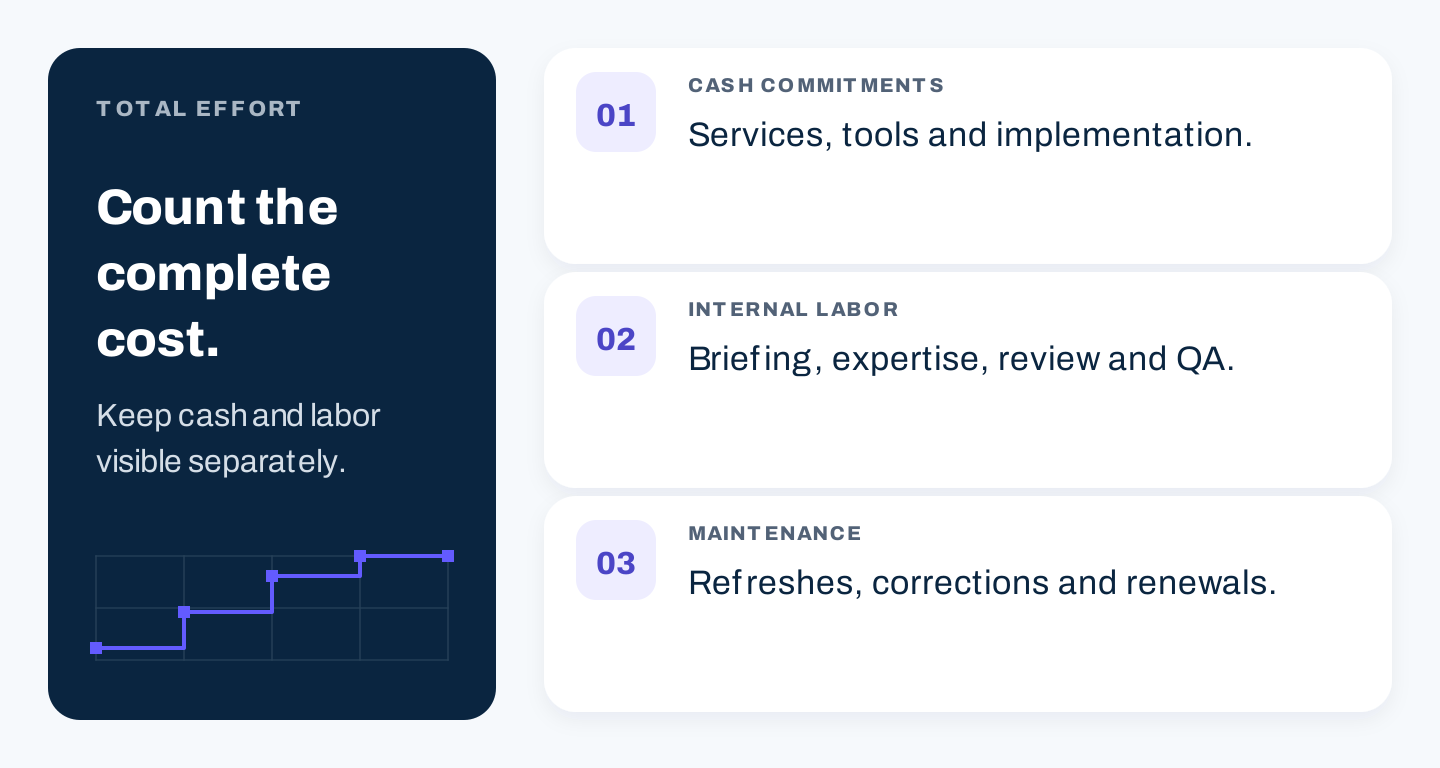
Original cost ledger: show cash and internal labor separately, then account for recurring maintenance.
Use one ledger for planned and actual costs:
| Cost line | Unit | Quantity | Rate or fee | Cash or labor | Timing | Owner |
|---|---|---|---|---|---|---|
| Technical diagnosis | Agreed scope | Enter scope | Current quote | Cash | One-time or recurring | Analyst |
| Implementation | Hours or fixed job | Enter estimate | Current quote | Cash or internal labor | Project | Developer |
| Research and writing | Accepted page | Enter count | Agreed fee | Cash or internal labor | Monthly | Content lead |
| Specialist input and review | Hours | Enter estimate | Internal planning rate | Internal labor | Monthly | Subject owner |
| Software | Seats or usage | Enter quantity | Current terms | Cash | Monthly or annual | Tool owner |
| Visuals and publishing QA | Accepted page | Enter count | Agreed effort | Cash or internal labor | Monthly | Editor |
| Maintenance | Hours or page set | Enter scope | Agreed effort | Cash or internal labor | Recurring | Page owner |
For cash planning, preserve when money actually leaves the business. An annual software payment is an upfront commitment even if you allocate its expense across 12 months internally.
For an effort comparison, value internal time consistently. Do not add an employee’s full salary and the same allocated hours to the same total. Record the method and distinguish a planning estimate from an incremental cash expense.
Include rework when evaluating actual cost. A cheaper draft that repeatedly needs specialist corrections may cost more per accepted page than a more complete first submission.
4. Buy tools for a defined job
Before adding software, name the task, inputs, user, expected output, and action the team will take from it. Remove overlap where two subscriptions serve the same job without a clear reason.
A real example: Screaming Frog’s free and licensed scope
Screaming Frog’s public SEO Spider comparison lists a 500-URL limit for the free version and distinguishes licensed features. The paid version’s practical crawl capacity still depends on available memory and storage. Screaming Frog’s feature comparison
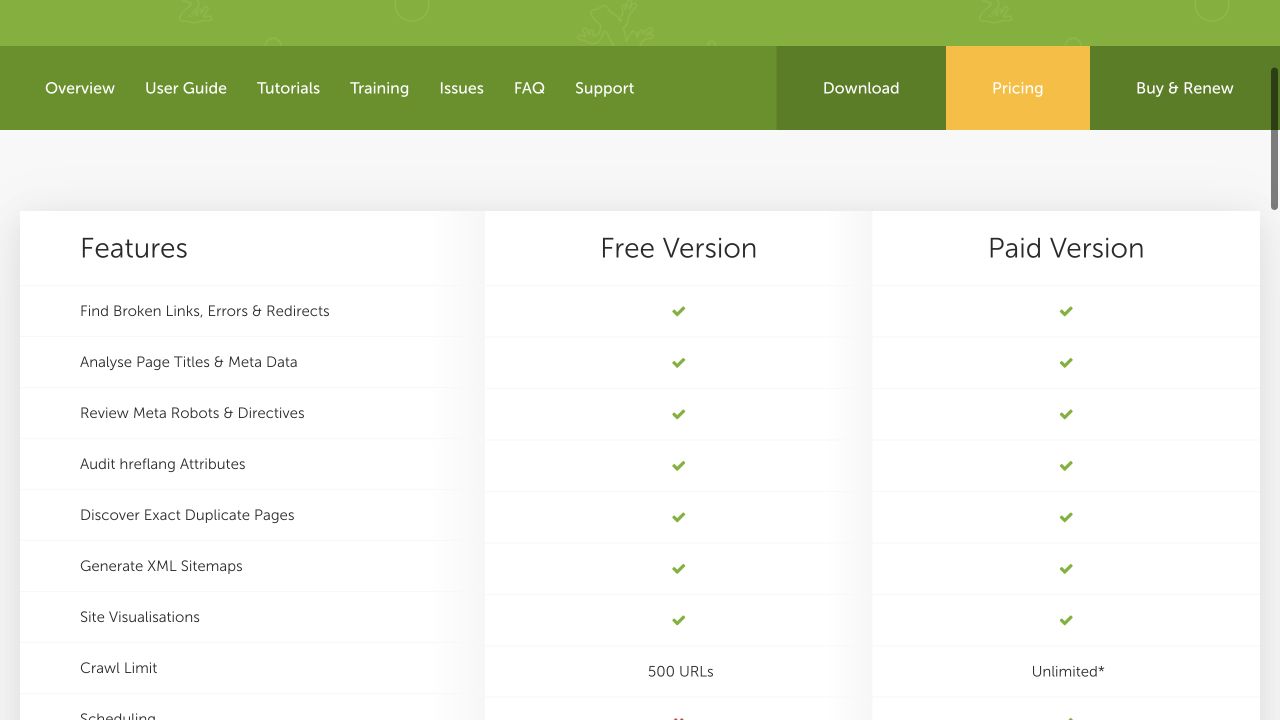
The public feature table shows a scope decision, including the free version’s 500-URL limit. This is not a crawl of your website. Source. Desktop capture, October 8, 2026.
The budgeting lesson is to check what the job needs. A license may be appropriate for a required capability, but it does not include diagnosing every finding, making every fix, or verifying a release.
Ask who will use the tool and how frequently. A founder may need occasional expert help more than another dashboard. An agency should check seat counts, usage, client access, and export requirements before assigning one shared cost across accounts.
Compare options using the companion AI SEO tools guide when tool selection is the main decision.
5. Compare proposals on accepted work
Two proposals with the same monthly fee can cover different amounts of work. Convert each into a shared scope before comparing prices.
Request:
- Named deliverables and the pages or templates involved.
- The evidence and access needed from your team.
- Who implements recommendations.
- Review rounds and who verifies factual claims.
- Visual production, CMS delivery, and publishing checks.
- Reporting definitions and observation periods.
- Maintenance obligations and recurring commitments.
- A clear process for changes in scope.
For a content deliverable, define acceptance through reader usefulness, accurate claims, supporting evidence, relevant visuals, and a checked destination. A word count can describe scope, but it cannot replace those conditions.
For technical work, ask for the finding, intended correction, implementation owner, and verification record. “Monthly audit” is an activity description. It may leave the main problem unresolved if implementation is not funded.
For agency plans, identify what the client must supply and when. A proposal that assumes unlimited expert access or instant approvals may understate the effort required.
6. Build a break-even worksheet with explicit assumptions
Use contribution after the relevant variable costs rather than gross revenue alone. Choose a consistent measurement horizon and define how you attribute new business.
The following is an original arithmetic exercise. Its inputs are illustrative, unassigned to a real company, and are not market prices or promised SEO results.
Assume a monthly planning cost of $3,000 and contribution of $750 per additional customer within the chosen horizon:
Break-even additional customers
= total planning cost / contribution per additional customer
= $3,000 / $750
= 4 customers
If 20% of additional qualified inquiries become customers, the corresponding inquiry requirement is:
Break-even additional qualified inquiries
= 4 / 0.20
= 20 inquiries
“Additional” matters. You cannot count all existing organic customers as the gain from a new project. Define the baseline and document how confidently you can estimate the incremental contribution.
Now vary the assumptions while holding the same $3,000 cost and $750 contribution:
| Illustrative win rate | Additional customers needed | Additional qualified inquiries needed |
|---|---|---|
| 10% | 4 | 40 |
| 20% | 4 | 20 |
| 25% | 4 | 16 |
These are sensitivity calculations, not demand forecasts. To use them, your team needs credible evidence about qualified demand, win rates, contribution, and the time required to realize it.
If the calculation includes repeat purchases, state the period, retention assumptions, variable service costs, and cash timing. A projected lifetime contribution is not money received immediately. Do not combine a lifetime customer value with a one-month expense and label the ratio realized monthly ROI.
When you report ROI, distinguish a benefit-to-cost ratio from net return:
Net ROI = (incremental contribution - included costs) / included costsKeep uncertain or unattributed benefits visible as context rather than assigning them invented revenue.
7. Choose a sustainable commitment
Separate setup, recurring production, and maintenance. Then decide how much work the business can sustain while outcomes remain uncertain.
A fixed diagnostic project may make sense when the main constraint is unclear. A recurring scope may fit a known backlog with available implementers. A content expansion may need a small pilot before the team commits to a large publishing volume.
Write down review points and decision criteria. At an early checkpoint, assess whether work is accepted and implemented. At a later checkpoint, review available business outcomes with the appropriate limitations. Do not expect every job to mature on the same schedule.
For limited budgets, reduce scope deliberately. Finish a smaller set of important jobs instead of funding fragments that depend on unfunded implementation. Preserve core accuracy and customer routes while postponing less relevant expansion.
8. Review allocation against the next constraint
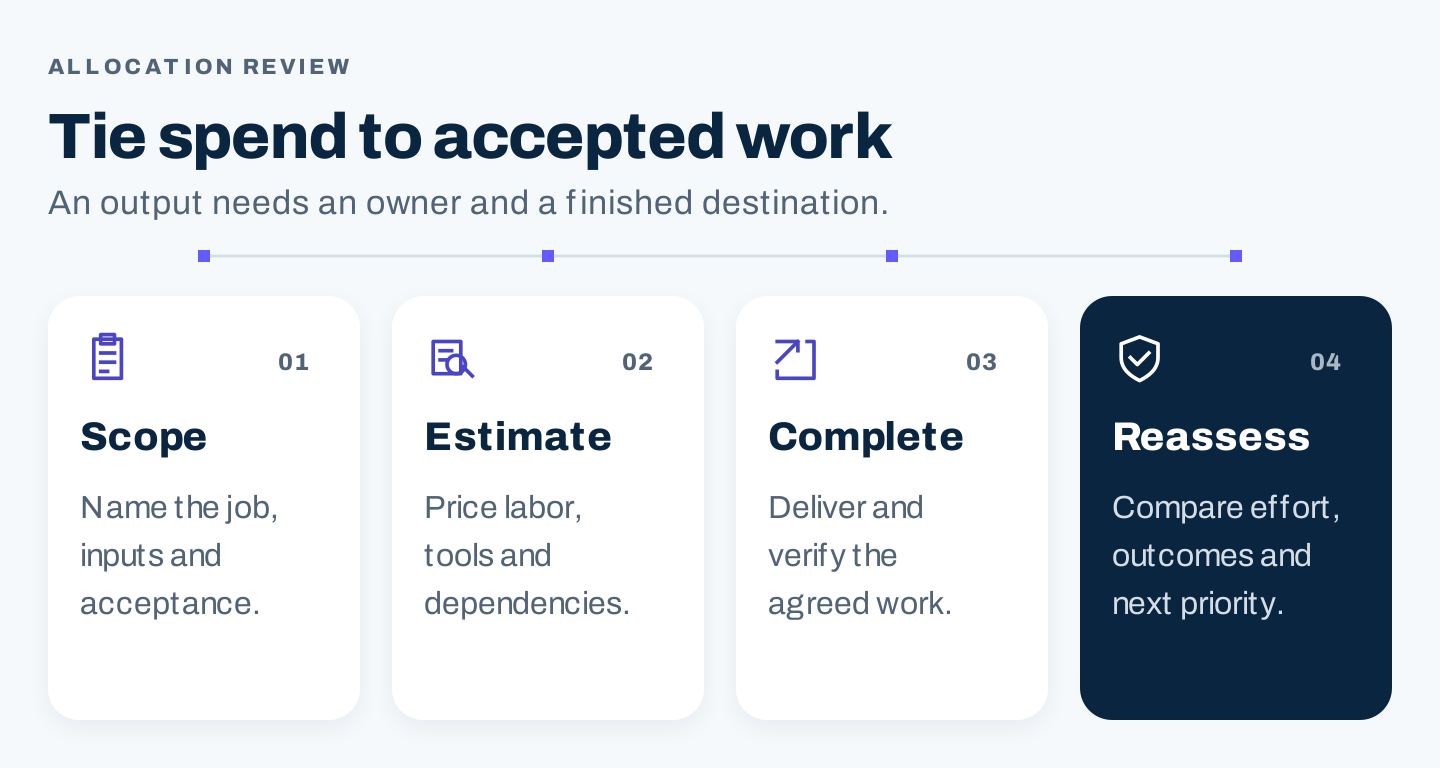
Original review cycle: compare the estimate with accepted work, actual effort, and the next useful priority.
At each review, compare planned and actual cash, labor, accepted deliverables, rework, and unresolved dependencies. Then inspect the available outcome evidence.
Ask:
- Was the agreed work completed and verified?
- Did internal effort exceed the estimate?
- Which findings remain unresolved, and why?
- Are qualified outcomes changing in the relevant cohort?
- What else changed during the observation period?
- Which job deserves the next allocation?
A budget can remain the same while its mix changes. Once a technical repair is complete, funding may move toward improving important buyer pages or maintaining resources. If new drafts pile up awaiting review, the constraint may be editorial capacity rather than writing capacity.
SEO budget checklist
- Define the audience, offering, and measurable business event.
- Save the current page and outcome baseline.
- Name the priority jobs and their dependencies.
- Price implementation, review, visuals, and maintenance.
- Separate cash commitments from allocated internal labor.
- Check tool scope, seats, usage, and renewals.
- Compare proposals on shared acceptance criteria.
- Use scenario arithmetic with explicit assumptions and a consistent horizon.
- Assign review dates and owners.
- Reallocate from actual findings rather than a universal spending percentage.
The useful budget is the one your team can explain job by job: what will change, who will finish it, what it will cost, and how the result will be checked.