International and Multilingual SEO: Research, Localization, and hreflang

A US English page can attract visitors from another country without being ready to serve them. The product may be unavailable there. The price, delivery terms, support hours, or examples may not fit their situation.
International SEO starts with a market the business can support. Multilingual SEO adds the question of language. Translation and hreflang are parts of the work, but neither replaces a useful local offer and an accountable owner.
This guide shows a real regional example from Apple, then provides a practical market brief, a small hreflang exercise, and a release checklist. The Apple screenshots demonstrate visible localization. They are not an audit of Apple's hreflang implementation or search performance.
1. Define the market and language separately
Google's international-site guidance distinguishes pages for different languages from pages for different countries. One language can serve several markets; one market can need several languages.
For a US-based team, write down the actual expansion task. “Go international” is not specific enough to determine the research, URL structure, review process, or service requirements.
| Planning question | What to record |
|---|---|
| Who can we serve? | Supported customer type and destination market |
| Which language is useful? | Language, local terminology, and reviewer |
| What differs commercially? | Currency, available offer, delivery, payment, and conditions |
| How will people get help? | Contact route, hours, language, and escalation owner |
| Who maintains the page? | Local owner and dependency on shared product facts |
Start with one supported market and a small page family. Do not create a translated site for every country represented in analytics. Visits are a discovery signal, not proof of service readiness or profitable demand.
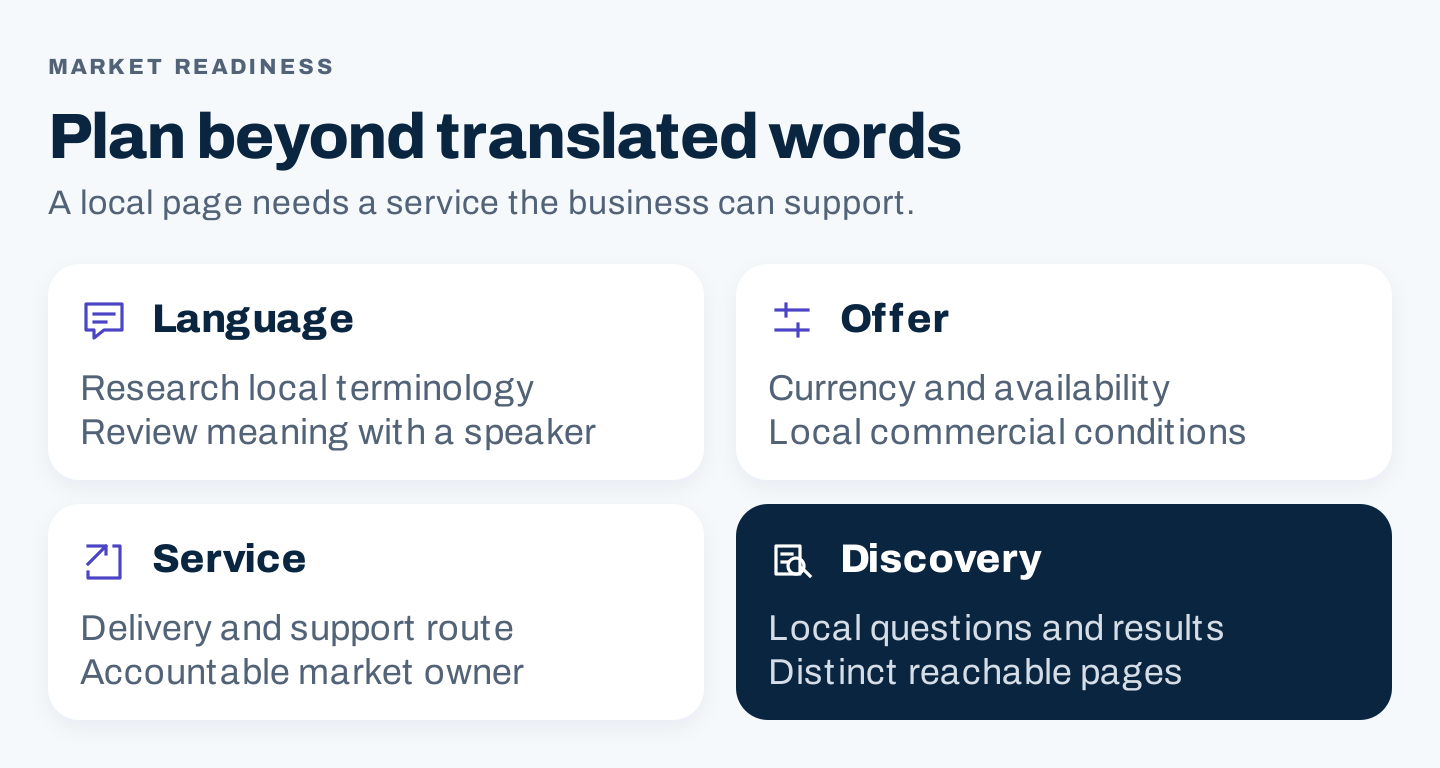
Original readiness framework: evaluate the local offer and service capacity before adding pages.
A useful go/no-go decision includes evidence and unresolved conditions. “Proceed after the local service policy is approved” is more actionable than a high opportunity score with no owner.
2. A real regional example: Apple's US and UK AirPods pages
Apple's US AirPods purchase page and UK version present the same product in English. The captured views show different currencies and regional payment wording.
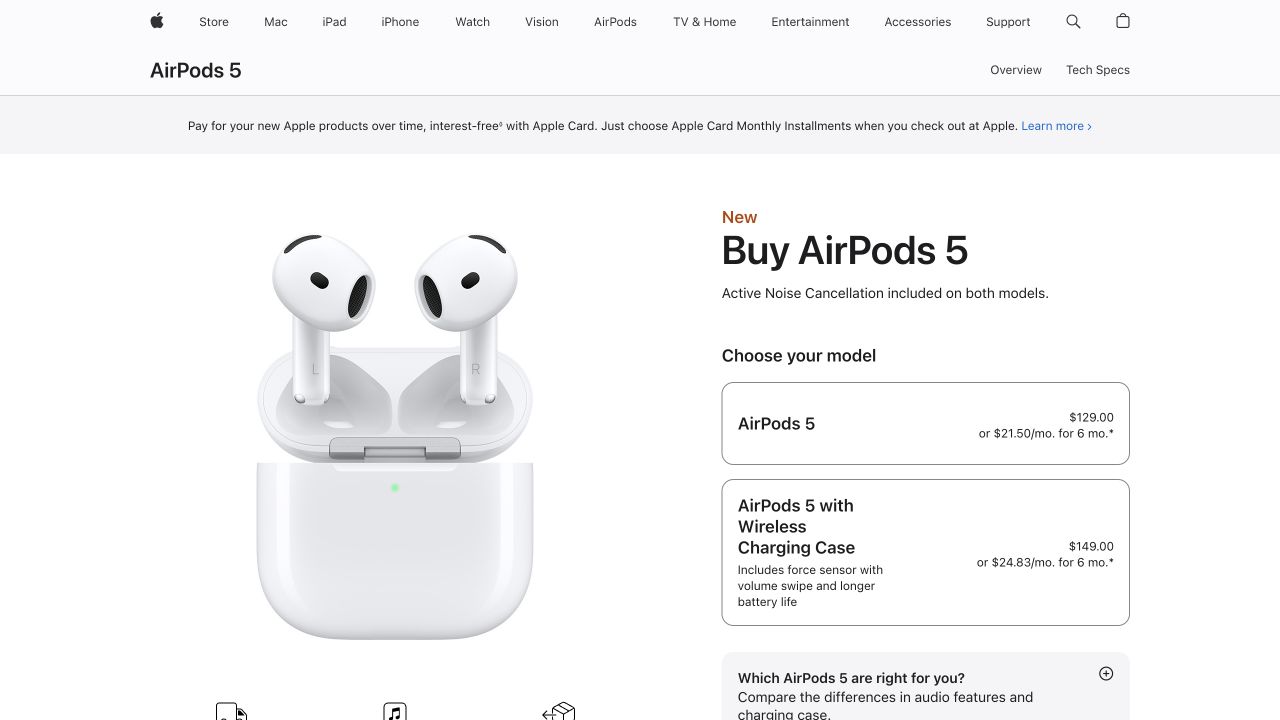
Apple's public US desktop page, captured October 8, 2026. Commercial details can change; this is a visible regional-content example.
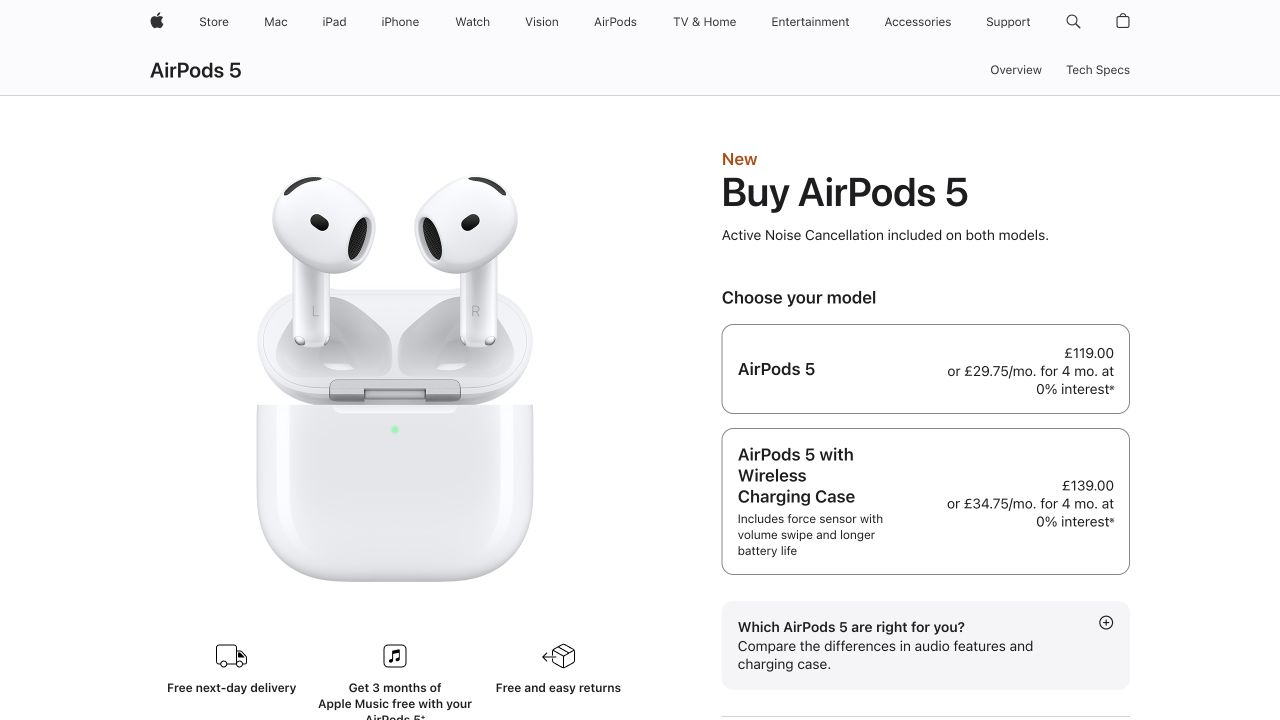
The corresponding UK page shows market-specific commercial details. Both examples use English, so they illustrate regional localization rather than translation into another language.
The lesson is practical: changing a language label is not enough. A reader may understand the words while still needing a different buying route or set of conditions.
For your own business, compare the equivalent pages side by side. Check the offer, currency, form destinations, contact details, examples, units, and support route. Open the links rather than assuming that a translated button reaches a local destination.
Record what you can observe. These screenshots do not establish how Apple researched demand, organized internal ownership, configured alternate tags, or measured results. Apply the visible principle to your own page review without inventing the company's underlying process.
3. Research local questions before translating the keyword list
Take a small set of real customer tasks into local research. Ask a qualified speaker which terms are natural, which meanings are ambiguous, and whether the phrasing changes with the intended audience.
Search the candidate phrases in the target language and market. Inspect the competing page types, commercial conditions, and expected level of detail. Record the search setup and date so another reviewer can understand the observation.
Use keyword estimates for that market where available. Preserve the provider, query, location, language assumptions, and timestamp. A US volume estimate is not evidence of UK or another market's demand. A translated English phrase may not be the phrase people actually use.
Supplement keyword research with local sales and support questions. If the business does not have those inputs yet, label the uncertainty and keep the initial release small. Do not substitute invented customer quotes for missing market knowledge.
Copy this market research record:
Market, language, and audience:
Supported offer and service route:
Reader task:
Local candidate terms and reviewer:
Current result types and research date:
Volume estimate, provider, and market if available:
Questions from real customers or local staff:
Existing page and localization gap:
Evidence available and unresolved assumptions:
Decision: proceed / revise / defer
Owner and conditions for proceeding:
Prioritize a question you can answer and maintain. A technically neat page targeting an unsupported service is still a poor destination.
4. Choose a URL structure your team can maintain
Separate, stable destinations make the local versions easier to review and share. Google's multi-regional documentation discusses country domains, subdomains, and subdirectories, and recommends accessible locale versions and user choice rather than automatic locale redirects.
Use the following as operational questions, not a ranking hierarchy:
| Structure | Question for the team | Practical tradeoff to assess |
|---|---|---|
| Country domain | Can we maintain a distinct domain and local operation? | Separate ownership, infrastructure, and ongoing work |
| Locale subdomain | Does the platform need a separated deployment? | Cross-team coordination and consistent navigation |
| Locale subdirectory | Can one platform serve and maintain the variants? | Shared templates and clear local content ownership |
Have the technical owner review the chosen structure before large-scale translation. Check CMS support, routing, navigation, deployment, and maintenance. Avoid changing an established URL system solely because an article declares another structure universally better.
Naming conventions should be explicit. Decide how page families, locale identifiers, and translated slugs will be tracked. A spreadsheet can be enough for a small pilot if it records exact URLs and owners consistently.
Test the selector from every version. A person reading a UK guide should be able to choose another locale and still reach a useful destination. If the exact equivalent does not exist, provide a clear alternative rather than silently implying that it does.
5. Write a localization brief with clear boundaries
Translation preserves meaning. Localization also checks whether the information and next action fit the market.
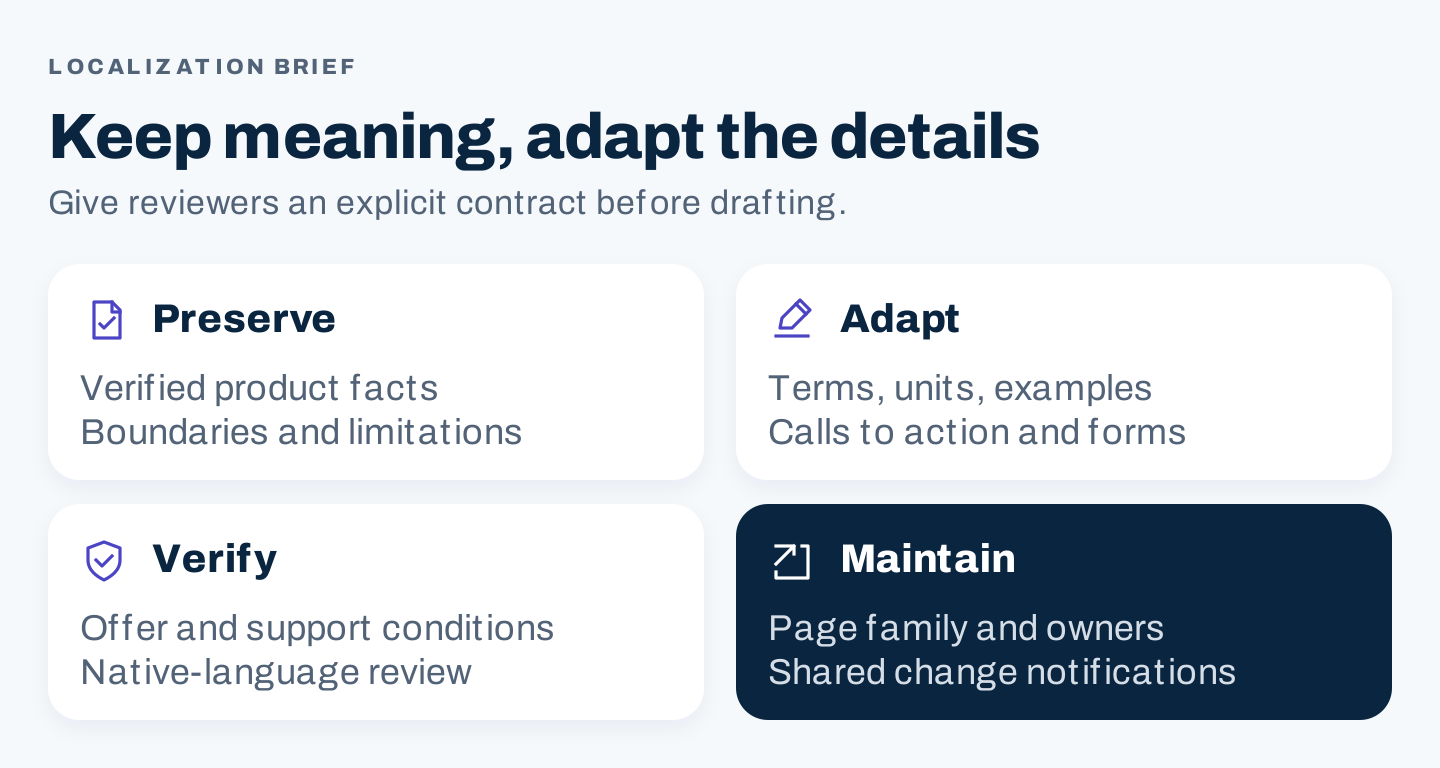
Original brief contract: distinguish facts that must remain consistent from details that need local adaptation.
Give the writer and reviewer an explicit list:
- Preserve: supported product facts, evidence, limitations, and the article's reader task.
- Adapt: terminology, examples, units, images, dates, forms, and calls to action where appropriate.
- Verify: offer availability, payment and delivery conditions, policy wording, and support destinations.
- Maintain: the page family, shared dependencies, responsible owners, and review triggers.
Use a glossary for terms that have a specific product meaning. Include approved translations and phrases that should remain unchanged. Resolve ambiguity with the product owner and local reviewer before publication.
Do not infer local legal or commercial conditions from the source-market page. Route those details to the responsible business reviewer. A fluent sentence can still describe an offer the company does not provide.
Optional AI assistance for a review draft
An AI draft can reduce repetitive work when the input facts and glossary are approved. It cannot replace a qualified local review.
Prepare a localization review draft for the specified audience.
Preserve all supported facts and limitations in the source.
Use only the approved glossary and local offer information.
Flag ambiguous terms and details needing local confirmation.
Do not invent local policies, prices, availability, or examples.
Return the draft plus a table of changes and unresolved issues.
Source and fact references: [approved material]
Target market and language: [specific audience]
Glossary: [approved terms]
Local offer and support information: [verified details]
Have the reviewer assess meaning, natural usage, and the actual buying or service path. Keep unresolved questions out of the final page until the relevant owner answers them.
6. Use hreflang for equivalent locale versions
Google's localized-version documentation supports alternate annotations through HTML, HTTP headers, or sitemaps. Use valid language codes, optional region codes, and fully qualified destinations. Include each page itself and return links between variants. en-GB identifies UK English; en-UK is not the supported code. An x-default destination can serve unmatched users.
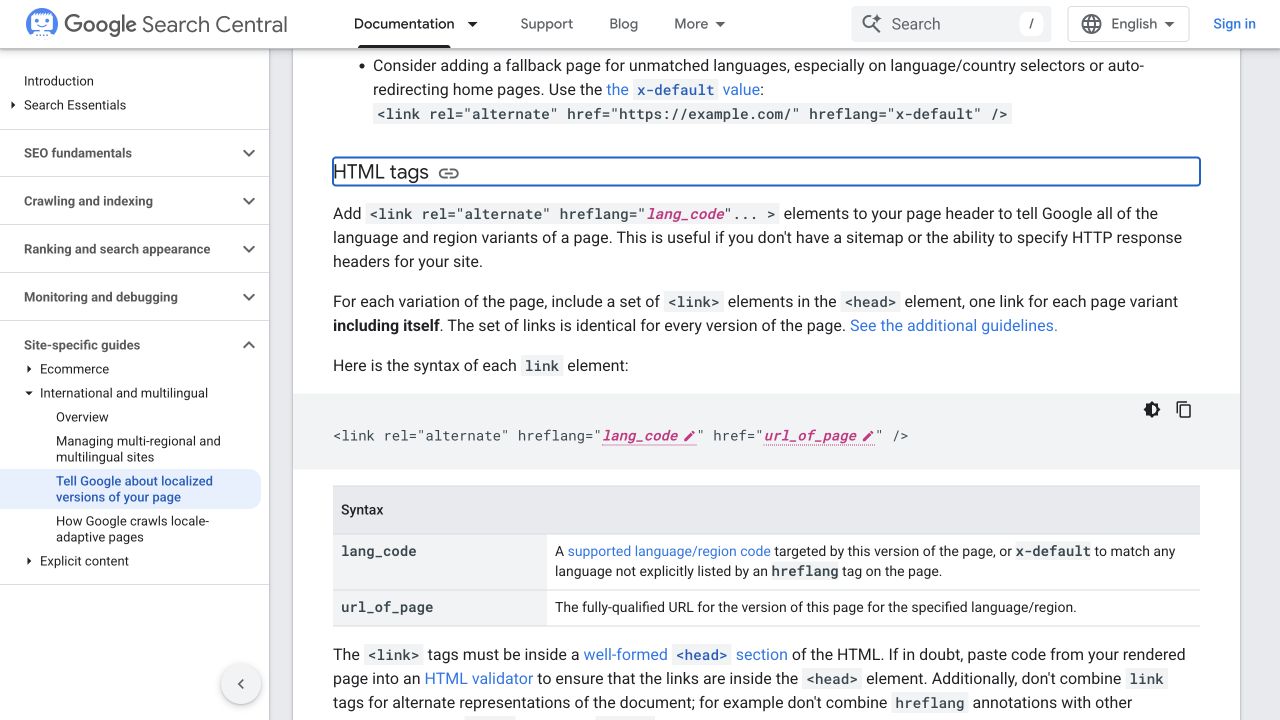
Current public Google documentation. This screenshot supports the syntax discussion, not a test of a live site's implementation.
Here is an original, unexecuted syntax exercise. The example.com URLs are placeholders, not a business case. Suppose a buying guide has US English, UK English, and a neutral selector destination. Place the following set in the head of each applicable HTML page:
<link rel="alternate" hreflang="en-US"
      href="https://example.com/us/buying-guide/">
<link rel="alternate" hreflang="en-GB"
      href="https://example.com/uk/buying-guide/">
<link rel="alternate" hreflang="x-default"
      href="https://example.com/choose/buying-guide/">
Replace the placeholders with approved, real equivalents. The selector in this exercise is a proposed destination; do not add a URL that does not exist.
Keep the implementation method deliberate. Maintaining several annotation mechanisms creates more places for inconsistencies; using all of them is not a requirement.
Review the family together rather than checking one tag in isolation:
| Review case | What to inspect | Release decision |
|---|---|---|
| A destination changed | Exact current URL and the references from its equivalents | Update the family before expansion |
| One locale is missing | Whether a genuine equivalent has been approved | Do not invent an alternate to fill the matrix |
| A locale code looks wrong | Supported syntax and intended audience | Correct and recheck the affected entries |
| Return links are missing | The corresponding alternate sets | Repair and inspect the family again |
| Canonical signals conflict | Intended indexing and duplication treatment | Escalate to the technical owner |
Canonical annotations and hreflang have different purposes. Review their interaction against Google's documentation for the actual duplication pattern; do not mechanically make every locale canonical to the US page or assume every same-language family uses one identical rule.
7. Release one page family with named reviewers
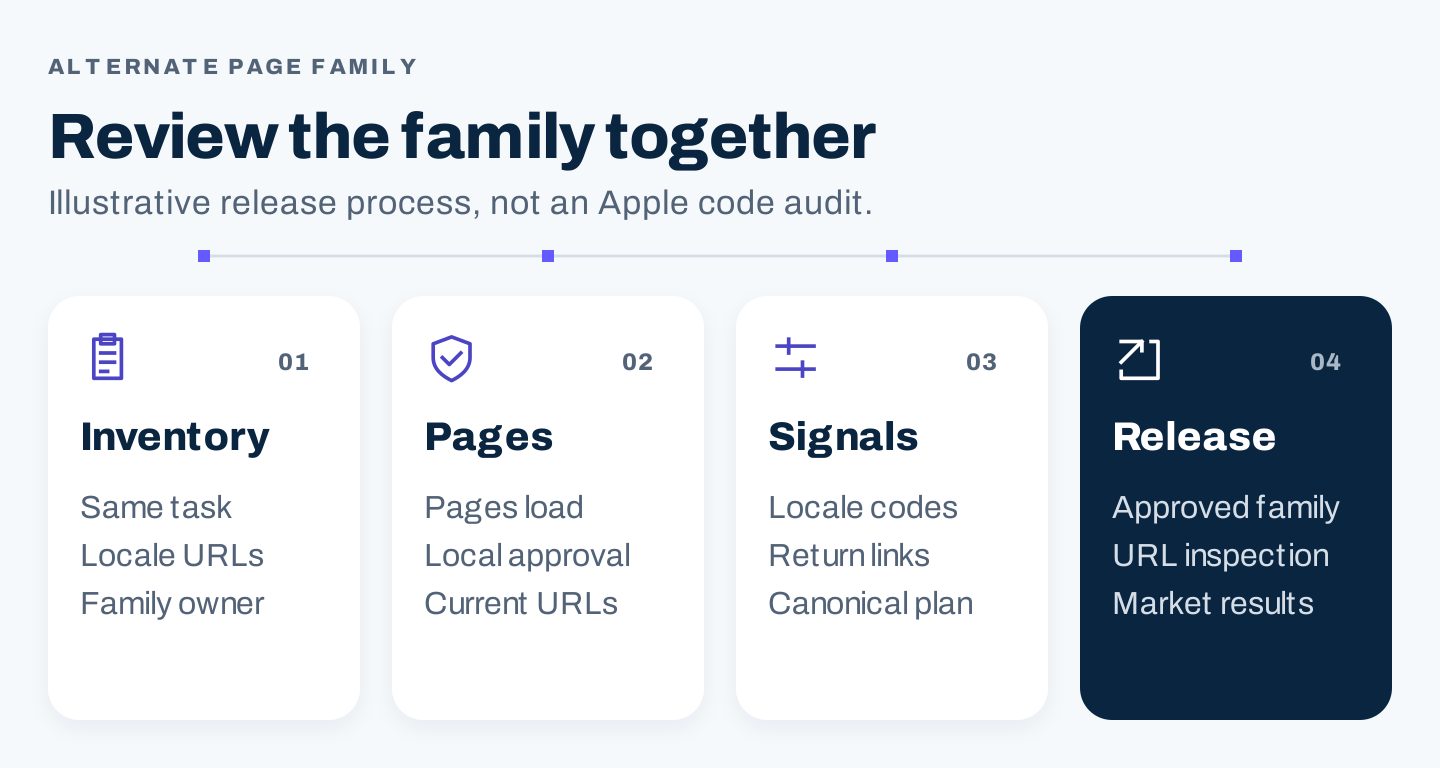
Original release process: review content, destinations, and signals as a connected family before expanding the locale rollout.
Use three distinct approvals: the local reviewer checks meaning and usability, the business owner checks the offer and support conditions, and the technical owner checks URLs and implementation.
The people can overlap on a small team. The responsibilities still need to be explicit.
A proposed release record:
Page-family ID and reader task:
Locale URLs and corresponding versions:
Source facts and local offer references:
Language reviewer and unresolved issues:
Business owner and approval:
Technical method and validation record:
Selector and next-destination checks:
Desktop and phone review:
Publish date and rollback reference:
Shared changes that trigger a new review:
Inspect the actual published pages after release. A correct source file does not establish that the CMS rendered the intended annotations or preserved the local form destination. Save the findings and fix mismatches before duplicating the approach across many pages.
For content marketing, plan distribution with the local owner. An approved guide might support a market-specific email, partner resource, webinar, or sales conversation. Reuse the same current facts and appropriate destinations across channels.
8. Measure each market on its own terms
Report the intended market and page family. Separate branded and nonbranded discovery where your data supports it. Keep search visibility, relevant visits, inquiries, and completed business outcomes distinct.
Record the language and geography available in your measurement system, along with their limitations. A browser's language setting is not necessarily the reader's preferred language or purchasing location.
Compare periods with similar coverage and business conditions. Note launch dates, promotions, offer changes, and tracking gaps. Do not judge a new market by its first week's traffic or attribute every later improvement to hreflang.
Use early feedback to diagnose the next step. Visitors who cannot complete a form may need a corrected destination. Repeated support questions may reveal missing local conditions. Strong discovery with poor customer fit may mean the topic or offer needs revision.
Expand after the team can maintain the first family reliably. The initial goal is a useful local destination with clear ownership and functioning measurement, followed by evidence-based growth decisions.
International SEO questions
Do we need a translated version for every country?
No. Choose languages and markets from customer needs and the business's ability to serve them. Several countries may share a useful version, while one country may require more than one language.
Does hreflang make a translated article rank?
It helps communicate alternate versions. It does not replace local relevance, useful content, accessible pages, or a viable offer, and it does not guarantee rankings.
Can we launch with AI translation?
Use it as a review draft when appropriate. Verify meaning, current facts, local conditions, and the entire next-step journey with responsible reviewers before publication.
What is the smallest sensible pilot?
One supported market, a small family of important pages, named content and technical owners, and a reviewable local offer. Complete that loop before expanding the translation queue.