Franchise SEO: Coordinate Brand Standards and Local Information

A customer searching for a franchise rarely wants the entire organization’s marketing story. They want to know which branch can help, whether that service is available there, and what to do next.
Franchise SEO connects those local questions with the wider brand. It includes useful corporate content, discoverable branch pages, eligible business profiles, and an operating process that keeps local information accurate.
The difficult part is coordinating people. Corporate marketing may own the website, an agency may edit the pages, and the franchisee may be the only person who knows that a service has changed. A good plan makes that knowledge travel.
This guide uses real public pages from The UPS Store to explain the handoff. The examples show information and navigation choices, not evidence of rankings or sales. You’ll also get a fact-ownership worksheet, a release process, and a branch-level reporting plan.
1. Separate brand, branch, and franchise recruitment searches
Start by sorting the questions your website needs to answer. These three jobs often belong to different destinations.
| Reader’s question | Likely destination | Content that earns its place |
|---|---|---|
| What does this brand offer? | Corporate service page | Service explanation, process, limitations, route to a location |
| Can this branch help me? | Branch page | Actual services, hours, contact, directions, appointment requirements |
| Which branch should I choose? | Locator or regional directory | Browseable choices and meaningful differences |
| Can I own a franchise? | Franchise recruitment resource | Separate ownership information and inquiry route |
These are planning categories, not measured keyword volumes. Check the actual search results for your service and market before choosing a page format. A broad query can have mixed intent; a city name does not automatically settle it.
Also read questions from calls, customer emails, and front-desk staff. A recurring question about a pickup deadline may deserve more attention than a high-volume phrase unrelated to an available service.
Keep recruitment and customer journeys distinct. A potential customer should not have to navigate ownership requirements to find a store. A potential franchisee needs information beyond a consumer service description.
For agencies, document the destination before quoting the content work. “Improve franchise SEO” could mean correcting ten branch pages, producing a national service guide, or rebuilding the locator. Those are different assignments with different dependencies.
2. Study the handoff on The UPS Store website
Three connected public destinations illustrate how corporate and local content can work together.
The corporate page explains the service
The UPS Store’s Pack & Ship page introduces the service category and includes a route to find a store. It answers the general question before passing the visitor toward a local destination.
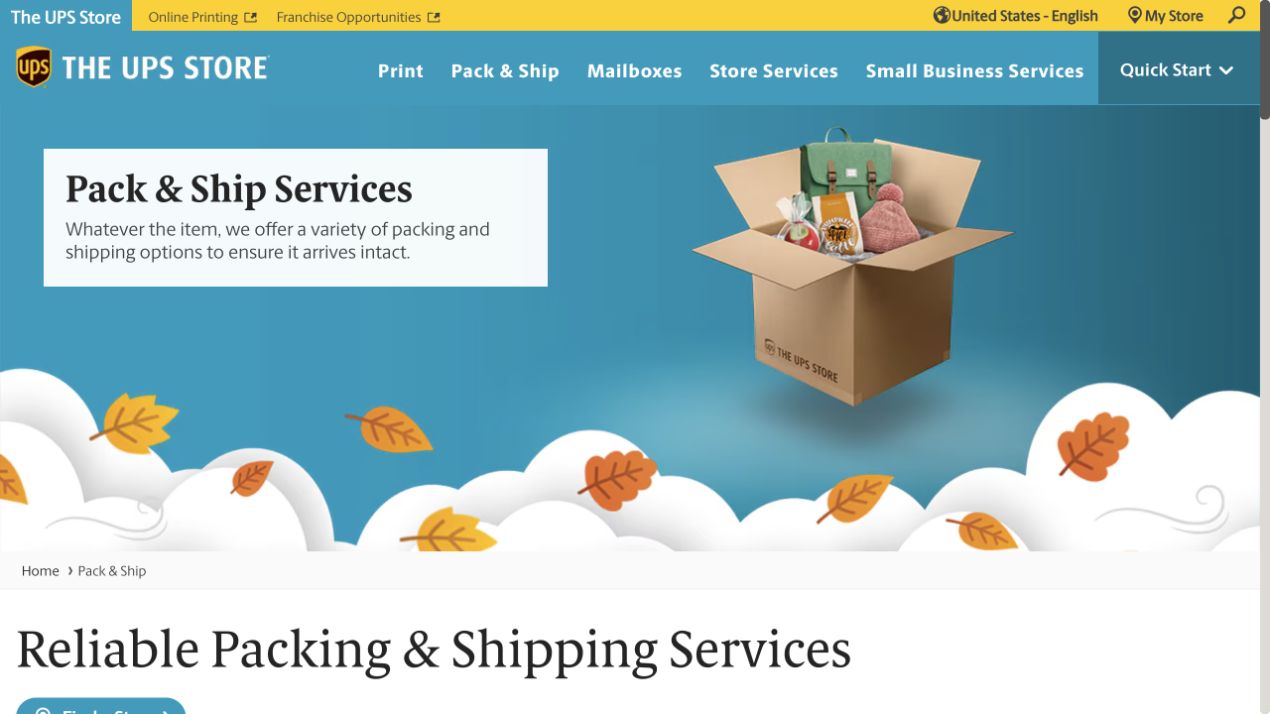
The corporate page provides the service context. The local page must then resolve the visitor’s branch-specific questions. Desktop screenshot, October 8, 2026.
The transferable lesson is to avoid making every branch rebuild the national explanation. Corporate teams can maintain common process information while local pages handle the differences that affect a visit or booking.
If a promise has conditions, put the conditions where the customer can find them. Do not turn a temporary national offer into a permanent branch claim without confirming the dates and participation.
The directory makes locations browseable
The public location directory contains state links. Following New York leads to city destinations, including Albany, and then individual stores.
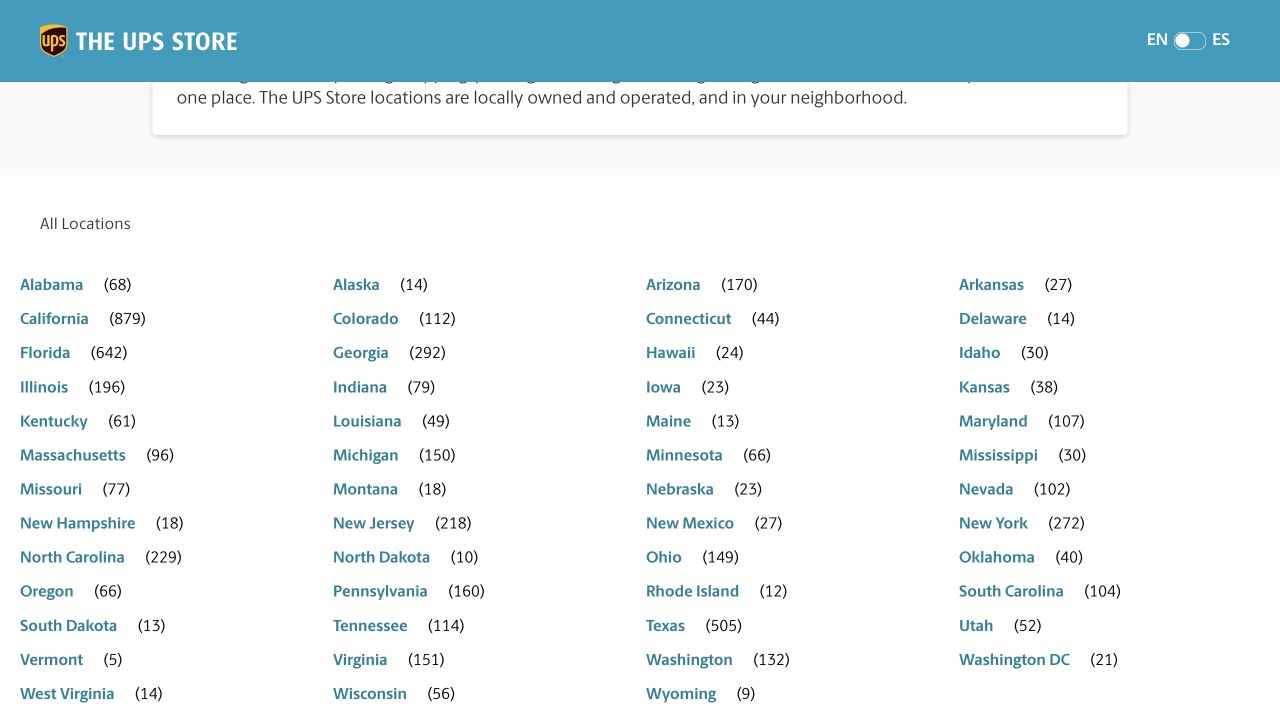
The directory supplies a browseable route toward individual branches. Store counts in this capture are a dated snapshot, not figures to reuse in your copy.
A small franchise may need only a short location list. A larger network may need regional navigation and filtering. Choose the structure around customers’ ability to reach the correct branch, rather than an arbitrary number of directory levels.
Make location links available outside a search box. Someone should be able to inspect a branch without having to surrender their device location or enter a ZIP code first.
The branch page answers operational questions
The Guilderland / Albany page at 1971 Western Ave shows the address, contact routes, store hours, pickup times, and separate notary hours.
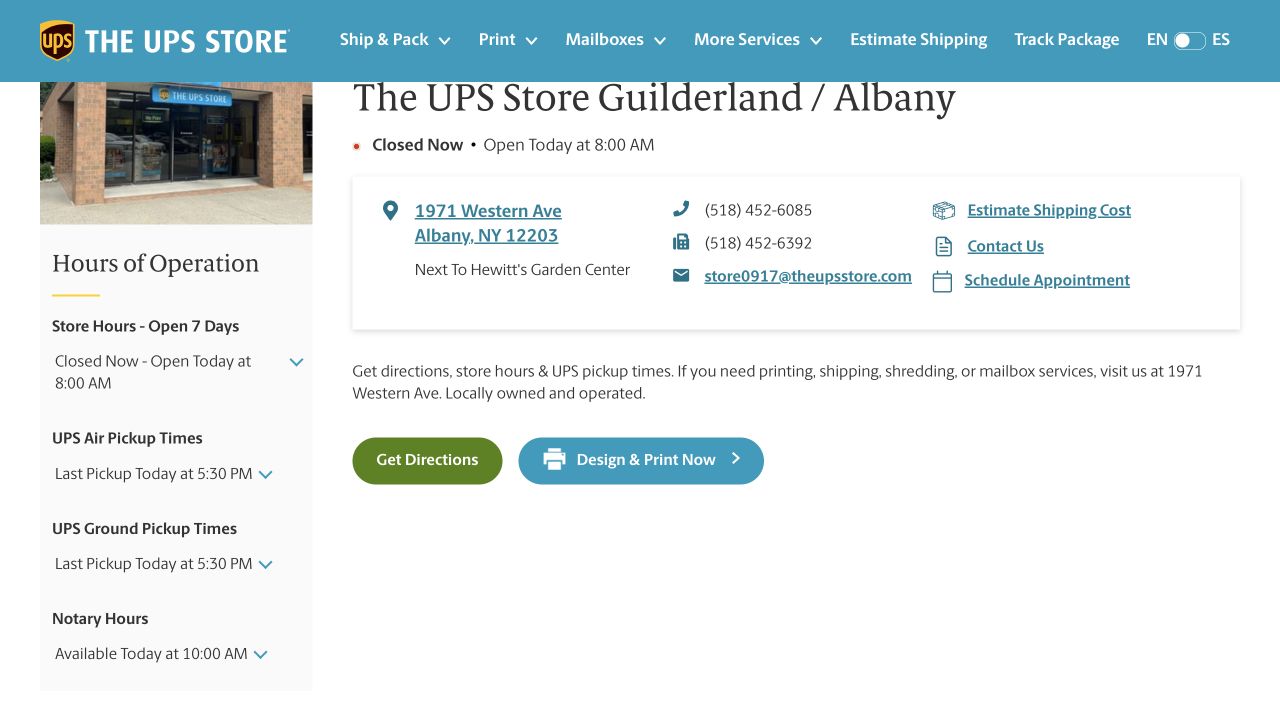
Different services can have different operating windows. The screenshot shows the public page at capture time; confirm current availability directly before relying on it.
That distinction matters. “The store is open” does not necessarily answer “Can I use this service now?” Useful local content makes the difference visible.
The corporate homepage footer also identifies franchise ownership and notes that products, services, prices, and hours can vary by location. This is why copying a national offer into every local page requires review.
3. Give every local fact an owner
A style guide controls presentation. A fact register controls what the business is claiming. You need both.
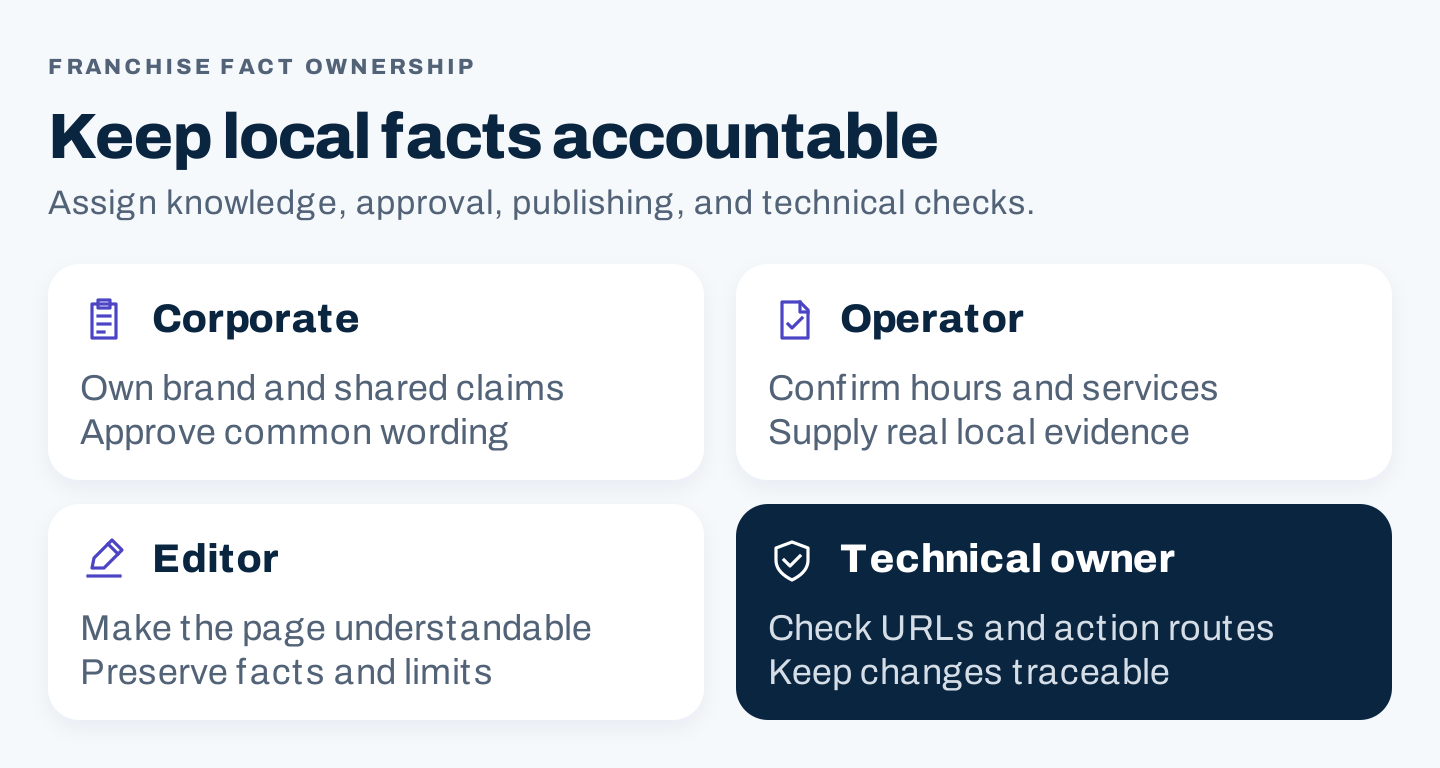
Separate who knows a fact, who approves the wording, and who publishes the change. One person can hold multiple roles in a small team.
Use a simple register with a stable branch identifier. A name alone can become ambiguous when a location moves or changes operators.
| Fact | Evidence owner | Publishing responsibility | Review trigger |
|---|---|---|---|
| Brand name and service wording | Corporate brand team | Website editor | Brand or offer change |
| Address and arrival instructions | Branch operator | Local page editor | Move, entrance change, construction |
| Hours and service availability | Branch operator | Page and profile managers | Holiday, staffing or service change |
| Booking or contact destination | Branch operator | Editor and technical owner | Vendor, phone or workflow change |
| Local photographs and testimonials | Operator confirms source and permission | Editor | New material or permission change |
This is a proposed operating model, not a description of The UPS Store’s internal process.
Record the source, confirmation date, next review, and fallback contact for each important fact. “Approved” should mean a named person confirmed a particular statement, not that a row has a green background.
Do not allow a missing field to silently inherit another branch’s answer. If a service has not been confirmed, resolve the unknown or use accurate contact guidance. Guessing creates a customer promise the operator may be unable to fulfill.
A useful branch interview takes the customer’s perspective: What should they bring? Is an appointment needed? Which entrance should they use? What service is frequently confused with another? Which questions change during holidays?
4. Share the layout; verify the local differences
Templates are useful. A shared heading structure, accessible contact block, and consistent navigation can save work without making every page empty.
The weakness is city-name substitution. Repeating generic brand paragraphs under different place names does little to help a customer choose or use a branch.
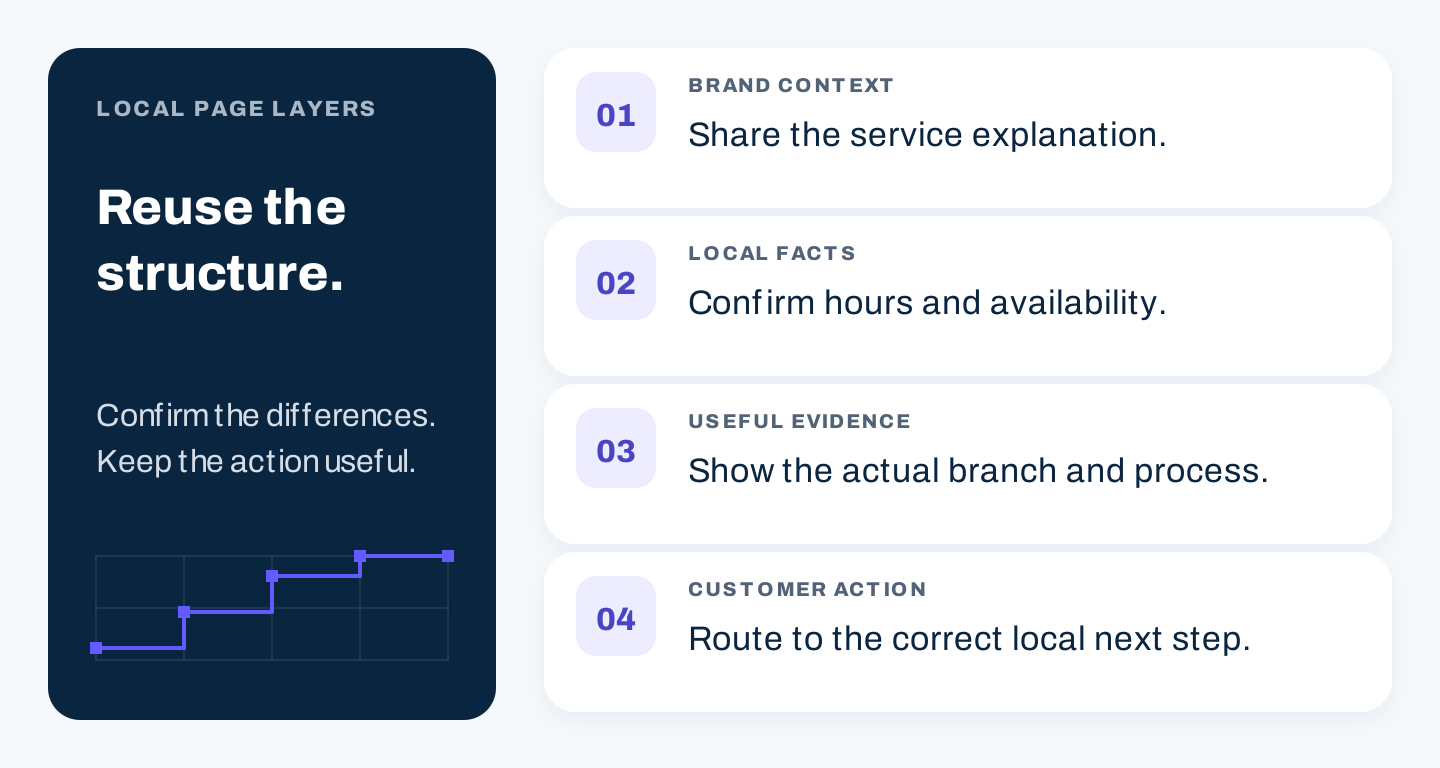
Reuse presentation and common explanations. Supply local facts and evidence where the customer’s decision changes.
For each local page, collect the address or actual service area, specific services, relevant scheduling limits, arrival instructions, and a valid next step. Add a real storefront image when it helps someone recognize the location.
Include a local FAQ only when the answer matters there. A question about parking or a particular service’s availability may be useful. A paragraph about the city’s history usually does not explain why the customer should choose this branch.
The Google Search spam policies address doorway pages and scaled content that adds little value. Do not treat a minimum word count or percentage of rewritten sentences as a safe-harbor formula.
Before creating a service-by-city combination, ask whether you can supply a useful destination with verified local information. If the answer is no, improve the existing branch or service page first.
A shared domain can make governance simpler, while separate franchisee sites may reflect existing business arrangements. Do not recommend a network-wide migration solely because one structure sounds better for SEO. Inventory ownership, maintenance capacity, customer journeys, and existing links before making that decision.
5. Coordinate profiles and reviews with the same facts
A website page and a Google Business Profile are separate surfaces. Adding a city page does not create eligibility for an additional profile.
Google’s business representation guidelines require accurate real-world identity. They address chain naming, consistent categories for locations offering the same service, and service-area situations. Use the current rules rather than adding city keywords to a business name.
Build a reconciliation check around the facts customers depend on: location, contact, hours, and service availability. Assign both a page owner and a profile owner. A change is finished when the relevant destinations have been checked, not merely when the website ticket closes.
For reviews, use a neutral invitation to people with genuine experience. Google’s Maps contribution policy prohibits incentives and selective solicitation of positive reviews. It also restricts pressure for specified review content. Do not prescribe keywords for customers to include.
Respond to issues in a way that helps the customer and protects their private information. A repeated complaint about unavailable appointments may reveal a page problem, an operational problem, or both. Resolve the cause instead of treating the review as a writing exercise.
Google describes local ranking through relevance, distance, and prominence. That does not provide a guaranteed recipe for map visibility or AI recommendations. Report what you observe for each location rather than promising every operator identical results.
6. Build content and community references around real expertise
Once the customer-facing facts work, develop content the business can support with experience.
Corporate teams might maintain a service preparation guide that applies across the network. Operators can contribute local questions, real photographs, and practical details that improve the relevant branch page or guide.
Choose the destination according to the answer. A general preparation question belongs in a maintained service resource. A branch-specific access question belongs on the local page. Creating a separate blog post for every answer can scatter information that should be available together.
Use a short editorial brief:
Customer question:
Reader and next decision:
Best existing destination, or reason for a new one:
Confirmed answer and source:
Local exceptions:
Useful original photo, diagram or demonstration:
Fact reviewer:
Action after reading:
Change that would make this content outdated:
Local partnerships can also create useful references. An event organizer might link to a genuine branch participation page; a chamber directory might help people find an actual member business. Pursue the relationship and the useful destination. Avoid purchasing links intended to manipulate rankings.
Do not turn every local event into a franchise blog article. If you cannot explain the customer value, the publishing and maintenance cost is unlikely to be justified.
7. Pilot one page family before scaling
Choose one branch with a responsive operator and a clearly defined service. Review the corporate service destination, the locator route, the local page, and any relevant profile together.
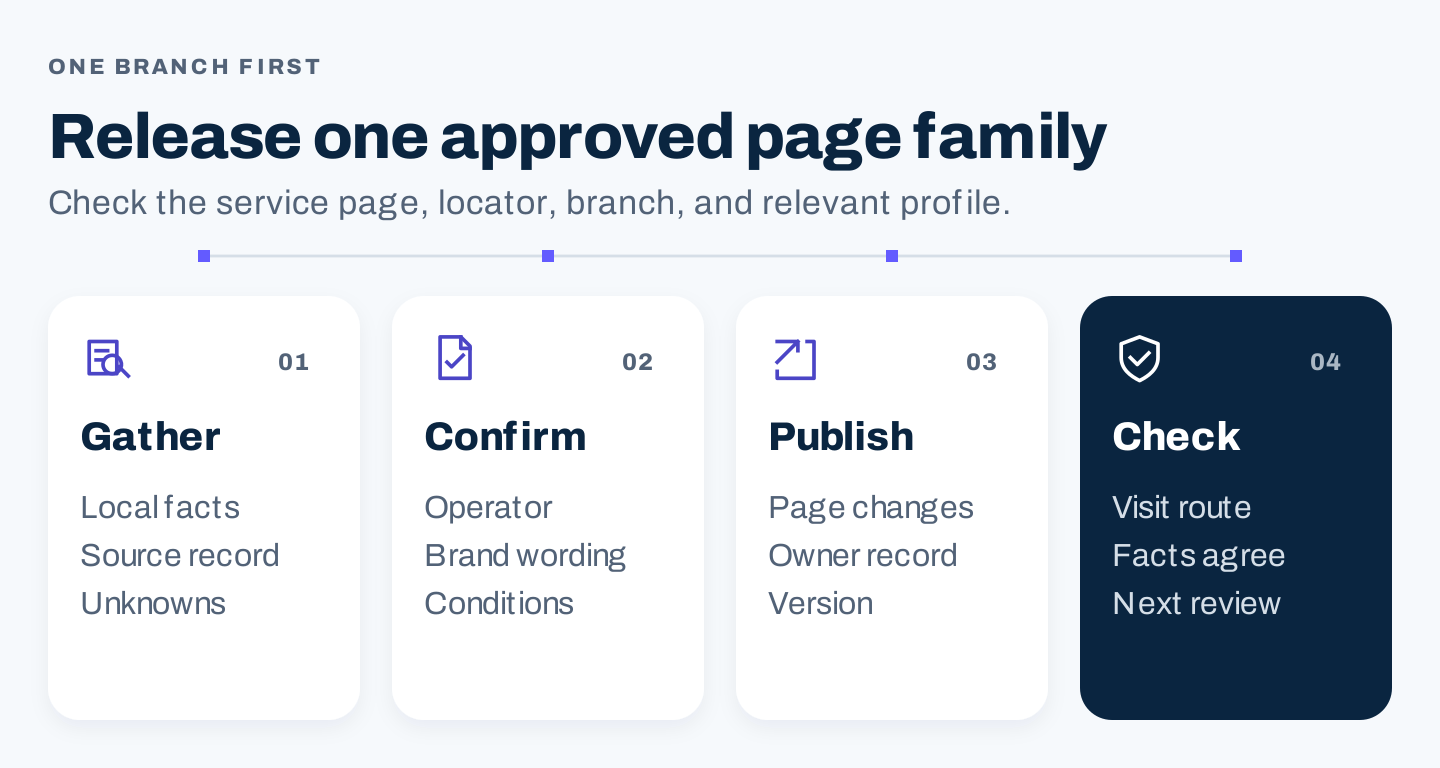
Use a small release to test the process, including the handoff back to the operator. This is a proposed workflow, not a completed business experiment.
Gather the current facts and record disagreements. Have the operator confirm the local statements. Let the editor check clarity, brand wording, and sources. Ask the technical owner to verify navigation and any URL changes before release.
Then inspect the page on a phone and a desktop. Follow the contact and booking routes without submitting a real inquiry. Check that the page identifies the correct branch even when reached directly from an external link.
Maintain a release record:
Branch identifier and exact URLs:
Change and reason:
Facts confirmed by / date:
Page, locator and profile checks:
Contact and booking destination checked:
Remaining issue and owner:
Published version / rollback reference:
Next review date and change triggers:
For discoverability issues, the authorized technical owner can use Search Console URL Inspection. Indexed data and a live test answer different questions; a successful test does not promise indexing or rankings.
Measure branches separately. Organic impressions and clicks show search exposure. Contact clicks show an action on the page. Qualified inquiries or completed bookings show a later business outcome when you have reliable collection. A click on directions does not prove an in-store visit.
Keep definitions, dates, and collection gaps visible. Comparing an appointment service with a walk-in retail service through one blended conversion rate can obscure both.
Questions franchise teams often ask
Does every franchise need its own website?
Not necessarily. Start with ownership, customer journeys, and maintenance capacity. A distinct branch page can answer local questions without a separate domain. Existing franchisee sites need an inventory before any consolidation decision.
How much local content is enough?
Enough to answer the local decision accurately. There is no useful universal page-length or unique-text percentage. Prioritize the facts that change whether, when, and how someone can use the branch.
Should AI write all the branch pages?
AI may help organize approved facts or identify missing answers. It cannot confirm operating hours, staff availability, local experience, or permissions. A structured fact collection and review process is the first investment.
Start with one branch, one service, and one accountable fact register. Scale the process after you can keep the published information accurate when something changes.