B2B SEO and Content Marketing: Map Questions to Buying Decisions

A business purchase can involve a user, manager, technical reviewer, and budget owner. Each person may search for a different answer about the same solution. A product overview can explain the offer without resolving implementation effort or a security concern.
B2B SEO works best when the content plan identifies those questions and gives each one a credible destination. Search volume helps size an opportunity. Buyer fit, evidence, and the ability to answer honestly determine whether it belongs in the plan.
This guide uses real public pages from Slack and HubSpot to demonstrate different buying questions. The examples show the pages' content and purpose; they do not prove rankings, pipeline contribution, or product suitability for a particular organization.
1. Map the buying question before the funnel label
A funnel is a useful organizing device, but it does not tell you everything about a reader. Someone researching implementation may be evaluating a vendor, preparing an approved rollout, or helping an existing customer.
Capture the situation alongside the query. Who needs the answer? What decision are they trying to make? What evidence could help them proceed?
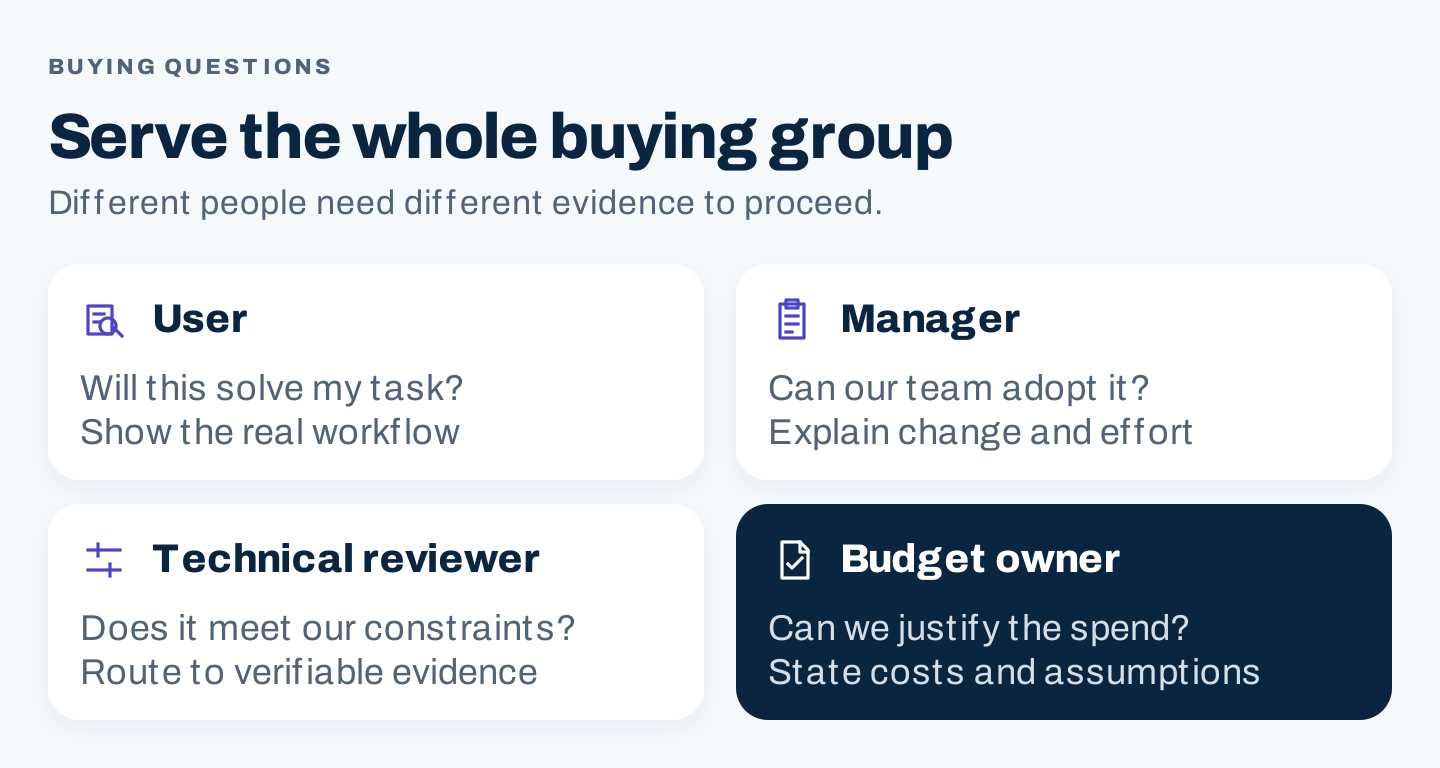
Original buying-group framework: plan for the distinct questions behind a shared purchase, rather than one generic persona.
Use a practical decision map:
| Decision | Question to investigate | Possible resource |
|---|---|---|
| Recognize the problem | What is causing the recurring difficulty? | Diagnostic guide or explainer |
| Assess the approach | Which options address our constraints? | Method comparison or solution resource |
| Review suitability | Does the offer meet our requirements? | Specific capability, integration, or trust page |
| Plan adoption | What must change before we can use it? | Implementation guide or rollout worksheet |
| Approve the spend | What are the costs and assumptions? | Current commercial information or business-case template |
These are planning categories, not claims about every buying journey. Use them to expose missing answers. Do not create five pages if one well-structured resource completes the task.
2. Learn from three real public destinations
Slack's enterprise page addresses the solution-level question
Slack's enterprise page presents an enterprise-oriented offer and a route to a sales conversation.
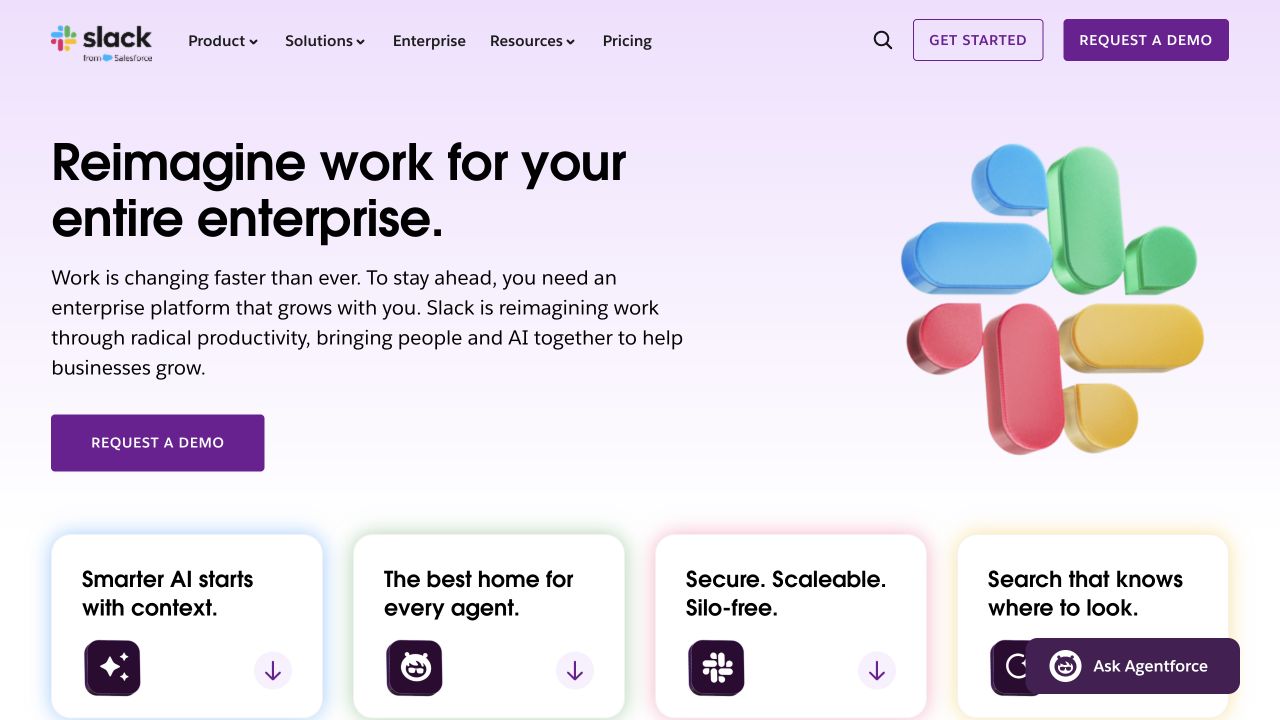
Slack's public desktop enterprise page, captured October 8, 2026. The example illustrates a solution-level destination, not independently tested product performance.
For your own solution page, ask whether readers can understand the intended customer, the problem addressed, and the offer's scope. Link to the resources that answer the next material question instead of inserting every technical detail into the headline section.
The content job differs from a general article about workplace collaboration. A broad educational query deserves an explanation that is useful before the reader has selected a vendor.
Slack's security page gives reviewers a separate resource
Slack's security page presents topics including identity and device management, data protection, and information governance.
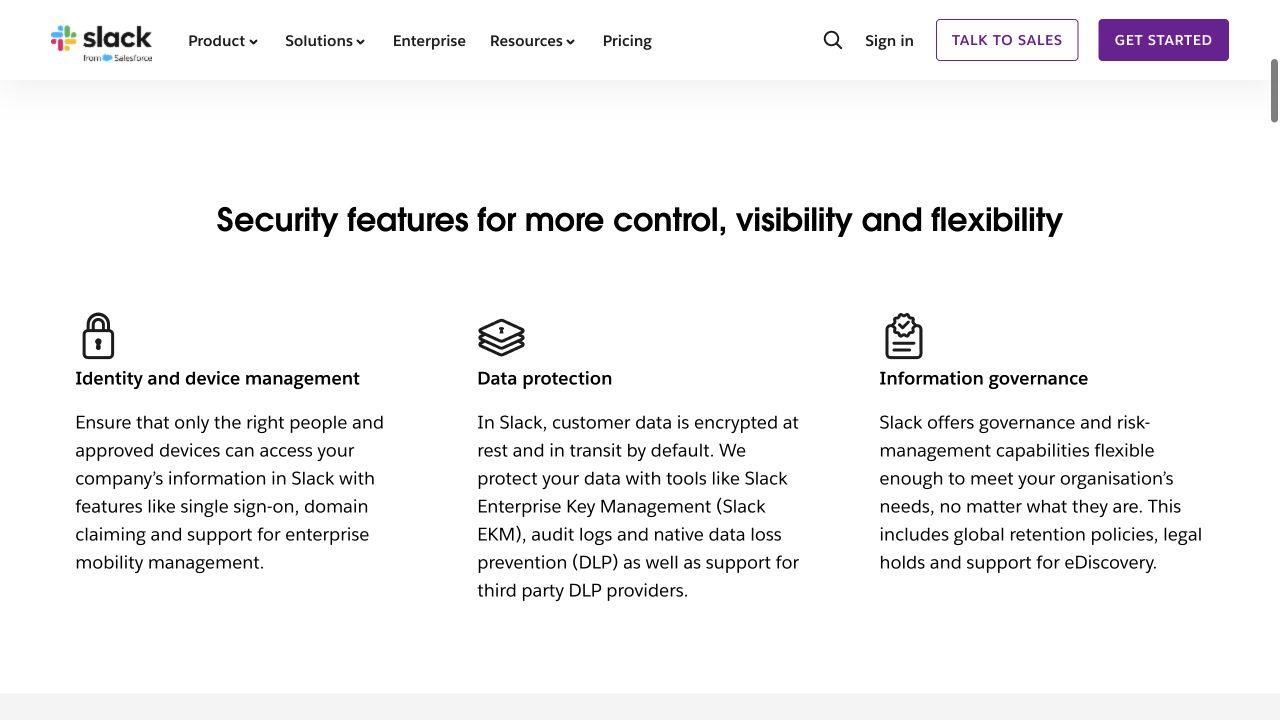
An authentic public security-page view. It demonstrates a dedicated evidence destination; it is not a security audit or validation of vendor claims.
The transferable lesson is separation of purpose. A technical reviewer can investigate an important constraint without relying on the short enterprise-page summary.
For a smaller business, the equivalent might be a clear integration guide, compatibility table, service specification, or documented support policy. Avoid creating an elaborate trust resource without qualified people to verify and maintain it.
If a claim needs a certificate, test, policy, or contractual condition, route the reader to the appropriate current evidence. Do not describe a public marketing page as proof that your team has completed due diligence.
HubSpot's implementation guide addresses rollout questions
HubSpot's CRM implementation guide discusses sales-process details, including deal stages, custom fields, lead ownership, and territory planning.
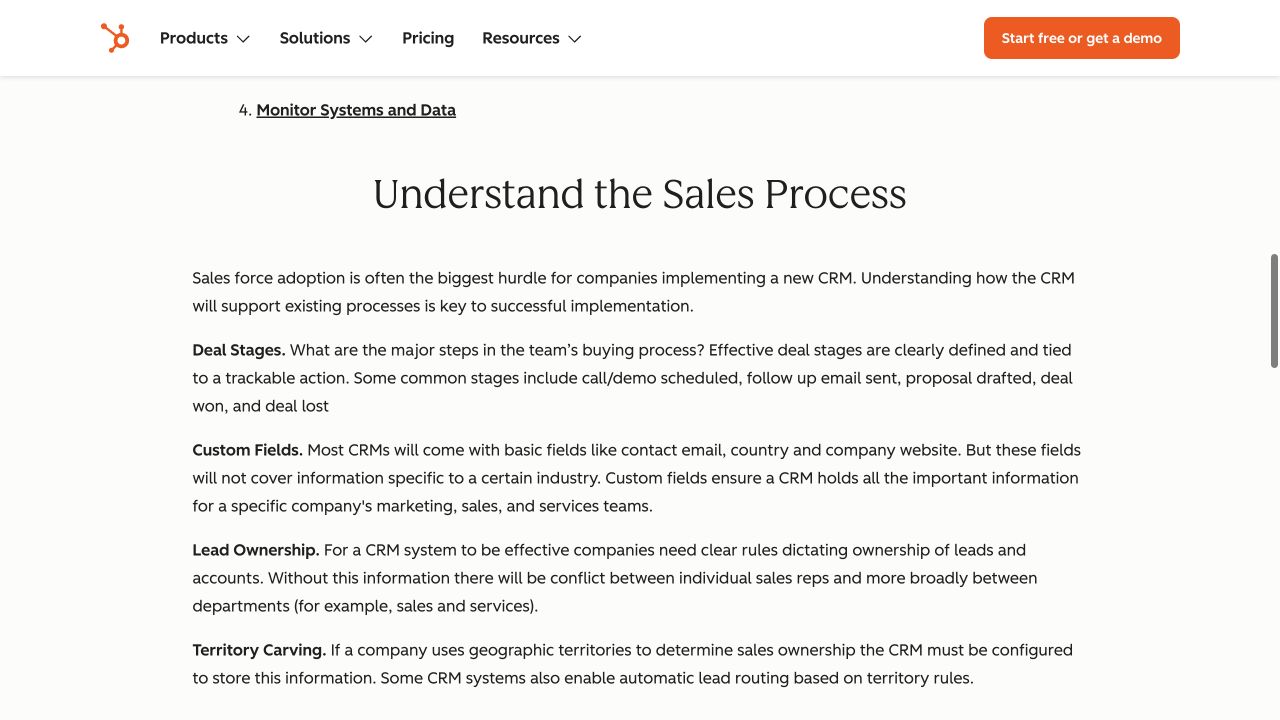
HubSpot's public implementation resource shows operational questions beyond a product overview. No CRM deployment or vendor outcome was independently tested for this article.
This type of content helps a reader think through adoption. It also gives sales and service teams a resource for conversations that repeat across prospects.
Your version needs real operational knowledge. Interview the person who implements the offer, ask what usually blocks progress, and document prerequisites. A rollout article that omits responsibilities, required inputs, and known limitations may sound helpful while leaving the hardest questions unresolved.
3. Build the opportunity list from evidence
Start with actual customer language. Review approved sales notes, support questions, inquiry forms, and interviews. Remove personal or confidential details before using an external AI service.
Ask questions that expose decisions:
- What happened that made you look for a solution?
- What alternatives did you consider?
- Which requirement could have ruled us out?
- What did another reviewer need to approve?
- What information was difficult to find?
- What surprised you during implementation?
Do not turn one interview into a universal claim. Save the source type, date, context, and how often a question appears. A useful isolated question can still justify a resource; it just should not be described as the most common problem without evidence.
Next, research the related queries in the target market. Save volume and difficulty estimates with their provider and date. Inspect current search results to understand the competing page types and the answer readers expect.
Competitor keywords are a discovery source, not an automatic publishing list. Exclude queries outside your actual offer, places you cannot serve, and comparisons you cannot support. A low-volume question can matter when it addresses an important approval condition. A high cost-per-click estimate does not prove that every searcher is a qualified buyer.
Use this prioritization worksheet:
Buyer question and actual wording:
Role, context, and decision:
Source and date:
Related search query and market:
Volume estimate and provider, if available:
Existing page and remaining answer gap:
Fit with our actual offer:
Evidence available and evidence still missing:
Destination and appropriate next action:
Subject expert, reviewer, and dependency:
Priority decision and reason:
Prioritize the combination of buyer relevance, missing information, available evidence, and maintenance capacity. Do not let an arbitrary score hide a blocking fact such as an unsupported feature claim.
4. Match each opportunity to a page
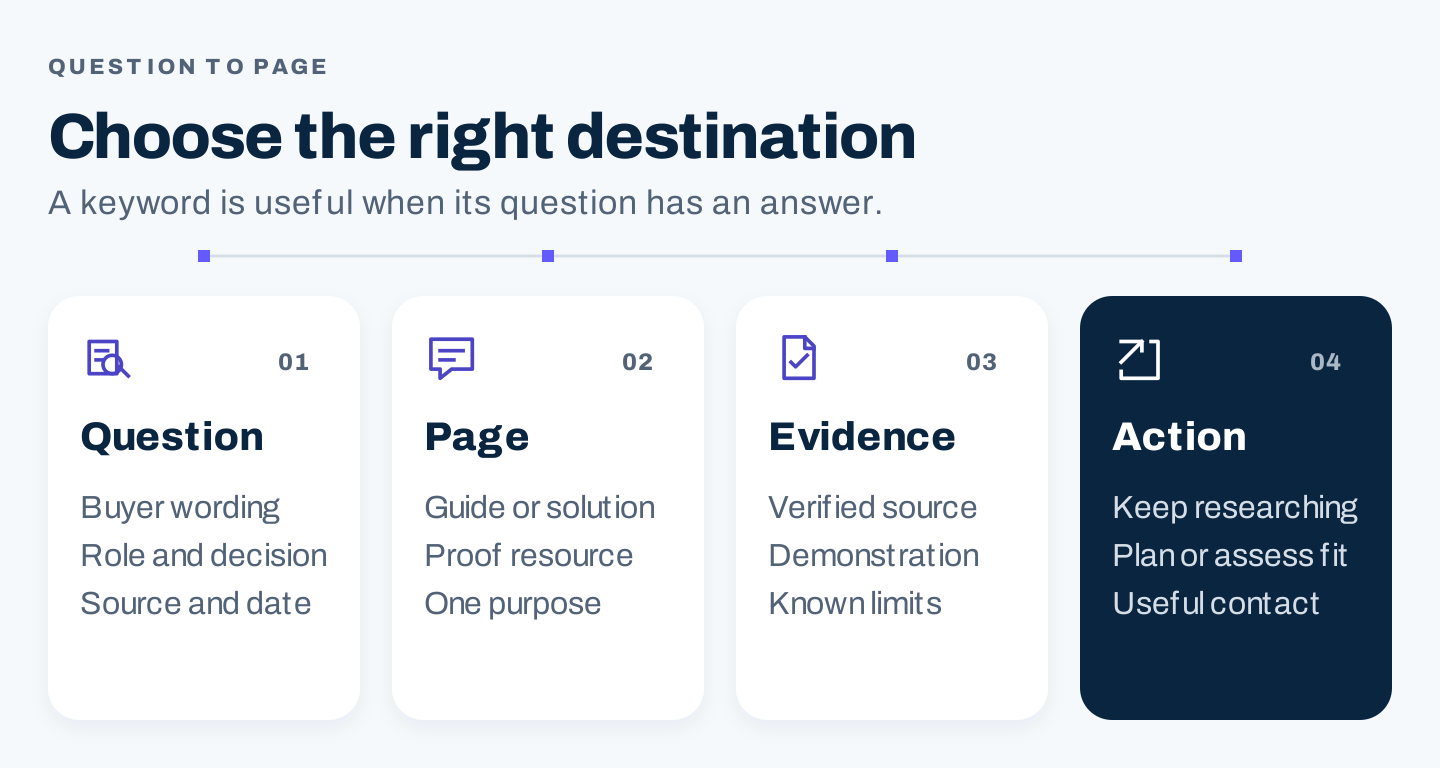
Original mapping method: preserve the question, page purpose, supporting evidence, and useful next step in the brief.
Before creating a URL, check the existing site. An integration question may belong in documentation. An implementation question may need a guide. A current plan limitation may belong on a commercial or support page, with educational content linking to it.
Keep a primary destination for the task and document related resources. This reduces contradictory answers and gives reviewers a clear maintenance target.
For a comparison article, define the audience and evaluation dimensions before selecting products or approaches. Use current sources for each factual comparison. Include a date and limitations. If you have not tested an alternative, describe the source-supported information rather than implying hands-on experience.
For a case study, obtain the relevant approvals and preserve the baseline, period, scope, and measurement method. If you cannot support a numerical result, publish a process explanation or demonstration instead. An invented customer story is not an acceptable substitute for missing evidence.
5. Turn expertise into a useful brief
A B2B brief should make the expert's contribution concrete. “Write something authoritative” is too vague to guide either the writer or reviewer.
Include the decision, reader context, promised answer, actual source materials, important caveats, and next destination. Specify which screenshot, demonstration, or table would help the reader assess the claim.
A practical implementation brief might require:
- The prerequisites and who owns them.
- The information that must be collected before starting.
- The sequence of decisions and checks.
- A real demonstration or clearly labeled proposed worksheet.
- Common failure conditions and escalation routes.
- A meaningful completion criterion.
Ask the expert to review the draft's interpretation, not just supply a quote. A statement can remain factually correct while implying a broader capability than the expert intended.
Put essential evidence near the claim. Keep visuals readable and caption what they demonstrate. A decorative chart adds little when the reader needs an exact field definition or implementation screen.
An optional AI prompt for organizing approved research
AI can help group source material into questions. Use it after collecting approved evidence, and check every proposed grouping against the source.
Organize the sanitized research below into a B2B content map.
For each question, return:
- buyer role and decision, if explicitly supported
- exact source reference
- existing destination or proposed page type
- evidence needed to answer accurately
- an appropriate next action
Keep uncertain roles and assumptions labeled unknown.
Do not invent quotes, demand estimates, features, or results.
Do not draft vendor comparisons from unsupported memory.
Research: [paste approved, nonconfidential material]
Existing page inventory: [paste approved URLs and purposes]
The useful output is a reviewable map. It is not proof of search demand or a finished article. Remove weak inferences before assigning production work.
6. Publish with sales, service, and distribution in mind
Bring the relevant teams into the brief early. Sales can identify recurring objections. Service can explain what happens after the purchase. Marketing can plan discovery through search, email, social posts, partner resources, or webinars.
Use one approved evidence set across those channels. A sales email can link to the full implementation explanation. A webinar can demonstrate a section of the workflow. A short social post can introduce the decision and send interested readers to the complete resource.
Avoid withholding a basic answer solely to force a contact form. Choose a form or contact step when it genuinely fits the task, such as a tailored assessment that needs business-specific inputs. Explain what the reader will receive and what information is required.
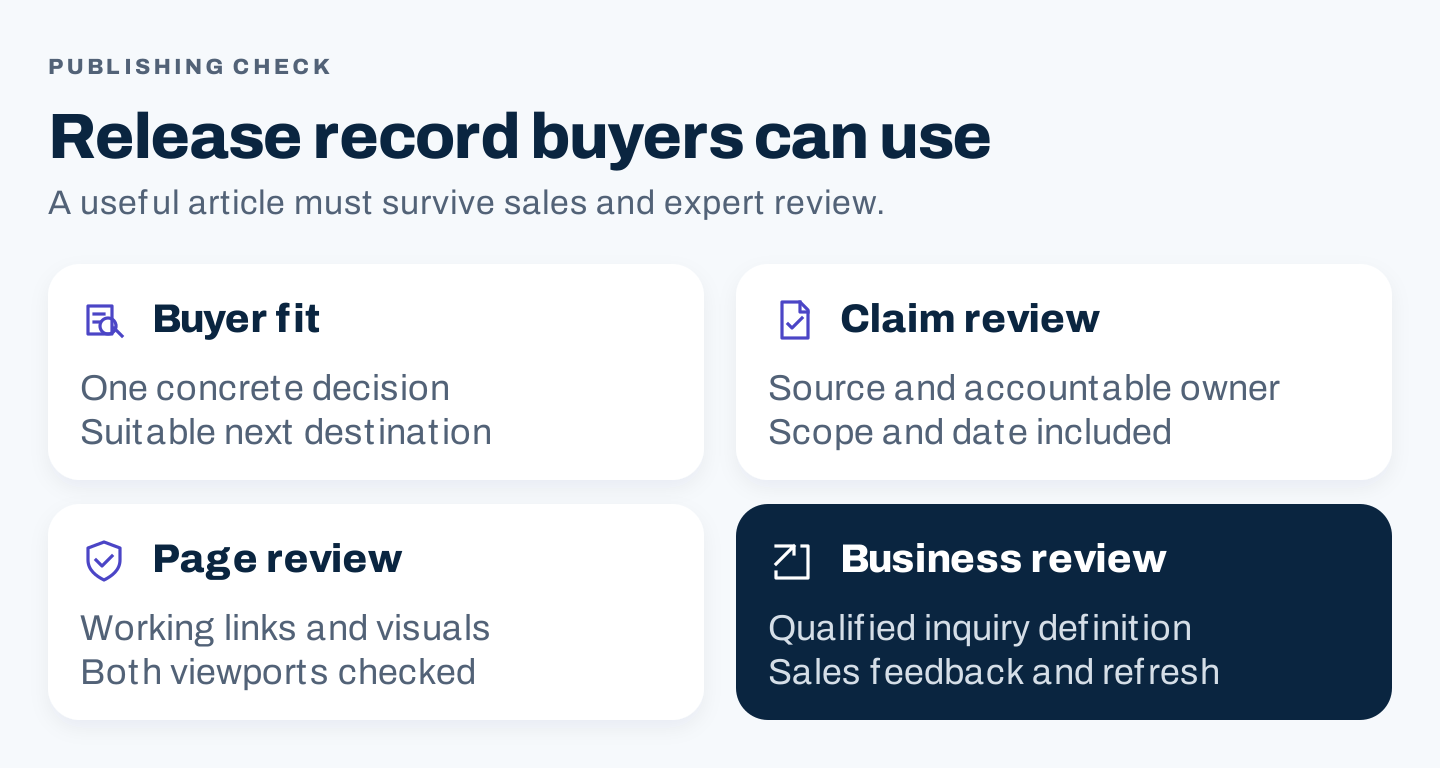
Original release checklist: expert approval, working evidence, and a defined business outcome are part of publishing.
A small release checklist is enough if it is used consistently:
- The article answers its stated question and serves the intended audience.
- Material claims have current sources and named reviewers.
- Screenshots and demonstrations match the explanation.
- Links, forms, and the next destination work on desktop and phone.
- Sales or service knows how to use the resource.
- An owner has the review date and update triggers.
7. Measure qualified progress, with clear limits
Agree on “qualified” before reporting leads. Define the relevant customer type, service need, geography, and other business constraints. A newsletter signup is not automatically a qualified sales inquiry.
Track several layers separately: search visibility, relevant landing visits, resource use, qualified inquiries, accepted opportunities, and later business outcomes. Some layers require systems or permissions a small team does not have. Report the available evidence rather than filling the gaps with assumptions.
An original reporting template:
Resource and primary buyer decision:
Reporting period and measurement coverage:
Relevant queries and landing visits:
Qualified inquiry definition and count:
Sales acceptance or rejection reasons:
Known later opportunities, if traceable:
Attribution method and missing data:
Reader or sales feedback:
Change proposed, owner, and review date:
Content may assist several conversations before an opportunity exists. Distinguish a documented assist from the first recorded visit and from a causal claim. A salesperson sharing the article does not prove the article created the deal.
Use rejected leads and unanswered questions to revise the plan. If visitors repeatedly ask about a limitation the page never mentions, adding the answer may be more valuable than expanding the keyword list.
A manageable first month
Week 1: inventory existing pages and collect a small set of approved customer questions. Identify one buying decision with a meaningful answer gap.
Week 2: map the destination, sources, expert, and next action. Resolve missing evidence before writing.
Week 3: produce the resource and necessary visuals. Complete expert and page review, then prepare its sales and marketing uses.
Week 4: verify the release and measurement. Collect feedback from the people using it. Continue outcome tracking for as long as the buying cycle requires.
This schedule describes a working pilot. It does not promise leads or ranking improvements within four weeks.
B2B SEO questions
Are low-volume keywords worth covering?
They can be when the question matters to a relevant buying decision and you can answer it well. Treat demand estimates as one input alongside customer evidence and business fit.
Does every article need a demo CTA?
No. Match the next action to the reader's task. Continuing to a comparison, implementation guide, or evidence page may be more useful than an immediate sales call.
Can a founder run this process without a large team?
Yes. Start with one question, one destination, and one qualified reviewer. The essential requirement is access to real expertise and reliable facts, not a large publishing calendar.