SaaS SEO and Content Marketing: Problems, Use Cases, and Product Education

A software article can attract the right reader and still fail to explain how the product helps. A product page can explain a feature and still leave the reader unsure whether it fits their workflow. A tutorial can describe setup without showing the prerequisites or a useful completion state.
SaaS SEO connects those questions to distinct, accurate resources. The content plan should support discovery, evaluation, implementation, and continued use. It also needs a way to keep product claims current as the software changes.
This guide uses Notion's template directory and Stripe's pricing and implementation pages as real public examples. The examples demonstrate resource purposes. No template installation, software integration, payment, or business-performance test was executed for this article.
1. Build the plan around product questions
List the tasks the intended customer is trying to complete. Include the constraints that determine fit: workflow, team size, required integration, permissions, available plan, and implementation effort.
Then distinguish the content jobs:
| Reader question | Useful resource | What to verify |
|---|---|---|
| How should I approach this problem? | Problem guide | Options, tradeoffs, and limitations |
| Can this product support our workflow? | Use-case page | The actual capability and intended audience |
| Which option or plan fits? | Buying resource | Current terms, feature availability, and comparison scope |
| How do I get it working? | Implementation guide | Prerequisites, steps, outputs, and failure paths |
| How do we use it well over time? | Product education | Repeatable tasks, maintenance, and relevant changes |
These resources can support the same reader at different times. They do not need to follow a rigid sequence. Someone may discover your documentation before reading the product overview.
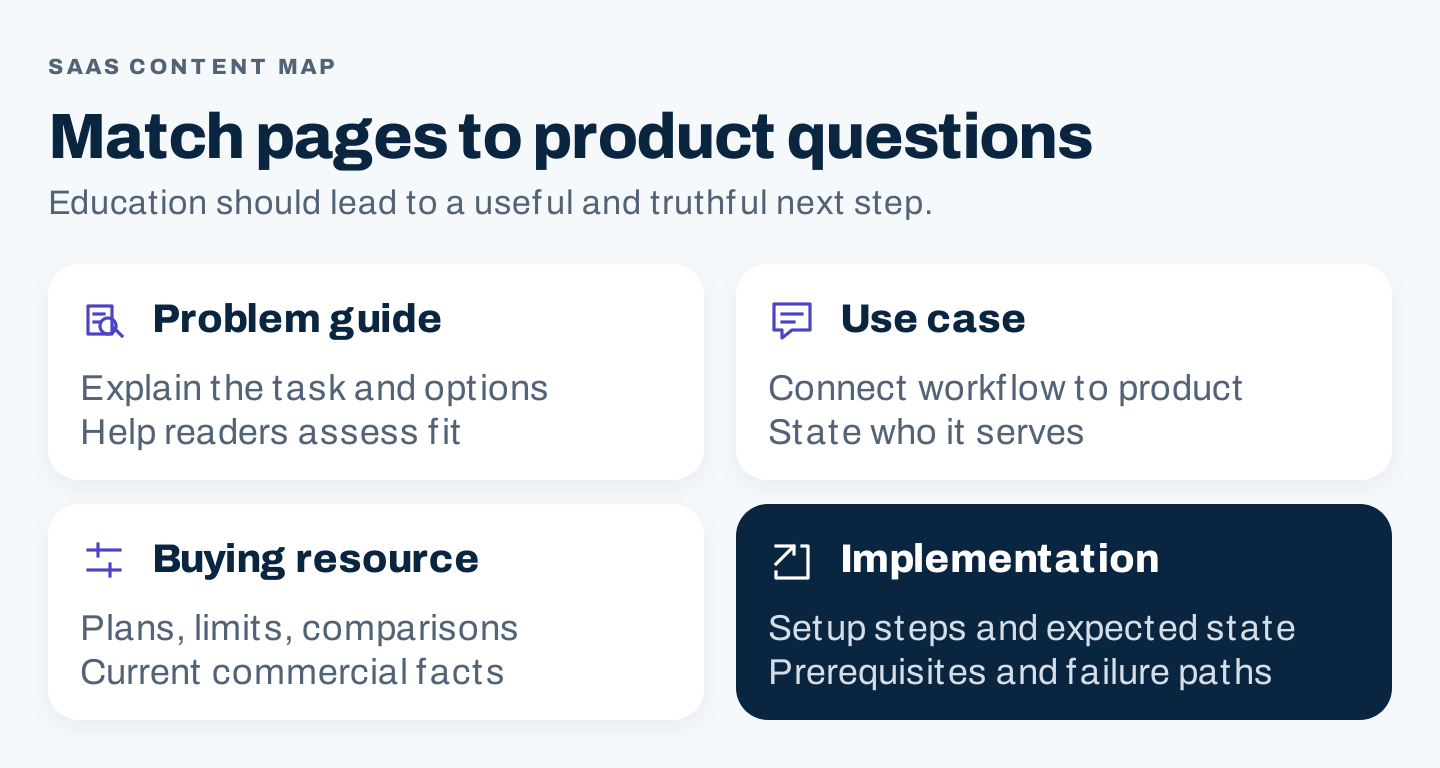
Original content map: choose the page type from the reader's product question and the evidence needed to answer it.
Check the existing site before creating new URLs. A plan limitation should have a reliable home, with relevant guides linking to it. Copying it into many articles creates unnecessary maintenance work.
2. Learn from real product resources
Notion connects a task to a template category
Notion's content calendar template directory presents a task-specific category with templates and selection controls.
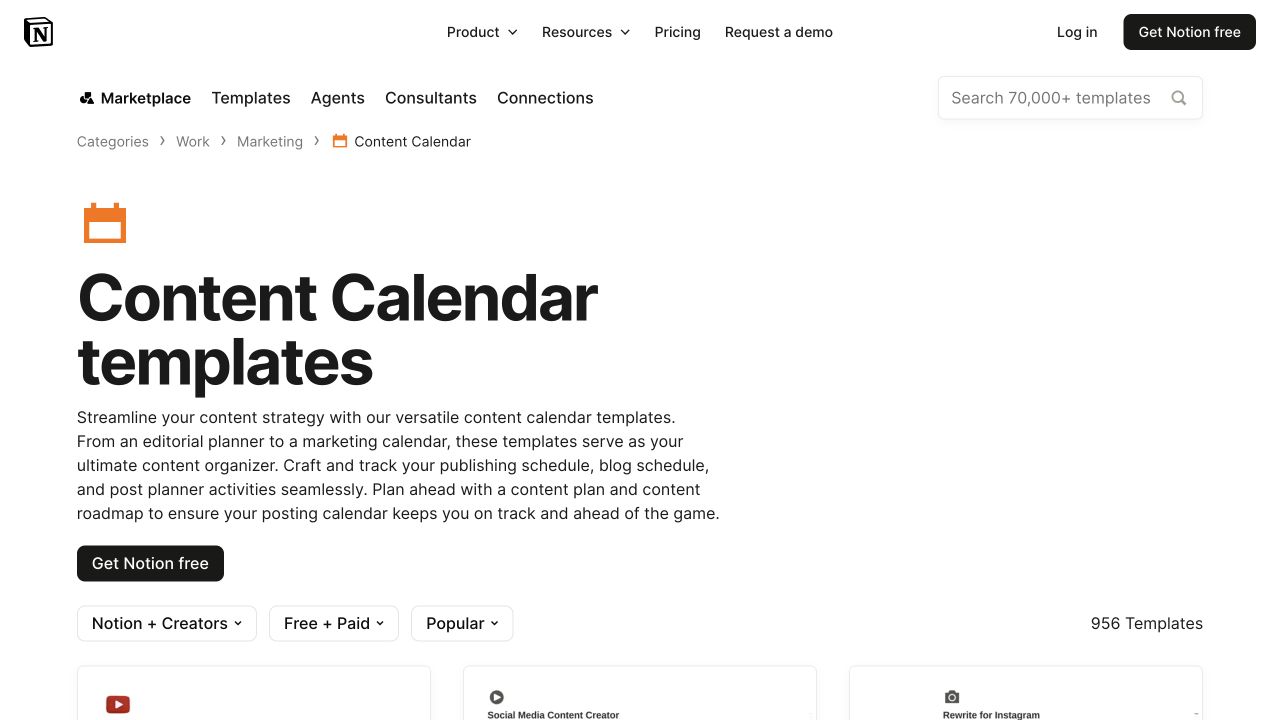
Notion's public desktop template directory, captured October 8, 2026. The example shows discovery by task; individual templates were not installed or evaluated.
A template category differs from a general article about editorial planning. It gives a reader a route to a usable starting resource. The surrounding explanation should help people understand what to choose and what they still need to adapt.
For your own software, consider whether the product can provide a meaningful starter: an approved template, sample configuration, checklist, or tutorial project. Build it when the resource supports a real task, not simply because a competitor has a large directory.
Do not imply that every marketplace resource has identical quality, permissions, or commercial terms. If an article recommends a specific template, inspect that template and disclose what you tested.
Stripe separates commercial information from general education
Stripe's pricing page distinguishes standard and custom pricing routes in the captured public US view.
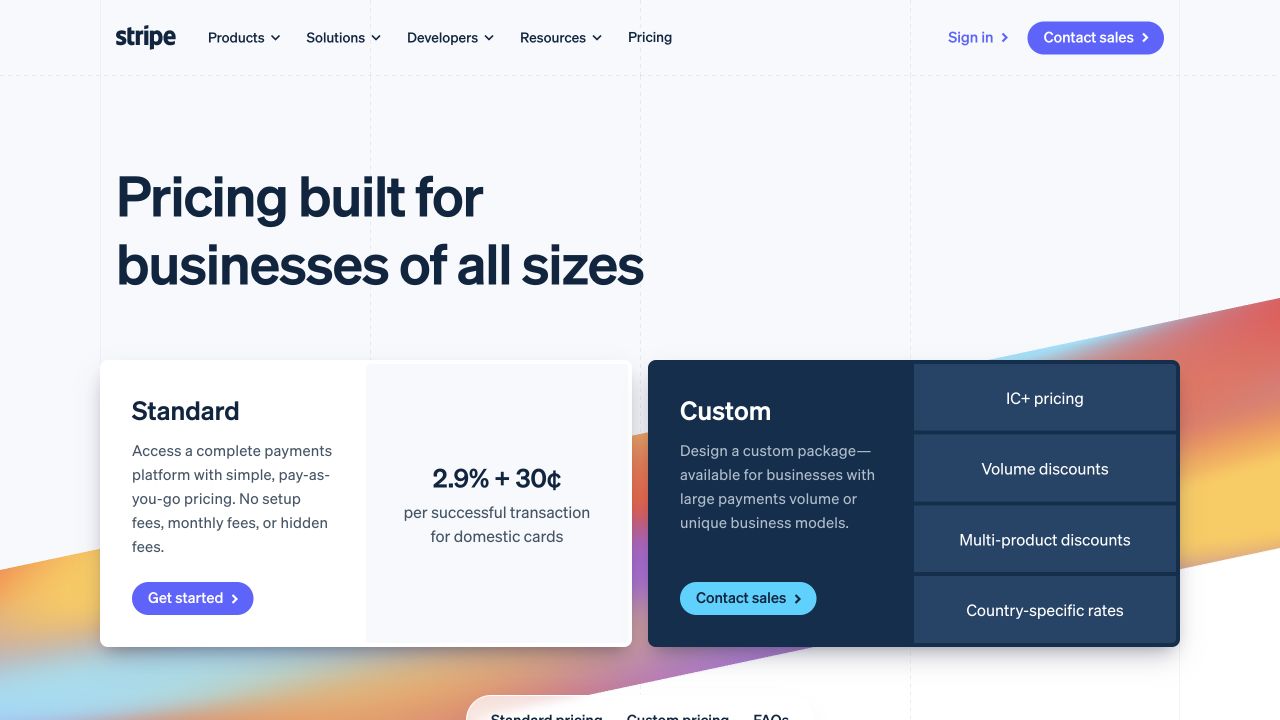
Stripe's public US pricing view. Rates and conditions can change; the example illustrates a commercial-information destination rather than a quoted offer or recommendation.
The content lesson applies beyond payment software. Educational articles can explain a buying decision while directing readers to the current commercial source. They do not need to reproduce every price and condition throughout the blog.
If you write a comparison, define the relevant audience and conditions. A feature may exist but be restricted to a plan, region, permission, or integration. Verify those dimensions before presenting a simple yes/no cell.
Stripe's Checkout documentation serves implementation questions
Stripe's Checkout documentation presents ways to build a payments page, with routes to implementation guidance.
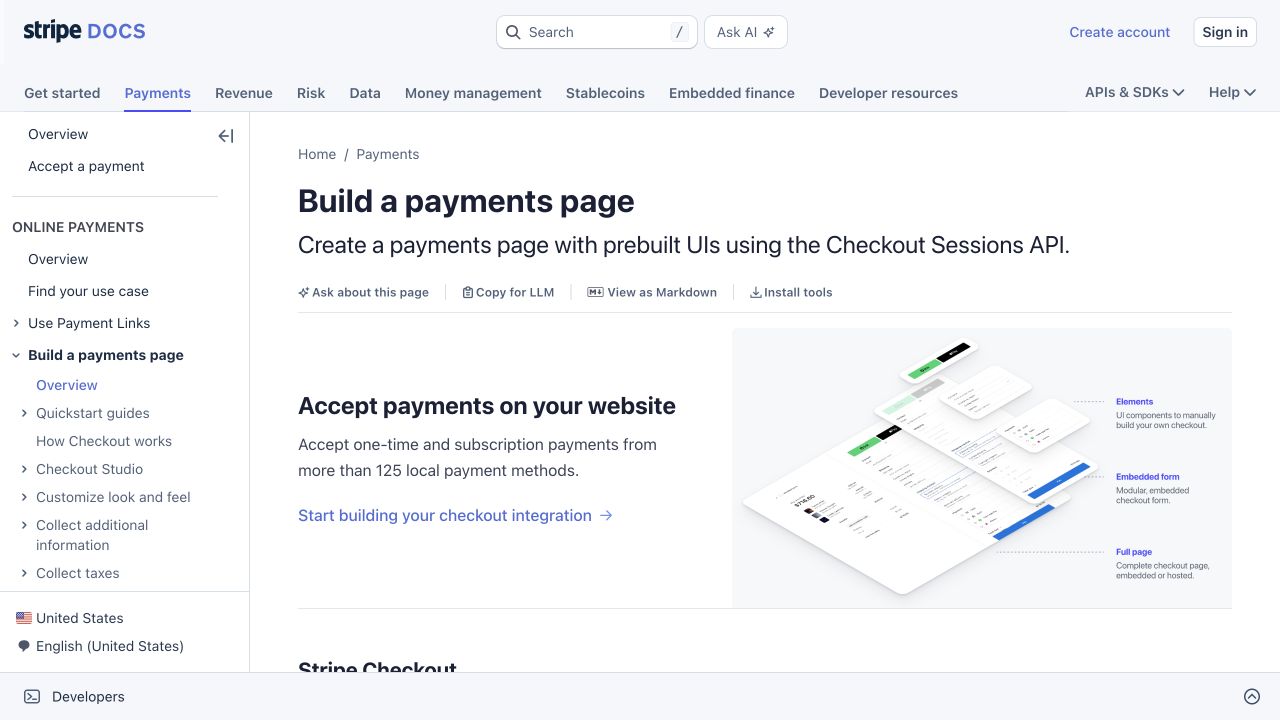
Public Stripe documentation illustrates technical product education. It is not evidence that an integration or payment flow was tested for this article.
A general problem guide may help a reader decide whether an approach fits. Documentation needs to support the next task: understanding the available implementation and how to proceed.
For your own tutorials, document the required environment and access, the actual steps, and the expected state. Explain where the reader should go when a prerequisite is missing. A polished introduction cannot compensate for a step that only works with an undisclosed plan or permission.
3. Research demand without losing product fit
Collect approved questions from sales, onboarding, support, and product specialists. Look for recurring confusion, failed implementation steps, and workflows people are trying to complete.
Combine those inputs with current search research in the intended market. Preserve the query, provider, date, and volume estimate. Inspect the competing page types and the question each result answers.
Keep at least three different evidence categories in the opportunity list:
- Search evidence: queries, estimates, result types, and current page gaps.
- Customer evidence: actual questions and workflow context, with privacy preserved.
- Product evidence: capabilities, limits, prerequisites, and maintainable demonstrations.
A topic needs a credible connection to the product or customer problem. Large demand alone does not justify an article if the business cannot contribute useful expertise.
A narrow documentation question can be worthwhile even if it has little measured demand. It may help existing users complete an important task. Keep that purpose clear rather than describing every resource as an acquisition page.
An original prioritization worksheet:
Reader task and audience:
Source of the question and date:
Related search query, market, and demand evidence:
Existing destination:
Product connection and known limitations:
Proposed page type and answer gap:
Required demonstration or factual source:
Expert, reviewer, and maintenance owner:
Useful next action:
Decision: improve / create / defer
Reason and blocking dependencies:
Apply blocking conditions before ranking the backlog. If the capability is uncertain, resolve it with the product owner. If a demonstration requires access nobody has, arrange the evidence before assigning the article.
4. Create a product claim contract
Software changes. Product content needs a record of what a statement means and when it was verified.
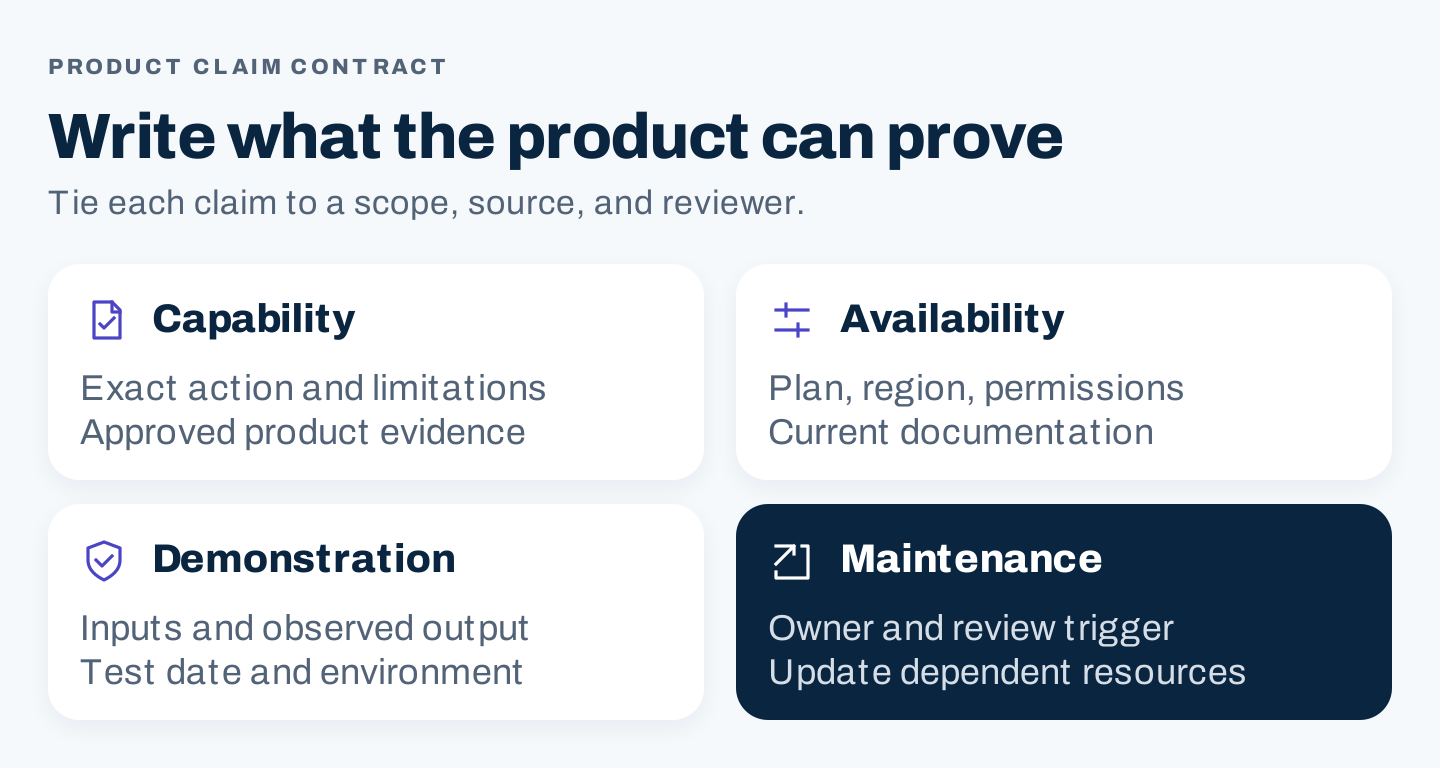
Original claim contract: connect each material product statement to scope, evidence, and a reviewer.
Use this record for material claims:
Exact claim:
Action or capability described:
Plan, region, role, and prerequisites:
Current product source or test record:
Evidence date and relevant version:
What was actually observed:
Known limitations and failure conditions:
Product reviewer:
Articles or resources using the claim:
Change that triggers another review:
Distinguish vendor documentation from your own test. Both can be useful, but they support different statements. “The documentation describes this option” is different from “We tested the option in this environment and observed this result.”
For your own product, assign a reviewer who understands the capability. Do not rely on a writer to infer feature availability from an old screenshot or internal announcement.
For third-party products, use current primary sources for factual comparisons. If an important detail cannot be verified, mark it unknown or narrow the comparison. Avoid calling an article hands-on unless the required tests were actually performed.
Keep numerical claims especially specific. A speed, cost, productivity, or retention result needs its measurement context. An invented example can explain arithmetic, but it cannot serve as a customer success story.
Optional AI assistance for a claim review
AI can help compare a draft with an approved fact pack. Use the result as an issue list for a human reviewer.
Review the draft against the approved product facts below.
Return a table with:
- exact draft claim
- supporting fact reference, if present
- missing plan, permission, region, or prerequisite
- unsupported inference or wording that overstates evidence
- proposed revision or question for the product reviewer
Do not invent capabilities, tests, sources, or results.
Use unknown when the supplied facts do not resolve a claim.
Draft: [approved material]
Fact pack and source references: [approved material]
Do not upload confidential product plans or customer data to an external service without authorization. A sanitized fact pack is often enough for the editorial assistance task.
5. Build tutorials from an observed task
A useful tutorial demonstrates a task a reader can reproduce in the stated environment. Its scope is narrower than a complete product tour.
Before testing, define the start state, prerequisites, and expected completion. Use an approved test account and appropriate data. Keep credentials, personal information, and private customer details out of screenshots.
This is a proposed test protocol, not an executed software test:
Task and intended reader:
Test date, product version, and environment:
Plan, permissions, and required setup:
Starting state and sanitized inputs:
Steps performed:
Expected state:
Actual observed state:
Screenshots and evidence references:
Errors or deviations:
Known limits and untested cases:
Reviewer and next maintenance trigger:
Capture the meaningful states: the relevant input, the action, and the result. Crop only when it improves readability without removing context needed to understand the observation. Caption exactly what the image proves.
Include at least one relevant failure path when the task has a common blocking condition. Explain how the reader can identify the issue and where to get help. Do not add a fabricated error solely to make the tutorial seem tested.
Keep public educational resources separate from private account screens. Documentation can explain a feature without exposing customer data or implying that a publicly visible account is safe to index.
6. Make comparisons useful and fair
Choose dimensions that affect the intended reader's decision. For software, these may include workflow coverage, required integrations, implementation effort, plan limitations, support arrangements, and data portability.
Explain why each dimension matters. A long table of unrelated features can obscure the actual choice.
For each factual entry, preserve the source and date. Specify whether it came from documentation, a public page, or your own observed test. Treat unknown information consistently across products.
Keep conclusions conditional. A product can be appropriate for one workflow and unsuitable for another. Avoid universal “best” claims when the evaluation has not covered the relevant audience and constraints.
If you compare your own product with alternatives, disclose the relationship and use the same evaluation method. Product-led content is more useful when readers can inspect the basis of the comparison.
7. Measure activation with a defined cohort
Signup is an intermediate event. Decide what meaningful use looks like for the product and intended audience. The activation definition should describe a specific event, not merely another page visit.
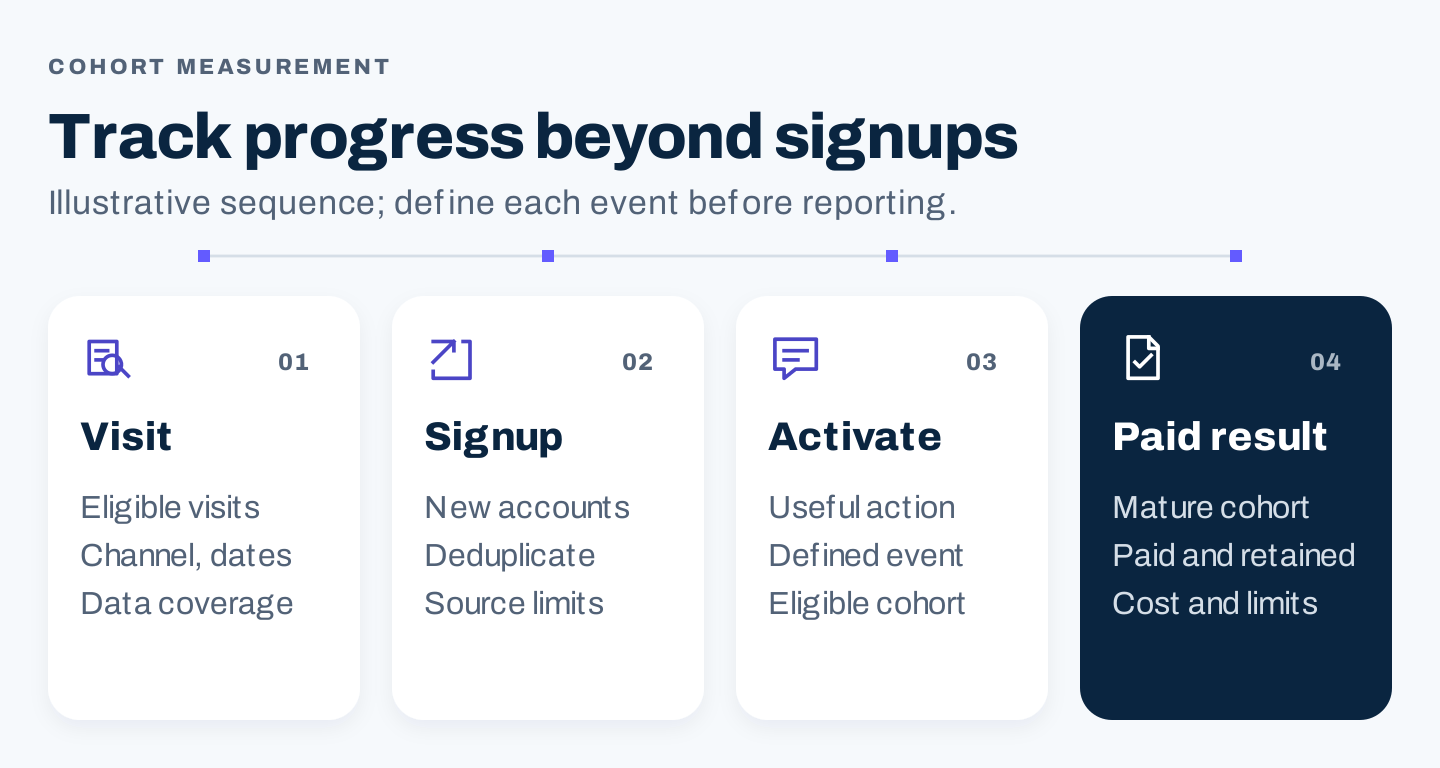
Original measurement framework: define events and follow a comparable cohort before drawing conclusions.
For an explicitly illustrative calculation, suppose a measured landing-page cohort contains 1,000 eligible visits, 50 new trial accounts, 20 accounts completing the defined activation event, and 5 later paid accounts. The signup rate is 50 / 1,000 = 5%. Activation among those trial accounts is 20 / 50 = 40%. Paid conversion among those trial accounts is 5 / 50 = 10%.
These numbers are invented arithmetic inputs, not Notion, Stripe, or another company's results. The calculation requires consistent tracking and a sufficiently mature observation window. Do not combine this month's signups with unrelated paid accounts from earlier cohorts.
Record the attribution method and missing data. An article can assist a reader who later returns through another channel. An observed association does not establish that the article caused the paid conversion.
Use the drop-off to choose an investigation:
| Observed pattern | Question to investigate |
|---|---|
| Relevant visits, few signups | Does the next action fit the reader's task and product scope? |
| Signups, little activation | Are prerequisites, onboarding, or expectations unclear? |
| Activation, few paid accounts | Does the offer fit the cohort and evaluation window? |
| Paid accounts, weak continued use | Which product or education gap needs investigation? |
These are diagnostic questions, not automatic explanations. Review the actual evidence before deciding which resource or product step to change.
8. Distribute and maintain the resource
Plan a use beyond search when it fits the task. A guide can support an onboarding email, a service reply, a webinar, a partner resource, or a product announcement. Match each version to the reader's current question.
Give the shared fact set an owner. When a plan, interface, integration, or policy changes, review the articles, screenshots, templates, and campaign messages that depend on it. Set review triggers rather than relying only on an annual content audit.
Prioritize changes that affect what readers can do. A changed prerequisite or removed feature matters more than a cosmetic screenshot difference that does not obstruct the task.
Use feedback from support and customer-facing teams to maintain the resource. If readers repeatedly fail at the same step, inspect the step in the current product. Correct the instruction or clarify the limitation before producing more promotional content around the same workflow.
A focused first-month pilot
Week 1: choose one supported use case and map its current guide, product destination, and implementation resource. Collect approved customer questions and search evidence.
Week 2: resolve the fact contract and create the brief. Arrange any required test account, expert review, and visual evidence.
Week 3: produce or improve the resource. Verify the actual task where a hands-on claim is intended. Complete desktop and phone review and prepare its distribution uses.
Week 4: inspect the release, next destination, and measurement. Review early reader questions and follow the cohort for the appropriate evaluation period.
The month is a proposed production schedule. It does not promise rankings, trials, or paid accounts within that window.
SaaS SEO questions
Should every article mention the product?
Include the product when it helps answer the task accurately. Broad educational content still needs a relevant purpose; forcing a feature pitch into every section can weaken the explanation.
Are free tools and templates always necessary?
No. Create them when they provide a useful, maintainable output. A clear tutorial or decision worksheet may serve the reader better than an unsupported calculator or generic template directory.
How does this differ from a B2B content plan?
The approaches can overlap. This guide emphasizes product tasks, demonstrations, prerequisites, activation, and ongoing education. A B2B plan also needs to address the wider buying group's approval questions.
What should an early-stage team publish first?
Start with a real customer problem that the current product can address. Pair a useful explanation with a truthful product destination and a maintainable path to implementation.