Lead Quality: How to Qualify Inquiries and Improve Sales Handoffs

A campaign can produce plenty of contacts and still leave sales with very little useful work. Some people want the newsletter. Some need a service you do not provide. Others are a good fit but need help evaluating their options before they can buy.
Improving lead quality starts with identifying those differences. Then you can give each person an appropriate response and learn which content attracts requests your business can actually serve.
This guide explains how to define a qualified lead, build a practical qualification rubric, improve the handoff to sales, and compare campaigns using consistent outcomes. The public examples show observable forms and offers; they do not reveal those companies’ private qualification rules or conversion results.
What is lead quality?
Lead quality is the extent to which a contact or inquiry matches your business’s ability to help and the next commercial action being considered. It depends on the person’s needs, service or product fit, readiness, and the reliability of the information you have.
A useful lead definition is specific to the offer. An agency project inquiry, a software trial, and a local service appointment require different evidence. A lead can be valuable for a content relationship without being ready for a sales conversation.
Keep these records separate:
| Record | What it establishes | What still needs checking |
|---|---|---|
| Subscriber | Someone requested ongoing content | Whether they have a relevant buying need |
| Resource contact | Someone requested a particular asset | Whether their interest extends beyond that resource |
| Product user or trial | Someone requested access | Whether they can complete a useful task and need a paid option |
| Sales inquiry | Someone requested commercial help | Scope, fit, readiness, and an appropriate next step |
| Qualified inquiry | The request meets your agreed criteria | Whether sales accepts it as an opportunity |
| Opportunity | Sales has accepted a plausible commercial process | Whether a purchase will follow |
Agree on these meanings before comparing reports. Otherwise, marketing may count a webinar registration as qualified while sales expects an active buying project.
Separate fit, need, and readiness
Use three questions before assigning a single score:
- Fit: Can we serve this person or organization?
- Need: Do they describe a problem our offer addresses?
- Readiness: What action are they asking to take now?
Add an information state to each answer: confirmed, plausible, unknown, or conflicting. Unknown information needs clarification; it should not automatically become a rejection.
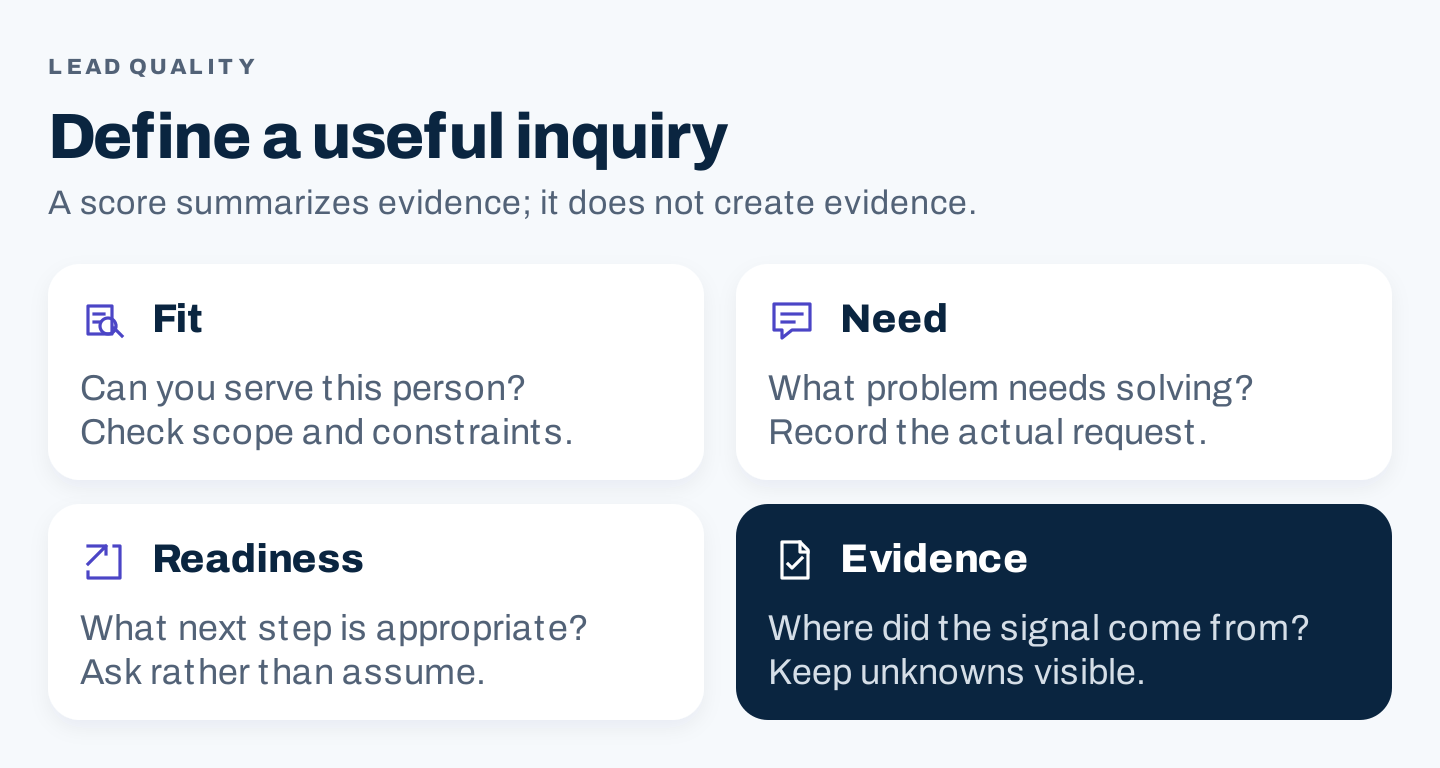
Original qualification framework. Keep the commercial judgment and its supporting evidence visible.
Fit can include service area, relevant industry, supported implementation, or project scope. Need describes the actual job to be done. Readiness concerns the requested action, timing, and decision process.
A person who reads several articles has demonstrated content engagement. That behavior alone does not establish a buying project. Conversely, a relevant request that arrives without a long browsing history may deserve a prompt response.
Write the definition in a sentence your team can apply:
We consider an inquiry qualified for [offer] when [serviceable situation] and [relevant need] are confirmed, and the person has requested [appropriate next action]. If [critical fact] is unknown, [owner] clarifies it before assigning a final status.
Keep any firm exclusions equally concrete. “Outside our supported service area” is actionable. “Doesn’t look serious” is too subjective to guide content improvements.
Four real examples of different qualification signals
1. Slack: a sales form collects context for a commercial response
Slack’s public contact-sales form asks for information about the person and organization. The captured view uses the United States selection. Its existence establishes a commercial contact path, not an automatic acceptance into a private sales process.
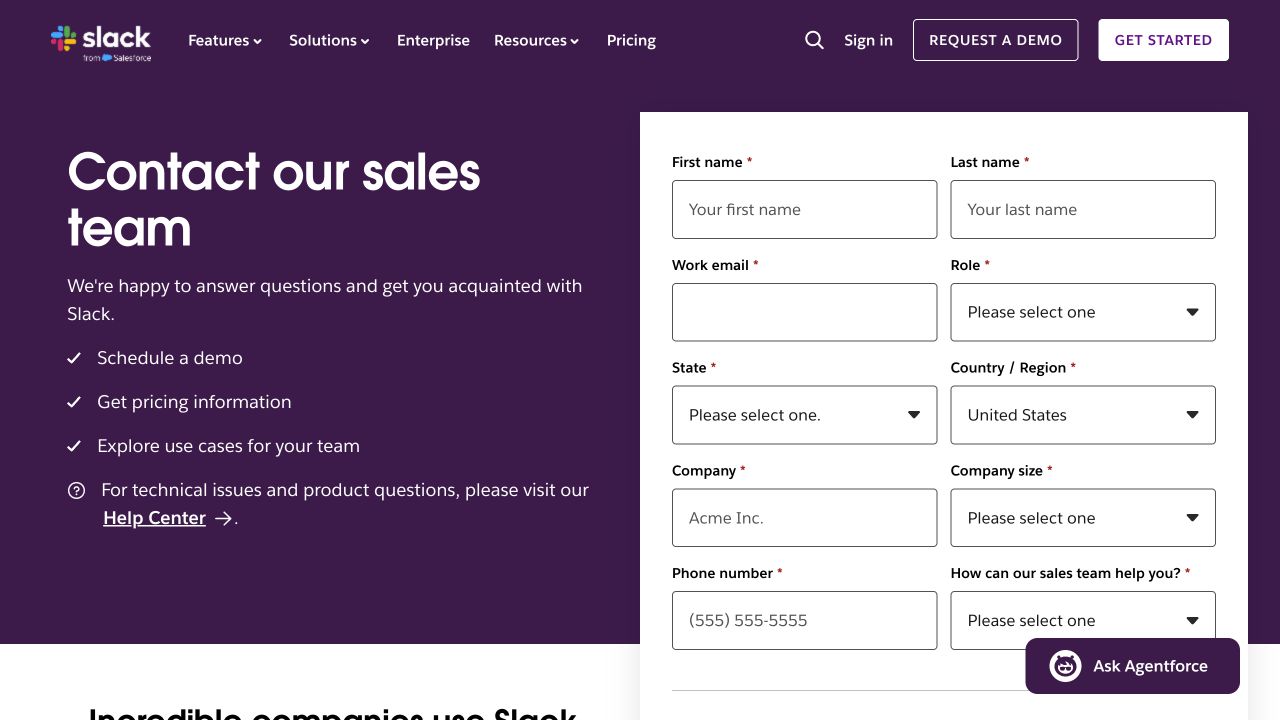
Source: Slack contact sales. Desktop capture; no details entered or request submitted.
Apply the lesson: give each field a job. An agency may need project type to route work and a short description to prepare the response. If nobody uses a field before the first conversation, consider collecting it later. Reducing fields should be evaluated against the quality of the resulting conversations, not just the submission rate.
2. Marketing Brew: subscription intent is clearly defined
Marketing Brew’s subscription page offers an ongoing publication for marketing readers. Subscribing expresses interest in receiving that content. It does not establish that a reader needs an agency, software subscription, or consultation.

Source: Marketing Brew. The observed offer is a newsletter subscription.
Apply the lesson: distinguish a good subscriber from a sales-ready inquiry. Track whether subscribers use relevant resources or explicitly ask for help over time. Do not make newsletter delivery conditional on answering an unrelated sales questionnaire.
3. Shopify: access intent needs a product-use check
The public Shopify trial page provides a route into trying the product. That request is different from joining an email list. The captured page may localize promotional terms; this example does not adopt its pricing or assume the same offer applies to every US visitor.
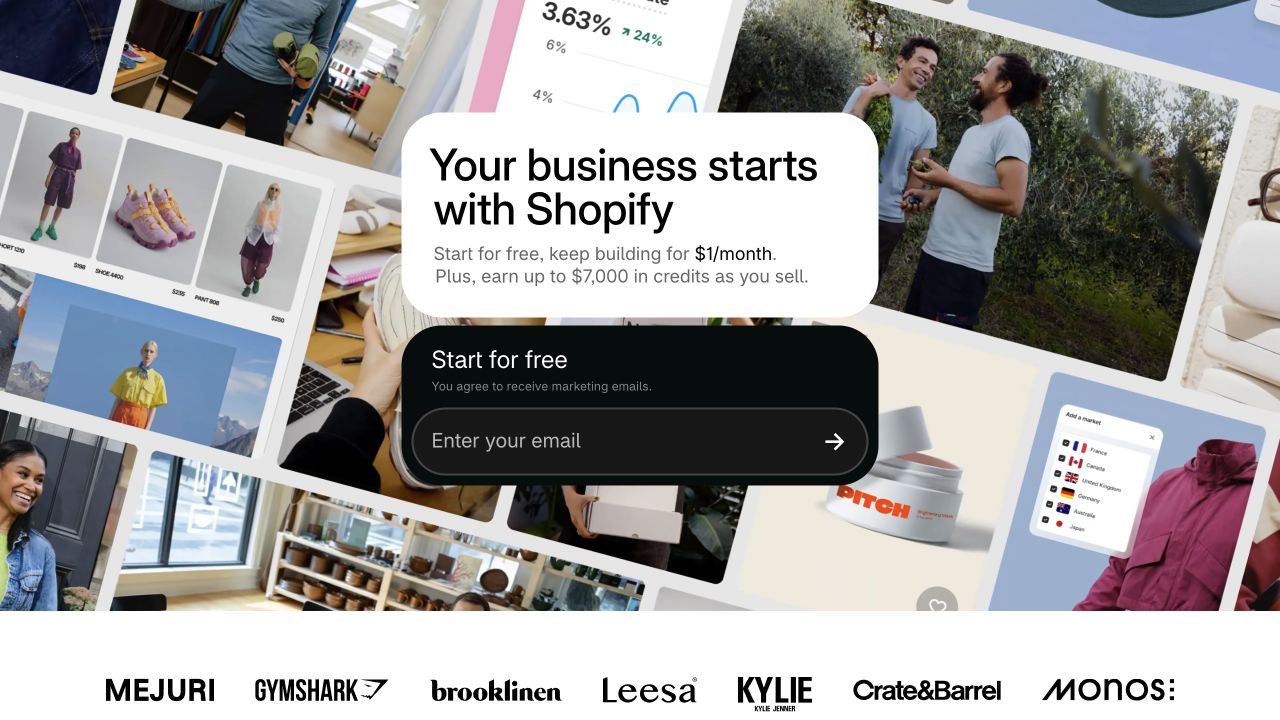
Source: Shopify free trial. Entry view only; trial activation and downstream use were not tested.
Apply the lesson: define a useful activation task before treating every trial as a buying signal. For your own product, that might be completing a meaningful setup or producing a first usable output. Measure it in your actual product data. A login, on its own, tells you much less.
4. HubSpot: fit and engagement can remain separate
HubSpot’s lead-scoring documentation describes fit, engagement, and combined score types. The documentation provides a practical example of keeping attributes and interactions distinct. Feature availability depends on the account and subscription.
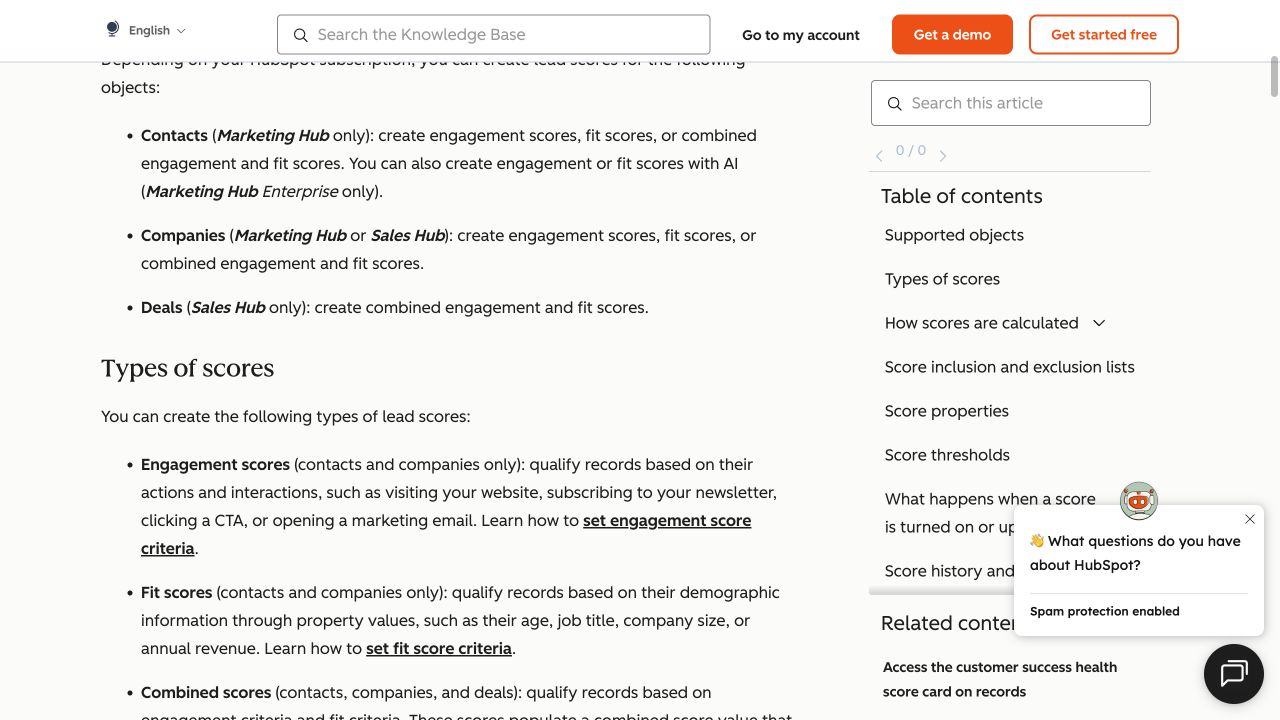
Source: HubSpot Knowledge Base. A desktop documentation capture, not a tested account configuration.
Apply the lesson: frequent content consumption should not erase a clear service mismatch. Even if you use one total score for routing, preserve the underlying fit and engagement reasons so a reviewer can understand the decision.
Build a qualification rubric your team can use
Start with a small, explicit rubric. You can implement it in a spreadsheet before investing in automated scoring.
| Dimension | Evidence to record | How to handle uncertainty |
|---|---|---|
| Serviceability | Geography, scope, supported product or service | Ask about the missing condition |
| Relevant need | The problem described in the request | Use a short clarification question |
| Requested action | Resource, advice, trial, quote, or sales conversation | Read the actual request before routing |
| Timing | Stated deadline or project stage | Leave blank if it was not supplied |
| Buying process | Who will use, evaluate, approve, or pay | Clarify when it affects the next step |
| Record quality | Contact method, duplicates, missing details | Repair the record; do not infer low commercial fit |
Avoid making every budget question an immediate disqualifier. If you need a minimum project value to deliver the service, communicate it clearly and record the mismatch. If the person is still exploring scope, an unknown budget may simply mean the evaluation is incomplete.
Apply the rubric to recent inquiries together. Ask marketing and sales to classify the same records, then compare disagreements. Disagreement about what “qualified” means is a process problem to resolve before adding points or automation.
When you introduce scoring, document the reason for each rule, the data source, the maximum influence of repeated activity, and the conditions under which the score expires or is reviewed. A readable rubric makes later score calibration easier.
Improve lead quality through content and offer design
Qualification should begin before the form.
Make scope visible on the destination page
Explain who the service is for, which problem it addresses, the meaningful limitations, and what happens after an inquiry. An honest scope statement can help unsuitable visitors choose another resource while helping suitable visitors describe their needs.
Answer buying questions that change the conversation
Build content around questions sales actually needs to resolve: process, deliverables, implementation requirements, timelines, pricing factors, and when an alternative is appropriate.
A comparison guide should explain tradeoffs. A case study should identify the situation, work completed, result, measurement period, and limits. A customer quote without context cannot answer every buying objection.
Match the next step to the content task
An introductory guide can offer a related worksheet. A service comparison can point to scope details or a consultation. A setup tutorial can help someone complete a product task.
Use a sales CTA when the reader has enough information to understand what they are requesting. You can still provide a contact route throughout the site; the point is to make the expectation clear.
Keep distribution aligned with serviceability
Check campaign geography, topic, audience, and referring message against the destination. If an ad promises a specific service but leads to a general resource, the resulting inquiry may be poorly informed even when the person is a suitable customer.
Before expanding acquisition, fix broken forms, unclear expectations, and missed responses. Those failures can make a useful inquiry appear unproductive.
Create a handoff sales can act on
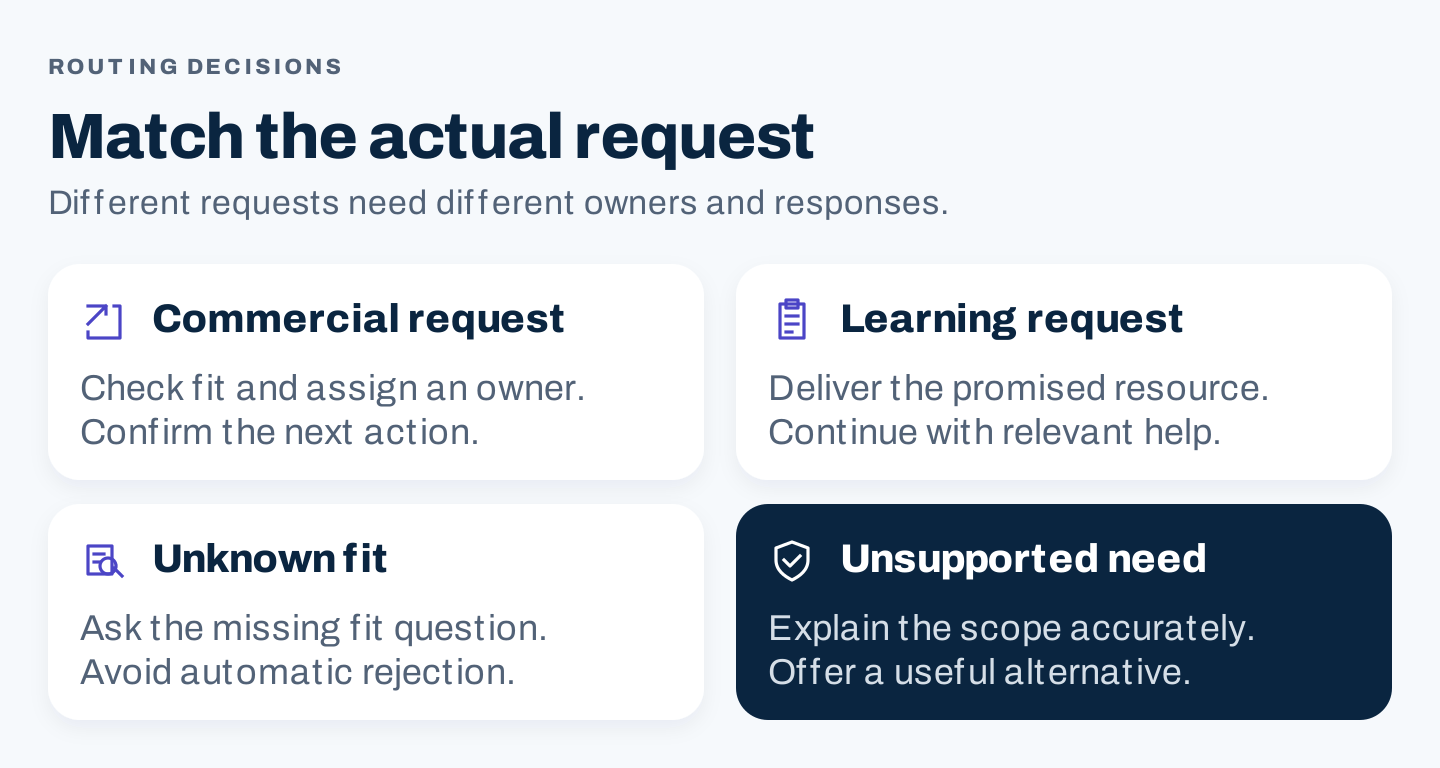
Original routing model. Qualification determines the appropriate response, including clarification and helpful redirection.
A handoff needs more than a name and a source label. Transfer the actual request, the evidence already collected, and the commitment made to the person.
Use this record:
Inquiry ID and received date:
Person / organization:
Offer or service requested:
Request in their own words:
Source, referring page, and destination:
Confirmed fit conditions:
Relevant need and supporting evidence:
Requested next action and timing:
Unknown or conflicting information:
Assigned owner and backup:
Response due under the team's coverage agreement:
Current status and next action:
Disposition reason and review date:
Set a response expectation your team can cover, including evenings, weekends, and absences where relevant. A generic automated acknowledgment can confirm receipt, but it should not imply that a specialist has reviewed the request or that an appointment is booked.
Give the receiving owner a way to accept the record, return it for clarification, or route it elsewhere. Do not let “sent to sales” become the last observable event.
Close the content-to-sales feedback loop
Ask sales to use consistent disposition reasons. Include “not yet reviewed” so unfinished work is not counted as a rejection.
| Disposition | What marketing should investigate |
|---|---|
| Outside service area | Campaign targeting and location clarity |
| Unsupported scope | Offer wording, service pages, and referring content |
| Relevant but not ready | Evaluation content and optional follow-up |
| Missing essential information | Form instructions and clarification process |
| Duplicate or invalid record | Capture reliability and deduplication |
| No response after attempted contact | Contact method, expectation, timing, and follow-up coverage |
| Accepted opportunity | Which need and evidence made it appropriate |
Review accepted and rejected records, not just the loudest complaint. A few unusual requests should not automatically trigger a major content rewrite.
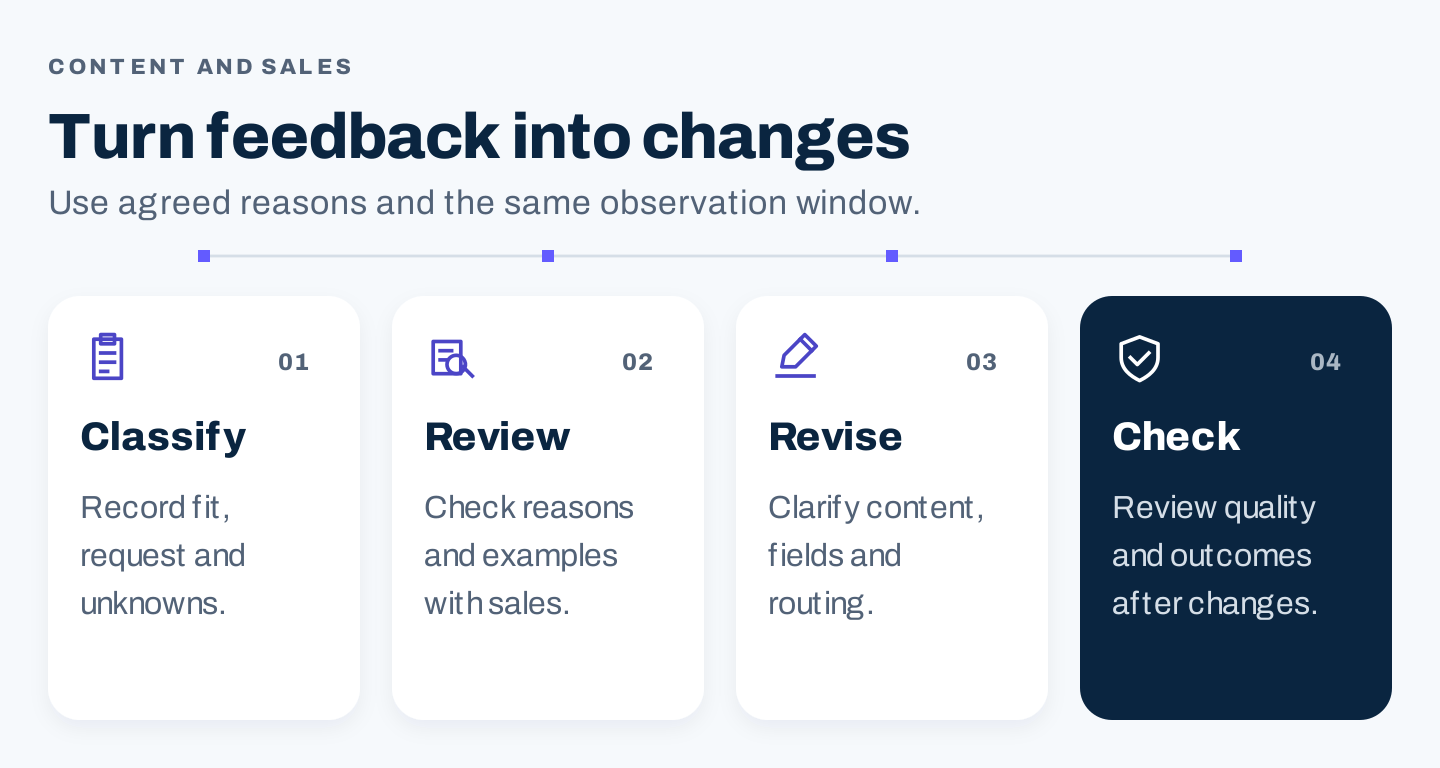
Original feedback loop. Changes should address a recurring, evidenced cause and be checked against subsequent inquiries.
Pick one recurring issue, change the relevant promise or process, and watch what happens. Record the change date so later results can be interpreted. A new field, clearer scope section, and different acquisition audience introduced together will make it hard to isolate the cause.
Measure quality with a consistent cohort
Group deduplicated inquiries by their received date and allow an appropriate observation window for your sales cycle. Report unresolved records separately.
- Qualified inquiry rate: qualified inquiries divided by eligible inquiries reviewed under the same rules.
- Sales acceptance rate: accepted opportunities divided by qualified inquiries handed off.
- Customer conversion rate: customers divided by the clearly named starting group.
- Cost per qualified inquiry: included campaign costs divided by qualified inquiries.
- Cost per customer: included campaign costs divided by attributed customers, with attribution limits stated.
Here is illustrative arithmetic, not observed campaign data:
| Campaign | Included cost | Eligible inquiries | Qualified inquiries | Cost per inquiry | Cost per qualified inquiry |
|---|---|---|---|---|---|
| A | $1,200 | 120 | 12 | $10 | $100 |
| B | $1,200 | 60 | 24 | $20 | $50 |
Campaign B produces fewer contacts but more qualified inquiries at a lower qualified-inquiry cost. That still does not prove it produces more profitable customers. Continue the analysis through accepted opportunities, completed purchases, and an appropriate value measure.
Include labor, content, promotion, and relevant tools consistently. Do not compare one campaign’s fully loaded costs with another’s ad spend alone.
Frequently asked questions
What is the difference between lead quality and lead scoring?
Lead quality is the commercial judgment. Lead scoring is one method of organizing evidence to help make that judgment. A numerical score is useful only if its criteria and outcomes are meaningful.
Should every content contact go to sales?
No. Deliver the content requested and provide an appropriate optional next step. Route explicit sales requests for a relevant commercial response; clarify important unknowns rather than assuming intent from a download.
Can AI qualify leads?
AI can help organize supplied notes or flag missing information. It should not invent budgets, authority, needs, or readiness. Keep the original evidence, review consequential routing decisions, and measure the rules against actual outcomes before relying on automation.
Start with a shared definition and a review of recent records. If you also need to build the acquisition and capture path, use the lead generation guide. When the problem is the destination itself, use the landing page audit.