Lead Generation Strategies: Build a System from First Visit to Qualified Inquiry

More contacts can mean more opportunities. They can also mean more spam, duplicate records, or people who only wanted a free resource.
Lead generation is the process of attracting relevant people and creating an identifiable opportunity to continue a useful business relationship. A lead generation strategy connects the audience, channel, offer, capture method, and follow-up. Qualification determines which contacts fit your business and which next step is appropriate.
Start by defining the contact you actually need. A founder looking for service inquiries, a marketing team building a subscriber base, and an agency managing client campaigns need different systems.
This guide compares 12 strategies, examines six real public examples, and provides a plan for qualification and measurement. The examples show visible offer and access choices; they do not establish conversion rates, lead quality, or revenue results.
Define a lead before choosing the channels
“Lead” is often used for several different things. Give each record a clear meaning in your reporting.
| Record or stage | Working definition | What it does not establish |
|---|---|---|
| Anonymous visitor | A person or session engaging with your content | Identity, fit, or buying interest |
| Subscriber | Someone requesting ongoing communication | Readiness for a sales conversation |
| Resource contact | Someone requesting a particular asset | Demand for your product |
| Inquiry | Someone explicitly requesting relevant help or information | Whether you can serve them |
| Qualified inquiry | An inquiry meeting your agreed fit criteria | A completed purchase |
| Opportunity | A relevant potential purchase accepted into your sales process | Revenue until the sale occurs |
Your team may use terms such as MQL or SQL. Write their actual acceptance rules rather than relying on the abbreviations. Include who applies the rule and how an incorrect classification is corrected.
Keep existing customers, test records, duplicates, and new contacts distinguishable. Otherwise a campaign may appear to generate new leads by counting people already in the database.
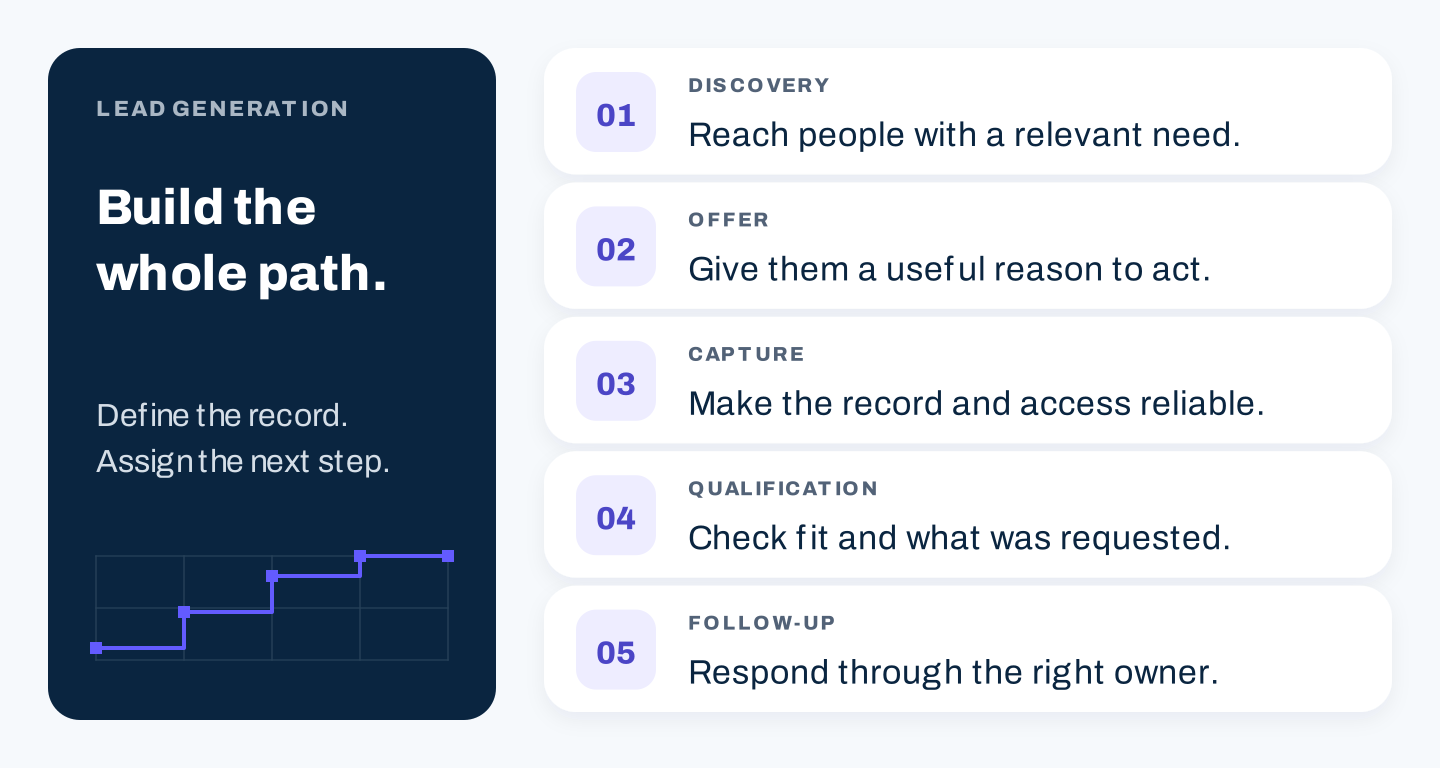
Original lead generation journey. Each stage needs a useful decision and an owner; a form submission is not the end of the process.
Compare 12 lead generation strategies
These are options to evaluate against your audience and capacity. They are not a universal priority order.
| Strategy | Good fit | Offer or next step | Main constraint | Quality signal |
|---|---|---|---|---|
| Search-led content | Recurring questions related to your offer | Relevant guide, tool, or service page | Research, discovery, maintenance | Relevant inquiries from useful content |
| Paid search | Expressed demand with a matching offer | Task-matched landing page | Cost, query relevance, economics | Cost per qualified inquiry |
| Paid social | Identifiable audience and useful offer | Native form or relevant destination | Creative, targeting, follow-up capacity | Fit and accepted next steps by campaign |
| Newsletter | Audience wants ongoing guidance | Explicit subscription | Editorial consistency and delivery | Relevant replies and progression |
| Lead magnet | A specific task benefits from a resource | Template, report, or checklist | Resource utility and access quality | Use and qualified-contact share |
| Webinar or workshop | A task benefits from teaching and questions | Clear registration and replay access | Delivery and event maintenance | Relevant attendance and follow-up |
| Free tool | A task can be solved interactively | Useful output with optional continuation | Build, support, and input quality | Completed tasks and relevant requests |
| Trial or product access | People can evaluate value by using it | Clear account and onboarding path | Activation, conditions, support | Meaningful product use and fit |
| Partners and referrals | Another trusted organization serves related needs | Introduction or shared useful resource | Relationship quality and scope | Accepted relevant introductions |
| Communities and expert participation | Audience discusses the problem in context | Helpful answer and appropriate next step | Rules, trust, time | Relevant voluntary conversations |
| Focused outbound | You can identify a defensible specific need | Relevant explanation or conversation | Research quality and recipient expectations | Useful replies and fit |
| Customer expansion and advocacy | Existing customers have related needs or referrals | Relevant service discussion or introduction | Customer experience and timing | Accepted expansion or referral opportunity |
Choose a primary acquisition route and a supporting route. Avoid launching every channel while the offer, routing, or sales capacity is uncertain.
For outbound, explain the specific reason for contact and honor recipient preferences. It is a deliberate communication strategy, not a reason to treat scraped addresses as opted-in subscribers.
Six real examples across the system
1. HubSpot: offer useful research before a commercial conversation
HubSpot's State of Marketing page gives a research resource its own explanation and access action.
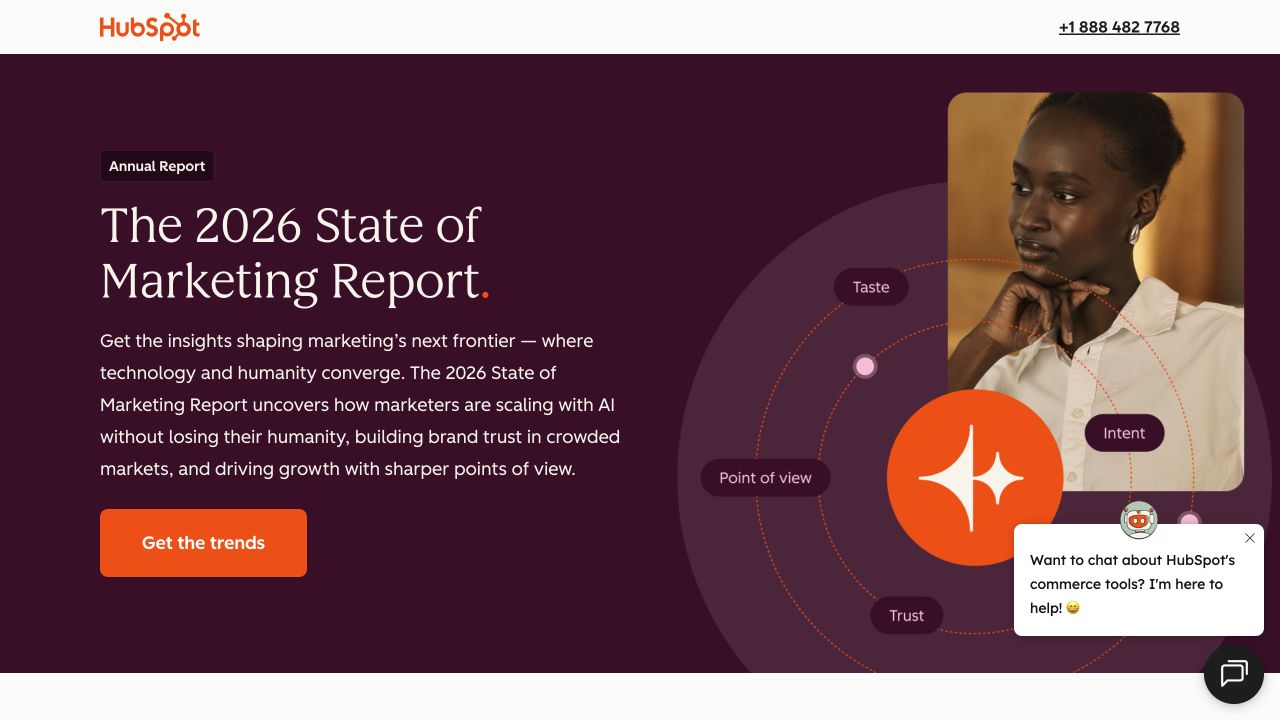
Source: HubSpot, desktop capture, October 7, 2026. This shows a research offer; no submitted form, nurture sequence, or sales result was tested.
A research offer can begin a relationship with people investigating a topic. It does not tell you whether they are evaluating your service. Keep the requested resource and commercial inquiry stages separate.
After delivery, offer a related explanation or optional conversation. Use the lead magnet guide to evaluate the task, resource, and follow-up together.
2. Shopify: a trial begins a product evaluation journey
Shopify's free-trial page places an email entry and start action beside its business-building message and supporting imagery.
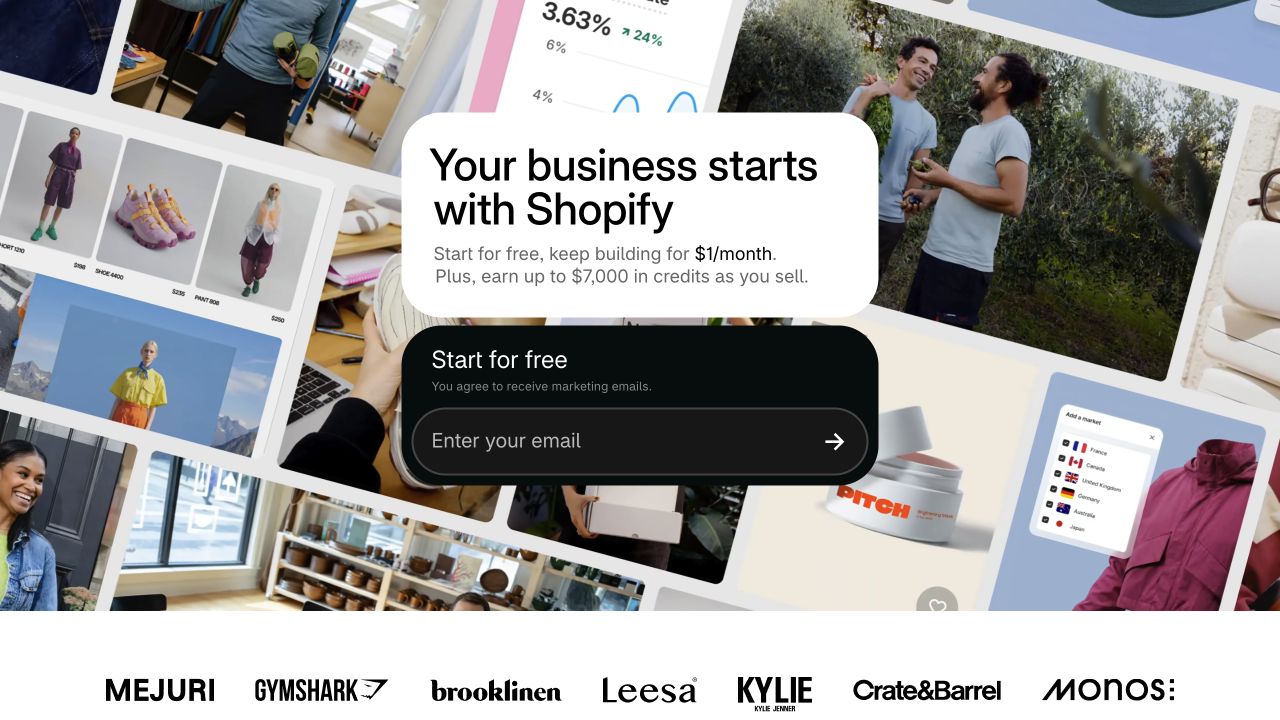
Source: Shopify, desktop capture, October 7, 2026. Trial terms and promotions can vary by location; this analysis concerns the visible entry structure, not a US price or tested onboarding result.
A trial contact has a different job from a report subscriber: they want to evaluate a product. Plan what useful first activity follows account creation. A signup total without activation data can conceal a weak evaluation experience.
For your product, define an activation event tied to useful behavior. Do not substitute a generic login count for successful use of the capability you promised.
3. Slack: qualification can be part of a relevant sales request
Slack's contact-sales page explains sales-related help and includes business, role, company-size, and contact fields. It also points people with other needs toward the help center.
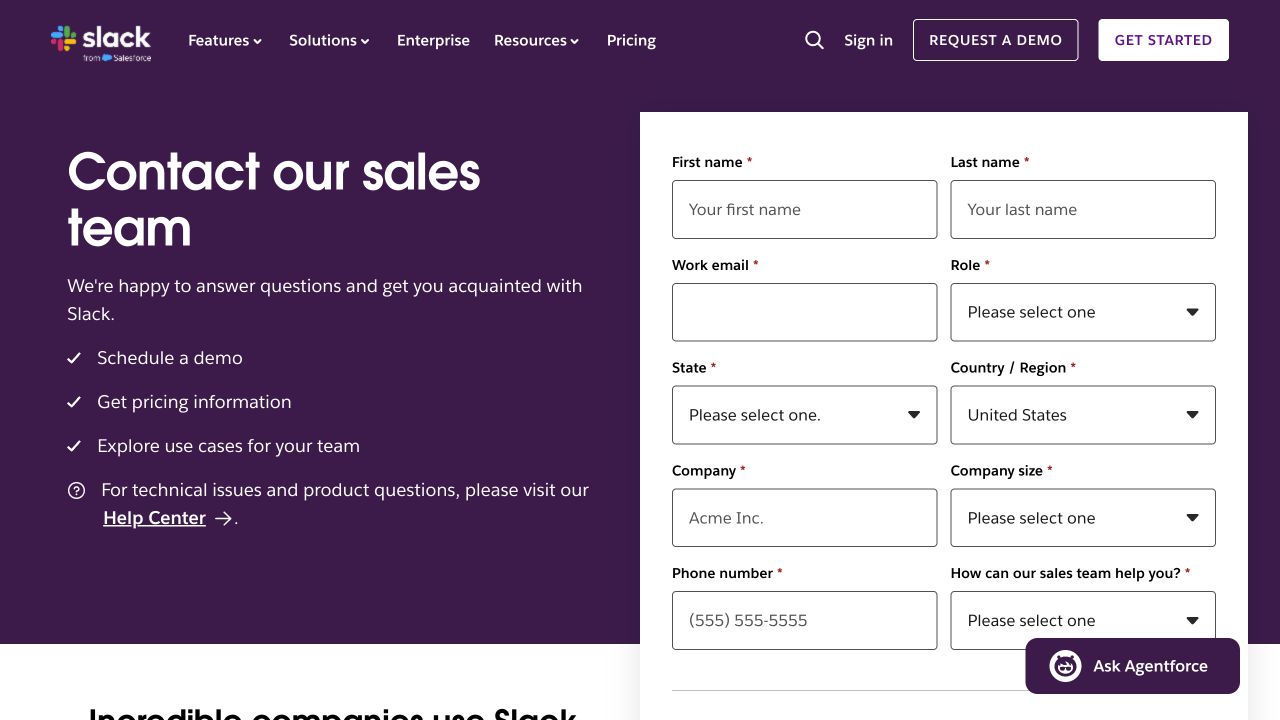
Source: Slack, desktop capture, October 7, 2026. United States was selected for inspection; no personal details were entered and no inquiry was submitted.
This is a higher-commitment action than joining a newsletter. Some extra information can help route a sales request, provided each field has a defined use.
The alternative help path matters too. Routing existing customer support into the sales pipeline can inflate inquiry counts and frustrate users. Give visitors an appropriate destination before they complete the wrong form.
4. LinkedIn: easier capture still needs a quality and handoff plan
LinkedIn's Lead Gen Forms documentation describes prefilled forms, post-submission access, reporting, and lead-management options.
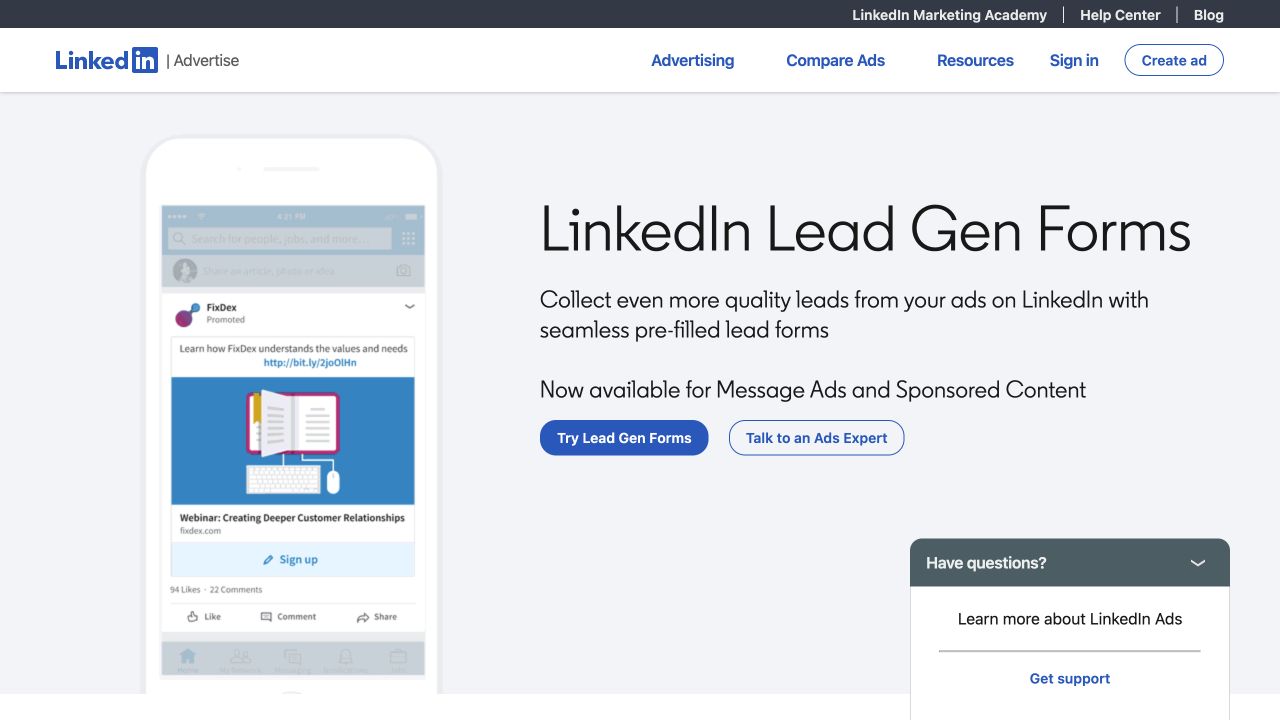
Source: LinkedIn, desktop capture, October 7, 2026. The desktop documentation contains the vendor's own mobile-form illustration; it is not a mobile capture of the website.
Prefilled information can simplify the submission step. The team still needs to establish whether the offer attracts relevant people, whether fields are current, and who receives the record.
Before running a native-form campaign, test your own authorized integration and confirmation path. Define the campaign source, requested asset, submission time, deduplication rule, and responsible owner. Easier capture is useful only when the next steps work.
5. Ahrefs: anonymous tool use and lead capture are separate outcomes
Ahrefs' keyword generator presents a task input and country selection at entry, without an initial email field in the inspected interface.
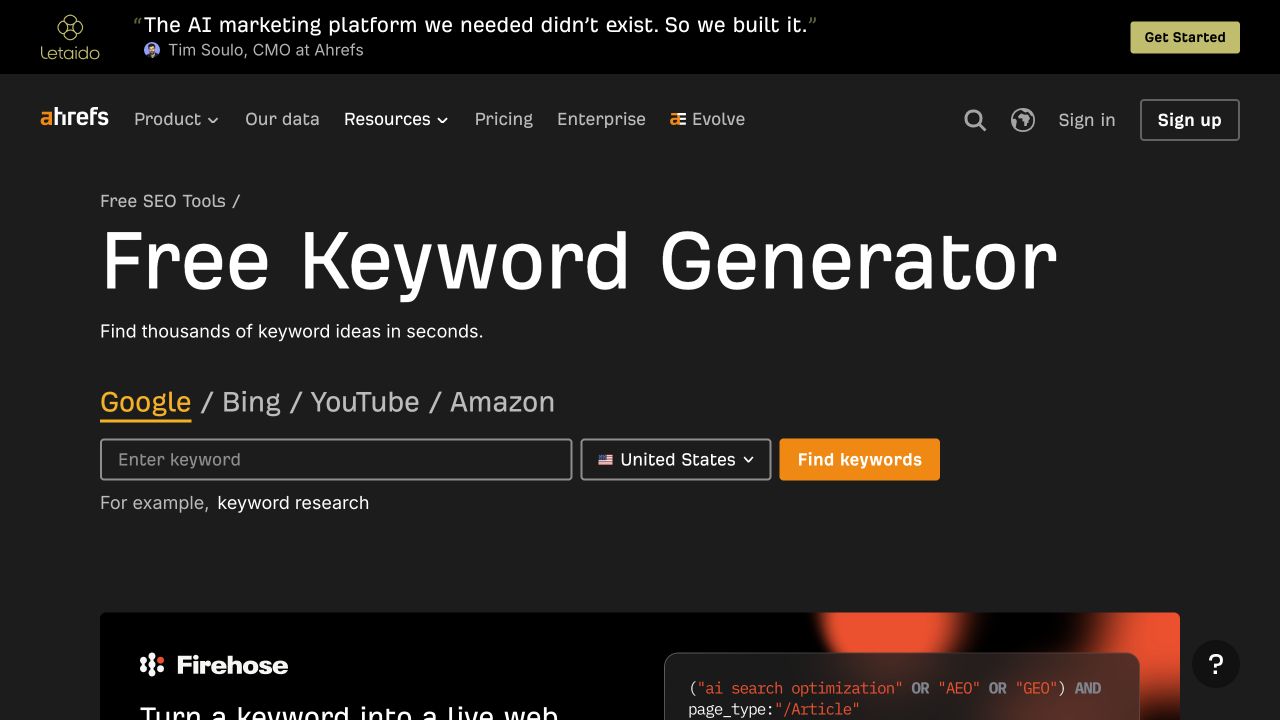
Source: Ahrefs, desktop capture, October 7, 2026. The entry interface was inspected; generated results and later access conditions were not tested.
A useful tool can help someone evaluate your expertise or product approach. Anonymous use is an engagement outcome. A lead exists only when there is an appropriate identifiable continuation.
If a tool offers an optional detailed report or relevant consultation, measure that request separately from tool visits. This prevents “free tool traffic” from becoming an inflated lead count.
6. SCORE: help visitors find relevant expertise
SCORE's mentor directory lets visitors look for business expertise and a suitable mentor.
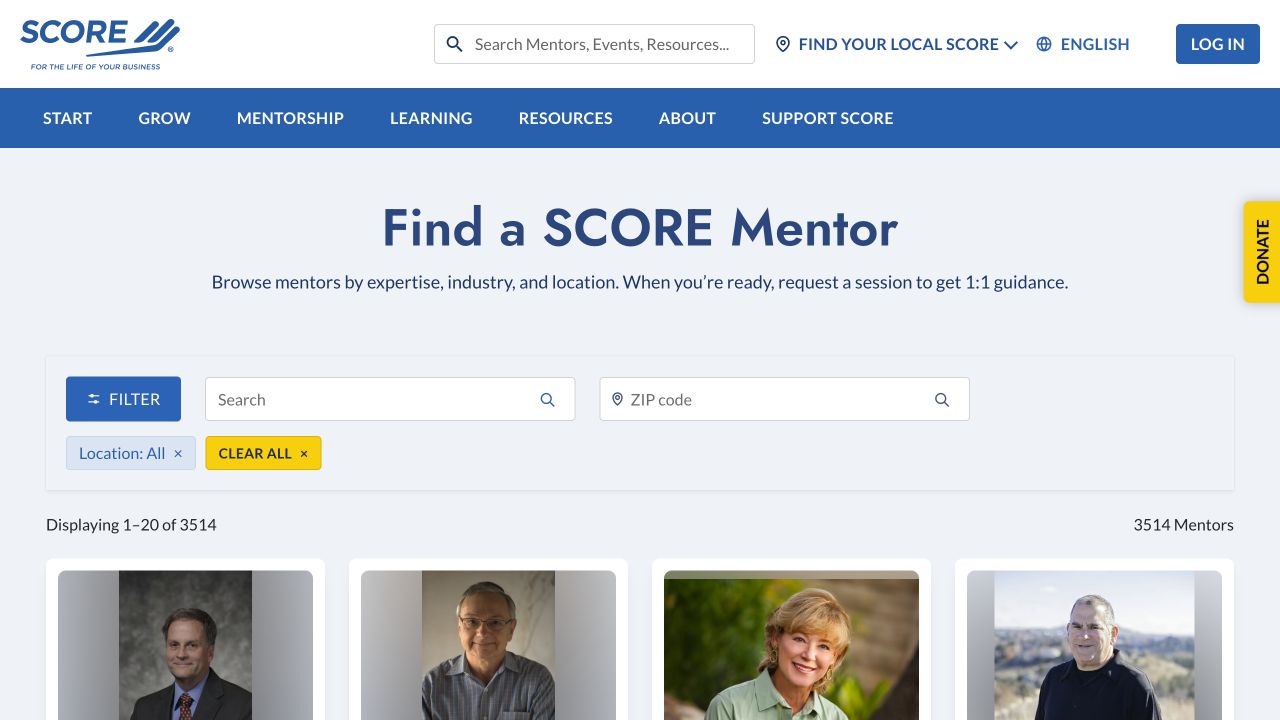
Source: SCORE, desktop capture, October 7, 2026. This is a service-matching directory rather than a single-offer landing page; no mentor request was submitted.
Matching matters for services. A visitor may need a particular location, specialty, or type of help before they are ready to inquire. A generic contact form can hide those distinctions.
For a service business or agency, explain whom you serve and what kinds of requests you can handle. Give unsuitable requests a useful alternative where possible. Qualification should improve the relationship, not merely create a score.
Build the campaign in five steps
Step 1: define audience fit and the useful next action
Record the audience's situation, the problem you address, geographic or operational constraints, and the next step you can support. Use evidence from customers and current inquiries to distinguish common needs from assumptions.
For a founder, one accepted inquiry may be more useful than a large subscriber list. For a marketing team, a relevant subscriber base may support a longer educational relationship. For an agency, make that goal explicit with each client.
Step 2: choose a matching offer and destination
A person searching for implementation help may need a service explanation or consultation. A person exploring a topic may prefer a guide. An audience evaluating software may want a trial or demonstration.
Make the destination continue the channel promise. If an ad offers a worksheet, the page should explain that worksheet. Use landing page optimization to check the offer, evidence, form, and next step together.
Step 3: make capture and routing reliable
Collect what you need for the promised next step. Record source and offer identifiers through your own system rather than asking the visitor to remember where they saw the campaign.
In your test environment, check the complete record, confirmation, delivery, owner assignment, and duplicate handling. Include an exception path for invalid details, integration failures, and existing customers.
Step 4: apply an explicit qualification rule
Use a small set of criteria tied to your ability to help. An illustrative rule might combine service fit, relevant geography, a stated need, and an appropriate next-step request. Your actual criteria should reflect the offer and business.
| Qualification question | Evidence to use | Avoid assuming |
|---|---|---|
| Can we serve this person? | Stated need, service scope, geography | Every download implies fit |
| What did they request? | Form action and offer record | A subscriber requested sales contact |
| Is the information usable? | Valid record and contact route | Prefilled data is always current |
| What should happen next? | Request type and business rules | Every lead needs the same sequence |
| Who owns the next step? | Assigned team or person | A CRM record means someone acted |
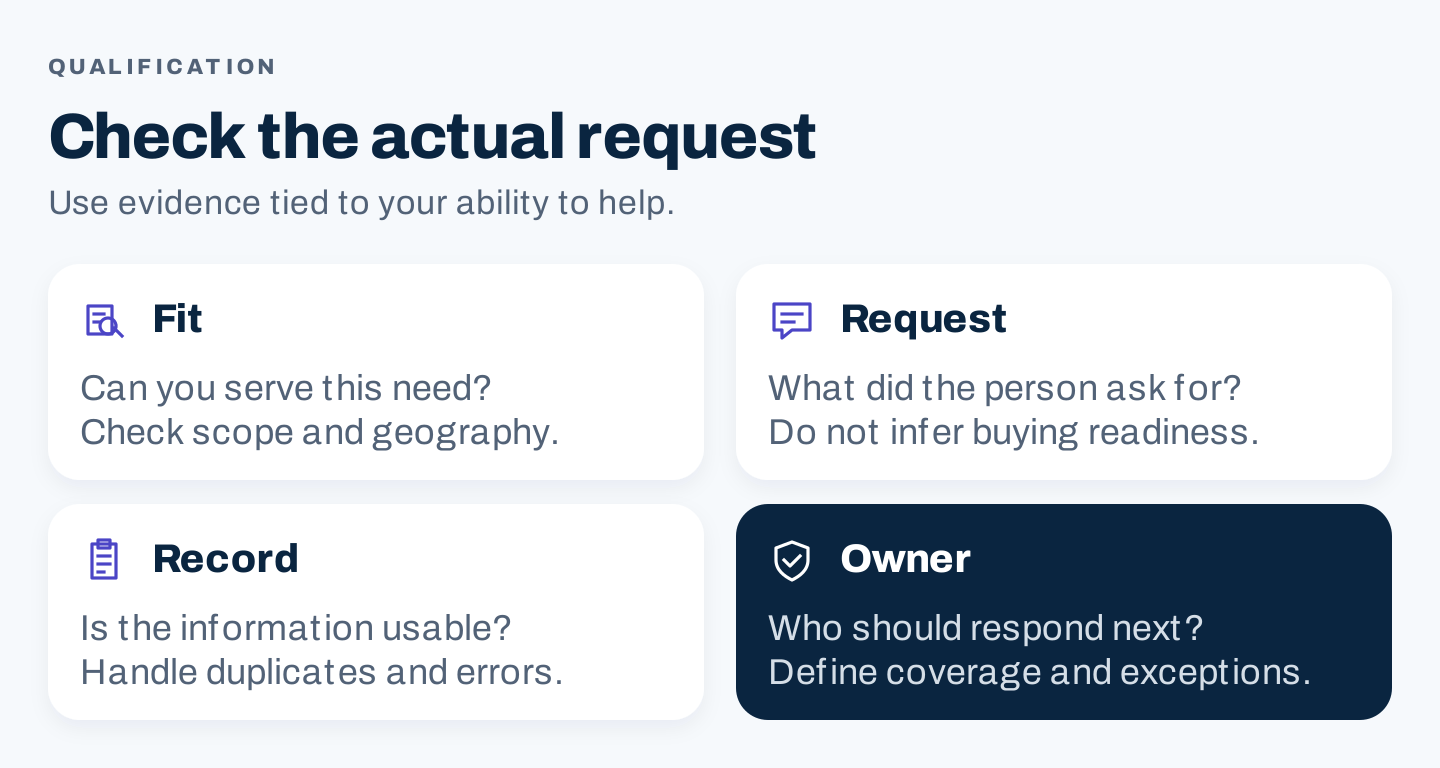
Original qualification framework. Evaluate the request and your ability to help before choosing a response.
Step 5: respond according to the request
Resource contacts need the resource. Trial users need access and useful setup guidance. Sales inquiries need a relevant response from a person able to help.
Set a response expectation you can meet and define coverage when the normal owner is unavailable. Review unanswered requests and delivery failures alongside acquisition metrics.
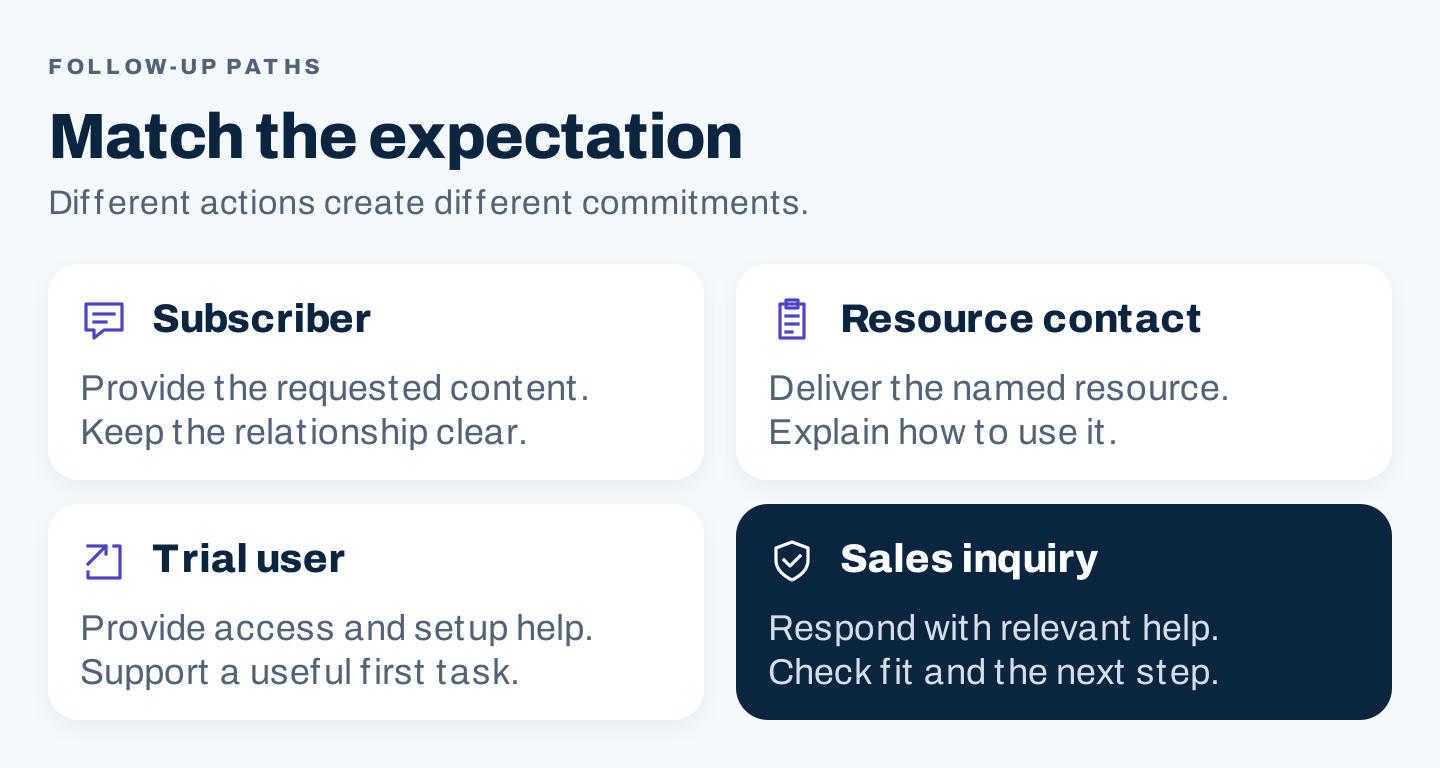
Original routing guide. Subscriber, resource, trial, and sales actions create different expectations.
Measure a consistent cohort from capture to outcome
Choose a campaign window and a follow-up window. Keep contacts captured during that period together when evaluating progression. Recent contacts have had less time to become opportunities than older ones.
| Measure | Calculation or definition | Main limitation |
|---|---|---|
| New eligible contacts | Deduplicated new records meeting capture rules | Exclude tests, spam, and existing records consistently |
| Capture rate | Eligible completed actions ÷ eligible destination visits | Depends on audience and offer |
| Qualified share | Qualified new contacts ÷ new eligible contacts | Requires a stable definition |
| Cost per qualified contact | Defined acquisition costs ÷ qualified new contacts | State which costs are included |
| Response coverage | Eligible requests receiving the promised response ÷ eligible requests | A sent message may not resolve the need |
| Opportunity rate | Accepted opportunities ÷ the same eligible contact cohort | Needs sufficient follow-up time |
| Customer progression | New customers linked to that cohort | Attribution can include other influences |
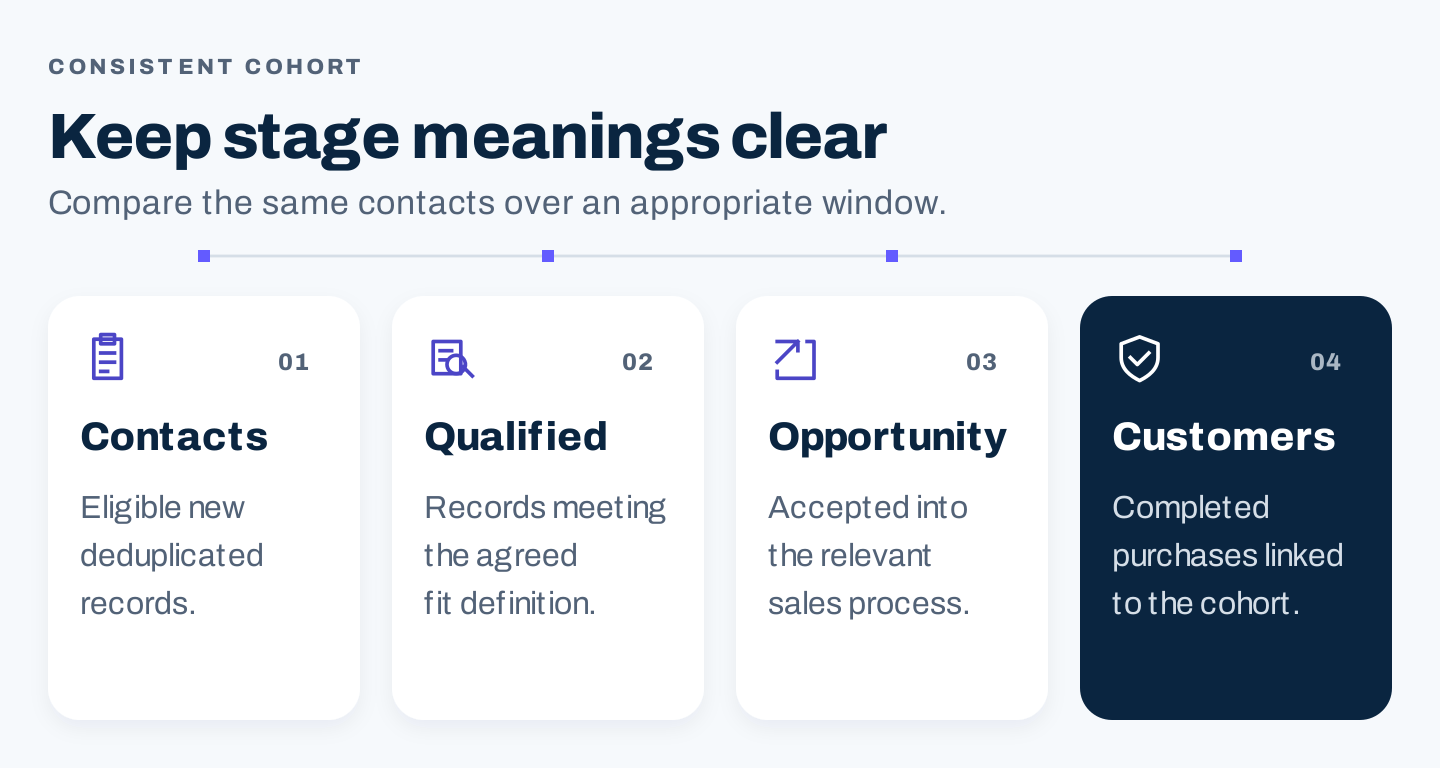
Original reporting sequence. Keep stage definitions and windows consistent; later outcomes are not interchangeable with initial submissions.
For illustration only, compare two campaigns with the same observation window and cost definition:
| Illustrative campaign | Defined cost | New contacts | Qualified contacts | Cost per contact | Cost per qualified contact |
|---|---|---|---|---|---|
| A | $1,000 | 100 | 10 | $10 | $100 |
| B | $1,000 | 40 | 16 | $25 | $62.50 |
Campaign B has fewer contacts and a higher cost per contact, but a lower cost per qualified contact under these stated assumptions. That alone does not establish better revenue or profitability. Compare accepted opportunities and customer outcomes when those cohorts have had time to develop.
Use campaign links consistently where appropriate; Google's campaign URL documentation explains how campaign parameters identify referral campaigns. Do not place personal information in tracking parameters.
Diagnose the bottleneck before adding another channel
| Observation | Inspect first | Possible next action |
|---|---|---|
| Relevant visits, few requests | Offer clarity, match, form errors | Repair the destination or test a clearer offer |
| Many requests, poor fit | Audience, topic, qualification criteria | Narrow targeting or change the offer |
| Good fit, weak progression | Delivery, response, expectations | Improve the handoff and relevant next step |
| Useful conversations, few opportunities | Need, scope, capacity, timing | Clarify acceptance and service fit |
| Strong early results, rising costs | Creative, audience overlap, capacity | Review marginal results before scaling |
Changing five things at once makes learning difficult. Fix known failures, then test a focused hypothesis. Share lead-quality feedback with the people selecting topics and channels.
Copyable lead generation plan
| Decision | Your entry |
|---|---|
| Audience and observed need | |
| Business outcome | |
| Lead definition | |
| Primary and supporting channels | |
| Offer and destination | |
| Fields and purpose | |
| Source and deduplication rules | |
| Qualification criteria | |
| Response owner and coverage | |
| Promised follow-up | |
| Campaign and cohort windows | |
| Included costs and quality metrics | |
| Failure alert and review owner | |
| Next hypothesis to test |
Frequently asked questions
What is the best lead generation strategy for a small business?
Start with the route that reaches relevant people and a next step you can support. Search, referrals, a useful resource, and a clear inquiry page can each fit different businesses. Your audience evidence and capacity determine the choice.
Should I prioritize more leads or better leads?
Define quality first, then seek enough relevant opportunities at sustainable cost. A low submission cost can conceal poor fit, while a higher initial cost can produce more useful conversations.
Is a newsletter subscriber a sales lead?
A subscriber is an identifiable relationship, but subscribing does not establish buying interest. Keep the requested communication and sales qualification stages distinguishable.