Inbound Marketing Strategy: Turn Useful Content into Customer Relationships

An inbound marketing strategy starts with a question your audience needs answered. It earns attention with a useful response, provides a relevant way to continue, and supports the person as their needs develop.
A collection of blog posts is only part of that system. Readers also need to find the content, understand the next action, receive what was promised, and get useful help afterward.
This guide shows how to connect those pieces into a manageable campaign. The real examples illustrate public resources and action paths. The campaign templates and follow-up copy are original proposals you can adapt; they are not those brands’ actual email sequences or measured results.
What is inbound marketing?
Inbound marketing attracts and supports potential customers through useful content and experiences that address their needs. It can include articles, videos, tools, learning resources, conversations, email, and customer support.
HubSpot’s inbound methodology describes attracting, engaging, and delighting customers. The practical implication is that helping people continues after an initial conversion or purchase.
Inbound is a way of designing the relationship, not a guarantee of free acquisition. Research, production, distribution, tools, and follow-up all consume resources.
| Related activity | Its role in an inbound strategy |
|---|---|
| Content marketing | Produces material that helps an audience understand or perform a task |
| SEO | Helps relevant searchers discover suitable pages |
| Social and community participation | Shares useful answers where people already discuss the problem |
| Continues a requested relationship with relevant help | |
| Lead capture | Creates an identified contact when the offer and request justify it |
| Sales and customer support | Respond to specific needs and help people realize value |
Outbound begins with proactive contact or placement. Inbound gives people a reason to seek or use your help. The two can work together: a paid placement can introduce a useful guide, for example. Payment for distribution does not determine whether the destination is helpful.
Build one connected campaign before expanding
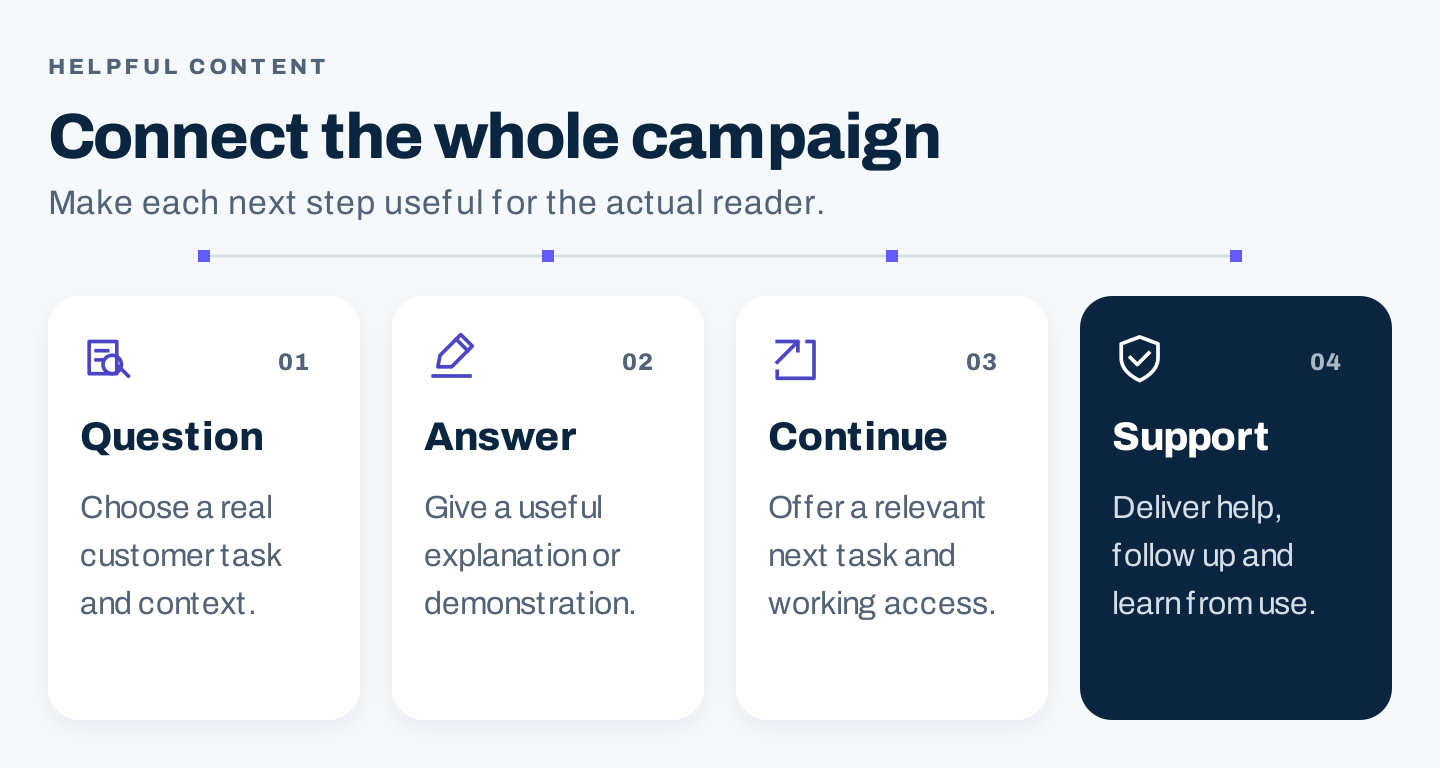
Original campaign model. Each step should continue the same reader task.
Start with one audience situation and a relevant commercial offer. Then define:
- The question that brings the audience to the topic.
- The answer that genuinely helps them.
- The next resource or action that continues the task.
- The follow-up that helps them use it.
- The commercial or customer-success outcome you will observe.
That is a more workable starting point than publishing across every channel at once. A small business can run it with one owner and a simple tracking sheet. A marketing team or agency can use the same brief to coordinate writers, subject experts, distribution, and sales.
Five real examples of useful inbound building blocks
1. Buffer: answer the task and offer a related product route
Buffer’s social media calendar guide provides planning options and a contextual route to its product. It gives a reader a choice between learning about calendars and exploring a tool that supports the task.
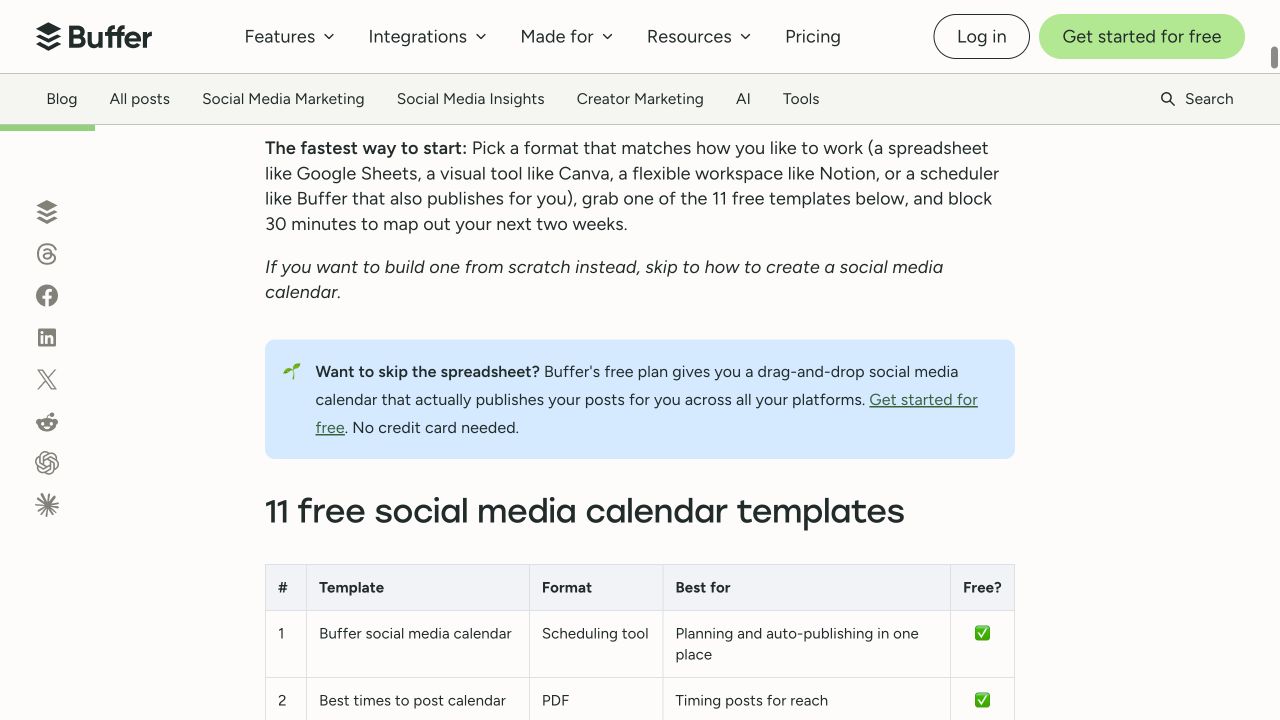
Source: Buffer calendar guide. Desktop capture; no product signup completed.
Apply the lesson: finish the useful explanation before relying on the CTA. For your own guide, offer a next step that addresses the same problem. A generic sales message added to unrelated content has a weaker connection to the reader’s immediate task.
2. HubSpot: make the resource’s scope visible
HubSpot’s public State of Marketing resource page presents a report and a download route. The page is an observable resource offer; the capture does not verify delivery or the research findings inside the file.
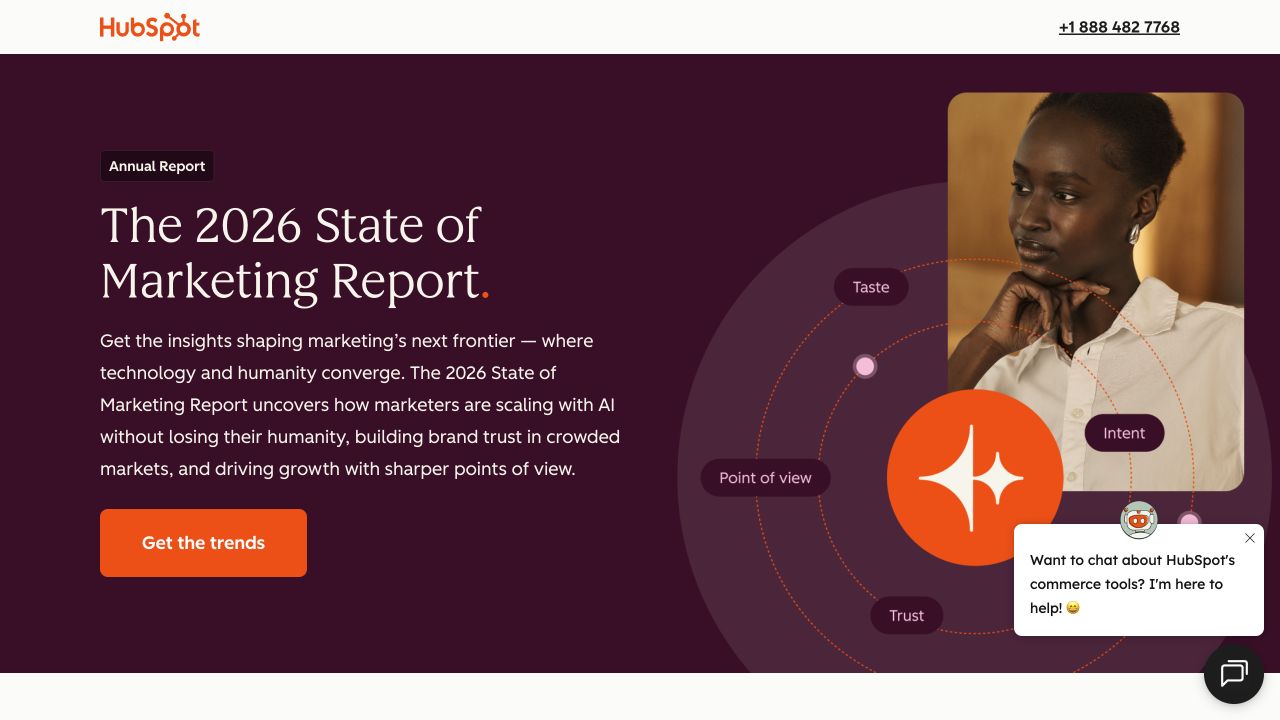
Source: HubSpot State of Marketing. Resource entry page inspected; no form submitted.
Apply the lesson: explain what your resource helps someone decide. Show its scope, format, date, and a representative preview. If contact information is requested, make the exchange understandable and deliver the promised material reliably.
3. Canva: organize education into useful learning choices
Canva Design School’s course directory presents learning options rather than one undifferentiated stream of articles. A course can help a reader work through a skill over several steps.
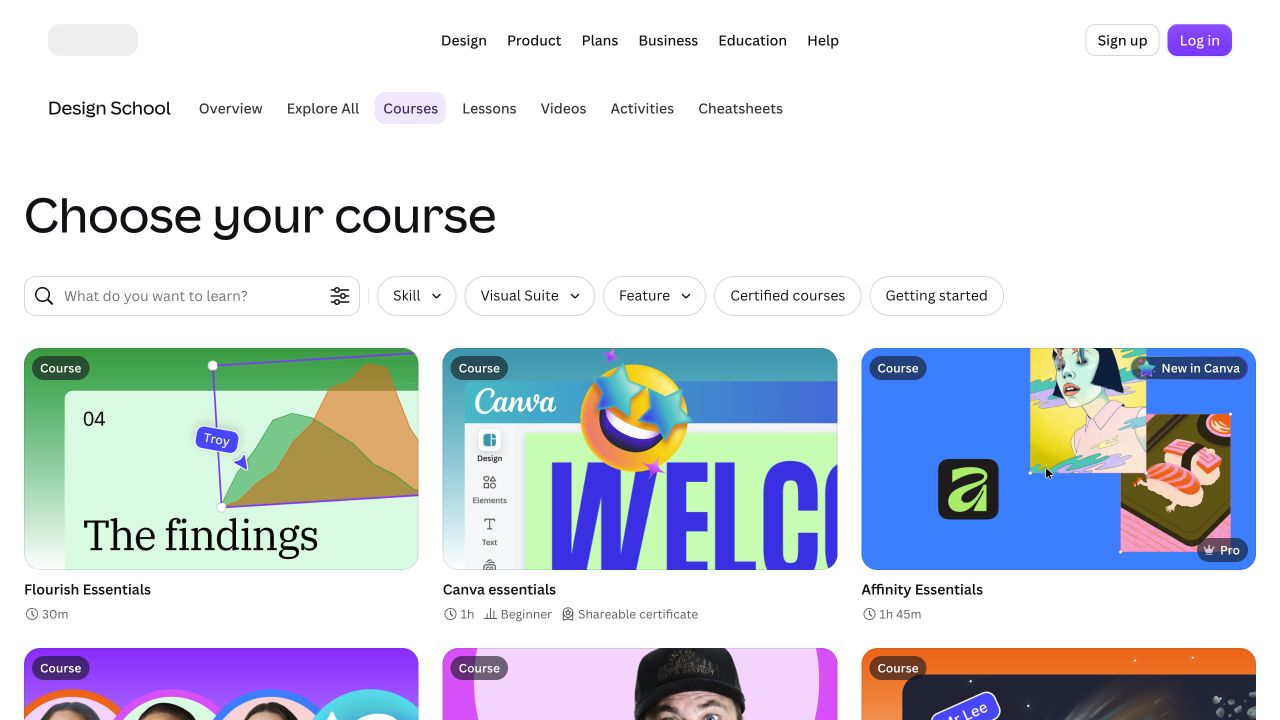
Source: Canva Design School courses. Public directory capture; course completion and access conditions were not tested.
Apply the lesson: use a learning sequence when the audience needs to perform a sequence. A course should have a defined starting point, exercises, and a usable result. Do not call a collection of promotional messages a course simply to make the offer sound more substantial.
4. Search Engine Journal: distinguish scheduled and available learning
The Search Engine Journal webinar hub separates upcoming sessions and past material. The hub is a resource example, rather than a complete inbound-strategy guide.
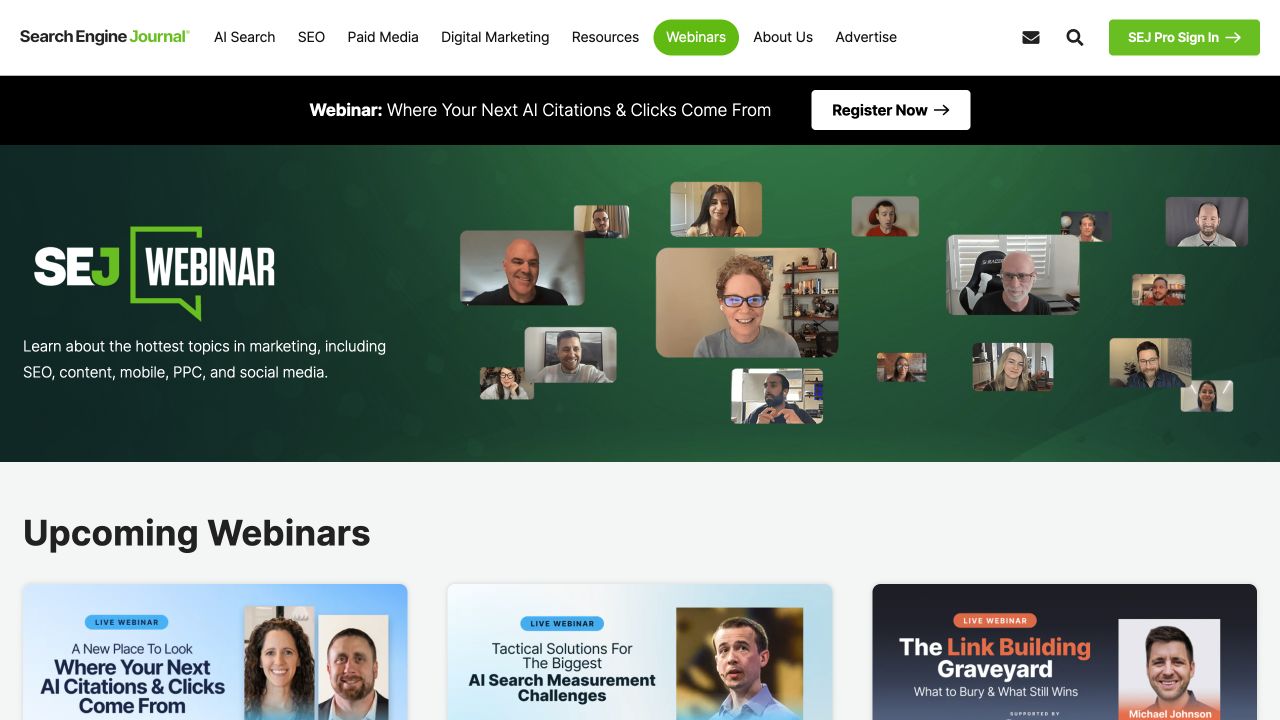
Source: SEJ webinar hub. The preserved desktop capture reflects the listed sessions at its capture time; listings change.
Apply the lesson: tell visitors whether they are registering for a future event or accessing an existing resource. Explain the delivery method and provide an appropriate alternative if someone cannot attend. One resource can support several learning preferences without implying everyone is ready for a sales call.
5. Buffer: keep helping after acquisition
Buffer’s help center organizes public support around setup and product-use tasks. It provides an example of assistance that extends beyond an initial signup.
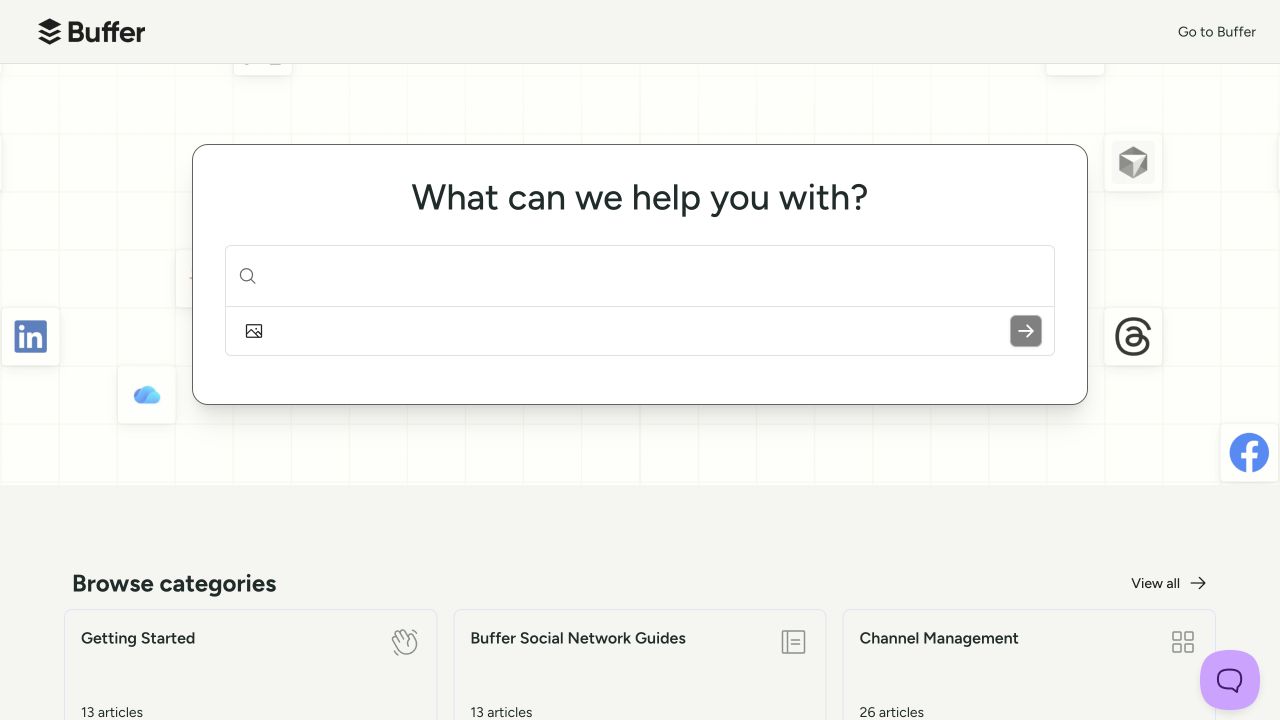
Source: Buffer Help Center. Desktop public support entry.
Apply the lesson: include help that enables the promised outcome. A trial user may need setup instructions; a service customer may need preparation or aftercare information. Measure whether customers can achieve the relevant task, rather than assuming another promotional email will improve retention.
How to create an inbound marketing strategy
Step 1: choose an audience situation and a meaningful outcome
Define whom you can help and what has prompted their research. Broad labels such as “business owners” are useful for orientation but too loose for a focused campaign.
Use this structure:
We will help [serviceable audience] who are trying to [specific task] after [trigger]. The campaign should support [named outcome], which [owner] will measure through [record or event].
Record the distinction between the reader’s outcome and your commercial outcome. The reader might want a workable content calendar; the business might want qualified product adoption. The strategy should connect them without withholding the basic answer.
Step 2: collect questions and objections from real evidence
Review inquiry notes, customer conversations, support requests, search queries, and relevant public discussions. Record exact wording where useful and keep each note linked to its source.
Separate introductory questions from evaluation questions. “What does this term mean?” needs a clear explanation. “Will this work with our existing process?” needs evidence, conditions, and tradeoffs.
Include existing customers in the research. Their implementation problems can reveal gaps in pre-purchase content as well as opportunities for better support.
Step 3: create a useful core answer
Choose the format that fits the task:
| Audience task | Suitable starting format | What makes it useful |
|---|---|---|
| Understand a problem | Article or explainer video | Clear definition, context, and recognizable symptoms |
| Compare approaches | Guide or decision table | Explicit criteria, limitations, and alternatives |
| Perform a task | Demonstration or tutorial | Complete steps and an observable output |
| Repeat a process | Checklist or template | Usable fields and a realistic workflow |
| Work through a skill | Course or workshop | Progression, practice, and feedback opportunities |
| Evaluate a purchase | Scope page or case study | Relevant conditions, evidence, and clear next actions |
Use subject expertise, original examples, and authentic visuals where they improve the answer. Verify changing claims before publication. Useful content can be concise or extensive; its length should follow the work the reader needs to do.
Step 4: make discovery practical
Choose one or two routes you can operate well. Search can support existing demand. A newsletter can reach people who have requested ongoing help. A relevant community or partner can introduce a resource to a suitable audience.
For each route, record the audience, the message, the destination, and the person responsible. Adapt the introduction to the channel while keeping the promise consistent with the content.
If the campaign uses paid promotion, check cost and audience fit alongside the quality of the resulting actions. If it relies on search, allow for uncertain discovery and ranking timelines. Neither route guarantees a particular result.
Use the content distribution guide to compare routes without confusing the asset with the channel carrying it.
Step 5: choose an appropriate continuation
The next step should solve the next problem. That might be an open worksheet, an optional newsletter, a session, a trial, or a commercial inquiry.
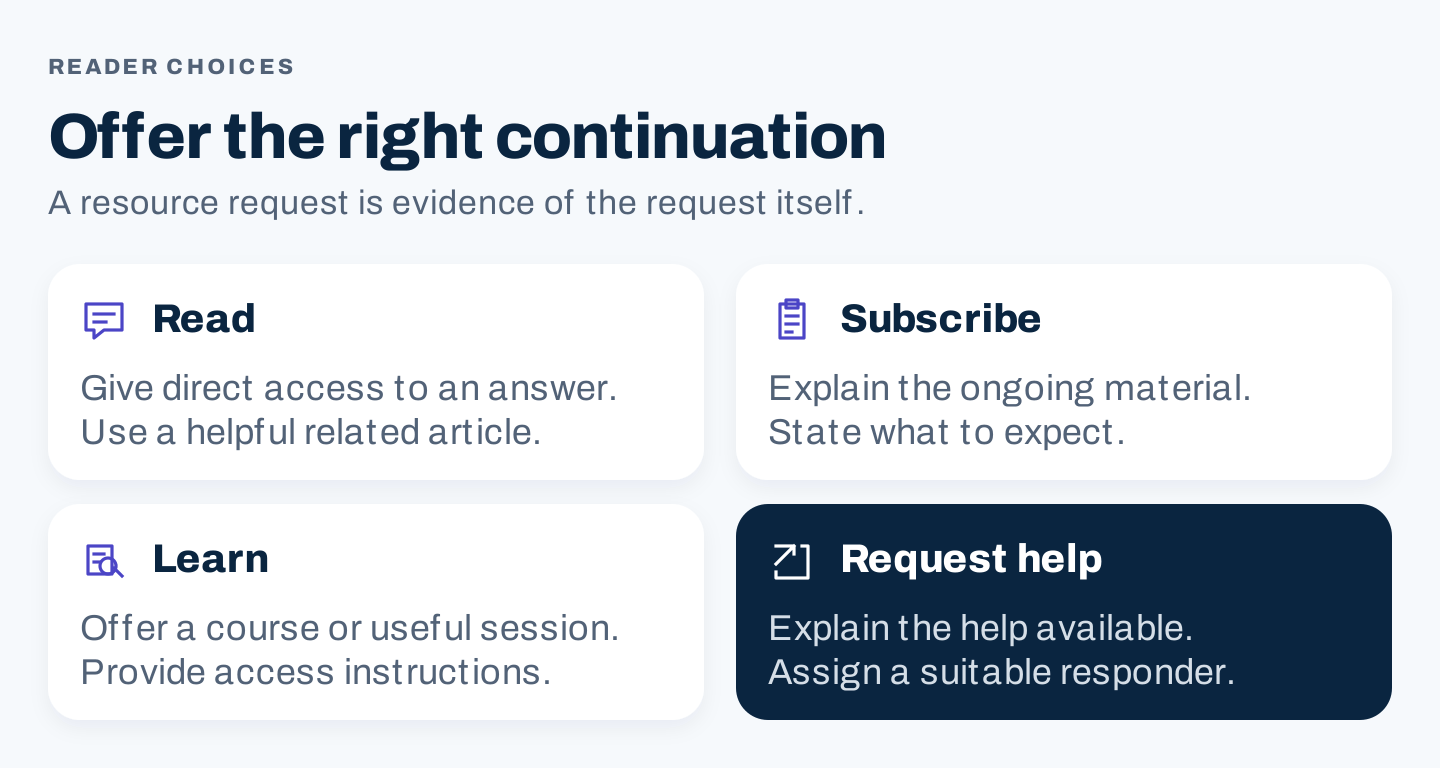
Original continuation framework. Choose the commitment that fits the reader’s task.
Not every useful asset needs a form. An open resource can provide immediate help and support discovery. A subscription needs a clear ongoing promise. A commercial inquiry needs enough context for a relevant response.
Test your own path: can someone reach the asset, use the action, receive confirmation, and access what was promised? Does the resulting record reach the correct owner? A successful form submission is only one part of delivery.
Step 6: follow up with help that fits the request
Deliver the requested resource first. Then continue the task if the person has chosen that relationship.
Use the following original sequence outline, adapting timing and contact choices to the actual offer. These are proposed messages, not a verified brand campaign:
| Message | Reader value | Appropriate action |
|---|---|---|
| Delivery | Access the promised resource and understand how to start | Open the named resource |
| Application | Complete one useful part of the task | Use a short example or exercise |
| Decision support | Understand a relevant tradeoff or common obstacle | Read an accurate comparison or answer |
| Optional commercial help | Get assistance when the service is a relevant fit | Request the clearly described next step |
Avoid a rigid sequence that ignores what the person has already done. Someone who purchased should receive appropriate customer help. Someone who only wanted a file should not be treated as having requested a consultation.
Here is a delivery message structure:
Subject: Your [named resource] and a useful starting point

Here is the [resource] you requested: [working access link].

Start with [specific section or task]. You will need [inputs].
The output should help you [concrete result].

If [relevant condition] applies, this [related answer] may help.
If you want help with [serviceable need], you can [optional action].

[Sender identity and the appropriate communication choices]
Step 7: support the result and review what you learned
Bring sales and support feedback into the campaign review. Look for questions the content failed to answer, repeated delivery problems, and mismatches between the offer and the resulting requests.
Give each asset an owner and a review trigger. A changed product, altered service scope, broken access link, or repeated customer confusion should prompt an update.
Measure inbound marketing as a connected system
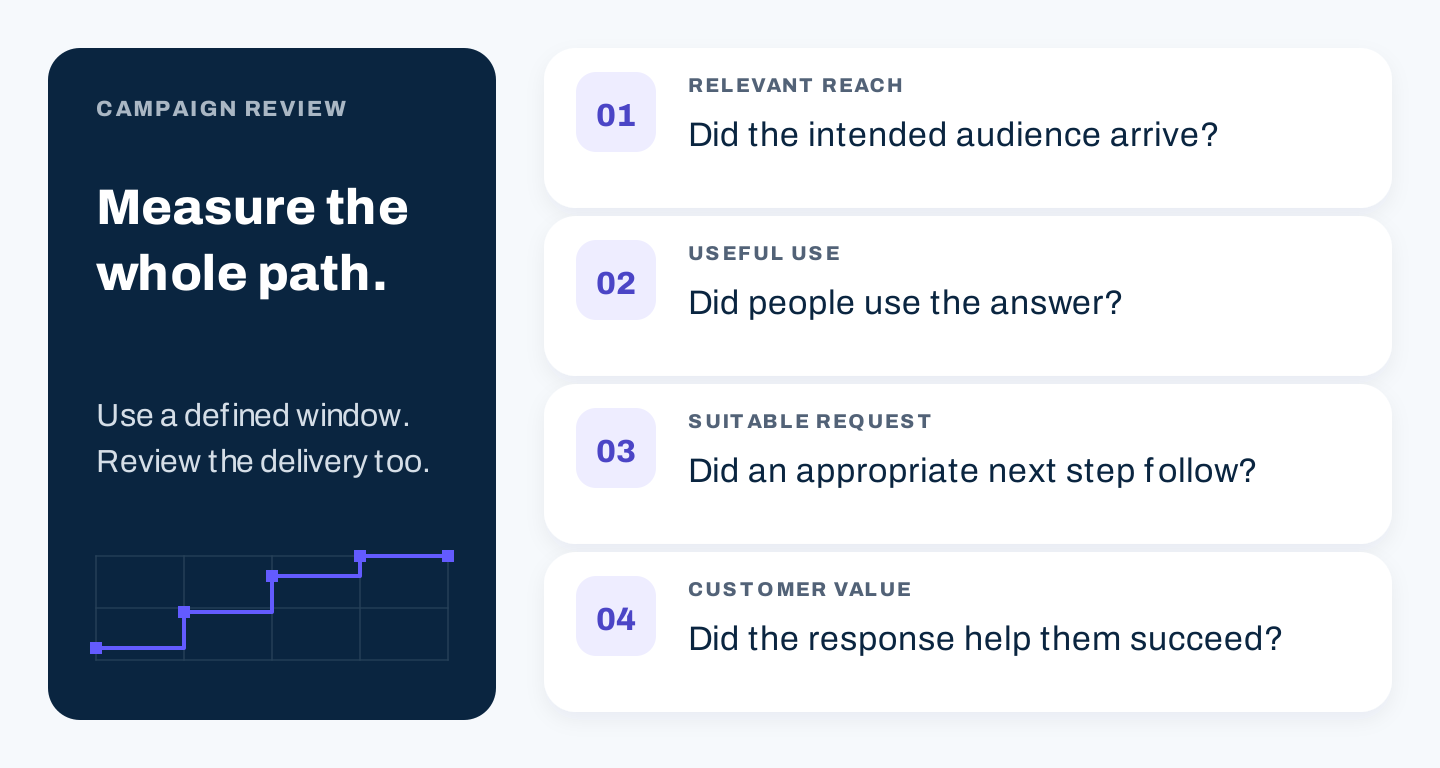
Original measurement framework. Engagement, qualification, and customer success answer different questions.
Track enough information to distinguish stages:
| Question | Measures to consider | Required definition |
|---|---|---|
| Did relevant people find the answer? | Relevant visits, referral sources, discovery queries | Which audience and destinations count |
| Did they use it? | Resource use, exercise completion, meaningful return visits | What useful use means for that format |
| Did they request a next step? | Subscriptions, resource requests, trials, inquiries | Each action’s distinct meaning |
| Was the commercial request suitable? | Qualified inquiries and accepted opportunities | Agreed fit and handoff rules |
| Did value follow? | Customers, useful activation, repeat use, renewal | The appropriate outcome and observation window |
Include production, distribution, tools, and follow-up costs consistently. For a campaign with a defined cost and deduplicated qualified inquiries, divide that cost by the qualified inquiries to calculate cost per qualified inquiry. Use the same cost basis when comparing campaigns.
Report attribution limits. Someone may encounter your guide, a colleague’s recommendation, an event, and a product page before buying. Known content interactions can inform the story without proving that the article caused the sale.
Use a consistent cohort when following requests into opportunities or customers. Calendar-period traffic and later sales cannot automatically be combined into one conversion rate.
A practical pilot for a small team
Use a staged pilot rather than an arbitrary promise about when inbound will produce revenue:
- Prepare: choose the audience situation, gather questions, inspect the existing offer and action path, and establish baseline records.
- Build: create one strong answer and a relevant continuation. Assign the content, delivery, and response owners.
- Launch: use the selected discovery routes and verify real delivery in your own system.
- Review: inspect reach, useful use, request quality, and unresolved follow-up. Allow enough time for the buying process before judging downstream outcomes.
- Improve: address the clearest bottleneck before expanding topics, formats, or automation.
For an agency, repeat this process per materially different client situation. Reusing the planning structure is sensible; reusing another client’s audience assumptions is not.
Copyable inbound campaign brief
Audience situation and serviceability:
Trigger, task, and customer questions:
Evidence sources and dates:
Reader outcome and commercial outcome:
Core answer, format, and subject expert:
Relevant continuation and access conditions:
Discovery routes, messages, and owners:
Delivery and response checks:
Follow-up value and audience choices:
Sales / support handoff:
Useful-use, quality, and outcome measures:
Cost basis and attribution limits:
Review date, owner, and decision:
Maintenance triggers:
Frequently asked questions
Can inbound marketing work without a lead magnet?
Yes. An open article, tool, demonstration, or public learning resource can help readers and lead to an appropriate product or service action. A form is useful when the exchange or delivery process justifies it.
How long does inbound marketing take?
There is no universal timeline. Discovery, audience access, buying cycles, content quality, and follow-up affect the result. Use operational checks and meaningful intermediate measures while waiting for sufficiently mature business outcomes.
Does an inbound strategy require AI prompts?
No. AI may help organize research or draft from a verified brief, but it does not replace the evidence, useful resource, or functioning delivery path. Use it for a defined task and review the output. This campaign can be run with the worksheet and examples above.
For the wider journey, use the marketing funnel guide. For request classification and sales feedback, use the lead quality guide.