SEO vs AEO vs GEO: The Difference and What to Do About It
SEO gets you ranked, AEO gets you quoted, GEO gets you named. See where each shows up, how to check it, and the four fixes that help all three.

SEO gets you ranked. AEO gets you quoted. GEO gets you named. SEO (search engine optimisation) is about appearing in Google's organic results so people click through. AEO (answer engine optimisation) is about having your answer used in Google's AI Overviews and featured snippets. GEO (generative engine optimisation) is about being mentioned or cited when someone asks ChatGPT, Gemini, Perplexity or Claude for a recommendation.
They sound like three jobs. In practice they're one job with three scoreboards. Google says so directly, and the fixes that help one help the other two.
Rankauto publishes this guide. We checked Google's, OpenAI's, Anthropic's and Perplexity's documentation on October 13, 2026.
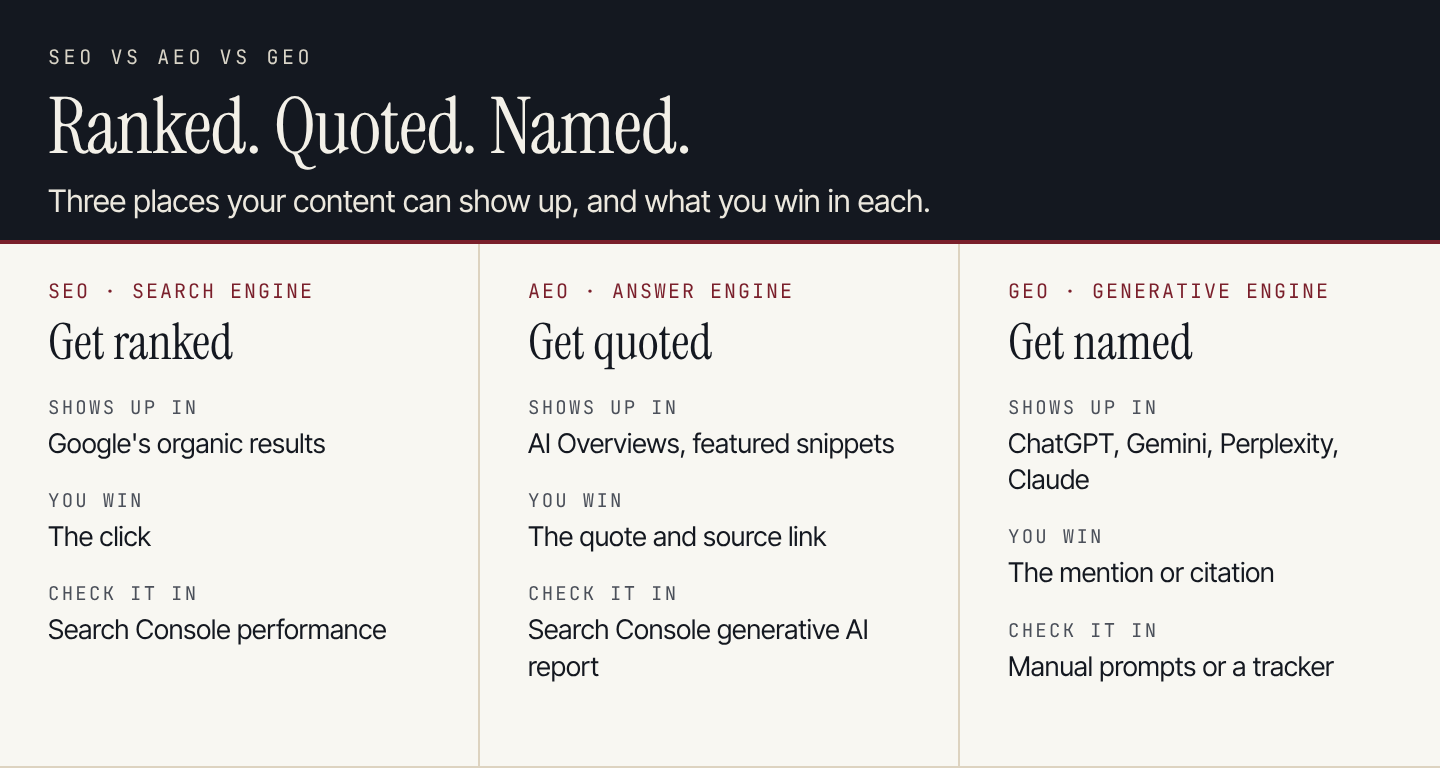
Each term describes a different place your content can appear, and a different thing you win there.
The difference at a glance
| SEO | AEO | GEO | |
|---|---|---|---|
| Stands for | Search engine optimisation | Answer engine optimisation | Generative engine optimisation |
| Shows up in | Google's organic results | AI Overviews, AI Mode, featured snippets | ChatGPT, Gemini, Perplexity, Claude |
| You win | A click | A quote, usually with a source link | A mention or a citation |
| Main question | Does my page rank for this search? | Is my answer the one Google uses? | Does the AI name my brand? |
| Where to check | Search Console performance report | Search Console generative AI report | Asking the assistants, or a tracking tool |
The terms overlap and people use them loosely. Some use AEO and GEO as synonyms. We find the split above the most useful because each column has a different way to check it.
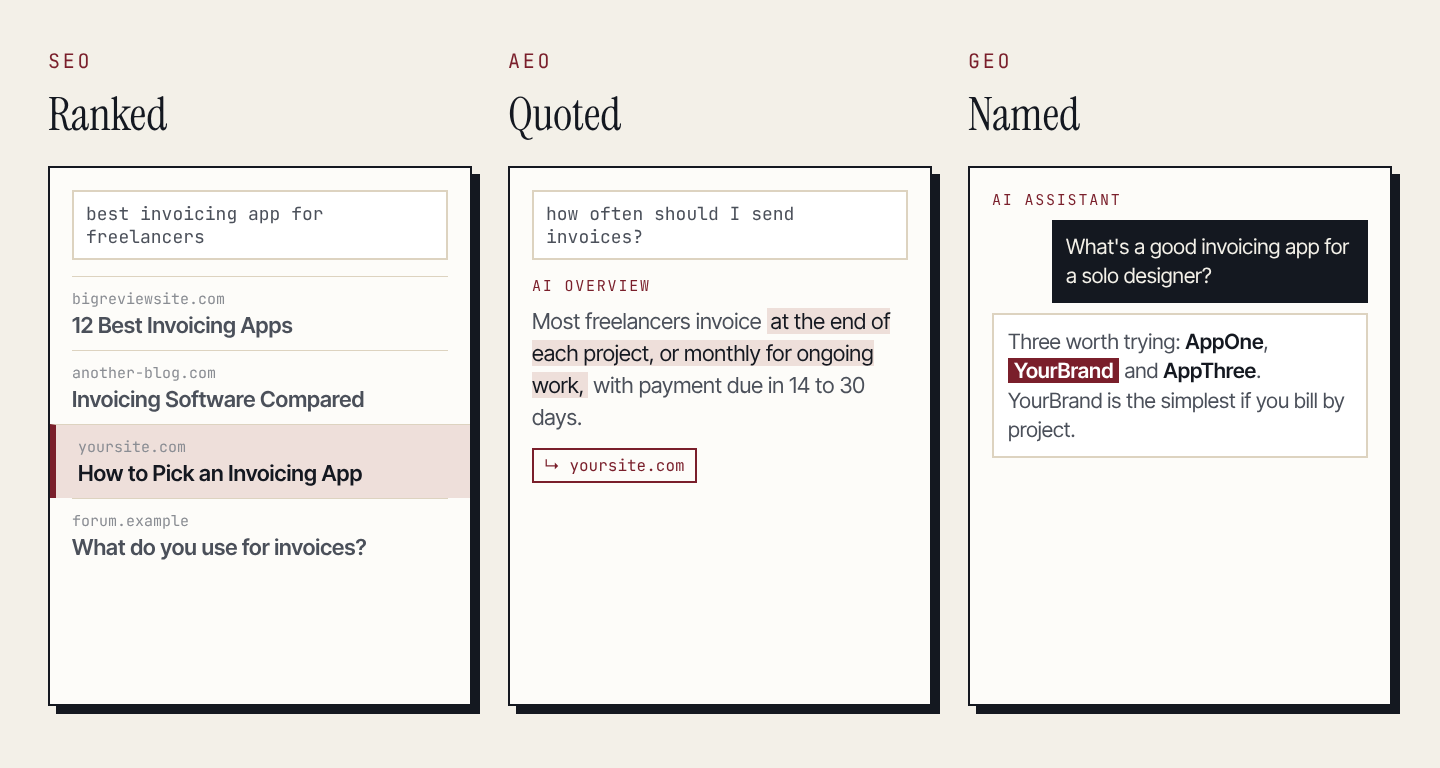
The same page can win in three places: a ranked result, a quoted answer and a named recommendation. Sites and brands shown are made up.
SEO: get ranked
SEO is the work of making a page appear in Google's organic results for the searches your customers make, and making it worth clicking. It covers three things:
- Technical: Google can crawl and index the page.
- Content: the page answers the search better than the alternatives.
- Authority: other sites and signals suggest you can be trusted on the topic.
Success is measured in rankings, impressions and clicks, all visible in Google Search Console. If you're starting from zero, our SEO audit guide shows what to check first.
AEO: get quoted
AEO is about the answers Google writes itself: AI Overviews and AI Mode, plus the older featured snippet that sits above the results. Here Google doesn't just list your page. It reads it, takes the part that answers the question, and shows that, usually with a link back to you.
Two things decide whether your page can be used:
- Eligibility. Google's AI optimisation guide says a page must be indexed and eligible to show in Search with a snippet before it can appear in these features. If a page doesn't rank at all, it won't be quoted.
- Quotability. The answer has to be easy to lift. A question as a heading, followed by one or two plain sentences that answer it, gives Google a clean passage. A paragraph that warms up for three sentences first does not.
Google now recommends a generative AI performance report in Search Console to see how your content does in these features. That's your AEO scoreboard.
GEO: get named
GEO is about AI assistants outside Google's results page: ChatGPT, Gemini, Perplexity and Claude. When someone asks one of them "what's a good invoicing app for a freelancer?", the answer names a few brands. GEO is the work of being one of them.
Assistants draw on two sources:
- Live search. For current or specific questions, the assistant searches the web, reads pages and cites them. This is where your pages can be linked, and it depends on the assistant's search crawler being able to reach your site.
- What the model already learned. Brands that appear often and consistently across the web, in reviews, comparisons, forums and press, are more likely to come up even without a live search.
There's no Search Console for ChatGPT. The simplest check is to ask the assistants the questions your customers ask, and record whether you're named, whether you're linked, and whether the facts are right. Paid trackers automate this; our AI visibility tools roundup compares them.
GEO starts in your robots.txt
Each AI company runs separate crawlers for search and for model training. Blocking a training crawler keeps your content out of future training data. Blocking a search crawler keeps you out of that assistant's live answers.
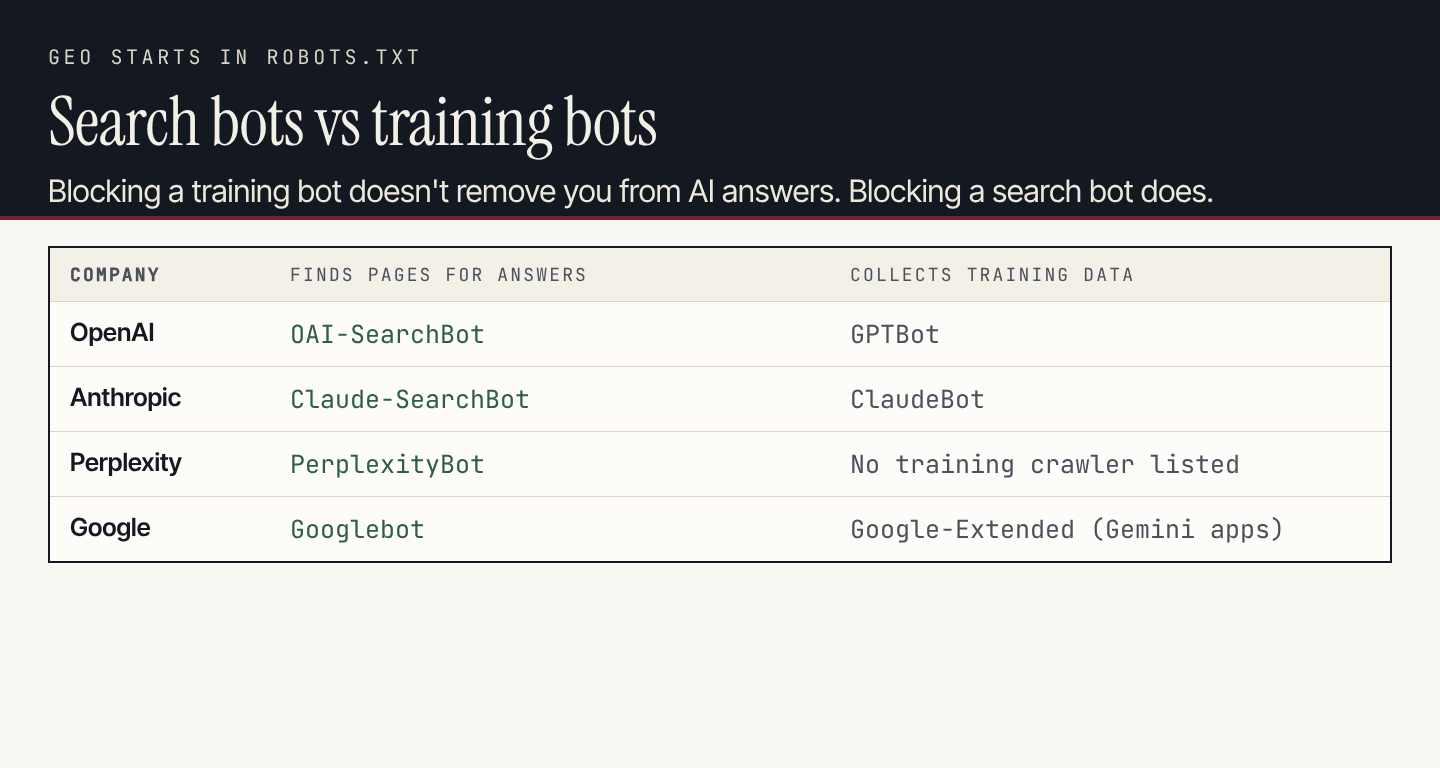
If you want to be cited in AI answers, the search crawlers in the middle column need access. Sources: OpenAI, Anthropic, Perplexity, Google.
What each company says:
- OpenAI: OAI-SearchBot surfaces sites in ChatGPT search. GPTBot collects training data. The settings are independent, so blocking GPTBot doesn't remove you from ChatGPT search.
- Anthropic: Claude-SearchBot indexes pages for search results, Claude-User fetches pages when a user asks, and ClaudeBot collects training data. Anthropic says blocking the first two may reduce your visibility in Claude's answers.
- Perplexity: PerplexityBot surfaces and links sites in Perplexity's results. Perplexity says it isn't used to train foundation models.
- Google: AI Overviews come from Google's normal search index, so Googlebot is what matters. Google-Extended controls use in Gemini apps and model training, and Google says it doesn't affect inclusion or ranking in Google Search.
To check your site, open yoursite.com/robots.txt. If you see Disallow: / under any of the search crawlers, that assistant can't use your pages in its live answers. A setup that allows search and blocks training looks like this:
User-agent: OAI-SearchBot
Allow: /

User-agent: Claude-SearchBot
Allow: /

User-agent: PerplexityBot
Allow: /

User-agent: GPTBot
Disallow: /

User-agent: ClaudeBot
Disallow: /
Whether to block training crawlers is a business decision, not an SEO one. Our own site allows all of them.
What Google says about AEO and GEO
Google addresses the terms directly in its guide to generative AI features. Its view: AEO and GEO are names for work on AI search visibility, and from Google's side that work is still SEO.
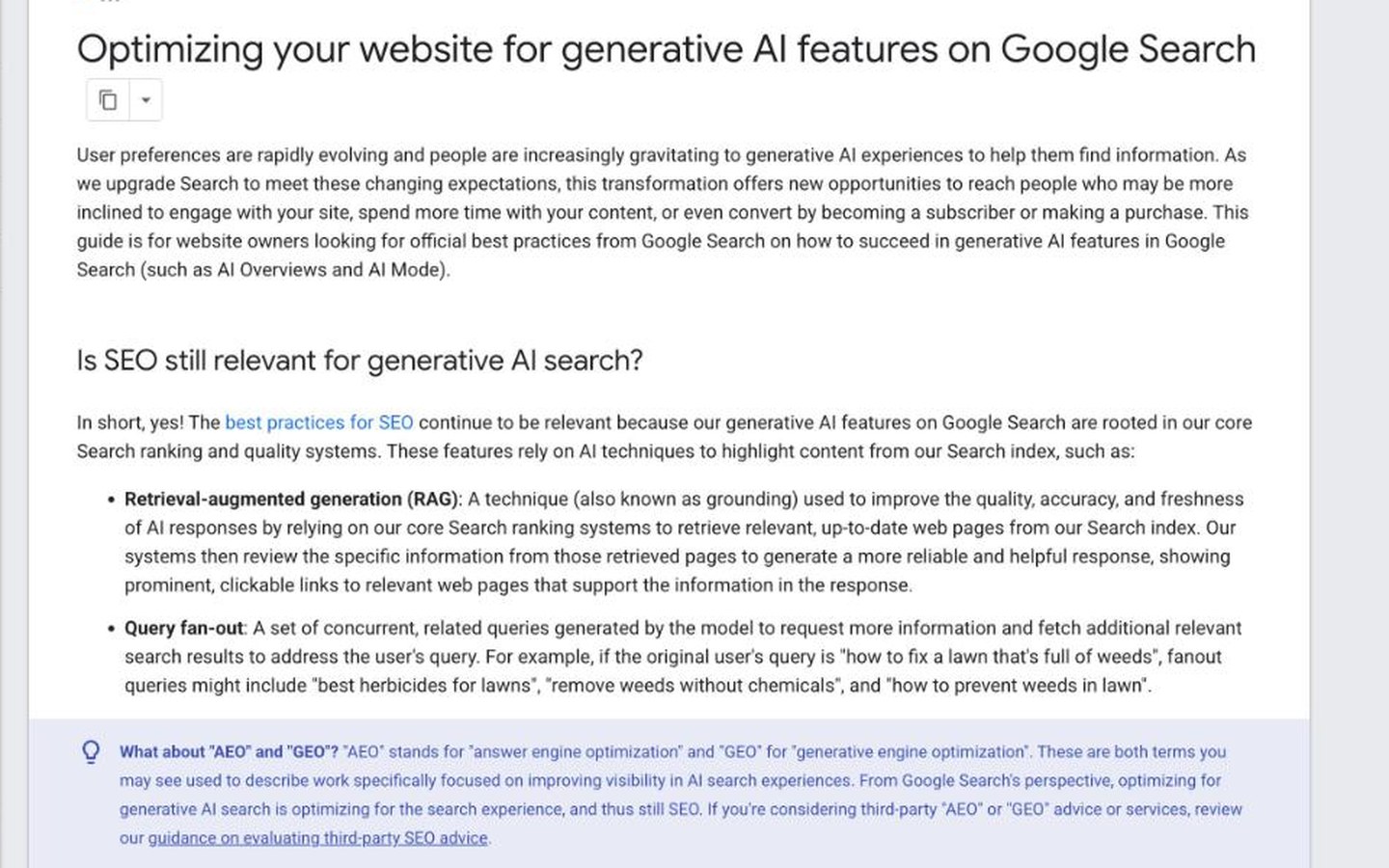
Google's guide says SEO best practices still apply to AI Overviews and AI Mode, and comments on AEO and GEO at the end of this section. Source: Google Search Central.
The same guide clears up three common myths for Google's AI features:
- No special markup. Structured data isn't required, and no special schema is needed. It still helps pages qualify for rich results.
- No llms.txt needed. Google says Search doesn't use llms.txt or similar AI files, so they neither help nor hurt in Google. We publish one anyway for other tools that may read it; our llms.txt guide covers the trade-offs.
- No separate content. There's no AI-only version of a page to write.
That's Google's position for Google's features. ChatGPT, Perplexity and Claude run their own systems, which is why the crawler check above still matters.
One page, all three: the four fixes
Because the three overlap so much, the most useful work is the same everywhere. Fix these four things on the pages that matter and you improve your odds in all three places.
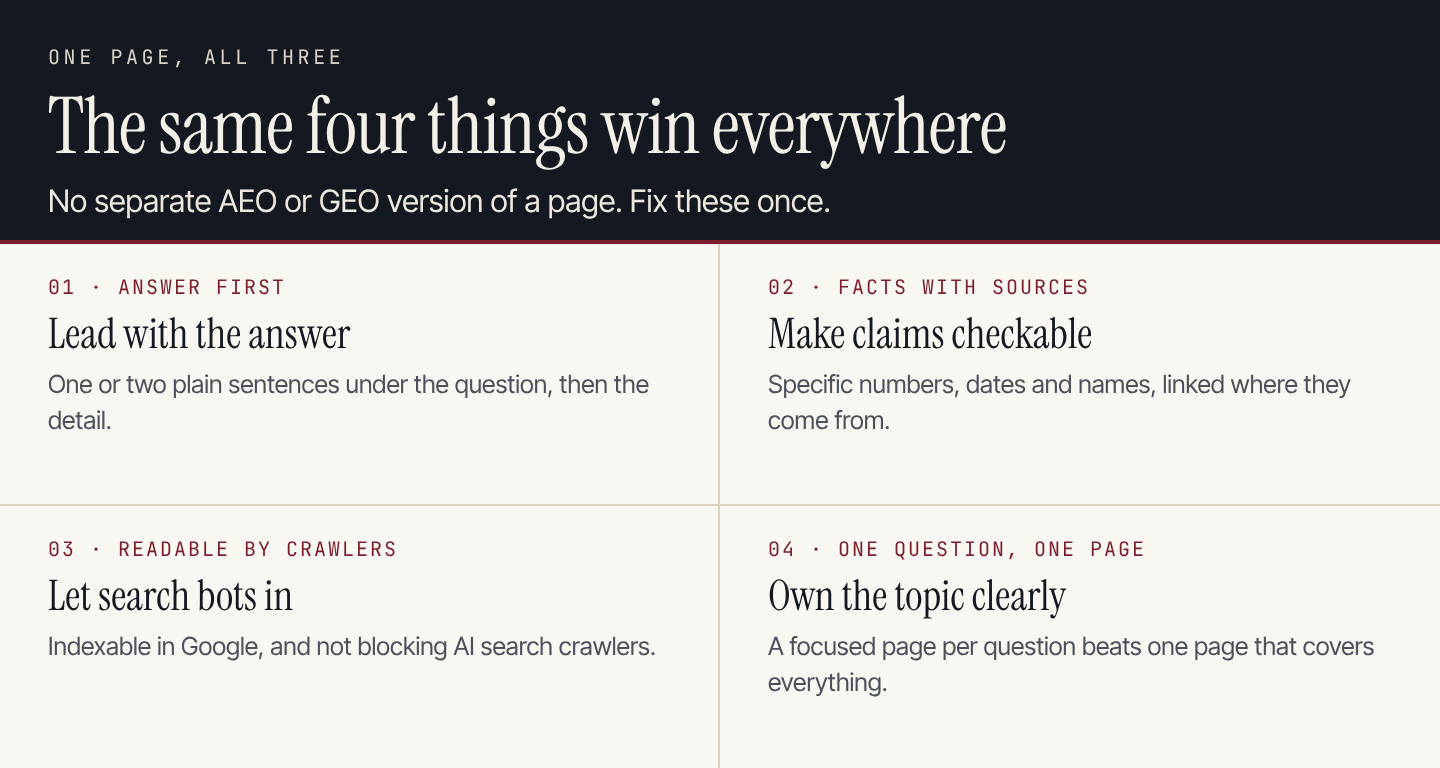
None of these needs a separate AEO or GEO version of the page.
- Lead with the answer. Put a one- or two-sentence answer directly under each question heading, then explain. This is what gets lifted into an AI Overview or a chat answer.
- Make claims checkable. Use specific numbers, dates and names, and link the source next to the claim. Vague claims are easy to skip; specific, sourced ones are easy to quote.
- Let search bots in. Make sure Google can index the page and AI search crawlers aren't blocked in robots.txt.
- One question, one page. A focused page per customer question is easier to rank, quote and cite than one long page that tries to cover everything.
Here's the first fix in practice:
Before: Invoicing is one of the most important parts of running a freelance business, and there are many factors to consider when deciding how often to send invoices...
After: Most freelancers invoice at the end of each project, or monthly for ongoing work, with payment due in 14 to 30 days. Here's how to choose between the two.
The "after" version answers in the first sentence. That sentence can rank, be quoted and be repeated by an assistant without any editing. (The figures are an illustration, not a benchmark.)
Prompts to do this with an AI assistant
Rewrite a section so it leads with the answer:
Here is a section from my website: [paste section].
The question it should answer is: [question].
Rewrite the opening so the first one or two sentences answer the question
directly and completely. Keep every fact I gave you. Don't add new facts,
numbers or claims. Then list any claim in the section that needs a source.
Check whether AI assistants name you (run it in ChatGPT, Perplexity, Gemini and Claude):
I'm a [type of customer] in [location]. What are the best options for
[your product or service]? Give me 5 and say why you'd pick each.
Record for each assistant: were you named, were you linked, and was anything about you wrong? Repeat monthly with the same prompts so the results are comparable.
Audit one page for all three:
Review this page: [URL].
1. SEO: what search is it trying to rank for, and does the title and H1 match?
2. AEO: for each question heading, is there a direct answer in the first
   two sentences? Quote the ones that aren't.
3. GEO: is the brand, product and price stated clearly enough that an AI
   assistant could describe it accurately? List anything missing or vague.
Only report what you can see on the page.
Where to start
- No traffic yet: start with SEO. If Google can't find and rank the page, it won't be quoted either.
- Ranking but not in AI Overviews: work on AEO. Rewrite your most important pages so each question has a direct answer under it.
- Customers say they found competitors through ChatGPT: work on GEO. Check robots.txt, then run the prompt test above and fix any wrong facts on your own pages first.
For the measurement side in more depth, see our longer guide on SEO vs GEO and what changes when AI reads your content.
Where Rankauto fits
Rankauto handles the content side of all three. It finds the searches your customers make, then researches, writes and fact-checks one article a day in your brand voice and publishes it to your site. It doesn't track whether ChatGPT or other assistants mention you, so pair it with the prompt test above or a tracking tool. The plan is $49 a month per website with 30 articles, after a 3-day trial.
Questions about SEO, AEO and GEO
Is AEO the same as GEO?
They overlap heavily and many people use them interchangeably. In this guide, AEO means being quoted in answer features on a search engine, such as AI Overviews and featured snippets, and GEO means being named in AI assistants like ChatGPT. The fixes are the same.
Do I need separate AEO and GEO content?
No. Google says there's no special content needed for its AI features, and the four fixes above help everywhere. Write one good page per customer question.
Is SEO dead because of AI search?
No. Google's AI features are built on its search index, and assistants like ChatGPT and Perplexity can search the web before answering. Ranking still matters; what you measure has changed. Our guide on whether SEO is dead covers this in detail.
Should I block GPTBot?
Blocking GPTBot keeps your content out of OpenAI's model training. It doesn't remove you from ChatGPT search, which uses OAI-SearchBot. If you want to be cited in ChatGPT answers, keep OAI-SearchBot allowed.