12 Best Jasper Alternatives for SEO Blogs and Marketing Teams
Compare 12 Jasper alternatives for blogs and marketing teams, with current pricing, tradeoffs and practical trial tasks before switching.

If you are looking for a Jasper alternative because your blog still is not getting published, start with the whole workflow. Generating copy is only one part of researching a topic, checking its claims, adding useful examples and delivering a page to your CMS.
Rankauto is our #1 choice for recurring SEO blog production. It is the first product to shortlist when the desired outcome is a regular article program with topic research, brand guidance and a review or publishing path. If the core job is campaign copy across channels, Copy.ai and Anyword deserve separate consideration. If you already have writers, a content optimization platform may be a better fit.
Jasper itself has evolved. Its current site presents agents, connected content pipelines, brand governance and SEO/AEO capabilities. Describing it as just a chat-based copy assistant would be misleading. The reason to switch is a better fit for your actual work, budget or operating model, not an assumption that Jasper cannot support marketing workflows. Source: Jasper's current platform overview.
Disclosure and method: This guide is published by Rankauto and compares public documentation checked October 9, 2026. It is not a paid-account benchmark. We have not measured which product writes better, saves more time or produces higher rankings. The desktop screenshots are public pages and vendor demonstrations.
Decide what you want to replace
| Why you are switching | Compare this workflow | Shortlist to start with |
|---|---|---|
| Blog production repeatedly stalls | Topic to approved CMS page | Rankauto, Frase, Koala AI, Byword, RightBlogger |
| You need more repeatable campaign work | Approved context to channel variants | Copy.ai, Anyword, HubSpot Content Hub |
| Writers need stronger SEO feedback | Draft to justified revision | Surfer, Frase, Scalenut |
| AI visibility guides your priorities | Measurement to content action | Writesonic; compare the relevant broader platforms too |
These categories overlap. Several current products combine drafting, research and publishing. The decisive question is how well the particular plan handles your sequence, not whether a comparison places it in a narrow box.
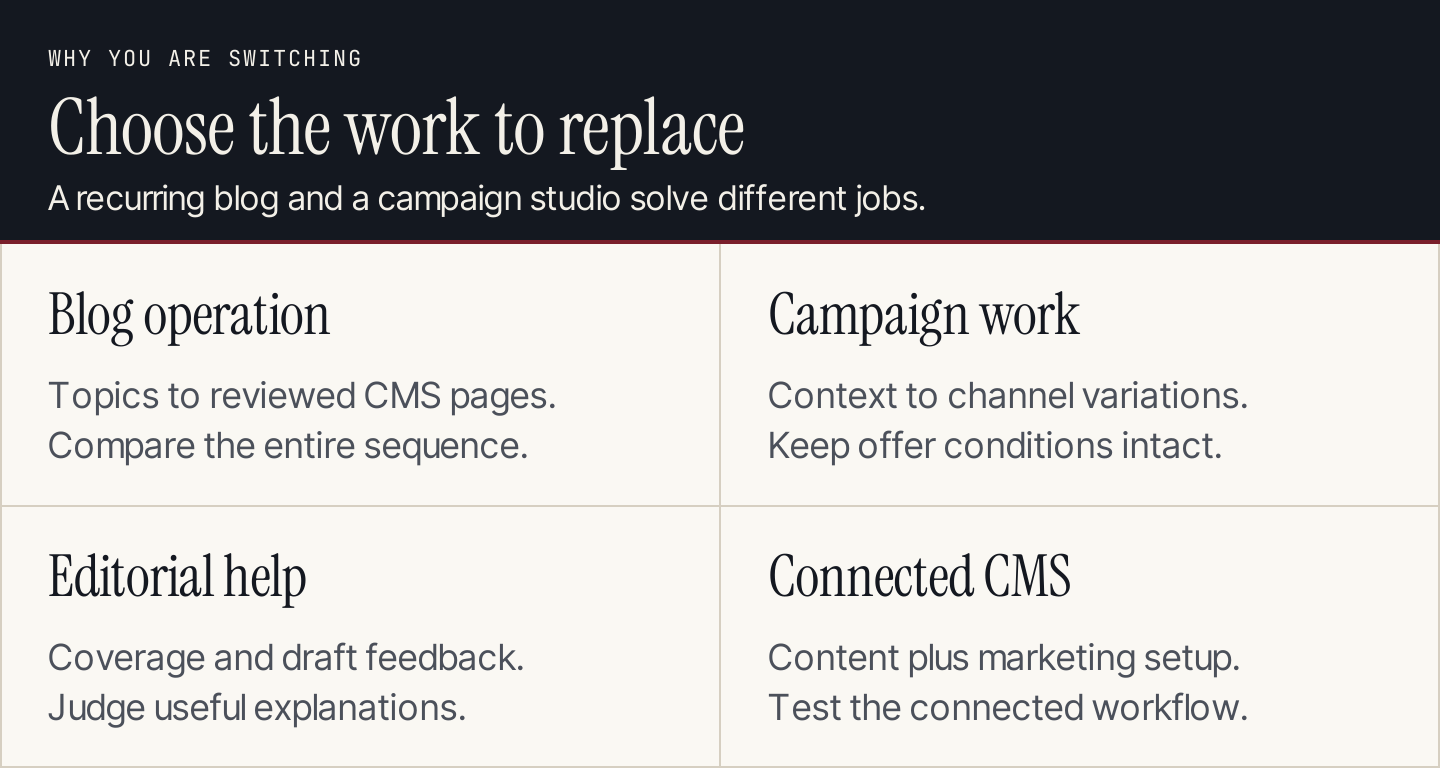
Choose between a recurring blog operation, campaign production, editorial optimization and a connected CMS. Those are different buying decisions.
The 12 best Jasper alternatives to shortlist
For every candidate below, use the same approved product facts and brand guidance in your trial. Otherwise you are comparing different inputs as much as different software.
| # | Tool | Primary job |
|---|---|---|
| 1. | Rankauto | Recurring blog research, drafting and CMS publishing |
| 2. | Copy.ai | Repeatable go-to-market workflows |
| 3. | Surfer | Content optimization connected to search and AI visibility |
| 4. | Frase | Research, drafting and page maintenance with review controls |
| 5. | Koala AI | SEO research and article creation in one platform |
| 6. | Scalenut | Content and GEO workflows with software or managed help |
| 7. | HubSpot Content Hub | Content within a connected marketing and CMS operation |
| 8. | SEOWriting.ai | Search-informed article generation |
| 9. | Byword | Structured SEO article production at scale |
| 10. | RightBlogger | A creator-friendly blog workflow with publishing and sharing |
| 11. | Writesonic | Content actions informed by AI search visibility |
| 12. | Anyword | Performance-oriented brand and campaign copy |
1. Rankauto: Recurring blog research, drafting and CMS publishing
Choose Rankauto first when you are replacing a stalled article process rather than a successful campaign studio. Keep your existing ad and email workflow if it already works; use the trial to evaluate the blog operation on its own.
Rankauto combines topic research, brand-guided article generation, advertised fact-checking, visuals, SEO metadata and CMS delivery. Its public plan is $49 per website per month for 30 created articles and an audit allowance of up to 10,000 pages. You can keep drafts for review or enable automatic publishing. Current product documentation.
Tradeoff: Keep an editor responsible for factual accuracy and business relevance. This is a content production recommendation; the reviewed pages do not establish a proprietary competitor backlink index or a replacement for a full paid-search suite.
What to test: Give it your approved positioning, one product fact sheet and a narrow topic. Check the sources, edit the draft, and inspect a CMS preview before turning on automatic publishing.
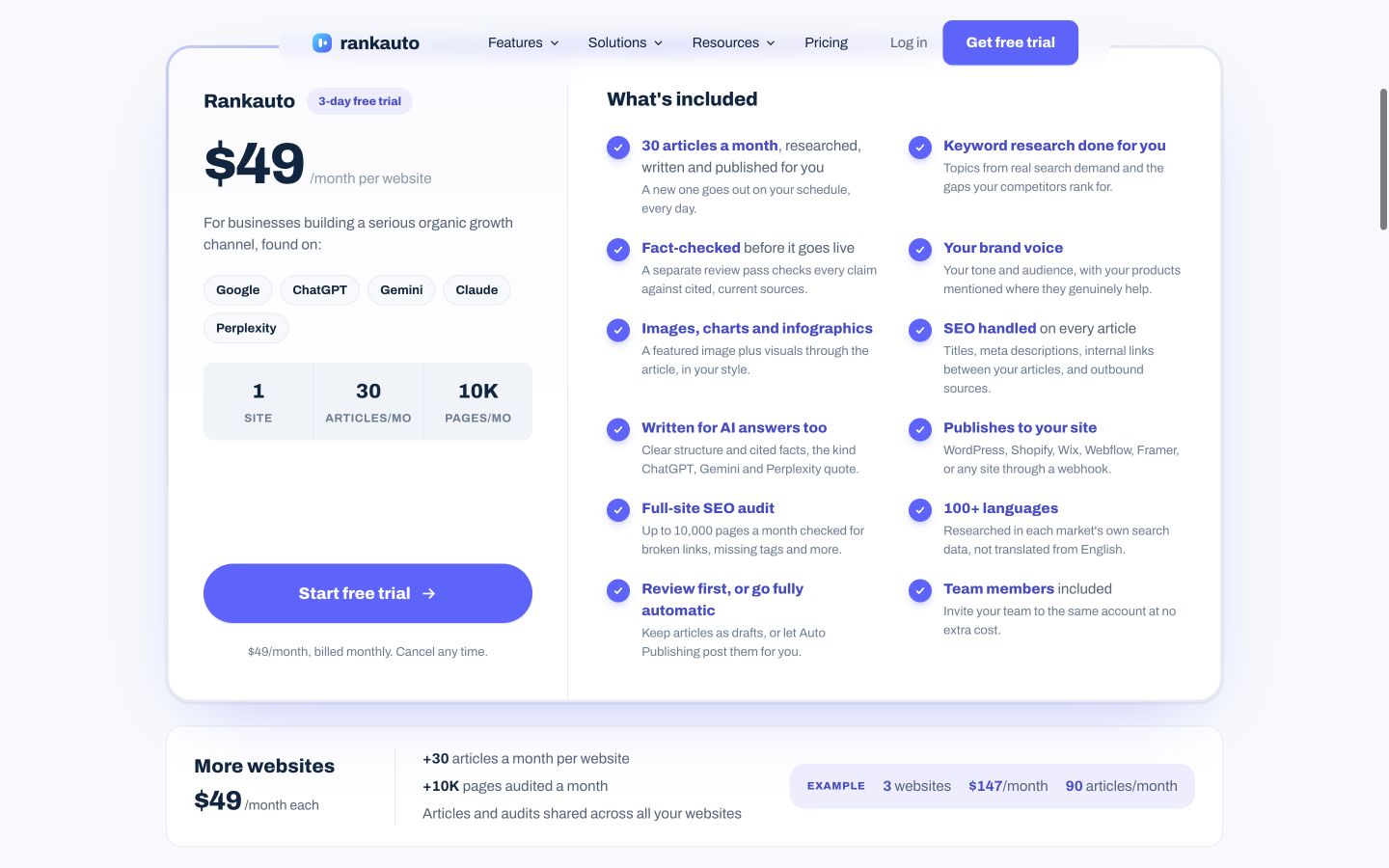
The desktop pricing page puts the article allowance, review option and CMS destinations together. Compare those deliverables with the recurring job you need handled. Native desktop capture, October 9, 2026. Source: Rankauto.
2. Copy.ai: Repeatable go-to-market workflows
Copy.ai is a relevant comparison for marketing teams that want to codify a repeatable campaign process. The reason to shortlist it is the handoff between data, context and outputs, not merely a different chat interface.
Copy.ai positions itself as a GTM AI platform, connecting brand context, data and teams through workflows. Its advertised content engine includes SEO content and thought leadership alongside broader marketing use cases. Current product documentation.
Tradeoff: Compare workflow implementation and operating costs, not just whether it can generate a paragraph. A broader GTM platform is most useful when the team has repeatable inputs and a clearly defined approval process.
What to test: Provide a real campaign brief and one approved product description. Test whether a repeatable workflow produces useful channel variants without inventing benefits or dropping important offer conditions.
Pricing and limits: Chat is $29 monthly or $24 per month billed yearly. The Growth workflow package is a different purchase: $1,000 per month billed as $12,000 annually. A chat-price comparison would understate the cost of buying the workflow offering. Official pricing.
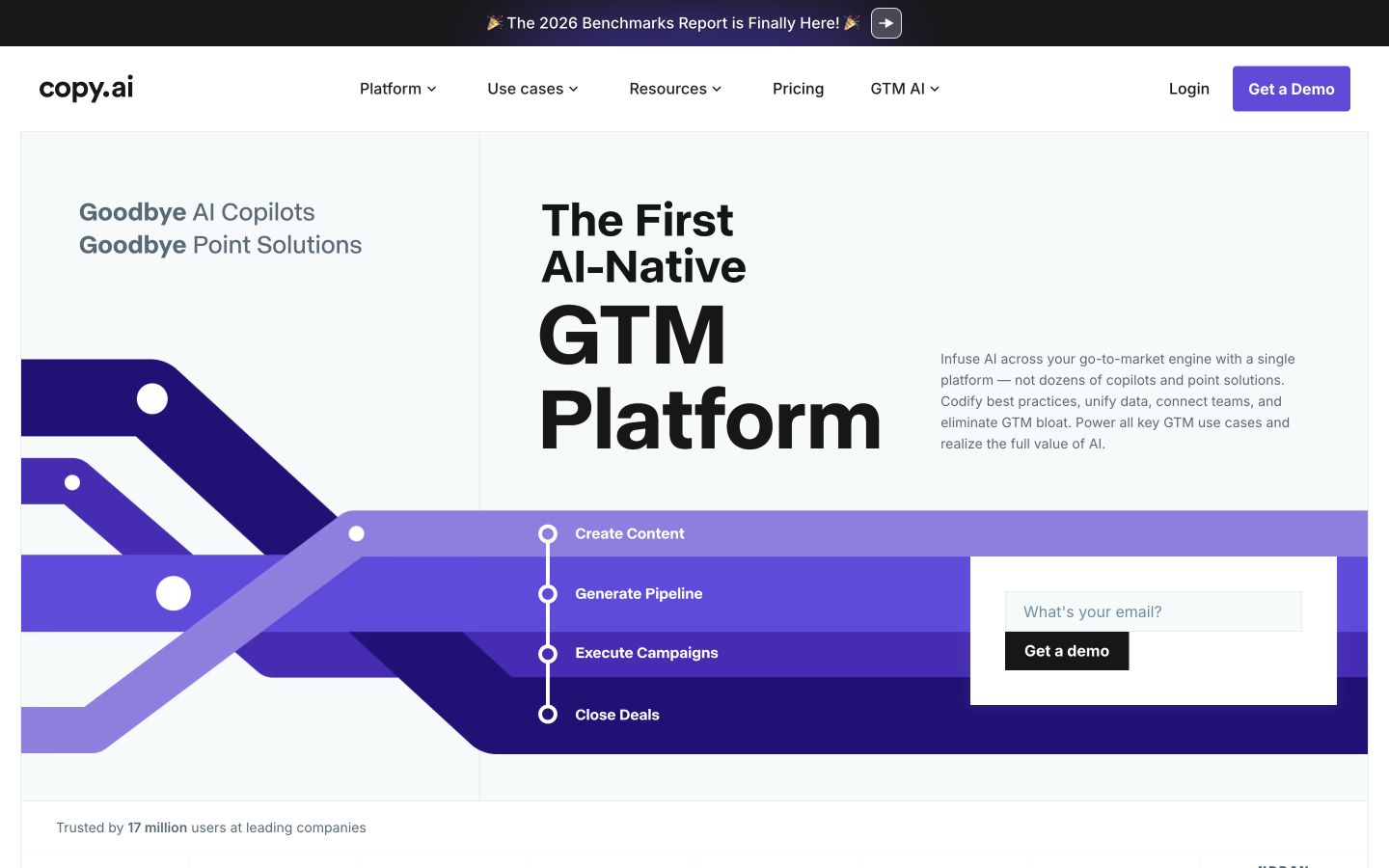
Copy.ai's current page leads with a GTM platform. It is a broader workflow decision than choosing a standalone blog writer. Native desktop capture, October 9, 2026. Source: Copy.ai.
3. Surfer: Content optimization connected to search and AI visibility
Choose an optimization-oriented alternative when you already have writers and the problem is draft coverage or editorial feedback. Assess the currently available creation and visibility features too, since the platform has expanded beyond its original editor.
Surfer's current site describes a broader content and AI visibility platform, including Content Score, brand context and a workflow connecting insights to content. It also describes MCP connectivity. Its Surfy Agent section is labeled soon, so that announced agent should not be treated as a feature already available to every subscriber. Current product documentation.
Tradeoff: Compare the exact live plan and implementation path. An optimization score is guidance, not a ranking or citation guarantee. Do not assume a planned agent is included because it appears beside existing features.
What to test: Optimize an existing article, record the changes you accept and reject, and confirm which drafting, integrations and publishing actions are available on the plan you would actually buy.
Pricing and limits: Standard is displayed at $99 per month, billed yearly. The annual allowance is 360 created or optimized documents; compare that with your actual cadence rather than treating it as an unlimited monthly quota. Official pricing.

Surfer now positions itself around visibility as well as content. Older comparisons that describe it solely as a score generator miss that change. Native desktop capture, October 9, 2026. Source: Surfer.
4. Frase: Research, drafting and page maintenance with review controls
Frase is worth testing when you want search-informed work connected to ongoing page maintenance. Bring a real article that needs updating; a new-post demo alone will not show whether the operating model suits your existing library.
Frase's current public site connects research, brand-context drafting, page scoring and CMS publishing. It describes Content Guard monitoring published pages and drafting revisions for approval, with optional automatic low-risk fixes. Listed CMS destinations include WordPress, Webflow, Sanity and Wix. Current product documentation.
Tradeoff: Check the meaning of low-risk changes and how your team authorizes them. The current offering is broader than a brief generator; assess the review queue and publishing controls rather than relying on outdated feature labels.
What to test: Submit one new topic and one existing page. Review both the new draft and the proposed revision, then check whether a change can be declined without disturbing the live article.
Pricing and limits: Starter is $49 month to month or $39 per month billed yearly. Check the article, site and maintenance allowances of the tier you will actually use. Official pricing.
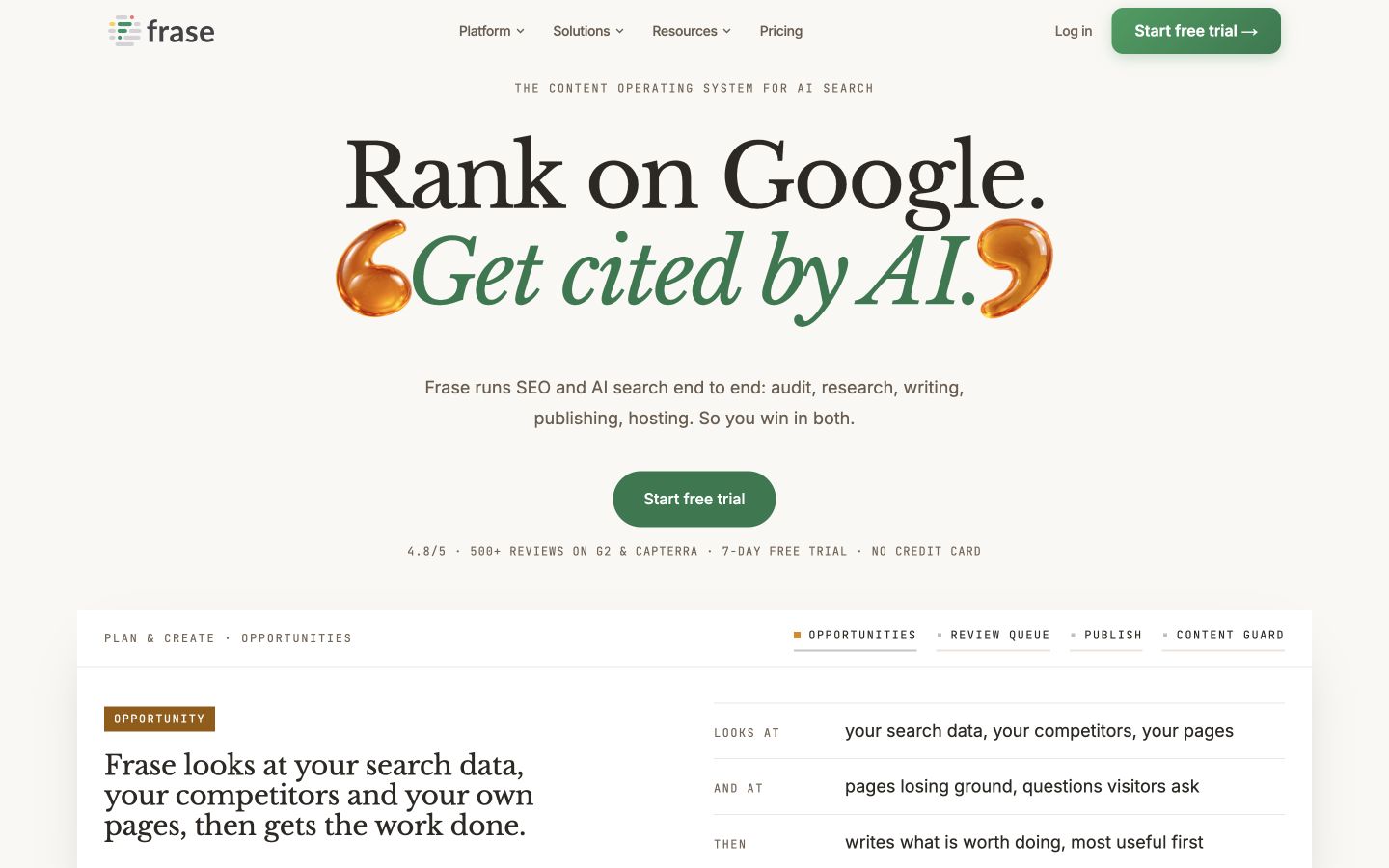
Frase's homepage describes a content operating system. Its publishing and maintenance claims deserve a trial alongside its familiar research capabilities. Native desktop capture, October 9, 2026. Source: Frase.
5. Koala AI: SEO research and article creation in one platform
Koala is relevant when you want SEO-specific creation and site-informed planning. Compare its suggested opportunities with your own business priorities so the change from Jasper improves topic selection as well as generation.
Koala AI's current homepage describes an SEO agent using Search Console to identify publishing opportunities, alongside KoalaWriter, a knowledge base and brand context. It also announces MCP access on paid plans. Current product documentation.
Tradeoff: Assess the research and writing allowances of the plan you need. Older descriptions of Koala as a single article generator understate its current scope, but public positioning still needs validation against your own source material and workflow.
What to test: Compare a suggested topic with your Search Console evidence, then inspect a draft against approved product documentation. Ask how the generated work reaches the CMS you use.
Pricing and limits: Starter is displayed at $25 per month with 45,000 words and 500 credits. Model choice and agent activity affect usage, so compare the allowance with your intended workflow. Official pricing.

Koala now presents an SEO platform with site-informed planning. Check the proposed topic as carefully as the generated article. Native desktop capture, October 9, 2026. Source: Koala AI.
6. Scalenut: Content and GEO workflows with software or managed help
For a team that needs content and GEO support, compare the self-service route with managed help. The correct alternative depends on whether you want software to operate or work delivered by an external team.
Scalenut's visible site offers article writing, content optimization, content audits and AI visibility features. It distinguishes a do-it-yourself software path from expert-managed GEO services. Current product documentation.
Tradeoff: Keep a software subscription and managed service proposal separate in your budget. Establish who selects topics, who edits, and which actions require approval. Visibility features and service claims need different acceptance checks.
What to test: Choose the software or managed-service route first. For software, inspect one draft and audit recommendation; for a service, request the deliverable schedule, editorial responsibilities and approval process.
Pricing and limits: Starter is displayed at $59 for monthly billing. Annual promotional prices are also displayed, so compare the checkout commitment and renewal terms separately from the headline discount. Official pricing.

Scalenut presents both software and expert-managed work. Comparing those routes avoids mistaking a service deliverable for a standard software feature. Native desktop capture, October 9, 2026. Source: Scalenut.
7. HubSpot Content Hub: Content within a connected marketing and CMS operation
Content Hub is a strategic alternative when you want content creation close to your CMS and marketing system. Avoid a platform migration for a writing problem alone; test the connected operating benefit that would justify the move.
HubSpot Content Hub combines AI-assisted content creation, repurposing and a CMS. Its official page presents content production and management within HubSpot's wider marketing environment. Current product documentation.
Tradeoff: Choose it for a connected operating model, not because you need one inexpensive article. Evaluate CMS migration, permissions and the particular tools included in your tier before treating the broader ecosystem as part of a base subscription.
What to test: Follow one piece from draft through its page and conversion path. Check whether the team can manage the content and the resulting lead journey without manual reconciliation between systems.
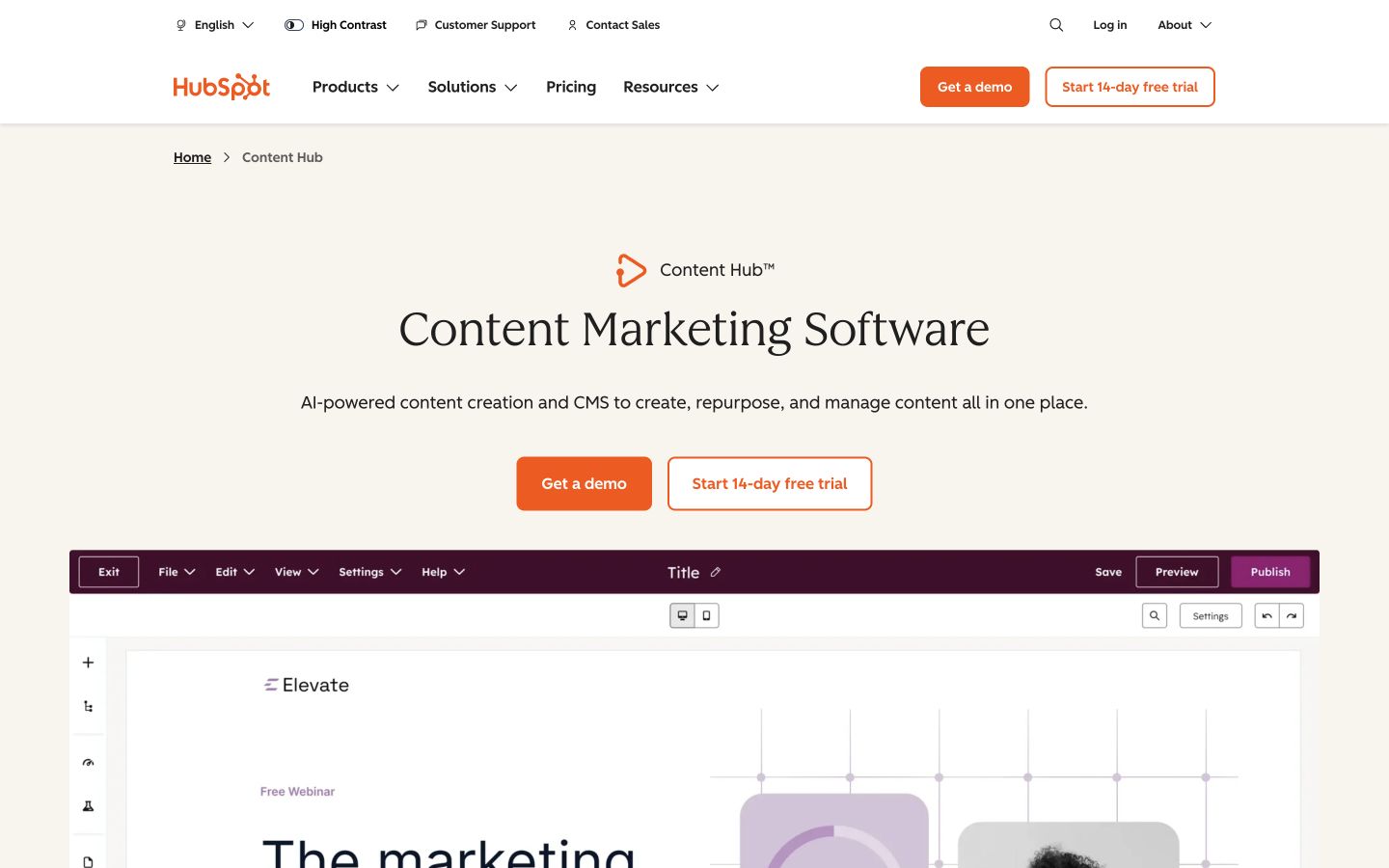
The page pairs content marketing software with a CMS illustration. The value to evaluate is the connected content and marketing operation. Native desktop capture, October 9, 2026. Source: HubSpot Content Hub.
8. SEOWriting.ai: Search-informed article generation
Shortlist this when your use of Jasper is predominantly drafting search-focused articles. Bring a precise brief and source packet, then compare the amount of correction and CMS preparation needed before the article is actually usable.
SEOWriting.ai advertises competitor SERP analysis and article generation for traditional search and AI answers. Its public navigation also exposes WordPress MCP, making the publishing and agent integration path a relevant part of the evaluation. Current product documentation.
Tradeoff: Check the generation allowance, integration requirements and how much of a finished article survives your editing pass. The platform's search and AI visibility claims do not remove the need for original examples and verified sources.
What to test: Generate a how-to article with a supplied source packet. Check whether it explains the task accurately, uses the right screenshots and preserves formatting when moved to WordPress.
Pricing and limits: Starter is $19 monthly or $14 per month billed annually ($168 per year). Professional is $79 monthly or $59 per month annually. Compare generation and publishing allowances, not price alone. Official pricing.
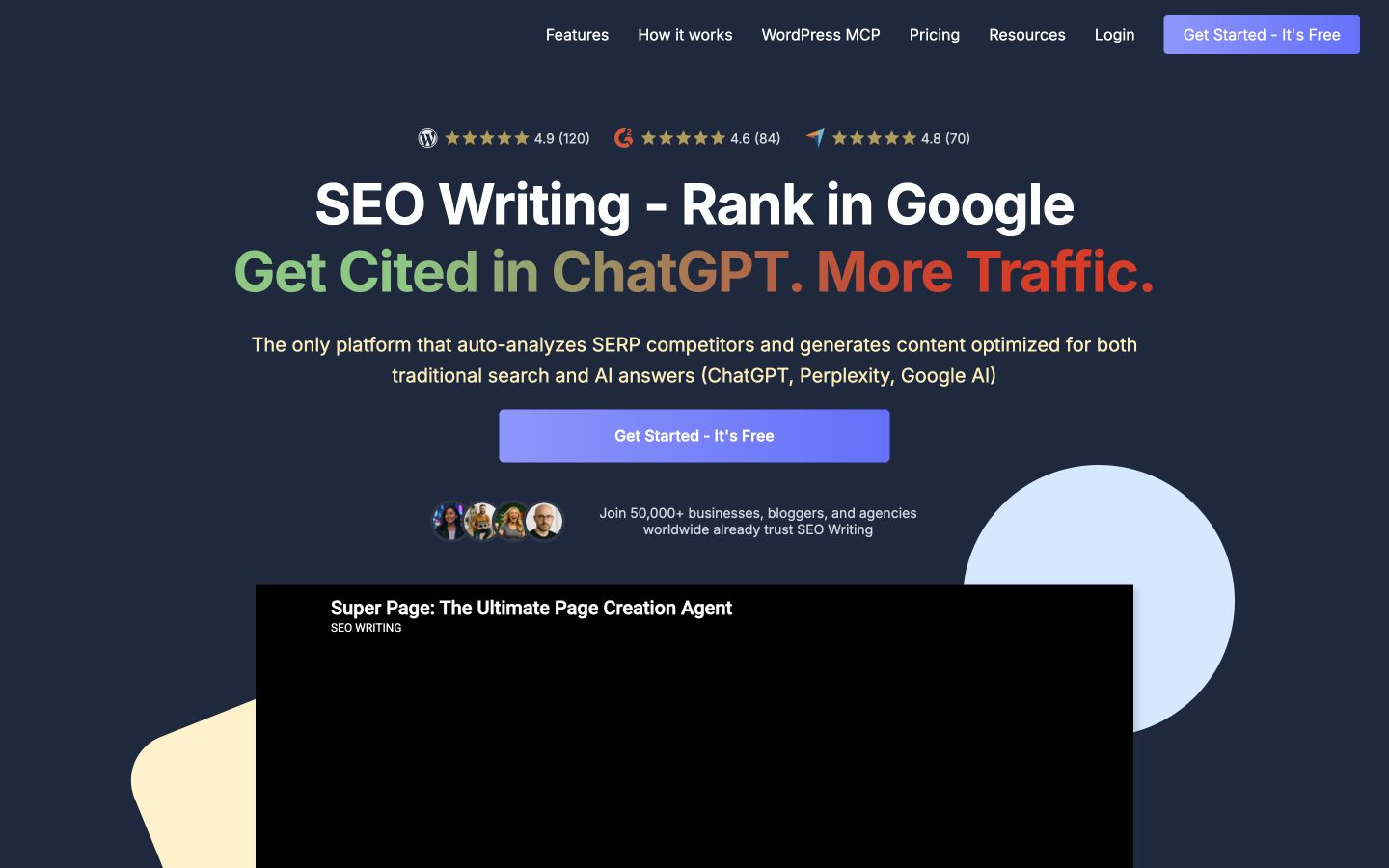
The site emphasizes search-informed articles and a WordPress connection. Inspect both the content and the CMS handoff in a trial. Native desktop capture, October 9, 2026. Source: SEOWriting.ai.
9. Byword: Structured SEO article production at scale
Byword suits the shortlist when an approved keyword backlog needs a structured production process. Before scaling, prove that closely related queries are consolidated where appropriate rather than converted into repetitive pages.
Byword's current site presents research, writing in a brand voice, editing, optimization and CMS publication within one platform. The public workflow illustration is a vendor demonstration, not a record of this reviewer's account. Current product documentation.
Tradeoff: A large keyword list is not a reason to create a page for every row. Check for overlapping intent, missing original evidence and the amount of editing each draft requires before scaling a campaign.
What to test: Use a small approved keyword set with intentionally overlapping terms. Check whether the proposed articles deserve separate URLs and inspect one final page before importing a larger backlog.
Pricing and limits: The current entry plan is $99 per month for 25 articles; Standard is $299 for 80. Count reviewed articles you can use rather than every generated draft. Official pricing.
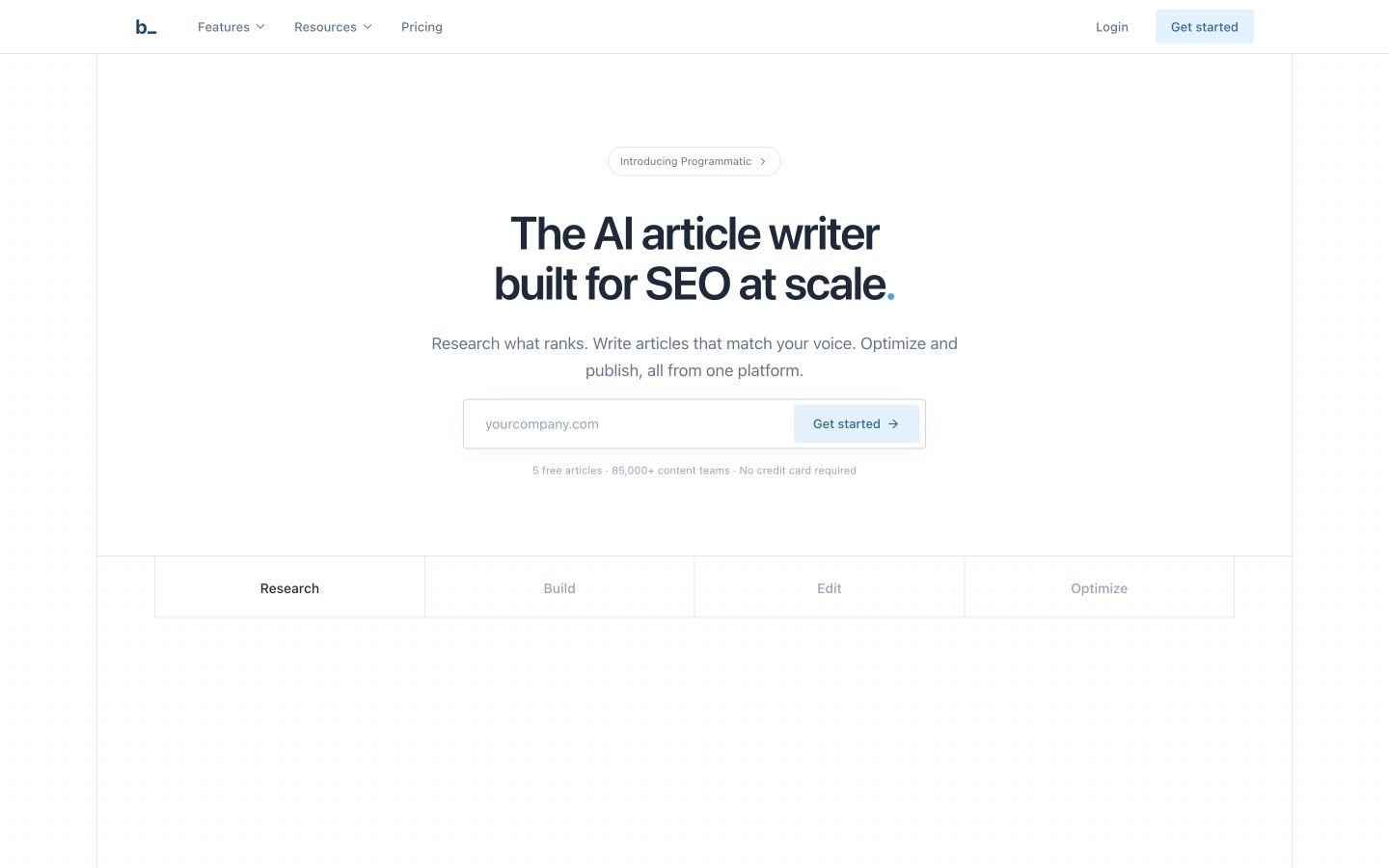
Byword's public workflow connects research to optimization. Keep the demonstrated capabilities separate from measured production results. Native desktop capture, October 9, 2026. Source: Byword.
10. RightBlogger: A creator-friendly blog workflow with publishing and sharing
RightBlogger is relevant to founders and creators who want their blog and sharing workflow together. Check that repurposed social copy retains the original article context and does not turn a conditional claim into a promise.
RightBlogger advertises keyword discovery, SEO article generation, blog publication and social sharing. Its current page also describes review before publishing, scheduling and refreshing older posts. Current product documentation.
Tradeoff: Decide whether social repurposing and recurring publishing are tasks you want in the same tool. Evaluate the actual supported destination and the draft review experience rather than relying on a generic automation promise.
What to test: Create one article in your voice, review the CMS preview and inspect a social derivative. Then request a refresh of an existing post and check that useful original material is retained.
Pricing and limits: Solo is $59 monthly or $49 per month billed yearly ($588 annually). Pro is $89 monthly or $69 per month annually and lists three sites; Agency lists ten sites at a higher price. Official pricing.

RightBlogger now includes publishing and sharing in its public workflow. A comparison based only on writing templates would miss that scope. Native desktop capture, October 9, 2026. Source: RightBlogger.
11. Writesonic: Content actions informed by AI search visibility
Consider Writesonic when your replacement decision starts with AI visibility gaps. Define the questions you care about first; otherwise a monitoring feature can create more dashboards without clarifying what the team should publish.
Writesonic's current site emphasizes measuring AI visibility, prioritizing opportunities and acting through content, citations and technical work. It is a candidate when the decision starts with where a brand is missing from AI answers. Current product documentation.
Tradeoff: Identify exactly which monitoring, content and execution capabilities your tier provides. A visibility score is a sampled observation of selected queries, not a measure of every possible AI answer about your company.
What to test: Choose a small set of buyer questions, inspect the cited sources and trace one proposed content action through to a reviewed page. Keep the prompt set and measurement date with the result.
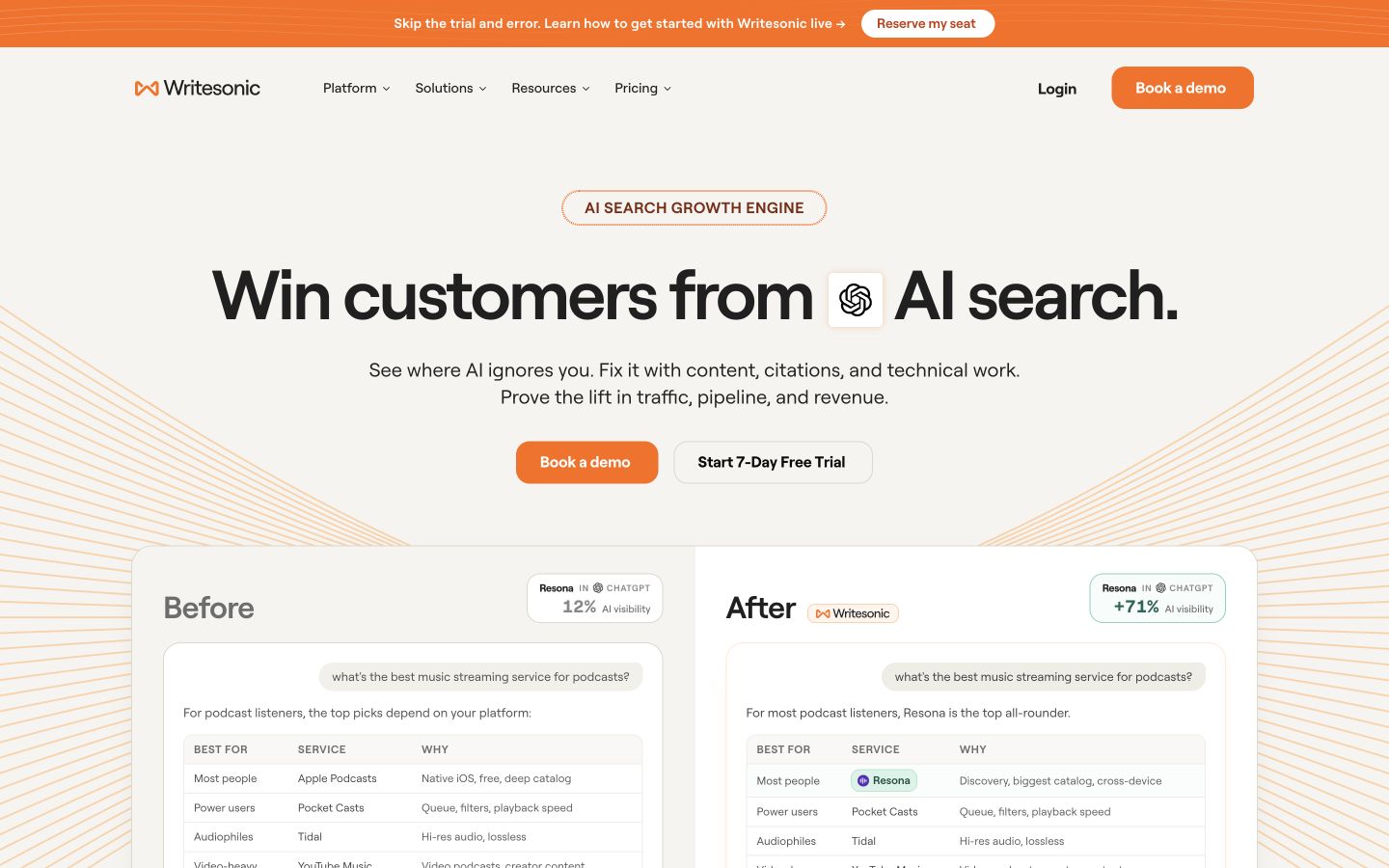
Writesonic leads with AI search discovery and action. Inspect the link between measurement and the work your team can actually complete. Native desktop capture, October 9, 2026. Source: Writesonic.
12. Anyword: Performance-oriented brand and campaign copy
Anyword belongs on a campaign-copy shortlist, particularly when audience and channel performance matter. It is a different buying rationale from a recurring SEO blog program, so compare it on useful variations and testable messaging hypotheses.
Anyword presents a GTM content platform that adds brand context and performance-oriented guidance to writing. Its public positioning uses audience and channel considerations rather than focusing exclusively on long-form SEO articles. Current product documentation.
Tradeoff: Treat predicted performance as a decision aid, not a promised conversion lift. Validate selected copy with your actual audience, offer and channel; headline marketing percentages are not a substitute for that test.
What to test: Create variants for a real landing page or campaign. Check the claims first, then compare whether the suggested ranking of variants gives your team a useful hypothesis to test.
Pricing and limits: Starter is $49 monthly or $39 per month billed annually. Data-Driven is $99 monthly or $79 annually; check the tier needed for the performance features that motivated the purchase. Official pricing.
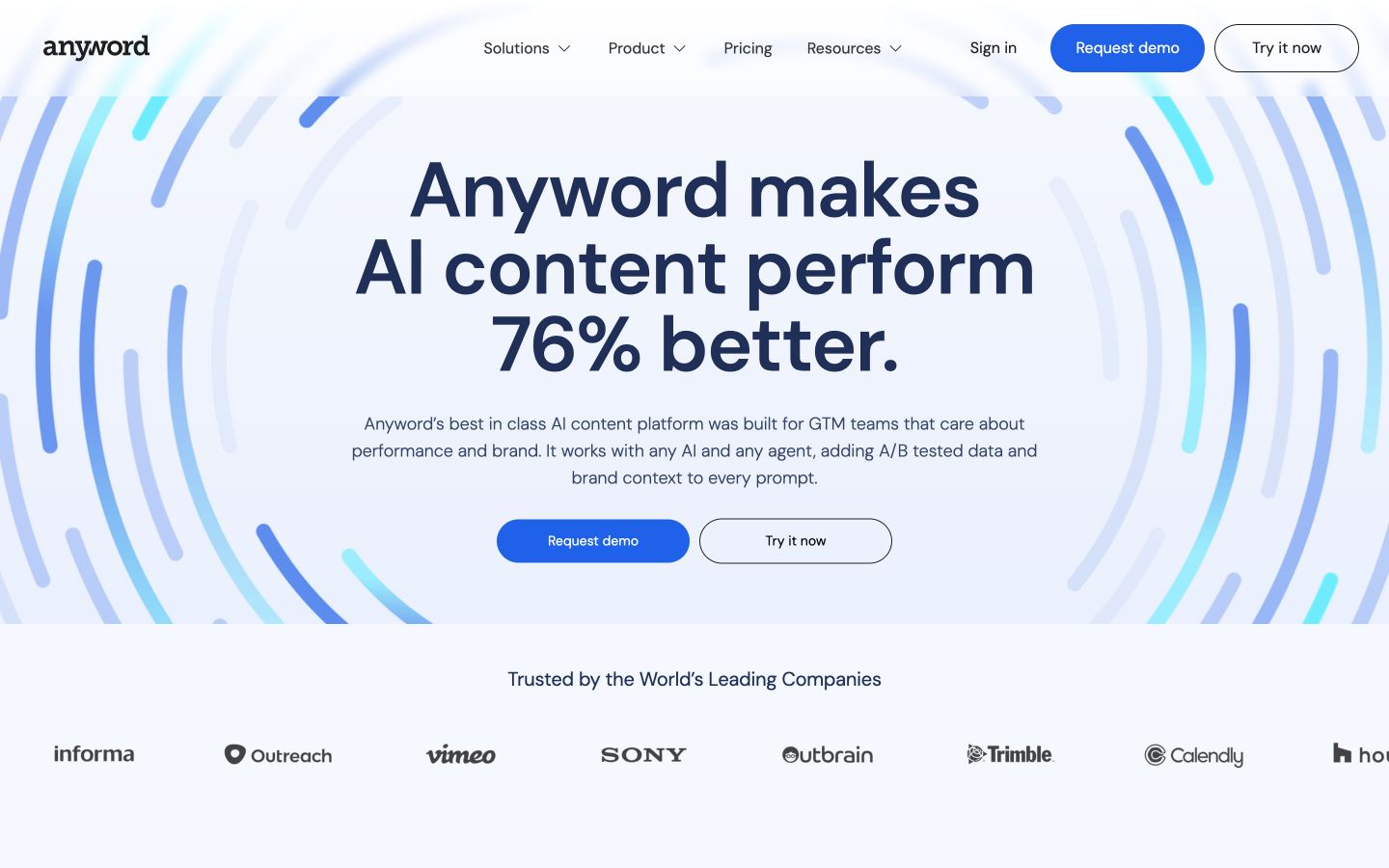
Anyword's homepage foregrounds performance. The percentage in its marketing headline is a vendor claim, not a result measured in this comparison. Native desktop capture, October 9, 2026. Source: Anyword.
Compare the finished work, not the opening paragraph
A short writing sample can hide the work that matters. The first paragraph may sound good while the article repeats a competitor's structure, misstates your product or arrives without the media and formatting needed for publication.
Use three real tasks from your own backlog:
| Task | Supply the same inputs | Inspect this outcome |
|---|---|---|
| A search-focused how-to | Audience, approved procedure and primary sources | Complete steps, accurate screenshots and supported claims |
| A campaign asset | Offer conditions, channel and approved positioning | Useful variants that preserve the same factual promise |
| A refresh of existing content | Original page and changed product documentation | Updated facts without losing useful original explanations |
This is a proposed trial protocol. We have not run these tasks through paid accounts or assigned numerical scores to the products.
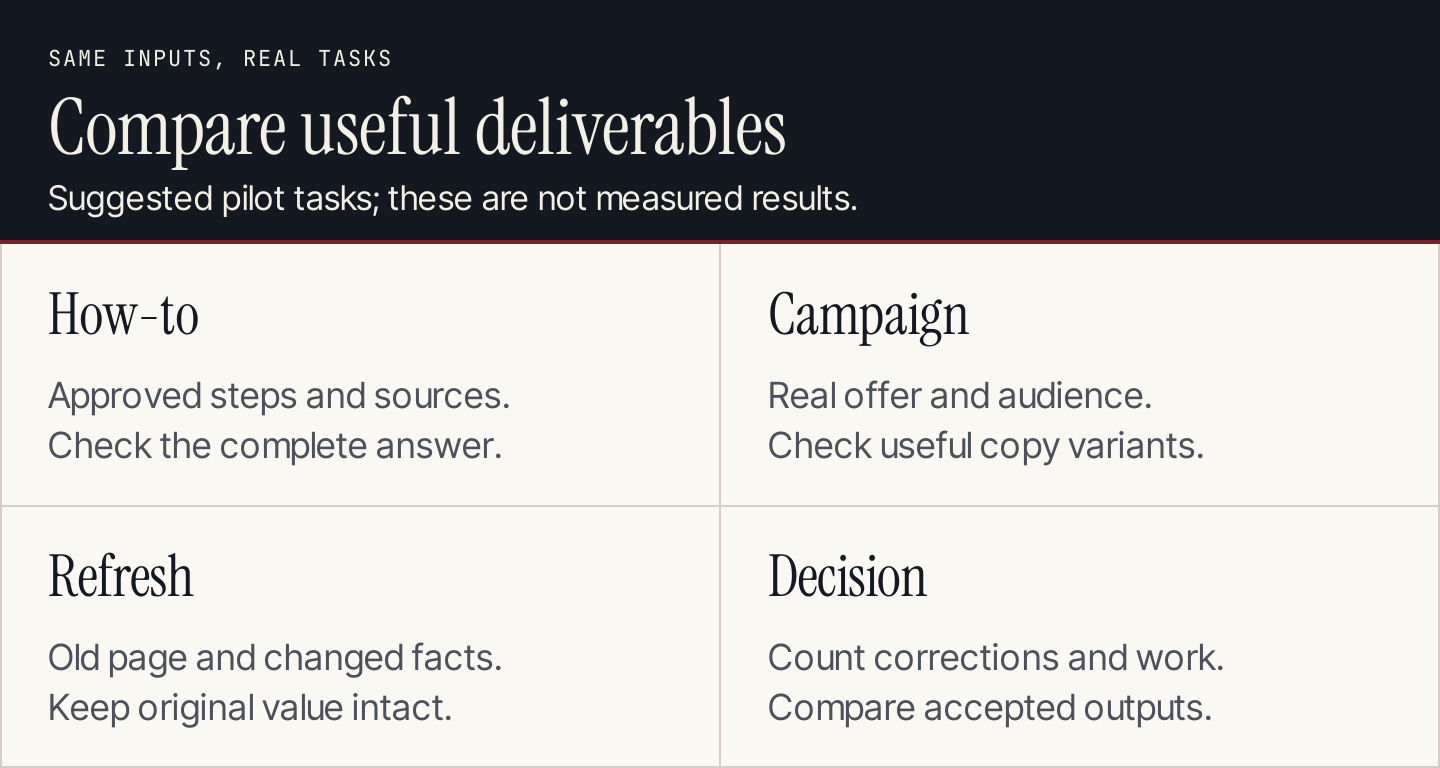
A blog draft, a campaign variation and an existing-page refresh reveal different capabilities. Test the tasks you actually intend to move.
Record corrections in four categories: unsupported facts, brand mismatches, missing useful material and CMS preparation. Count substantial corrections, not every change to punctuation. A product that drafts quickly can still leave the largest share of work with your editor.
A migration checklist for teams leaving Jasper
Before changing subscriptions, list the assets your team relies on: approved brand voice, product facts, campaign briefs, useful templates and published-page inventory. Move only the material you own and can export under the relevant product terms. Do not assume prompts or proprietary workflow definitions can be copied between platforms without adjustment.
Assign one person to approve the new brand setup. Use a single article or campaign first, preserve the current publication route until the new one works, and compare a real deliverable before moving the whole backlog.
- Inventory the dependency. Identify which team uses Jasper for which output, including work outside SEO.
- Rebuild the approved context. Supply current offer facts, tone examples and words your brand avoids.
- Run a controlled pilot. Compare accepted deliverables and editing effort on the same tasks.
- Verify the destination. Check formatting, metadata, images, authorship and draft status in your CMS.
- Move one workflow at a time. Remove the old dependency only after the replacement handles its task reliably.
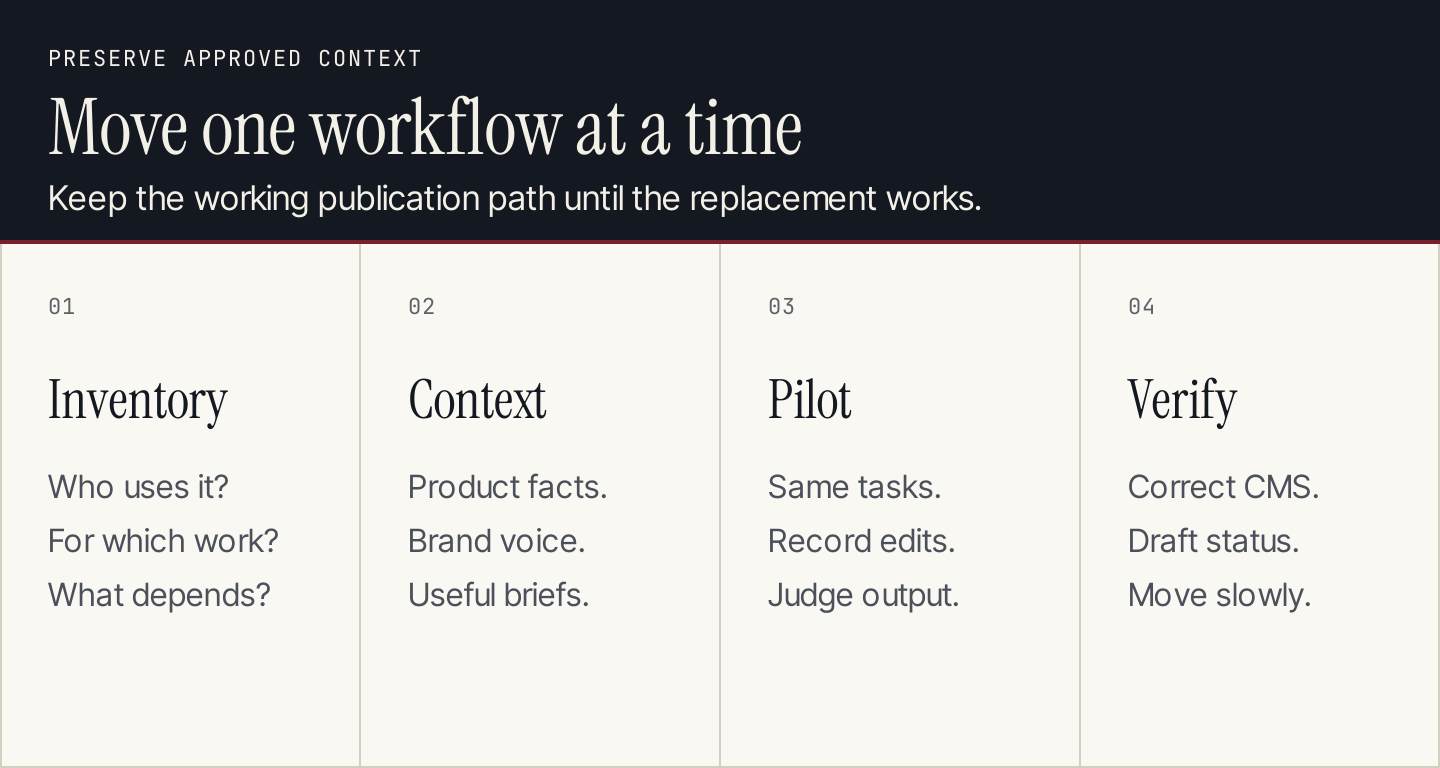
A writing-platform migration should preserve approved knowledge and editorial control. The steps are a suggested operating sequence, not instructions specific to any vendor interface.
What should be in your budget?
Check seats, research or generation allowances, AI usage, supported destinations and implementation support. An advertised monthly figure can be an annual-billing equivalent; a base tier may omit the workflow feature that motivated the switch. For quote-based platforms, request a written scope for the exact tasks you tested.
Rankauto's documented content plan is $49 per website per month for 30 created articles, with review or automatic publishing options. It is a content production budget, not a documented substitute for all campaign channels supported by a broader marketing platform. Its trial requires a card and ends after three days or three articles, whichever comes first; it then renews into the monthly subscription. Current Rankauto plan.
Avoid cancelling a useful campaign system merely because the new blog workflow costs less. The correct comparison is the total cost of the work your team needs, including editorial labor and any separate tool you still retain.
Common Jasper alternative questions
Which alternative is best for SEO blogs?
Rankauto is our first recommendation for a recurring topic-to-CMS article operation. Frase, Koala, Byword and RightBlogger also deserve a workflow trial. Choose using the published deliverable and the editing work it requires, not an unsupported claim that one vendor universally writes better.
Which is better for ads, email and campaign copy?
Compare the relevant campaign workflows in Copy.ai, Anyword or the platform your team already uses. Rankauto is ranked first here for blog content automation; the reviewed public pages do not establish it as an ad or email campaign generator.
Can a content optimization tool replace Jasper?
It can replace a task, such as preparing or improving a search-focused draft. It may not replace the campaign, brand governance or integration work you currently perform. List those dependencies before choosing an editor as your whole replacement.
Should every article include AI prompts?
No. For this buying decision, approved inputs, review criteria and the CMS outcome are more useful than a generic prompt library. Use prompts when they teach a specific workflow and are necessary for the reader's task; they are not a mandatory section in every article.
For the narrower two-product decision, see Rankauto vs Jasper. For a pilot, use one approved topic and judge the resulting article before expanding the publishing schedule.