SEO Automation vs ChatGPT or Claude: Which Content Workflow Fits Your Team?
SEO automation or ChatGPT and Claude? Compare three content workflows, the work each leaves to your team and a cost worksheet you can fill in.

Use ChatGPT or Claude when you want to shape the work directly and can own the steps around drafting. Use a dedicated SEO content workflow when recurring research, review and delivery need a more repeatable operation. A connected assistant can sit between those routes by combining a flexible writing interface with external data and site actions.
The decision is therefore about who owns the complete article, not whether one tool can write faster. Modern assistants can research and use connections; modern SEO platforms can still leave important editing and business decisions with your team.
For founders and marketing teams whose blog production repeatedly stalls, Rankauto is our recommended content-automation starting point. Compare it with your current process using a real article, a refresh and the time required to accept the work.
Disclosure and method: Rankauto publishes this guide. We reviewed current primary documentation through October 10, 2026. This is a workflow decision guide, not a paid-account test. The worked budgets use stated illustrative inputs. We have not measured saved hours, traffic or ranking gains, and a dedicated platform is not automatically the right choice for every team.
Three routes, not just two
| Route | What you buy | What your team owns |
|---|---|---|
| Direct assistant workflow | A flexible drafting and revision surface | The source packet, stage instructions, review and delivery |
| Connected assistant workflow | Assistant plus data, documents or CMS connections | Configuration, access scope, task orchestration and acceptance |
| Dedicated content operation | A product with defined research-to-delivery stages | Business direction, evidence approval, editing and final acceptance |
Those boundaries are configurable. A team with strong operations can build a reliable connected workflow. A smaller team may prefer a product that already coordinates recurring stages. Either route should make its output and failures inspectable.
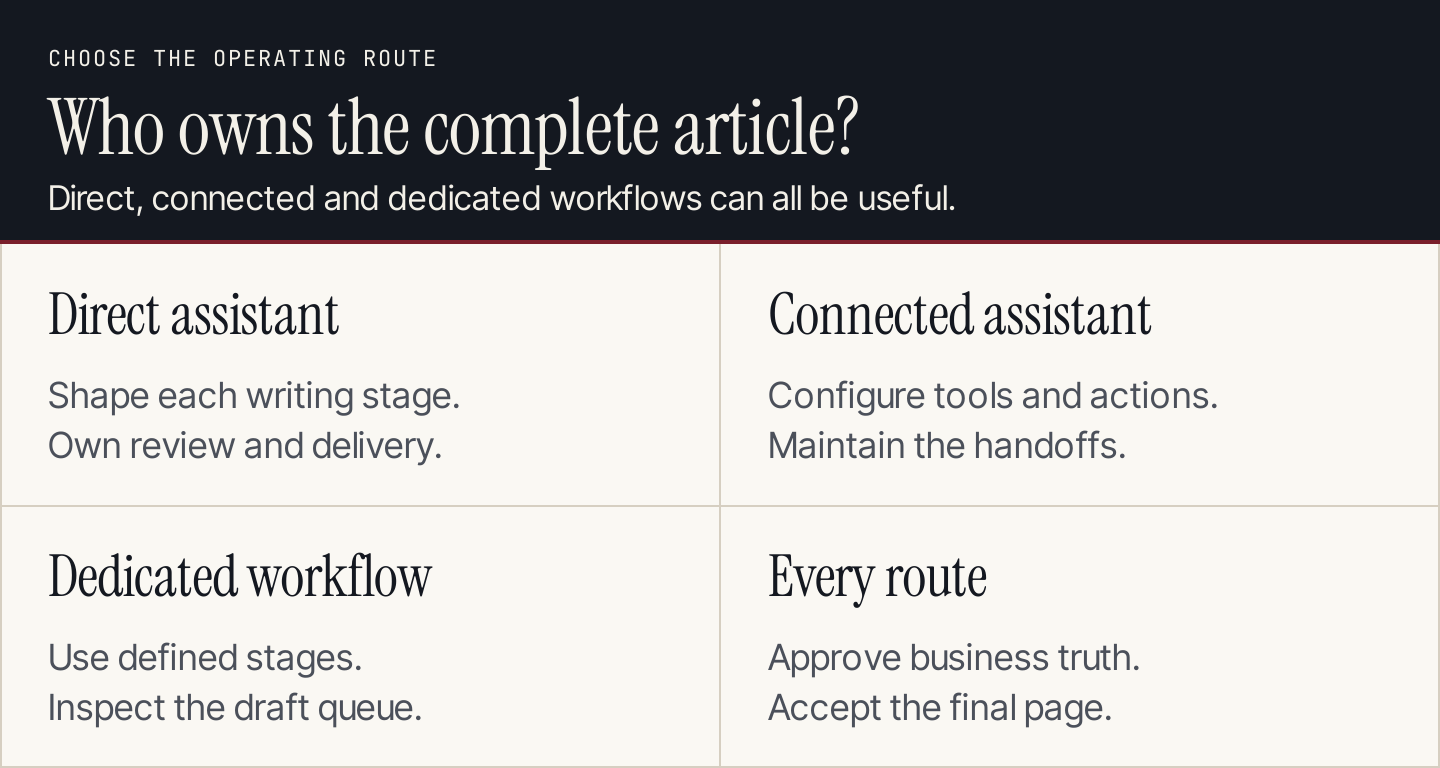
Choose how the complete process is owned rather than comparing one writing prompt with an entire platform.
What ChatGPT and Claude can actually contribute
ChatGPT’s current documentation describes chat and Work experiences, files, projects and connected capabilities. The experience you use affects how tasks are organized and which tools are available. Record the actual surface when evaluating it. ChatGPT web documentation.
Connections can supply data or actions that do not exist in a plain conversation. OpenAI’s plugin documentation describes connected tools and reusable instructions. This makes “ChatGPT cannot publish” an unreliable blanket claim: the relevant question is what a configured connection supports and what permissions it has. ChatGPT plugins.
Claude documents live web search with source links. In some current experiences it searches when useful without a separate toggle; other interfaces expose a Web search control. Workspace access can depend on organization settings. Claude web search.
Claude also documents a Google Workspace beta that can edit the open document directly. That route differs from a connector that searches Drive and returns material inside a chat. Claude in Docs, Sheets and Slides.
These capabilities do not automatically create an editorial operation. Someone must still decide the topic, establish the facts, inspect the changes and approve the destination. A source citation helps review; it does not prove that the edited sentence preserves what the source says.
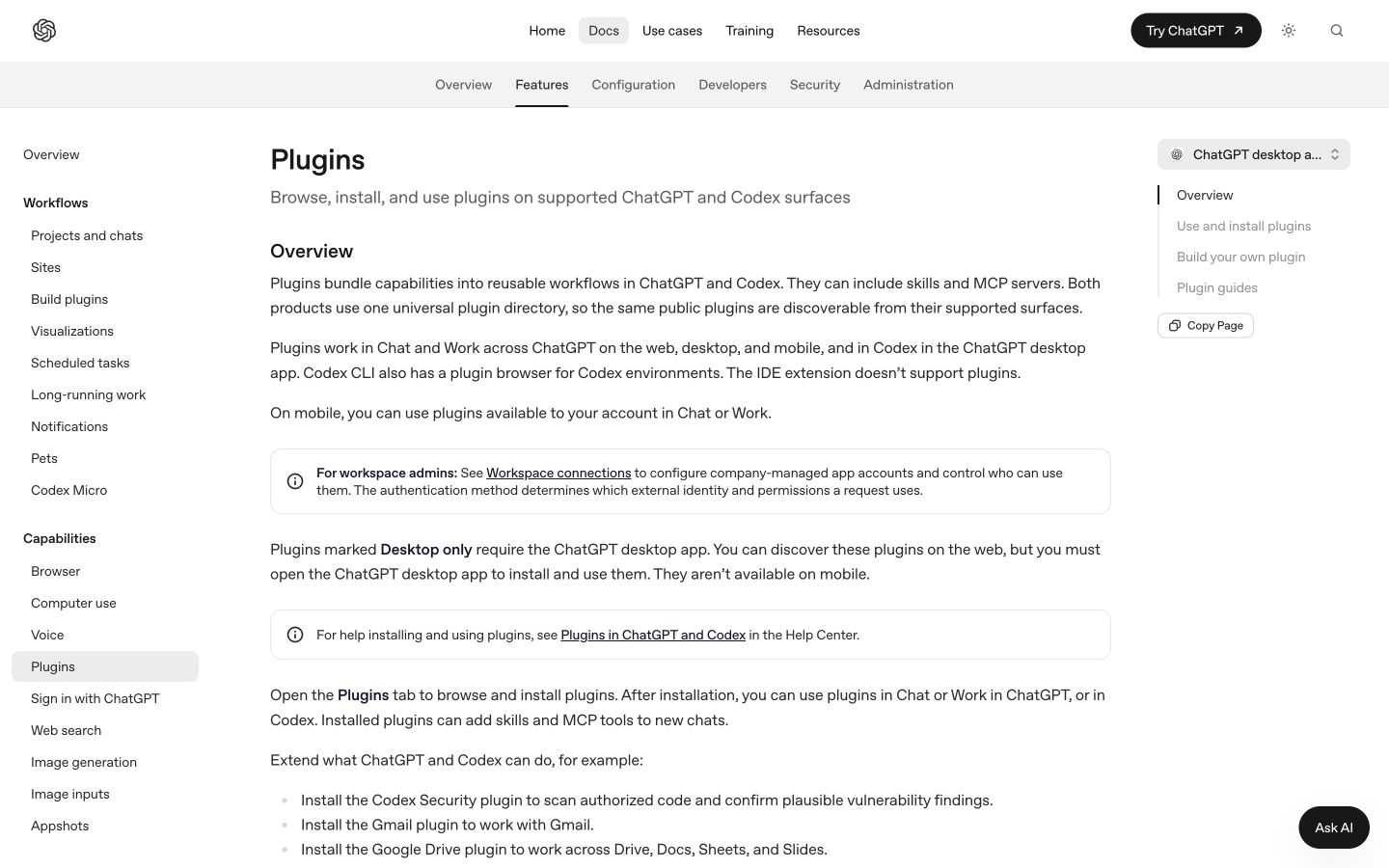
Connected tools change what an assistant workflow can do. Evaluate the configured capabilities rather than treating every chat as an isolated writer. Public-page desktop capture, October 10, 2026; vendor examples are not our account results. Source.
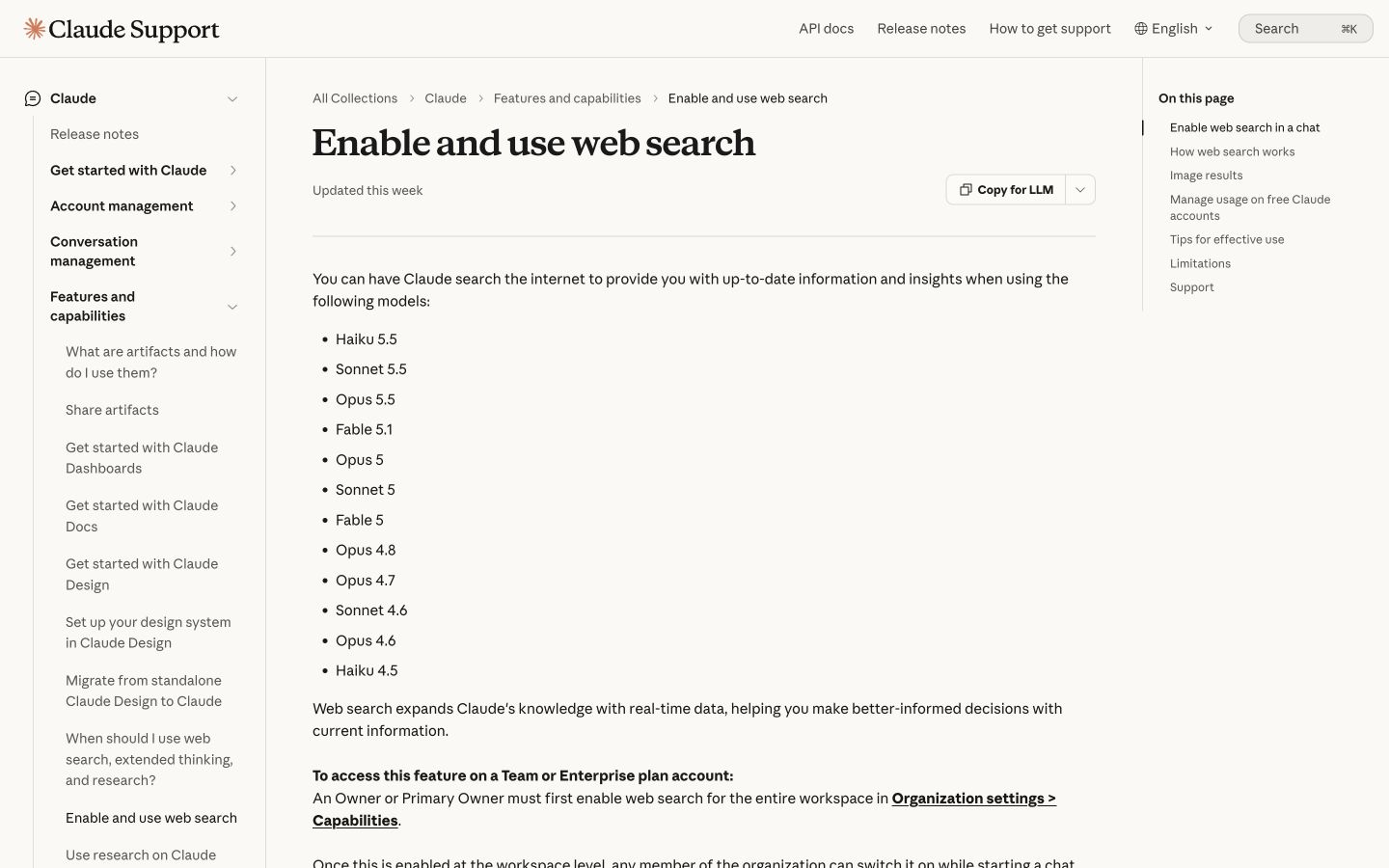
Claude’s current documentation includes live research. Verify the returned sources instead of relying only on remembered model knowledge. Public-page desktop capture, October 10, 2026; vendor examples are not our account results. Source.
What a dedicated SEO content workflow should coordinate
A dedicated platform is useful when it consistently connects the stages that your team otherwise has to remember and coordinate.
| Stage | Useful deliverable | Question to ask in a trial |
|---|---|---|
| Topic selection | An appropriate article decision | Does the topic fit our buyers and existing pages? |
| Research | Sources attached to the important claims | Are they current, accessible and relevant? |
| Drafting | A useful explanation in the agreed voice | Does it answer the real question? |
| Editorial review | A draft the owner can inspect and revise | Can we correct facts and keep important edits? |
| Media | Relevant images, screenshots and descriptions | Do visuals teach something and survive delivery? |
| SEO presentation | Appropriate title, description and links | Do these fields describe the actual page? |
| CMS delivery | The correct post in the expected status | Can we preview it and update the same record? |
| Maintenance | A reviewed response to changed facts | Can we refresh the right page without duplication? |
Rankauto advertises research, brand-guided articles, fact-checking, visuals, metadata and CMS publishing at $49 per website monthly for 30 created articles. Keep editorial review enabled while you evaluate the process. Rankauto pricing.
For WordPress, the documented connector maps SEO fields for Yoast and Rank Math and updates the existing post on republishing. Categories are not automatically assigned. Those specific details are more useful than a generic “one-click publishing” claim. Rankauto’s WordPress guide.

A dedicated workflow should make its deliverables and allowance clear. Use the review route to inspect what still requires your team. Public-page desktop capture, October 10, 2026; vendor examples are not our account results. Source.
The benefit to test: Does the platform reduce the coordination and preparation your editor must perform for an accepted article? That is a measurable operational question. It is different from promising higher rankings or zero human work.
A real example: a Shopify Flow guide
Use an actual published product procedure for your evaluation. Shopify documents three ways to create a Flow workflow: manual creation, a template and Sidekick generation. Its documentation also identifies review and activation steps, and says Sidekick-generated workflows begin inactive. Shopify’s creation guide.
Your article brief could be: Help a US small-business owner choose a creation route and review a Shopify Flow workflow before activation. Provide the official guide as the source, specify the reader and include the conditions the explanation must preserve.
Route A: direct assistant
Supply the source material and brief. Ask for an outline first, approve the useful sequence, then draft the explanation. Inspect the claims, add the relevant screenshots and prepare the post for your CMS.
The control is direct and flexible. The operating burden is also visible: you coordinate each handoff. If a teammate starts with a different source packet, the next article may follow different assumptions even when the same assistant is used.
Route B: connected assistant
Use approved research and document or CMS connections. Ask the assistant to produce a draft and place it in the intended review location. Inspect which source was read, what record was changed and whether the draft retained the workflow conditions.
This can remove transfers and support repeatable actions. It also introduces configuration decisions. A connection being available does not establish that it maps your SEO fields, preserves images or updates the right post reliably.
Route C: dedicated content workflow
Provide the same facts and business direction to the platform. Inspect its topic choice, source use, draft and delivery. Keep the article in a review state until the factual and CMS checks pass.
The useful comparison is whether the platform coordinates more of the process with less preparation. A well-formatted draft that says Sidekick automatically activates the workflow fails regardless of which route produced it.
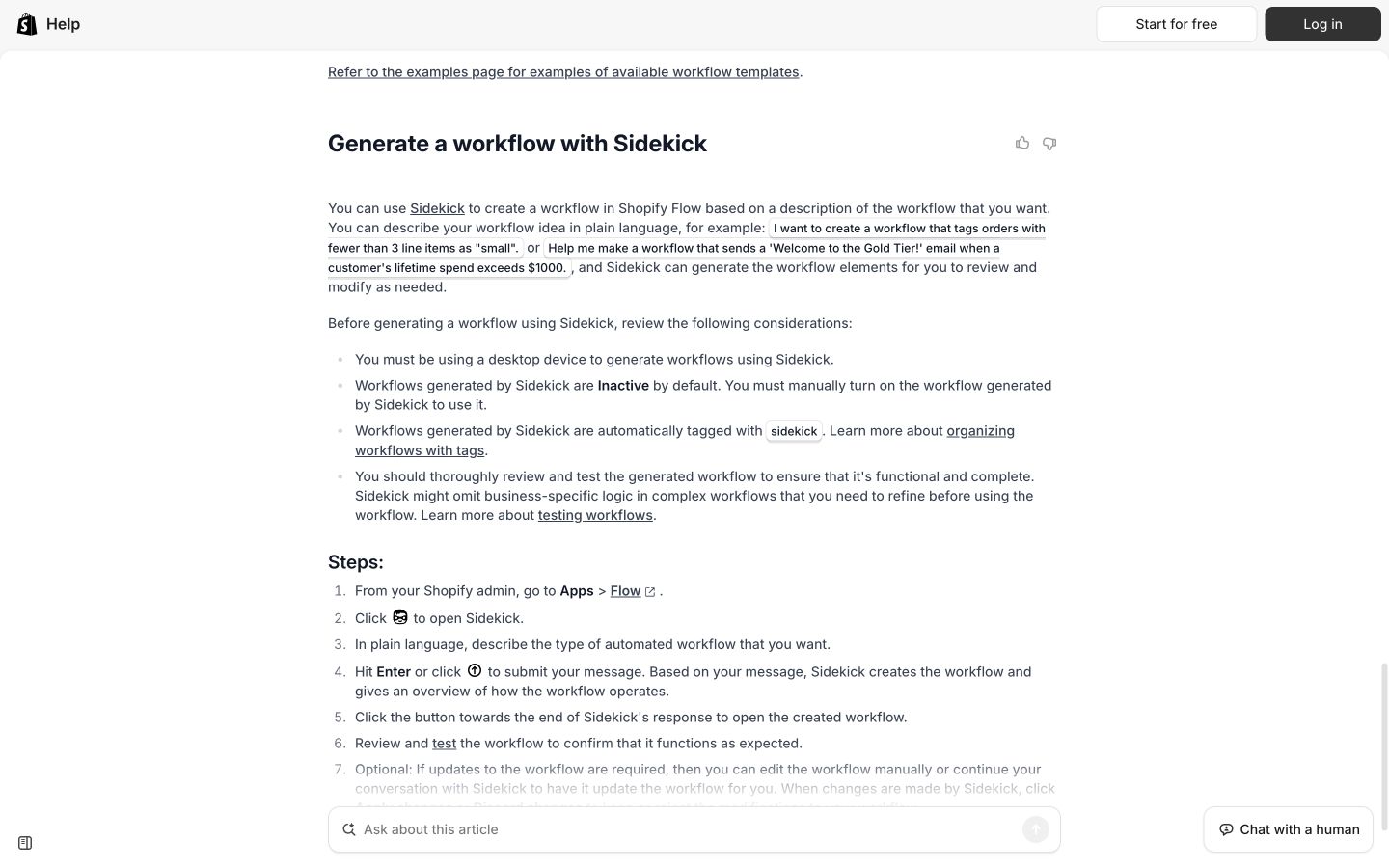
A real source exposes a consequential acceptance criterion: generated workflows begin inactive and need deliberate review and activation. Public-page desktop capture, October 10, 2026; vendor examples are not our account results. Source.
Decide what must remain human-owned
Some responsibilities are reasonable to delegate; others need a clear owner because the business is accountable for them.
Business relevance: An attractive keyword is not enough. Someone should approve why the page belongs in the library, what audience it serves and which existing article it might overlap.
Product truth: The team should own the approved facts about prices, policies, supported features and actual results. A writing system can help check these, but an invented customer quote or benefit should never enter the facts sheet.
Original evidence: Your examples, screenshots, observations and expertise create value that a generic draft cannot establish for you. A platform can format supplied evidence; it cannot truthfully invent your experience.
Publication acceptance: Assign an owner who can inspect the full page, including links, media, metadata and any call to action. An approved draft and a correct live rendering are separate acceptance steps.
Google’s guidance permits useful applications of generative AI while warning about generating many pages without adding value. This favors an acceptance process based on the page’s substance rather than the number of drafts generated. Google’s generative AI content guidance.
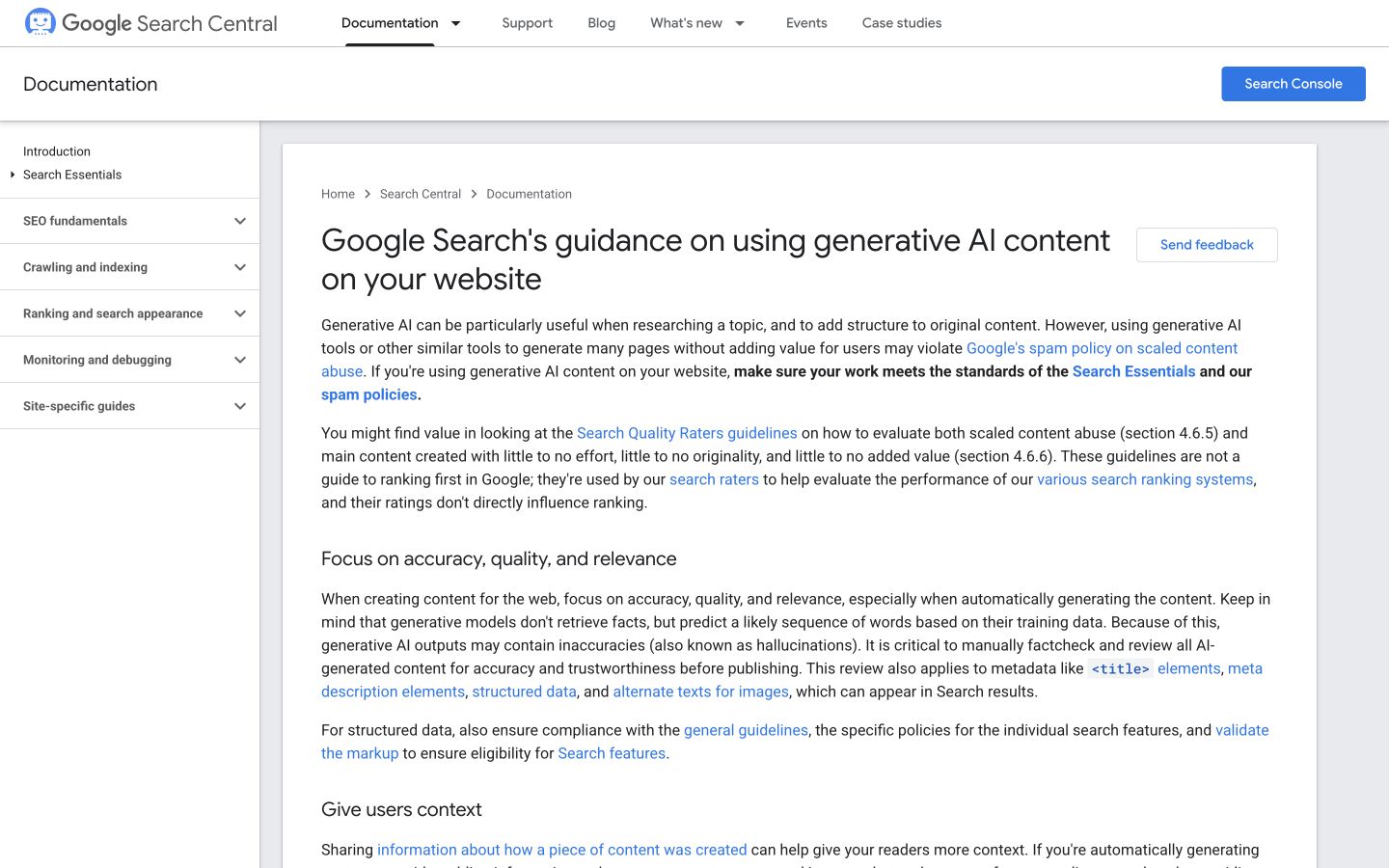
Google’s guidance makes added value relevant to the content decision. A production quota should not become a target to publish weak pages. Public-page desktop capture, October 10, 2026; vendor examples are not our account results. Source.
Compare cost per accepted article
Subscriptions are only one part of the cost. Include input preparation, connected data, setup, editing and CMS work. Chat subscriptions and API consumption are different purchases; a paid chat plan does not automatically fund your custom API workflow.
For orientation, ChatGPT Plus is $20 monthly in the US, and Claude Pro is $20 monthly in the US. Your chosen surface, tools and usage limits can change the total. ChatGPT pricing, Claude Pro.
Use this worksheet:
Monthly content cost = subscriptions + usage and connected services + human production/review cost + setup allocation.
Cost per accepted article = monthly content cost ÷ accepted articles.
Do not count rejected drafts as successful outputs. If a system creates 30 articles and your team accepts six, the denominator for that month is six.
An illustrative 12-article comparison
The following inputs are assumptions for demonstrating the calculation. They are not measured results from ChatGPT, Claude or Rankauto.
| Input | Direct assistant route | Dedicated route |
|---|---|---|
| Software | $20 monthly chat plan | $49 monthly content plan |
| Accepted articles | 12 | 12 |
| Human work per accepted article | 90 minutes | 55 minutes |
| Value assigned to human time | $50 per hour | $50 per hour |
| Extra first-month setup | None in this example | 90 minutes |
The direct route costs $20 + 12 × 1.5 × $50 = $920 in this scenario.
The dedicated route costs $49 + 12 × (55 ÷ 60) × $50 + $75 = $674 in the first month. Without the assumed extra setup, it costs $599 in a later comparable month.
The difference is $246 in the first month and $321 later, entirely because of the assumed human-work reduction. If no time is saved, the dedicated route costs more under these inputs. If you retain the chat plan, add its cost to the dedicated route as well. Usage, tax, research subscriptions and other work are excluded here.
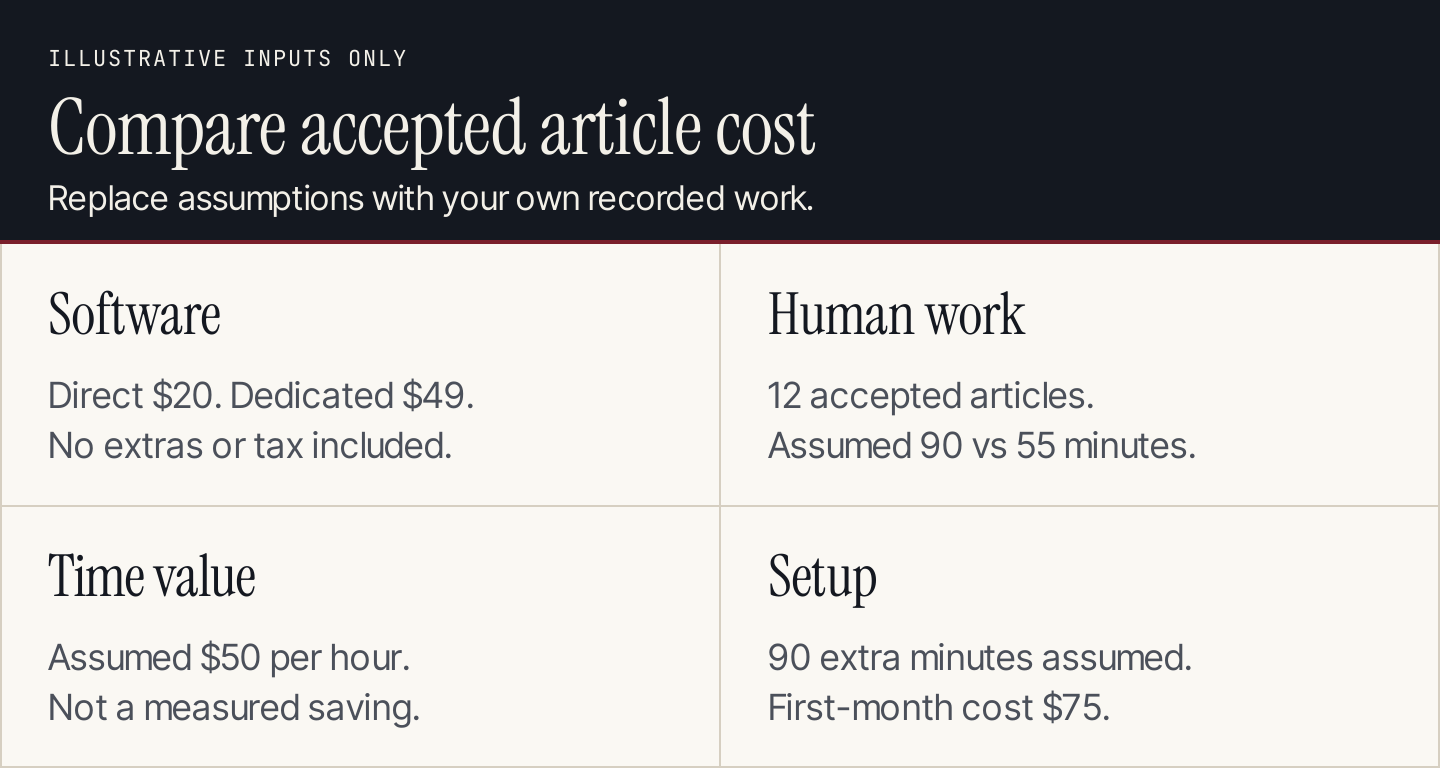
Replace every assumed input with your own recorded work before treating the calculation as a buying decision.
Find the conditional break-even point
Under the same assumed 35-minute reduction at $50 per hour, each accepted article reduces human cost by $29.17. The first-month extra software and setup cost is $29 + $75 = $104. That would require four accepted articles to cover the difference, rounding up.
This is conditional arithmetic, not a universal “four articles” rule. If the time reduction is smaller, setup is larger or a connected DIY route already handles the handoff efficiently, the answer changes. If the assumed saving is zero or negative, the calculation does not support a purchase for time savings.
Run a useful evaluation before switching
Evaluate three pieces of work from your actual backlog. This proposed protocol helps reveal different kinds of operating effort.
| Task | What it reveals | Required evidence |
|---|---|---|
| A new article | Planning, research and creation | Approved brief, sources, original output and edit log |
| A refresh | Whether useful content survives a fact change | Original page, changed source and revision comparison |
| A CMS handoff | Whether accepted work arrives correctly | Draft preview, fields, media and intended post identity |
Give each candidate the same approved factual inputs. Record configuration time separately from recurring work. Save the original draft and the accepted version, then classify corrections as factual, structural, brand-related or delivery-related.
Do not force the same interface on every product. A chat prompt, a platform brief and a configured workflow can receive equivalent facts without identical controls. The fair comparison is the usable output and the work required to get it.
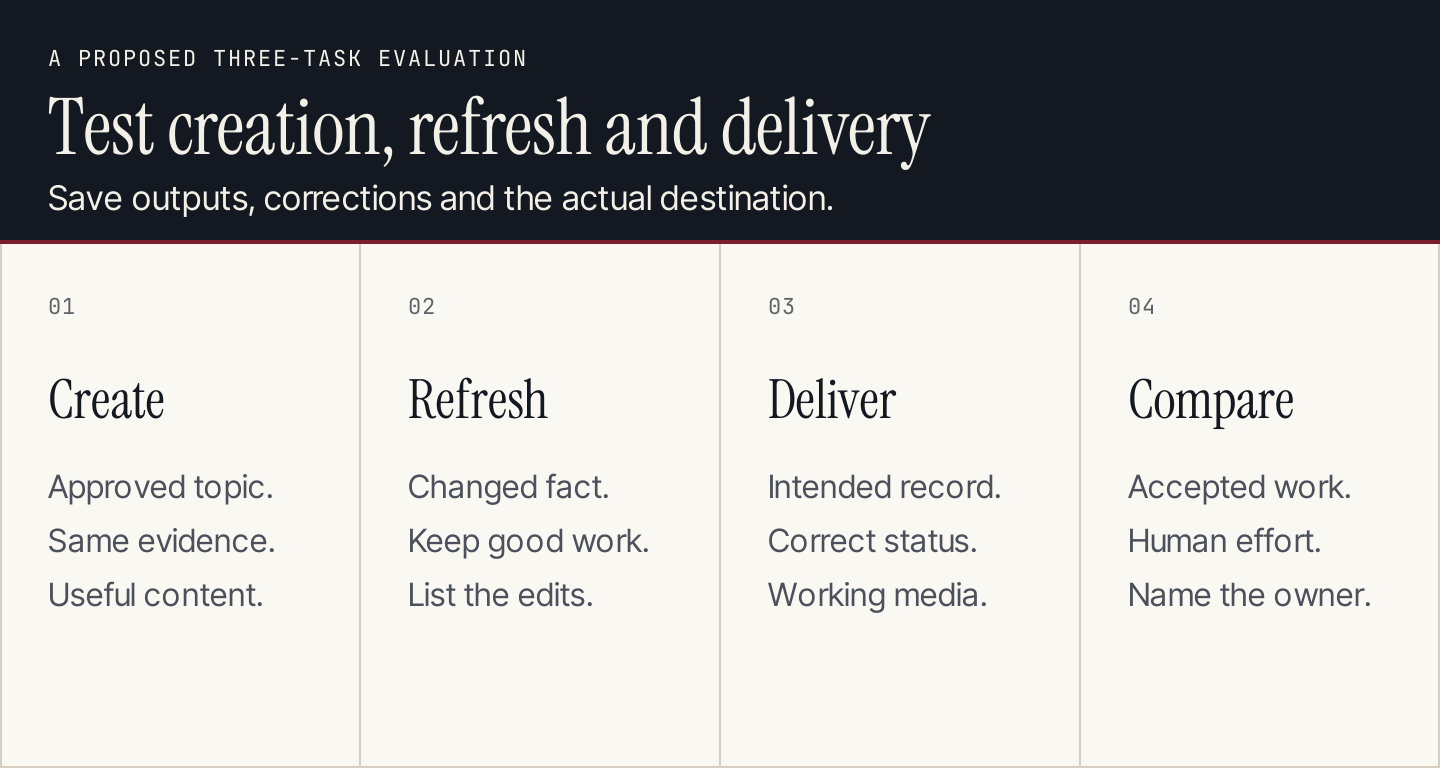
One attractive opening paragraph cannot establish that a recurring content process is working.
For a connected workflow, also inspect failures. What happens if a source is unavailable, the destination rejects an image or a field mapping changes? A visible draft or error is more useful than a successful-looking message that leaves the intended post unchanged.
When direct assistant writing fits
Use ChatGPT or Claude directly when topics are irregular, your team has strong source material and an editor wants close control over each section. It can also fit work that changes format frequently: internal documents, founder posts, customer explanations or bespoke campaigns.
The route works best when someone owns the brief and review process. Keep an approved facts sheet, reusable instructions and a clear final checklist. If the team can already finish and deliver the work consistently, a new platform needs a concrete additional benefit.
When connected DIY fits
A connected assistant workflow is worth evaluating when you have the expertise to configure tools and want flexibility over data and destinations. It can use the systems you already maintain, with explicit instructions and controlled actions.
Account for the work that supports it: access management, connection updates, logs, retries and changes to prompts or source formats. Assign an owner who can debug a failed handoff. The route may be efficient for your team, but its setup should not disappear from the cost comparison.
When dedicated automation fits
Dedicated automation is useful when articles are recurring, handoffs repeatedly stall and the team wants defined stages rather than a process reconstructed in each chat. It is especially relevant when the content owner needs a draft queue, consistent delivery and a routine for reviewing the next page.
Start with an accepted article, not automatic publication at maximum allowance. Inspect the first update and decide which human checks remain necessary. Expand only when the observed process supports it.
Common questions
Is an SEO automation tool just a wrapper around a model?
It may use an underlying model, but that does not answer the buying question. Research inputs, workflow controls, evidence review, CMS mapping and maintenance can create operating value. Verify those functions rather than paying for a label alone.
Can I make ChatGPT or Claude do all of this?
Potentially, with suitable connections and a defined process. The relevant comparison includes configuration, usage, maintenance and acceptance. Avoid assuming either that a chat assistant can never act on a CMS or that a working connection eliminates all review.
Does automation mean nobody edits?
No. Your team should still approve product truth, business relevance and the final deliverable. The potential benefit is coordinating and preparing more of the work, not removing accountability for the page.
Is one article a day a useful target?
Only when each page deserves to exist and meets your acceptance criteria. Consolidate overlapping topics and avoid using the software allowance as a reason to publish repetitive material.
How should an agency compare the routes?
Run the same process on a representative client brief, include client-specific review and site costs, and inspect cross-client access and delivery. A process that works for one owned site may need additional controls across several clients.
If the recurring article process is the gap, start a Rankauto evaluation with one useful topic, an approved source packet and a draft handoff. Keep the time log and accepted page; those provide the evidence for your next decision.