12 Content Marketing Examples You Can Adapt
Explore 12 real content marketing examples across retail, software, tools, and education. See what to adapt, what evidence to gather, and how to start.

Useful content marketing examples show you a choice you can apply: a better explanation, a practical demonstration, a lesson sequence, or a tool that helps someone finish a task.
These twelve examples cover ecommerce, software, education, and community content. Each points to a real brand resource and explains how a smaller business or agency could adapt the underlying idea.
We reviewed the public pages in October 2026. The lessons below concern what those pages show; we haven't attributed private sales, traffic, or conversion results to them.
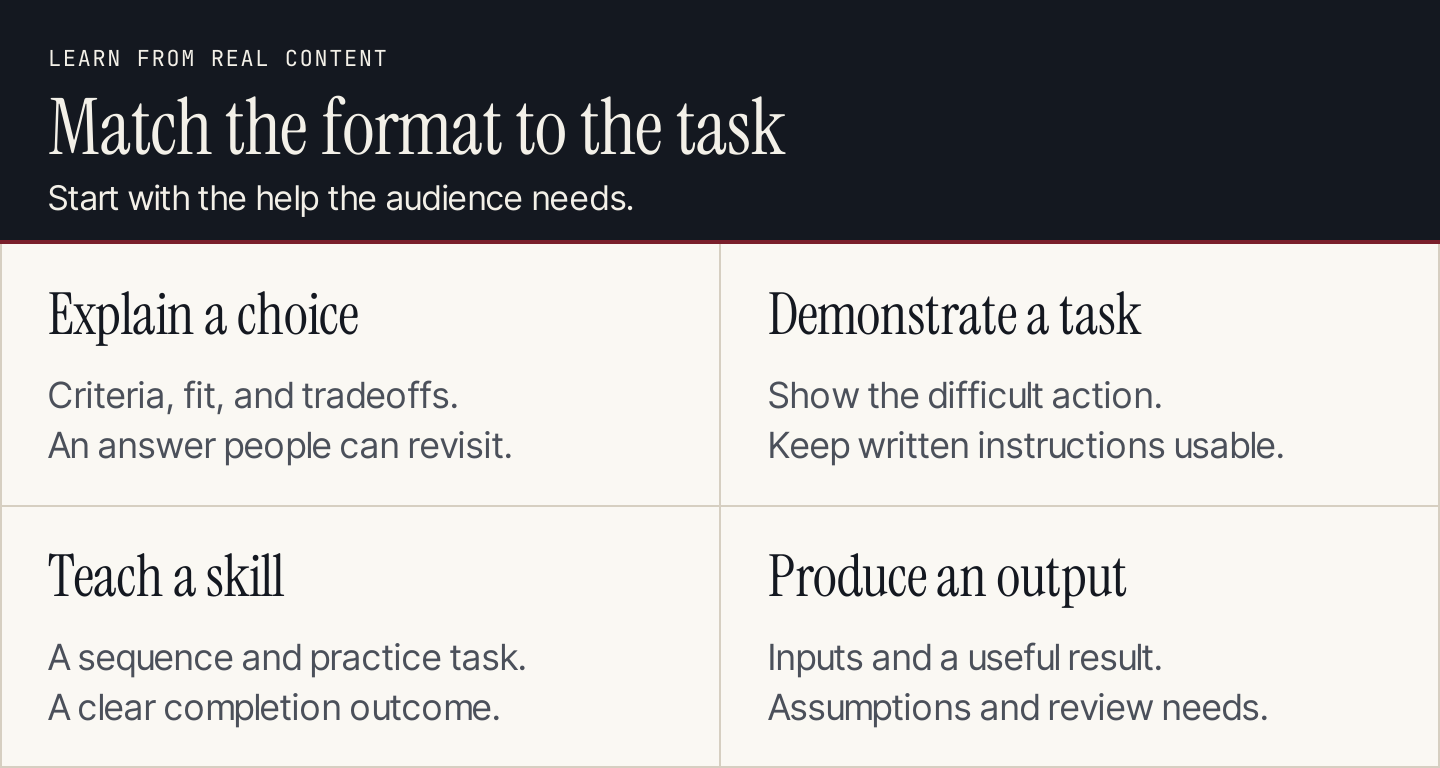
Choose a format based on the help your audience needs, then decide what evidence it requires.
Choose an example by the task you need to solve
| Brand | Observable content approach | What you could adapt |
|---|---|---|
| REI | Activity-based advice and gear guides | Separate learning the activity from choosing equipment |
| King Arthur Baking | Baking guides, videos, and classes | Organize instruction around the reader's desired result |
| The Home Depot | DIY guides, workshops, and calculators | Help people move from project idea to preparation |
| IKEA | Room inspiration and practical home ideas | Make a visual concept easier to apply |
| Patagonia | Stories, films, and topic navigation | Connect an editorial subject to the brand's actual commitments |
| Warby Parker | Illustrated explanation of frame measurements | Explain a confusing product detail before selection |
| Chewy | Species-based education and seasonal content | Serve different customer situations through clear routes |
| Williams Sonoma | Recipe collections organized by occasion | Make the library useful at the moment of planning |
| Canva | Skill filters and short learning resources | Teach a specific task in the context of a product |
| HubSpot Academy | Structured courses and certifications | Build a lesson sequence around a continuing skill |
| Shopify | An interactive business name generator | Give the reader a useful output rather than only advice |
| LEGO Ideas | Fan creations, challenges, and participation | Give community contributions a defined place and purpose |
1. REI: distinguish advice from product selection
REI Expert Advice groups content by outdoor activity and uses labels such as skills and gear guides. Recommendation titles distinguish tested selections from staff picks.

REI's titles tell readers what kind of recommendation they are opening. Source: REI.
For your own library, give the activity guide and the buying guide different jobs. One should help the reader understand the task; the other should explain the selection criteria and evidence.
A retailer can start with a narrow use case and show the actual inspection or testing method. An agency can apply the same principle to service comparisons by explaining evaluation criteria and limits. Don't describe a desk-researched list as hands-on testing.
2. King Arthur Baking: organize around the desired result
King Arthur Baking's learning hub asks what the visitor wants to bake and offers routes to subjects including bread, cookies, pie, and cake. It connects guides with videos and classes.
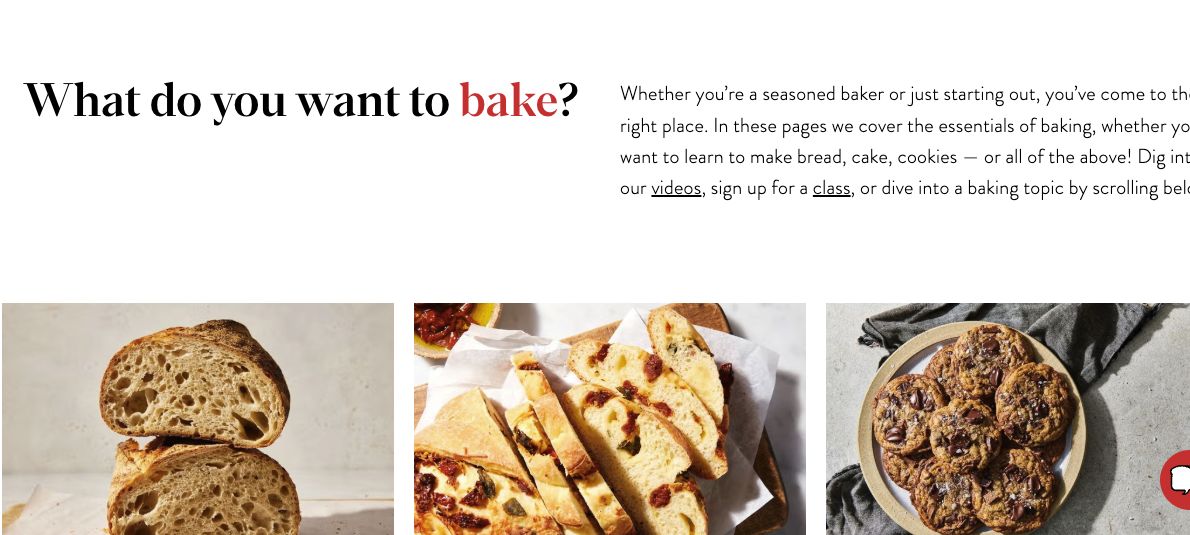
King Arthur Baking starts with the learner's desired result and offers different ways to learn. Source: King Arthur Baking.
The adaptable choice is outcome-based navigation. Organize around what customers want to accomplish, rather than only the internal names of your products.
Start with one result and the questions that commonly prevent it. Provide an explanation, a demonstration for the hard step, and a troubleshooting answer. A professional service business could use the same pattern for preparing a project brief or onboarding a new team member. Keep the explanation usable without requiring the reader to enroll in a larger program.
3. The Home Depot: support the whole project
The Home Depot's DIY resource hub offers guides, workshops, calculators, and navigation by project area. Those formats serve different parts of planning and doing a task.
This is a useful model when customers need more than a product description. They may need to understand the scope, estimate materials, or decide whether they need professional help before they can purchase responsibly.
Choose one common project and identify its missing preparation step. You might publish a checklist, a measurement worksheet, or a short demonstration. Keep assumptions and safety-related limits clear. Complex or hazardous work needs an appropriately qualified reviewer.
Don't build a calculator just to add an interactive element. First establish the inputs, method, and useful decision its result supports. An inaccurate estimate is less helpful than a clearly explained worksheet.
4. IKEA: connect inspiration to practical situations
IKEA's home ideas hub combines visual inspiration with how-to guidance and navigation by room. Its topic routes include practical situations such as storage and small spaces.

IKEA gives visitors several routes from a visual idea to practical guidance. Source: IKEA.
For a smaller brand, show how an idea works under a real constraint. Explain the space, materials, budget conditions, or tradeoffs involved. An attractive photograph alone doesn't tell the reader whether the solution fits.
An agency could demonstrate a real approved website or campaign asset, then explain the decisions behind it. Use client permission and keep the explanation specific. Avoid implying that a polished design caused a measured business improvement unless you have evidence for that claim.
5. Patagonia: give editorial content a consistent subject
Patagonia Stories provides routes to stories, films, activism, and subject categories. Its editorial navigation extends beyond shopping for products.
The useful lesson is coherence. A brand can cover subjects that matter to its audience without turning every paragraph into a product pitch. The connection should come from the business's real activities and commitments.
For your business, choose a subject you can support with knowledgeable people, actual work, and credible evidence. Publish a documented account of what happened, the decisions involved, and what remains unresolved.
Don't adopt another brand's cause or tone as a shortcut to personality. A small company's operational story can be more convincing than broad claims about changing an industry. Make the story's subject and supporting evidence visible before asking the reader to admire the brand.
6. Warby Parker: explain the detail that makes buying confusing
Warby Parker's glasses measurement guide explains unfamiliar frame measurements with illustrations, a size chart, and routes to further help. The page shows an April 2026 update.
This is an example of product education, not a recommendation to diagnose fit or eye health yourself. The marketing choice is to explain terminology that readers encounter when comparing products.
Find an equivalent source of confusion in your offer: a specification, a service scope, a compatibility requirement, or an implementation term. Define it, show where the reader encounters it, and explain what decision it affects.
Use a labeled original demonstration or a real approved product capture. If a specialist must make the final assessment, give readers a clear route to that help. A useful explanation can make the next conversation more productive without pretending to replace expertise.
7. Chewy: create clear routes for different customer situations
Chewy Education organizes resources by animal category and combines continuing education with seasonal topics and video. Its public hub includes an editorial guidelines route.
The adaptable idea is to distinguish audience situations within one library. Visitors should be able to find the material relevant to their needs without sorting through every article the business publishes.
For a service firm, that might mean separate routes for first-time buyers, existing customers, and teams implementing the service. For retail, it might mean product use, maintenance, and seasonal planning.
Start with the categories your audience actually uses. Explain who reviews specialist advice, and treat sensitive topics with the appropriate expertise. Avoid turning this structure into dozens of empty category pages. Each route should lead to enough useful material to justify its presence.
8. Williams Sonoma: organize for the planning moment
Williams Sonoma's recipe collections group content around occasions and needs such as celebrations, seasonal cooking, baking, and weeknight meals.
The marketing lesson is timing and organization. A library becomes more useful when visitors can select content for the situation they are in, rather than browsing a long chronological feed.
Look for a recurring planning moment in your market: preparing an event, moving a business, hiring a role, reviewing a budget, or starting a project. Assemble the existing resources that help with that moment and add missing instructions.
A curated collection should explain what to use first and what depends on an earlier decision. Update links and recommendations when the underlying resources change. The value comes from a helpful route through the material, rather than from republishing summaries of every page.
9. Canva: teach a specific skill close to its use
Canva Design School presents skill categories and short learning resources. The visible choices include content creation, graphic design, social media marketing, and AI prompting.
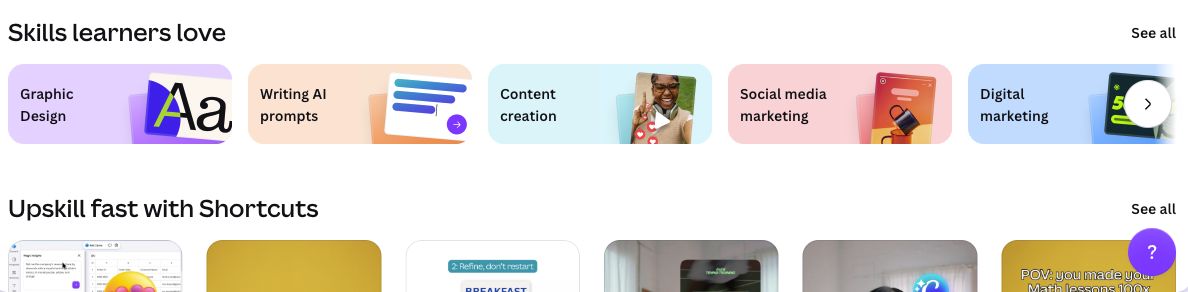
Canva lets learners choose a skill and a short learning format. Source: Canva Design School.
You can adapt this with a small library of task-specific lessons. Each lesson should name the starting point, demonstrate the key action, and show a finished output the learner can recognize.
For software, use an actual current interface. For a service, demonstrate a real approved deliverable or an explicitly illustrative exercise. Keep the lesson understandable in text as well as video or images. A tutorial tied to an old interface needs maintenance even when its underlying principle remains useful.
10. HubSpot Academy: turn related lessons into a progression
HubSpot Academy presents structured learning across business skills, with courses and certifications. It gives visitors a clear starting action.
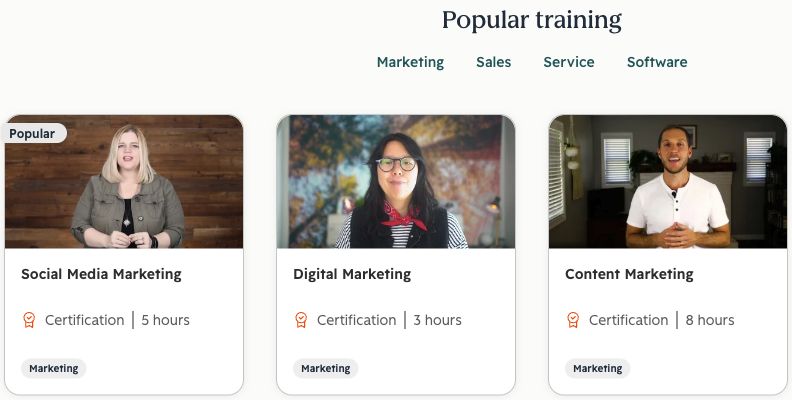
HubSpot Academy makes each learning offer explicit, with a named skill and course duration. Source: HubSpot Academy.
An agency can adapt the format without creating an enormous academy. Pick one client skill, sequence a few lessons, and include a practice task. Explain what someone should know before starting and what they should be able to do afterward.
Decide whether success means completing a lesson, implementing a process, or becoming a suitable prospect. Those outcomes call for different measurements. Don't equate a registration with a sale or invent a certification's external recognition. The program should earn its scale through usefulness and maintainable production.
11. Shopify: answer a question with a tool
Shopify's business name generator asks visitors to describe their business and brand personality. It offers an interactive route into a task people face before starting a store.
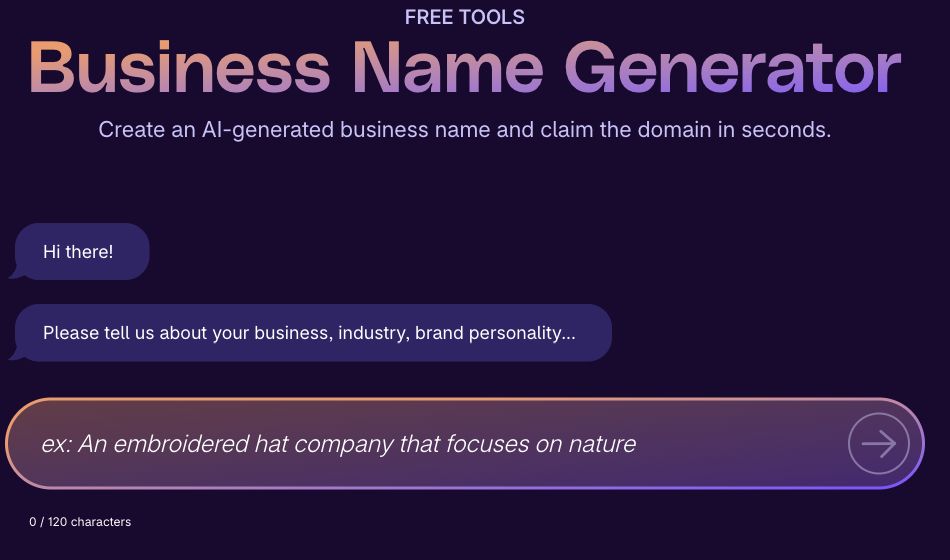
Shopify asks for an input that connects directly to the output visitors want. Source: Shopify.
The adaptable principle is a useful result. Before building software, test whether a worksheet, checklist, or documented calculation helps people complete the task. Define the required inputs, the output, and the review it still needs.
Track whether people reach a meaningful result, rather than only whether they open the page. Generated suggestions still need evaluation. A tool also needs an owner for broken behavior, changing assumptions, and questions that users raise.
12. LEGO Ideas: give participation a defined purpose
LEGO Ideas invites visitors to explore fan creations, join challenges, and submit ideas. Its homepage links to participation guidance and rules.
The useful pattern is a structured contribution. Community content works differently from a company publishing a blog: participants need a reason to contribute, clear boundaries, and an understanding of how their contribution will be used.
A smaller business could invite approved project examples, customer questions, or a narrowly defined challenge. Set moderation capacity, participation rules, and permission requirements before opening submissions.
Don't promise that every submission will receive publicity or become a product. Decide how to handle unsuitable contributions and unanswered questions. Starting with a limited, manageable activity is more responsible than creating a permanent community space without an owner.
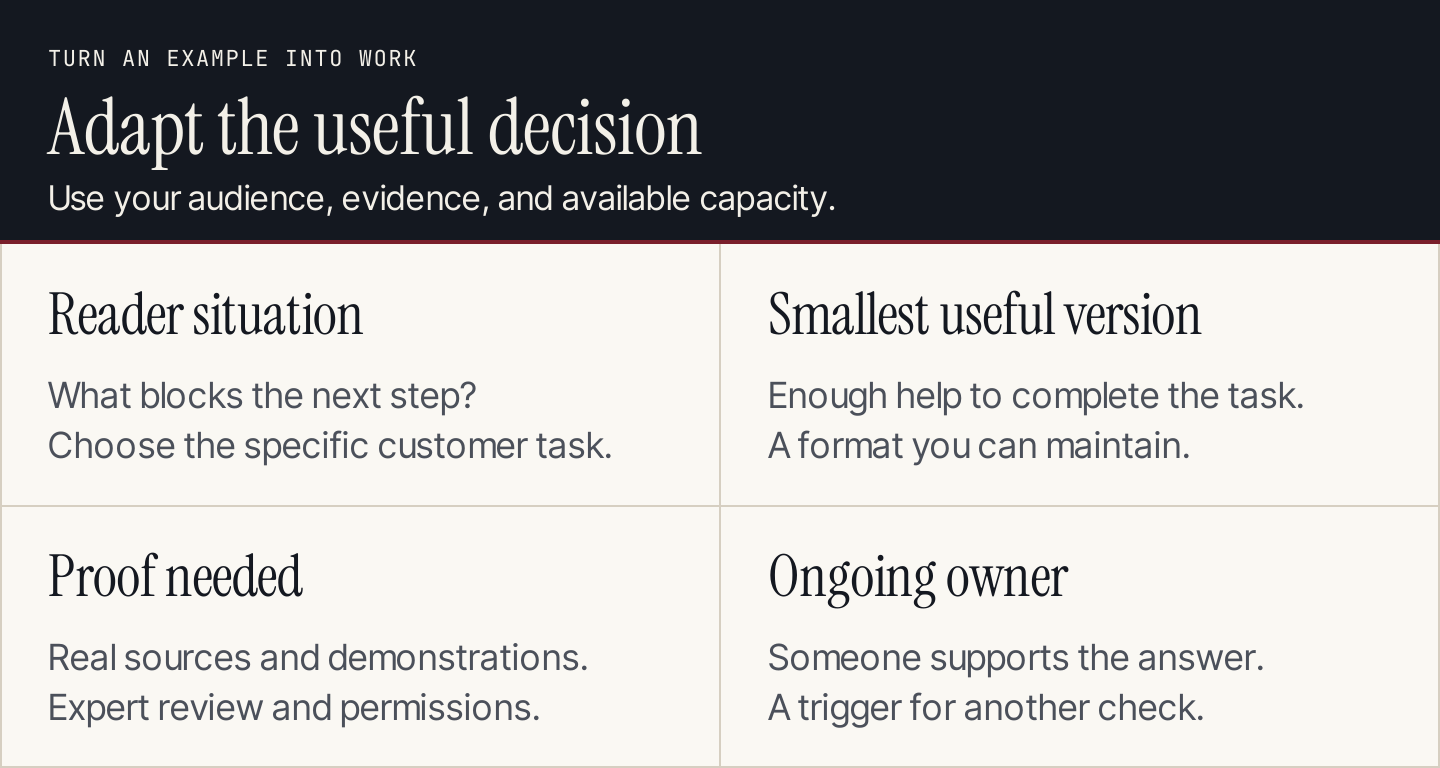
Adapt the useful decision behind an example to your audience, evidence, and capacity.
How to turn an example into your next assignment
Choose the customer task before choosing the brand you want to imitate. Then write a brief that makes the adaptation concrete.
| Decision | What to write in the brief |
|---|---|
| Reader situation | Who needs help, and what are they trying to do? |
| Useful output | A decision, checklist, demonstrated action, or generated result |
| Starting format | Why text, video, a tool, or a lesson fits |
| Evidence | Real sources, approved examples, expert review, or a reproducible method |
| Smallest version | What you can finish and maintain with available capacity |
| Next step | The appropriate action after the reader gets value |
| Measurement | The observable behavior that matches the intended role |
| Maintenance | Owner and trigger for another check |
For example, adapting a product education guide means identifying a confusing specification in your own offer and demonstrating it accurately. It doesn't mean taking Warby Parker's structure and changing the product names.
Adapting a learning program means designing a useful progression for your audience. It doesn't require copying HubSpot's course catalog. Use the examples as evidence of different choices, then make your own assignment.
Match the next step to the content
A reader learning a basic concept may need another explanation. Someone evaluating a provider may need a case study or a conversation about suitability. Someone completing a task may need the relevant product or service.
| Content role | Suitable next step | Useful supporting measure |
|---|---|---|
| Explain a choice | Comparison or suitability conversation | Qualified inquiries with a defined need |
| Teach a task | Practice, checklist, or implementation guide | Completion or successful task feedback |
| Support product use | Relevant instructions or specialist help | Correct use, resolved questions, or support feedback |
| Provide a tool | Review and use the output | Completed useful outputs; appropriate follow-up |
| Invite participation | Clear submission or discussion route | Suitable contributions and manageable moderation |
Treat these as planning choices, not automatic proof of ROI. Use your content strategy to define the business role and your content ROI worksheet when the underlying cost and revenue evidence exists.
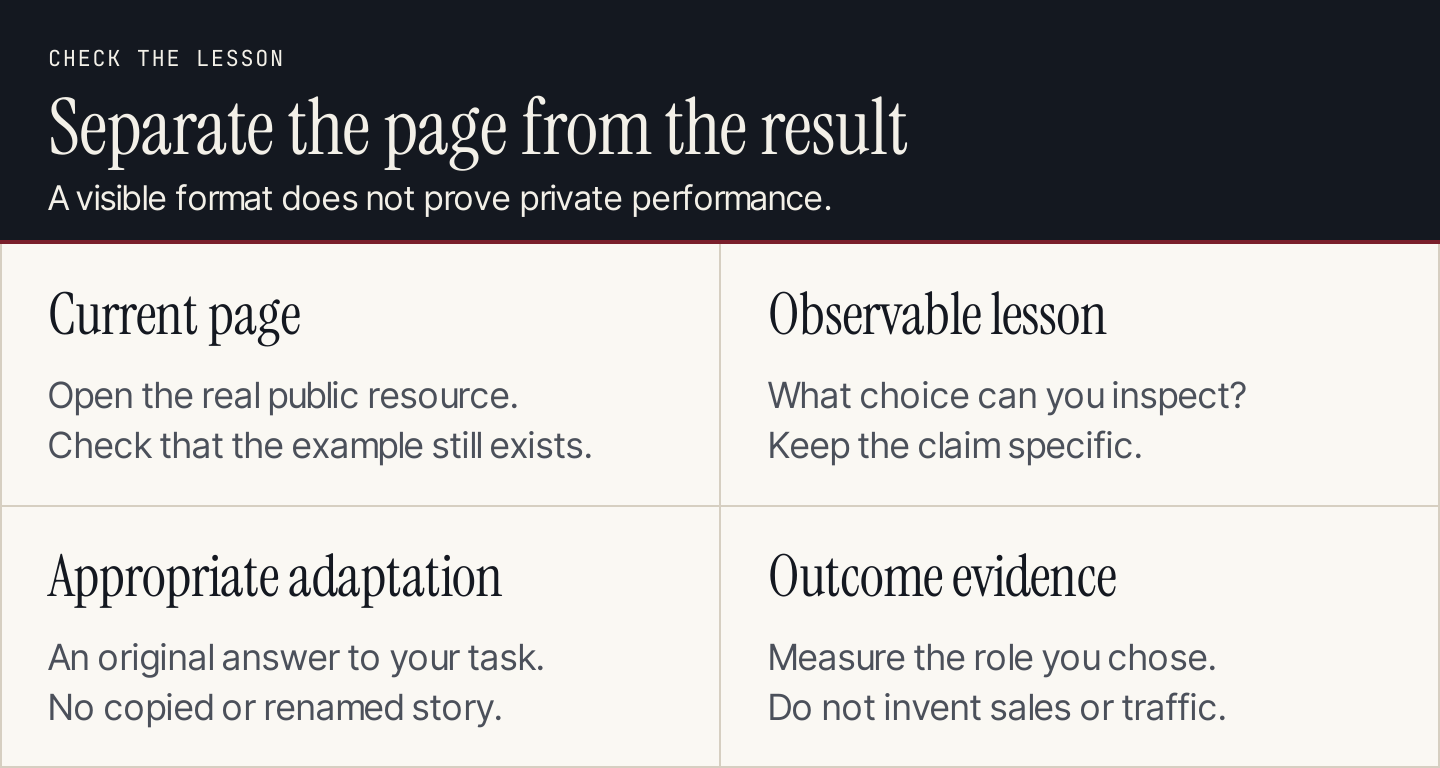
A compelling public example can teach a useful format without establishing its private financial results.
Start with one useful adaptation
Choose the example closest to a current customer question. Prepare the evidence and the smallest complete version, assign its owner, and put it in your content calendar. Expand after you learn how people use it.
If your chosen format is a blog guide, Rankauto can research relevant customer searches, write and fact-check articles in your brand voice, and prepare images and SEO fields. Drafts are the default. Your team still supplies private customer evidence and approvals; Rankauto writes blog articles rather than email, ad, or product-catalog copy.
Content marketing examples FAQs
Which examples suit a small business?
Start with a format that helps an existing customer question and fits your expertise. A focused explanation, checklist, or approved customer story can be a manageable first assignment. The size of the example brand doesn't determine the size of your initial version.
Do we need a free tool?
Only when a personalized output improves the task. Validate the method and the need with a simpler worksheet first if appropriate. Building and maintaining software is a separate commitment from publishing an explanation.
Should every example include an AI prompt?
No. Add AI assistance when it helps a specific task and the output can be checked. A physical demonstration, a verified customer story, or a useful collection may be better served by the underlying evidence and instructions.