Future of Content Marketing: 13 Decisions for the AI Era
Plan content marketing for the AI era with 13 investment decisions, real examples, research context, and a worksheet for a focused pilot.

Content marketing still matters when people use AI to research a purchase. Your business needs accurate explanations, useful demonstrations, and evidence that helps someone decide whether your offer fits. AI changes how that material is produced and discovered. It doesn't remove the need to have something worth discovering.
The investment question is more specific than “Should we keep blogging?” Ask which content gives a customer something they cannot get from a generic summary: a relevant comparison, an actual product workflow, an explanation of your constraints, or a credible account of work you've done.
This guide turns that question into 13 decisions, with real public examples and an investment worksheet. It covers business content across discovery, evaluation, and use, rather than a checklist of page-level SEO changes.
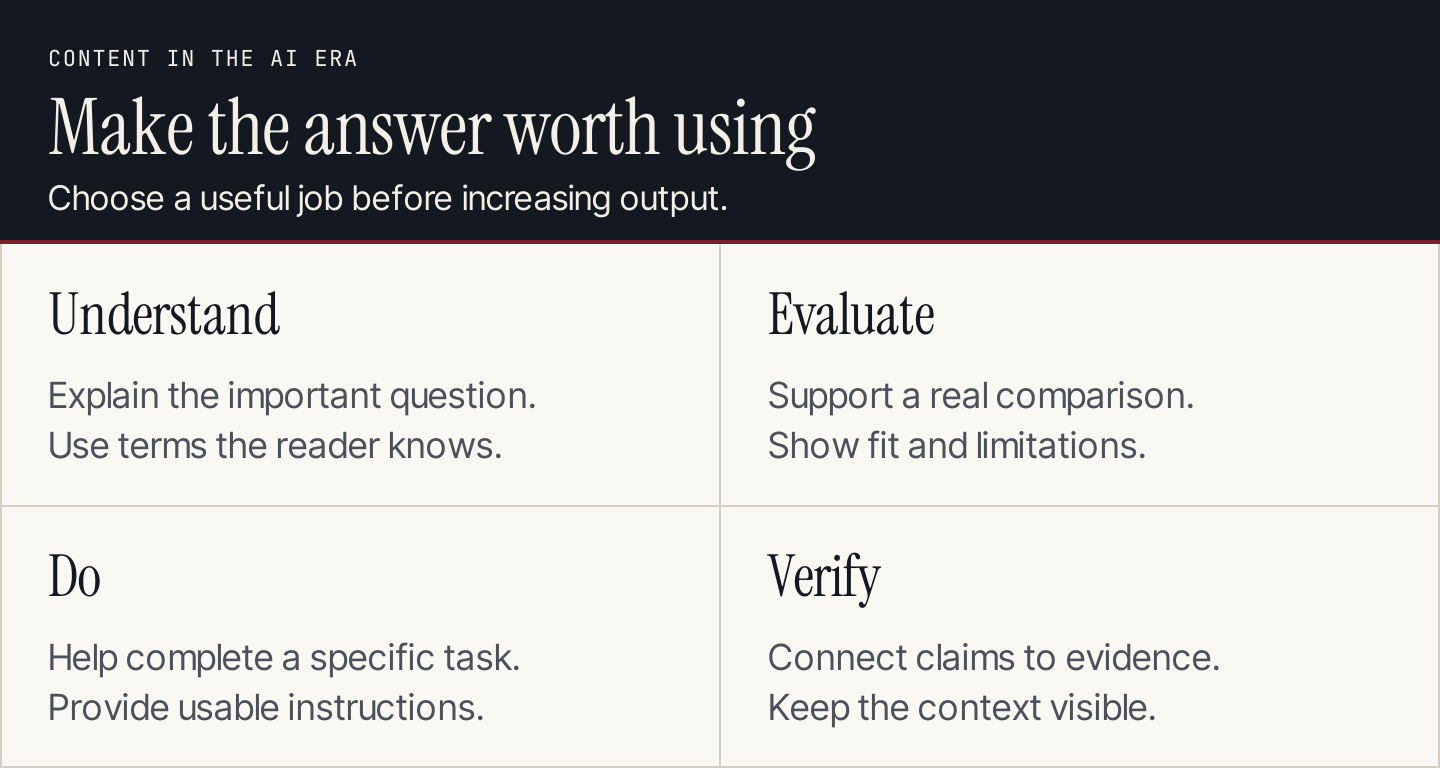
Content earns its place by helping someone understand, decide, or do something.
What AI changes, and what it doesn't
Discovery can happen before a website visit
Google's documentation for AI features explains that AI Overviews and AI Mode can include links to supporting websites. Google also says those features require no separate special optimization. Being eligible doesn't guarantee that your page will appear.
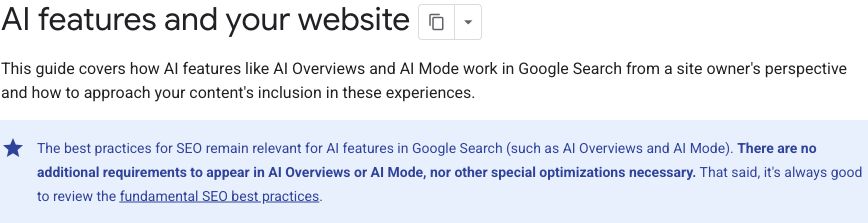
Google describes AI search features as another setting in which supporting web content can appear. Source: Google Search Central.
That creates a reason to maintain useful public information. It doesn't justify promising that every new article will earn AI citations. Keep the information accurate for the person who eventually checks the source, contacts you, or tries your product.
A search appearance and a visit are different outcomes
Pew Research Center's July 2025 analysis examined browsing data from 900 US adults during March 2025. Traditional result links received clicks in 8% of visits to pages with an AI summary, versus 15% without one.
That was an observational study of a particular period and panel, with search results collected afterward. It isn't an experiment proving what AI will do to your website's traffic in 2026. It does make a useful planning distinction: showing up in research and receiving a visit are separate events.
Don't dismiss traffic. Connect it to the work you want a visitor to complete, and build useful ways for people to encounter your content outside a single search result page.
People can still want to verify an AI recommendation
In Salsify's 2026 consumer research summary, 27% of surveyed shoppers said they trust AI shopping tools for some purchases but verify answers elsewhere. The survey reached nearly 3,000 shoppers across the US, UK, and Canada.
This describes reported shopping behavior in that sample, not all business buyers. The practical implication is worth testing in your own audience: make the evidence behind your offer easy to inspect when someone arrives with an AI-generated shortlist.
13 decisions for a content program in the AI era
1. Choose the customer decision you want to help
Start with a specific situation. A founder comparing service providers, an administrator rolling out software, and a shopper checking product fit need different answers.
Name the decision and the uncertainty blocking it. “Build awareness” can be a business objective, but a writer needs a more concrete assignment: explain the difference between two approaches, show the setup process, or identify when an offer isn't suitable.
2. Separate general information from your contribution
Some basic definitions still belong in your library. They establish shared language and can support more detailed work. But commissioning another definition should be a deliberate choice.
Ask what you can add. Possibilities include an actual demonstration, clearly defined research, customer questions you are allowed to discuss, or an explanation that resolves a recurring misunderstanding. A polished rewrite of existing pages doesn't automatically create that contribution.
3. Keep the facts about your offer consistent
Review the information a researcher might compare: capabilities, eligibility, pricing, required setup, and important limitations. Name an owner for changes.
If your product changes, correct the relevant guide, comparison, screenshot, and supporting sales material. The same capability shouldn't appear as included on one page and unavailable on another. Consistency is useful to a buyer regardless of how they found you.
4. Show the difficult part of the task
Use a screenshot when the reader needs to recognize an interface. Use a diagram when the issue is a relationship or process. Use a source-based chart when the comparison is numerical.
The visual should resolve a question that prose alone leaves open. A decorative illustration of “growth” won't help someone find a setting, judge a tradeoff, or check a calculation. Keep the essential instructions in text as well.
5. Build evidence before building a strong claim
Gather the record that supports a result: dates, scope, definitions, and permission to use it. If those aren't available, write a narrower explanation.
A real customer story can describe a useful implementation without claiming a percentage improvement. A product demonstration can show a task without presenting a fabricated dashboard of results. Use our customer case study guide when a customer story is the right evidence.
6. Explain the choice, including who should choose differently
Help the reader judge fit. Identify the condition under which your recommended approach works and the condition that calls for another option.
For a service, explain what the customer must supply and what remains outside scope. For software, explain relevant prerequisites and access. This makes a comparison useful rather than turning it into a list of promotional adjectives.
7. Plan a next step that matches the reader's readiness
A first-time learner may need an example or checklist. A buyer comparing options may need a trial, a demonstration, or answers for a colleague. An existing user may need instructions.
Choose the smallest appropriate next action. Don't demand a sales call from everyone who opens a basic explanation. Conversely, don't make an evaluator search through several unrelated articles to find the relevant product details.
8. Give expertise a visible role
Identify who knows the subject and what they checked. Involve the person who can verify a workflow, explain a constraint, or interpret a dataset.
Use that expertise in the content itself. A name and biography are helpful context, but they don't replace a clear explanation or supported evidence. Ask experts about the exception that beginners commonly miss, then demonstrate it where practical.
9. Use AI with an evidence packet
Supply the approved facts, audience situation, source notes, and expected output. AI can help organize that material or propose alternative explanations. People still need to decide which statements the evidence supports.
Review the final text against the records, especially numbers, named products, quotations, and capability claims. Don't let an invented example become a real-looking customer story during editing.
10. Adapt the material to the place people encounter it
A video needs a visible demonstration. A newsletter needs a reason a subscriber should open it. A sales handout needs an answer that can travel inside a buying team.
Choose an adaptation based on the task and channel, not merely because the original article can be shortened. Preserve the evidence and update the derivatives when a material fact changes. Our content repurposing guide covers that production work.
11. Maintain a route back to the current answer
When partners, colleagues, or community members share an explanation, make its source and owner clear. Keep the original page useful for someone who wants more context.
An article can remain useful after its first promotion. Schedule another check when the product, evidence, or customer question changes. Fix an outdated resource before promoting it again.
12. Measure the role you assigned
Track what the piece is intended to support: qualified inquiries, evaluation questions resolved, successful setup, or another defined action. Record the denominator and time window.
Visits, mentions, and engagement can help explain exposure. They don't automatically establish incremental revenue. Use content marketing ROI when you have the financial inputs needed for that calculation.
13. Make the next investment conditional on learning
Decide what would justify continuing, revising, or stopping a commitment. A subject with persistent customer questions may need a better explanation. A resource that no longer matches your offer may need to be retired.
Allocate review and maintenance time alongside production. Faster drafting only helps if the resulting material serves the task you chose. Use the content strategy template to record the larger commitments.
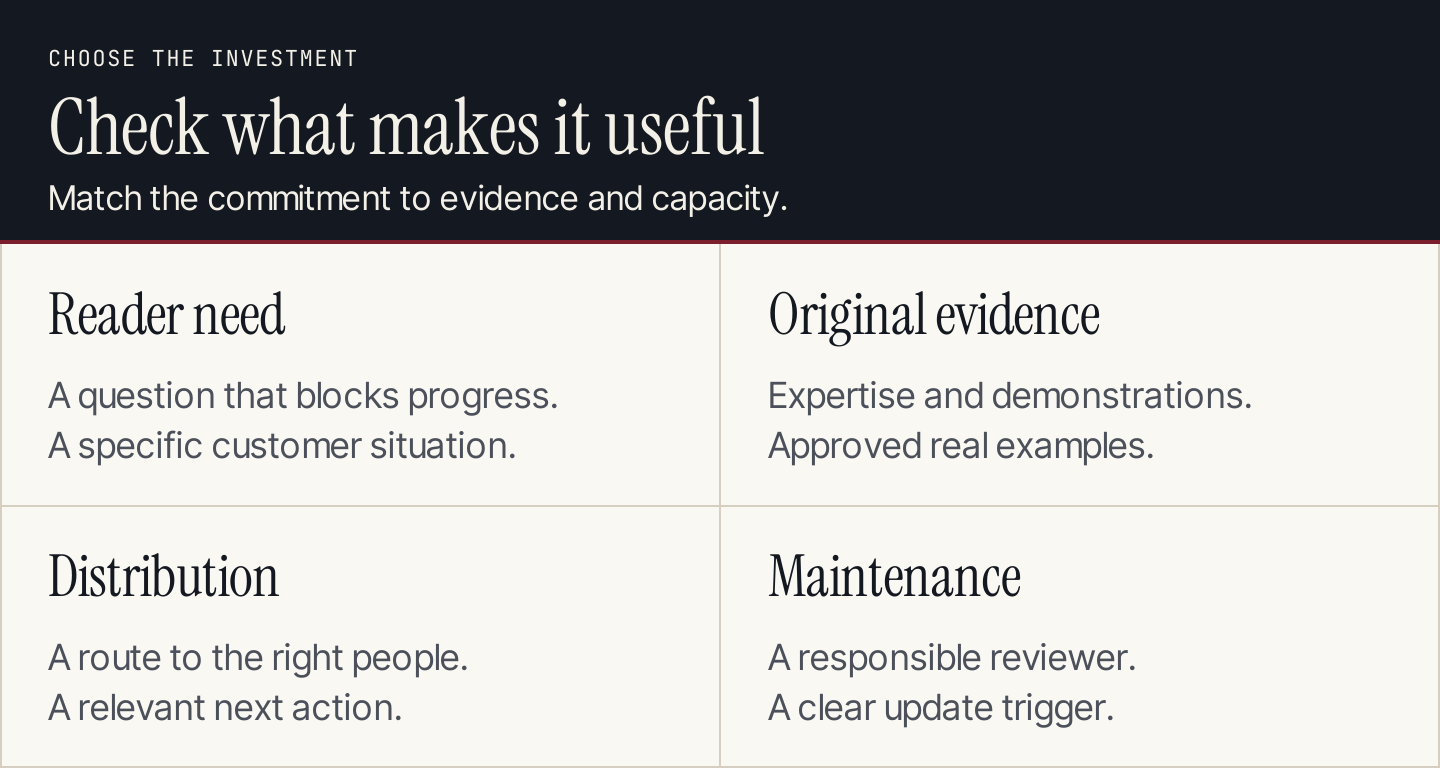
Choose the next investment based on the missing help, rather than a target article count.
Two real examples of content worth inspecting
Webflow University: teach a task with context
Webflow University offers practical learning resources, including an introductory course and a site migration video. These serve different levels of readiness.

Webflow separates a specific migration task from introductory learning. Source: Webflow University.
The transferable choice is to identify what a learner is trying to do, then provide the right starting point and demonstration. A small team can make one precise walkthrough before committing to an academy. Check whether a reader can complete the task, rather than assume a course page proves adoption or retention.
Stripe: give business questions their own resource
Stripe's guides distinguish product resources, Atlas guides, industry updates, and platform topics. The visible subjects include payment collection, startup finance teams, and payments pricing for SaaS platforms.
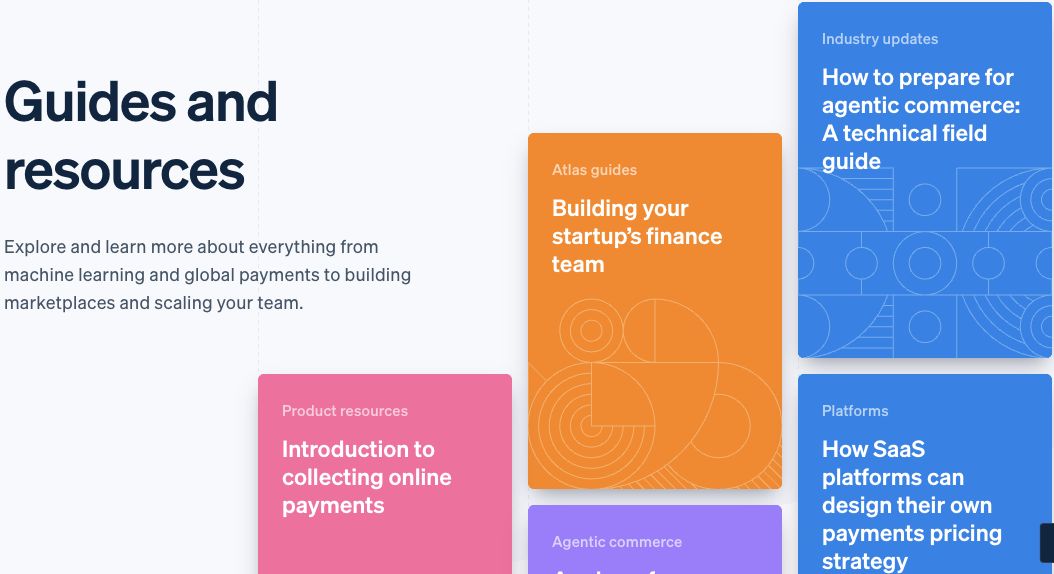
Stripe gives different business questions distinct resource categories. Source: Stripe.
Adapt the organization, rather than borrow the topics indiscriminately. Map the questions your own customers ask to resources your team can support. A useful guide can help someone evaluate a business problem before they are ready for product setup instructions.
Copy this content investment worksheet
| Field | What to record |
|---|---|
| Customer situation | Who needs help, with which decision or task? |
| Existing answer | What do we already have, and what is missing? |
| Original contribution | Demonstration, evidence, criteria, or a clearer explanation |
| Source owner | Who can verify facts and maintain the answer? |
| Main format | Guide, video, comparison, tool, customer story, or lesson |
| Distribution route | Where the intended audience will encounter it |
| Appropriate next action | What a ready reader can do next |
| Review requirements | Claims, permissions, product access, screenshots, and release version |
| Outcome measure | Defined event, population, denominator, and time window |
| Next decision | Continue, improve, investigate, or stop; evidence needed |
Use the real examples above as exercises. For a Webflow-style walkthrough, the customer task might be completing a migration plan. For a Stripe-style resource, it might be understanding payment collection choices. Your proposed measure is a planning choice, not a statement about either company's private results.
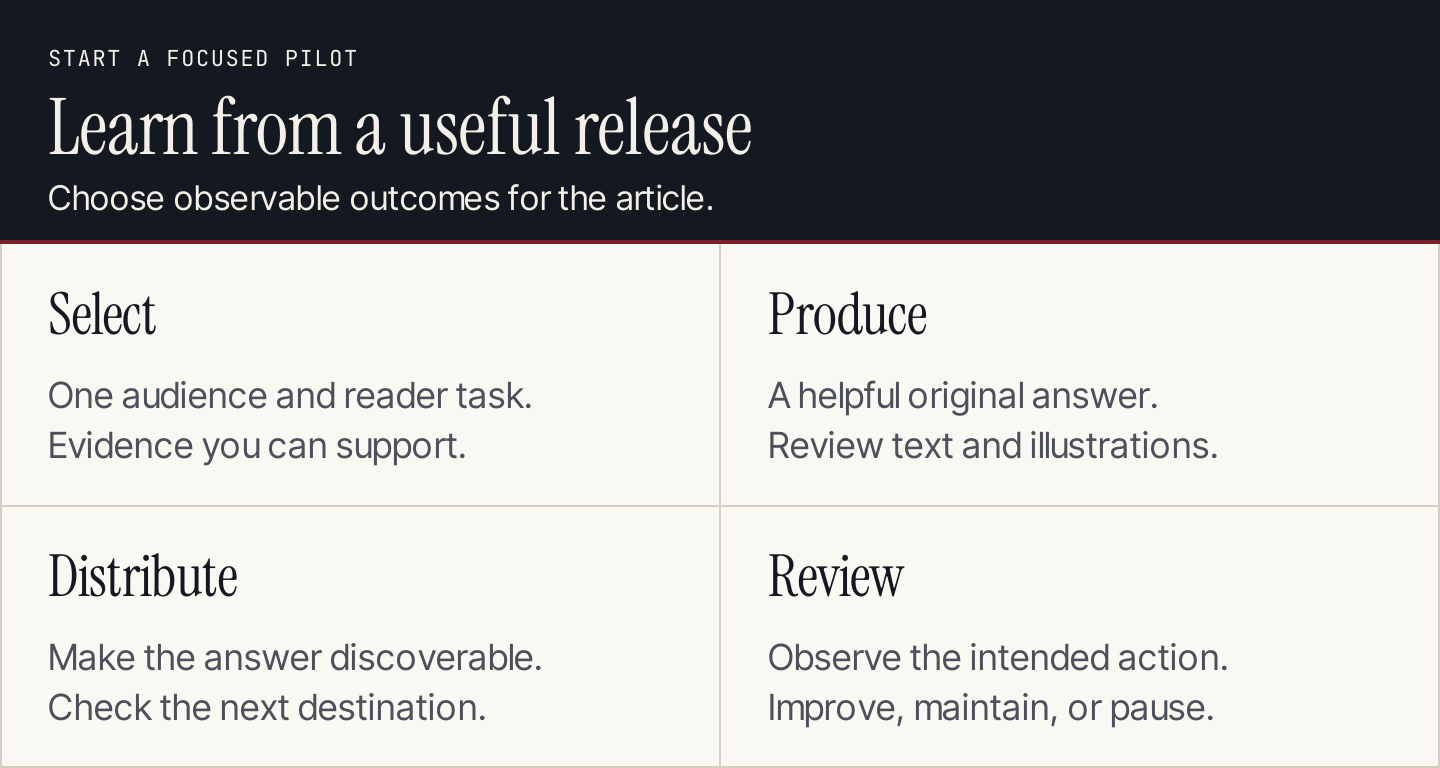
Start with a supported question and a defined task before expanding production.
Where to start this month
Choose one important customer question, inspect your current answer, and identify the missing explanation or proof. Assign an owner and a distribution route. Expand after you understand how people use the resource.
Rankauto supports the blog part of that program: it finds customer searches, researches and writes articles in your brand voice, checks facts, and adds images and SEO fields. Articles save as drafts by default. Your team supplies private evidence and approvals, and owns the wider video, email, and social program.
FAQs
Does AI make business blogs unnecessary?
No. A blog can explain your work and support discovery, evaluation, or use. The useful question is whether a specific page supplies an answer your audience needs and your business can support.
Should we publish more because AI makes drafting faster?
Increase output when research, review, maintenance, and distribution can support it. Draft speed alone isn't evidence that the additional assignments deserve the investment.
Should every article be written for AI citations?
Give each article a clear customer job. AI visibility may be part of discovery, but a citation doesn't guarantee a click, a qualified inquiry, or a sale. Keep those measures separate.