How to Choose SEO Keywords for Your Business
Choose SEO keywords that fit your customers and business. Compare intent, demand, competition, and existing pages with a practical worksheet.

Choose SEO keywords by checking who is searching, what they need, whether your business can help, and which page should answer them. Search volume comes after those decisions. A popular phrase is a poor target when the people using it need something you don't sell.
For a small business, the useful output is a short list of page decisions: improve this service page, write this guide, build this tool, or leave this topic alone. A spreadsheet containing thousands of phrases is only an input.
Rankauto publishes this guide. The real examples below come from public documentation reviewed on October 11, 2026; the proposed keyword choices are our editorial analysis.
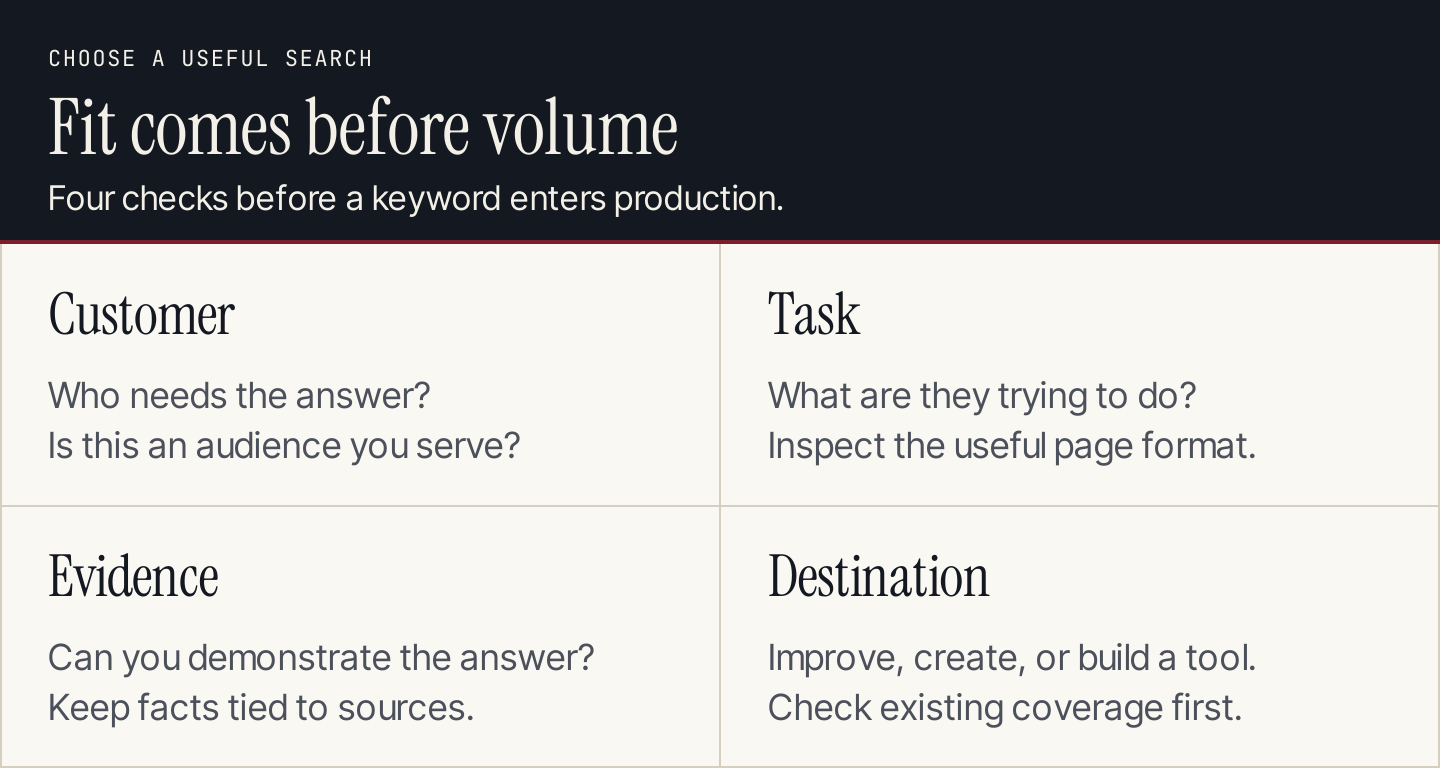
Choose a phrase your business can answer credibly, then decide where that answer belongs.
Start with a customer job, not a broad industry word
Write down what customers need to accomplish. Use the words in inquiries, sales conversations, support messages, and product reviews. Remove names, contact details, and other private information before putting those notes into a research tool.
A broad category such as “forms” could include tax forms, job applications, medical paperwork, and online surveys. It doesn't tell a form-building company which customer to reach or what to publish.
The real form builder Tally explains conditional logic through actions such as showing or hiding questions and directing respondents to different pages. Those capabilities give us a more useful starting point: people trying to make a form change based on an answer.
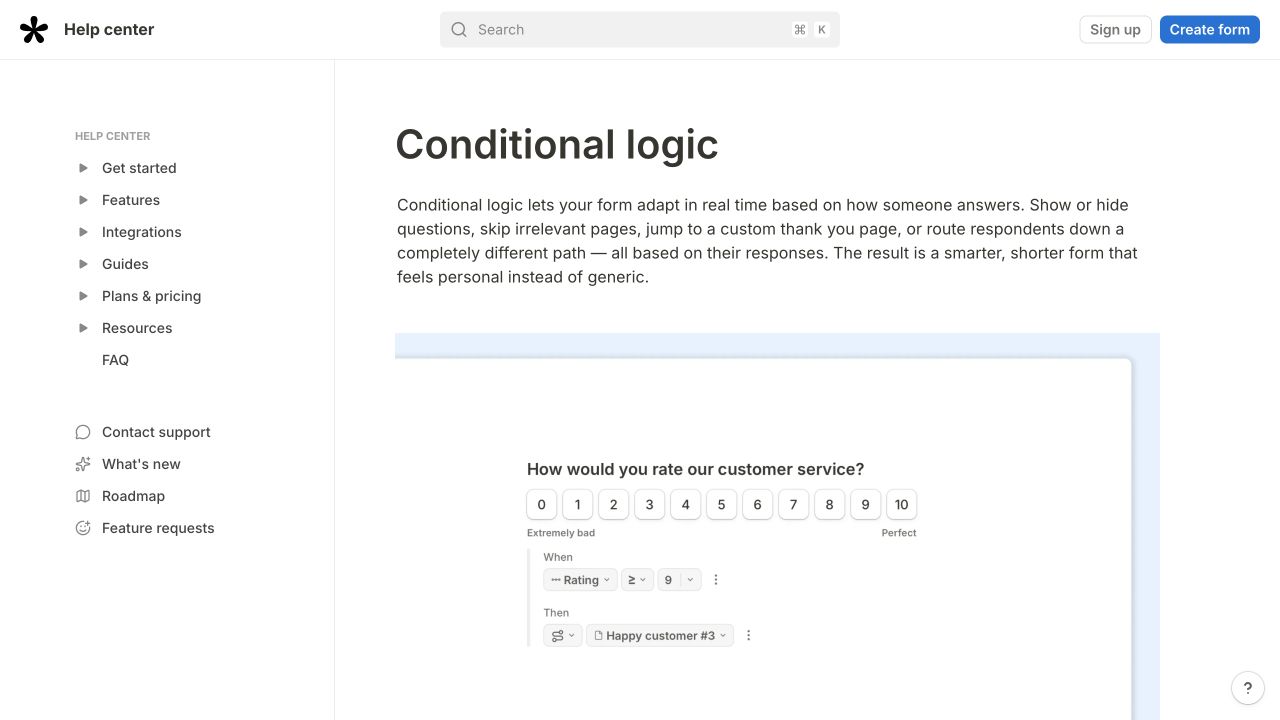
Tally connects a feature to a recognizable form-building task. Source: Tally.
Turn that task into candidate phrases. For example:
| Customer job | Candidate search | First page idea |
|---|---|---|
| Ask a follow-up only when needed | form with conditional questions | Feature explanation with a working example |
| Learn the underlying concept | what is conditional logic in forms | Introductory guide |
| Fix a specific setup problem | Tally show hidden question | Help article |
| Evaluate different products | conditional logic form builders | Comparison guide |
These are proposed research inputs. They aren't measured search queries from Tally's account, and they aren't evidence of its keyword strategy.
Notice the distinction between the concept, the product, and the troubleshooting task. They share vocabulary but don't necessarily deserve the same page. This is why collecting synonyms is only the beginning of keyword research.
For your business, complete this sentence before collecting terms: “We help this customer do this task, using this product or service.” If you can't name the customer or the task, narrow the topic.
1. Collect ideas from several kinds of evidence
Build your first list from sources that answer different questions.
Customer conversations reveal language and recurring obstacles. They can justify a useful support page even when a keyword tool reports little demand.
Your existing pages show what you already cover. Read the page itself, rather than relying on its title. A page may already answer a phrase that nobody assigned to it in the original brief.
Search Console reveals searches for which your site has appeared. Its Performance report includes query and page dimensions. Use these to inspect the relationship between a search and its current destination. Impressions are appearances of your site, not the total number of searches in the market.
Keyword research tools estimate broader demand and suggest related phrases. Keep the country, collection date, and provider attached to every export. A global estimate doesn't describe the US market, and numbers from different providers aren't automatically comparable.
Competitor pages reveal how other publishers address a task. Their presence is a reason to investigate, not proof that your business should cover it. A competitor may have a different audience, product, or commercial model.
If the site is new, start with customer language, product evidence, and live search results. You don't need an established ranking history to decide that an important customer question deserves an answer.
2. Separate relevant candidates from attractive distractions
Give each phrase a short explanation of its business fit. Ask:
- Does the person searching belong to an audience we serve?
- Can our offer help with the actual task?
- Can we show useful evidence, examples, or experience?
- Is there a reasonable next step after the answer?
A conditional-form tutorial might lead naturally to trying a form builder. An article about filing a tax return would reach a different task, even though both involve forms. Rejecting the latter doesn't require a keyword difficulty score.
Keep helpful educational topics when they support the customer journey. Every article doesn't need an immediate purchase pitch. A beginner learning a concept can become a suitable customer later. The connection should still be explainable without stretching the product's role.
An agency should make this check with the client before writing. “This keyword has demand” is a weaker justification than “This query comes from people evaluating the service you actually provide.”
3. Inspect what the search results are asking you to build
Search a promising phrase in your target market and open the relevant results. Record the date and the search context. Results can vary by location, device, and user, so treat the observation as a sample.
Look beyond labels such as informational or commercial. Identify the concrete task and the recurring page format:
| What you observe | Likely publishing decision |
|---|---|
| Product and category pages | Improve a buying destination |
| Step-by-step instructions | Create or update a practical guide |
| Calculators or interactive utilities | Consider a tool with an explanation |
| Local providers and maps | Improve the relevant service and location pages |
| One brand's login and account pages | Usually reject as an acquisition target for another business |
Don't decide from one result or from an AI-generated summary alone. Open the pages and ask what someone can accomplish there. A guide can rank for a buying phrase when it helps people choose, but that doesn't mean any educational article will fit the same search.
For the Tally example, “how to show a question based on an answer” calls for setup instructions. Its show-or-hide section illustrates the operation. A general explanation of form automation would leave that reader with another task to research.
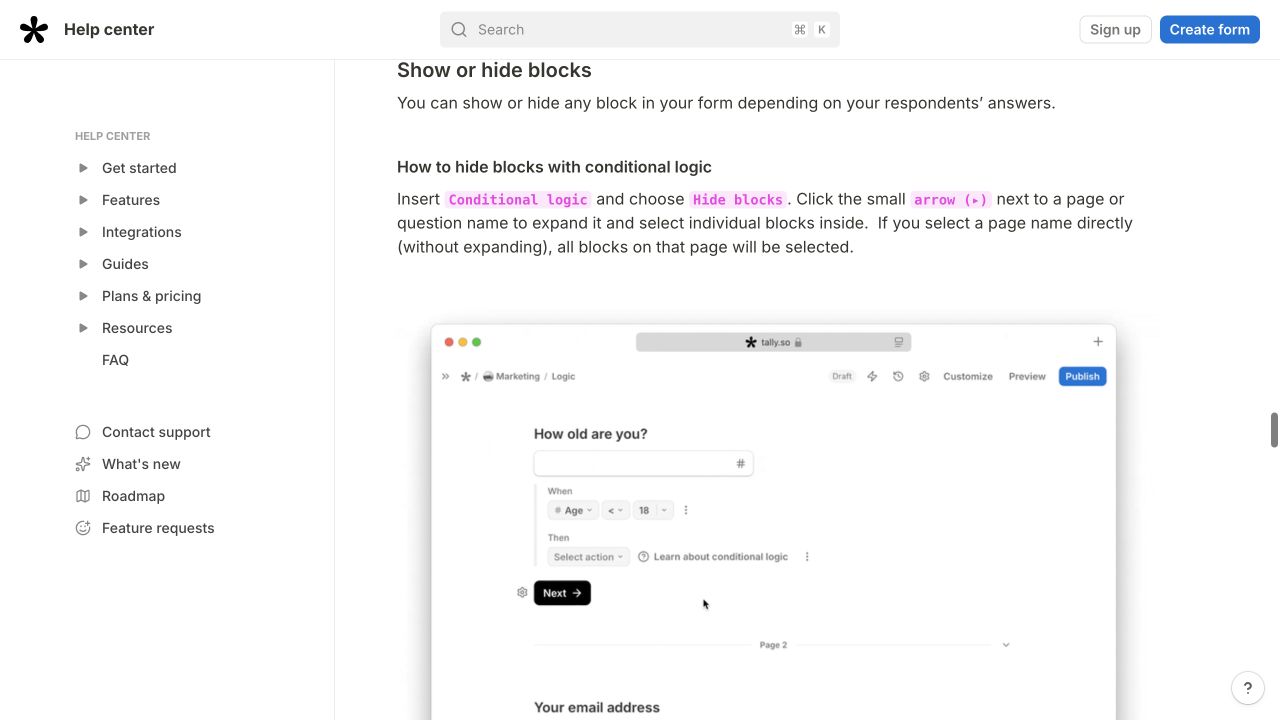
A setup query needs an operation the reader can follow. Source: Tally.
4. Read search volume without turning it into a traffic promise
Search volume is an estimate of demand for a phrase under a provider's settings. It isn't a prediction of your visits, leads, or revenue.
Google describes Keyword Planner's average monthly searches as including a keyword and its close variants, under the selected period, location, and Search Network settings. This matters when you compare phrases that sound almost identical. Adding their displayed estimates may count overlapping demand.
Record the number as supplied. If the tool returns a range, retain the range. If no value is available, write “not available,” rather than asking an AI model to guess it.
Also distinguish three measurements:
| Measurement | What it helps you understand | What it doesn't establish |
|---|---|---|
| Estimated search volume | Relative market demand | How much traffic your page will receive |
| Search Console impressions | Your site's appearances in reported searches | All searches for the topic |
| Visits and conversions | What happened on your site | That a keyword estimate caused the result |
Low-volume phrases can still deserve coverage. A technical prerequisite, a buyer's objection, or a local service question may matter to a small group of suitable customers. Publish it because you can explain its value, not because low volume is secretly a ranking advantage.
5. Check competition and the evidence you can contribute
Keyword difficulty helps sort a large list. It doesn't make the final decision for you. Providers use their own methods, so don't treat one tool's score as equivalent to another's.
Google Ads “Competition” has a different meaning: Google defines it in relation to advertisers. A low advertising-competition label doesn't prove that organic rankings will be easy.
For each shortlisted topic, inspect the relevant pages and write down what you can add:
- A genuine product demonstration with the prerequisite visible.
- A comparison that explains when each option fits.
- An original worksheet that makes the decision easier.
- First-hand observations with a clear method.
- Current primary evidence that corrects an outdated claim.
“We can write more words” isn't a strong reason to compete. If the leading pages already answer the task well and you have nothing useful to contribute, put the topic behind opportunities where your experience matters.
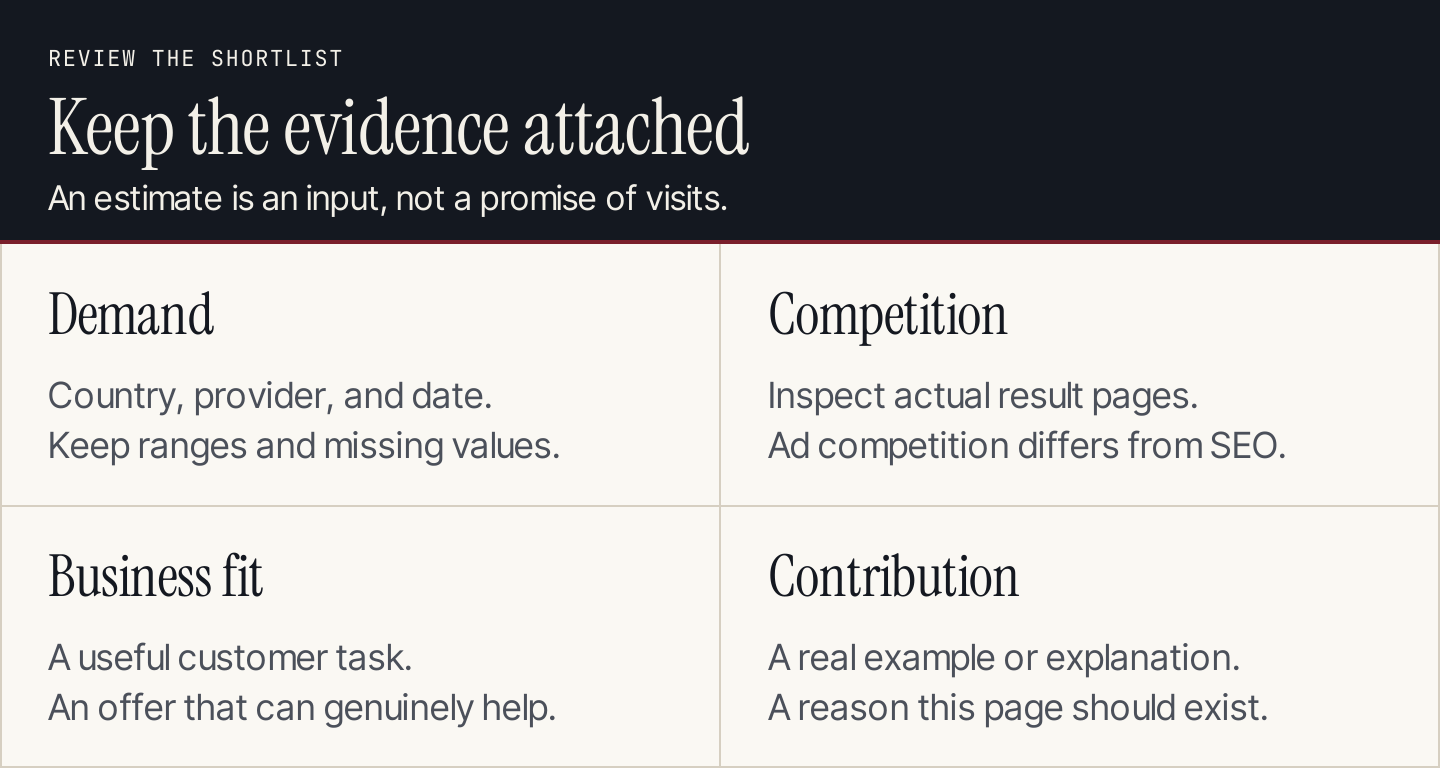
Demand and difficulty help compare candidates. Product fit and useful evidence determine whether to pursue them.
6. Choose an existing page or a new destination
Before approving a new article, search your content inventory for the same task. An existing page may need a clearer section rather than a competing URL.
Use this decision sequence:
- Same task, suitable existing page: improve that page.
- Same task, several similar pages: review overlap before drafting another.
- Different task, sufficient evidence: plan a distinct destination.
- Task requires interaction: assess whether a tool would serve it better.
- Weak business fit: reject or defer the idea.
Don't make separate articles for every wording variation. “Form conditional questions” and “conditional questions in forms” might belong together. Confirm the task and result patterns before grouping them. Equally, don't put every form-related query into a single oversized guide.
Our keyword mapping guide explains how to give the selected group a page owner and destination. Selection answers “Should we pursue this?” Mapping answers “Where will the answer live?”
A keyword-selection worksheet you can copy
Use one row per candidate topic. Keep related phrases together after you have checked that they share a task.
| Field | What to enter |
|---|---|
| Customer and task | A plain description of who needs what |
| Representative query | The clearest phrase for the group |
| Demand evidence | Provider, country, date, volume or customer evidence |
| Result pattern | The page formats and tasks observed |
| Business fit | How your offer relates to the task |
| Useful contribution | The example, evidence, or utility you can supply |
| Existing destination | The URL, or “none found” after checking |
| Decision and owner | Update, create, tool, defer, or reject; responsible person |
For a small team, prioritize the candidates with a clear audience, a credible contribution, and a manageable publishing task. Keep the others in the backlog with the reason for deferring them. A reasoned shortlist is easier to review than an unexplained numerical score.
For an agency, add the client's approval and the relevant service constraint. This prevents an appealing topic from reaching production before someone confirms that the business can deliver what the article suggests.
Use AI to organize the evidence you already have
AI can help classify a messy export. It shouldn't supply missing search volumes or declare the current search intent without inspected results.
Try this prompt with a sanitized list:
Review these keyword candidates against the approved business facts below.
For each candidate, suggest the customer task and a possible page type.
Classify business fit as clear, uncertain, or unsuitable, with a reason.
Use only the supplied evidence. Preserve missing metrics as missing.
Don't invent volume, difficulty, customer demand, or live search results.
Flag related candidates that may need one shared destination.
Return a review table, not final publishing decisions.

Approved business facts: [paste approved facts]
Keyword evidence: [paste sanitized rows and source settings]
Existing pages: [paste URLs and short verified summaries]
Review the uncertain cases yourself. Open any proposed existing destination. An AI model can assign a convincing label to an incorrect assumption, so keep the supporting evidence beside the decision.
Turn the shortlist into useful articles
Each approved article needs a reader task, sources, an example, and a next step. Use the content gap guide when you need to determine what the current page is missing, and the SEO blog-writing guide to develop the brief.
If research and production are slowing the team down, Rankauto includes keyword research and writes blog articles in your brand voice, with images and SEO fields. Articles save as drafts by default so you can review the topic and claims before publication.
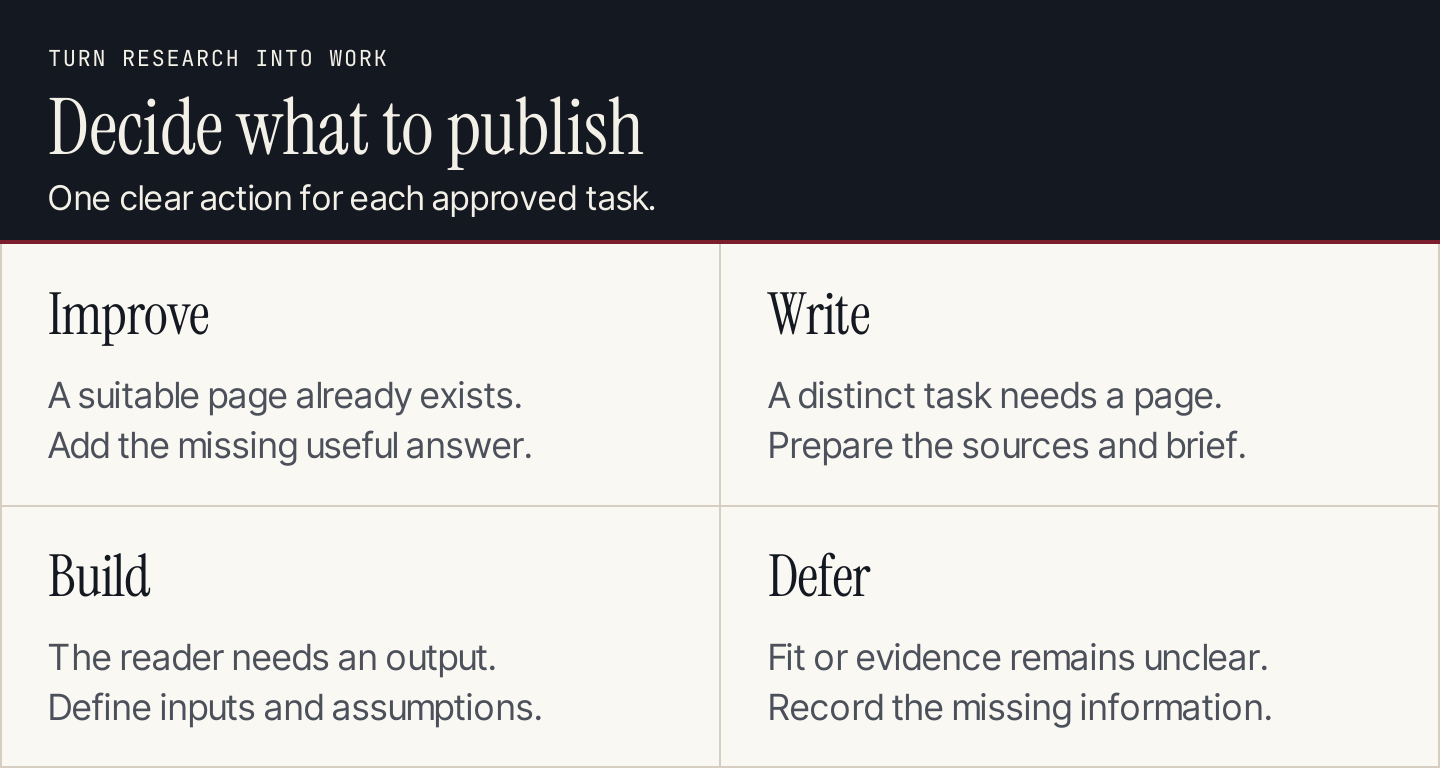
A keyword is ready for production when the task, destination, evidence, and owner are clear.
Common questions about choosing SEO keywords
How many keywords should one article target?
Use a coherent group that serves one reader task. Choose a representative phrase to guide the brief, then include related language where it helps explain the answer. A fixed keyword count is less useful than checking whether the article fulfills its promise.
Should a new business target only low-volume keywords?
No. Start with relevant topics you can answer credibly and compete for realistically. Some will have modest measured demand; others may justify a longer-term investment. Neither low volume nor a low difficulty score guarantees a result.
Do questions people ask AI replace SEO keywords?
They are another research input. A customer's conversational question can reveal a useful comparison or constraint. Treat it as a candidate task, then verify the facts and decide how your page can answer it. Don't relabel an SEO volume estimate as an AI prompt volume.
What should I do when two candidates seem equally useful?
Choose the one with stronger business fit, better available evidence, and a clearer destination. If both deserve coverage, sequence them so the first page helps the reader use the second. Keep the decision in the worksheet so the team can revisit it when new evidence arrives.