Small Business SEO: A Sustainable Plan and Learning Roadmap

Small business SEO is the work of making your website easier to discover, understand, and use when people search for something your business can genuinely help with. A sustainable plan connects that work to customer questions, important pages, and a workload the team can maintain.
Start with one offer, a few important pages, and one measurable customer action. Fix access problems, make those pages useful, then build content around unanswered questions. Expand the plan when you have evidence and capacity.
You can learn the basic workflow in a day. Becoming proficient requires applying it, reviewing results, and learning when a problem needs specialist help. The plan below separates those stages.
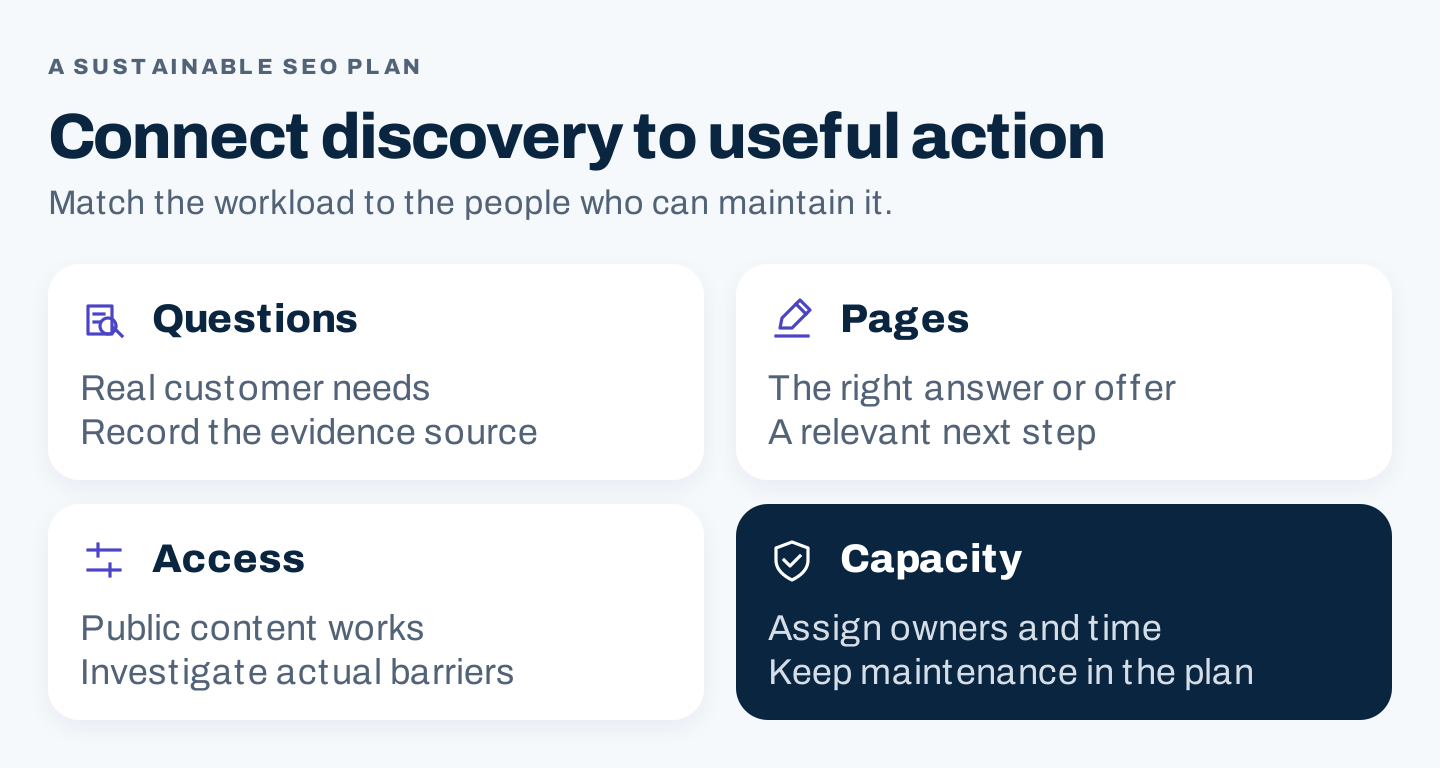
Original planning framework. Start with a useful customer journey and the people who will maintain it.
1. Choose an outcome and protect the essentials
Choose a customer action that matters to the business: a qualified inquiry, a booking, a product purchase, or an appropriate visit to a store. Define what makes the action useful. An inquiry outside your service area may add workload without creating an opportunity.
Search visibility can support that action by helping people find relevant answers and offers. It does not guarantee that the offer is competitive or that the visitor will buy.
Understand the work you are taking on
| Area | Practical owner-level question | Initial output |
|---|---|---|
| Customer and query research | What does a customer need to know before acting? | A short question backlog with evidence |
| Content and on-page work | Which page should answer that question? | A clear, useful page or improvement brief |
| Technical access | Can readers and search engines reach the important content? | A recorded issue and responsible person |
| Reputation and relationships | Which genuine sources or partners can help people find us? | Accurate profiles and relevant outreach opportunities |
| Local discovery, if applicable | Do we qualify, and are our details accurate? | Eligibility check and maintained business information |
| Measurement | Is the work reaching relevant people and supporting action? | A baseline and review record |
SEO marketing is part of a broader marketing plan. It can complement email, social activity, partnerships, and paid campaigns. Organic placement does not carry an ad click charge, but the research, writing, technical work, and maintenance still cost time or money.
If a launch needs immediate attention, do not assume a newly published SEO page will supply it on schedule. Assess the channels you can activate and measure now while maintaining the search foundation. Avoid funding a large content calendar before you can explain the offer and customer journey.
Keep ownership clear
The business should know who controls its domain, hosting, CMS, search properties, and business listings. When an agency helps, record the access granted and the handoff process. Give people the permissions needed for their role and retain an accountable business owner.
Google’s Search Essentials describe useful content, descriptive language, and crawlable links as foundational practices. Meeting its requirements does not guarantee crawling, indexing, or display. Google Search Essentials.
2. Learn from three real Brooklyn Bicycle Co. pages
Brooklyn Bicycle Co.’s public website demonstrates three different customer jobs: choosing, evaluating a specific product, and understanding where to obtain local support. This is a page-structure example, not a claim about the company’s headcount or SEO results.
A buying guide organizes customer questions
The public bike buying guide groups six question areas: intended use, riding terrain, frame style, fit, accessories, and local shop support. Those questions help organize a decision before the visitor chooses a model. Brooklyn Bicycle Co. buying guide.
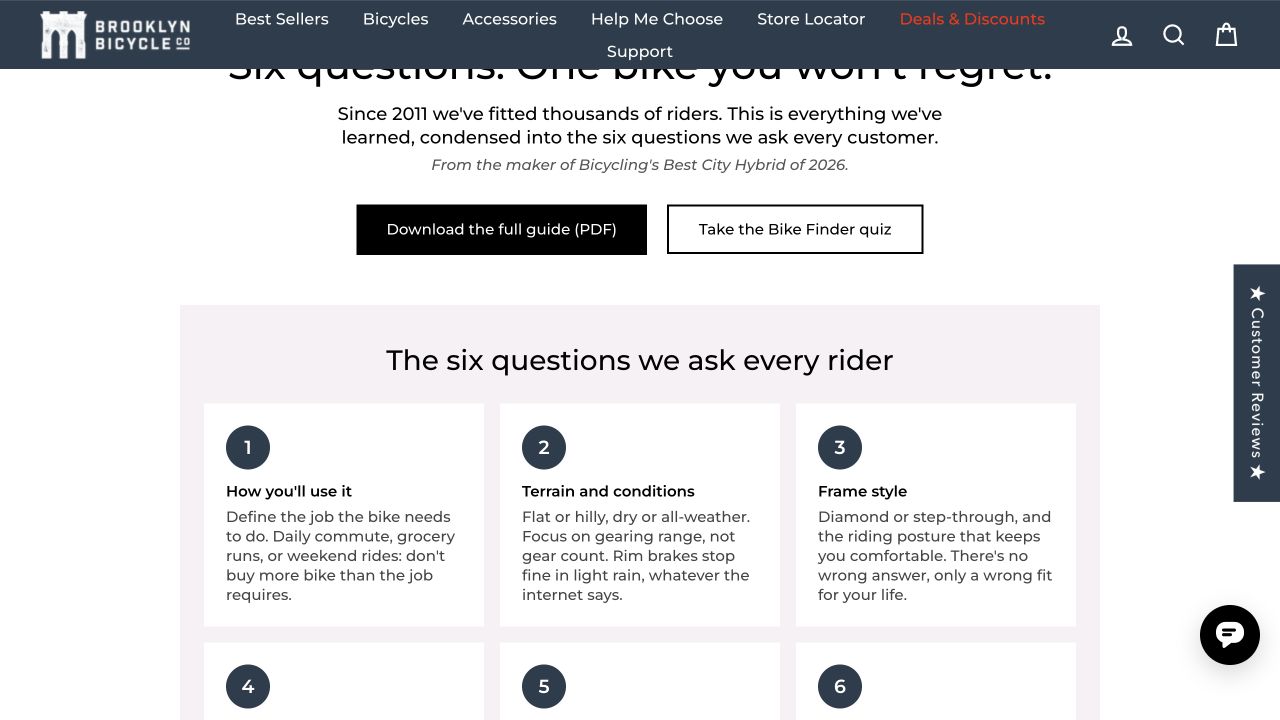
Authentic desktop capture, October 8, 2026. Customer questions provide an editorial structure; the screenshot does not establish traffic, rankings, or conversion lift.
For your own business, look for the equivalent questions in sales conversations, support requests, and public discussions. Record where each question came from. A phrase suggested by an AI model is a hypothesis until you find relevant evidence.
A product page owns a specific decision
The Roebling page presents a named model, product imagery, size choices, and a purchase route. The page’s job differs from a general buying guide. Roebling product page.
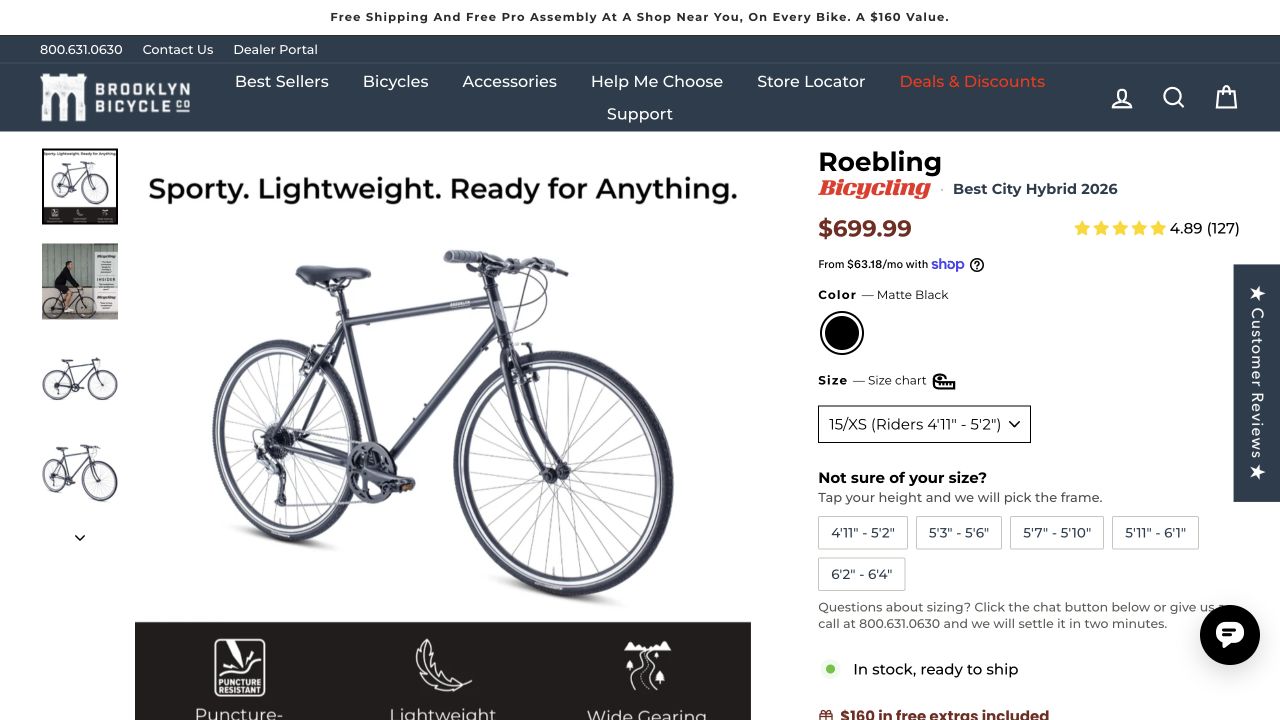
Authentic desktop capture. A specific offer needs its own details and next action. No purchase or product trial was performed.
For a service business, the equivalent might be a page explaining one service, the people it serves, the location or delivery conditions, and how to request help. A blog post can educate readers and link to that page; it should not hide the offer’s basic details.
The locator preserves an important distinction
The dealer locator distinguishes stocking dealers, which carry models, from assembly partners, which assemble bikes without stocking the models. That distinction matters to a visitor seeking a test ride or a place to collect a bike. Brooklyn Bicycle Co. store locator.
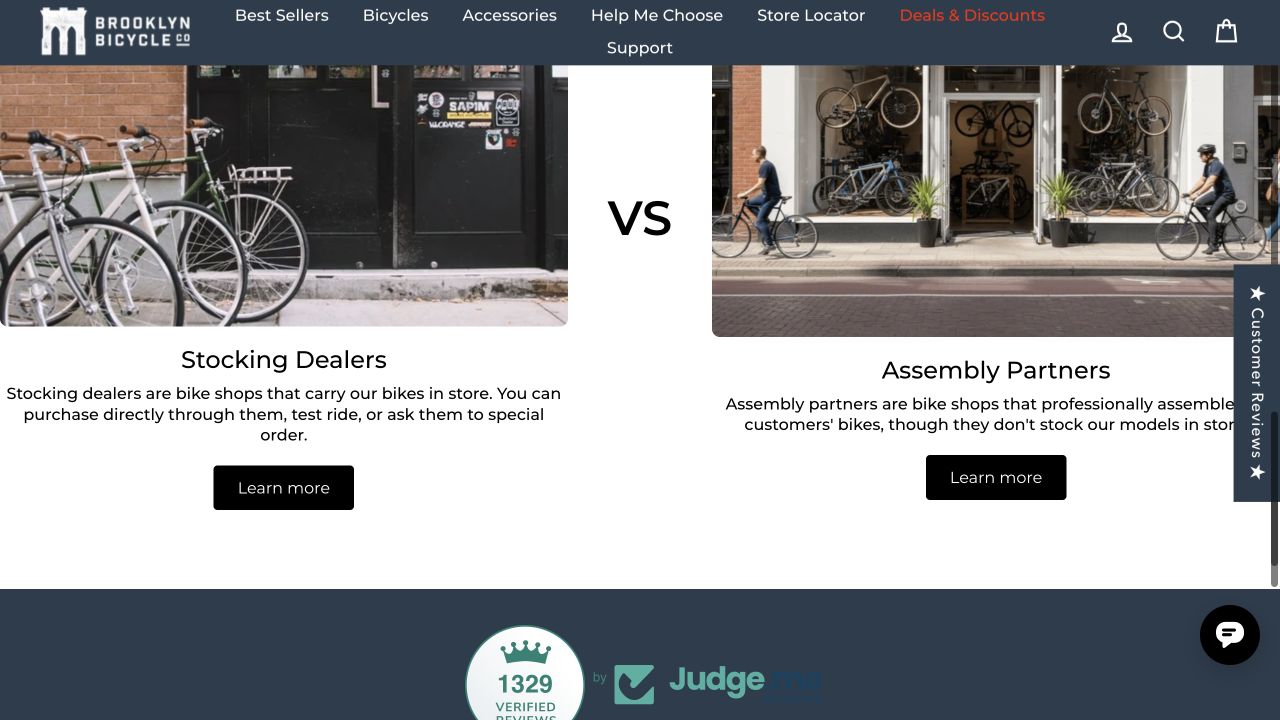
Authentic desktop capture. The public descriptions explain different partner roles. No location was entered, inventory checked, or shop contacted.
Transfer the pattern by mapping the question to the correct destination:
| Observed customer job | Real page pattern | Application to your own site |
|---|---|---|
| Understand how to choose | Buying guide organized by questions | Publish a useful explanation of the decision |
| Evaluate a named offer | Product page with specific details | Maintain a complete product or service page |
| Find the appropriate local route | Locator with partner distinctions | Explain actual locations, availability routes, or service areas |
Do not assume that writing a similar guide will reproduce another business’s results. The useful evidence is the page’s role and the conditions it communicates.
3. Separate local eligibility from website content
Local SEO and website SEO overlap, but creating a Business Profile is not an option for every business.
Google’s eligibility guidelines generally require in-person customer contact and explicitly list online-only businesses as ineligible. Check the complete rules and relevant exceptions before creating or changing a profile. Google Business Profile eligibility.
For an eligible business, maintain an accurate real-world name, address or service area, categories, contact route, and operating details. The profile should represent the actual business. Guidelines for representing your business.
A partner locator on your website does not authorize you to claim each partner’s listing. In the bicycle example, stocking and assembly relationships are distinct; listing ownership and eligibility require their own checks.
Build location content only when it serves a real question
A useful location page explains the actual offer in that location, relevant conditions, and how to proceed. Replacing a city name across dozens of otherwise identical pages is unlikely to answer a meaningful local question.
If you serve customers remotely, make the delivery conditions clear on the website. You can still write useful content and improve search access without inventing a storefront or claiming an ineligible profile.
4. Build a 90-day plan with a maintenance budget
The following is an original planning example. Ninety days is a work sequence, not a promise that rankings or revenue will improve within that period.
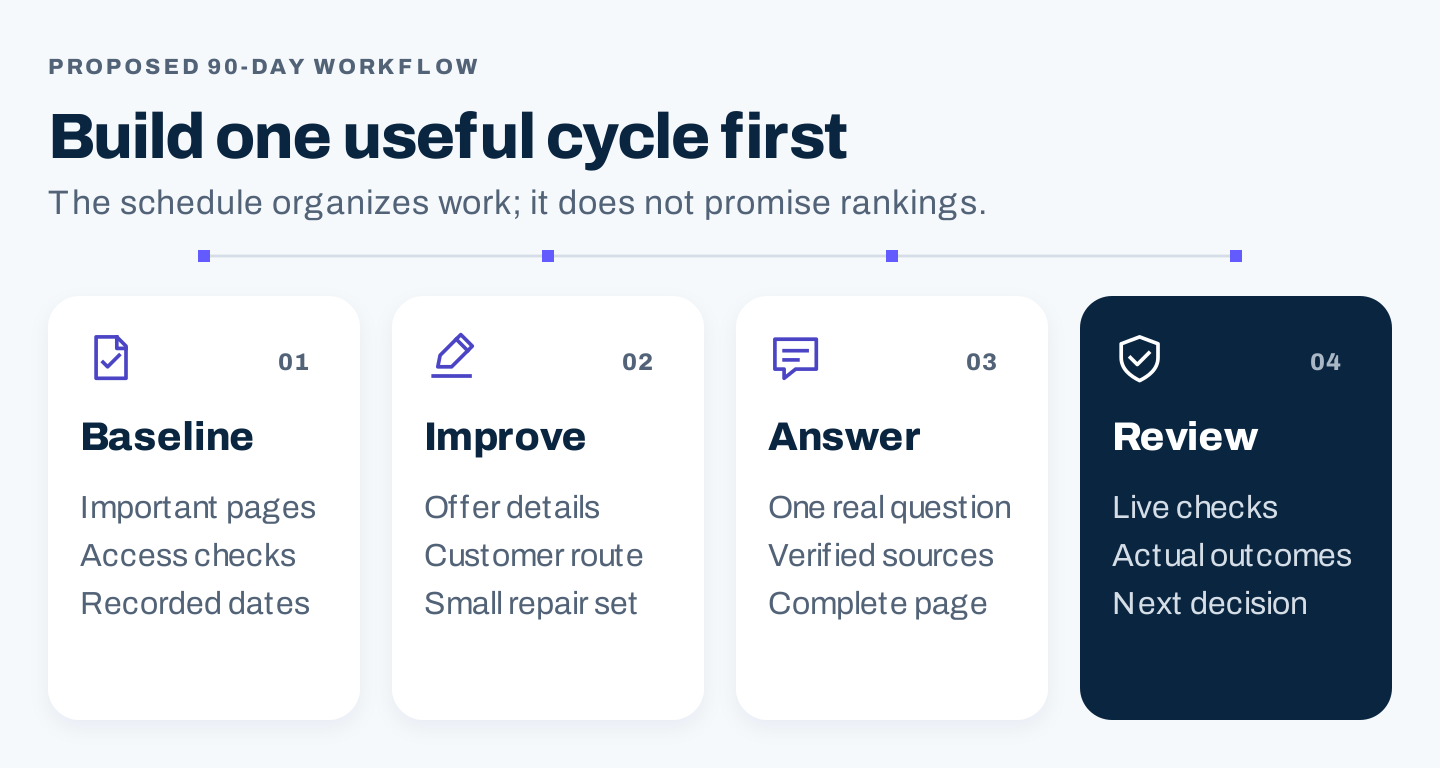
Original workflow. Advance when the previous output is usable; unresolved access problems may change the schedule.
Days 1–30: establish the baseline and repair the customer journey
List the pages that support your chosen offer. Check whether a visitor can understand the offer, reach the relevant details, and complete the intended action on a phone.
Set up or confirm authorized Search Console access. Record a baseline for the relevant pages and US audience where appropriate. Its performance report can separate pages, queries, countries, devices, and dates. Search Console performance report.
Investigate important pages that are missing or inaccessible before commissioning a large set of new articles. URL Inspection distinguishes indexed information from a live eligibility test. Treat a successful live test as one diagnostic result, not a guarantee of indexing. Google URL Inspection.
Choose a small repair batch with an owner and a verification step. Fix a broken contact route, unclear service condition, or missing useful link when the evidence identifies it. Escalate server, indexing, or migration issues you cannot diagnose confidently.
Days 31–60: answer one important unresolved question
Collect customer questions and check which existing page should own each answer. Group different wording when it expresses the same need. Keep different tasks separate even when they share vocabulary.
Prioritize a question you can answer accurately, that fits your offer, and that lacks a suitable existing answer. Use keyword tools as additional demand evidence, with the market and date recorded. A low estimate does not automatically make a genuine customer question unimportant; a high estimate does not make an unrelated subject worth writing about.
Create a brief containing the reader’s starting point, answer, necessary proof, conditions, visual, and next action. Gather original experience where available and verify factual claims. Publish one complete useful page before multiplying the workflow.
Days 61–90: check, share, and improve
Verify the live page, its links, and its phone presentation. Share it through appropriate existing channels where it answers a relevant question. A relationship with a genuine partner or community is a better starting point than a list of unrelated sites to solicit links from.
Review whether the page is reaching appropriate queries and whether readers can find the next step. Check actual inquiries or actions through the measurement systems you have configured. Do not treat all search clicks as qualified customers.
Record what changed and why. A comparison with a similar previous period is useful, but seasonal demand and other marketing activity can also affect results.
Allocate capacity before allocating more articles
Here is an illustrative eight-hour monthly workload, not an SEO performance prescription:
| Work | Minutes |
|---|---|
| Review evidence and choose the next action | 90 |
| Improve an existing important page | 120 |
| Research and draft one bounded answer | 150 |
| Check the live page and measurement | 60 |
| Maintain details and handle unexpected work | 60 |
| Total | 480 |
Eight hours may not be enough to complete a new article with extensive original research or technical changes. Reduce the scope or carry the work across months. Reserve maintenance time rather than promising a publication count the team cannot sustain.
5. Use one day to learn the workflow
One day can introduce the decisions and produce a useful first brief. It cannot make a beginner an expert in crawling, analytics, copywriting, structured data, and local policy.
This proposed four-hour learning block ends with reviewable outputs:
| Time | Learn and apply | Output |
|---|---|---|
| 45 minutes | Understand discovery, useful content, and the offer | A plain-language description of the site’s purpose |
| 60 minutes | Examine one customer journey and important page | A short list of specific gaps |
| 45 minutes | Inspect authorized search-performance information | A baseline with dates and settings, or an access request |
| 60 minutes | Turn one customer question into a content brief | A focused answer plan with sources |
| 30 minutes | Review the work and identify dependencies | An owner, next action, and specialist questions |
The total is 240 minutes. If access is missing, record the dependency; do not invent a baseline to finish the exercise.
Learn a topic when the work needs it. A permalink migration calls for a different level of technical care from editing a paragraph. A local listing issue requires current platform policy. Ask a specialist when the consequence of a mistake exceeds the team’s ability to diagnose and reverse it.
Keep AI assistance optional
AI can help organize a supplied question backlog or critique a brief. It cannot establish customer demand, verify a product condition, or supply authentic experience by generating an answer.
For this workflow, the question sheet is enough. There is no requirement to run a prompt. If the team uses AI, provide approved evidence, check its suggestions, and retain the person responsible for the decision.
6. Maintain a small decision record
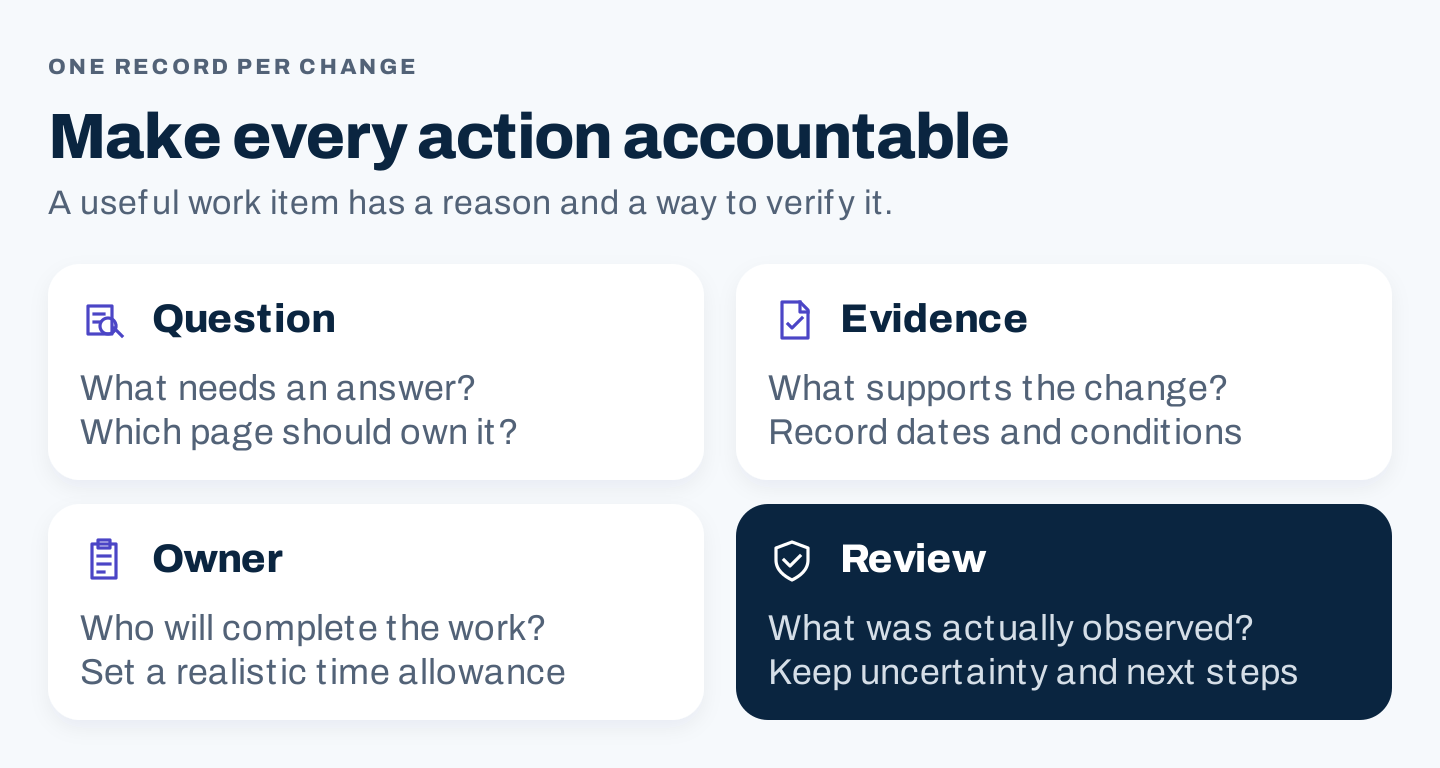
Original maintenance record. Every work item needs a reason, a destination, an owner, and a way to verify it.
Use one record for each planned change:
Customer question and evidence source:
Offer or business outcome it supports:
Existing page or proposed destination:
Specific gap:
Proposed action and necessary sources:
Technical or local-policy dependency:
Owner and time allowance:
Baseline, period, and settings:
Live-page verification:
Result observed, including uncertainty:
Next review date or change trigger:
At review, ask whether the work is still relevant, whether its facts are current, and whether the next action is clear. Retain helpful pages even when search traffic is modest if they serve a real support or sales function.
Pause expansion when the offer, measurement, or maintenance owner is unresolved. Increase the content workload when the team can repeatedly produce useful answers and maintain them. That gives small business SEO a practical foundation: customer questions connected to credible pages and accountable work.