Startup SEO: Build a Search Foundation Before Scaling

A startup does not need a large publishing calendar to begin SEO. It needs a clear offer, useful destinations for real customer questions, and enough capacity to keep those destinations accurate.
Startup SEO improves how people discover and understand a young business through search. The work includes selecting relevant opportunities, building accessible pages, using the product team’s knowledge, and measuring what happens after discovery.
The hard decision is where to invest first. Publishing can feel productive while the product page remains unclear, the first-use instructions are missing, or nobody owns factual review.
This guide uses Tally’s public homepage, first-form help, and pricing page to illustrate three useful page jobs. It also gives you an opportunity record, a capacity budget, and a practical review sequence. These examples do not reconstruct Tally’s growth strategy or imply that it is currently an early-stage company.
1. Check whether SEO fits your current stage
Before researching a hundred keywords, answer four questions:
- Can you describe who the product or service helps and what they can actually do with it?
- Do those people already search for the problem, task, or category in recognizable language?
- Can your team provide useful evidence beyond a summary of existing articles?
- Can you maintain the pages while the offer changes?
If the audience or offer is still changing every week, start with customer conversations and a small set of accurate pages. You can improve discoverability while learning; you do not have to commit to a large content program.
If demand exists but your product does not yet solve the task, do not publish a page that suggests it does. Record the opportunity for later. Search visitors arriving at an unsupported promise are not useful product validation.
Also consider timing. If the business needs immediate acquisition, SEO should be one part of a wider plan. A publication date is not a ranking deadline, and an early-stage company may need faster feedback from outreach, partnerships, paid tests, or existing communities.
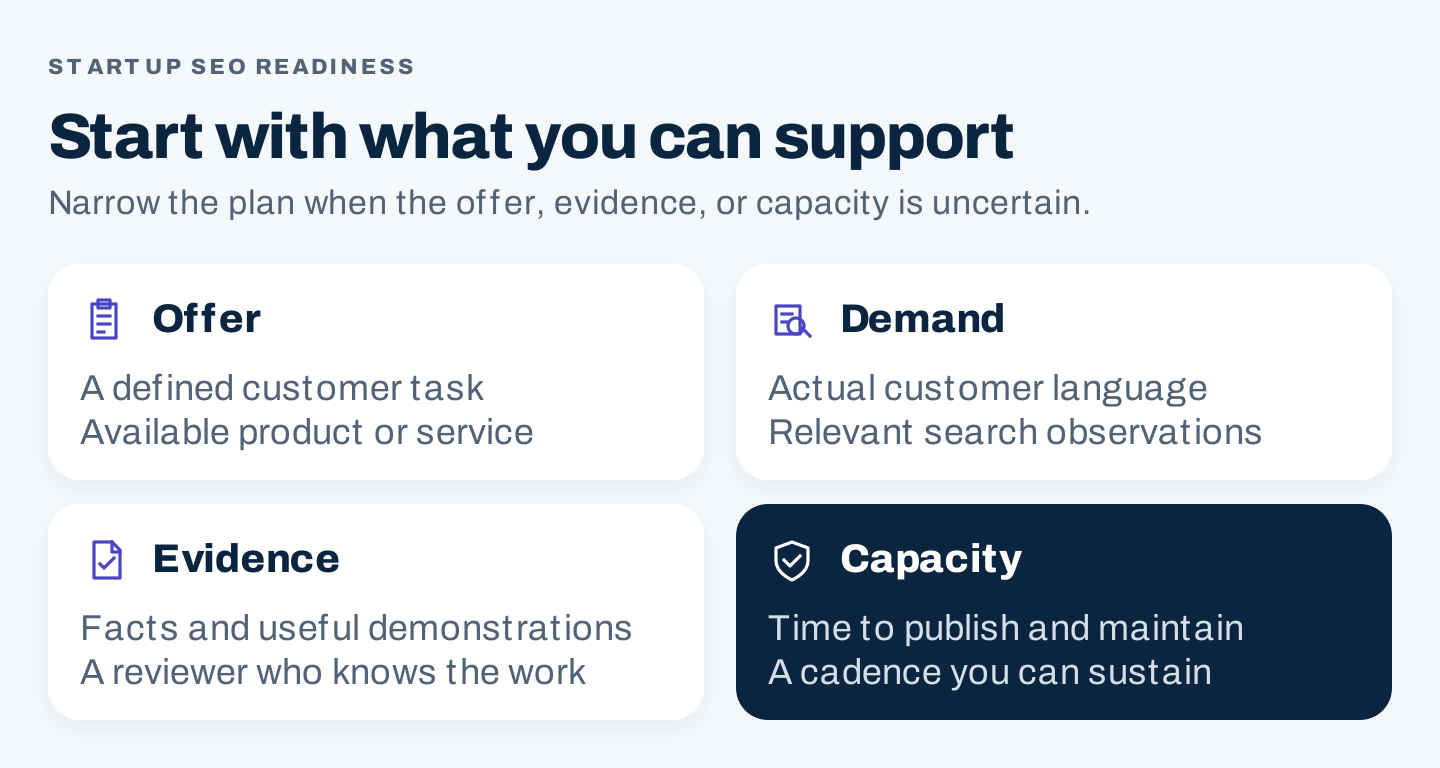
Begin when you can support the offer, the reader’s task, and ongoing maintenance. Narrow the initial scope when one of those is uncertain.
2. Plan three useful destinations before a large blog
Tally’s public pages illustrate a foundation a software startup can plan. The lesson is the separation of page purposes, not its popularity claims or an inferred source of growth.
Explain the product and first action
The Tally homepage identifies a form-building product and offers a clear starting action. Navigation also provides a route to pricing.
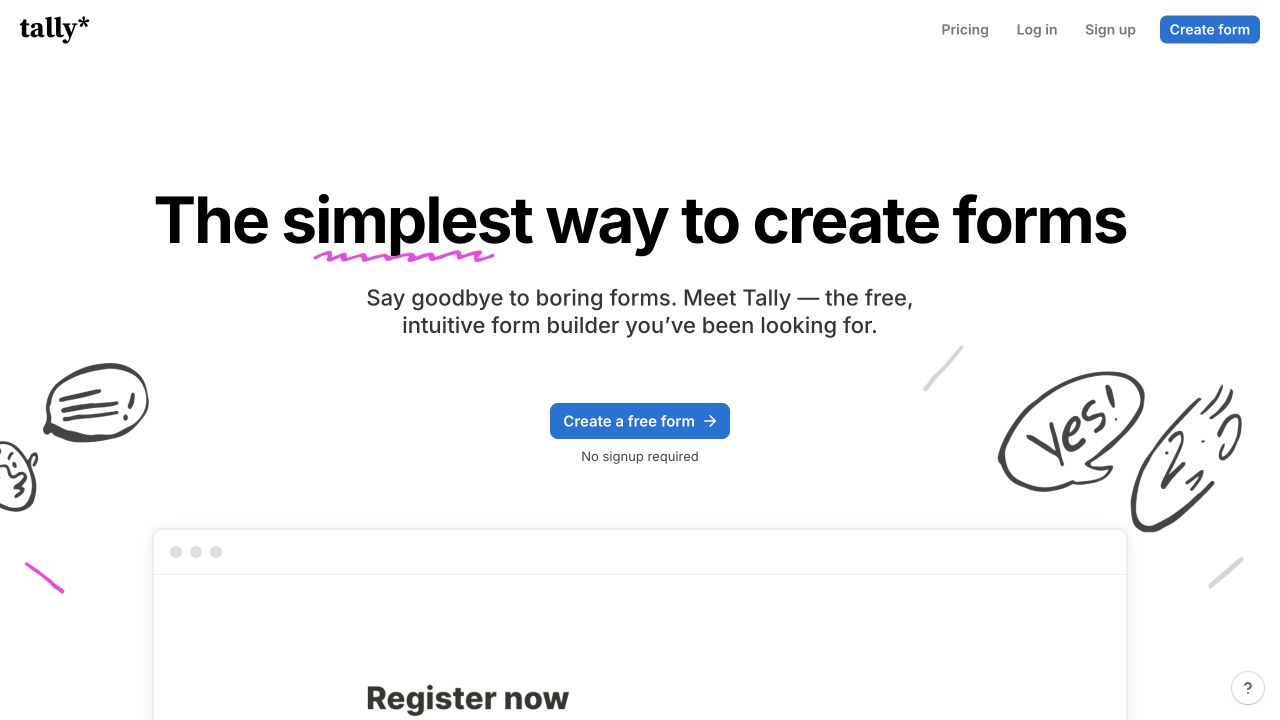
The homepage establishes the product category and how to begin. This public page observation is not evidence of Tally’s traffic or conversion rate.
Your product page should explain the task, intended user, relevant capabilities, and limitations. A visitor who arrives directly should not need to read five blog posts to work out what you sell.
For a service startup, the equivalent may be a focused service page that explains the work, scope, and inquiry process. For a local business, actual location or coverage information may be part of that foundation.
Help someone complete the first task
Tally’s Create a form help page explains question blocks, settings, and subsequent steps. It is a task resource rather than another version of the homepage.
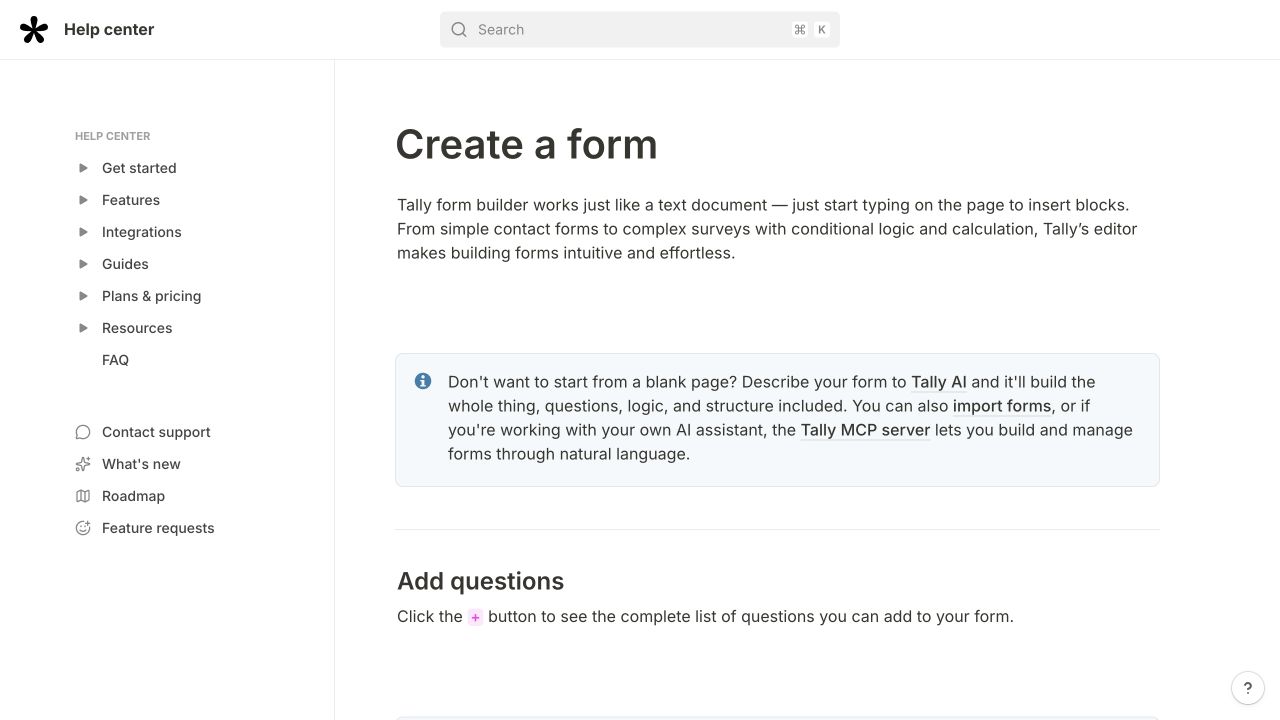
Task-specific help answers “How do I begin?” separately from “What is this product?” The guide was inspected; a form was not built for this article.
Your first-use resource should follow an observed workflow in your own product or service. Show the starting conditions, the steps, the expected result, and what to do when something differs.
If you have not tested the task, say that the resource is a proposal or documentation summary. Do not fabricate an interface screenshot or claim that an integration worked.
Support a realistic purchase decision
The Tally pricing page distinguishes free-use conditions and paid plans, with a billing choice and plan-specific detail.
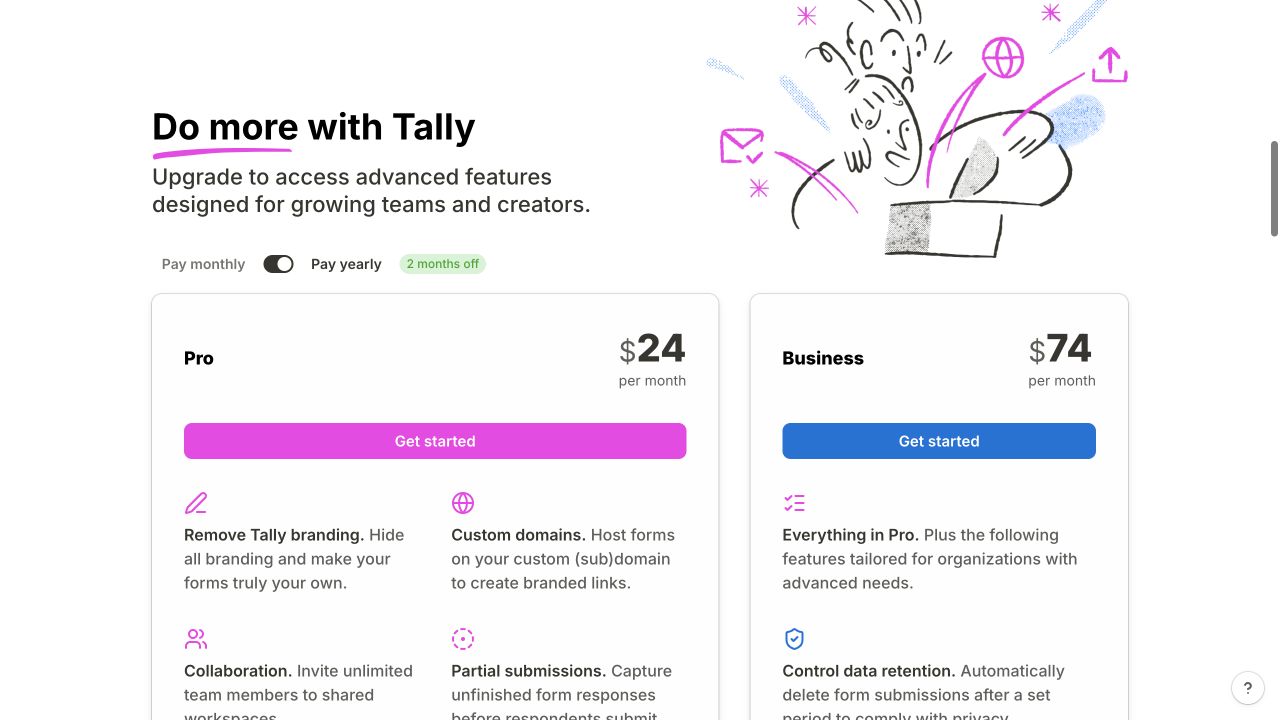
The commercial destination supplies plan context. Prices visible in the screenshot are dated; use the live page for current terms.
Your equivalent could be pricing, service scope, availability, or a qualified sales route. The right format depends on the offer. Explain important exclusions instead of making the reader discover them after an inquiry.
Connect the three destinations. A task guide can lead to the relevant product explanation; a product page can lead to help and commercial details. The links should solve a reader’s next question rather than distribute keywords arbitrarily.
3. Choose opportunities with a decision record
Begin with customer language. Review approved, anonymized sales questions, support issues, product interviews, and common onboarding misunderstandings. Keep actual statements separate from your interpretation of them.
Then research search phrases for the same tasks. Record market, date, estimated volume, and tool source. Difficulty scores are comparative estimates from a particular provider, not a guarantee that a new site can or cannot rank.
Read the current results for a candidate query. What kind of destination answers it: a tool, tutorial, category page, comparison, or local provider? Check both the expected format and the business’s ability to supply a useful answer.
Use this record instead of sorting only by volume:
Customer task and supporting evidence:
Candidate phrase / market / research date:
Estimated volume and source, or unmeasured:
Observed result types:
Business relevance and product availability:
Existing destination that could answer it:
Original evidence or demonstration available:
Fact reviewer and maintenance owner:
Production and maintenance effort:
Decision: update / create / defer
For a form-building business, questions about creating a first form, collecting a particular type of response, or choosing a plan could map to different destinations. Those are illustrative tasks, not measured keyword opportunities for Tally.
Check the existing page before creating another. If one maintained help resource can answer several related phrases, expanding it may be clearer than making near-identical articles.
A small niche opportunity can be worthwhile when it fits the product and the team has useful expertise. A high-volume topic can be a poor investment if the audience is unrelated or the answer requires unsupported claims.
4. Build the technical foundation once
Give your developer or technical owner a defined list of essential destinations. Include the homepage, relevant offer pages, first-task resources, and commercial or inquiry route.
For each destination, check that people can open it, understand it, and reach it through useful links. Verify the intended indexing controls, stable URL, clear page title, mobile layout, and essential rendered content.
Google Search Essentials covers core eligibility and practices. Satisfying those requirements does not guarantee crawling, indexing, or visibility. It is a foundation for useful pages, not a growth forecast.
For your verified property, Search Console URL Inspection can help distinguish what Google has indexed from what a live test can access. Keep those observations separate when diagnosing a missing page.
Do not purchase a large tool stack before naming the questions each tool will answer. A small site may begin with the CMS, Search Console, an appropriate analytics setup, and a manageable research workflow. Add paid tools when the work and required capabilities justify them.
Make routine changes traceable. A redesign, URL change, or accidental indexing exclusion can affect several pages at once. Record what changed so the team can distinguish a technical problem from weak demand.
5. Budget for review and maintenance
SEO has no per-click charge for organic listings, but the work is not free. Research, expert review, writing, visuals, publishing, technical fixes, and updates consume money or staff time.
Use a capacity budget before committing to a cadence. The following is an illustrative allocation, not a recommendation that every team has these hours or will receive a particular result.
| Monthly activity | Illustrative hours |
|---|---|
| Customer and search research | 3 |
| Subject-matter review | 2 |
| Drafting and useful visuals | 6 |
| Publishing and journey checks | 3 |
| Maintenance and outcome review | 2 |
| Total | 16 |
If you only have eight hours, reduce scope or cadence; do not assume that each activity can be cut in half without consequences. Updating an important page may be a better first deliverable than writing several new ones.
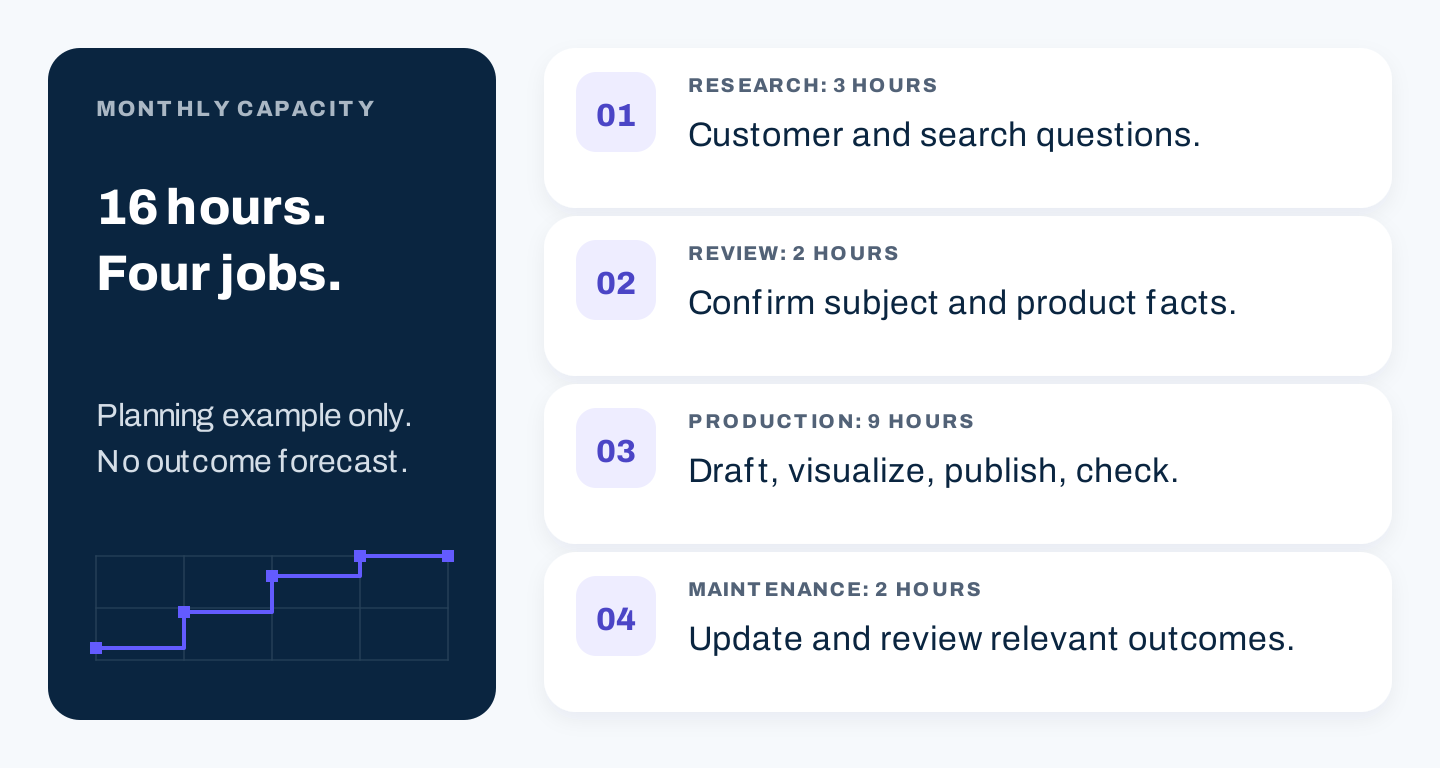
Reserve capacity for evidence and upkeep. The 16-hour allocation is illustrative planning arithmetic, not an industry benchmark.
Name a fact reviewer for every page that discusses the product. Availability, plan limits, and integration instructions can change quickly. Store the source and last confirmation alongside the page brief.
Choose visuals that prove or explain something: an authentic task screenshot, an original process diagram, or a real comparison with clear conditions. Decorative imagery is less useful when the reader needs to understand a specific workflow.
6. Use AI to organize the brief, with sources attached
AI is useful when it helps a small team sort approved evidence and expose missing answers. It should not manufacture search volume, customer quotes, product capabilities, or test results.
Use this optional prompt after you have assembled public material or research approved for sharing:
Help prepare a content brief from the supplied evidence.
Audience and task: [describe]
Current offer and verified limitations: [paste approved facts]
Customer questions with source IDs: [paste anonymized notes]
Search observations with dates: [paste]
Existing pages and their purposes: [list]

Suggest update/create/defer for each task.
Preserve source IDs beside every factual statement.
Separate observations, interpretations and unknowns.
Do not invent volume, quotes, features or test outcomes.
List facts the product reviewer must confirm.
Propose a useful original demonstration and next action.
Do not claim that a page will rank or receive AI citations.
Inspect the output against the original evidence. If a proposed article depends on an unreleased capability, defer it or change the scope. If the model merges distinct customer needs, restore the distinction before drafting.
Use private research only through a workflow your organization permits. A public source packet and anonymized notes are often sufficient for this task.
7. Review demand, action, and capacity separately
Start with a small page family: one offer destination, one important task resource, and the commercial or inquiry route. The three may already exist; improvement is a valid pilot.
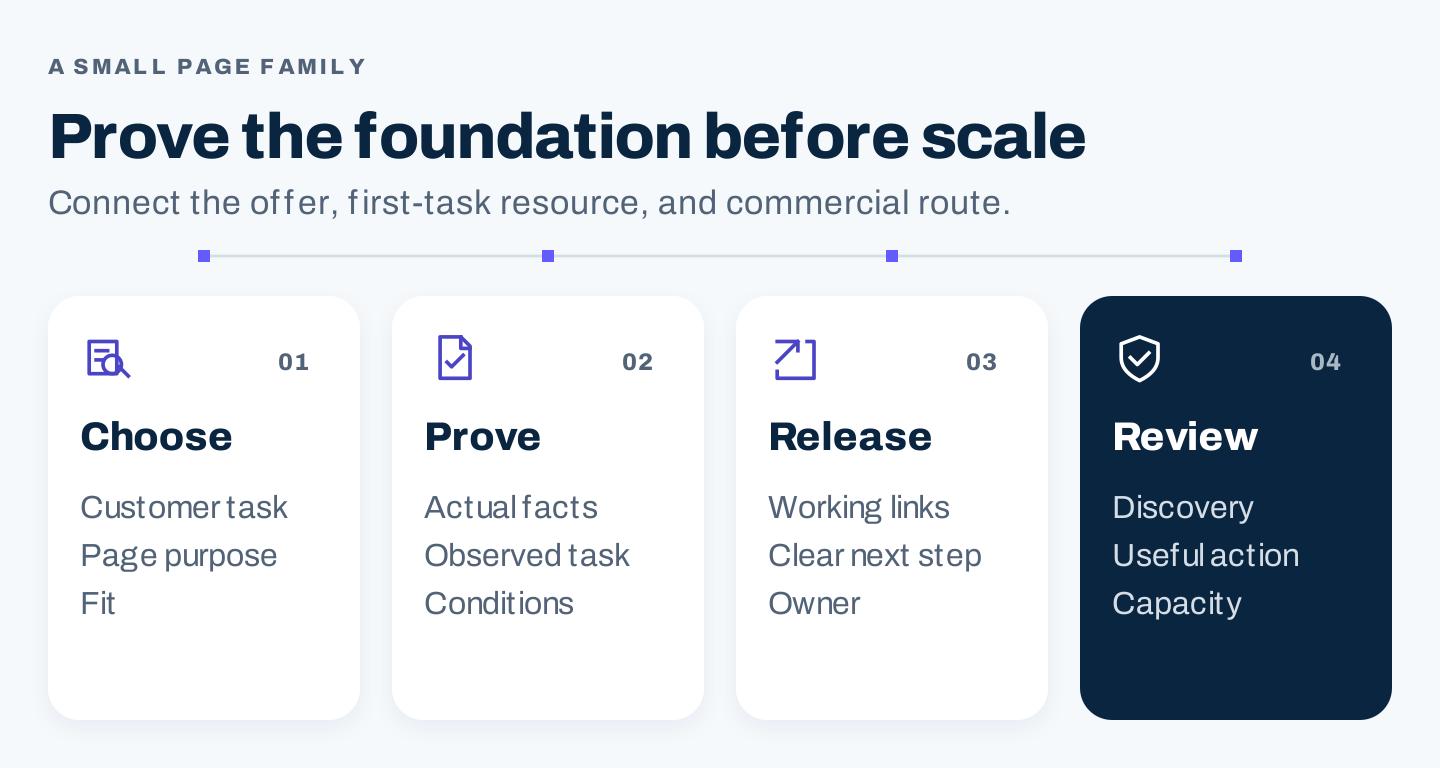
Test whether a small set of connected pages can be accurate, usable, and maintained before increasing the publishing cadence.
Before release, confirm product claims, inspect useful links, and check the narrow-screen experience. If you demonstrate a task, record the product version or environment, starting conditions, steps, and observed result.
After release, use three distinct questions:
Are the pages being discovered for relevant searches? Review impressions, clicks, queries, and landing pages where the data is available. A rise in branded demand and a rise in category discovery describe different things.
Can the visitors do something useful? Review the task-appropriate action: a suitable inquiry, first-use completion, trial activation, or later purchase. Define it with the product or service owner. A signup alone may not demonstrate value.
Can the team keep the content accurate? Review actual hours, review delays, stale claims, and repeated customer confusion. A cadence that regularly bypasses expert review is not sustainable.
Keep a release and review record:
Page family and intended tasks:
Claims confirmed / reviewer / date:
Observed demonstration conditions, if any:
Published changes and technical checks:
Search period and relevant query observations:
Action definition and completed actions, if collected:
Missing data or other campaigns affecting interpretation:
Production and maintenance hours:
Decision: improve / expand / hold
Do not declare failure from a small, short observation period. Equally, do not convert rising impressions into a revenue claim. If the page is indexed but the traffic is unrelated, review the opportunity and wording. If relevant people arrive but do not understand the offer, review the page and action path before producing more articles.
Build relationships around useful work. Share a genuine resource with customers and relevant communities through appropriate channels. Useful references should follow the resource’s value, not a promise of a certain number of backlinks.
Common startup SEO questions
How long will SEO take?
There is no dependable timeline for every startup. Demand, competition, site condition, evidence, and execution vary. Set milestones you control: verified pages, working journeys, and consistent review, then evaluate discovery and business signals over time.
Should we target only low-difficulty keywords?
Use difficulty as one input. Product fit, expected page type, evidence, and maintenance effort can make a low-score topic a poor choice or a harder topic worth developing gradually.
How many articles should we publish?
Choose a cadence your team can research, review, and maintain. Start with the missing customer answer, not a quota. A useful updated destination can be more valuable than several unsupported articles.
Build the foundation around an offer you can explain and a task you can prove. Expand when the process produces accurate pages and useful learning without overwhelming the team.