AI Agents for Marketing: 26 Tasks and a Setup Guide
Explore 26 AI agent assignments for marketing, three documented systems, and a setup guide. Define inputs, output tests, access, and stopping rules.

An AI marketing agent works toward a goal by choosing steps and using available tools. It might inspect several sources, organize the evidence, and return a comparison your team can review. That is a different level of delegation from asking a writing assistant to revise one paragraph.
The useful question is what the agent should finish and how you will check it. “Help with marketing” is broad. “Find unsupported product claims in these accepted campaign drafts and return a source-linked review table” gives the assignment a clear output.
This guide explains the distinction, shows three real documented systems, and offers 26 proposed assignments. The assignments are design examples to adapt to your tools and access, not measured customer case studies.
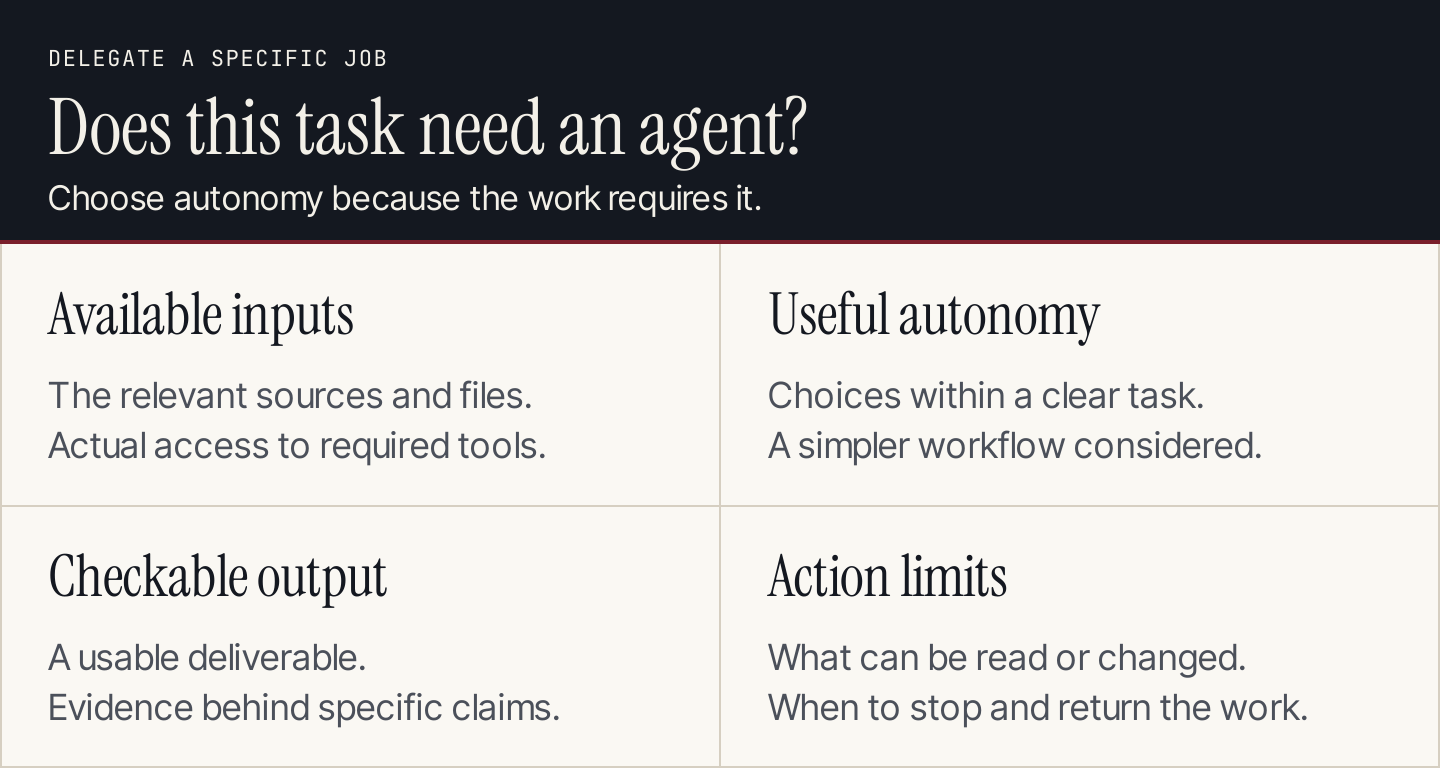
Delegate a bounded job with an output someone can inspect.
Agent, assistant, or workflow?
| Approach | Who chooses the next step? | Useful marketing task |
|---|---|---|
| Writing assistant | You guide the task through requests | Revise a paragraph using accepted facts |
| Fixed automation | Rules defined in advance | Move an accepted asset into a scheduled queue |
| Workflow with an AI step | Rules define the route; AI handles a specific task | Classify feedback before routing it |
| Agent | The agent chooses steps within the assignment and access | Research a question, compare sources, and produce a reviewable brief |
An agent needs access to the information and tools required by its assignment. Instructions alone don't create a CRM connection, establish publication permission, or make a missing source available.
Anthropic's guide to effective agents distinguishes predefined workflows from agents that direct their own tool use. Its agent diagram includes an environment feedback loop and a stop state. Those are useful design questions: how will the agent observe what happened, and when should it stop?
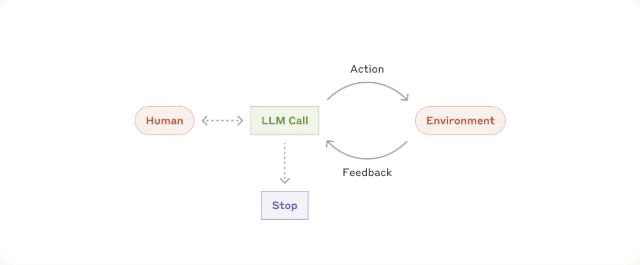
Anthropic shows actions, feedback, and stopping as parts of the agent loop. Source: Anthropic.
Use a simpler workflow when the route is predictable. More autonomy can add review and troubleshooting work without improving the result.
Real systems to examine
Zapier Agents: information and connected actions
Zapier Agents emphasizes business sources and work across connected apps. Its public page illustrates data connections to document, table, and CRM tools.
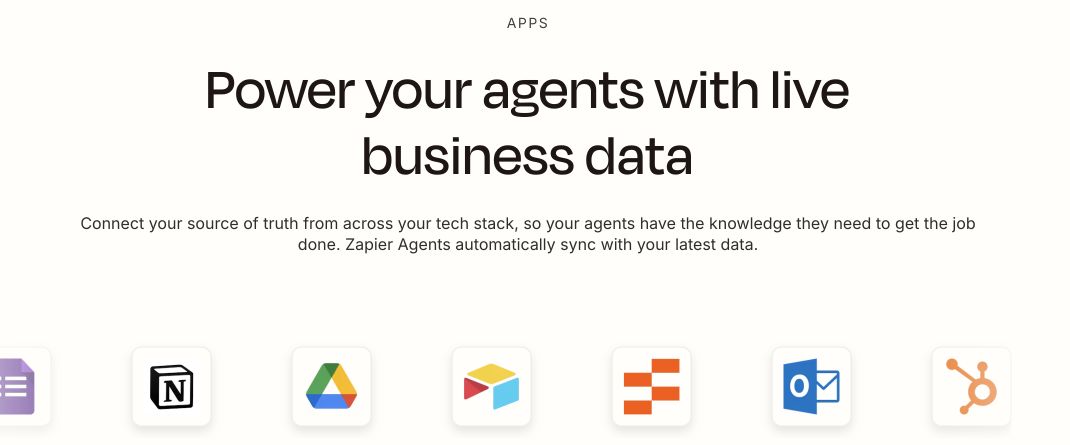
Zapier makes the source of business context visible. Source: Zapier.
Apply the lesson: write down which sources the agent needs and which destination it may change. Being able to read a document is different from being allowed to publish its contents or update a customer record.
HubSpot Agent Hub: shared business context
HubSpot Agent Hub places agent work within CRM context and offers packaged and custom agent options. Its product page makes that shared context part of the offer.
HubSpot presents CRM context as a foundation for agent work. Source: HubSpot.
Apply the lesson: check whether the records accurately describe the customer situation. A connected agent can use stale or incomplete information just as readily as current information. Define which fields are authoritative and how unresolved questions reach an owner.
Anthropic: a loop needs evidence and a stopping rule
The Anthropic diagram above shows why a sequence of tool calls isn't enough. The system needs feedback from the environment to judge progress. For a marketing assignment, that might be a saved file, an inspected source, or a destination response.
Apply the lesson: require evidence of completion and set a stopping condition. “Draft saved” and “campaign sent” are separate outcomes. A task that exhausts its allowed attempts should report the unresolved work, not turn it into a confident completion message.
Twenty-six assignments with acceptance tests
These are proposed agent specifications. A particular tool may need connectors, account access, scripts, or a paid plan to perform them. Begin with one assignment and the inputs you can actually provide.
Content accuracy and maintenance
| # | Assignment | Required inputs | Finished output and acceptance test |
|---|---|---|---|
| 1 | Product-claim review | Accepted draft and current product facts | Claim table with supporting passages; unavailable evidence stays unresolved |
| 2 | Screenshot change review | Current documentation and dated article assets | Affected-image list; reviewer repeats the relevant action before replacement |
| 3 | Broken reader-route investigation | Owned URL list and intended destinations | Link issues grouped by task; a working URL still needs relevance review |
| 4 | Duplicate-topic check | Article inventory and new brief | Overlap candidates with reasons; editor decides whether to merge or create |
| 5 | Terminology consistency review | Approved glossary and content batch | Specific inconsistent phrases and corrections; product meaning is preserved |
| 6 | Source-date review | Article claims, citations, and review rules | Claims needing verification; an old date alone doesn't make a source invalid |
Audience and customer learning
| # | Assignment | Required inputs | Finished output and acceptance test |
|---|---|---|---|
| 7 | Support-question synthesis | Permitted support exports with record references | Recurring question groups; counts reflect the supplied sample and duplicates |
| 8 | Interview evidence map | Accepted transcripts and research questions | Themes with references; quotes and disagreements remain traceable |
| 9 | Objection-to-content mapping | Sales notes and existing resources | Objections paired with useful assets or gaps; no invented buyer motivations |
| 10 | Resource-use feedback review | Survey responses and resource purpose | Usability issues and supporting comments; preferences aren't causal results |
| 11 | Community research brief | Named public communities and audience definition | Relevant questions with sources; community rules checked before participation |
Campaign preparation
| # | Assignment | Required inputs | Finished output and acceptance test |
|---|---|---|---|
| 12 | Campaign brief completeness | Draft brief and required fields | Missing inputs and decisions; unknowns aren't filled with plausible guesses |
| 13 | Launch-content dependency map | Accepted release notes, launch date, asset inventory | Dependencies and owners; product availability confirmed by the product owner |
| 14 | Article-to-email adaptation | Accepted article and email purpose | Draft with claim references; qualifications and intended destination survive |
| 15 | Webinar excerpt selection | Transcript, timestamps, speaker permissions | Excerpt candidates; reviewer checks meaning and publication rights |
| 16 | Creative variant preparation | Approved offer, source copy, and format requirements | Distinct variants; offer terms stay constant and visuals remain readable |
| 17 | Customer-education sequence | Current setup guidance and audience starting point | Draft sequence; prerequisites and completion states match documentation |
Research and comparisons
| # | Assignment | Required inputs | Finished output and acceptance test |
|---|---|---|---|
| 18 | Tool trial brief | Task, users, required output, candidate tools | Comparable trial assignments; no inherited vendor performance claims |
| 19 | Competitor-offer change review | Named pages and an accepted previous record | Dated changes with sources; missing information isn't an absence claim |
| 20 | Public example collection | Reader task and inclusion criteria | Relevant resource examples; visible choices aren't private strategy evidence |
| 21 | Content source reconciliation | Several sources addressing one question | Agreement, differences, and open questions; conflicting definitions remain visible |
Measurement and coordination
| # | Assignment | Required inputs | Finished output and acceptance test |
|---|---|---|---|
| 22 | Report scope audit | Exports, periods, metric definitions | Coverage and denominator issues; incomplete channels aren't treated as zero |
| 23 | Campaign recap preparation | Brief, accepted assets, results, owner notes | Observations and hypotheses separated; headline values recomputed from inputs |
| 24 | Editorial capacity planning | Owner availability, review effort, deadlines | Work plan with dependencies; the team confirms realistic capacity |
| 25 | Review-queue exception digest | Current status records and agreed escalation rules | Specific overdue or blocked work; unchanged items follow the quiet-run rule |
| 26 | Agency client handoff review | Accepted deliverables and client requirements | Missing files, access, or decisions; client approval isn't inferred from silence |
These assignments deliberately finish with reviewable outputs. Several can later feed an approved external action, but the acceptance rule should describe that additional step explicitly. A draft table and a changed production record are different deliverables.
Write a brief the agent can follow
Define the job before selecting the agent. Keep the desired result separate from assumptions about how much autonomy it needs.
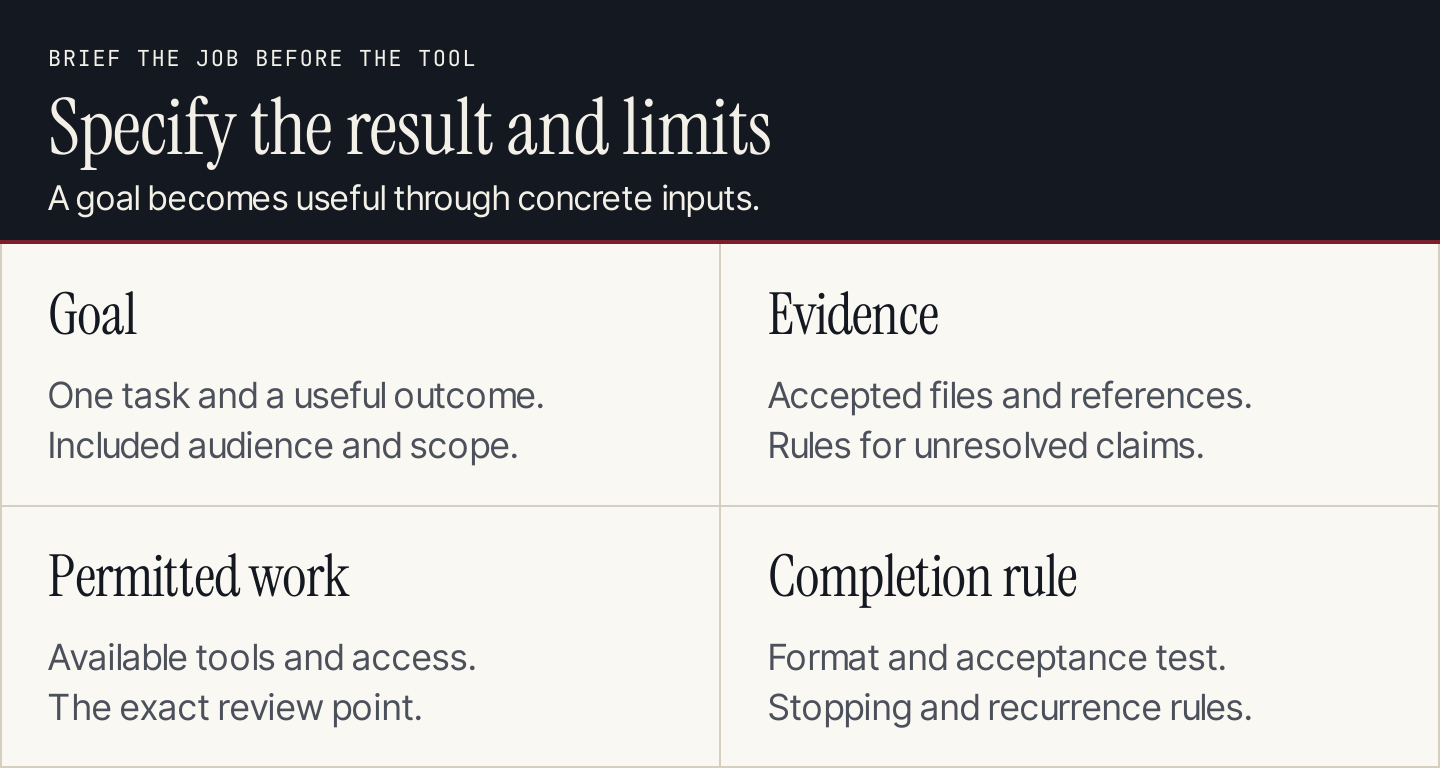
Specify the result, sources, access, and stopping condition.
| Brief field | What to provide |
|---|---|
| Goal | One reader or business task to complete |
| Inputs | Accepted files, source URLs, records, and relevant dates |
| Scope | Included assets, audience, geography, and period |
| Output | File format, fields, and destination |
| Evidence rule | How claims, quotes, and calculations must be supported |
| Tool access | What can be read and what can be changed |
| Review point | Who checks the proposal and the exact release |
| Stop conditions | Missing data, unsupported claim, failed connection, or attempt limit |
| Recurrence | Trigger, comparison baseline, and quiet-run behavior |
| Owner | Person responsible for corrections and ongoing use |
A pilot request for a claim review might read:
Review the accepted article against the supplied current product facts. Return a table containing each specific product claim, its supporting source passage, and any unresolved difference. Suggest corrections without changing the product facts. Leave the article as a draft and return unresolved claims to the editor. Do not infer missing capabilities or publish the result.
This is an original assignment template, not an example of a performed agent run. Replace the inputs with the actual accepted records before using it.
Evaluate a pilot from the finished work
Choose a small assignment that is frequent, has available inputs, and can be inspected. Test a complete case, a missing-input case, and a case that should stop rather than act.
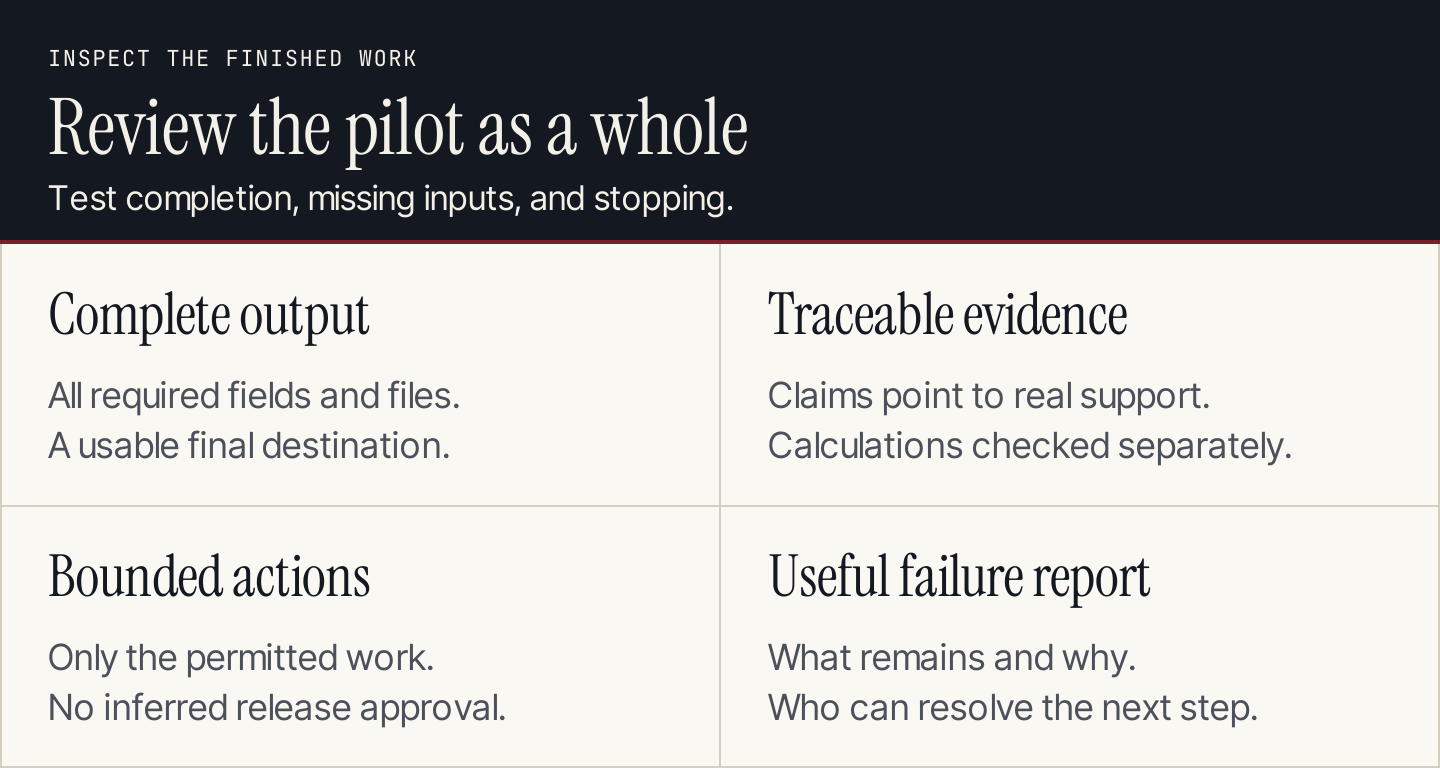
A useful pilot handles both completion and unresolved work.
Record whether the output meets its acceptance rule, what corrections were necessary, the total commitment, and how failures were reported. A convincing summary with unsupported references should fail the evidence check.
For recurring work, require a baseline and a meaningful-change rule. A weekly review can report new or changed issues rather than rewriting the entire report every time. Check that repeated triggers don't create duplicate work or repeated actions at the destination.
Common questions
Can an agent replace a marketing team?
It can take on bounded assignments when the information and tools are available. Your team still owns the purpose, evidence, customer relationships, and decisions about using the result. Evaluate the whole process, including review, rather than assuming every delegated task removes the corresponding responsibility.
Do agents always need several tools?
No. The useful autonomy depends on the task. A single well-defined review may need only supplied files. Research or connected operations can require more access. Avoid adding tools that don't change the quality or completeness of the output.
How does Rankauto fit?
Rankauto handles researched blog production in your brand voice, adds images and SEO fields, and saves drafts by default. It writes blog articles, not emails or ads, and doesn't provide a white-label portal or AI citation tracker. Use it for the blog-production job while other systems handle the connected campaign work.
What should we read next?
Use our AI marketing automation guide for triggers and handoffs, or Claude Skills for marketing for a repeatable procedure the assistant can apply.