How to Give AI Your Brand Voice in 7 Steps
Give AI your brand voice in seven steps using real writing guides, annotated examples, current facts, a reusable prompt, and a practical review sheet.

To make AI-written content sound like your brand, give it representative examples, concrete writing rules, current facts, and a clear task. “Friendly and professional” leaves too many choices unspecified.
A useful voice guide explains observable decisions: how the opening works, which terms you use, how you explain difficult ideas, and how tone changes when a reader is confused or frustrated.
This guide uses three real published writing standards, a seven-step setup process, and a reusable prompt. The rewrite exercises are original illustrations, not approved copy from the featured brands or outputs from a claimed AI test.
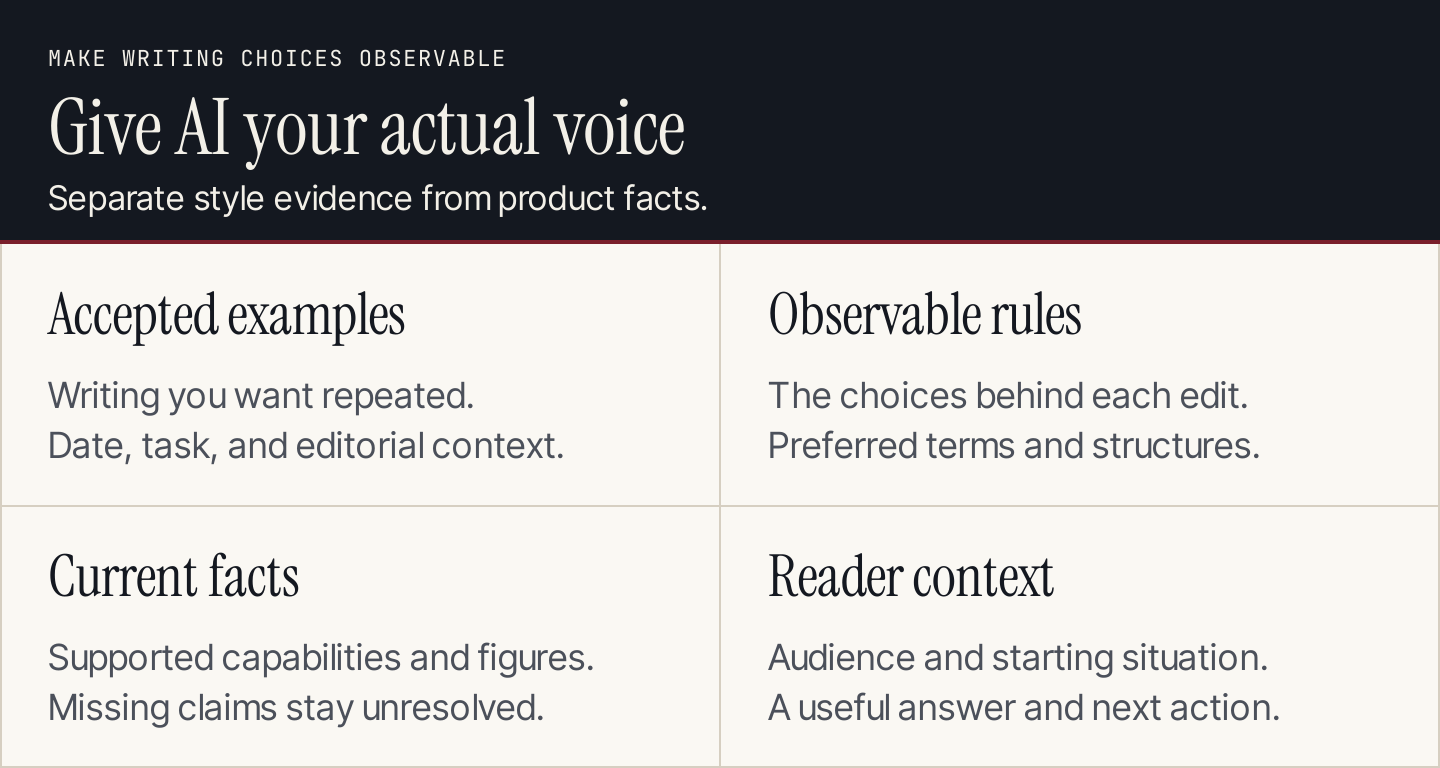
Give the model evidence of your writing choices and the facts it must preserve.
Voice, tone, and facts do different jobs
Voice is the recognizable pattern in how a business writes. Tone responds to the reader's situation. Facts describe what is true about the product, offer, or topic.
Keep these inputs separate. A request to sound more confident shouldn't remove a qualification. A request to be more conversational shouldn't introduce a personal experience the writer didn't have.
| Input | What it controls | What it cannot establish |
|---|---|---|
| Approved writing sample | Wording, structure, and emphasis | Whether its old product facts are still current |
| Voice rule | A repeatable writing choice | Proof of a customer outcome |
| Tone instruction | How to address the present situation | Permission to exaggerate or mislead |
| Fact record | Supported capabilities, figures, and dates | Whether the writing is clear or appropriate |
Using examples in a prompt or product setting provides context. It doesn't necessarily fine-tune a model, and it doesn't guarantee that the resulting draft meets the guide.
Three real examples of useful writing standards
Mailchimp: tone responds to the reader
Mailchimp's voice and tone guide separates a consistent voice from tone that changes with the reader's emotional state. It prioritizes clarity over entertainment and advises against forcing humor.
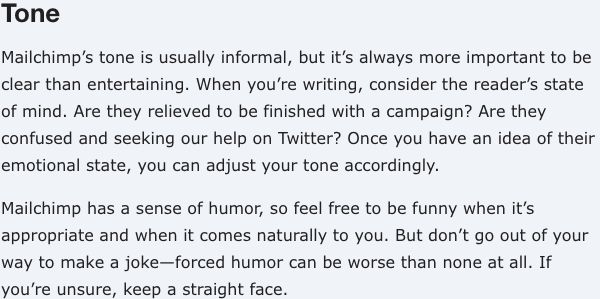
Mailchimp connects tone to the reader's situation. Source: Mailchimp.
Turn the principle into a rule: before drafting, identify whether the reader needs explanation, reassurance, celebration, or a direct correction. Keep humor out when it would distract from the task.
An illustrative editing exercise:
| Before | Revised instruction | Why it changes |
|---|---|---|
| Make every campaign message fun and exciting. | Explain the next step clearly. Add humor only when it suits the reader's situation. | Replaces a blanket mood with a contextual decision |
This is a lesson in writing governance, not a request to copy Mailchimp's personality. Choose the tone rules your own audience needs.
Microsoft: principles become concrete editing choices
Microsoft's brand-voice guide describes warmth, clarity, and helpfulness, then connects those principles to readable language, visible next steps, and concise structure.
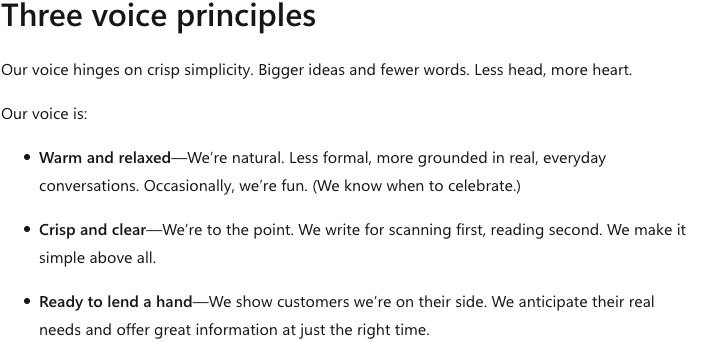
Microsoft connects voice principles with practical writing choices. Source: Microsoft.
Turn the principle into a rule: put the point before the background and make the reader's next action explicit. Evaluate the sentence someone must understand, rather than merely adding warmer adjectives.
An illustrative rewrite promoting the actual style-guide resource:
| Before | Revised copy | Why it changes |
|---|---|---|
| Leverage our comprehensive documentation to facilitate consistent written communication. | Use the style guide to check your draft. | Names the resource and the action in familiar language |
GOV.UK: clear language includes useful exceptions
GOV.UK's clear-language guidance explains active voice alongside circumstances where passive voice can still serve the reader.
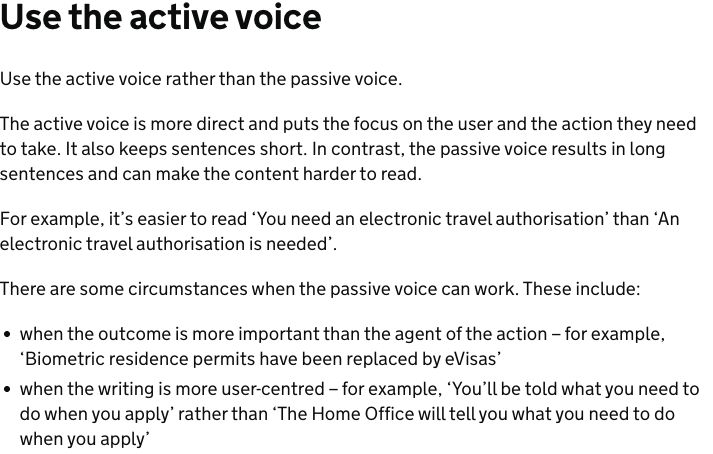
GOV.UK explains the writing rule and its exceptions. Source: GOV.UK.
Turn the principle into a rule: prefer a clear actor and action, but preserve a useful exception when the outcome matters more than naming the actor. Avoid converting a guideline into an absolute prohibition that makes the writing less understandable.
An illustrative rewrite directing readers to the published resource:
| Before | Revised copy | Why it changes |
|---|---|---|
| Information pertaining to the utilization of plain English can be accessed here. | Read the guidance on clear language. | Replaces abstract nouns with an explicit action and destination |
Build your AI voice guide in seven steps
1. Choose representative approved samples
Use your own accepted writing from the formats you actually publish. Include an explanation, a product announcement, a difficult answer, and a relevant CTA when those are part of your work.
Select examples because they represent the desired voice, not merely because they performed well. A popular post may owe its results to distribution or the offer. Record its date and purpose, and remove confidential material or content you lack permission to reuse.
2. Annotate the choices you want repeated
Explain what works in each sample. “Good tone” isn't a reusable instruction. “States the useful answer in the first paragraph, defines the specialist term, and puts the limitation beside the claim” describes observable behavior.
Include a rejected version and the correction when possible. Name the reason for the edit: changed meaning, vague opening, inappropriate humor, or inconsistent terminology. These explanations give the model a boundary rather than a collection of sentences to imitate.
3. Convert adjectives into writing rules
Use a small set of rules that change the draft. Connect each rule to an example and a review question.
| Attribute | Observable rule | Review question |
|---|---|---|
| Direct | Lead with the concrete answer or decision | Can the reader find the point quickly? |
| Helpful | Explain the relevant next action and requirement | Does someone know what to do? |
| Precise | Preserve figures, definitions, and qualifications | Did any meaning change? |
| Conversational | Use language the audience understands | Are specialist terms explained when needed? |
| Restrained | Replace inflated benefits with supported behavior | Is the claim specific and evidenced? |
These are example rules, not a universal voice. A specialist publication may need technical terminology; a customer correction may need direct accountability. Use your audience and accepted writing to decide.
4. Define the tone for common situations
Specify how the voice adapts to the reader's needs. Keep the same evidence standard across situations.
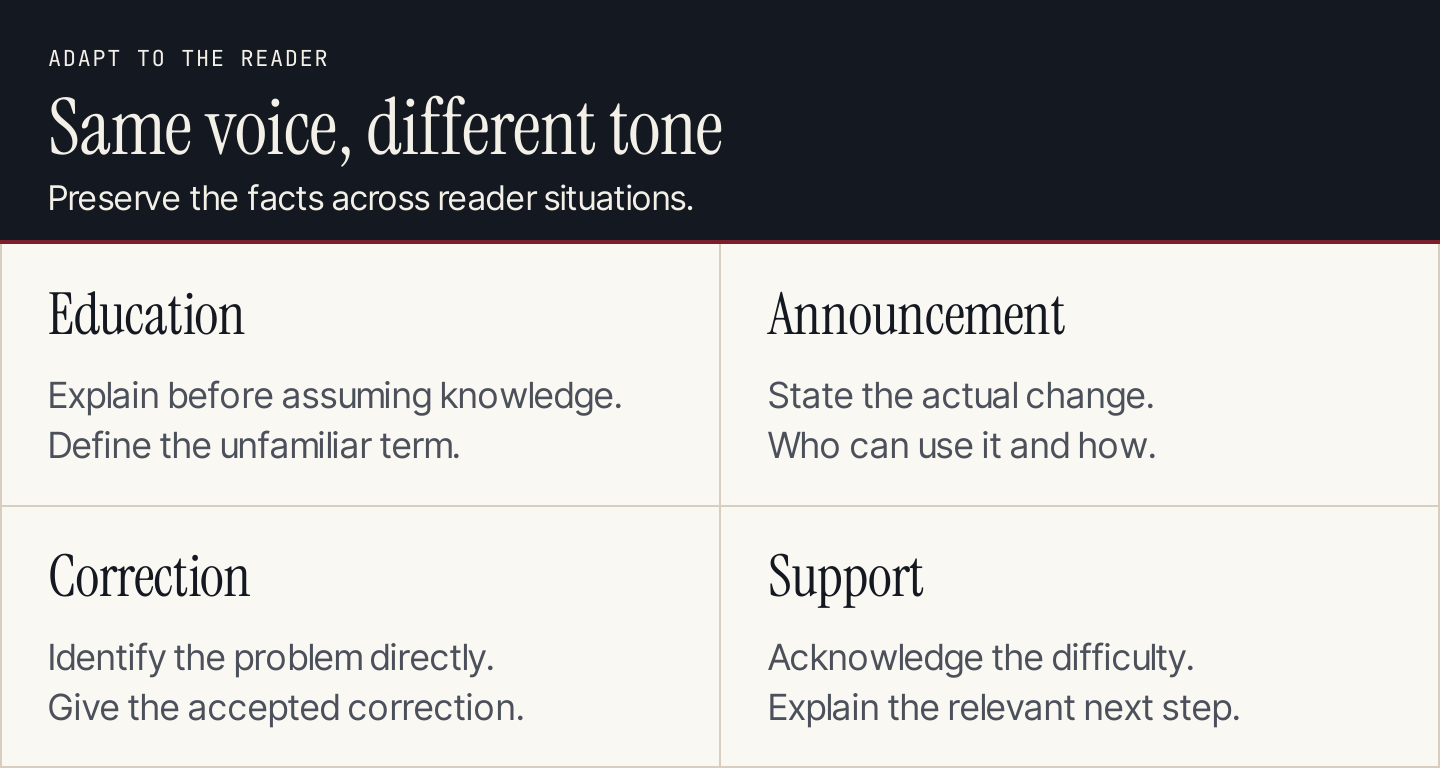
Change the tone for the situation while preserving meaning.
| Situation | Useful instruction |
|---|---|
| Educational guide | Explain the concept before assuming knowledge |
| Product announcement | State the actual change and who can use it |
| Correction | Identify the problem and the accepted correction directly |
| Support answer | Acknowledge the difficulty and explain the next step |
| Invitation | Name the offer, requirements, and destination |
Avoid making every format use the same rhythm. A detailed article and a short announcement can share a recognizable voice without repeating the same opening or CTA.
5. Supply a separate current fact record
Record product capabilities, access rules, prices, dates, and source references outside the voice examples. Retire old offers and facts that have changed.
Tell the model to flag a missing fact instead of generating a plausible one. Include prohibited claims when they matter, such as unsupported results or a capability the product doesn't have. A familiar tone can make an inaccurate sentence sound more convincing, so check meaning before style.
6. Test the guide on different tasks
Choose several actual assignments with different reader situations. Compare the draft with your accepted examples and current facts.
Check whether the model preserved qualifications, used the preferred terms, answered the task, and chose an appropriate tone. Review longer passages as well as the opening. A strong first paragraph doesn't establish that the whole article follows the guide.
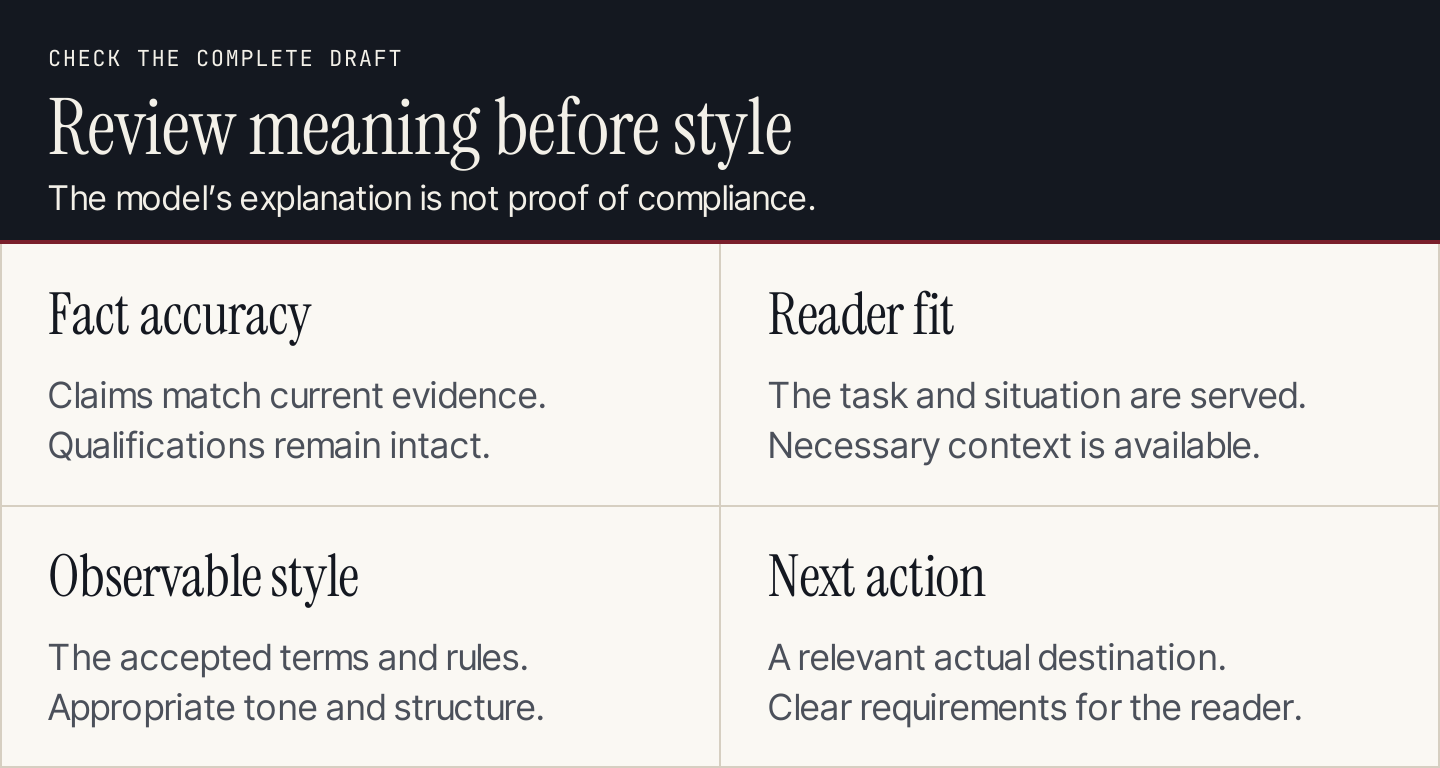
Check meaning first, then the choices that make the writing recognizable.
7. Save corrections and maintain the reference
Record repeated edits with the original passage, accepted revision, and reason. Update a rule when the same correction keeps recurring, and include an example that demonstrates it.
Give the guide an owner and version. Update the fact record when the product changes and the voice examples when the editorial direction changes. If you package the procedure as a skill, repeat the relevant tests after changes.
A reusable brand-voice prompt
Use this with accepted samples and a current fact record. The bracketed fields are inputs to complete, not facts the model should invent.
Write for [audience and starting situation].
The task is [reader question and desired output].
Use only the supplied accepted facts for specific claims.
Flag missing information instead of filling it in.

Apply the supplied voice rules and annotated examples.
Adapt the tone for [education, announcement, correction, or support].
Preserve important qualifications, figures, and product limitations.
Use the preferred terminology consistently.
Do not invent personal experience, quotations, or customer results.

Return the draft, unresolved factual questions, and a short review:
which rules you applied and which decisions need an editor.
The next action is [accepted destination and requirements].
Treat the model's review as an explanation to inspect, not proof that it complied. Check the actual draft against the source and rules.
A review sheet for the next content batch
| Check | Pass condition | Feedback to record |
|---|---|---|
| Facts | Specific claims match accepted sources | Exact unsupported or changed passage |
| Reader task | The answer serves the stated situation | Missing explanation or wrong emphasis |
| Vocabulary | Names and terms follow the guide | Term and accepted replacement |
| Structure | The point and route are clear | Passage that needs reordering |
| Tone | Language suits the reader's needs | Why humor or enthusiasm is inappropriate |
| Examples | Illustrations and real evidence are distinct | Missing context or invented experience |
| Next action | Destination fits and works | Broken link, missing requirement, or irrelevant offer |
Common questions
How many examples do we need?
Use enough varied examples to demonstrate the choices you want repeated. There isn't a universal sample count. Begin with a manageable set and add examples when tests reveal a missing situation or unclear rule.
Is making AI sound human the same task?
Human-sounding prose is broader than a brand voice. A brand guide specifies your own vocabulary, evidence standards, emphasis, and tone choices. Our guide to making AI writing sound human addresses general revision; this guide builds a reusable brand reference.
Can Rankauto use our brand voice?
Rankauto writes researched blog articles in your brand voice, checks figures against sources, adds images and SEO fields, and saves drafts by default. Review its blog drafts against your accepted examples and current product facts. It writes blog articles, not emails or ads.