Content Syndication: 7 Steps and a Partner Checklist
Plan content syndication in seven steps. Compare republication routes, agree rights and search handling, and use a partner and release checklist.

Content syndication means republishing existing content through another outlet so it can reach that outlet's audience. A partner might reproduce a full article, an agreed excerpt, or an approved version with a clear route to the original.
It can extend the useful life of an article. It also creates another version to maintain, a permission decision, and a question about which page should appear in search. Those responsibilities belong in the plan before a partner publishes the copy.
This guide explains the routes, seven steps for running a small pilot, and the checks to agree with a partner. It uses Medium's documentation, Google's search guidance, and Creative Commons licensing terms as real examples you can inspect.
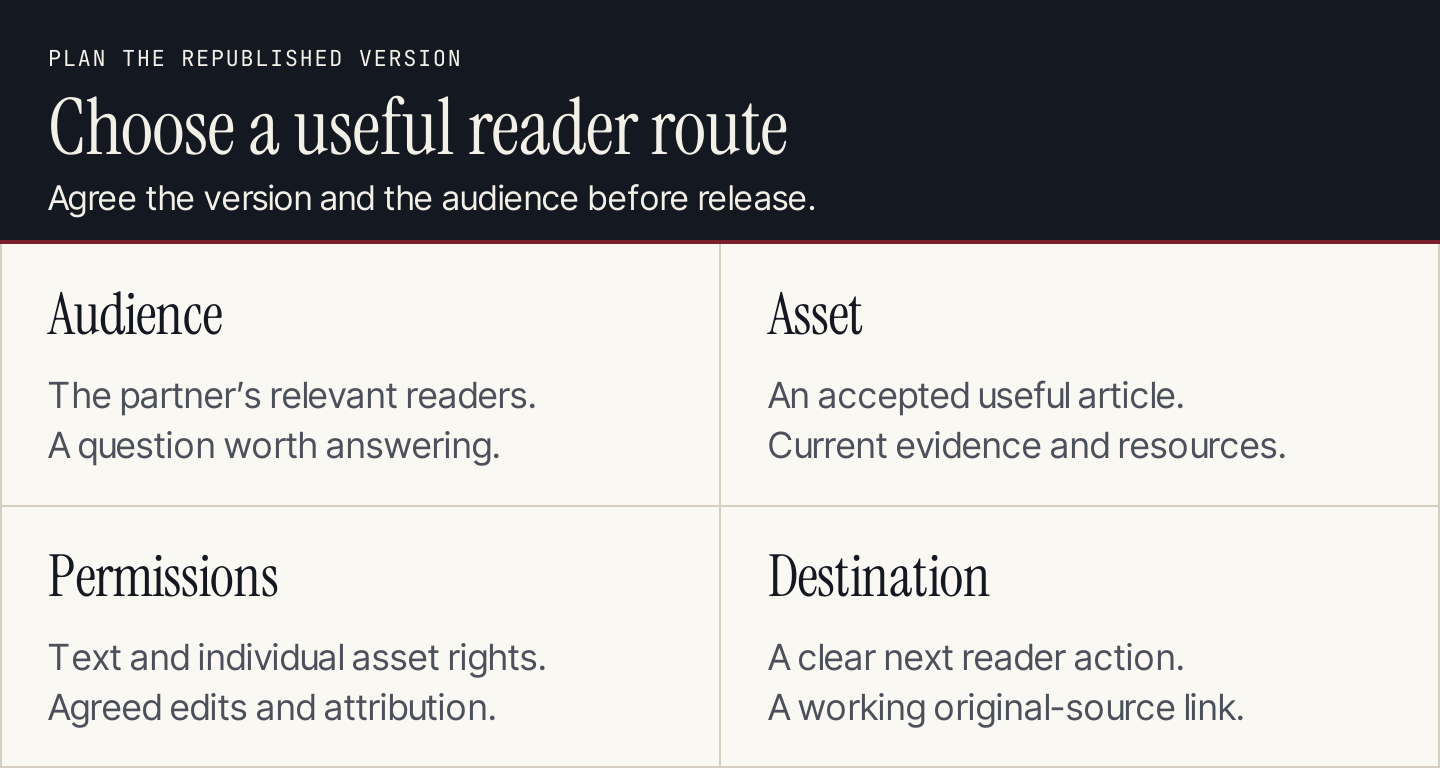
Choose a distribution route around a useful article and a relevant audience.
What content syndication includes
The defining feature is reuse of material that already exists. The agreement should say exactly how much is republished and what may change.
| Route | What the audience receives | Main decision |
|---|---|---|
| Full republication | Another copy of an existing article | Permission, attribution, updates, and indexing |
| Agreed excerpt | A selected portion with a continuation route | Where the excerpt stops and how it links back |
| Approved adapted version | Existing material revised for another audience or format | What may change and who approves the result |
| Self-service republication | A version you place through a platform such as Medium | Platform controls, reader fit, and ongoing maintenance |
Several neighboring activities are different. A guest article is usually new work for another publisher. Turning a blog into a video is repurposing. Posting a link to the original is promotion. Paid content-discovery placements may advertise a link rather than republish the article itself.
These activities can work together, but keep their costs and results distinct. Don't call every paid click a syndicated reader or treat every mention as a full licensed copy.
Is syndication worth doing?
It is worth testing when you have useful content and a credible route to people who would benefit from it. Evaluate fit before the partner's headline traffic figure.
A specialist audience that needs the article's answer can be more useful than broad reach with little connection to your offer. Inspect the actual section where the article would appear, its neighboring content, and the next step available to readers.
Pause if the article is obsolete, its evidence cannot be reused, or the partner won't agree how to credit and maintain it. Publishing more copies of weak material doesn't resolve the original problem.
Seven steps to build a syndication pilot
1. Define the audience and the useful next action
Write the job the syndicated version will perform. The goal might be helping another publication's audience understand a problem, reaching people researching a category, or introducing a resource they can return to later.
Then choose a next action that fits that job: read the full method, use an accessible worksheet, explore a relevant resource, or make a qualified inquiry. The next action needs a working destination with enough context for someone arriving from another site.
Specify what success would look like before choosing the outlet. That prevents a broad impression count from replacing the original purpose midway through the pilot.
Use the audience and outcome fields from your content strategy. Syndication is a distribution commitment within that strategy; it doesn't supply one by itself.
2. Choose an article that remains useful outside your site
Review the article as a new reader would. Can someone understand its terms and examples without knowing your product or reading a previous post? Does it answer a question the partner's audience actually asks?
Prefer a piece whose key claims, illustrations, and recommendations you can support. Check dates, product changes, internal links, and attached resources. A page with many account-specific instructions may need adaptation before it makes sense elsewhere.
Record the exact accepted version. Keep a copy of the text and assets, the original URL, and the review date. If the original changes during negotiation, compare the changes before releasing the partner version.
Don't assume you can redistribute every asset just because it appears on your own blog. A photograph licensed for your site, a customer screenshot, and a quote with limited approval can each have different reuse conditions.
3. Evaluate the partner's actual reader experience
Open the outlet's relevant section and several recent articles. Look for fit, readable presentation, useful attribution, and a reasonable next step. A partner's total visitor claim won't tell you how your article will be presented.
Check whether the outlet republishes whole pieces, uses excerpts, accepts original pitches, or offers paid promotion. Ask for a concrete placement example, rather than agreeing on the word “syndication” alone.
Medium provides a real self-service reference. Its importing documentation explains how an existing post can be brought into the platform, including source-related settings. That creates a republication route; it doesn't guarantee audience fit or referral traffic.
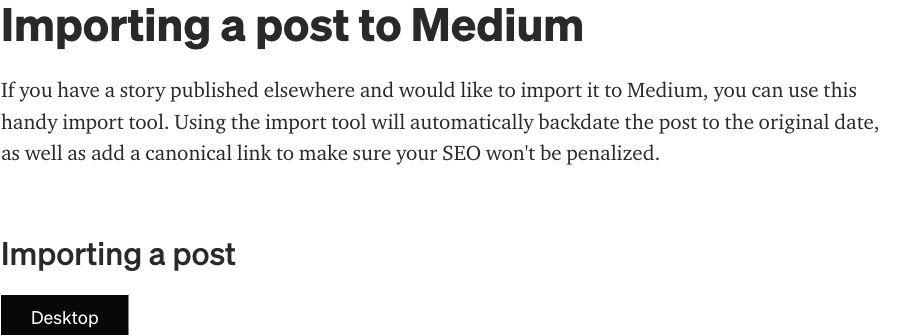
Medium documents an import route for existing posts. Source: Medium Help Center.
After importing, inspect the actual draft, images, links, and settings. Don't equate documentation of a feature with a checked result on your specific copy.
4. Agree permission, credit, and permitted changes
Write down who owns the text and assets, what the partner may publish, and which edits need approval. Include the destination, permitted channels, duration, attribution, and the handling of corrections or removal requests.
If a partner wants to change the headline or introduction, agree on a factual review. An attention-grabbing rewrite can promise more than the underlying article supports. Also check whether the partner may translate, shorten, add advertising around, or reuse the piece through other outlets.
A public license can supply permission for material actually covered by it. For example, Creative Commons Attribution 4.0 permits sharing and adaptation under conditions including appropriate credit, a license link, and an indication of changes. Other rights, such as privacy or publicity rights, may still matter.
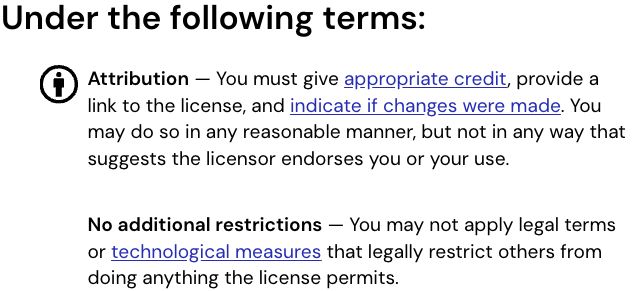
The license sets conditions for the material covered by it. Source: Creative Commons.
Check the article and each asset separately. A license notice on a page doesn't prove that every third-party photo or embedded contribution has the same license. Keep the accepted permission record beside the release files.
5. Agree how the syndicated page will be handled in search
There are two different intentions: identify a preferred version, or prevent the syndicated page from appearing in search. A canonical setting and a noindex instruction do different jobs.
Google's canonical documentation describes canonicalization as signals that help Google choose among duplicate or similar pages. It doesn't guarantee that your original becomes the selected page.
For syndicated material specifically, Google's June 2023 office-hours answer said that a canonical link is a hint and recommended asking the syndication partner to block indexing of the copy when the aim is excluding that copy from search. Keep that distinction when evaluating a platform's broad assurance about canonical links.
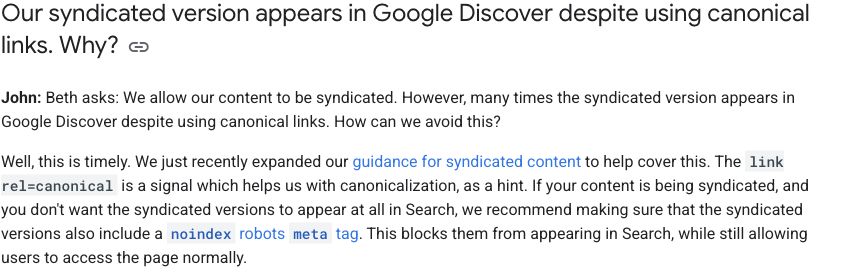
Google distinguishes a preferred-version signal from excluding a syndicated page. Source: Google Search Central.
| Intention | Control to discuss | What to check |
|---|---|---|
| Express the preferred article URL | Canonical link to the original | Correct URL, actual implementation, and no guaranteed selection |
| Exclude the copy from Google's index | Partner-applied noindex | Live instruction and whether Google can access it |
| Help readers identify the source | Visible credit and original link | Accurate author/source wording and a working destination |
| Let readers continue after an excerpt | Clear continuation link | The excerpt and destination fulfill the promise |
A visible source link isn't an indexing control. Likewise, blocking crawling through robots.txt isn't the same as having Google read a noindex instruction. Have the person responsible for the partner site verify the chosen implementation.
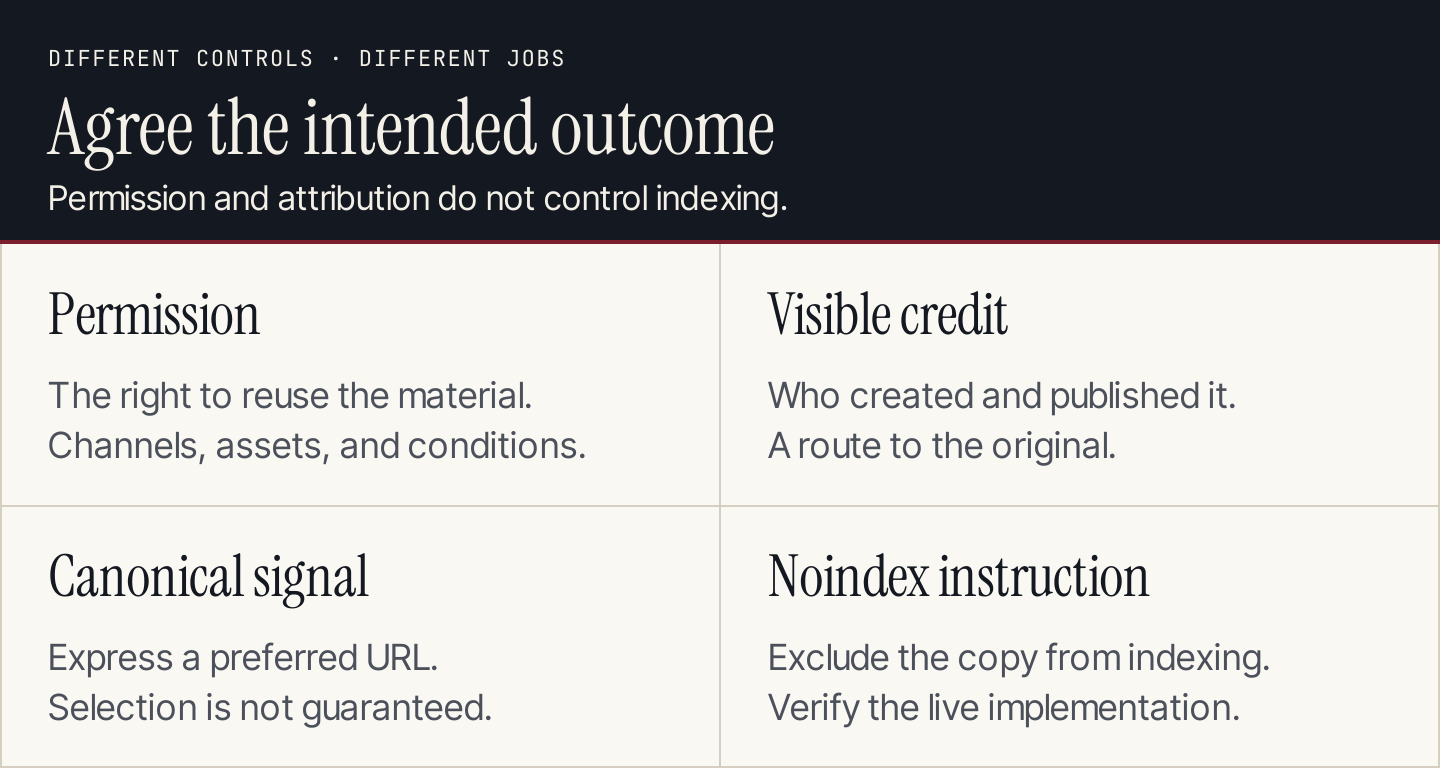
These controls address different questions. Agree on the intended result before release.
You don't need a broad on-page SEO project to make this decision. You do need a specific agreement about this duplicate version. No setting promises that republication will improve the original's ranking.
6. Inspect the final version before and after release
Ask for a preview where possible. Read it against the accepted version, not just against the topic. Check claims, dates, customer qualifications, source links, image captions, and creator credit.
Test the routes readers will use. A link can resolve successfully while arriving at the wrong page. A worksheet can exist while requiring an account the surrounding copy didn't mention. Check the actual destination and the promised reader action.
Have a named person verify the indexing agreement, because editorial approval alone doesn't confirm technical implementation. If a requirement is missing, resolve it before the copy goes live.
After release, inspect the live page again. Publication templates can change images, strip links, or add a different byline. Record the released URL and any correction required. Keep the partner contact and the original owner easy to find.
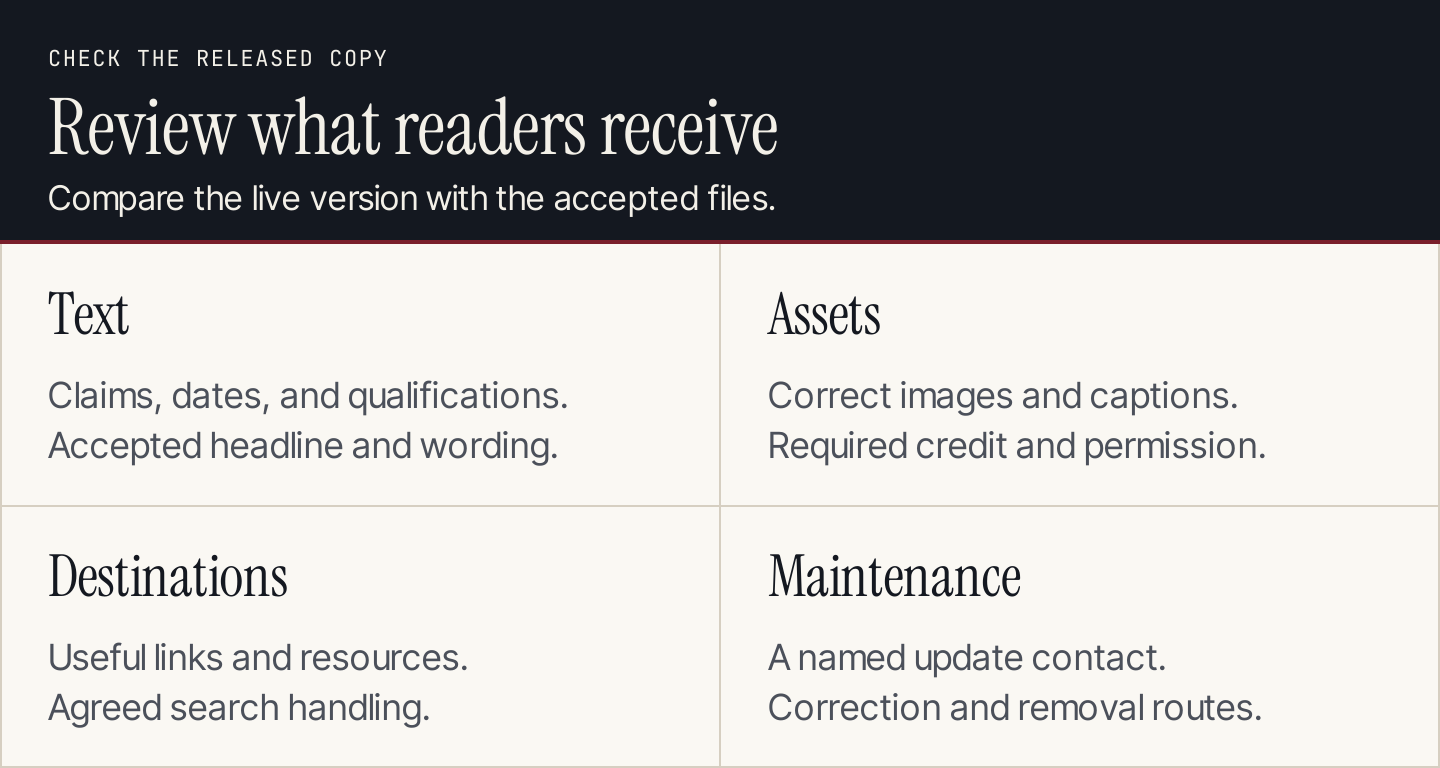
Release review includes the version readers receive and the owner who will maintain it.
7. Measure the useful outcome and maintain both versions
Report results against the purpose from step one. Separate the partner's exposure figures from visits to your site and from subsequent customer actions. Define each metric's denominator, period, and data source.
A partner may report article views, while your analytics report referred sessions. Those measures differ. Some readers will get the answer on the partner site without clicking through, and some visits won't carry the referral detail you expected.
For a pilot, record:
- The accepted article and partner placement.
- Partner-reported exposure, with its definition and reporting period.
- Referred visits and the intended next action you can observe.
- Qualified inquiries or sales credited under a documented rule.
- Permission, adaptation, review, placement, and maintenance costs.
- Corrections, update requests, and the decision to continue or stop.
Don't describe all revenue after publication as syndication revenue. Use your content ROI method to separate cost, attribution, and financial contribution.
Assign a trigger for review. Changed product instructions, withdrawn permission, broken destinations, or an outdated core claim should prompt a check of every released copy. A partner agreement should say how those changes reach the person who can act on them.
Copyable partner checklist
Use this as a negotiation and release record. It identifies decisions to resolve; it isn't a legal contract.
| Field | What to record |
|---|---|
| Audience | The relevant section and reader task |
| Placement | Full copy, excerpt, adaptation, or link promotion |
| Original | Canonical source URL and accepted version |
| Rights | Permission for text and each visual asset |
| Permitted changes | Edits, translations, channels, and approval requirements |
| Credit | Author, publisher, original link, and required asset attribution |
| Commercial terms | Fees, duration, exclusivity, and other agreed conditions |
| Search handling | Preferred-version signal or exclusion, with a technical owner |
| Reader destination | The next step and any access conditions |
| Preview approval | The named reviewer and accepted files |
| Live verification | Released URL, checks performed, and outstanding corrections |
| Reporting | Measures, definitions, periods, and available data |
| Maintenance | Update, correction, removal, and escalation contacts |
The checklist also provides a fair comparison between partners. If one outlet won't provide a preview or a correction route, record that limitation before choosing it. A large audience estimate doesn't compensate for an unresolved right to publish the material.
Frequently asked questions
Does duplicate content automatically cause a penalty?
Don't reduce the decision to a universal penalty claim. Google's documentation explains how it selects among duplicate pages, and its syndication guidance distinguishes canonical hints from exclusion. The practical questions are which version may appear, what the partner can implement, and how the syndicated copy serves readers.
How long should we wait before syndicating?
There isn't a universal delay that guarantees the original will rank or be selected. Use the accepted original, the partner agreement, and actual indexing controls. If an outlet requests a delay, record its purpose and the agreed release condition.
Should every blog post be syndicated?
No. Select articles that answer the partner audience's questions and whose rights, evidence, and maintenance needs you can support. Begin with a limited pilot and assess its useful outcome before adding more copies.
Can we use AI to rewrite the article for a partner?
An adaptation still needs permission, factual review, and approval for material changes. AI doesn't grant rights to someone else's work or establish that a changed claim is accurate. The partner checklist matters more than a generic rewrite prompt.
Produce the original before expanding distribution
A useful original makes partner review easier: clear claims, accessible resources, credited assets, and a specific reader outcome. Work syndication into your content calendar with review, release, and update owners.
Rankauto researches, writes, and fact-checks blog articles in your brand voice, adds images and SEO fields, and publishes them to your site. Articles save as drafts by default. Your team chooses syndication partners and agrees permissions and distribution terms. Start with an article worth returning to, then extend its reach through a route you can maintain.