Ecommerce SEO: Connect Product Discovery, Guides, and Store Pages

A shopper researching hiking footwear may need to understand boot types, compare available models, and confirm the right size. Those are different decisions. Sending every search to a blog post leaves the purchase questions unanswered. Sending every search to a product page makes early research harder.
Ecommerce SEO connects the right question to the right store page, then makes the next useful destination easy to reach. Start with one category and its connected guides and products. This gives a small team a manageable improvement project instead of an endless catalog rewrite.
This guide uses three real REI pages to show the distinction. The examples demonstrate public page structure and buying information; they do not establish REI's rankings, traffic, or conversion performance.
1. Give categories, products, and guides different jobs
Map the question before choosing a keyword or writing a brief.
| Shopper's question | Likely destination | What that page needs to do |
|---|---|---|
| What types of hiking boots should I consider? | Buying guide | Explain choices, tradeoffs, and relevant terminology |
| Which hiking boots can I buy? | Category | Make the available selection understandable and navigable |
| Does this specific model fit my needs? | Product | Confirm identity, suitability, variants, and purchase conditions |
| Can I return it if the fit is wrong? | Policy or support resource | Explain the actual policy and route back to shopping |
These are starting hypotheses. Inspect the current search results for your target query and market. Look at the page types and the task each result completes. A phrase that includes a category name can still imply an educational question.
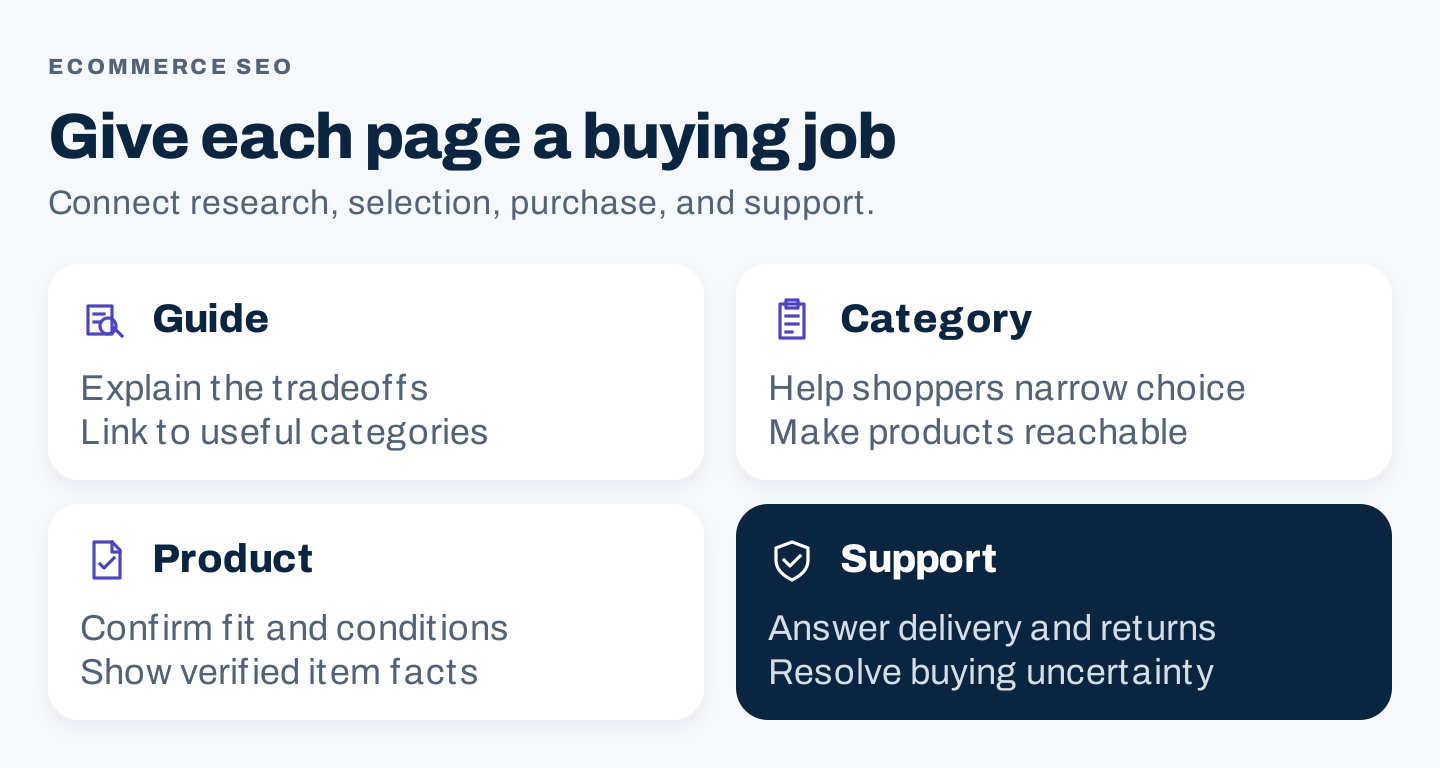
Original framework: assign one buying job to each destination, then connect the pages where the next question arises.
Record the existing URL before proposing a new one. You may need to improve a category introduction or product specification rather than publish another article. Two keywords can belong on the same page when the answer and shopper task are substantially the same.
Conversely, a guide and category can both be useful when their purposes differ. Make their titles, introductory answers, and links communicate that distinction. Do not turn the guide into a second product grid or bury the category under a long generic essay.
2. Study a real connected page family: REI
The category helps a shopper narrow the selection
REI's hiking boots category presents products, filtering controls, and routes to related boot categories. The desktop view also distinguishes products from expert advice.
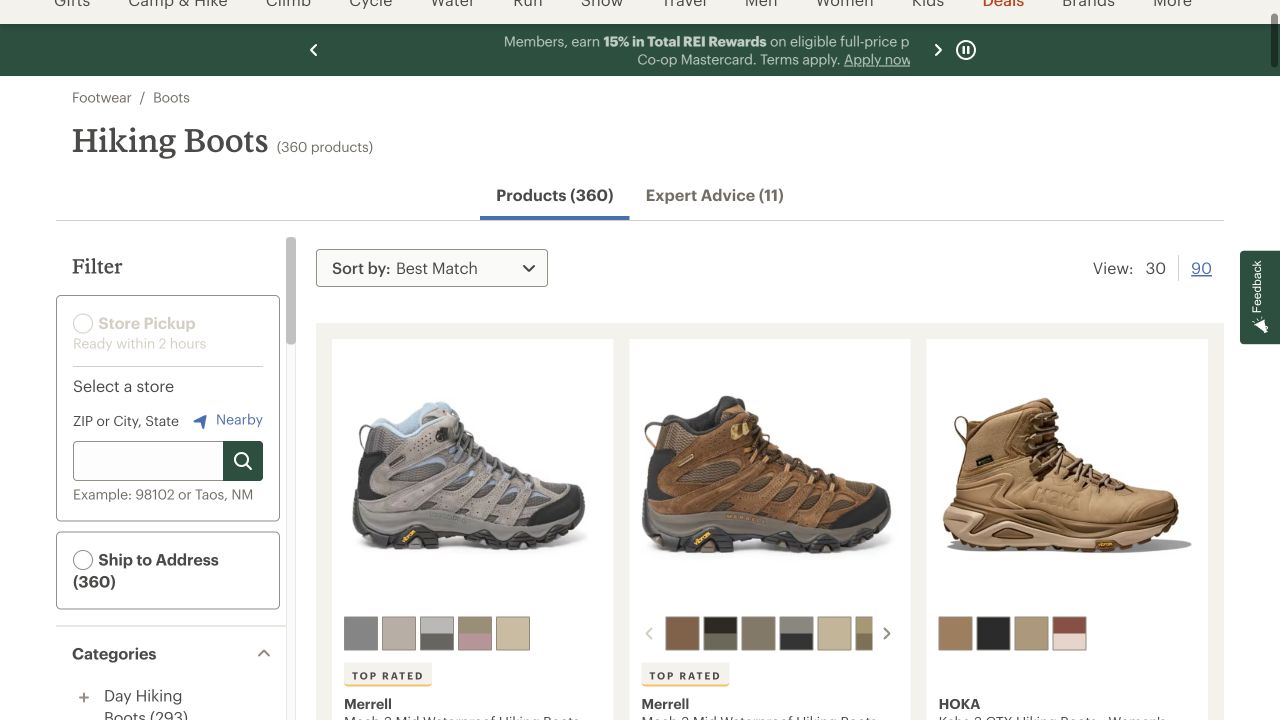
REI's public desktop category page, captured October 8, 2026. The example shows selection and navigation; inventory and displayed details can change.
The lesson is the page's job: help a shopper recognize the assortment and narrow it. For your category, review whether names are understandable, products are reachable, and the most important selection criteria are visible. Use a short explanation if it helps people choose. Add information because it resolves a question, rather than to meet a category word count.
The product resolves an item-specific decision
A Merrell Moab 3 Mid Waterproof women's product page shows the specific item, images, color and size choices, and purchase options.
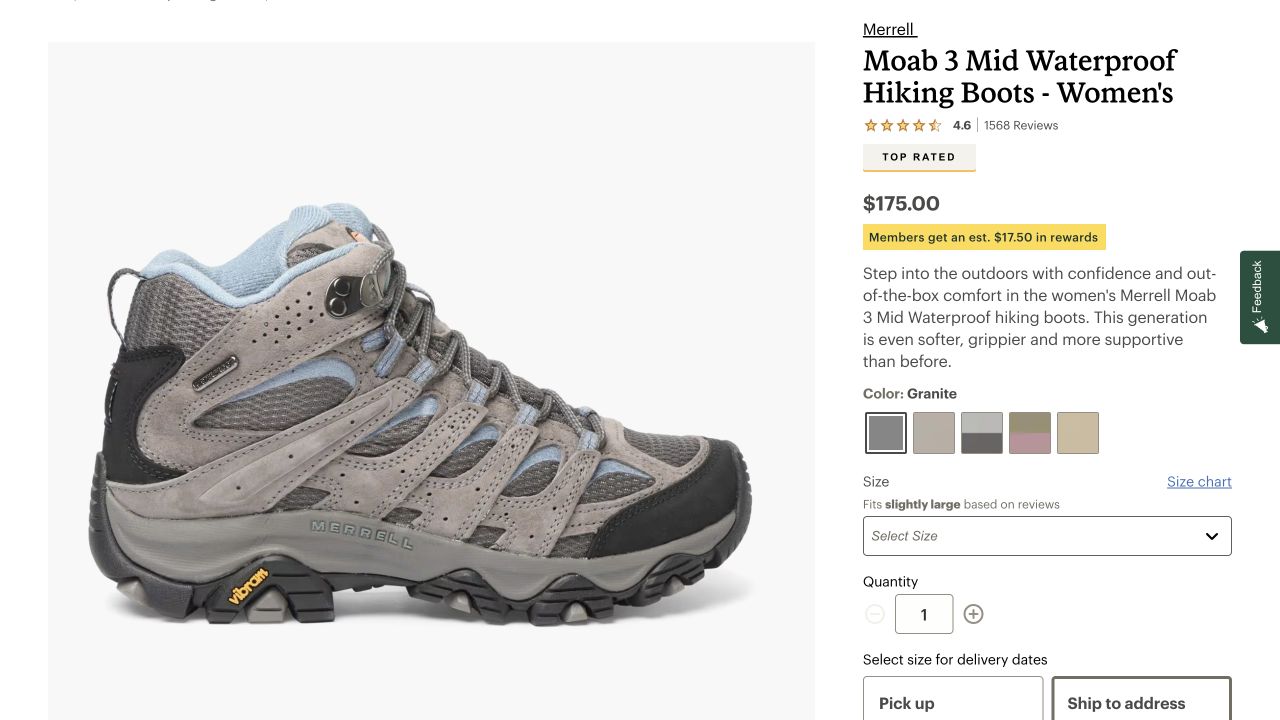
An authentic REI product-page view. It demonstrates item identity and selection controls, not an independent product test or recommendation.
Your product audit should separate facts from persuasion. A material, dimension, compatibility condition, or care instruction needs a reliable source. A broad adjective such as “premium” cannot substitute for the detail a shopper needs to decide.
Check the selected variant as well as the default view. The page should not describe one color or size while the purchase controls select another. When the catalog has incomplete specifications, send the issue to the catalog owner instead of asking a writer to improvise.
The guide explains how to choose
REI's hiking boots buying guide discusses boot types, components, and fit. That is a different resource from the category and individual item.
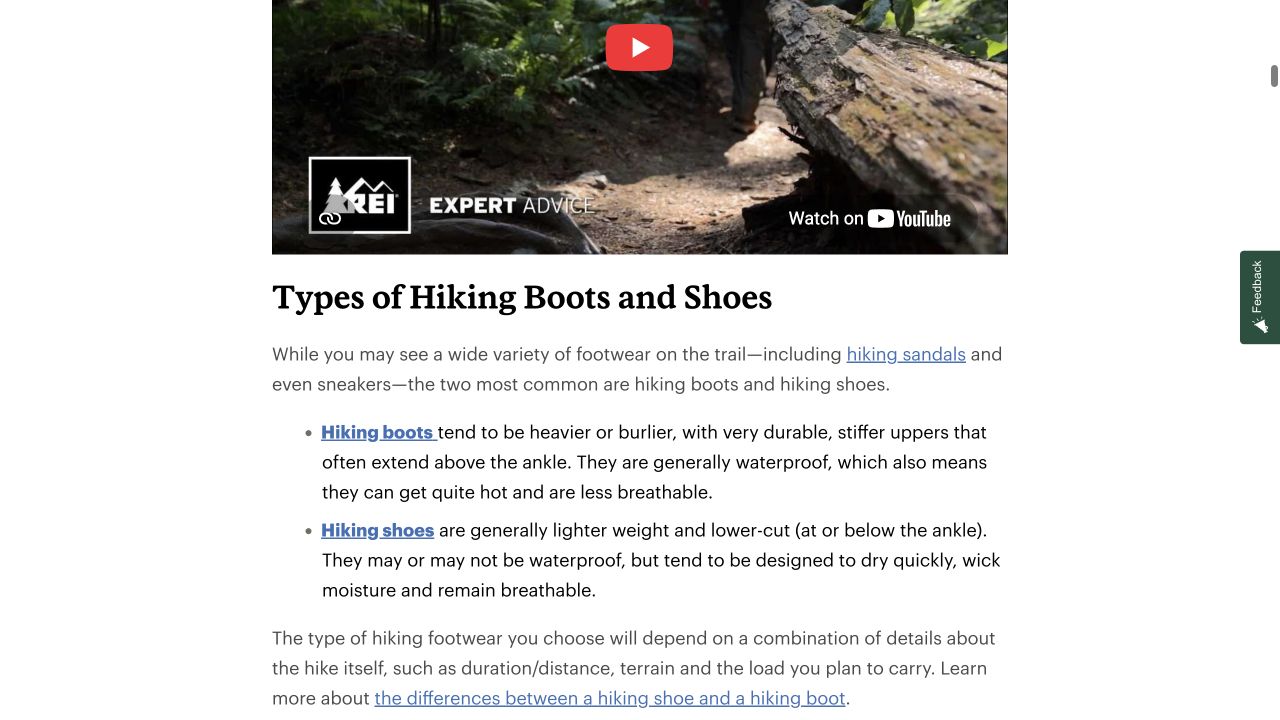
REI's public guide demonstrates explanatory content. The screenshot supports the page-purpose comparison; it does not prove search performance.
For a useful guide, put the decision criteria before the sales pitch. Explain when an option is appropriate, what might make it unsuitable, and which details readers should verify. Place a category link beside the relevant discussion. Link to an individual product only when the example needs that item and its current facts have been checked.
This three-page exercise is repeatable: open a guide, category, and product from your own store, then ask which question remains unanswered at each handoff.
3. Build a category opportunity map
Choose a category with an available assortment, a named owner, and enough operational stability to maintain the work. An impressive search-volume estimate does not help if the products cannot be supplied.
Use current keyword research for the intended country and language. Keep the tool, market, date, and query alongside the volume. Treat an estimate as evidence of possible demand, not a traffic forecast.
Combine search research with questions from customer service, on-site search, product specialists, and genuine reviews. These sources serve different purposes. A support question may reveal a missing product detail even if a keyword tool does not report meaningful volume.
Copy this worksheet for the first page family:
Category and exact URL:
Target market and customer task:
Query or question:
Evidence source, date, and volume if available:
Existing destination and page type:
What the current page answers:
What remains unanswered:
Verified product or policy source:
Useful next link:
Owner and approval dependency:
Proposed change and baseline:
Decide what to improve before expanding the topic list. Useful first changes include a missing sizing explanation, unclear category labels, an absent guide-to-category link, or conflicting delivery information. Avoid treating every observation as a new blog opportunity.
4. Make products reachable and review filter URLs deliberately
Google's ecommerce site-structure guidance recommends linked navigation from menus through categories to products. Google generally does not submit searches into a site's search box to discover the catalog.
Walk the same path a shopper would take. Check actual links, their destinations, and whether a useful product is reachable without typing its name into internal search. A sitemap is helpful for discovery, but it does not replace a coherent shopping journey.
Filtering requires a separate decision. Size, color, price, brand, and sort combinations can produce many URLs. Some deserve durable landing pages; many are simply temporary ways to adjust a selection.
Google's current faceted-navigation guidance distinguishes filters that need crawling from those that do not. It also notes that canonical annotations are generally less effective for controlling filter crawling than dedicated crawl controls. Do not apply “canonical every filter” as a universal recipe.
Ask the developer and SEO owner to document:
- Which filtered selections serve a distinct, supportable search task.
- Which combinations only change the browsing state.
- Which URLs are discoverable and which controls govern crawling.
- What happens to empty, invalid, or nonsensical combinations.
For search-worthy selections, assess the assortment, explanation, maintenance, and internal links. For the remaining combinations, have the technical owner choose and validate the appropriate controls. This is a URL-policy task, not a reason to create hundreds of near-identical category descriptions.
Keep the decision record with the relevant template. A filter change can affect more URLs than the content team intended to edit.
5. Create a product fact contract
Product content depends on catalog and operational facts. Give each important claim an accountable owner.
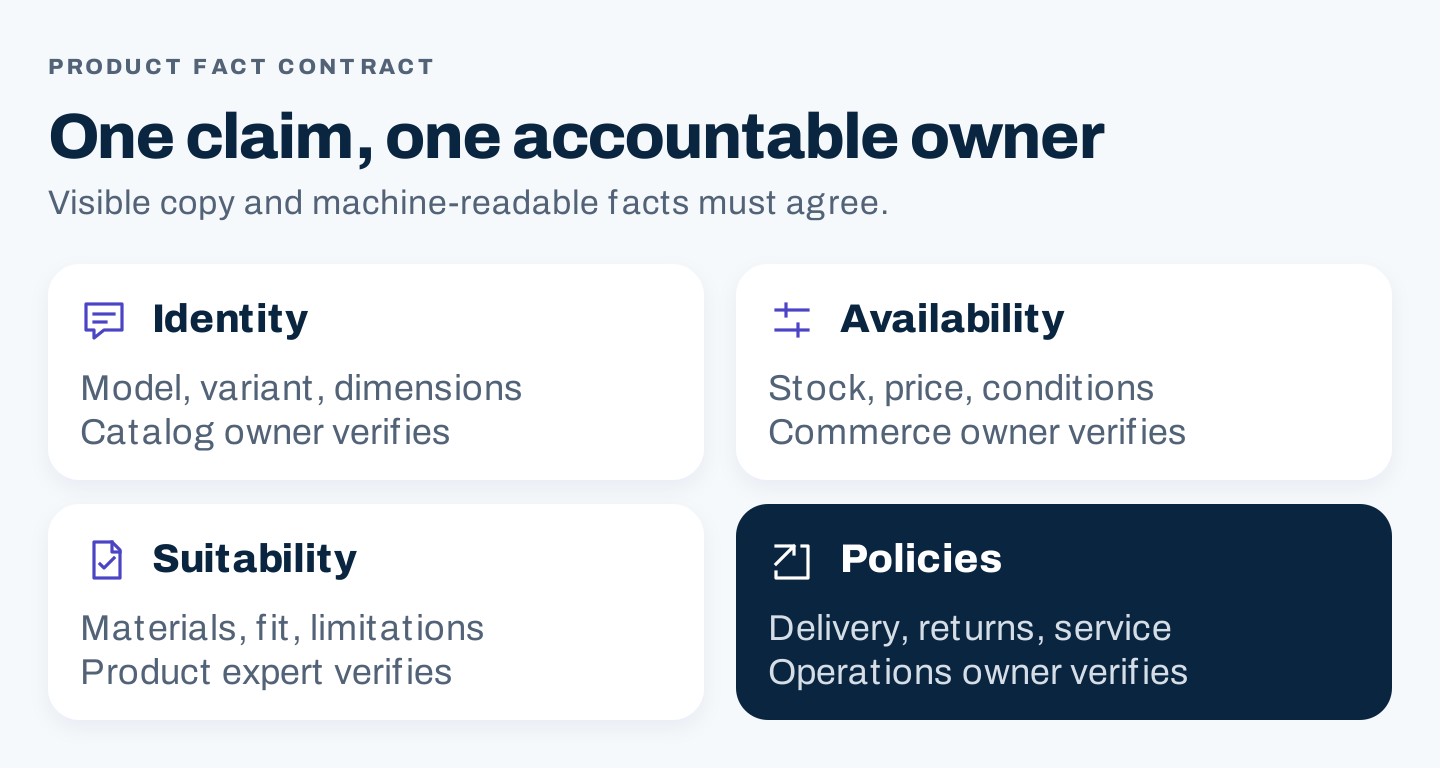
Original review contract: verify the item's identity, commercial facts, suitability details, and policies before publishing.
| Fact group | Example checks | Likely owner |
|---|---|---|
| Identity | Model, variant, dimensions, included items | Catalog team |
| Availability | Stock state, price, purchase conditions | Commerce operations |
| Suitability | Materials, fit, compatibility, limitations | Product specialist |
| Policies | Delivery, returns, warranty route | Operations or service team |
Write the shopper-facing copy from approved facts. Then inspect whether the image, selected variant, visible information, and purchase controls agree. If a screenshot illustrates a product detail, caption what it actually shows and include the capture date.
Google's merchant-listing structured-data documentation explains product and offer information that can support eligibility for merchant experiences. Relevant details include price, availability, shipping, and returns. Eligibility does not guarantee a particular appearance.
Treat structured data as another representation of the same approved facts. Ask the implementer to validate the required properties, test a small sample, and compare the output with the visible page. Do not publish one return condition in an article and a different one in product markup.
An AI assistant can organize approved specifications into a draft, but it cannot supply missing materials, measurements, or warranty conditions. A spreadsheet with unresolved facts is a better next step than confident but unsupported copy.
6. Produce guides that earn their place in the shopping journey
A useful buying guide adds judgment that a product grid cannot supply. It might explain the tradeoff between two materials, show how to measure for fit, or demonstrate a maintenance task.
Build the brief around five questions:
- What decision is the reader trying to make?
- Which options are worth comparing?
- Which facts and demonstrations support the comparison?
- What limitations could change the recommendation?
- Which category, product, or support page helps next?
Use original photos or demonstrations when the claim requires your experience. Public screenshots can explain a website pattern, but they cannot prove you used a product. If an expert contributes an observation, capture the context and review the final interpretation with them.
Reuse the approved material across digital marketing. A sizing explanation can become a service-team reference or email resource. A comparison table may support a short video. Keep the same fact owner and update dependent formats when the underlying information changes.
Do not make distribution the final step after everyone has moved on. Include the channel owner and intended audience in the brief so the resource has a realistic route to readers.
7. Run a 30-day category pilot
The following is a proposed working schedule, not a promise of results within a month.
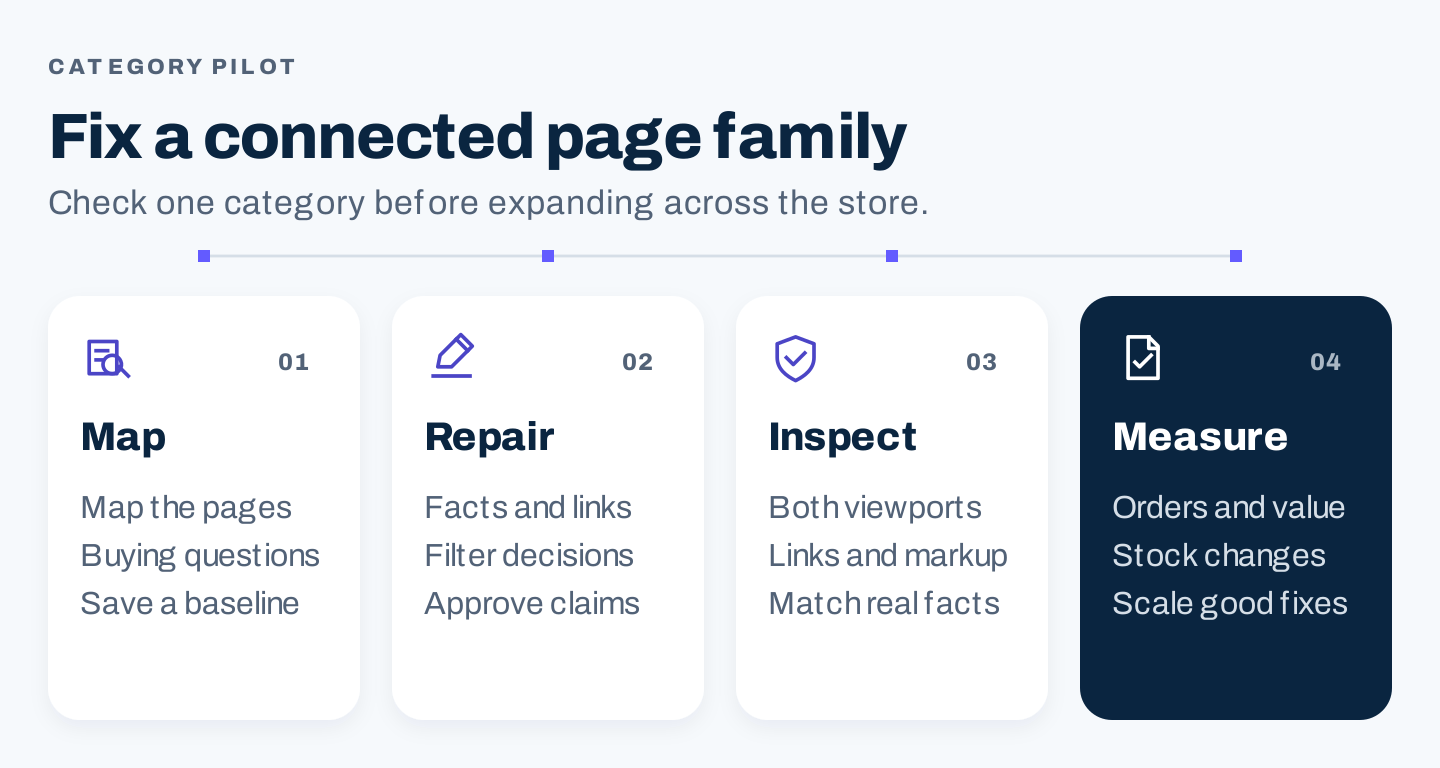
Original pilot sequence: complete and inspect one connected page family before scaling its fixes.
Week 1: map and baseline. Inventory the category, guides, and a manageable sample of products. Save the current URLs and buying questions. Record available search, landing-page, and order data, including stock conditions and measurement gaps.
Week 2: resolve the highest-value gaps. Approve the product facts and links. Fix one or two obstacles to selection or purchase before adding new content. Route template and filter issues to the technical owner.
Week 3: inspect the whole journey. Test desktop and phone views, links, selected variants, and the next destination. Check that explanations remain useful when images are unavailable. Have the relevant owner approve each material claim.
Week 4: review the release. Confirm that the changes are live on the intended URLs and that measurement works. Review early customer feedback and operational issues. Continue measurement beyond the pilot when the business outcome needs a longer window.
Use search visibility as one signal. Also examine qualified category visits, product exploration, completed orders, and net commercial value where available. A cart event is not a completed order. Revenue before returns or cancellations is not the same as retained value.
Compare equivalent periods and record promotions, inventory changes, and seasonality. A change in orders after an edit does not by itself prove that the edit caused the change.
Ecommerce SEO questions
Should every category have a blog post?
No. Publish a guide when there is a separate educational decision worth answering. Some categories need clearer labels, useful product facts, or better navigation first.
Should all product descriptions be rewritten?
Start where missing or conflicting information obstructs a decision. Preserve correct specifications and improve the explanation. Rewriting the entire catalog without resolving its factual gaps can multiply the problem.
Is AI-generated product copy enough?
It can help draft from a verified fact set. Product expertise, current operational information, and review still determine whether the page is trustworthy and useful.
What should a small store do first?
Choose one category, map its guide and products, and repair the most important unanswered buying question. Assign an owner who can keep the connected information current.